
EOC REVIEW Use i Civics website for extra
EOC REVIEW Use i. Civics website for extra review. We will review by reporting categories.
Mr. Raymond’s EOC Review Academy Category 3 https: //www. youtube. com/watch? v=x 0 vd 6 fqbpr 0
Category 3 1. 2. 3. 4. 5. 6. 7. 8. 9. Political Parties: SS. 7. C. 2. 8 Qualifications for Political Office: SS. 7. C. 2. 9 Monitoring & Influencing Government: SS. 7. C. 2. 10 Media & Political Communications: SS. 7. C. 2. 11 Public Policy: SS. 7. C. 2. 12 Multiple Perspectives: SS. 7. C. 2. 13 U. S. Domestic & Foreign Policy: SS. 7. C. 4. 1 Participation in International Organizations: SS. 7. C. 4. 2 U. S. & International Conflicts: SS. 7. C. 4. 3
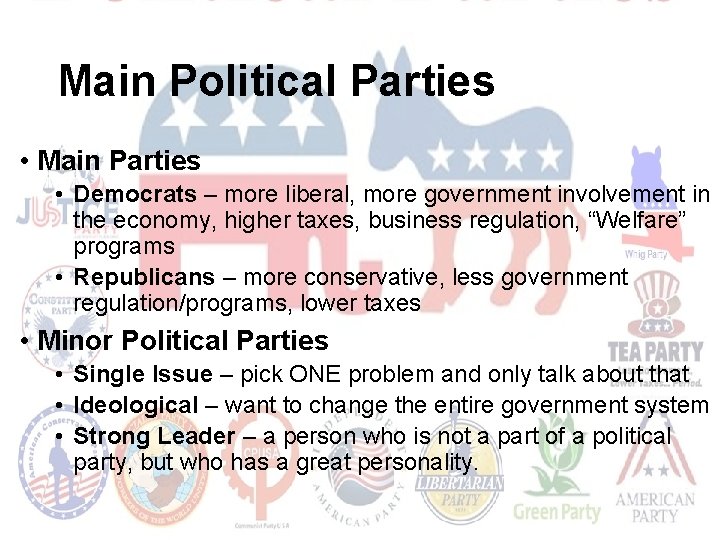
Main Political Parties • Main Parties • Democrats – more liberal, more government involvement in the economy, higher taxes, business regulation, “Welfare” programs • Republicans – more conservative, less government regulation/programs, lower taxes • Minor Political Parties • Single Issue – pick ONE problem and only talk about that • Ideological – want to change the entire government system • Strong Leader – a person who is not a part of a political party, but who has a great personality.
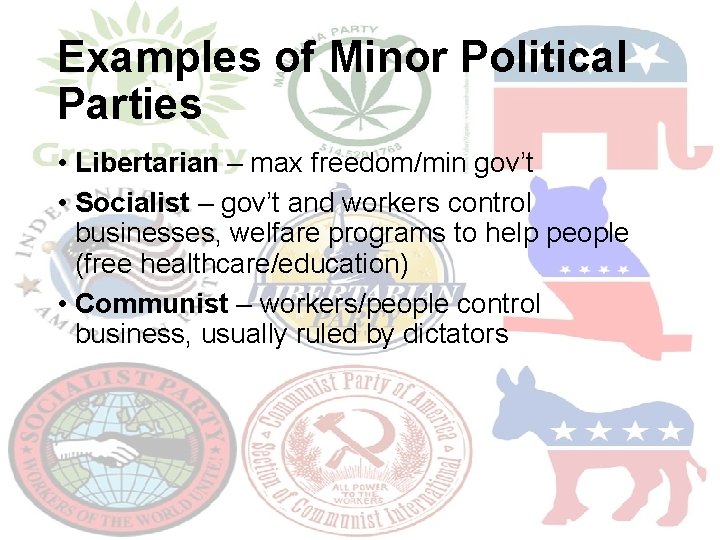
Examples of Minor Political Parties • Libertarian – max freedom/min gov’t • Socialist – gov’t and workers control businesses, welfare programs to help people (free healthcare/education) • Communist – workers/people control business, usually ruled by dictators
Reason for Political Parties • Support Candidates • Communicate with citizens • Run the government • Link different parts of government • Act as a “Watchdog”
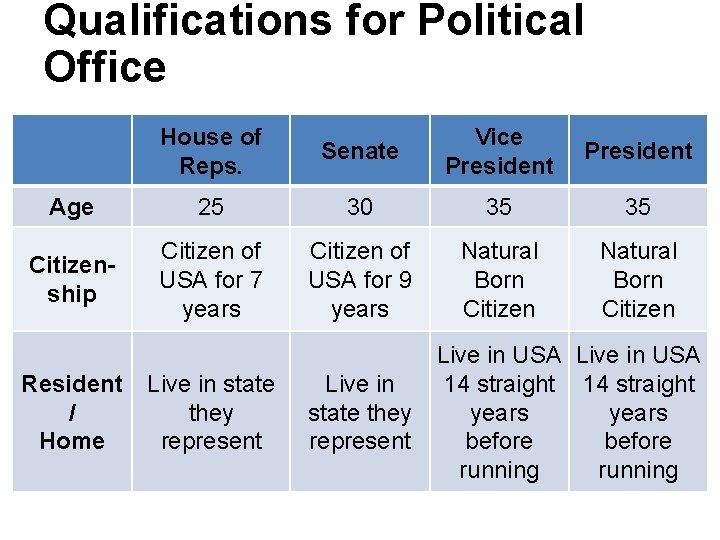
Qualifications for Political Office House of Reps. Senate Vice President Age 25 30 35 35 Citizenship Citizen of USA for 7 years Citizen of USA for 9 years Natural Born Citizen Resident / Home Live in state they represent Live in USA 14 straight years before running
Influencing Government • Interest groups – groups that form because of a common goal. They attempt to influence people by working together for their goal. • can work with members of Congress or with other elected legislators to get laws passed. This is usually referred to as lobbying. • An interest group can also educate its members on issues it wants the group members to support. • Political Action Committees – which are often connected to interest groups, can raise money and contribute to the campaigns of candidates that they support.
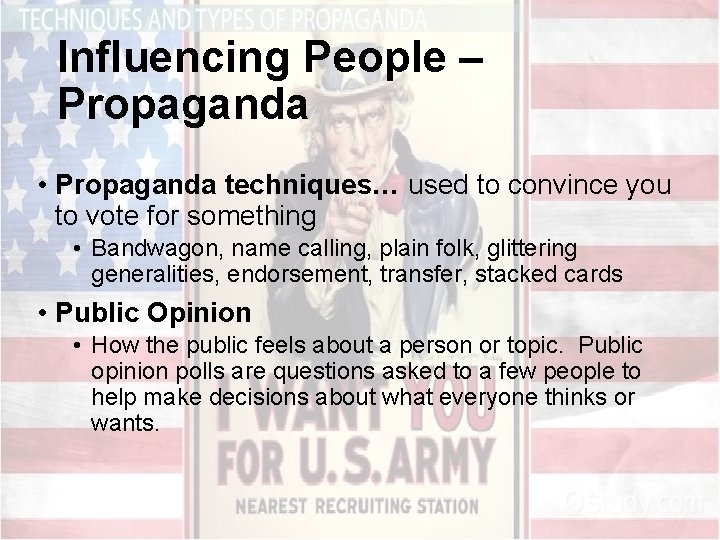
Influencing People – Propaganda • Propaganda techniques… used to convince you to vote for something • Bandwagon, name calling, plain folk, glittering generalities, endorsement, transfer, stacked cards • Public Opinion • How the public feels about a person or topic. Public opinion polls are questions asked to a few people to help make decisions about what everyone thinks or wants.
The Media • Forms of media • • TV Radio Internet/Social Media Newspaper/Magazine • Bias • Prejudice in favor of or against one thing, person, or group compared with another, usually in a way considered to be unfair.
Public Policy Governments at all levels (local, state, or federal) are responsible for protecting and providing for its citizens. • When a problem or issue comes up, the citizens can get the help of the government to solve these problems. • National: military, interstate and foreign trade, interstate environmental issues/healthcare • State: education, intrastate trade/environmental/safety • Local: local schools/roads/safety/sanitation/services • Many of these government solutions come in the form of public policy – which is a policy that is made in response to an issue or problem that requires attention. U. S. citizens have the right
Assignments for Week 5 (4/27 – 5/1) 1. Answer the 15 questions through Google Classroom using Google Forms 2. EOC Vocabulary Term Index Cards #76 -100 3. Weekly Question
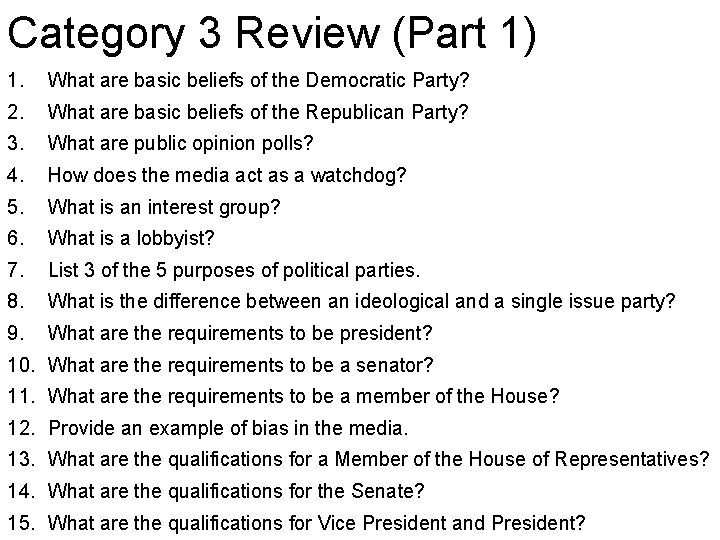
Category 3 Review (Part 1) 1. What are basic beliefs of the Democratic Party? 2. What are basic beliefs of the Republican Party? 3. What are public opinion polls? 4. How does the media act as a watchdog? 5. What is an interest group? 6. What is a lobbyist? 7. List 3 of the 5 purposes of political parties. 8. What is the difference between an ideological and a single issue party? 9. What are the requirements to be president? 10. What are the requirements to be a senator? 11. What are the requirements to be a member of the House? 12. Provide an example of bias in the media. 13. What are the qualifications for a Member of the House of Representatives? 14. What are the qualifications for the Senate? 15. What are the qualifications for Vice President and President?
- Slides: 13