
ENZYMES WHAT IS AN ENZYME Most enzymes are

- Slides: 37
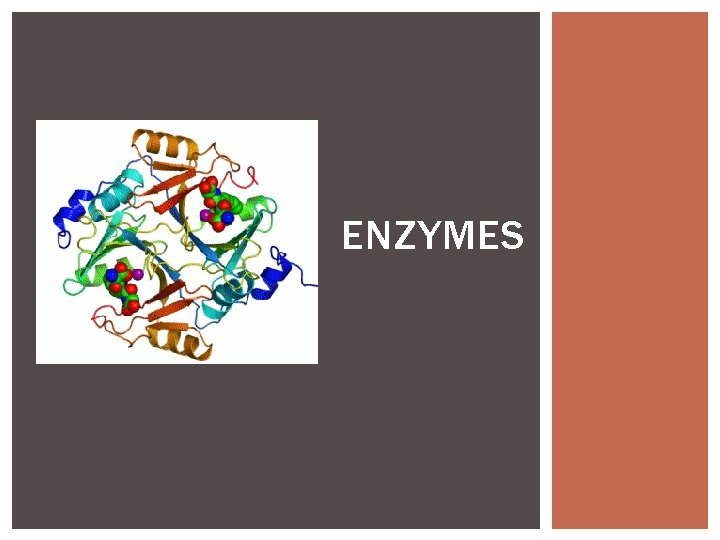
ENZYMES
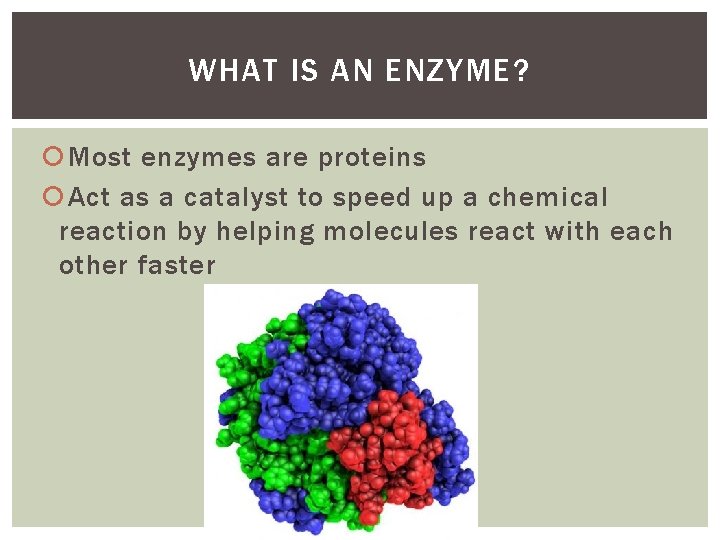
WHAT IS AN ENZYME? Most enzymes are proteins Act as a catalyst to speed up a chemical reaction by helping molecules react with each other faster
ENZYMES ARE… Reusable! Specific for what they catalyze (speed up) § End in “-ase” § Named for the reaction they help. For example… § Sucrase breaks down sucrose § Proteases break down proteins § Lipases break down lipids § DNA polymerase builds DNA
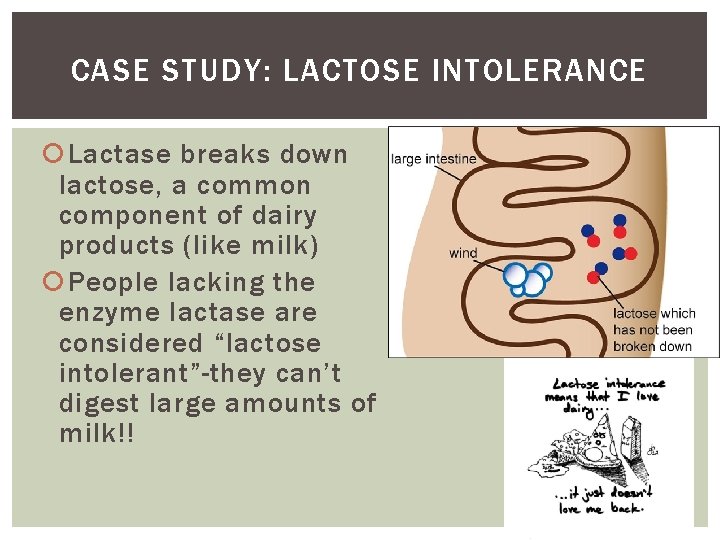
CASE STUDY: LACTOSE INTOLERANCE Lactase breaks down lactose, a common component of dairy products (like milk) People lacking the enzyme lactase are considered “lactose intolerant”-they can’t digest large amounts of milk!!
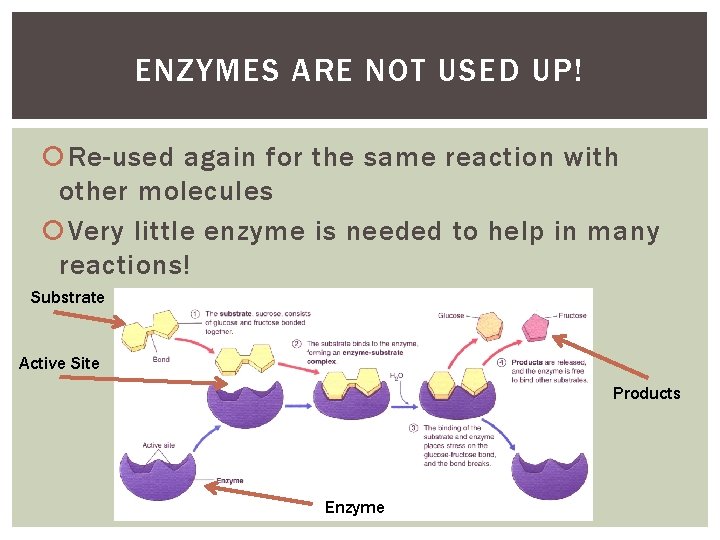
ENZYMES ARE NOT USED UP! Re-used again for the same reaction with other molecules Very little enzyme is needed to help in many reactions! Substrate Active Site Products Enzyme
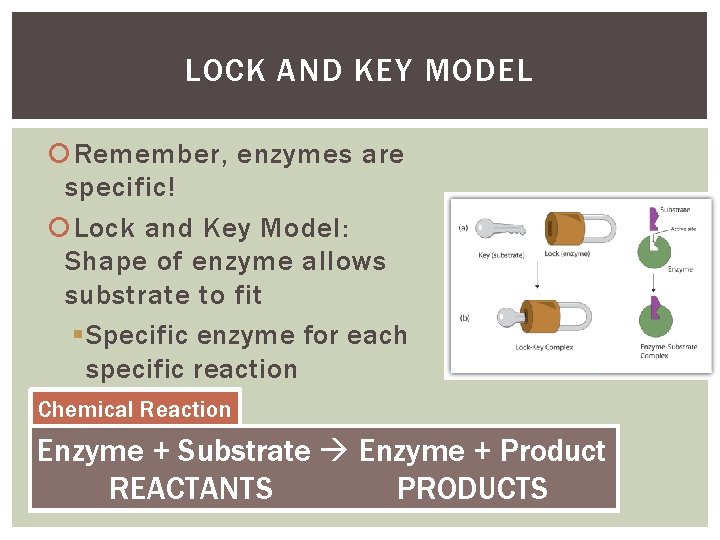
LOCK AND KEY MODEL Remember, enzymes are specific! Lock and Key Model: Shape of enzyme allows substrate to fit § Specific enzyme for each specific reaction Chemical Reaction Enzyme + Substrate Enzyme + Product REACTANTS PRODUCTS
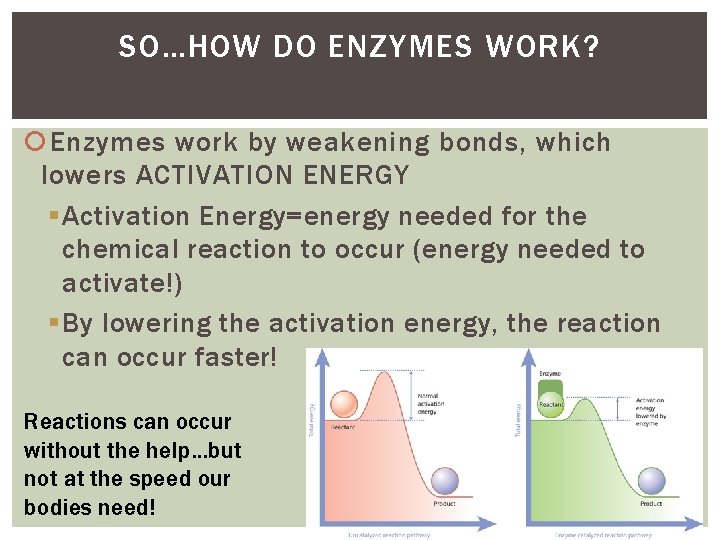
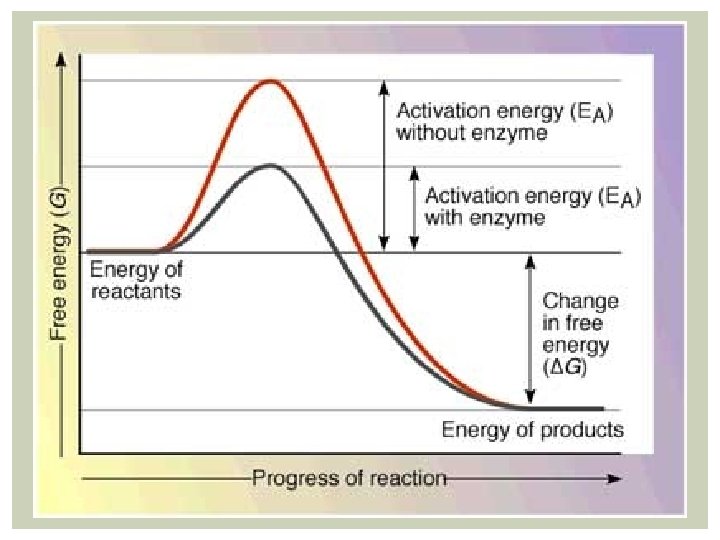
SO…HOW DO ENZYMES WORK? Enzymes work by weakening bonds, which lowers ACTIVATION ENERGY § Activation Energy=energy needed for the chemical reaction to occur (energy needed to activate!) § By lowering the activation energy, the reaction can occur faster! Reactions can occur without the help…but not at the speed our bodies need!
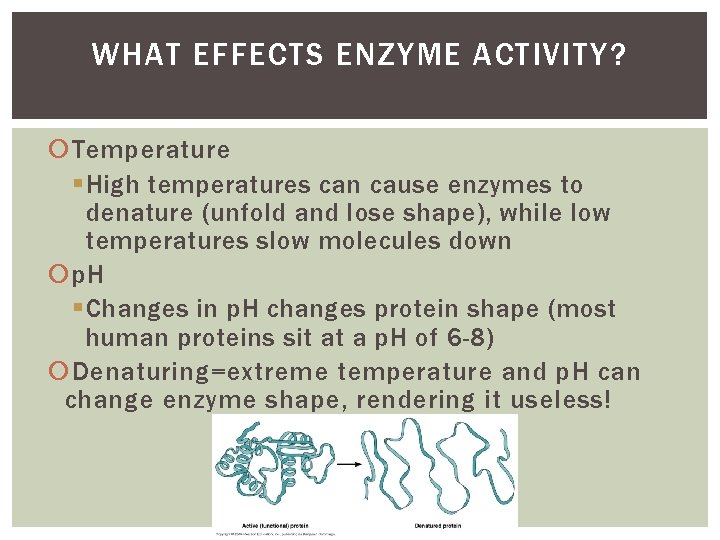
WHAT EFFECTS ENZYME ACTIVITY? Temperature § High temperatures can cause enzymes to denature (unfold and lose shape), while low temperatures slow molecules down p. H § Changes in p. H changes protein shape (most human proteins sit at a p. H of 6 -8) Denaturing=extreme temperature and p. H can change enzyme shape, rendering it useless!
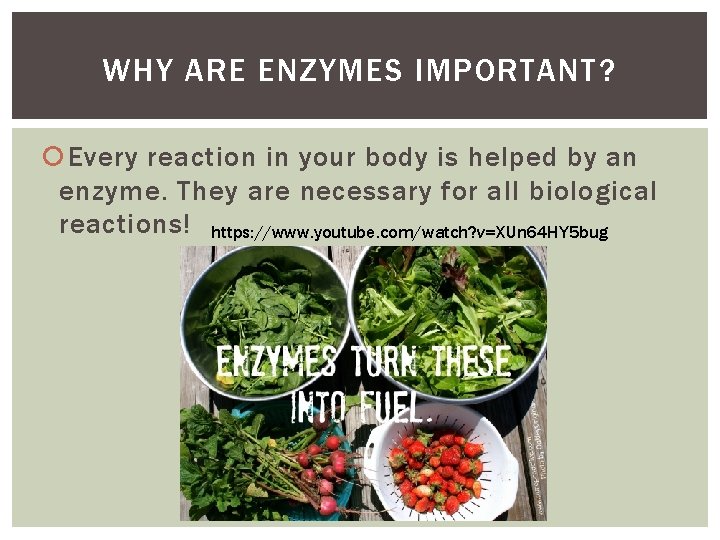
WHY ARE ENZYMES IMPORTANT? Every reaction in your body is helped by an enzyme. They are necessary for all biological reactions! https: //www. youtube. com/watch? v=XUn 64 HY 5 bug
PHOTOSYNTHESIS Energy in the cell
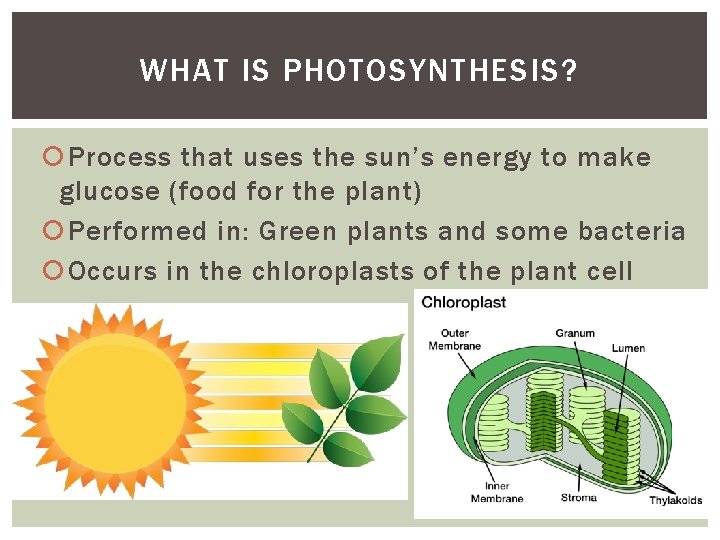
WHAT IS PHOTOSYNTHESIS? Process that uses the sun’s energy to make glucose (food for the plant) Performed in: Green plants and some bacteria Occurs in the chloroplasts of the plant cell
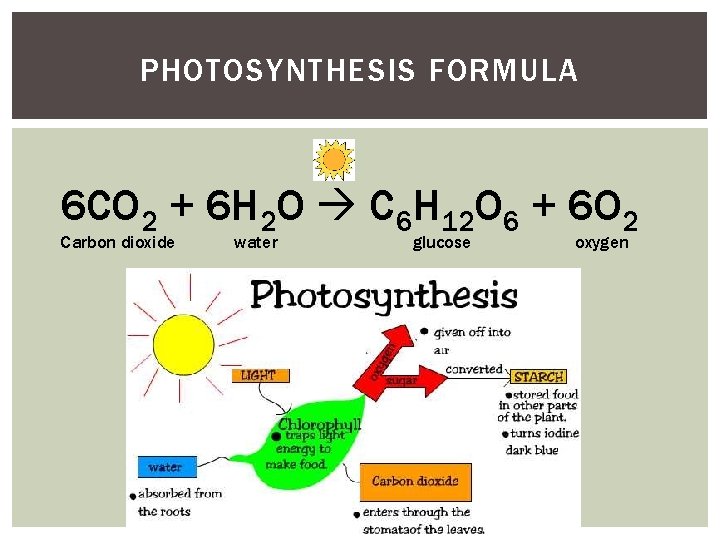
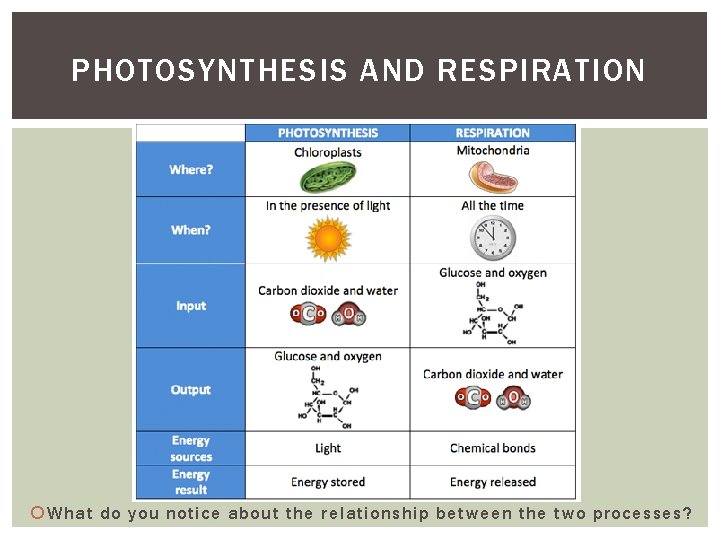
PHOTOSYNTHESIS FORMULA 6 CO 2 + 6 H 2 O C 6 H 12 O 6 + 6 O 2 Carbon dioxide water glucose oxygen
RATE OF PHOTOSYNTHESIS The rate (speed) at which a plant performs photosynthesis is based on a number of things: # of reactants § More reactants yields more products Temperature and p. H § Recall that enzymes are directly impacted by these factors! Light § No light=no photosynthesis
CELLULAR RESPIRATION Energy in the Cell
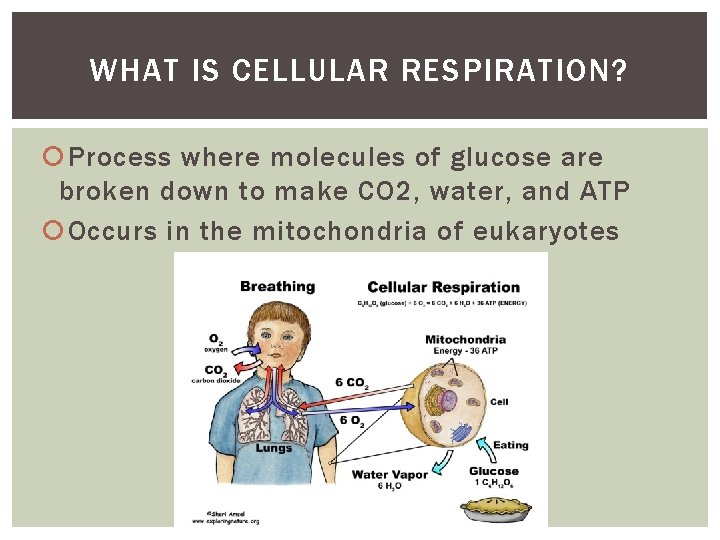
WHAT IS CELLULAR RESPIRATION? Process where molecules of glucose are broken down to make CO 2, water, and ATP Occurs in the mitochondria of eukaryotes
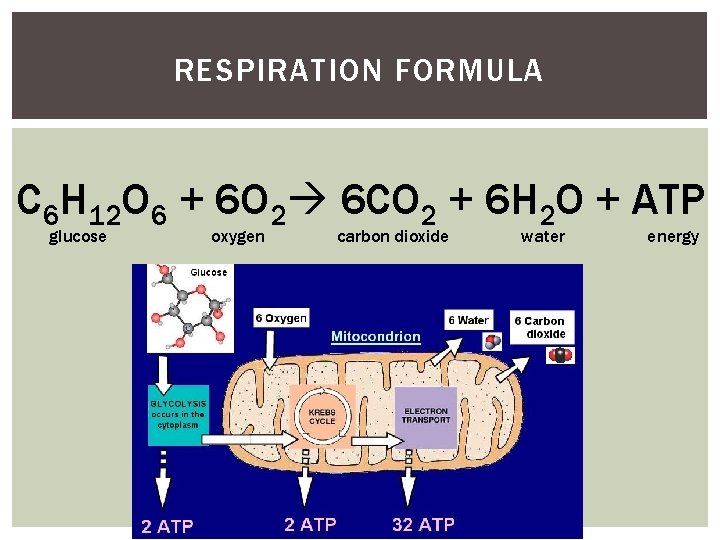
RESPIRATION FORMULA C 6 H 12 O 6 + 6 O 2 6 CO 2 + 6 H 2 O + ATP glucose oxygen carbon dioxide water energy
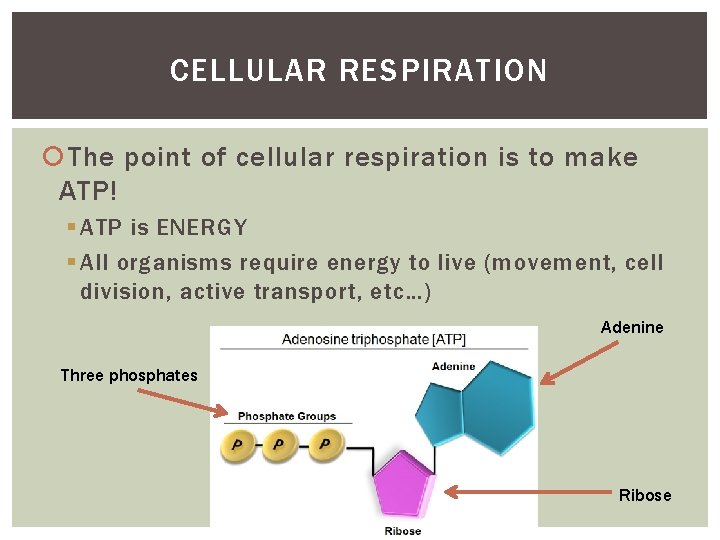
CELLULAR RESPIRATION The point of cellular respiration is to make ATP! § ATP is ENERGY § All organisms require energy to live (movement, cell division, active transport, etc…) Adenine Three phosphates Ribose
PHOTOSYNTHESIS AND RESPIRATION What do you notice about the relationship between the two processes?
AEROBIC VS. ANAEROBIC RESPIRATION Comparing Energy Processes
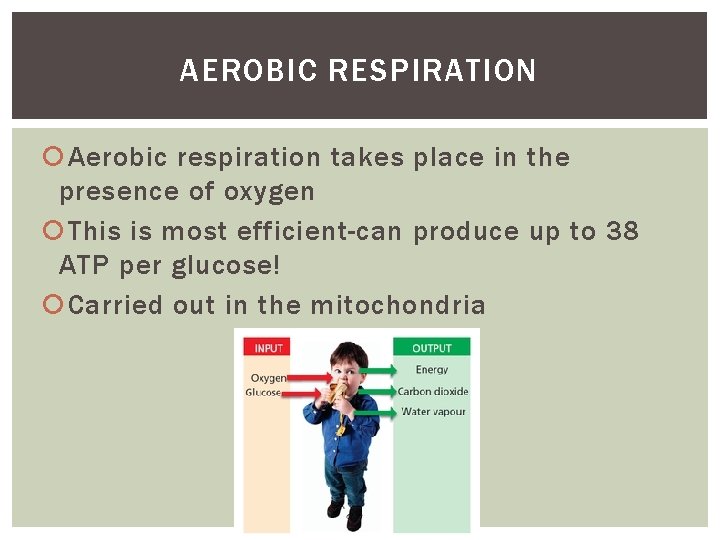
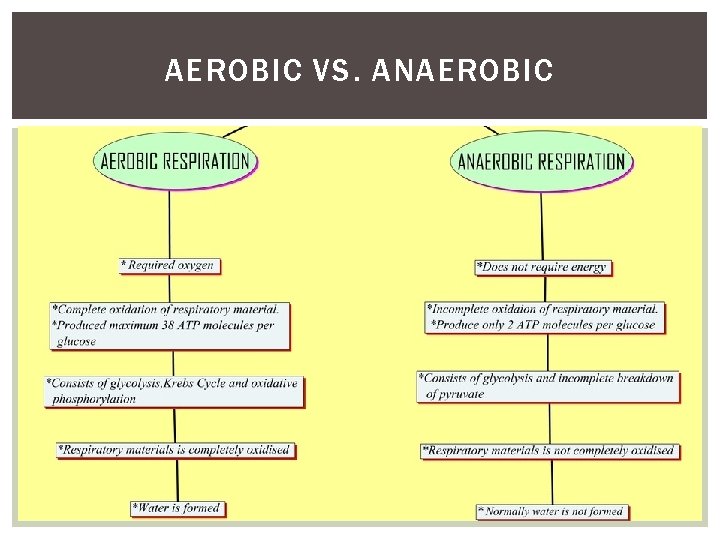
AEROBIC RESPIRATION Aerobic respiration takes place in the presence of oxygen This is most efficient-can produce up to 38 ATP per glucose! Carried out in the mitochondria
BUT WHAT IF OXYGEN ISN’T AVAILABLE?
ANAEROBIC RESPIRATION Anaerobic Respiration (fermentation) occurs when oxygen is NOT present Less efficient-only 2 ATP produced! Occurs in anaerobic bacteria, yeast, and muscle cells Carried out in the cytoplasm
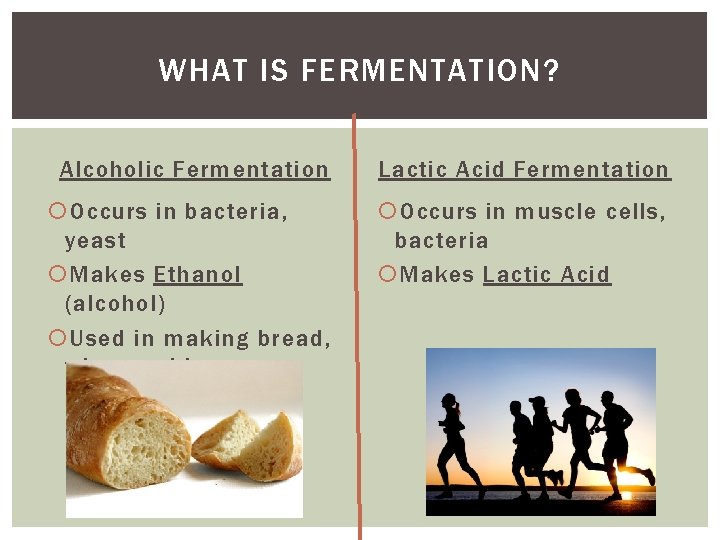
WHAT IS FERMENTATION? Alcoholic Fermentation Lactic Acid Fermentation Occurs in bacteria, yeast Makes Ethanol (alcohol) Used in making bread, wine, and beer Occurs in muscle cells, bacteria Makes Lactic Acid
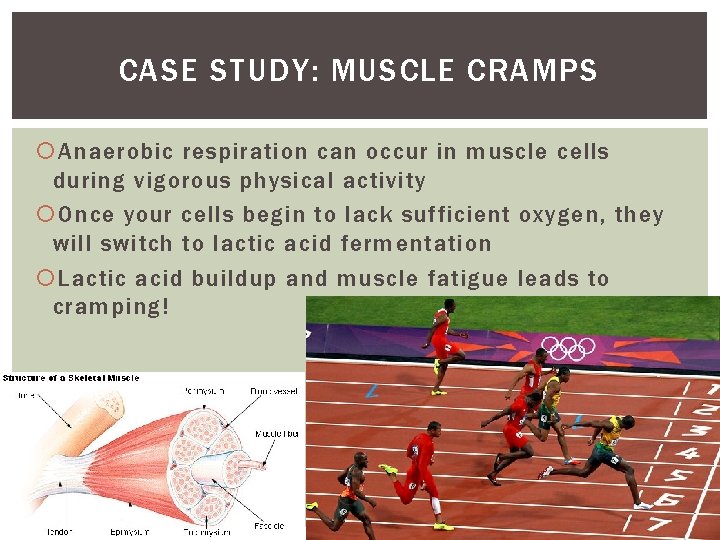
CASE STUDY: MUSCLE CRAMPS Anaerobic respiration can occur in muscle cells during vigorous physical activity Once your cells begin to lack sufficient oxygen, they will switch to lactic acid fermentation Lactic acid buildup and muscle fatigue leads to cramping!
AEROBIC VS. ANAEROBIC
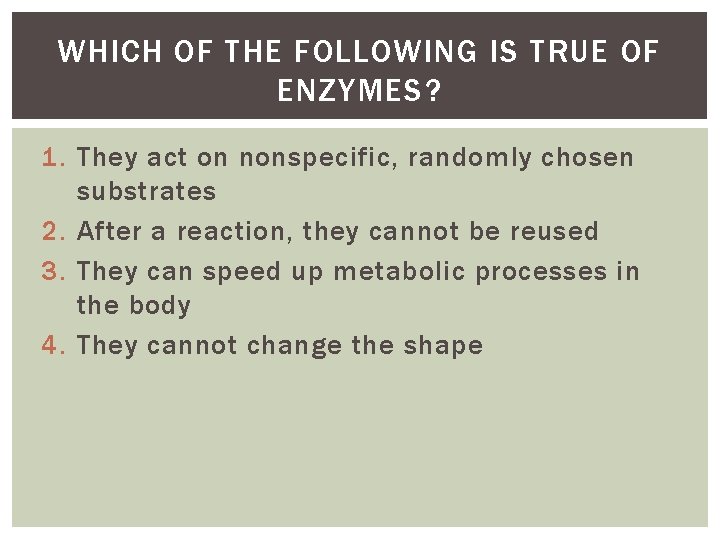
WHICH OF THE FOLLOWING IS TRUE OF ENZYMES? 1. They act on nonspecific, randomly chosen substrates 2. After a reaction, they cannot be reused 3. They can speed up metabolic processes in the body 4. They cannot change the shape
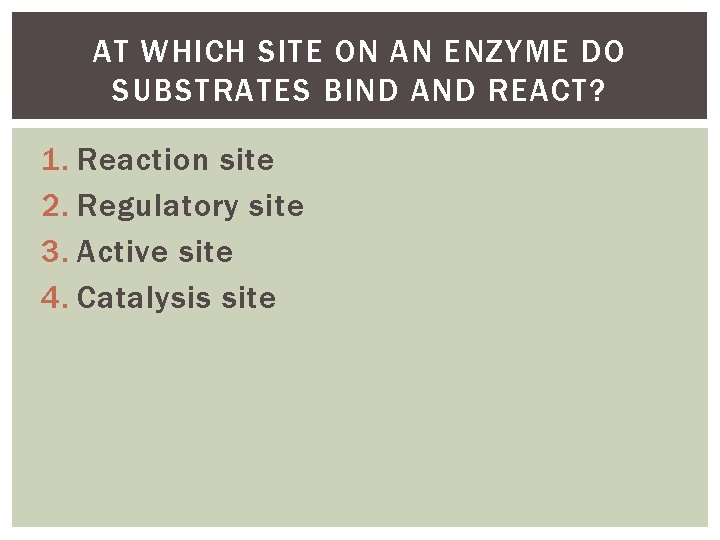
AT WHICH SITE ON AN ENZYME DO SUBSTRATES BIND AND REACT? 1. Reaction site 2. Regulatory site 3. Active site 4. Catalysis site
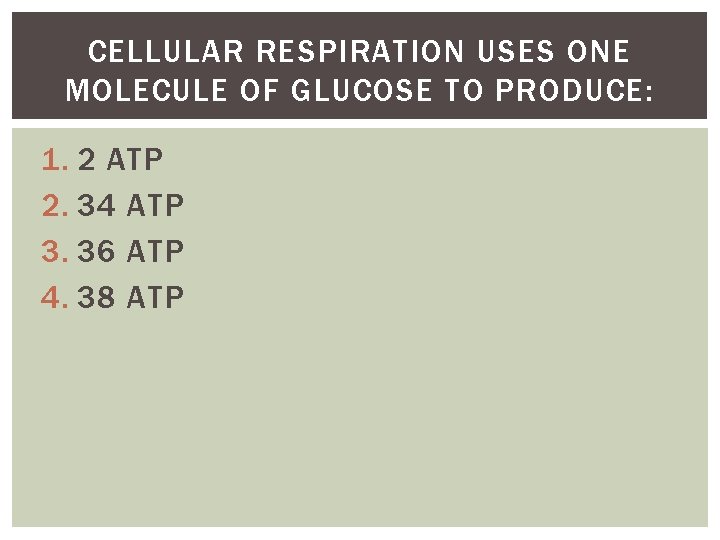
CELLULAR RESPIRATION USES ONE MOLECULE OF GLUCOSE TO PRODUCE: 1. 2 ATP 2. 34 ATP 3. 36 ATP 4. 38 ATP
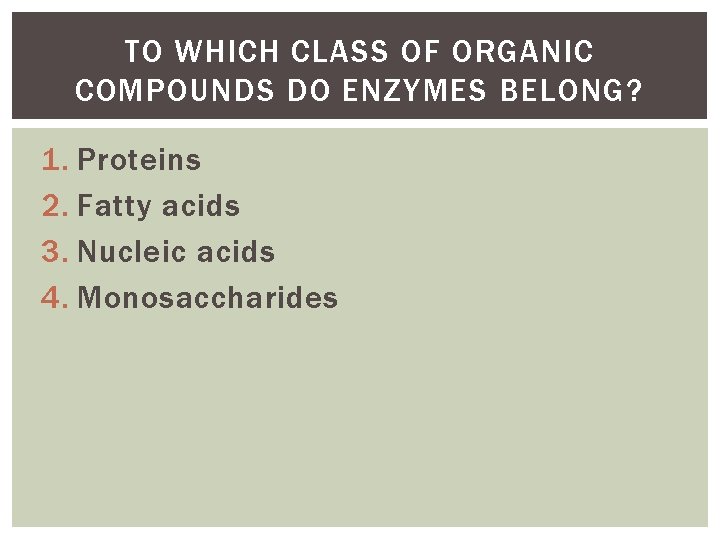
TO WHICH CLASS OF ORGANIC COMPOUNDS DO ENZYMES BELONG? 1. Proteins 2. Fatty acids 3. Nucleic acids 4. Monosaccharides
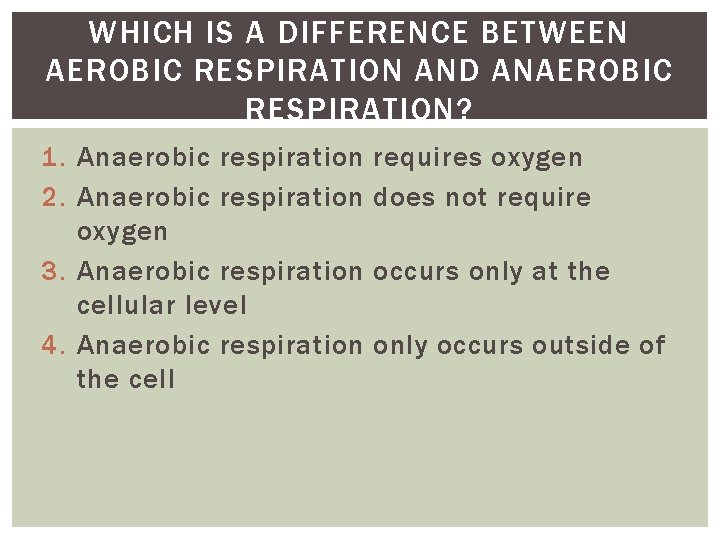
WHICH IS A DIFFERENCE BETWEEN AEROBIC RESPIRATION AND ANAEROBIC RESPIRATION? 1. Anaerobic respiration 2. Anaerobic respiration oxygen 3. Anaerobic respiration cellular level 4. Anaerobic respiration the cell requires oxygen does not require occurs only at the only occurs outside of
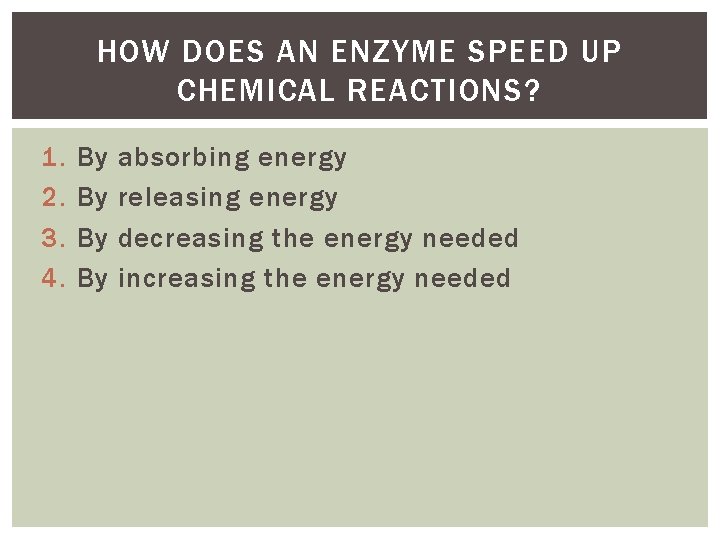
HOW DOES AN ENZYME SPEED UP CHEMICAL REACTIONS? 1. 2. 3. 4. By By absorbing energy releasing energy decreasing the energy needed increasing the energy needed
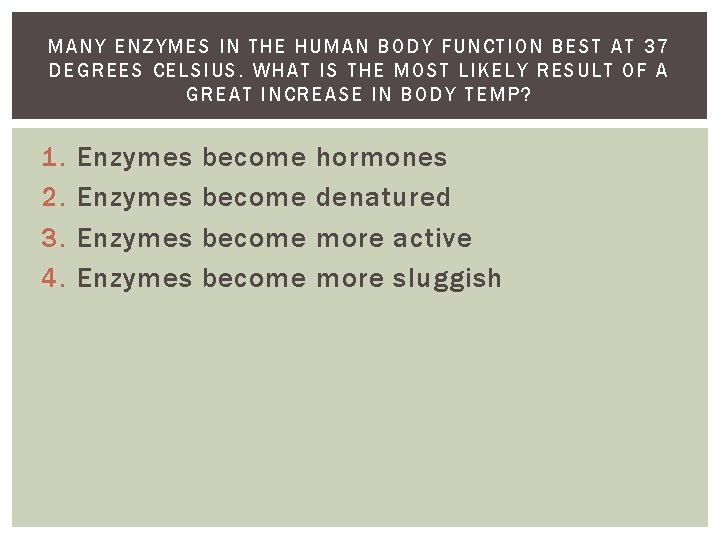
MANY ENZYMES IN THE HUMAN BODY FUNCTIO N BES T AT 37 DEGREES CELSIUS. WH AT IS THE MOST LIKELY RESU LT O F A GREAT INCREASE IN BODY TEMP ? 1. 2. 3. 4. Enzymes become hormones denatured more active more sluggish
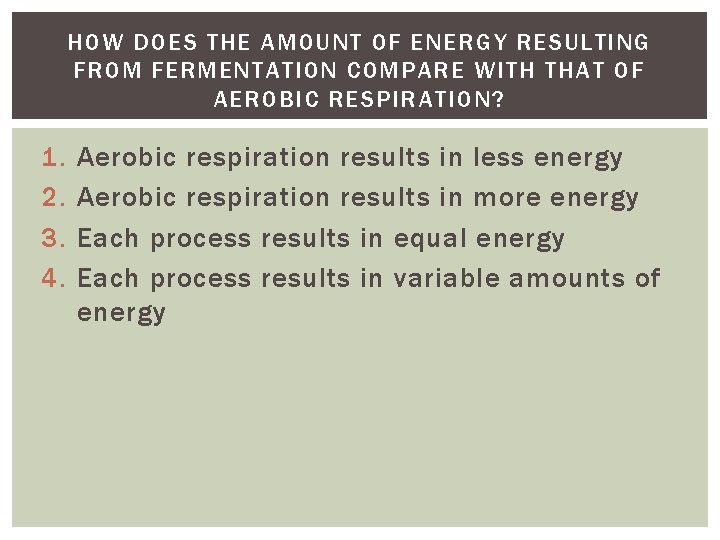
HOW DOES THE AMOUNT OF ENERGY RESULTING FROM FERMENTATION COMPARE WITH THAT OF AEROBIC RESPIRATION? 1. 2. 3. 4. Aerobic respiration results in less energy Aerobic respiration results in more energy Each process results in equal energy Each process results in variable amounts of energy
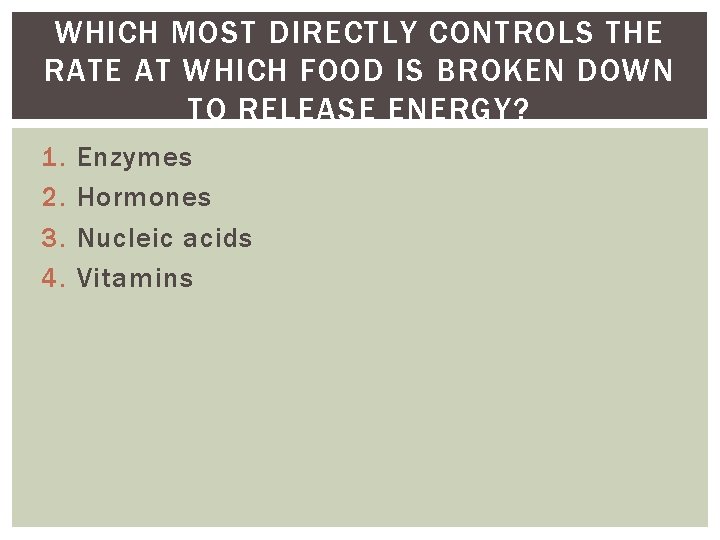
WHICH MOST DIRECTLY CONTROLS THE RATE AT WHICH FOOD IS BROKEN DOWN TO RELEASE ENERGY? 1. 2. 3. 4. Enzymes Hormones Nucleic acids Vitamins
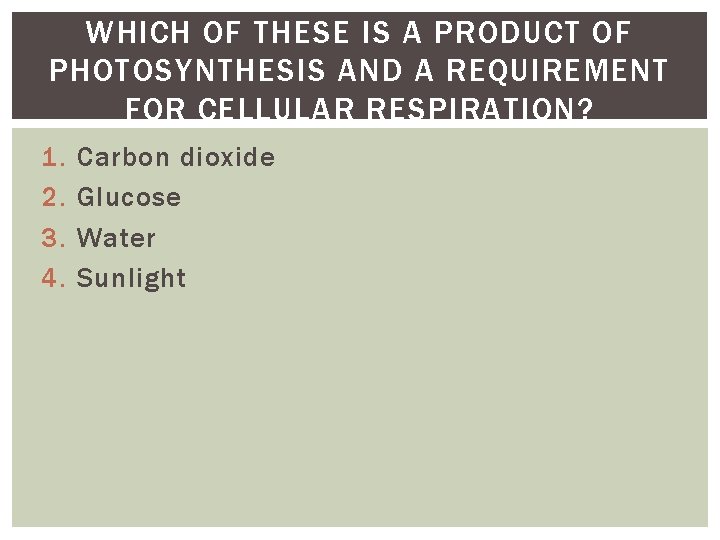
WHICH OF THESE IS A PRODUCT OF PHOTOSYNTHESIS AND A REQUIREMENT FOR CELLULAR RESPIRATION? 1. 2. 3. 4. Carbon dioxide Glucose Water Sunlight
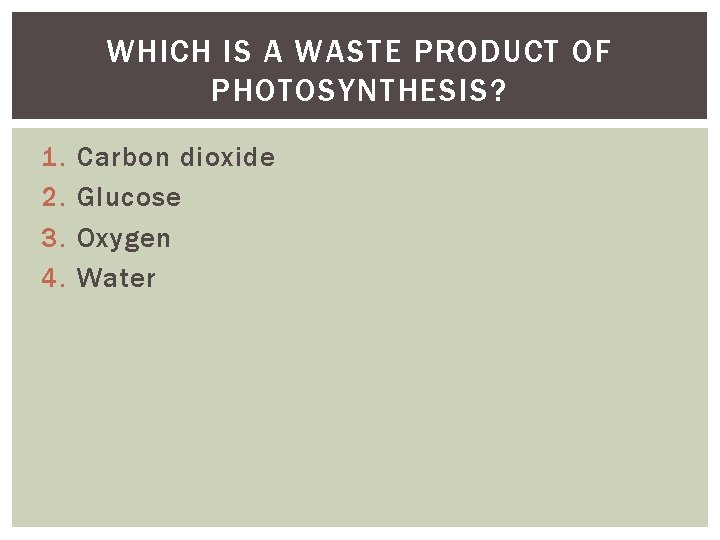
WHICH IS A WASTE PRODUCT OF PHOTOSYNTHESIS? 1. 2. 3. 4. Carbon dioxide Glucose Oxygen Water