
Enzymes Inhibition and Mechanisms Andy Howard Introductory Biochemistry
Enzymes: Inhibition and Mechanisms Andy Howard Introductory Biochemistry 31 October 2013 inhibition and mechanisms 10/31/2013
Inhibition and Mechanisms Inhibition is important in its own right and as a tool for understanding kinetics and mechanisms n Mechanistic studies enable us to recognize how enzymes do their job n 10/31/2013 inhibition and mechanisms P. 2 of 57
Inhibition & Mechanism Topics n Reversible Inhibitors: n n mixed Pharmaceuticals What makes an inhibitor useful? Enzyme mechanisms n General principles Binding modes n 10/31/2013 n Mechanisms, cont’d n n n n inhibition and mechanisms Transition states Diffusion-controlled Reactions Binding Modes of Catalysis Redox reactions Induced fit Active-site residues p. H dependence P. 3 of 57

Mixed inhibition n n Usually involves interference with both binding and catalysis Km goes up, Vmax goes down Easy to imagine the mechanism: Binding of inhibitor alters the active-site configuration to interfere with binding, but it also alters turnover Same picture as with pure noncompetitive inhibition, but with Ki ≠ Ki’ 10/31/2013 inhibition and mechanisms Cf. G&G fig. 13. 16 P. 4 of 57
Most pharmaceuticals are enzyme inhibitors n n n Some are inhibitors of enzymes that are necessary for functioning of pathogens Others are inhibitors of some protein whose inappropriate expression in a human causes a disease. Others are targeted at enzymes that are produced more energetically by tumors than they are by normal tissues. 10/31/2013 inhibition and mechanisms P. 5 of 57
Characteristics of Pharmaceutical Inhibitors n n Usually competitive, i. e. they raise Km without affecting Vmax Some are mixed, i. e. Km up, Vmax down Iterative design work will decrease Ki from millimolar down to nanomolar Sometimes design work is purely blind HTS; other times, it’s structure-based 10/31/2013 inhibition and mechanisms P. 6 of 57
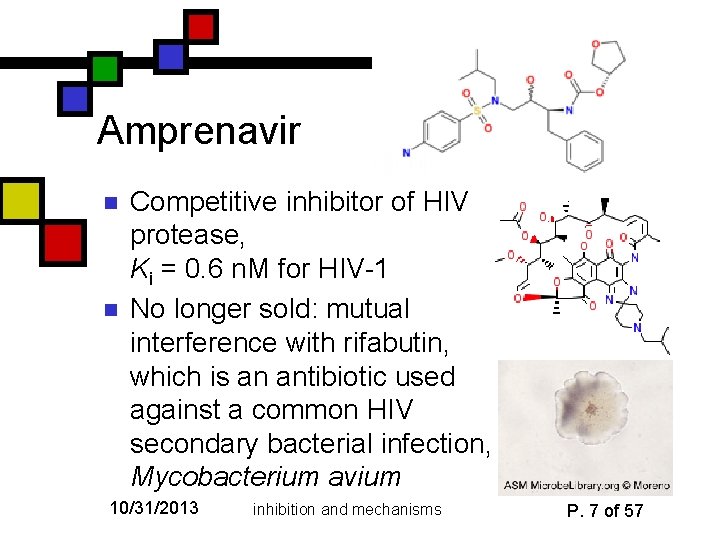
Amprenavir n n Competitive inhibitor of HIV protease, Ki = 0. 6 n. M for HIV-1 No longer sold: mutual interference with rifabutin, which is an antibiotic used against a common HIV secondary bacterial infection, Mycobacterium avium 10/31/2013 inhibition and mechanisms P. 7 of 57
When is a good inhibitor a good drug? n n n It needs to be bioavailable and nontoxic Beautiful 20 n. M inhibitor is often neither Modest sacrifices of Ki in improving bioavailability and non-toxicity are okay if Ki is low enough when you start sacrificing 10/31/2013 inhibition and mechanisms P. 8 of 57
How do we lessen toxicity and improve bioavailability? n n n Increase solubility… that often increases Ki because the van der Waals interactions diminish Solubility makes it easier to get the compound to travel through the bloodstream Toxicity is often associated with fat storage, which is more likely with insoluble compounds 10/31/2013 inhibition and mechanisms P. 9 of 57
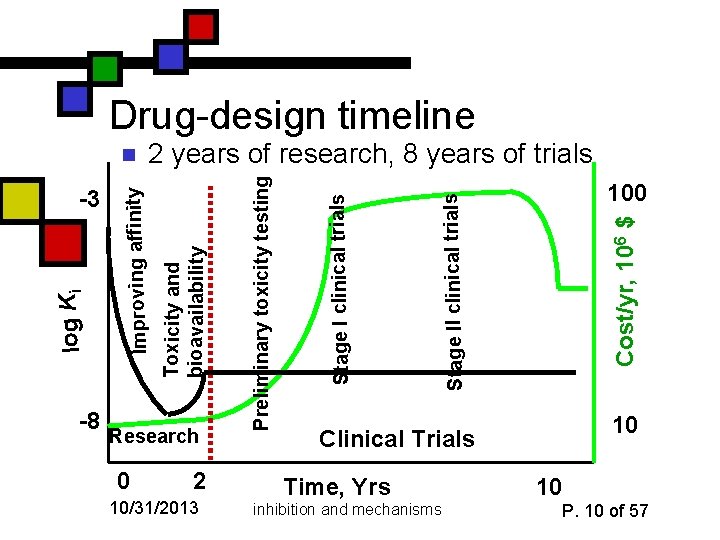
Drug-design timeline Research 0 2 10/31/2013 100 Cost/yr, 106 $ Stage II clinical trials Stage I clinical trials Preliminary toxicity testing -8 Toxicity and bioavailability log Ki -3 2 years of research, 8 years of trials Improving affinity n 10 Clinical Trials Time, Yrs inhibition and mechanisms 10 P. 10 of 57
Atomic-Level Mechanisms n n n We want to understand atomic-level events during an enzymatically catalyzed reaction. Sometimes we want to find a way to inhibit an enzyme in other cases we're looking for more fundamental knowledge, viz. the ways that biological organisms employ chemistry and how enzymes make that chemistry possible. 10/31/2013 inhibition and mechanisms P. 11 of 57
How we study mechanisms n There a variety of experimental tools available for understanding mechanisms, including isotopic labeling of substrates, structural methods, and spectroscopic kinetic techniques. 10/31/2013 inhibition and mechanisms P. 12 of 57
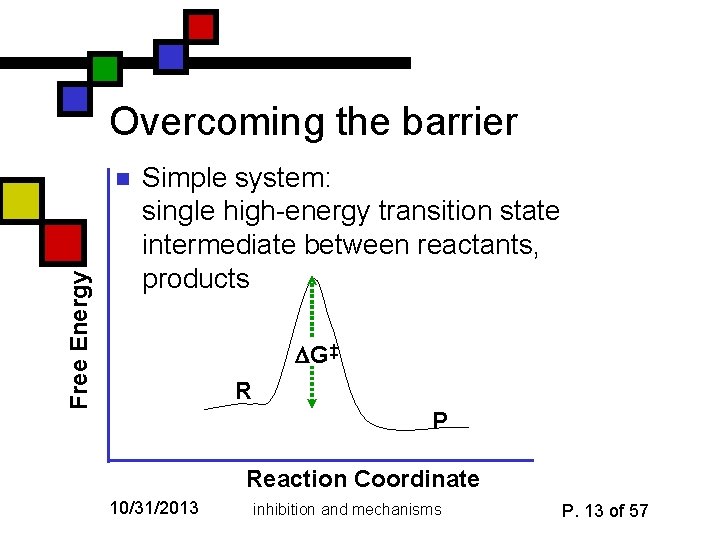
Overcoming the barrier Free Energy n Simple system: single high-energy transition state intermediate between reactants, products G‡ R P Reaction Coordinate 10/31/2013 inhibition and mechanisms P. 13 of 57
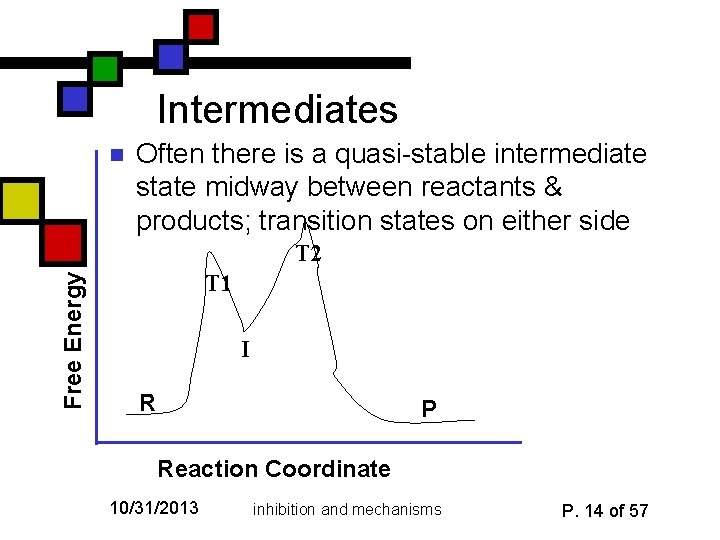
Intermediates n Often there is a quasi-stable intermediate state midway between reactants & products; transition states on either side Free Energy T 2 T 1 I R P Reaction Coordinate 10/31/2013 inhibition and mechanisms P. 14 of 57
Activation energy & temperature n n It’s intuitively sensible that higher temperatures would make it easier to overcome an activation barrier Rate k(T) = Q 0 exp(- G‡/RT) G‡ = activation energy or Arrhenius energy This provides tool for measuring G‡ 10/31/2013 inhibition and mechanisms Svante Arrhenius P. 15 of 57
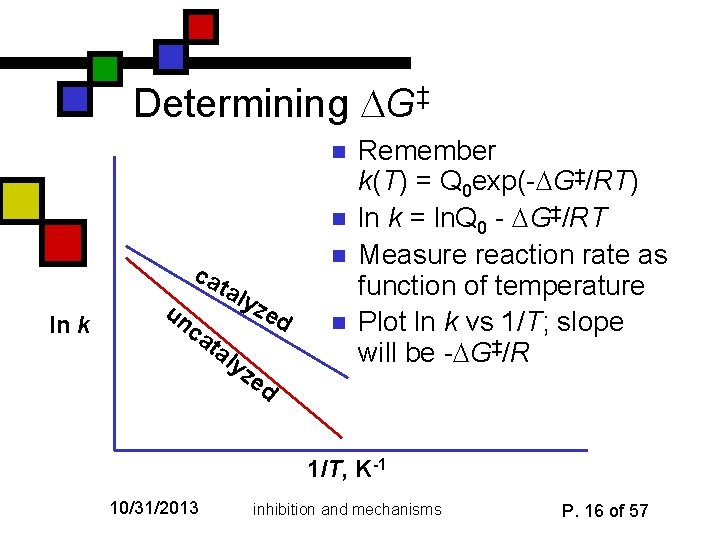
Determining G‡ n n n ca ln k tal un ca t al y yz ed ze n Remember k(T) = Q 0 exp(- G‡/RT) ln k = ln. Q 0 - G‡/RT Measure reaction rate as function of temperature Plot ln k vs 1/T; slope will be - G‡/R d 1/T, K-1 10/31/2013 inhibition and mechanisms P. 16 of 57
How enzymes alter G‡ n n n Enzymes reduce G‡ by allowing the binding of the transition state into the active site Binding of the transition state needs to be tighter than the binding of either the reactants or the products. In fact, the enzyme must stabilize the transition-state complex EX‡ more than it stabilizes the substrate complex ES (see section 14. 2). 10/31/2013 inhibition and mechanisms P. 17 of 57
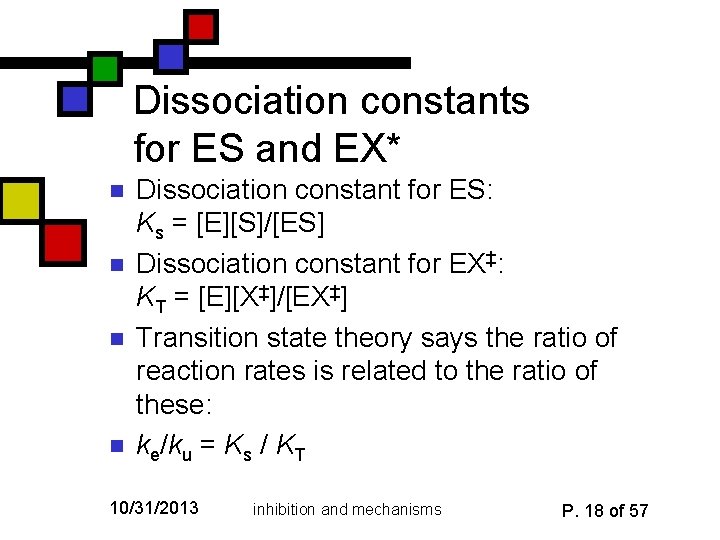
Dissociation constants for ES and EX* n n Dissociation constant for ES: Ks = [E][S]/[ES] Dissociation constant for EX‡: KT = [E][X‡]/[EX‡] Transition state theory says the ratio of reaction rates is related to the ratio of these: ke/ku = Ks / KT 10/31/2013 inhibition and mechanisms P. 18 of 57
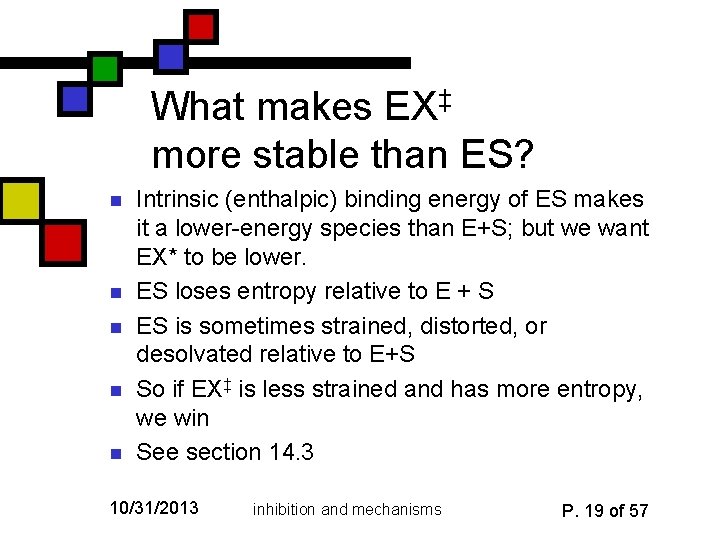
What makes EX‡ more stable than ES? n n n Intrinsic (enthalpic) binding energy of ES makes it a lower-energy species than E+S; but we want EX* to be lower. ES loses entropy relative to E + S ES is sometimes strained, distorted, or desolvated relative to E+S So if EX‡ is less strained and has more entropy, we win See section 14. 3 10/31/2013 inhibition and mechanisms P. 19 of 57
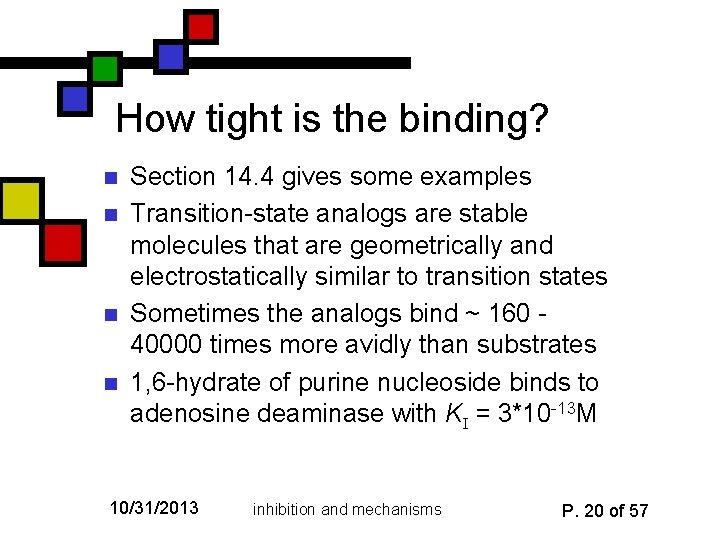
How tight is the binding? n n Section 14. 4 gives some examples Transition-state analogs are stable molecules that are geometrically and electrostatically similar to transition states Sometimes the analogs bind ~ 160 40000 times more avidly than substrates 1, 6 -hydrate of purine nucleoside binds to adenosine deaminase with KI = 3*10 -13 M 10/31/2013 inhibition and mechanisms P. 20 of 57
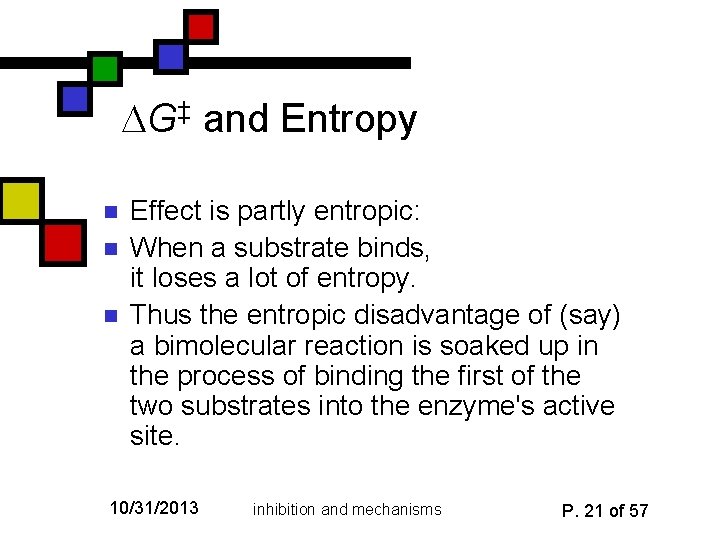
G‡ and Entropy n n n Effect is partly entropic: When a substrate binds, it loses a lot of entropy. Thus the entropic disadvantage of (say) a bimolecular reaction is soaked up in the process of binding the first of the two substrates into the enzyme's active site. 10/31/2013 inhibition and mechanisms P. 21 of 57
Enthalpy and transition states n n Often an enthalpic component to the reduction in G‡ as well Ionic or hydrophobic interactions between the enzyme's active site residues and the components of the transition state make that transition state more stable. 10/31/2013 inhibition and mechanisms P. 22 of 57
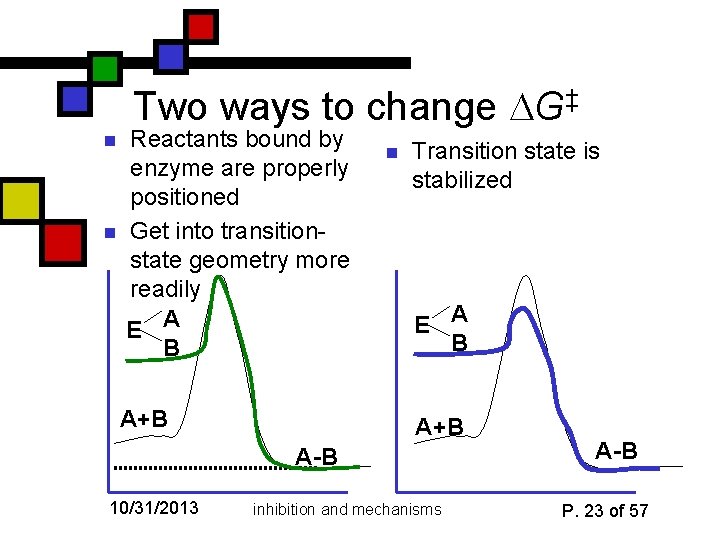
Two ways to change G‡ n n Reactants bound by enzyme are properly positioned Get into transitionstate geometry more readily E A B A+B n Transition state is stabilized E A B A+B A-B 10/31/2013 inhibition and mechanisms A-B P. 23 of 57
The protein moves as well! n Changes to active-site conformation: n n n Help with substrate binding Position the catalytic groups Induce formation of an NAC Help to break or make bonds Facilitate conversion of S to P Sometimes involve networks of concerted amino acid changes 10/31/2013 inhibition and mechanisms P. 24 of 57
Atomic-Level Mechanisms n n n We want to understand atomic-level events during an enzymatically catalyzed reaction. Sometimes we want to find a way to inhibit an enzyme in other cases we're looking for more fundamental knowledge, viz. the ways that biological organisms employ chemistry and how enzymes make that chemistry possible. 10/31/2013 inhibition and mechanisms P. 25 of 57
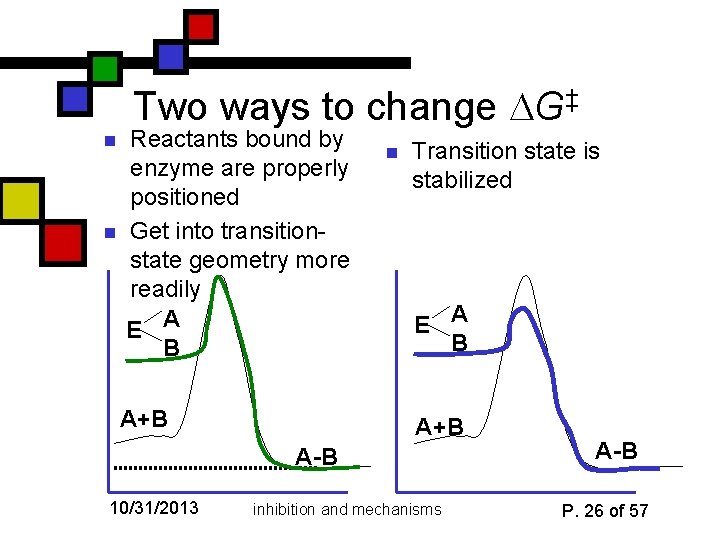
Two ways to change G‡ n n Reactants bound by enzyme are properly positioned Get into transitionstate geometry more readily E A B A+B n Transition state is stabilized E A B A+B A-B 10/31/2013 inhibition and mechanisms A-B P. 26 of 57
The protein moves as well! n Changes to active-site conformation: n n n Help with substrate binding Position the catalytic groups Induce formation of a near-attack conformation (NAC) Help to break or make bonds Facilitate conversion of S to P Sometimes involve networks of concerted amino acid changes 10/31/2013 inhibition and mechanisms P. 27 of 57
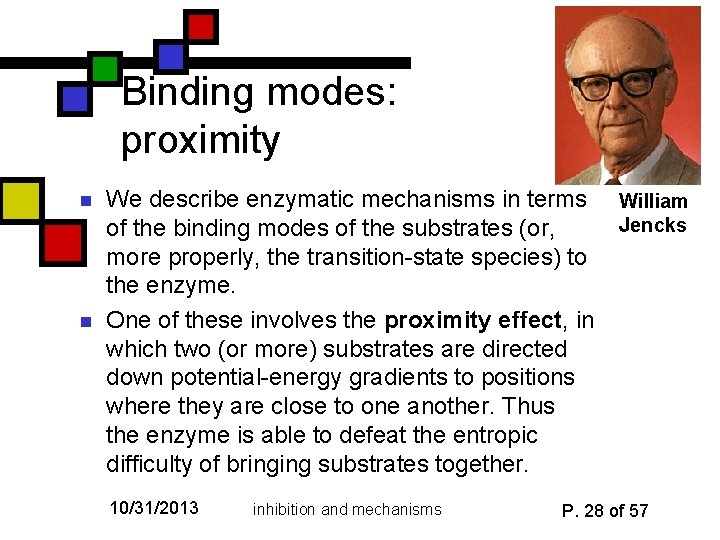
Binding modes: proximity n n We describe enzymatic mechanisms in terms of the binding modes of the substrates (or, more properly, the transition-state species) to the enzyme. One of these involves the proximity effect, in which two (or more) substrates are directed down potential-energy gradients to positions where they are close to one another. Thus the enzyme is able to defeat the entropic difficulty of bringing substrates together. 10/31/2013 inhibition and mechanisms William Jencks P. 28 of 57
Binding modes: efficient transition-state binding n n Transition state fits even better (geometrically and electrostatically) in the active site than the substrate would. This improved fit lowers the energy of the transition-state system relative to the substrate. Best competitive inhibitors of an enzyme are those that resemble the transition state rather than the substrate or product. 10/31/2013 inhibition and mechanisms P. 29 of 57
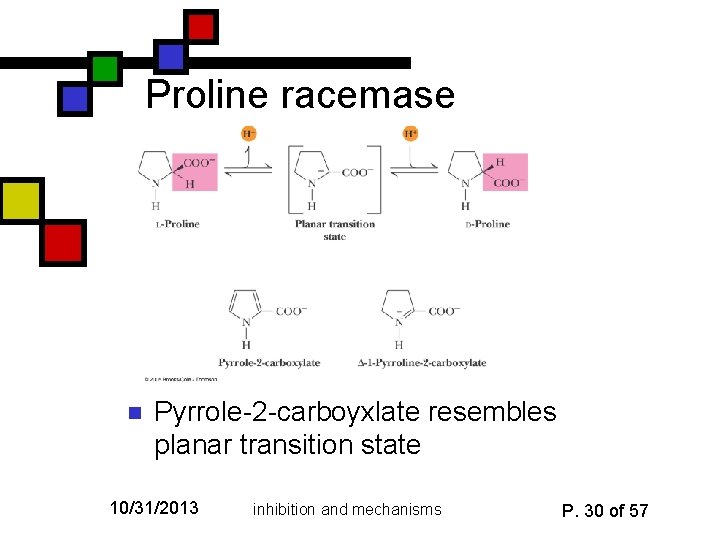
Proline racemase n Pyrrole-2 -carboyxlate resembles planar transition state 10/31/2013 inhibition and mechanisms P. 30 of 57
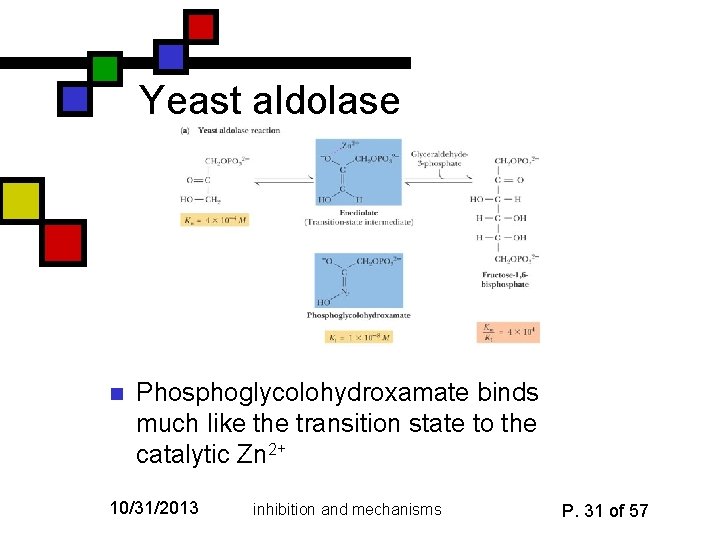
Yeast aldolase n Phosphoglycolohydroxamate binds much like the transition state to the catalytic Zn 2+ 10/31/2013 inhibition and mechanisms P. 31 of 57
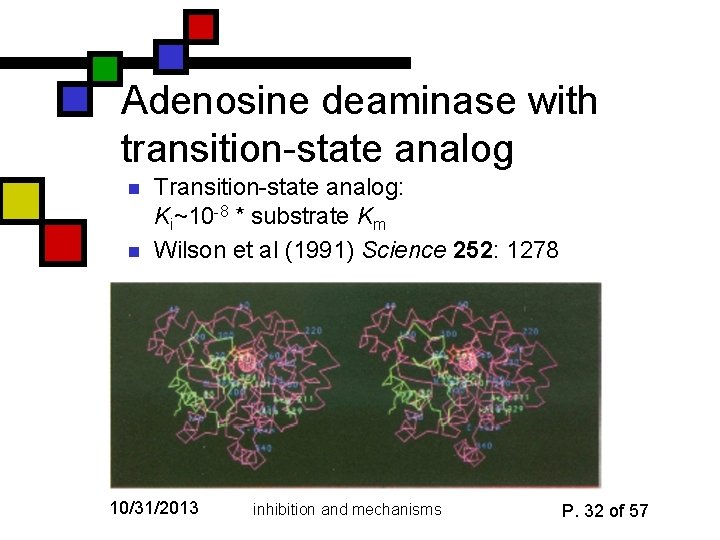
Adenosine deaminase with transition-state analog n n Transition-state analog: Ki~10 -8 * substrate Km Wilson et al (1991) Science 252: 1278 10/31/2013 inhibition and mechanisms P. 32 of 57
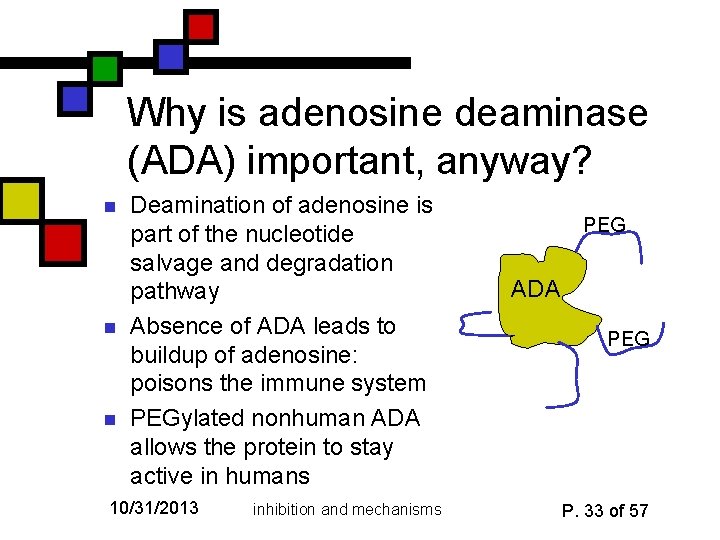
Why is adenosine deaminase (ADA) important, anyway? n n n Deamination of adenosine is part of the nucleotide salvage and degradation pathway Absence of ADA leads to buildup of adenosine: poisons the immune system PEGylated nonhuman ADA allows the protein to stay active in humans 10/31/2013 inhibition and mechanisms PEG ADA PEG P. 33 of 57
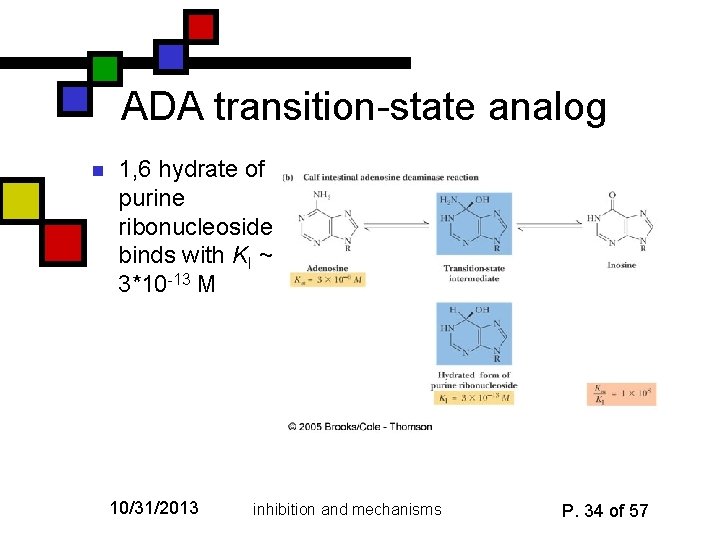
ADA transition-state analog n 1, 6 hydrate of purine ribonucleoside binds with KI ~ 3*10 -13 M 10/31/2013 inhibition and mechanisms P. 34 of 57
Diffusion-controlled reactions n n Some enzymes are so efficient that the limiting factor in completion of the reaction is diffusion of the substrates into the active site: These are diffusion-controlled reactions. Ultra-high turnover rates: kcat ~ 109 s-1. We can describe kcat / Km as catalytic efficiency (or the specificity constant) of an enzyme. A diffusion-controlled reaction will have a catalytic efficiency on the order of 108 M-1 s-1. 10/31/2013 inhibition and mechanisms P. 35 of 57
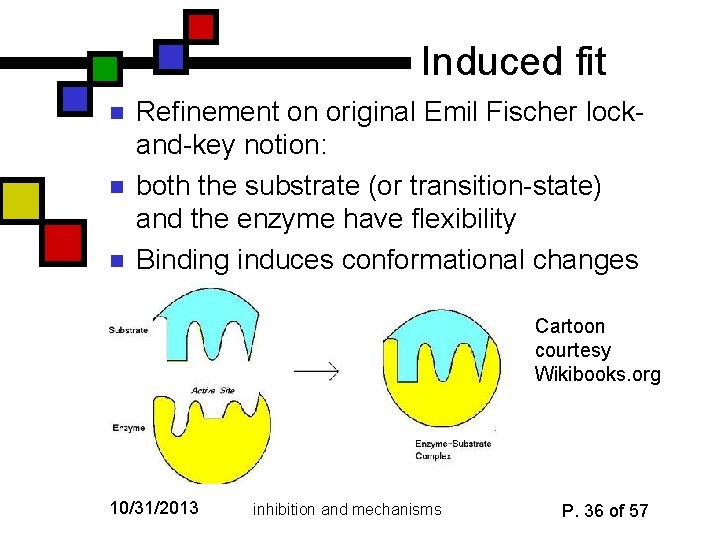
Induced fit n n n Refinement on original Emil Fischer lockand-key notion: both the substrate (or transition-state) and the enzyme have flexibility Binding induces conformational changes Cartoon courtesy Wikibooks. org 10/31/2013 inhibition and mechanisms P. 36 of 57
Ionic reactions n n Define them as reactions that involve charged, or at least polar, intermediates Typically 2 reactants n n Electron rich (nucleophilic) reactant Electron poor (electrophilic) reactant Conventional to describe reaction as attack of nucleophile on electrophile Drawn with nucleophile donating electron(s) to electrophile 10/31/2013 inhibition and mechanisms P. 37 of 57
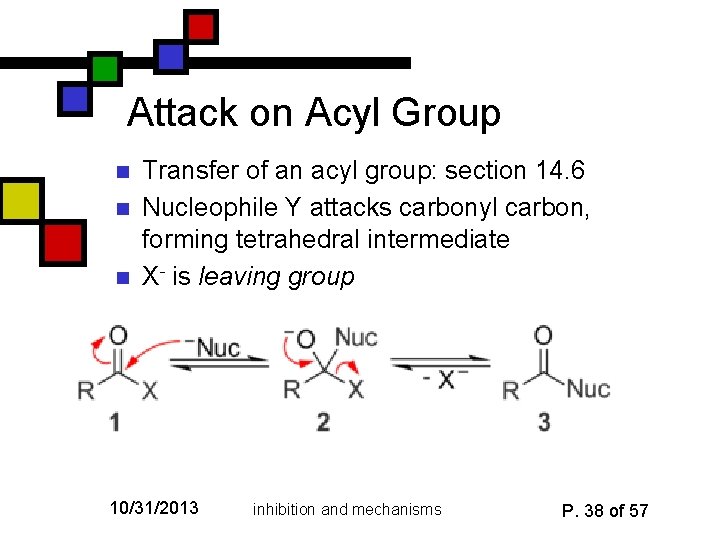
Attack on Acyl Group n n n Transfer of an acyl group: section 14. 6 Nucleophile Y attacks carbonyl carbon, forming tetrahedral intermediate X- is leaving group 10/31/2013 inhibition and mechanisms P. 38 of 57
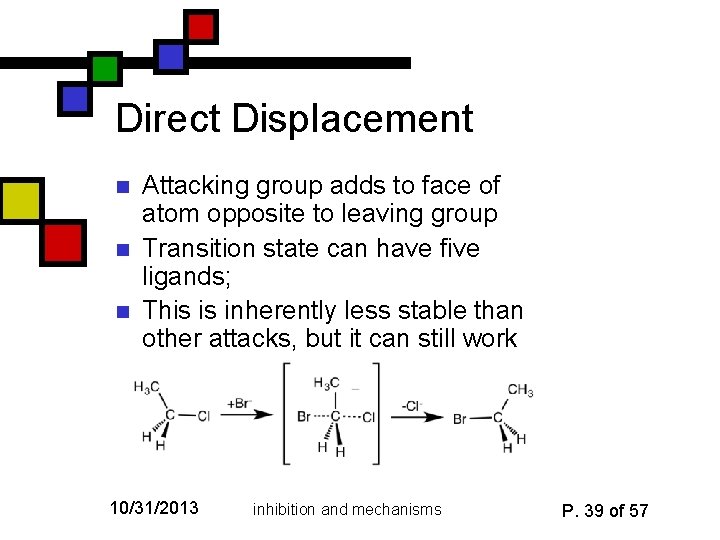
Direct Displacement n n n Attacking group adds to face of atom opposite to leaving group Transition state can have five ligands; This is inherently less stable than other attacks, but it can still work 10/31/2013 inhibition and mechanisms P. 39 of 57
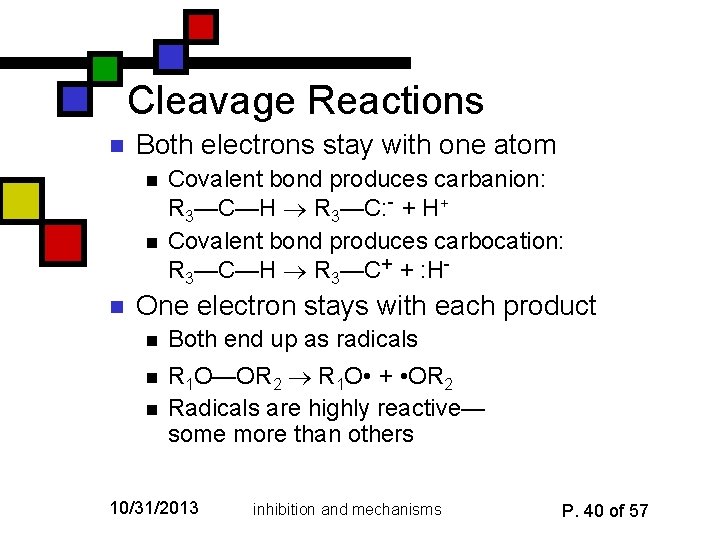
Cleavage Reactions n Both electrons stay with one atom n n n Covalent bond produces carbanion: R 3—C—H R 3—C: - + H+ Covalent bond produces carbocation: R 3—C—H R 3—C+ + : H- One electron stays with each product n Both end up as radicals n R 1 O—OR 2 R 1 O • + • OR 2 Radicals are highly reactive— some more than others n 10/31/2013 inhibition and mechanisms P. 40 of 57
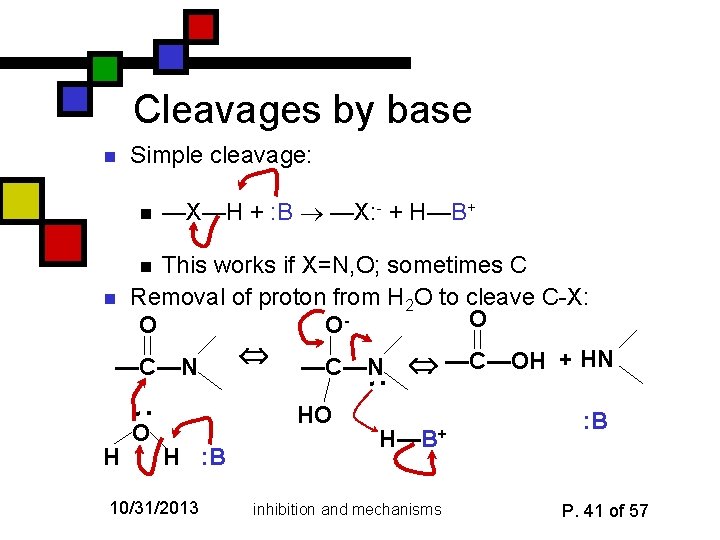
Cleavages by base n Simple cleavage: n —X—H + : B —X: - + H—B+ This works if X=N, O; sometimes C n Removal of proton from H 2 O to cleave C-X: O O O —C—N —C—OH + HN —C—N : n : HO H : B 10/31/2013 H—B+ inhibition and mechanisms : B P. 41 of 57
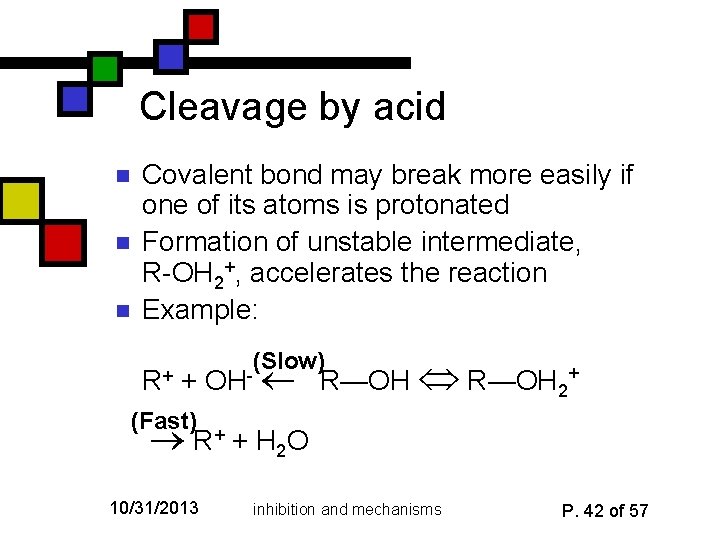
Cleavage by acid n n n Covalent bond may break more easily if one of its atoms is protonated Formation of unstable intermediate, R-OH 2+, accelerates the reaction Example: R+ + (Slow) OH- R—OH 2+ (Fast) R + + H 2 O 10/31/2013 inhibition and mechanisms P. 42 of 57
Low-barrier H-bonds n Ordinary H-bonds buy us 10 -30 k. J mol-1 n n n O—O separation = 0. 28 nm (similar for O-N) O—H = 0. 1 nm so H…O distance is 0. 18 nm As the O’s get closer to each other, the bond order gets closer to 0. 5 for both We than have an O-O distance ~ 0. 22 nm & much stronger (60 k. J mol-1) interaction p. Ka for the two heteroatoms must be nearly equal for this to happen Several mechanisms employ these 10/31/2013 inhibition and mechanisms P. 43 of 57
Oxidation-Reduction Reactions n n Commonplace in biochemistry: EC 1 Oxidation is a loss of electrons Reduction is the gain of electrons In practice, often: n n oxidation is decrease in # of C-H bonds; reduction is increase in # of C-H bonds 10/31/2013 inhibition and mechanisms P. 44 of 57
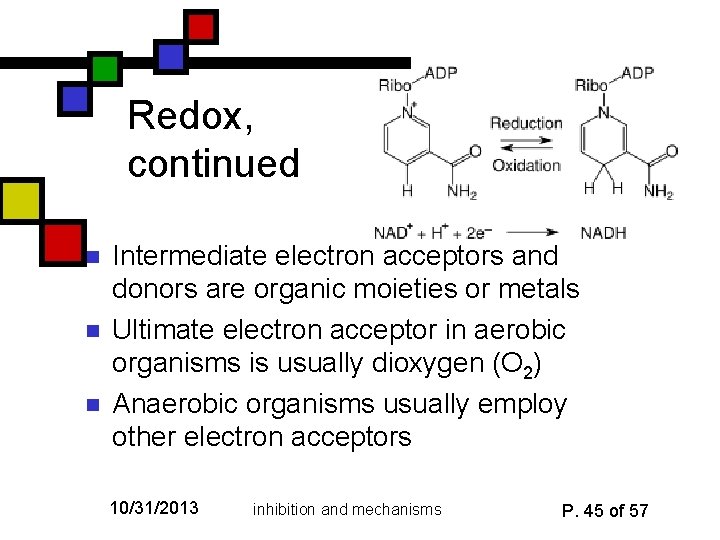
Redox, continued n n n Intermediate electron acceptors and donors are organic moieties or metals Ultimate electron acceptor in aerobic organisms is usually dioxygen (O 2) Anaerobic organisms usually employ other electron acceptors 10/31/2013 inhibition and mechanisms P. 45 of 57
Biological redox reactions n n n n Generally 2 -electron transformations Often involve alcohols, aldehydes, ketones, carboxylic acids, C=C bonds: R 1 R 2 CH-OH + X R 1 R 2 C=O + XH 2 R 1 HC=O + X + OH- R 1 COO- + XH 2 X is usually NAD, NADP, FAD, FMN A few biological redox systems involve metal ions or Fe-S complexes Usually reduced compounds are higher-energy than the corresponding oxidized compounds 10/31/2013 inhibition and mechanisms P. 46 of 57
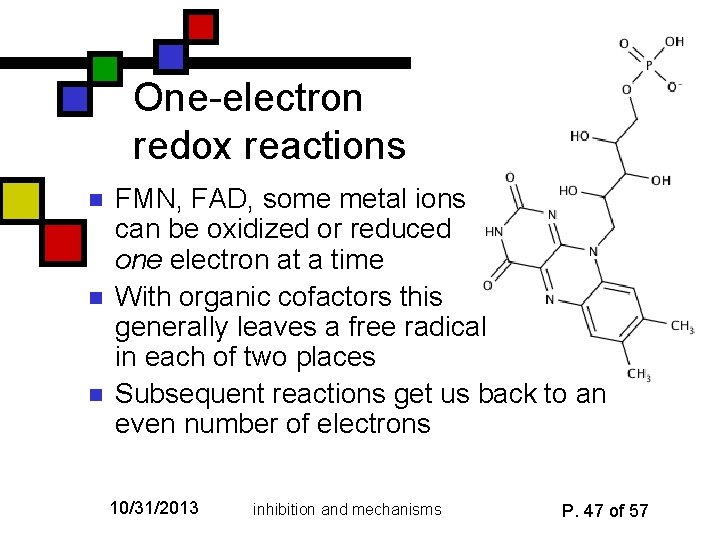
One-electron redox reactions n n n FMN, FAD, some metal ions can be oxidized or reduced one electron at a time With organic cofactors this generally leaves a free radical in each of two places Subsequent reactions get us back to an even number of electrons 10/31/2013 inhibition and mechanisms P. 47 of 57
Covalent catalysis n n Reactive side-chain can be a nucleophile or an electrophile, but nucleophile is more common n A—X + E X—E + A n X—E + B B—X + E Example: sucrose phosphorylase n n Net reaction: Sucrose + Pi Glucose 1 -P + fructose Fructose=A, Glucose=X, Phosphate=B 10/31/2013 inhibition and mechanisms P. 48 of 57
Example: hexokinase n n n Glucose + ATP Glucose-6 -P + ADP Risk: unproductive reaction with water Enzyme exists in open & closed forms Glucose induces conversion to closed form; water can’t do that Energy expended moving to closed form 10/31/2013 inhibition and mechanisms P. 49 of 57
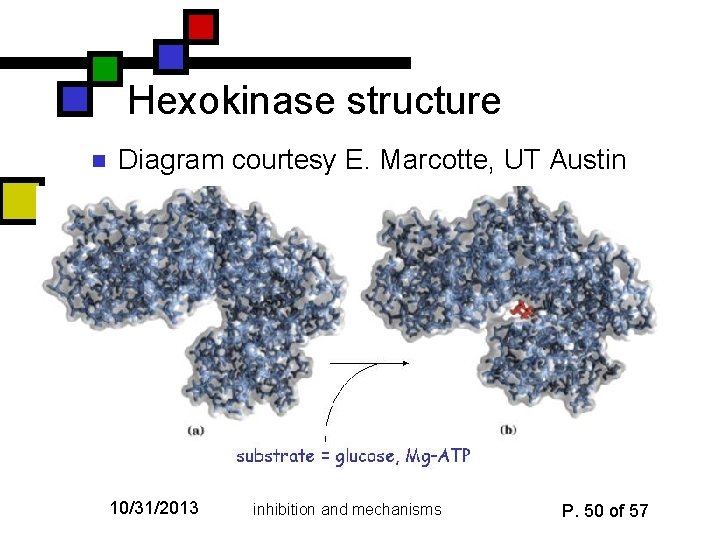
Hexokinase structure n Diagram courtesy E. Marcotte, UT Austin 10/31/2013 inhibition and mechanisms P. 50 of 57
Tight binding of ionic intermediates n n Quasi-stable ionic species strongly bound by ion-pair and H-bond interactions Similar to notion that transition states are the most tightly bound species, but these are more stable 10/31/2013 inhibition and mechanisms P. 51 of 57
Reactive sidechains in a. a. ’s AA Group Charge @p. H=7 Asp —COO-1 Glu —COO-1 His Imidazole ~0 Cys —CH 2 SH ~0 Tyr Phenol 0 Lys NH 3+ +1 Arg guanidinium +1 Ser —CH 2 OH 0 10/31/2013 Functions Cation binding, H+ transfer Same as above Proton transfer Covalent binding of acyl gps H-bonding to ligands Anion binding, H+ transfer Anion binding See cys inhibition and mechanisms P. 52 of 57
Generalizations about activesite amino acids n n n Typical enzyme has 2 -6 key catalytic residues His, asp, arg, glu, lys account for 64% Remember: n n p. Ka values in proteins sometimes different from those of isolated amino acids Frequency overall Frequency in catalysis 10/31/2013 inhibition and mechanisms P. 53 of 57
Rates often depend on p. H n n If an amino acid that is necessary to the mechanism changes protonation state at a particular p. H, then the reaction may be allowed or disallowed depending on p. H Two ionizable residues means there may be a narrow p. H optimum for catalysis 10/31/2013 inhibition and mechanisms P. 54 of 57
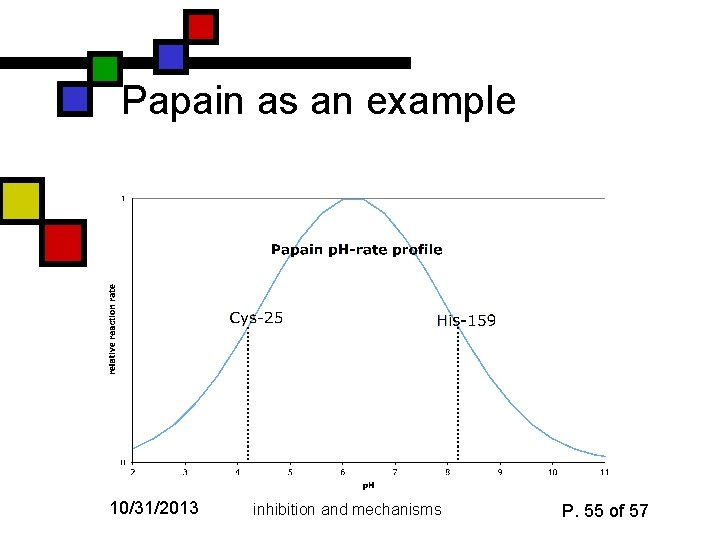
Papain as an example 10/31/2013 inhibition and mechanisms P. 55 of 57
i. Clicker quiz, question 1 Why would the nonproductive hexokinase reaction H 2 O + ATP ADP + Pi be considered nonproductive? n (a) Because it needlessly soaks up water n (b) Because the enzyme undergoes a wasteful conformational change n (c) Because the energy in the high-energy phosphate bond is unavailable for other purposes n (d) Because ADP is poisonous n (e) None of the above 10/31/2013 inhibition and mechanisms P. 56 of 57
i. Clicker Quiz question 2 Triosephosphate isomerase (TIM) interconverts dihydroxyacetone phosphate (DHAP) and Dglyceraldehyde 3 -phosphate. What would bind tightest in the TIM active site? n (a) DHAP (substrate) n (b) D-glyceraldehyde (product) n (c) 2 -phosphoglycolate (Transition-state analog) n (d) They would all bind equally well n (e) None of them would bind at all. 10/31/2013 inhibition and mechanisms P. 57 of 57
- Slides: 57