
Enzymes in the Food Industry Food Chemistry Lab
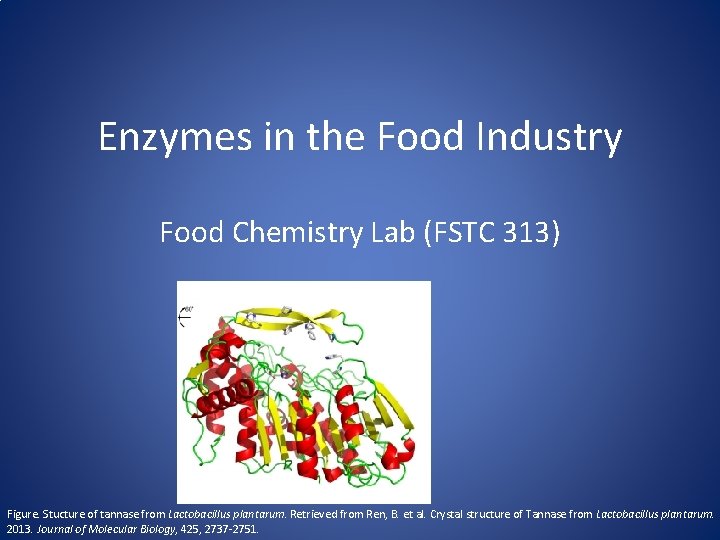
Enzymes in the Food Industry Food Chemistry Lab (FSTC 313) Figure. Stucture of tannase from Lactobacillus plantarum. Retrieved from Ren, B. et al. Crystal structure of Tannase from Lactobacillus plantarum. 2013. Journal of Molecular Biology, 425, 2737 -2751.
Outline • Enzyme Basics - Definitions - Factors to Consider • Enzymes in Food Processing • Enzymes and Food Quality • Expectations for Lab #5 (Today) and Protein Lab Reports
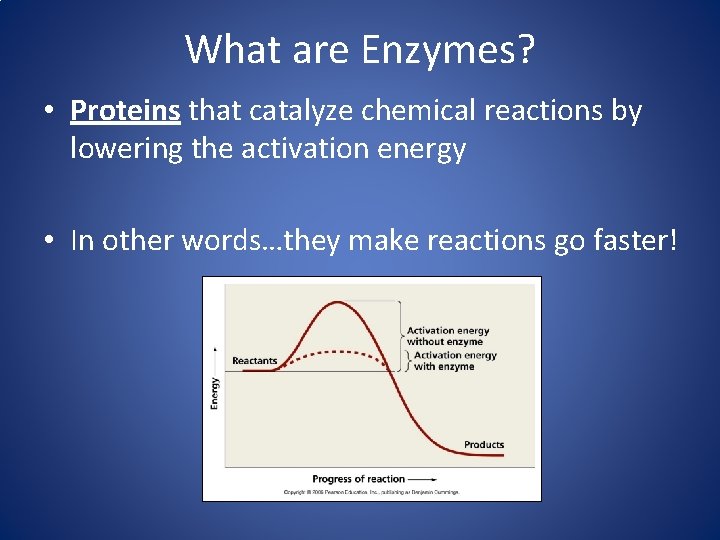
What are Enzymes? • Proteins that catalyze chemical reactions by lowering the activation energy • In other words…they make reactions go faster!
Factors to Consider with Enzymes • p. H • Temperature • Concentration Substrate and Enzyme • Specificity • Cofactors and Inhibitors
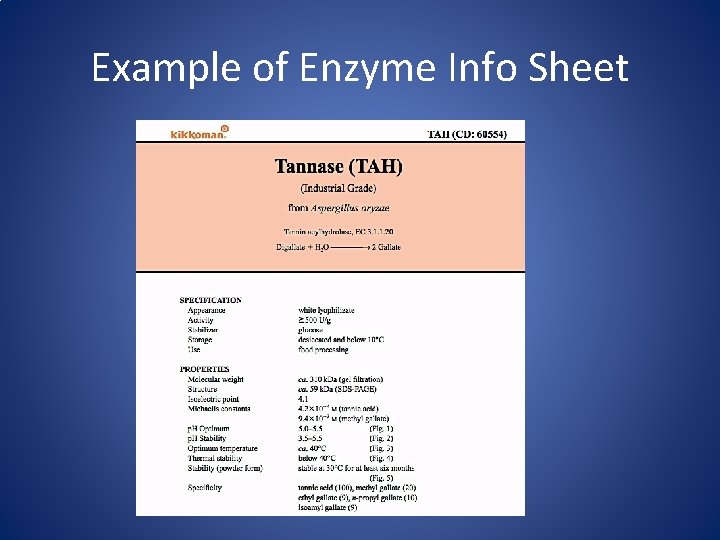
Example of Enzyme Info Sheet
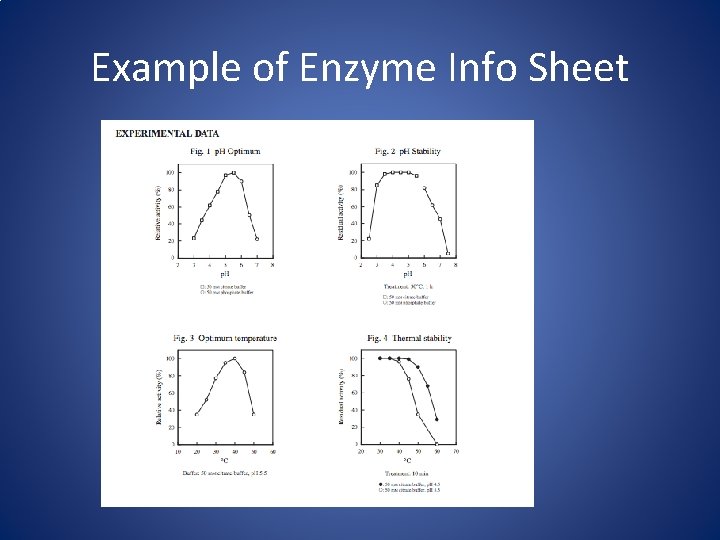
Example of Enzyme Info Sheet
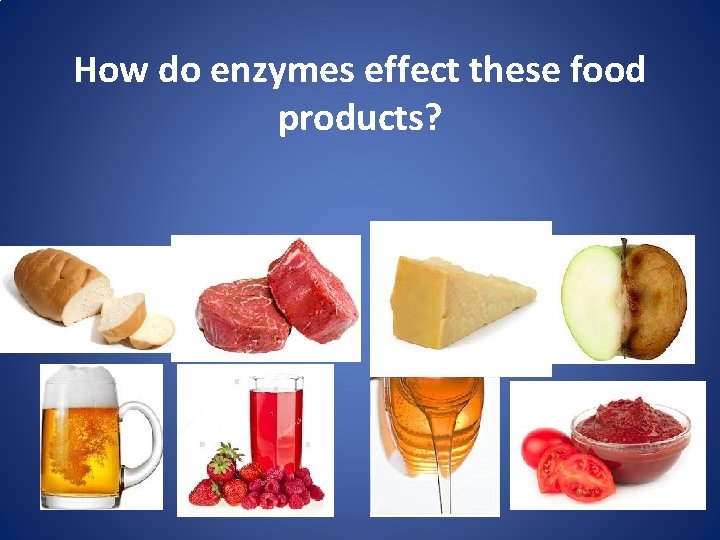
How do enzymes effect these food products?
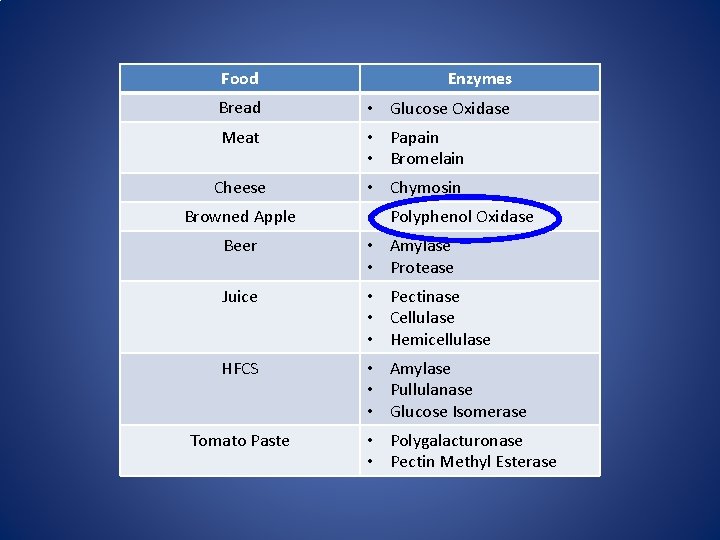
Food Enzymes Bread • Glucose Oxidase Meat • Papain • Bromelain Cheese • Chymosin Browned Apple • Polyphenol Oxidase Beer • Amylase • Protease Juice • Pectinase • Cellulase • Hemicellulase HFCS • Amylase • Pullulanase • Glucose Isomerase Tomato Paste • Polygalacturonase • Pectin Methyl Esterase
Enzymes in Food Processing • Enzymes are used to improve food quality (Meat, Juice) • Enzymes are used to speed up/control the production process (HFCS, Bread, Cheese) • Natural enzymes from the raw material are manipulated during processing (Beer, Tomato Paste) • Enzymes cause food quality issues (Citrus, Browned apples)
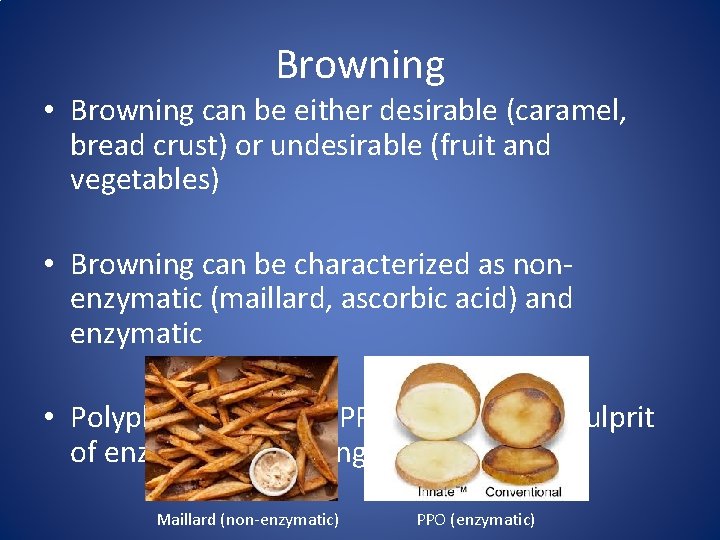
Browning • Browning can be either desirable (caramel, bread crust) or undesirable (fruit and vegetables) • Browning can be characterized as nonenzymatic (maillard, ascorbic acid) and enzymatic • Polyphenol oxidase (PPO) is the major culprit of enzymatic browning in foods Maillard (non-enzymatic) PPO (enzymatic)
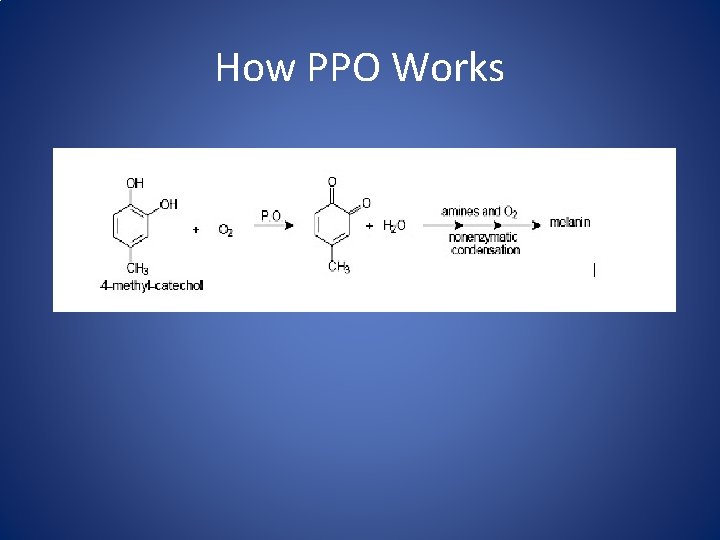
How PPO Works
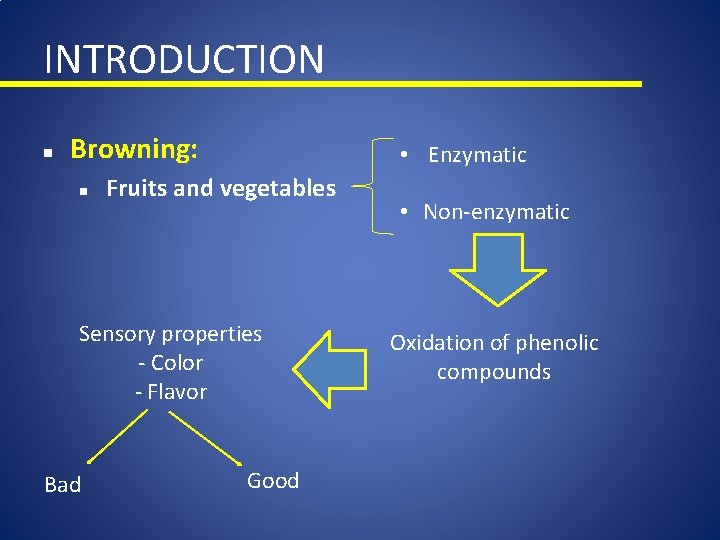
INTRODUCTION n Browning: n • Enzymatic Fruits and vegetables Sensory properties - Color - Flavor Bad Good • Non-enzymatic Oxidation of phenolic compounds
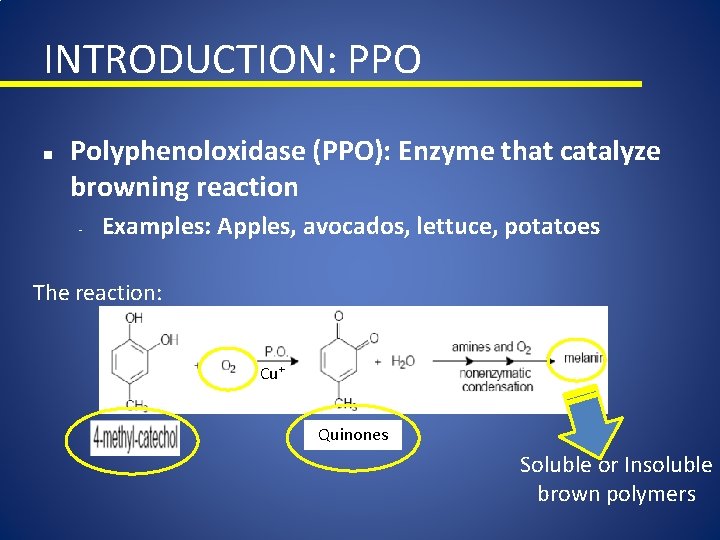
INTRODUCTION: PPO n Polyphenoloxidase (PPO): Enzyme that catalyze browning reaction - Examples: Apples, avocados, lettuce, potatoes The reaction: Cu+ Quinones Soluble or Insoluble brown polymers
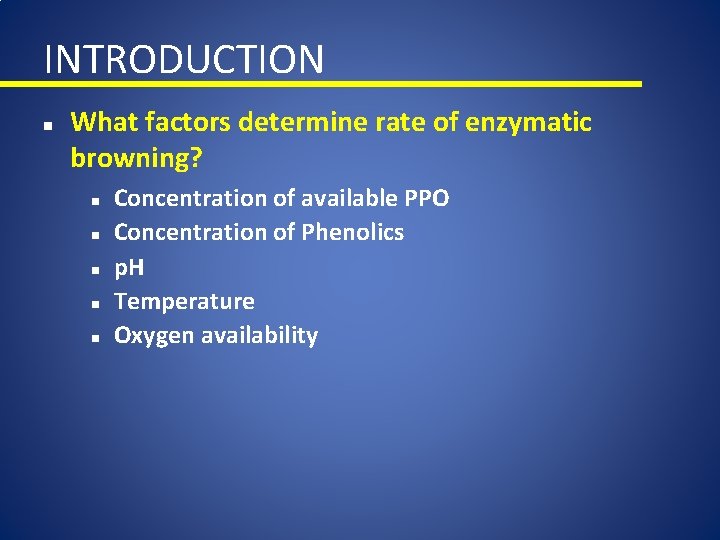
INTRODUCTION n What factors determine rate of enzymatic browning? n n n Concentration of available PPO Concentration of Phenolics p. H Temperature Oxygen availability
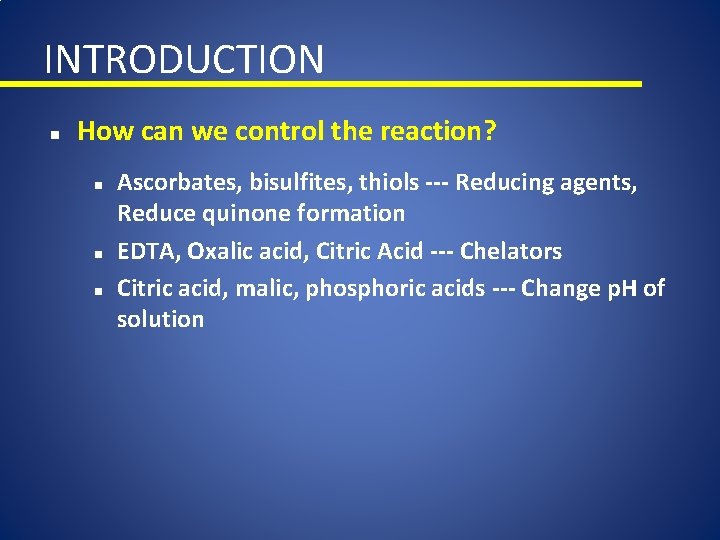
INTRODUCTION n How can we control the reaction? n n n Ascorbates, bisulfites, thiols --- Reducing agents, Reduce quinone formation EDTA, Oxalic acid, Citric Acid --- Chelators Citric acid, malic, phosphoric acids --- Change p. H of solution
Questions to get you thinking… • Are there any foods where browning by PPO is desirable? • Are all PPOs the same? For example, if I were to isolate PPO from 2 different vegetables would I get the same protein? • Knowing what we know about enzymes and proteins, how can we inhibit their activity? • Is it possible to stop this reaction without inhibiting the enzyme?
OBJECTIVES n n To measure enzymatic activity and determine concentration dependence of an enzymecatayzed reaction rate on substrate concentration Evaluate influence of inhibitors
MATERIAL n n n Potato filtrate Substrate: 20 m. M catechol dissolved in buffer 5 m. M ascorbic acid dissolved in buffer
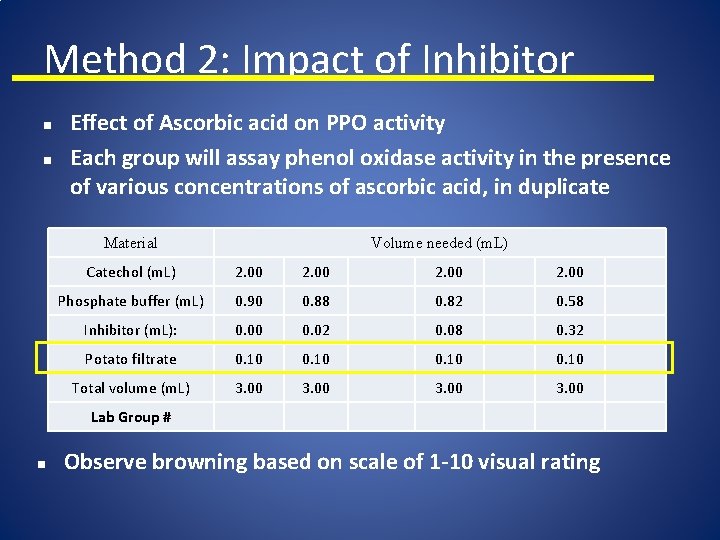
Method 2: Impact of Inhibitor n n Effect of Ascorbic acid on PPO activity Each group will assay phenol oxidase activity in the presence of various concentrations of ascorbic acid, in duplicate Material Volume needed (m. L) Catechol (m. L) 2. 00 Phosphate buffer (m. L) 0. 90 0. 88 0. 82 0. 58 Inhibitor (m. L): 0. 00 0. 02 0. 08 0. 32 Potato filtrate 0. 10 Total volume (m. L) 3. 00 Lab Group # n Observe browning based on scale of 1 -10 visual rating
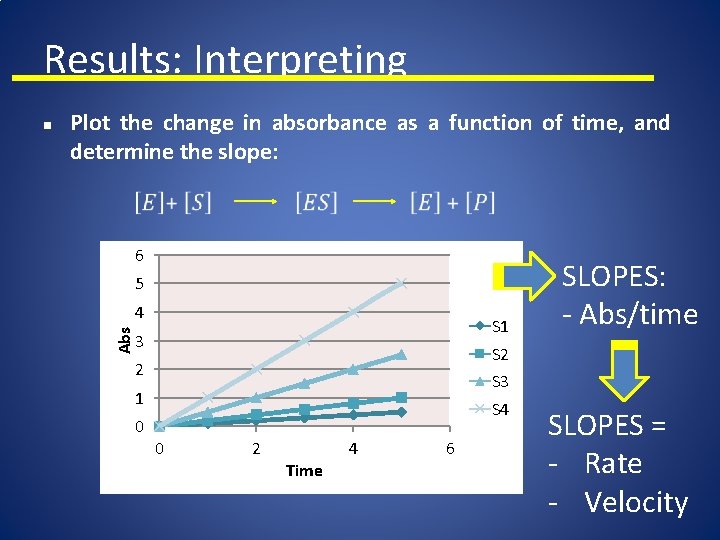
Results: Interpreting Plot the change in absorbance as a function of time, and determine the slope: 6 5 4 Abs n S 1 3 S 2 2 S 3 1 0 SLOPES: - Abs/time S 4 0 2 Time 4 6 SLOPES = - Rate - Velocity
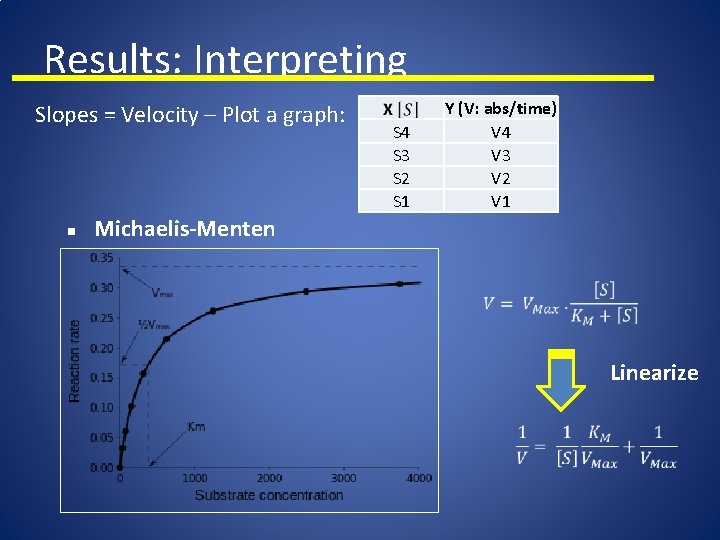
Results: Interpreting Slopes = Velocity – Plot a graph: n Y (V: abs/time) V 4 V 3 V 2 V 1 S 4 S 3 S 2 S 1 Michaelis-Menten Linearize
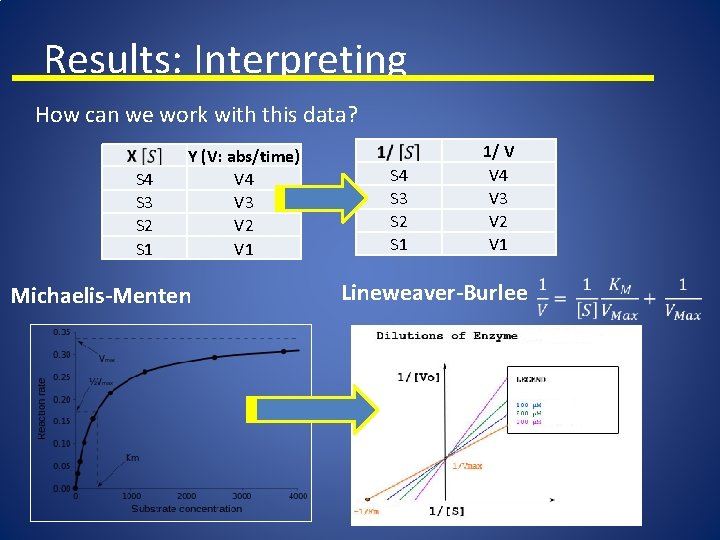
Results: Interpreting How can we work with this data? S 4 S 3 S 2 S 1 Y (V: abs/time) V 4 V 3 V 2 V 1 Michaelis-Menten S 4 S 3 S 2 S 1 1/ V V 4 V 3 V 2 V 1 Lineweaver-Burlee
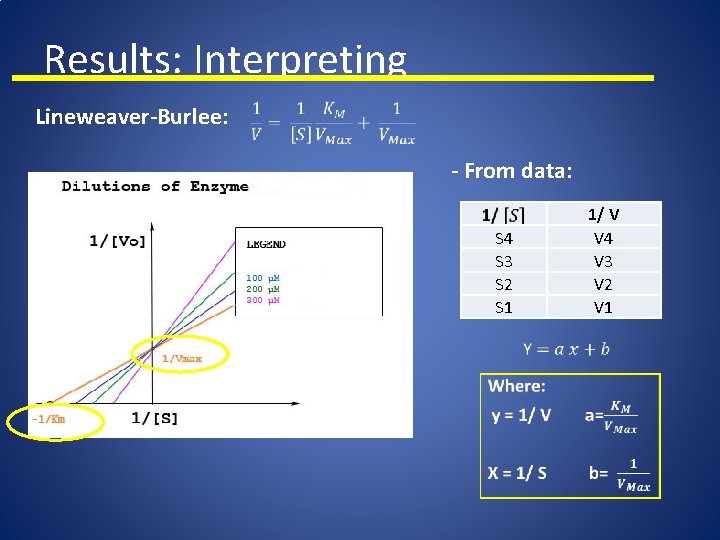
Results: Interpreting Lineweaver-Burlee: - From data: 1/ V V 4 V 3 V 2 V 1 S 4 S 3 S 2 S 1
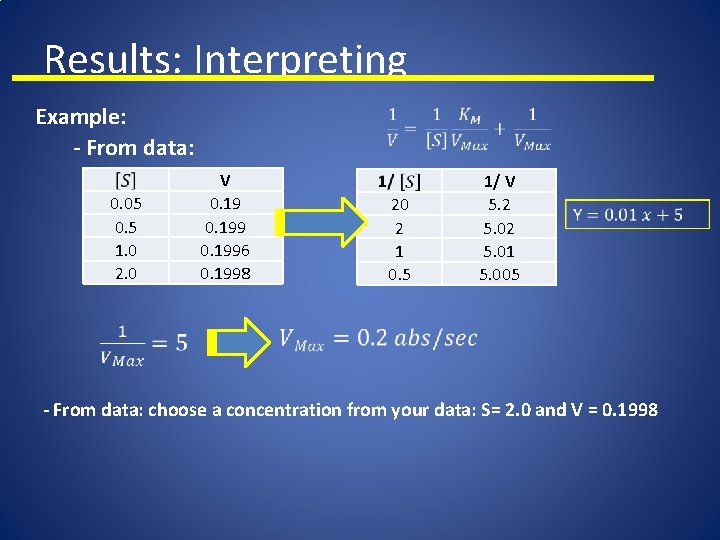
Results: Interpreting Example: - From data: 0. 05 0. 5 1. 0 2. 0 V 0. 1996 0. 1998 20 2 1 0. 5 1/ V 5. 2 5. 01 5. 005 - From data: choose a concentration from your data: S= 2. 0 and V = 0. 1998
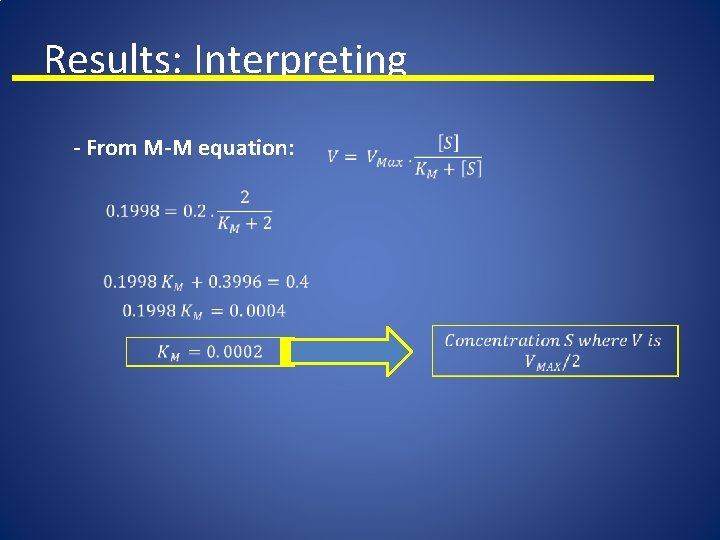
Results: Interpreting - From M-M equation:
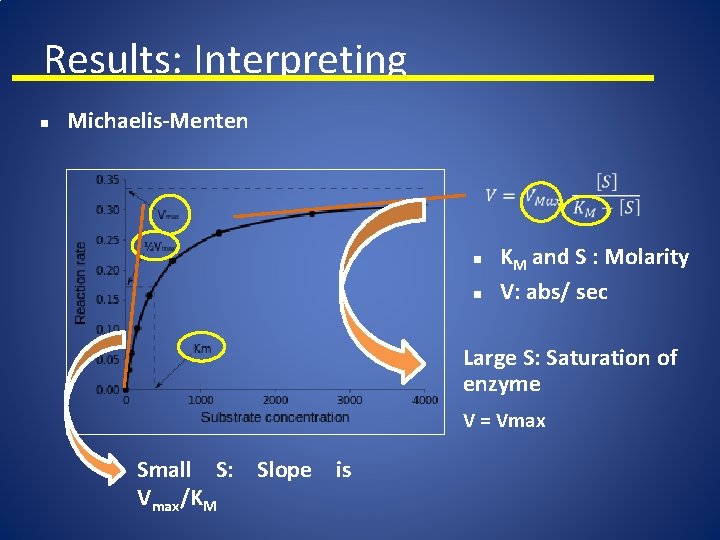
Results: Interpreting n Michaelis-Menten n n KM and S : Molarity V: abs/ sec Large S: Saturation of enzyme V = Vmax Small S: Slope is Vmax/KM
Visual observations: • “Experiment” with the browning reactions and record your observations. • Choose factors that you believe will influence the – rate of the reaction – severity of browning – reversibility of the browning – timing of the reaction – timing of reversibility of color
Visual observations: – Expect to conduct MANY different observational trials, using about 10 m. L of solution for each. – Take your time and record all observations. – You are on your own, so the more data you collect the better the discussion you can write. – THINK about what you are doing before you do it. Create a hypothesis and experimentally test it.
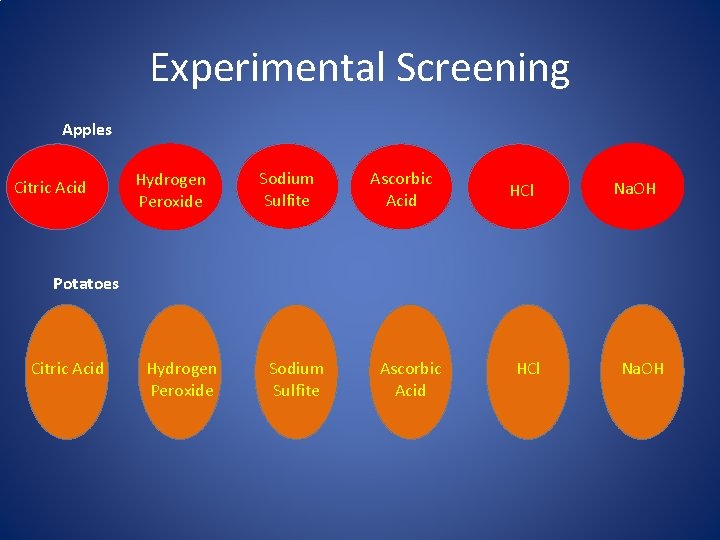
Experimental Screening Apples Citric Acid Hydrogen Peroxide Sodium Sulfite Ascorbic Acid HCl Na. OH Potatoes Citric Acid Hydrogen Peroxide Sodium Sulfite Ascorbic Acid HCl Na. OH
Practical Trails • Place Catechol solution on potato and apples, let sit for 10 minutes • Take the solutions that helped inhibit browning in previous trai. Is and treat potatoes and apples with 0. 5 m. L • Record observations
Practical Trails • Compare apples/potatoes that were sitting out to apples/potatoes that were in an ice water bath • Cut the apples and potatoes into smaller pieces and observe the effect • Observe if leaving the potatoes and apples out for longer periods of times prevents inhibition of browning
Materials • Citric Acid – Chelator, organic/weak acid • HCl – strong acid • Na. OH – strong base • Hydrogen peroxide – pro-oxidant • Sodium sulfite – reducing agent • Ascorbic acid – reducing agent • Catechol – polyphenol • Potato/apples – source of PPO
Tool Box: • • • A beaker and stir-bar for mixing. Buffers to control p. H Hydrochloric acid solution to modify p. H Citric acid to modify p. H and act as a metal chelator Phosphates to act as metal chelators Hydrogen peroxide as an oxygen source A hot plate to provide heat Ice to provide cold Ascorbic acid and/or sodium sulfite (inhibitor) Bentonite clay, as a protein binding agent Sodium Borate (Borax) (inhibitor)
- Slides: 33