
Enzymes IBBiology Topics 2 5 and 8 1

Enzymes IB-Biology Topics 2. 5 and 8. 1 S
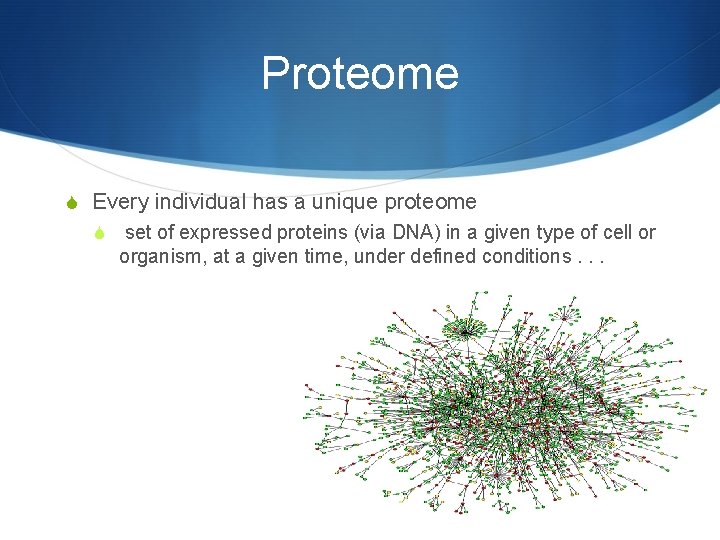
Proteome S Every individual has a unique proteome S set of expressed proteins (via DNA) in a given type of cell or organism, at a given time, under defined conditions. . .
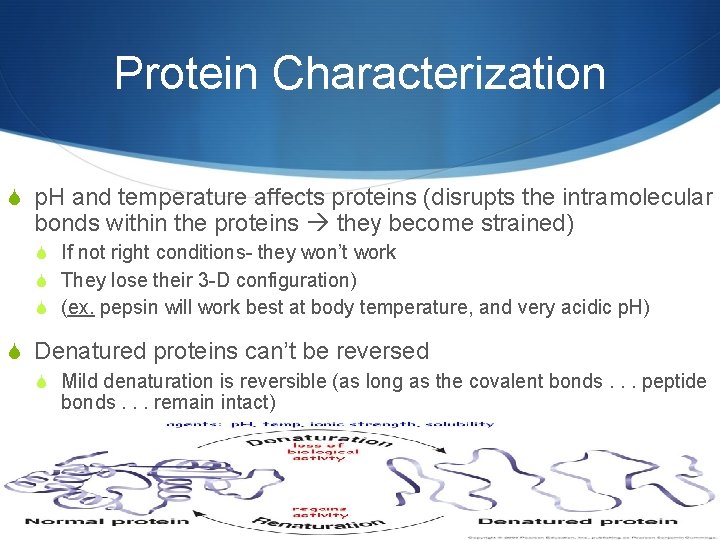
Protein Characterization S p. H and temperature affects proteins (disrupts the intramolecular bonds within the proteins they become strained) S If not right conditions- they won’t work S They lose their 3 -D configuration) S (ex. pepsin will work best at body temperature, and very acidic p. H) S Denatured proteins can’t be reversed S Mild denaturation is reversible (as long as the covalent bonds. . . peptide bonds. . . remain intact)
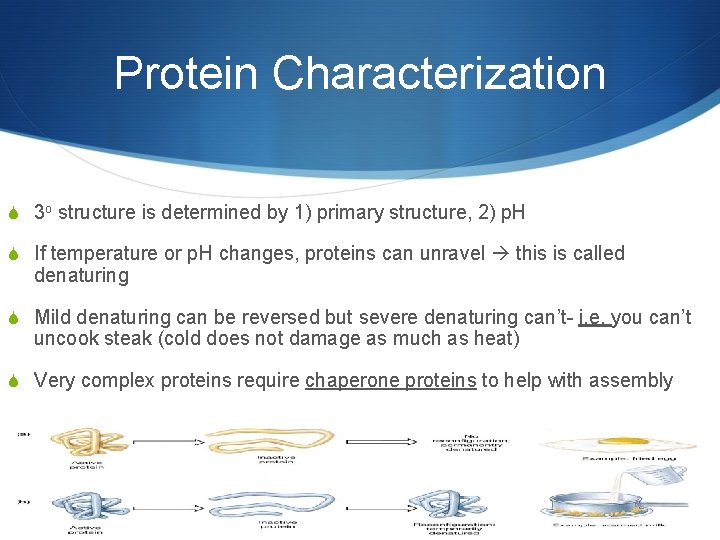
Protein Characterization S 3 o structure is determined by 1) primary structure, 2) p. H S If temperature or p. H changes, proteins can unravel this is called denaturing S Mild denaturing can be reversed but severe denaturing can’t- i. e. you can’t uncook steak (cold does not damage as much as heat) S Very complex proteins require chaperone proteins to help with assembly
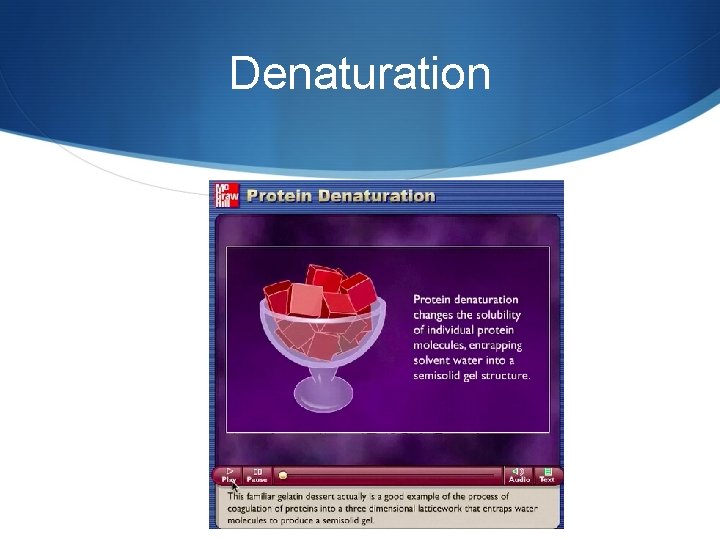
Denaturation
Enzymes “We are proteins too. ” S
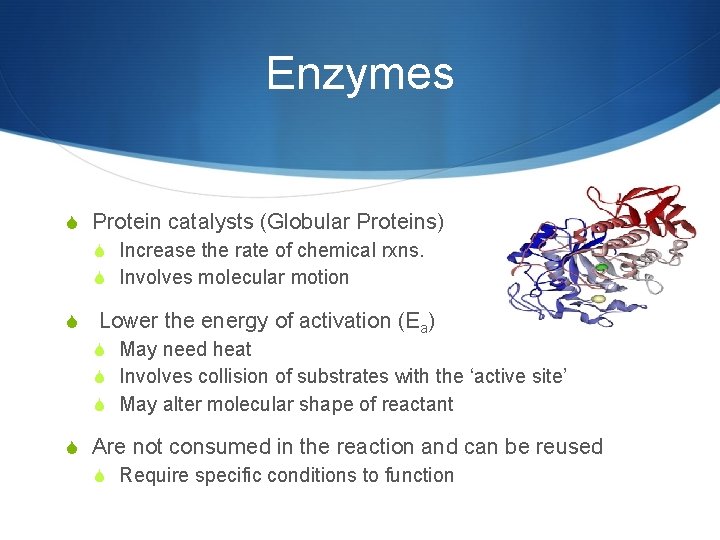
Enzymes S Protein catalysts (Globular Proteins) S Increase the rate of chemical rxns. S Involves molecular motion S Lower the energy of activation (Ea) S May need heat S Involves collision of substrates with the ‘active site’ S May alter molecular shape of reactant S Are not consumed in the reaction and can be reused S Require specific conditions to function
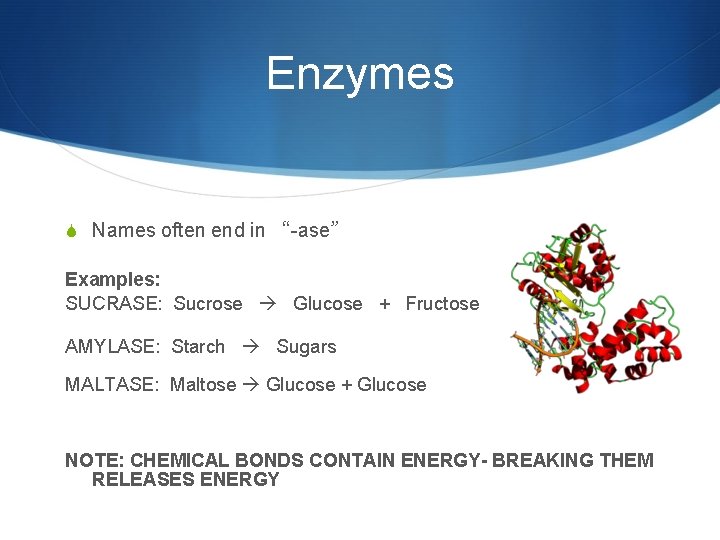
Enzymes S Names often end in “-ase” Examples: SUCRASE: Sucrose Glucose + Fructose AMYLASE: Starch Sugars MALTASE: Maltose Glucose + Glucose NOTE: CHEMICAL BONDS CONTAIN ENERGY- BREAKING THEM RELEASES ENERGY
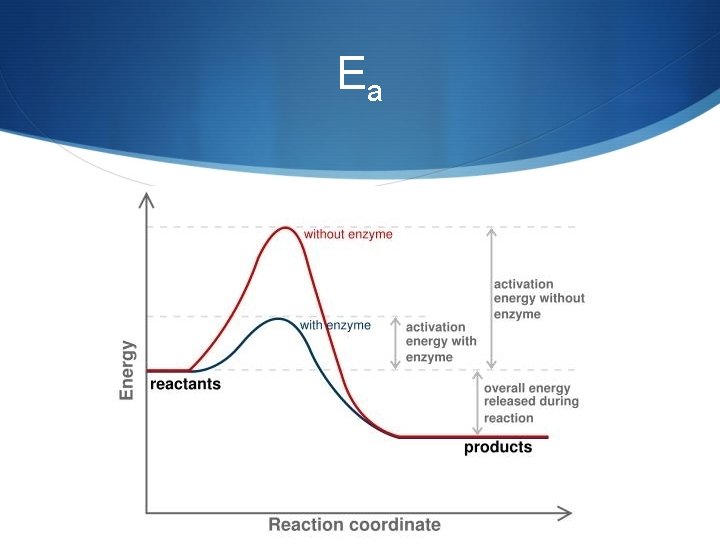
Ea
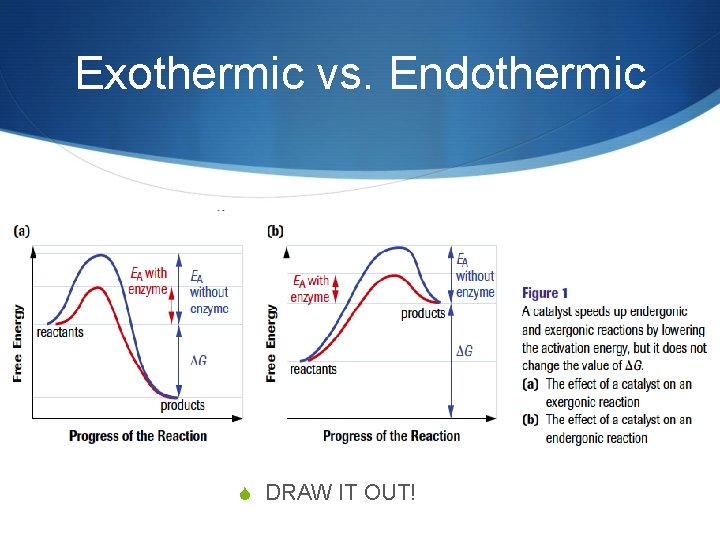
Exothermic vs. Endothermic S DRAW IT OUT!
Key Terms S Substrate – the molecule that needs the enzyme to react. S Active site – the site on the enzyme where the substrate bonds. When an enzyme bonds to its substrate, it changes shape to more closely fit with the substrate. This is known as the induced fit model of enzyme activity. The result is something called the enzyme – substrate complex. S Cofactor – an inorganic compound that assists an enzyme (ie. zinc). S Coenzyme – an organic compound that assists an enzyme
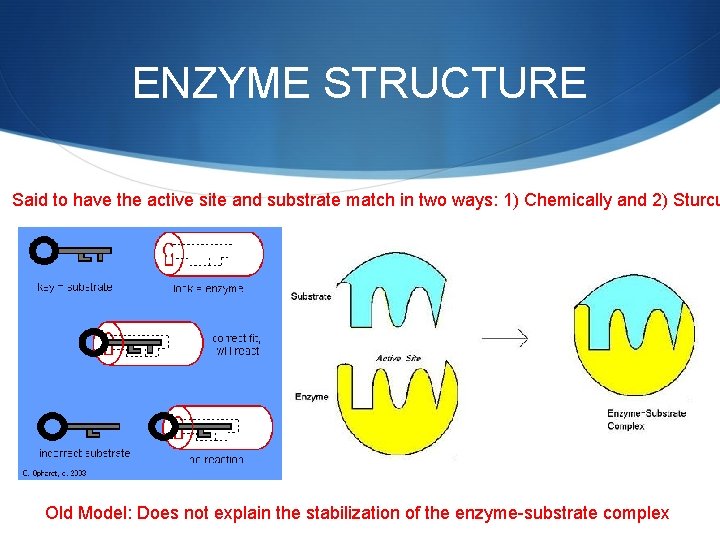
ENZYME STRUCTURE Said to have the active site and substrate match in two ways: 1) Chemically and 2) Sturcu Old Model: Does not explain the stabilization of the enzyme-substrate complex

ENZYME STRUCTURE
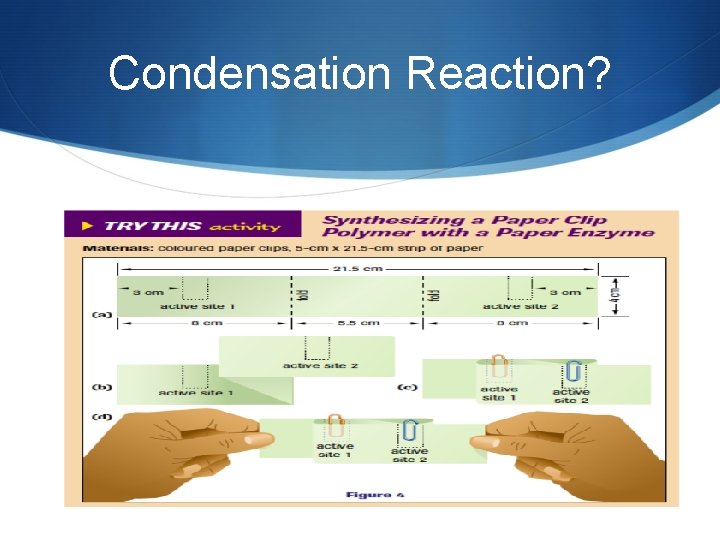
Condensation Reaction?
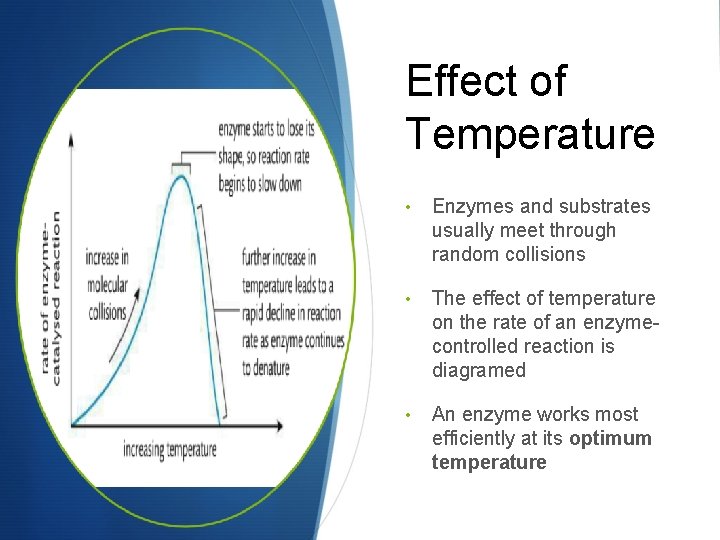
Effect of Temperature • Enzymes and substrates usually meet through random collisions • The effect of temperature on the rate of an enzymecontrolled reaction is diagramed • An enzyme works most efficiently at its optimum temperature
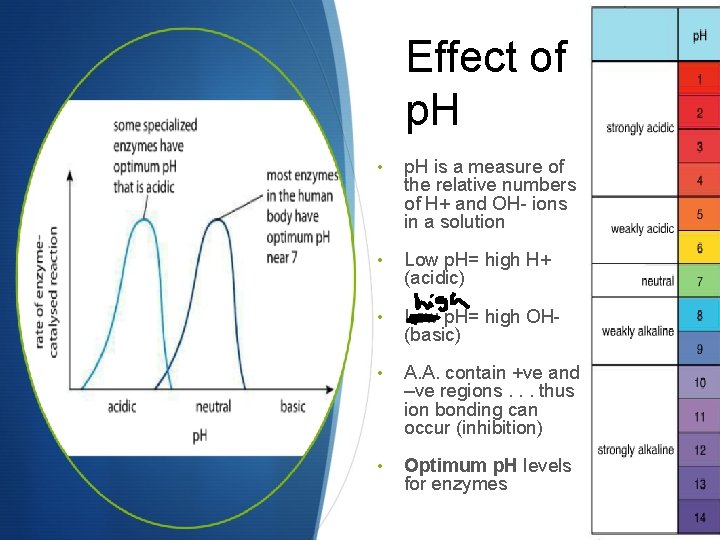
Effect of p. H • p. H is a measure of the relative numbers of H+ and OH- ions in a solution • Low p. H= high H+ (acidic) • Low p. H= high OH(basic) • A. A. contain +ve and –ve regions. . . thus ion bonding can occur (inhibition) • Optimum p. H levels for enzymes
![Effect of Substrate Concentration • If there is a set [enzymes] present in a](http://slidetodoc.com/presentation_image_h2/274825fa93accb1a954252f1ece00f9b/image-17.jpg "Effect of Substrate Concentration • If there is a set [enzymes] present in a")
Effect of Substrate Concentration • If there is a set [enzymes] present in a reaction mixture, and the [substrate] increases, the rate of production of the products will increase because of the greater chance of collisions between substrate and enzyme molecules • There is a limit to the increase in reaction rate if the [substrate] increases too much, it will exceed the maximum rate at which the enzyme can work (all active site occupied)
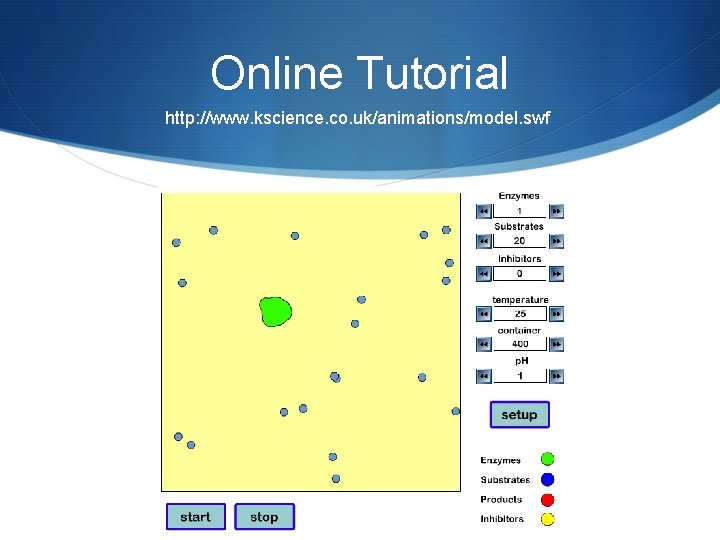
Online Tutorial http: //www. kscience. co. uk/animations/model. swf
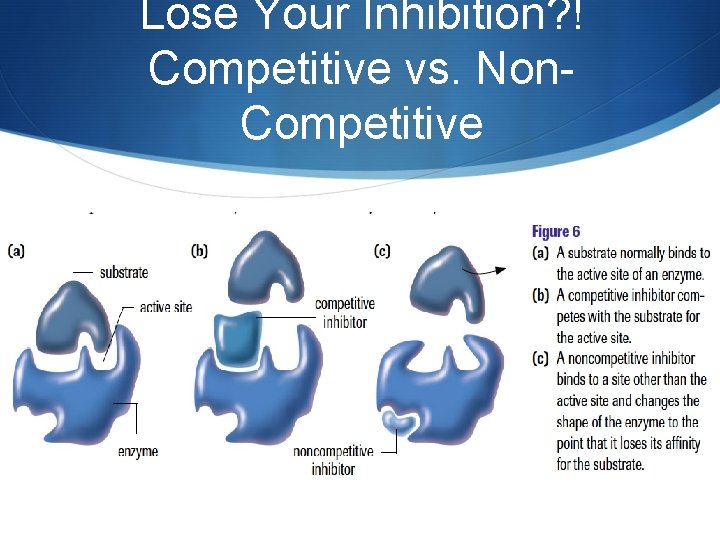
Lose Your Inhibition? ! Competitive vs. Non. Competitive
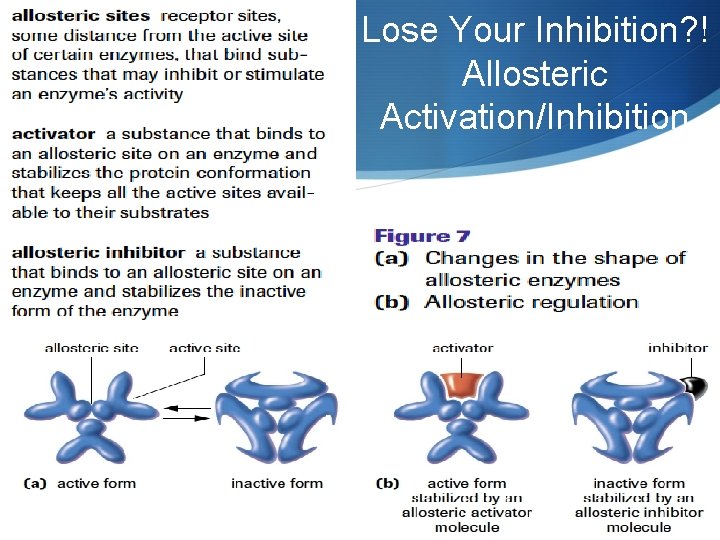
Lose Your Inhibition? ! Allosteric Activation/Inhibition
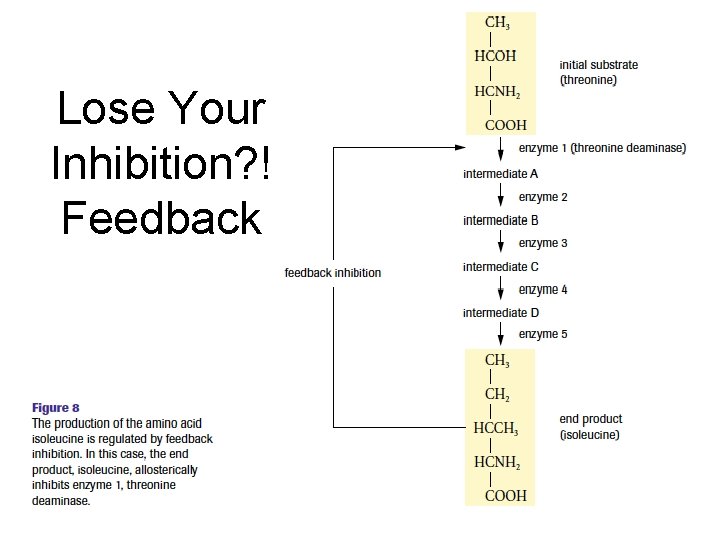
Lose Your Inhibition? ! Feedback
Enzymes in Industry S Enzymes work as catalysts in biological reaction but they are not used up so they can work over and over again S People have used enzymes from microorganisms for thousands of years in baking, cheese production and brewing S Additionally, enzymes from fungi are used to produce biological detergents and in the textile industry to smooth fabrics
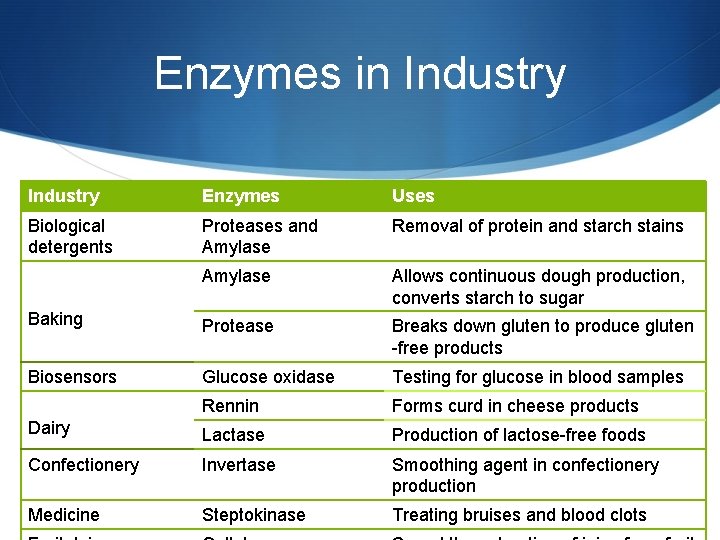
Enzymes in Industry Enzymes Uses Biological detergents Proteases and Amylase Removal of protein and starch stains Amylase Allows continuous dough production, converts starch to sugar Baking Protease Breaks down gluten to produce gluten -free products Biosensors Glucose oxidase Testing for glucose in blood samples Rennin Forms curd in cheese products Dairy Lactase Production of lactose-free foods Confectionery Invertase Smoothing agent in confectionery production Medicine Steptokinase Treating bruises and blood clots
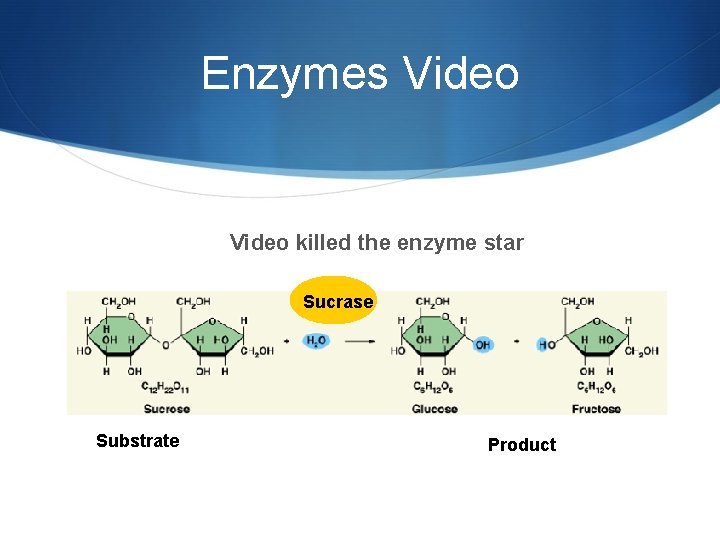
Enzymes Video killed the enzyme star Sucrase Substrate Product
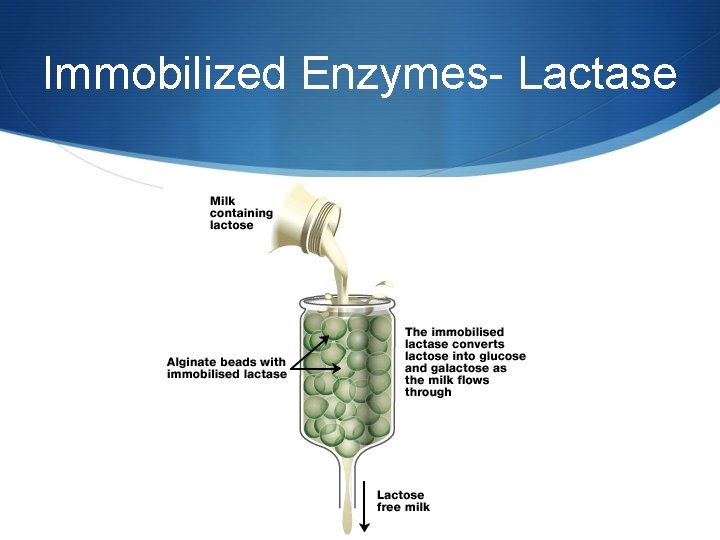
Immobilized Enzymes- Lactase
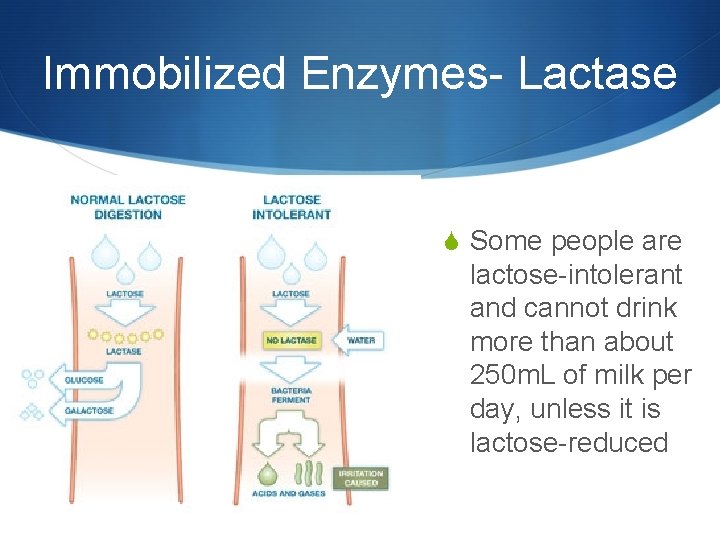
Immobilized Enzymes- Lactase S Some people are lactose-intolerant and cannot drink more than about 250 m. L of milk per day, unless it is lactose-reduced
Immobilized Enzymes- Lactase S Immobilized enzymes are used in the production of lactose free milk for people who are lactose intolerant S Lactose= glucose + galactose (naturally occurring in milk) and the enzyme lactase hydrolyzes this reaction S Lactase is obtained from Kluveromyces lactis (type of yeast that grows naturally in milk) S Galactose and glucose are sweeter than lactose (so less sugar needs to be added to sweet foods) S Lactose tends to crystallize during the production of ice cream, giving its gritty structure S Since glucose and galactose are more soluble than lactose, they remain dissolved, giving a smoother texture
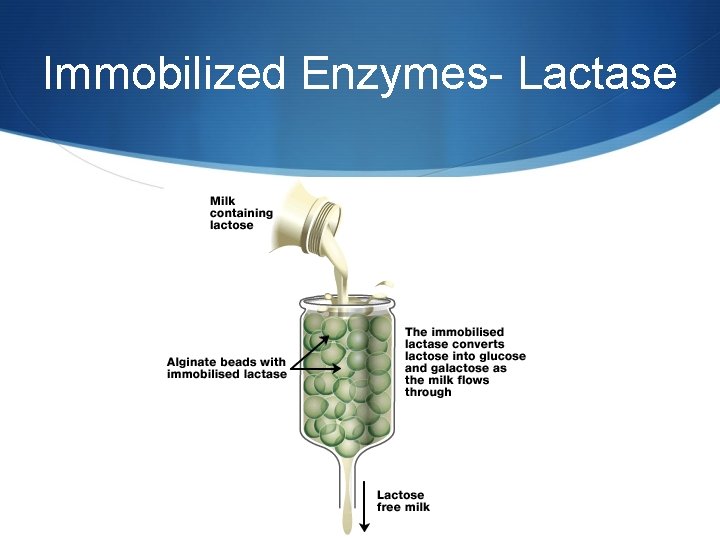
Immobilized Enzymes- Lactase
Immobilized Enzymes S The enzymes used in industry are usually immobilized S This process is the attachment of the enzymes to another material or into aggregations, so that movement of the enzyme is restricted S There are several advantages: S Enzyme can easily be separated from the products of the reaction (preventing contamination) S After being retrieved from reaction mixture enzymes can be recycled S Increases stability of the enzymes to changes in temperature/p. H (less replacement- they are expensive)
- Slides: 29