
Enzymes are Proteins that act as Biological Catalyst
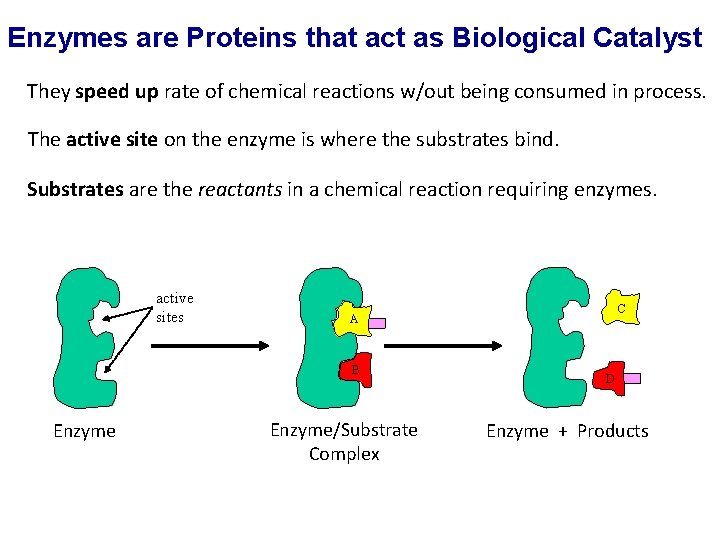
Enzymes are Proteins that act as Biological Catalyst They speed up rate of chemical reactions w/out being consumed in process. The active site on the enzyme is where the substrates bind. Substrates are the reactants in a chemical reaction requiring enzymes. active sites B Enzyme C A Enzyme/Substrate Complex D Enzyme + Products
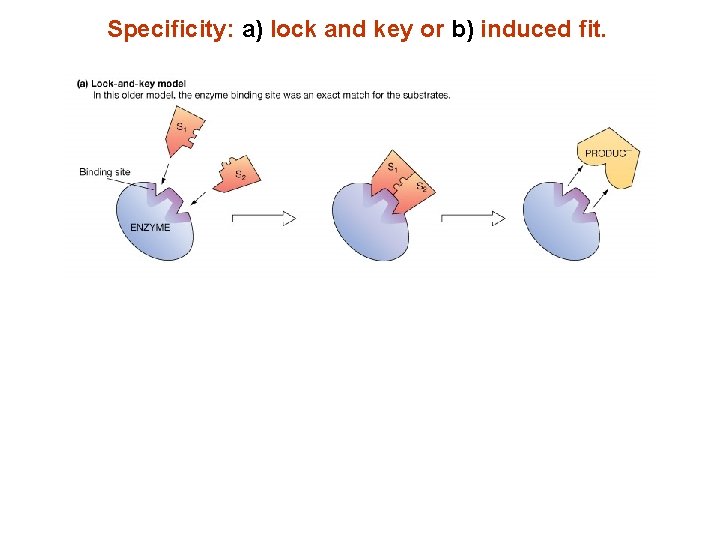
Specificity: a) lock and key or b) induced fit.
Naming of Enzymes Most enzymes end with ase and typically their name indicates their function or the substrates they bind. Some important examples: kinase - adds phosphates to molecules; phosphotase - removes phosphates from molecules; dehydrogenase - removes Hydrogens; hydrolase - adds H 2 O; synthase - dehydration synthesis reactions; carbonic anhydrase - removes H 2 O from carbonic acid; amylase - digests starch; lipase - digests lipids; protease - digests proteins.
Enzyme Specificity - ability of enzyme to catalyze only certain reactions. Some are very specific, such as glucokinase. It catalyzes this reaction: Glucose + Pi glucokinase Glucose 6 -P. • Other enzymes have broader specificities, e. g. peptidases break all peptide bonds. The type and amount of enzymes in the body can vary. e. g. , alcohol dehydrogenase removes H’s from ethanol (‘alcohol’) thereby reducing its toxic effects. Q: Is everyone’s ability to “handle” alcohol the same?

Enzyme Activation Some enzymes exists in an inactive state, need to be activated. 1) Proteolytic Activation: e. g. Pepsinogen + HCl (inactive) (longer) Pepsin (active) (shorter) Other Examples of Proteolytic Activation: Fibrinogen - > becomes… Thrombinogen - > becomes… Angiotensinogen - > becomes …
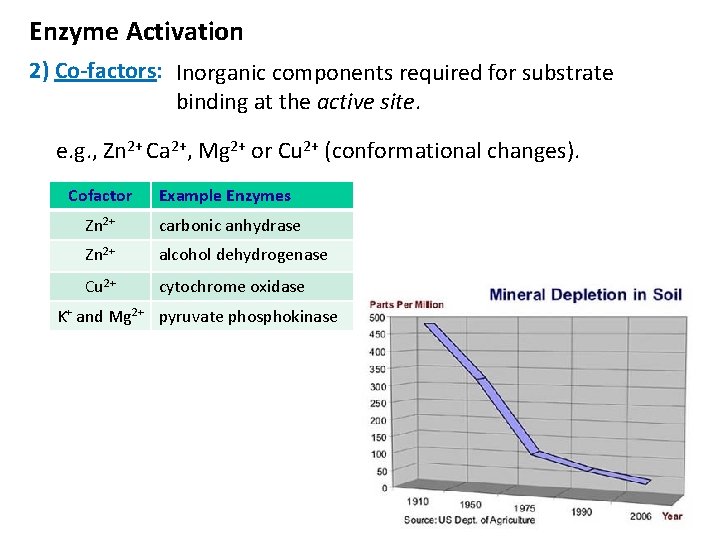
Enzyme Activation 2) Co-factors: Inorganic components required for substrate binding at the active site. e. g. , Zn 2+ Ca 2+, Mg 2+ or Cu 2+ (conformational changes). Cofactor Example Enzymes Zn 2+ carbonic anhydrase Zn 2+ alcohol dehydrogenase Cu 2+ cytochrome oxidase K+ and Mg 2+ pyruvate phosphokinase

3) Co-enzymes: Small organic molecules to accept and transfer electrons (e-s) from different enzymatic reactions. Bind loosely to an enzyme at active site to help catalyze reactions. Usually vitamins, vitamin derivatives, or from nucleotides. Apoenzyme - an inactive enzyme that requires cofactor/coenzyme. Holoenzyme - a complete and catalytically active enzyme because it has its cofactor/coenzyme. e. g. , Co-enzyme NAD+ shuttles e-s in glycolysis
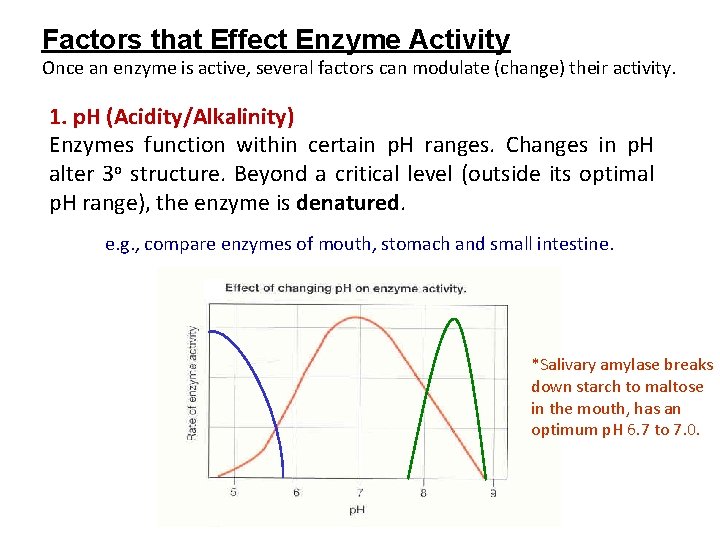
Factors that Effect Enzyme Activity Once an enzyme is active, several factors can modulate (change) their activity. 1. p. H (Acidity/Alkalinity) Enzymes function within certain p. H ranges. Changes in p. H alter 3 o structure. Beyond a critical level (outside its optimal p. H range), the enzyme is denatured. e. g. , compare enzymes of mouth, stomach and small intestine. *Salivary amylase breaks down starch to maltose in the mouth, has an optimum p. H 6. 7 to 7. 0.
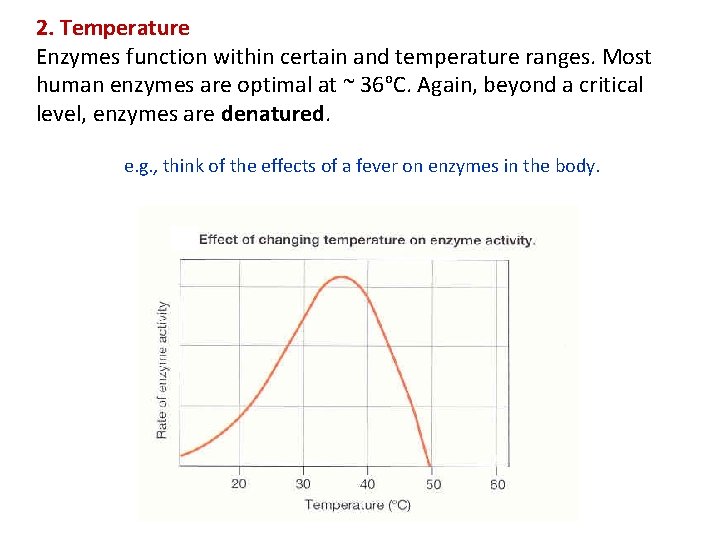
2. Temperature Enzymes function within certain and temperature ranges. Most human enzymes are optimal at ~ 36 o. C. Again, beyond a critical level, enzymes are denatured. e. g. , think of the effects of a fever on enzymes in the body.
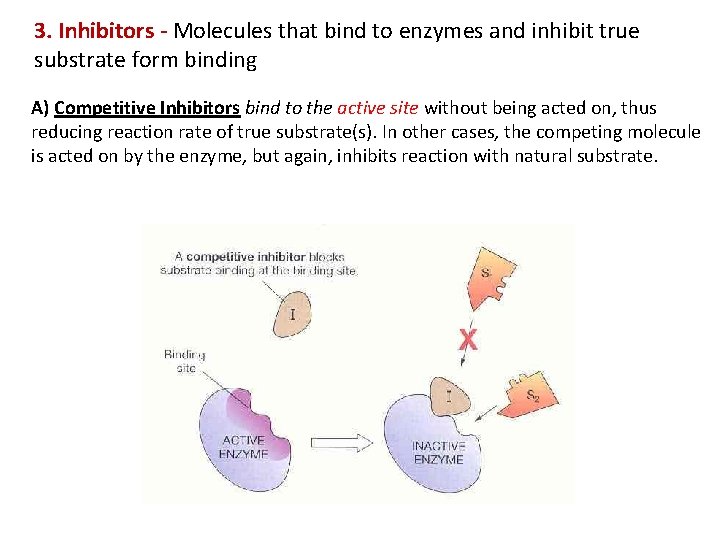
3. Inhibitors - Molecules that bind to enzymes and inhibit true substrate form binding A) Competitive Inhibitors bind to the active site without being acted on, thus reducing reaction rate of true substrate(s). In other cases, the competing molecule is acted on by the enzyme, but again, inhibits reaction with natural substrate.
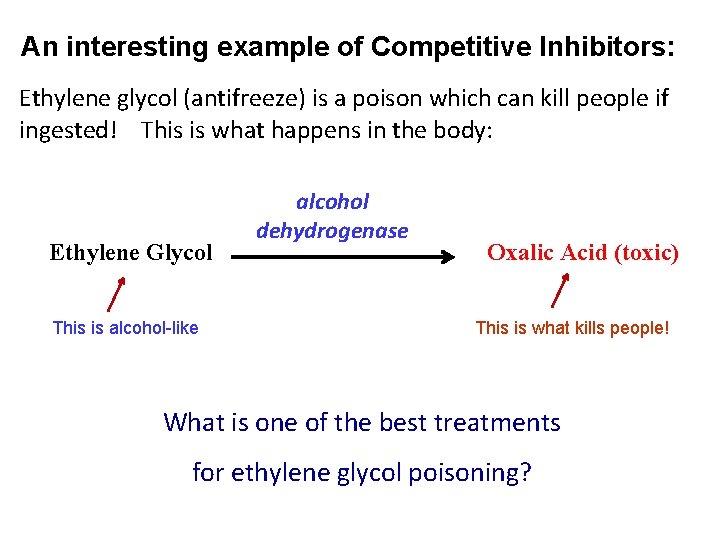
An interesting example of Competitive Inhibitors: Ethylene glycol (antifreeze) is a poison which can kill people if ingested! This is what happens in the body: Ethylene Glycol This is alcohol-like alcohol dehydrogenase Oxalic Acid (toxic) This is what kills people! What is one of the best treatments for ethylene glycol poisoning?
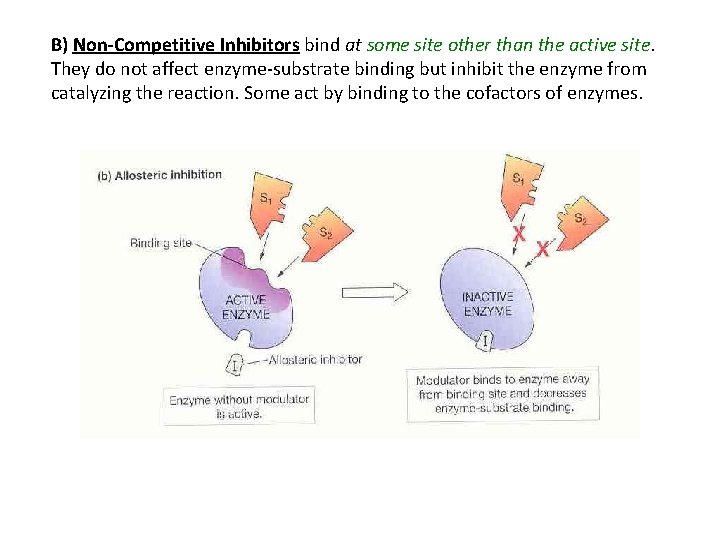
B) Non-Competitive Inhibitors bind at some site other than the active site. They do not affect enzyme-substrate binding but inhibit the enzyme from catalyzing the reaction. Some act by binding to the cofactors of enzymes.
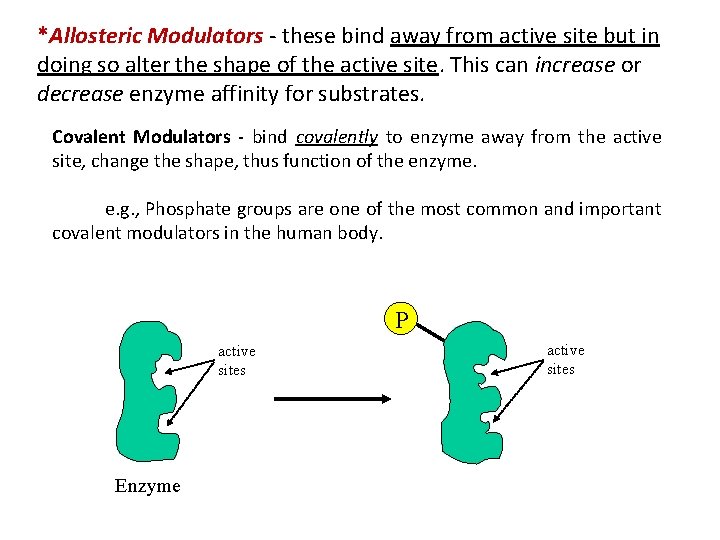
*Allosteric Modulators - these bind away from active site but in doing so alter the shape of the active site. This can increase or decrease enzyme affinity for substrates. Covalent Modulators - bind covalently to enzyme away from the active site, change the shape, thus function of the enzyme. e. g. , Phosphate groups are one of the most common and important covalent modulators in the human body. P active sites Enzyme active sites
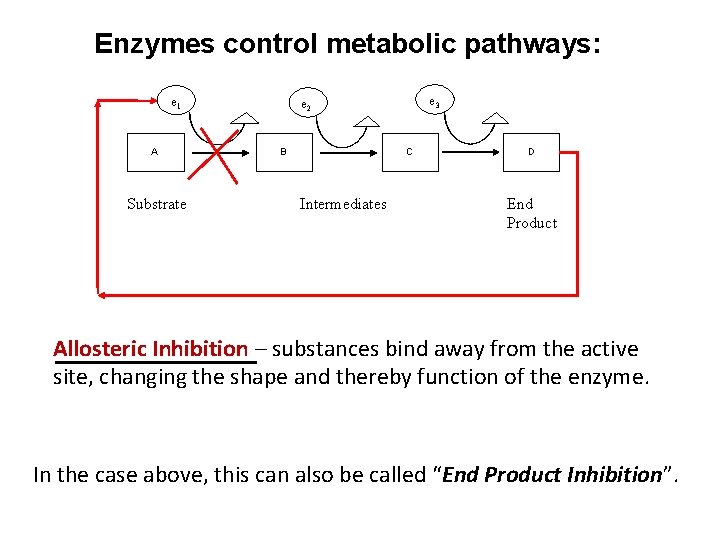
Enzymes control metabolic pathways: e 1 A Substrate e 3 e 2 B C Intermediates D End Product Allosteric Inhibition – substances bind away from the active site, changing the shape and thereby function of the enzyme. In the case above, this can also be called “End Product Inhibition”.
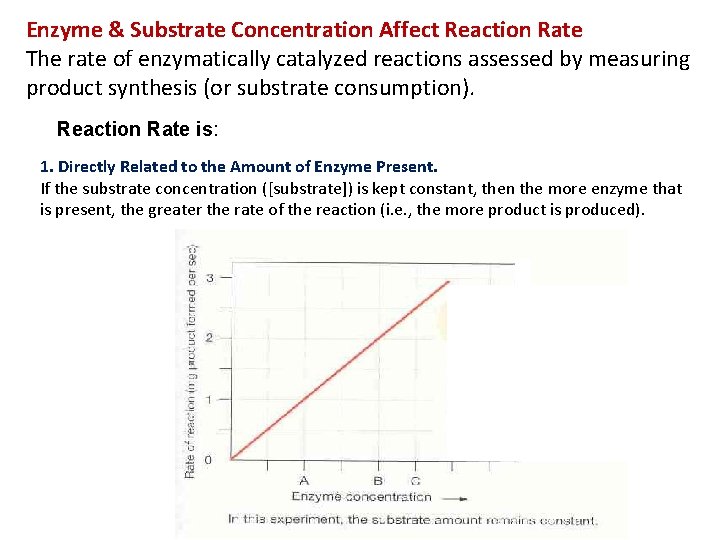
Enzyme & Substrate Concentration Affect Reaction Rate The rate of enzymatically catalyzed reactions assessed by measuring product synthesis (or substrate consumption). Reaction Rate is: 1. Directly Related to the Amount of Enzyme Present. If the substrate concentration ([substrate]) is kept constant, then the more enzyme that is present, the greater the rate of the reaction (i. e. , the more product is produced).
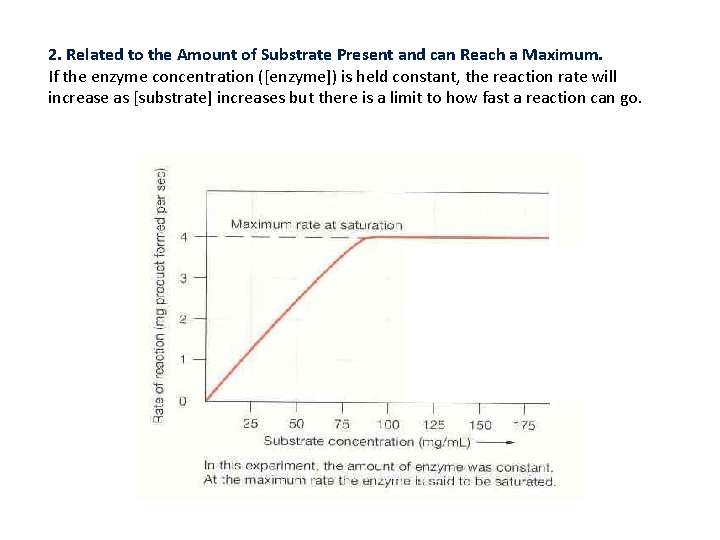
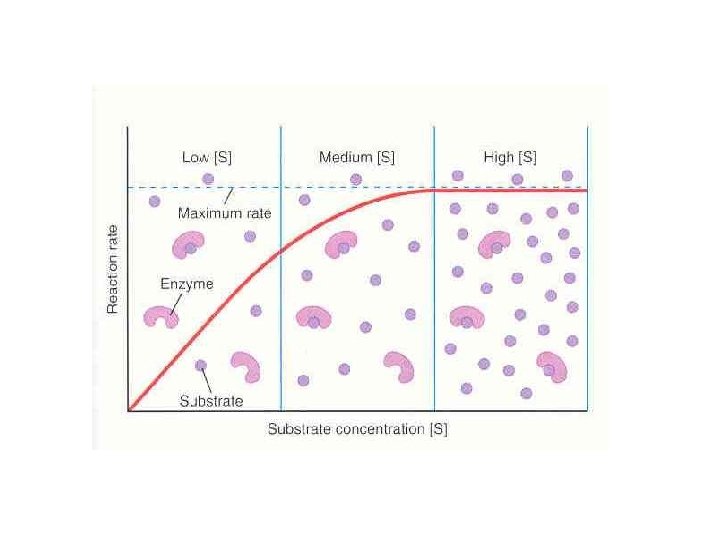
2. Related to the Amount of Substrate Present and can Reach a Maximum. If the enzyme concentration ([enzyme]) is held constant, the reaction rate will increase as [substrate] increases but there is a limit to how fast a reaction can go.
- Slides: 17