
Enzymes and Enzymatic Reactions A Sample Experiment Observation
Enzymes and Enzymatic Reactions A Sample Experiment
Observation: Lit Search • A Literature Search allows you to discover information about what already has been discovered about your system. • From your search, you can make a third person OBSERVATION about your system.
Observation: Lit Search Our sample literature search has revealed: • Increased Na. Cl concentration has been shown to increase peroxidase activity in the halophytic archaen, Halobacterium halobium. (Brown-Peterson 1993)
Observation: Lit Search Our sample literature search has revealed: • Many plants show an increase in peroxidase activity when experiencing salt stress. In one study on rice (Oryza sativa), salt stress was induced by immersing the plant’s roots in 0. 1 M Na. Cl for 48 hours. (Swapna 2003)
Observation: Lit Search Our sample literature search has revealed: • Wild-type Saccharomyces cereviseae does have some degree of salt tolerance. Concentrations of 0. 3 M Na. Cl induced stress responses in yeast after 45 minutes of exposure. (Lewis 1995)
Question Based on these observations, we might ask… “How would a change in Na. Cl concentration (for example, from 0. 0 M to 0. 3 M) affect yeast’s rate of hydrogen peroxide catalysis? "
Overall Hypothesis Phrased as an overall hypothesis, one might posit… “Salt stress will affect the rate of hydrogen peroxide catabolysis in yeast (Saccharomyces cereviseae). ”

Experimental Hypotheses Phrased as a two-tailed statistical hypotheses, this becomes HO – The rate of oxygen production will not differ between control yeast and yeast subjected to salt stress. HA – The rate of oxygen production will differ between control yeast and yeast subjected to salt stress.
Experimental Hypotheses Phrased as one-tailed statistical hypotheses… HO – The rate of oxygen production will not differ between control yeast and yeast subjected to salt stress. HA – The rate of oxygen production will be [higher] [or] [lower] in control yeast than in yeast subjected to salt stress.
Prediction We know (from our literature search) that increased Na. Cl concentration increases catalase activity in multiple, distantly related species. Therefore, a logical prediction would be: Increasing Na. Cl concentration in a yeast suspension from 0 M to 0. 3 M will increase the rate of the peroxidase reaction.
Experimental Design Based Na. CL solution concentrations from the literature search, we will compare the rate of O 2 production (a measure of H 2 O 2 catabolysis) in – untreated yeast – yeast incubated for 30 minutes in 0. 3 M Na. Cl solution (to induce salt stress).
Experimental Design The type of data collected will be reaction rates: O 2 produced/minute. Control and treatment groups will each consist of multiple experimental runs. Mean reaction rates of control and treatment groups will be compared.
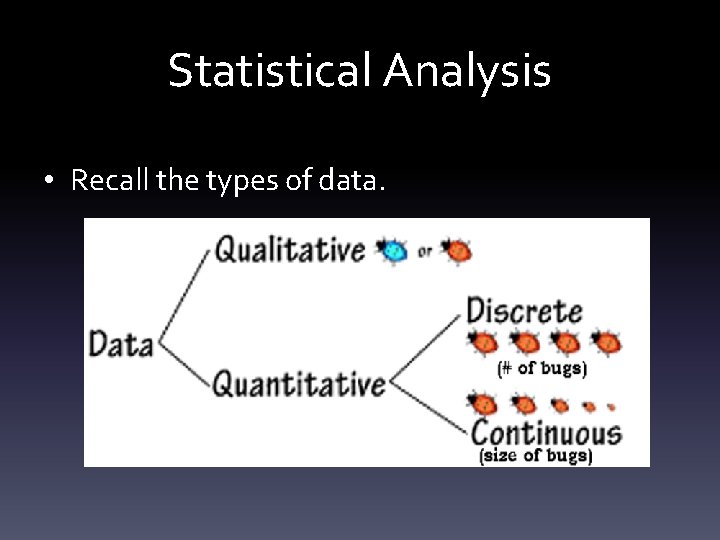
Statistical Analysis • Recall the types of data.
Statistical Analysis You will be measuring rates of reaction in two populations. Will your data be • qualitative or quantitative? • discrete/ordinal or continuous? • parametric or non-parametric?
Planning Your Experiment Step One: develop a solid plan. • All calculations needed for mixing reagents should be done in advance. • The protocol plan must be complete before the experiment is begun.
Planning Your Experiment Step Two: Know Your Reagents. • Stock yeast suspension: – 70 g yeast/L of p. H 7 sodium phosphate buffer solution. • Stock H 2 O 2 solution – 33 m. L of 30 -volume (9. 1%) hydrogen peroxide in 1 L of p. H 7 sodium phosphate buffer solution.
Planning Your Experiment Step Three: Calculate Your Quantities. Yeast suspension: • Six trials (three treatment, three control) – each trial requires 10 m. L of yeast suspension • Total needed: 60 m. L yeast suspension. • Take no more than 70 m. L of the stock suspension to your station. Don’t waste!
Planning Your Experiment Step Three: Calculate Your Quantities. Hydrogen Peroxide (H 2 O 2) solution: • Six trials, each requiring 20 m. L • Total needed: 120 m. L of H 2 O 2 solution • Take no more than 135 m. L to allow for measurement error. Don’t waste!
Planning Your Experiment Step Three: Calculate Your Quantities. Sodium chloride (Na. Cl) solution: • You will use stock 1 M Na. Cl to stress your treatment yeast. • Yeast will incubate for 30 minutes to allow the yeast to react to the increased salt concentration.
Planning Your Experiment IMPORTANT: Never measure reagents in beakers or flasks. • Only graduated cylinders or syringes are accurate enough for proper measurement of reagents in any experiment.
Planning Your Experiment Know how to calculate MOLARITY is the number of moles of solute divided by the number of liters of solution. One mole = 6. 02 x 10 23 particles A one molar (1 M) solution contains 6. 02 x 10 23 molecules of solute in each liter of solution.
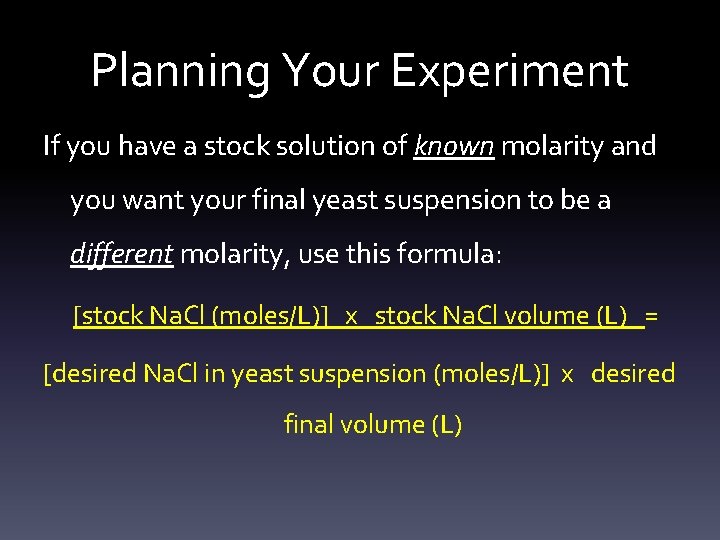
Planning Your Experiment If you have a stock solution of known molarity and you want your final yeast suspension to be a different molarity, use this formula: [stock Na. Cl (moles/L)] x stock Na. Cl volume (L) = [desired Na. Cl in yeast suspension (moles/L)] x desired final volume (L)
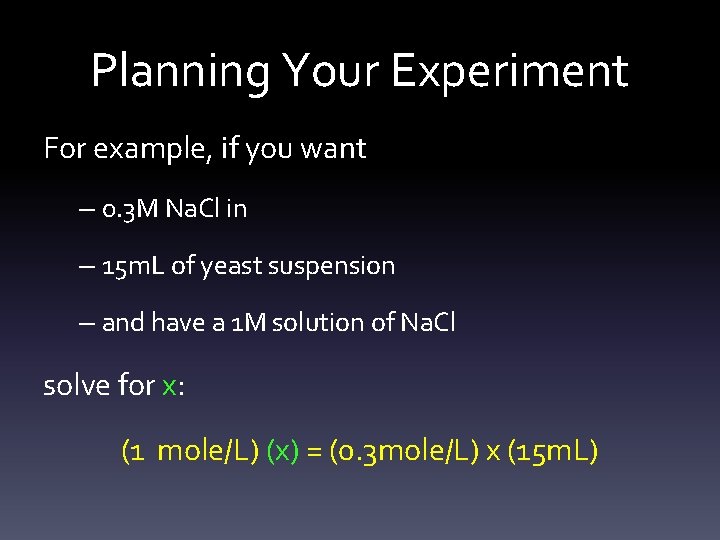
Planning Your Experiment For example, if you want – 0. 3 M Na. Cl in – 15 m. L of yeast suspension – and have a 1 M solution of Na. Cl solve for x: (1 mole/L) (x) = (0. 3 mole/L) x (15 m. L)
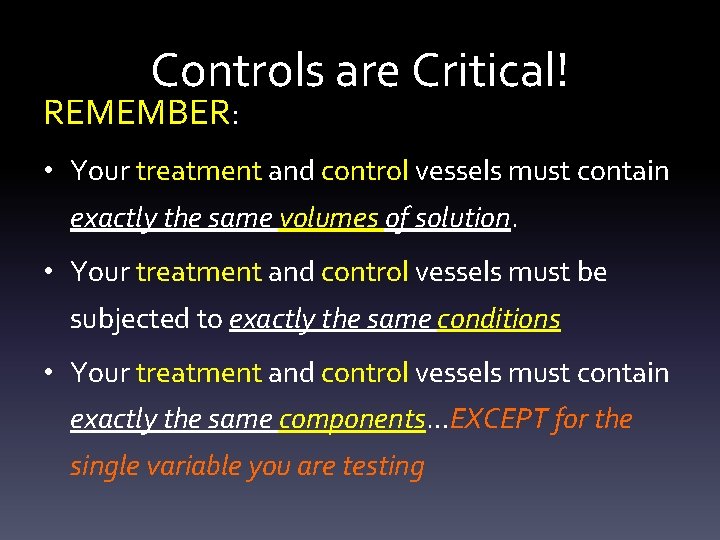
Controls are Critical! REMEMBER: • Your treatment and control vessels must contain exactly the same volumes of solution. • Your treatment and control vessels must be subjected to exactly the same conditions • Your treatment and control vessels must contain exactly the same components…EXCEPT for the single variable you are testing
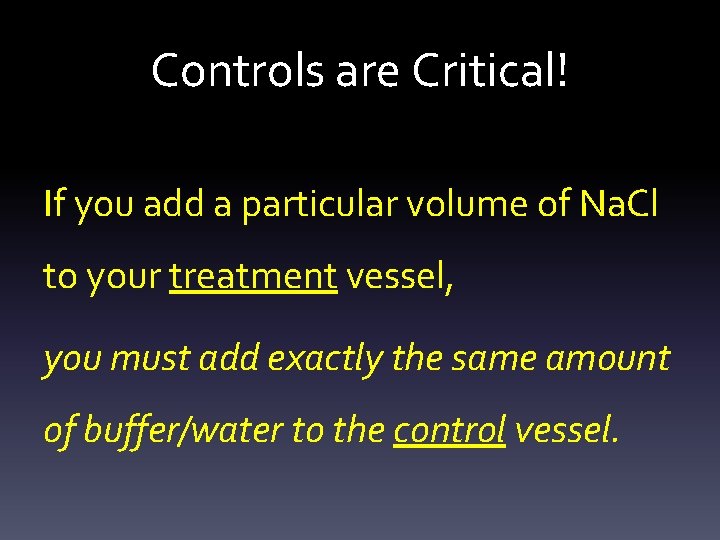
Controls are Critical! If you add a particular volume of Na. Cl to your treatment vessel, you must add exactly the same amount of buffer/water to the control vessel.
Controls are Critical! If you incubate your treatment sample for a particular amount of time, you must incubate your control sample for exactly the same amount of time.
You Know the Drill: Open your online lab syllabus and click here: http: //www. bio. miami. edu/dana/151 F 15_enzymes 2. p df Ready. Set. Go!
- Slides: 27