
ENZYMES A globular protein1 with catalytic properties2 due
ENZYMES A globular protein(1) with catalytic properties(2) due to the presence of active sites(3) which permit specific reactions(4) to occur. A BIOLOGICAL CATALYST Set yourself up by trying to comprehend the meanning of each underlined phrase, (1), (2), (3) & (4)
Chemical reactions o o Chemical reactions need an initial input of energy = THE ACTIVATION ENERGY During this part of the reaction the molecules are said to be in a transition state.
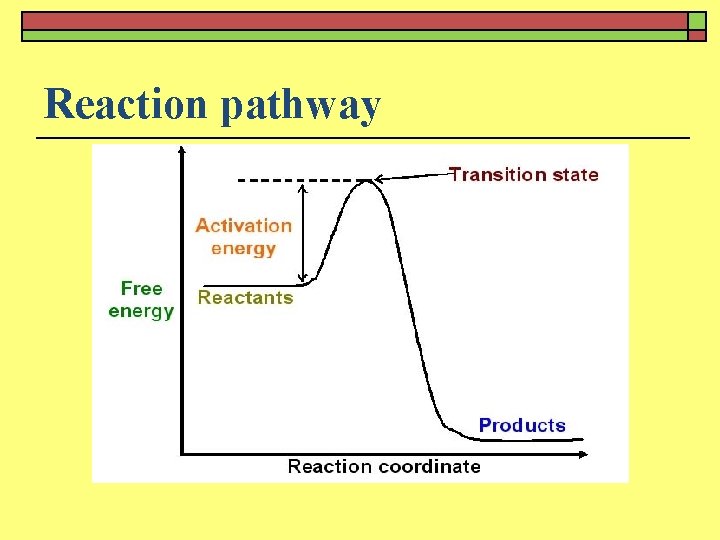
Reaction pathway
Making reactions go faster o o o Increasing the temperature make molecules move faster Biological systems are very sensitive to temperature changes. Enzymes can increase the rate of reactions without increasing the temperature. They do this by lowering the activation energy. They create a new reaction pathway “a short cut”
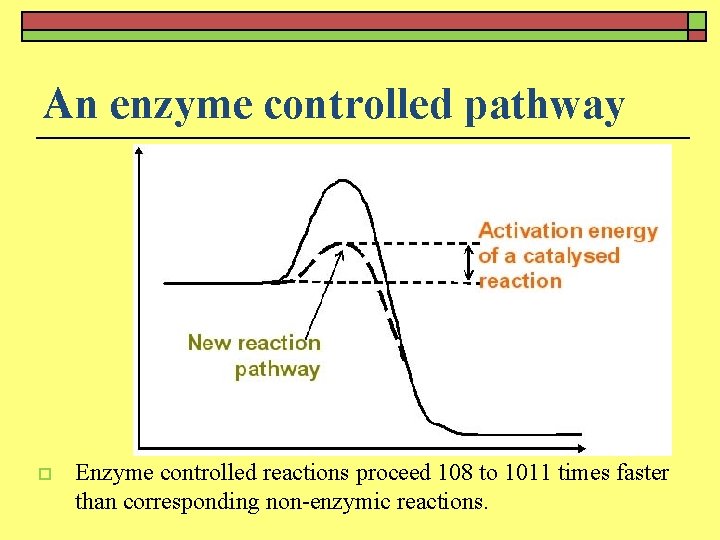
An enzyme controlled pathway o Enzyme controlled reactions proceed 108 to 1011 times faster than corresponding non-enzymic reactions.
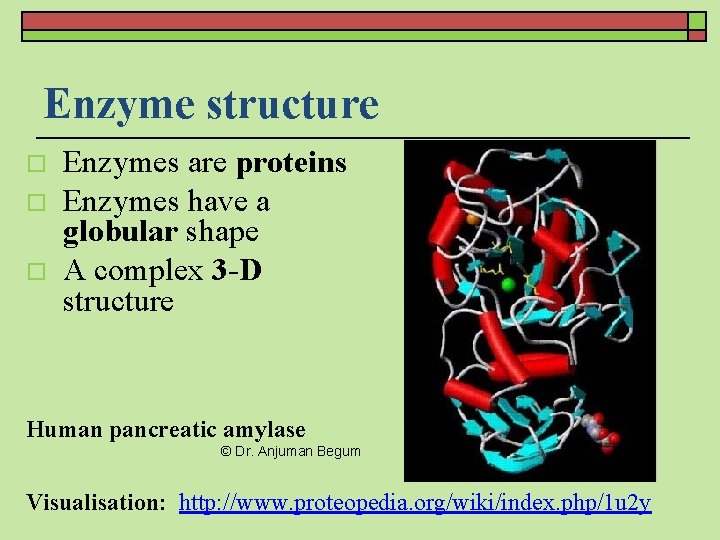
Enzyme structure o o o Enzymes are proteins Enzymes have a globular shape A complex 3 -D structure Human pancreatic amylase © Dr. Anjuman Begum Visualisation: http: //www. proteopedia. org/wiki/index. php/1 u 2 y
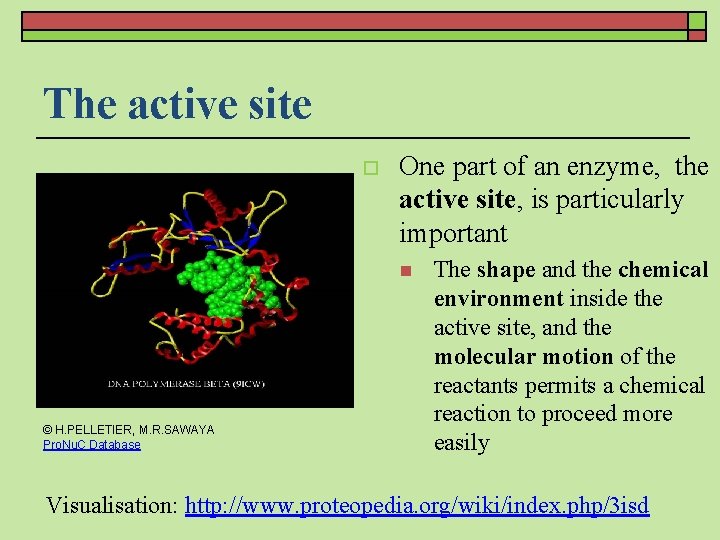
The active site o One part of an enzyme, the active site, is particularly important n © H. PELLETIER, M. R. SAWAYA Pro. Nu. C Database The shape and the chemical environment inside the active site, and the molecular motion of the reactants permits a chemical reaction to proceed more easily Visualisation: http: //www. proteopedia. org/wiki/index. php/3 isd
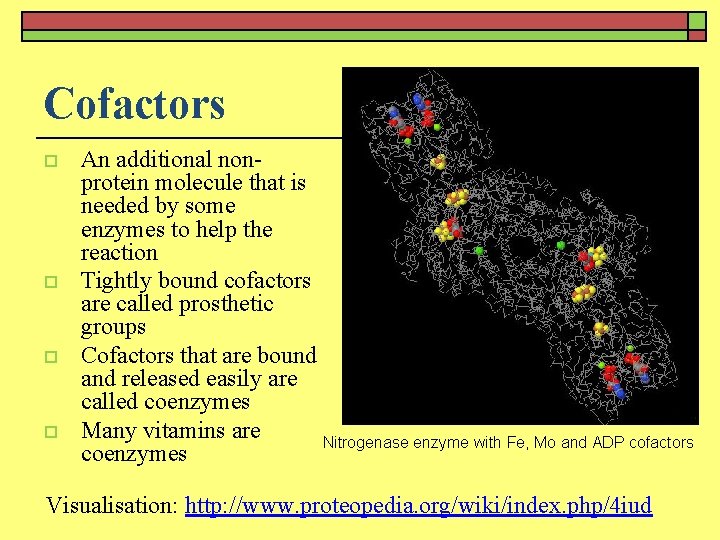
Cofactors o o An additional nonprotein molecule that is needed by some enzymes to help the reaction Tightly bound cofactors are called prosthetic groups Cofactors that are bound and released easily are called coenzymes Many vitamins are Nitrogenase enzyme with Fe, Mo and ADP cofactors coenzymes Visualisation: http: //www. proteopedia. org/wiki/index. php/4 iud
The substrate o o o The substrate of an enzyme are the reactants that are activated by the enzyme Enzymes are specific to their substrates The specificity is determined by the active site
The Lock and Key Hypothesis o o o o Fit between the substrate and the active site of the enzyme is exact Like a key fits into a lock very precisely The key is analogous to the substrate and the enzyme is analogous to the lock. Temporary structure called the enzyme-substrate complex formed Products have a different shape from the substrate Once formed, they are released from the active site Leaving it free to become attached to another substrate
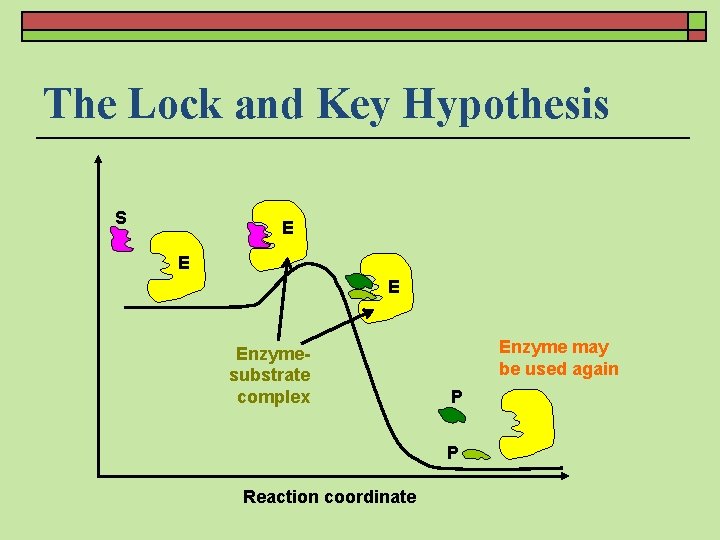
The Lock and Key Hypothesis S E Enzymesubstrate complex Enzyme may be used again P P Reaction coordinate
The Lock and Key Hypothesis o o This explains enzyme specificity This explains the loss of activity when enzymes denature
The Induced Fit Hypothesis o o o Some proteins can change their shape (conformation) When a substrate combines with an enzyme, it induces a change in the enzyme’s conformation The active site is then moulded into a precise conformation Making the chemical environment suitable for the reaction The bonds of the substrate are stretched to make the reaction easier (lowers activation energy)
The Induced Fit Hypothesis Hexokinase (a) without (b) with glucose substrate http: //www. biochem. arizona. edu/classes/bioc 462/462 a/NOTES/ENZYMES/enzyme_mechanism. html o This explains the enzymes that can react with a range of substrates of similar types
Factors affecting enzyme action o o substrate concentration p. H temperature inhibitors
Substrate concentration: Non-enzymic reactions Reaction velocity Substrate concentration o The increase in velocity is proportional to the substrate concentration
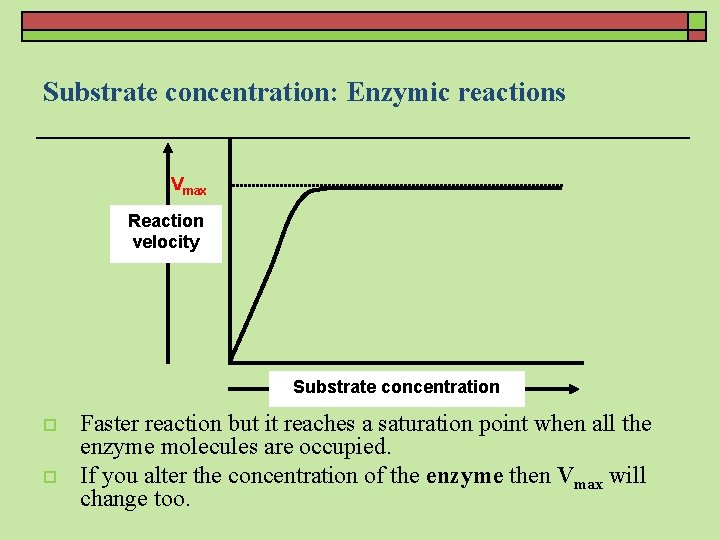
Substrate concentration: Enzymic reactions Vmax Reaction velocity Substrate concentration o o Faster reaction but it reaches a saturation point when all the enzyme molecules are occupied. If you alter the concentration of the enzyme then Vmax will change too.
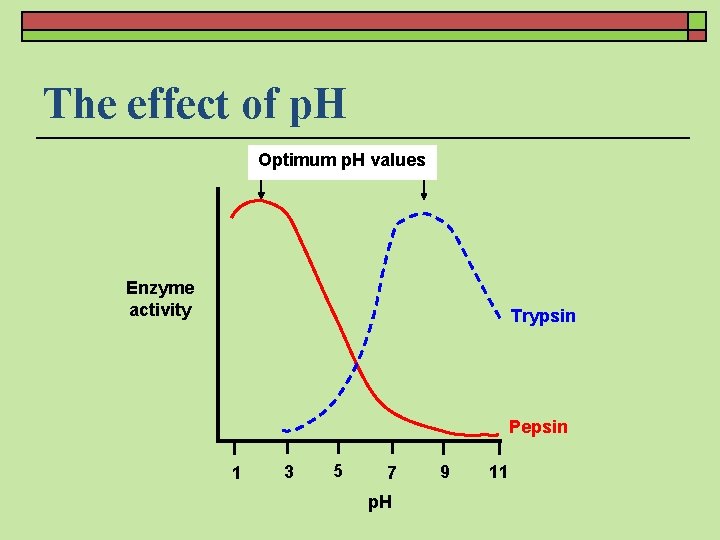
The effect of p. H Optimum p. H values Enzyme activity Trypsin Pepsin 1 3 5 7 p. H 9 11
The effect of p. H o o o Extreme p. H levels will produce denaturation The structure of the enzyme is changed The active site is distorted and the substrate molecules will no longer fit in it At p. H values slightly different from the enzyme’s optimum value, small changes in the charges of the enzyme and it’s substrate molecules will occur This change in ionisation will affect the binding of the substrate with the active site.
The effect of temperature o o o Q 10 (the temperature coefficient) = the increase in reaction rate with a 10°C rise in temperature. For chemical reactions the Q 10 = 2 to 3 (the rate of the reaction doubles or triples with every 10°C rise in temperature) Enzyme-controlled reactions follow this rule as they are chemical reactions BUT at high temperatures proteins denature The optimum temperature for an enzyme controlled reaction will be a balance between the Q 10 and denaturation.
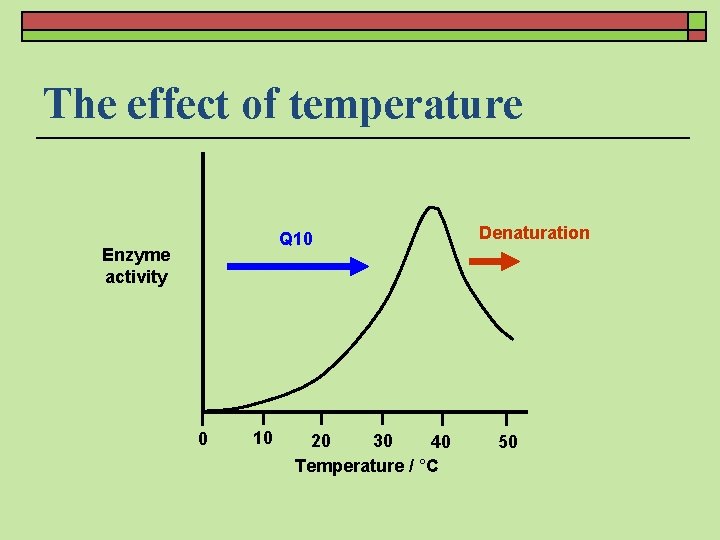
The effect of temperature Q 10 Enzyme activity 0 10 20 30 40 Temperature / °C Denaturation 50
The effect of temperature o o For most enzymes the optimum temperature is about 30°C Many are a lot lower, cold water fish will die at 30°C because their enzymes denature A few bacteria have enzymes that can withstand very high temperatures up to 100°C Most enzymes however are fully denatured at 70°C
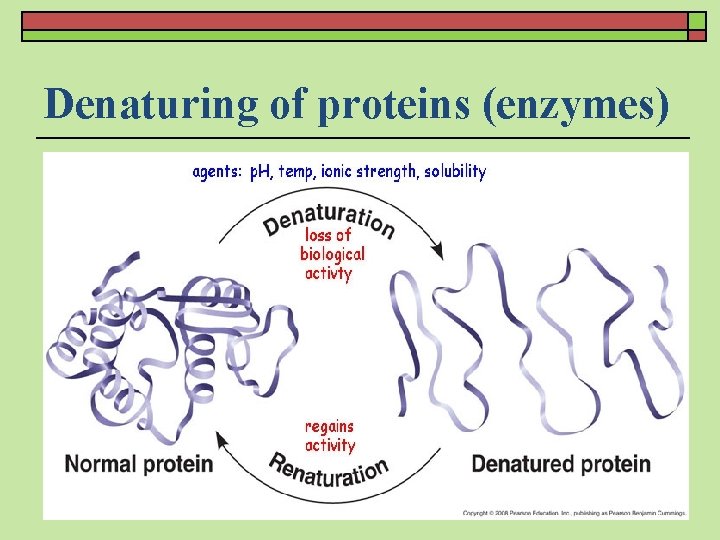
Denaturing of proteins (enzymes)
Inhibitors o o Inhibitors are chemicals that reduce the rate of enzymic reactions. The are usually specific and they work at low concentrations. They block the enzyme but they do not usually destroy it. Many drugs and poisons are inhibitors of enzymes in the nervous system.
The effect of enzyme inhibition Irreversible inhibitors: Combine with the functional groups of the amino acids in the active site, irreversibly. Examples: nerve gases and pesticides, containing organophosphorus, combine with serine residues in the enzyme acetylcholine esterase. o
The effect of enzyme inhibition Reversible inhibitors: These can be washed out of the solution of enzyme by dialysis. There are two categories. o
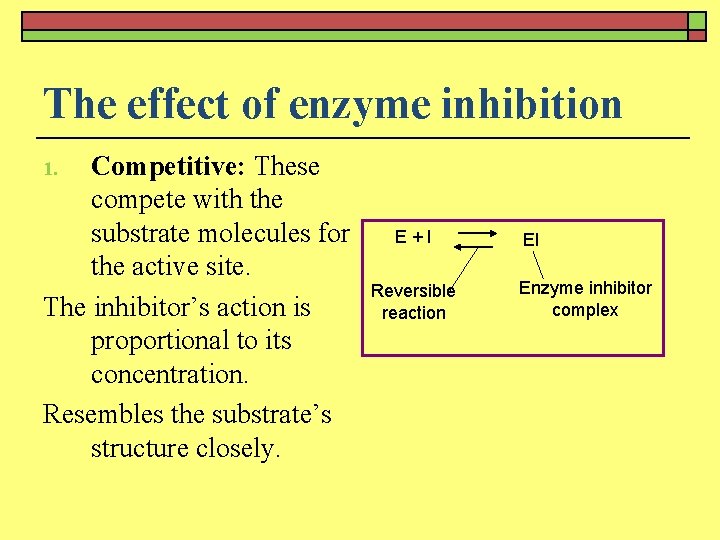
The effect of enzyme inhibition Competitive: These compete with the substrate molecules for the active site. The inhibitor’s action is proportional to its concentration. Resembles the substrate’s structure closely. 1. E+I Reversible reaction EI Enzyme inhibitor complex
The effect of enzyme inhibition Example of Competitive Inhibition Methanol poisoning occurs because methanol is oxidized to formaldehyde and formic acid which attack the optic nerve causing blindness. Ethanol is given as an antidote for methanol poisoning because ethanol competitively inhibits the oxidation of methanol. Ethanol is oxidized in preference to methanol and consequently, the oxidation of methanol is slowed down so that the toxic by-products do not have a chance to accumulate.
The effect of enzyme inhibition Non-competitive: These are not influenced by the concentration of the substrate. It inhibits by binding irreversibly to the enzyme but not at the active site. Examples o Cyanide combines with the Iron in the enzymes cytochrome oxidase, breaking di-sulphide bonds, so disruoting the electron transport chain. o Heavy metals, Ag or Hg, combine with –SH groups. 2.
Applications of inhibitors o o o Negative feedback: end point or end product inhibition Poisons snake bite, plant alkaloids and nerve gases. Medicine antibiotics, sulphonamides, sedatives and stimulants
End Product Inhibition End-product inhibition is a form of negative feedback in which increased levels of product decrease the rate of product formation. • Because metabolic pathways usually consist of chains (e. g. glycolysis) or cycles (e. g. Krebs cycle), the product can regulate the rate of its own production by inhibiting an earlier enzyme in the metabolic pathway. • The product binds to an allosteric site of an enzyme, causing a conformational change in the active site (non-competitive inhibition). • As the enzyme can not currently function, the rate of product formation will decrease (and with less product there is less enzyme inhibition).
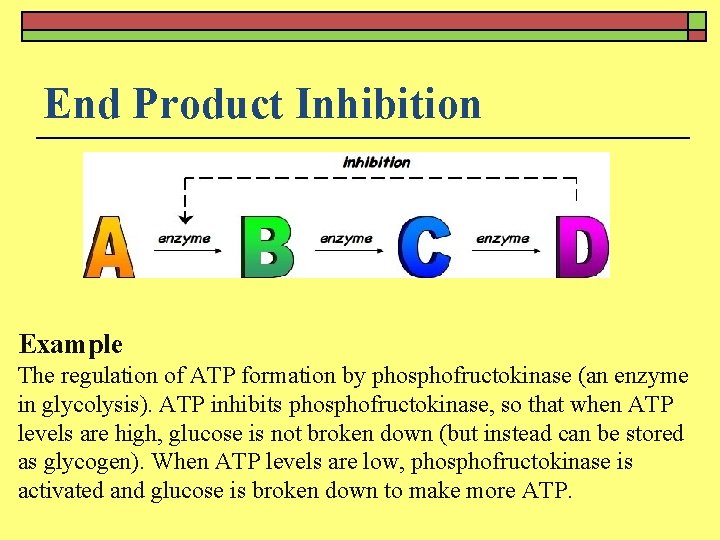
End Product Inhibition Example The regulation of ATP formation by phosphofructokinase (an enzyme in glycolysis). ATP inhibits phosphofructokinase, so that when ATP levels are high, glucose is not broken down (but instead can be stored as glycogen). When ATP levels are low, phosphofructokinase is activated and glucose is broken down to make more ATP.
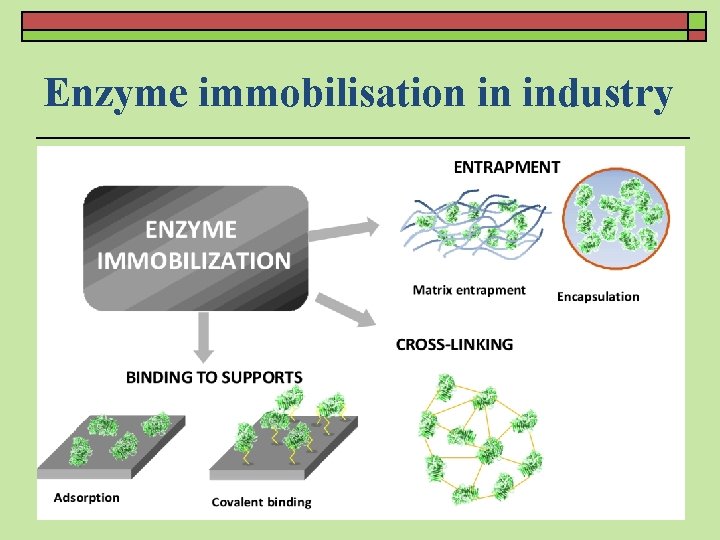
Enzyme immobilisation in industry
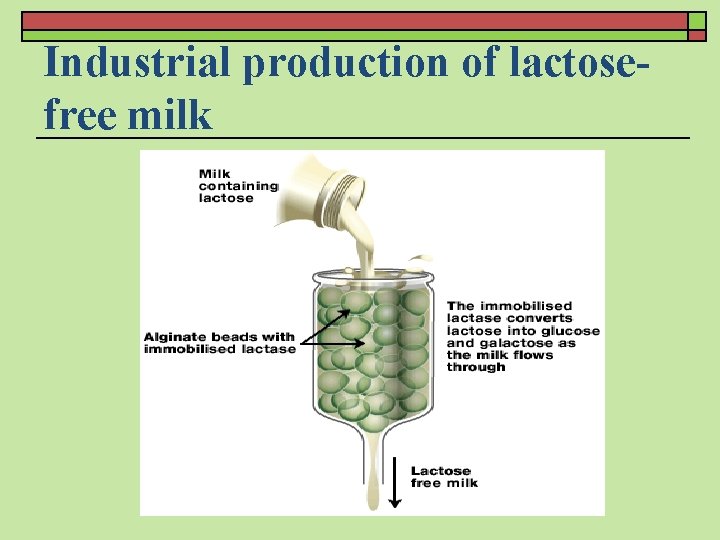
Industrial production of lactosefree milk
- Slides: 34