
Enzymes 2 Lectures Foundation Block Dr Usman Ghani
Enzymes 2 Lectures (Foundation Block) Dr. Usman Ghani • What are enzymes? • Classification of enzymes and naming • Coenzymes, Cofactors, Isoenzymes • Enzyme activity and specificity • Factors affecting enzyme activity
Enzymes (Foundation Block) • Enzyme kinetics (Michaelis Menten equation) • Enzyme inhibition and types • Regulation of enzyme activity • Enzymes in clinical diagnosis
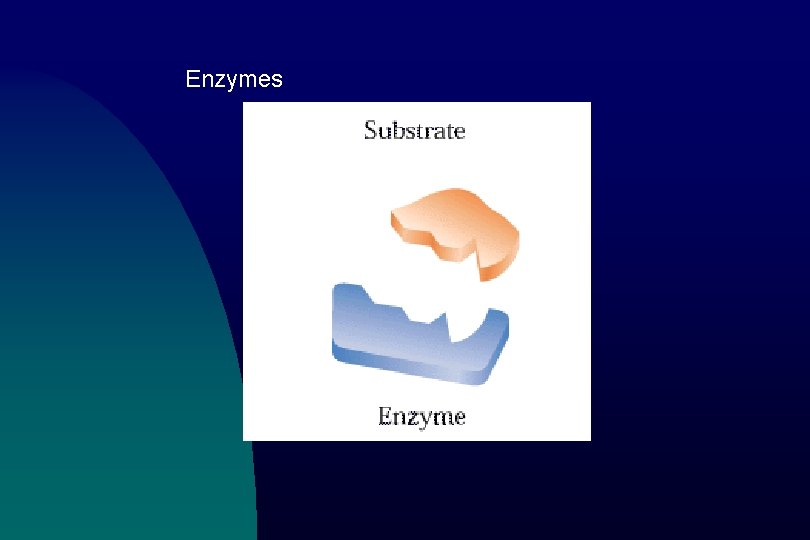
What are Enzymes? n n n Enzymes are biological catalysts that speed up the rate of a reaction without being changed in the reaction All enzymes are protein in nature But all proteins are not enzymes All enzymes have one or more active sites Some enzymes have both active and regulatory sites Enzymes bind to their specific substrates in the active site to convert them to product(s)
Enzymes
Active site n n n The region of enzyme where a substrate binds is called active site Once the substrate is bound, catalysis takes place All enzymes have one or more active sites
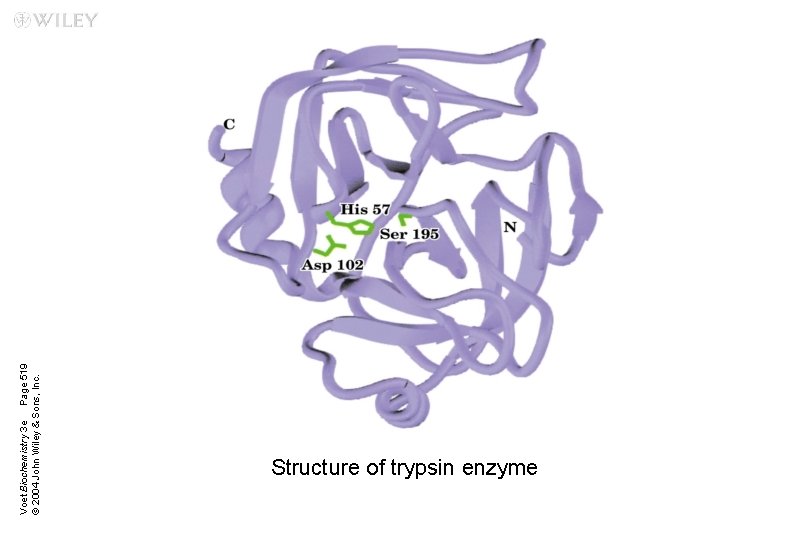
Voet Biochemistry 3 e Page 519 © 2004 John Wiley & Sons, Inc. Structure of trypsin enzyme
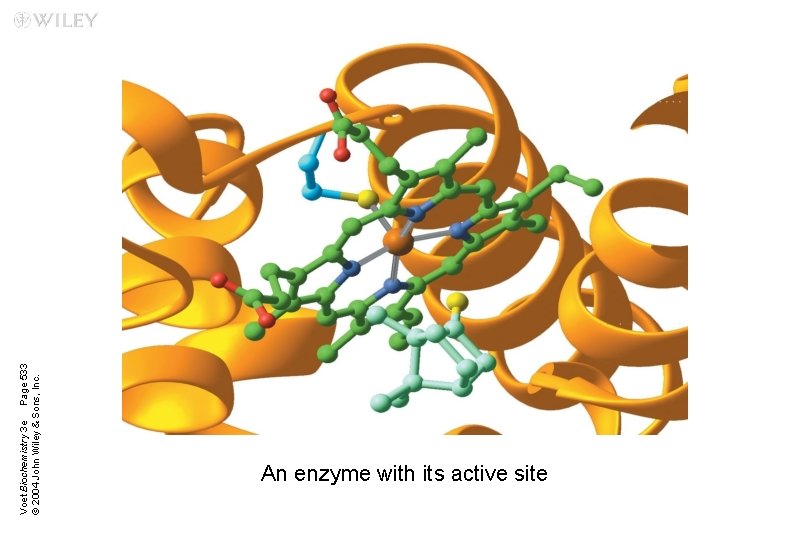
Voet Biochemistry 3 e Page 533 © 2004 John Wiley & Sons, Inc. An enzyme with its active site
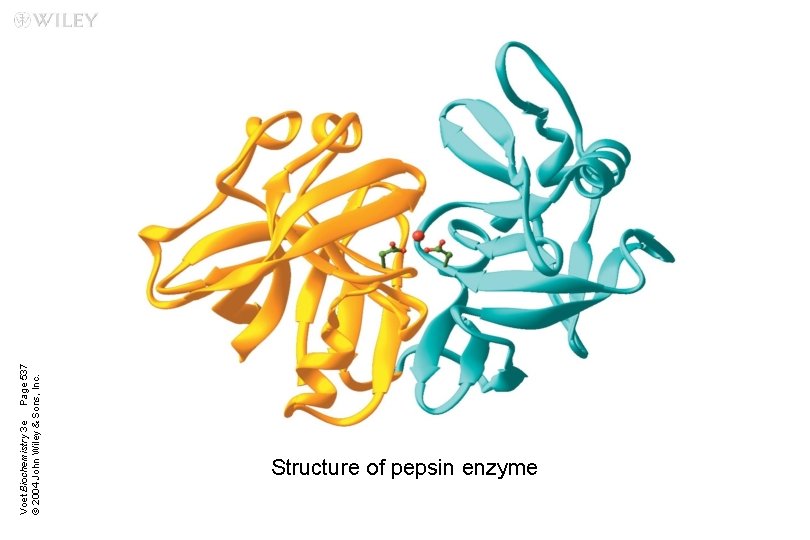
Voet Biochemistry 3 e Page 537 © 2004 John Wiley & Sons, Inc. Structure of pepsin enzyme
Classification of Enzymes n Enzymes are classified into six types according to the type of reaction catalyzed
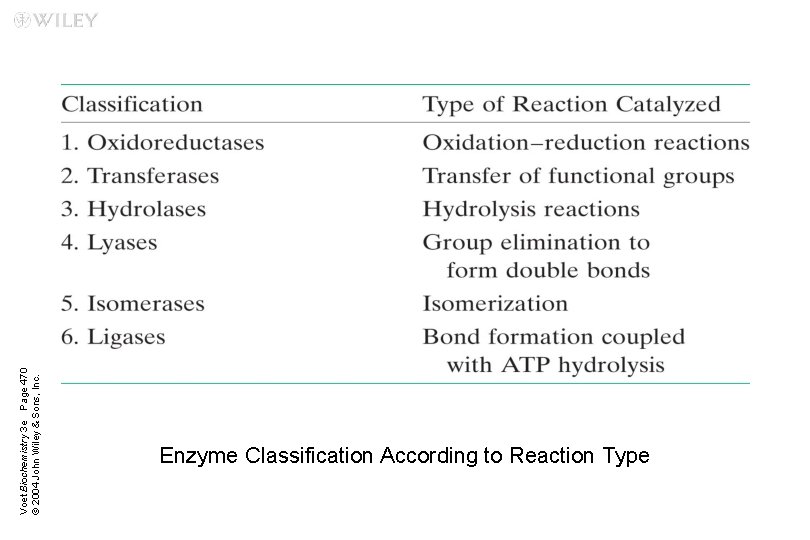
Voet Biochemistry 3 e Page 470 © 2004 John Wiley & Sons, Inc. Enzyme Classification According to Reaction Type
Enzyme nomenclature (Naming) n n Enzyme nomenclature is based on the rules given by IUBMB (International Union of Biochemistry and Molecular Biology) EC 3. 4. 17. 1 EC Class. Subclass. Subsubclass. Enzyme number EC = Enzyme Commission

Enzyme specificity n n Enzymes are highly specific to their substrate They catalyze only one type of reaction
Enzyme –substrate binding Two models have been proposed: n Lock and key binding u The enzyme has an active site that fits the exact dimensions of the substrate
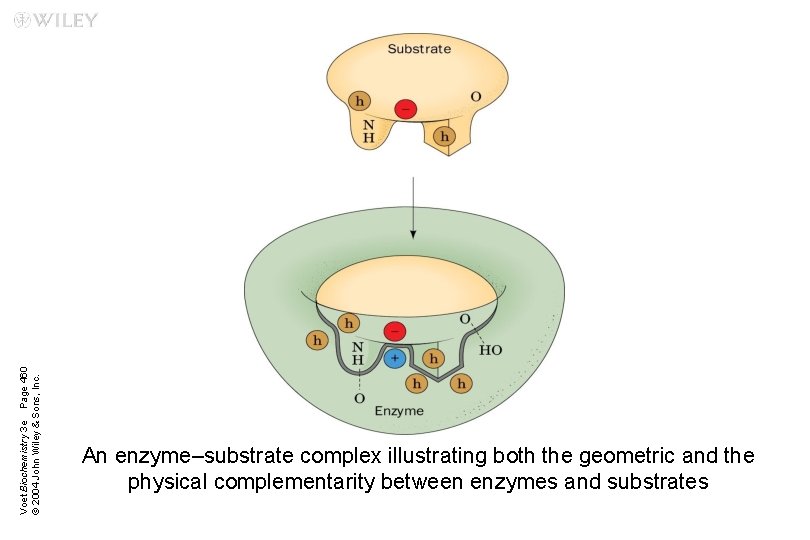
Voet Biochemistry 3 e Page 460 © 2004 John Wiley & Sons, Inc. An enzyme–substrate complex illustrating both the geometric and the physical complementarity between enzymes and substrates
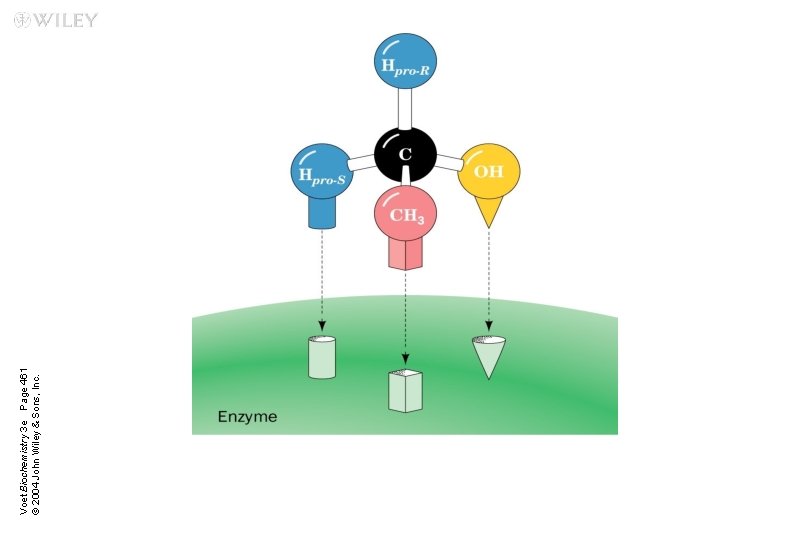
Voet Biochemistry 3 e Page 461 © 2004 John Wiley & Sons, Inc.
Enzyme –substrate binding n Induced-fit binding u After the binding of substrate, the enzyme changes its shape to fit more perfectly with substrate
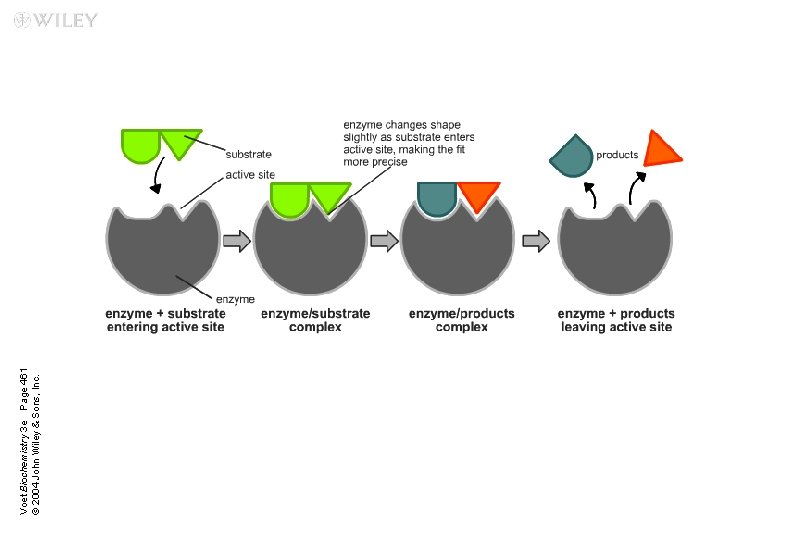
Voet Biochemistry 3 e Page 461 © 2004 John Wiley & Sons, Inc.
Enzyme Activity or Velocity is the rate of a reaction catalyzed by an enzyme n Enzyme activity is expressed as: mmoles of product formed/min/mg enz n
Cofactors, Coenzymes, Isoenzymes n n n Cofactors are small molecules or metal ions such as Cu 2+, Fe 3+, Zn 2+, etc. which help an enzyme to catalyze a reaction Cofactors may also be organic molecules known as coenzymes such as NAD+ Some cofactors are only temporarily associated with an enzyme known as cosubstrates
Cofactors, Coenzymes, Isoenzymes n n Some cofactors are permanently associated with an enzyme known as prosthetic groups An active enzyme-cofactor complex is called a holoenzyme The inactive form of an enzyme without its cofactor/coenzyme is called an apoenzyme Isoenzymes catalyze the same chemical reaction but they have slightly different structures
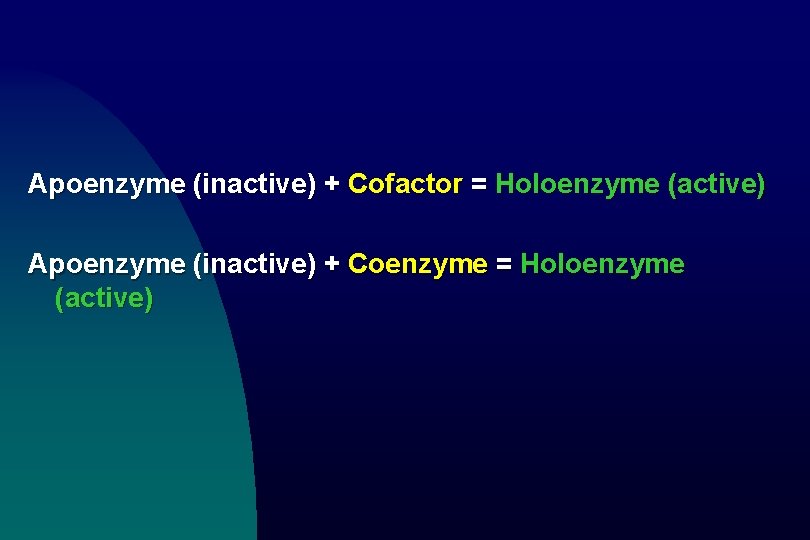
Apoenzyme (inactive) + Cofactor = Holoenzyme (active) Apoenzyme (inactive) + Coenzyme = Holoenzyme (active)
Ribozymes n Ribozymes are RNA (ribonucleic acid) with enzymatic activity
Zymogens n Zymogens are inactive forms of enzyme n They are activated when needed
How do enzymes work? n n n In every chemical reaction, the reactants pass through a transition state that has greater energy than that of the reactants or products alone The difference in energy between the reactants and the transition state is called the activation energy If the activation energy is available then the reaction can proceed forming products
How do enzymes work? n n n An enzyme reduces the activation energy required for a reaction It provides an alternative transition state of lower energy called the enzyme-substrate complex and thus speeds up the reaction Enzymes decrease the activation energy but they do not cause a change in the free energy (∆G) (available energy)
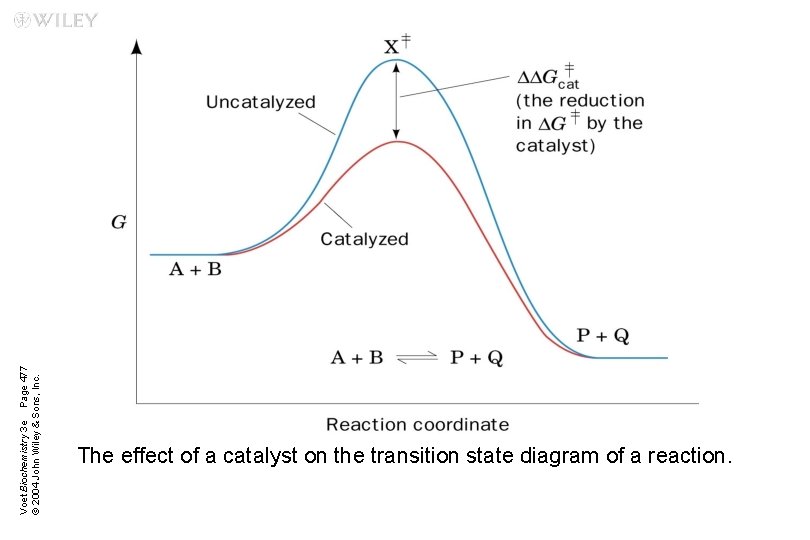
Voet Biochemistry 3 e Page 477 © 2004 John Wiley & Sons, Inc. The effect of a catalyst on the transition state diagram of a reaction.
Factors affecting enzyme activity n Effect of temperature u The rate of an enzyme reaction increases with rise in temperature (increase in velocity) u Every enzyme has an optimal temp. for catalyzing a reaction u At high temp. enzymes are denatured and become inactive u In humans most enzymes have an optimal temp. of 37 o. C
Factors affecting enzyme activity n Effect of p. H u p. H changes the ionizable groups in the active site – this affects catalysis u Every enzyme has an optimal p. H for catalyzing a reaction u Most enzymes have highest activity between p. H 6 and p. H 8 u Pepsin has highest activity at p. H 2
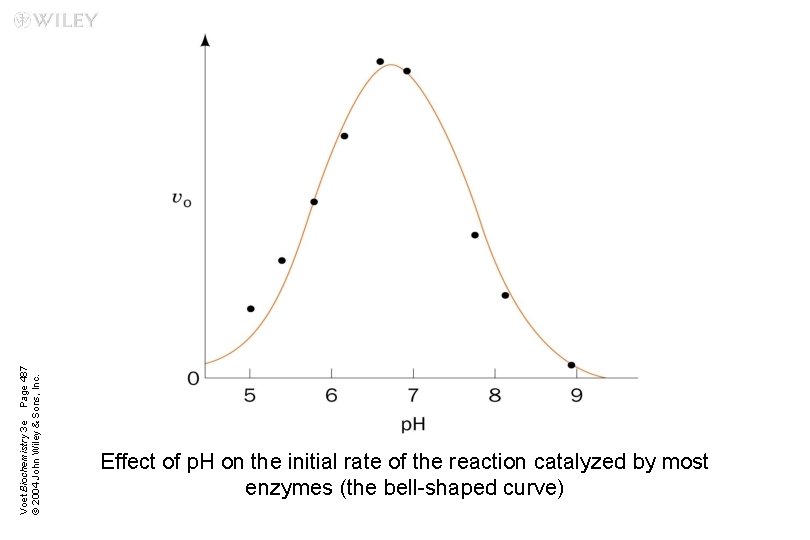
Voet Biochemistry 3 e Page 487 © 2004 John Wiley & Sons, Inc. Effect of p. H on the initial rate of the reaction catalyzed by most enzymes (the bell-shaped curve)
Factors affecting enzyme activity n Effect of [E] and [S] u Enzyme reaction rate is directly proportional to the conc. of enzyme if the substrate concentration [S] is higher than enzyme u The reaction velocity increases initially with increasing [S] u Further addition of substrate has no effect on enzyme velocity (v) u At low [S], the reaction rate is proportional to [S]
Enzyme kinetics n n The model of enzyme kinetics was first proposed by Michaelis and Menten in 1913 and later modified by Briggs and Haldane The Michaelis Menten equation describes the relationship of initial rate of an enzyme reaction to the [S]
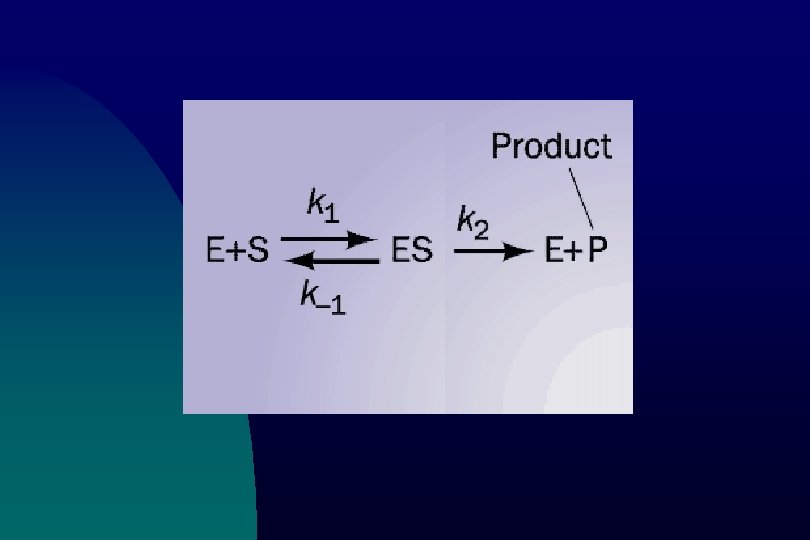
Initial rate of enzyme reaction Pre-steady state kinetics u When an enzyme is mixed with high [S] u There is an initial short period of time (a few hundred microseconds) in which intermediates of product are formed u This is called pre-steady state reaction
n Steady state kinetics u After the initial state, the reaction rate and the conc. of intermediates change slowly with time u This is called steady state reaction n Michaelis-Menten equation measures the initial velocity (vo) of an enzyme reaction
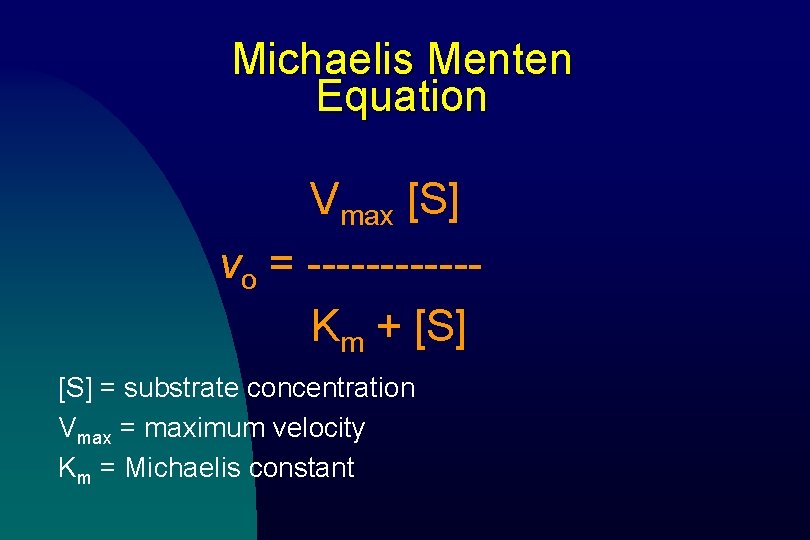
Michaelis Menten Equation Vmax [S] vo = ------Km + [S] = substrate concentration Vmax = maximum velocity Km = Michaelis constant
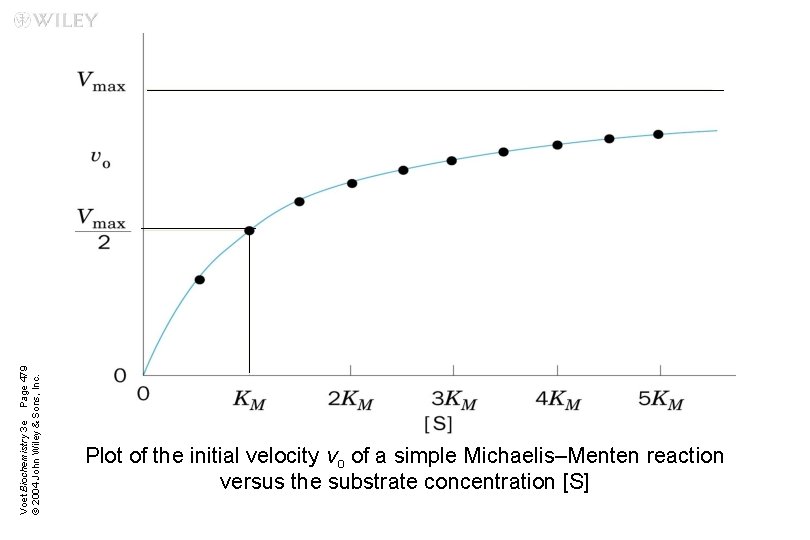
Voet Biochemistry 3 e Page 479 © 2004 John Wiley & Sons, Inc. Plot of the initial velocity vo of a simple Michaelis–Menten reaction versus the substrate concentration [S]
Km (Michaelis Constant) n n Km is the [S] at which the initial rate is one-half of the maximum rate (½ Vmax) It is the [S] required to saturate all of the active sites of an enzyme
n The Km value of a substrate depends on its affinity with the enzyme u High Km means low affinity with enzyme (more substrate needed to saturate the enzyme) u Low Km means high affinity with enzyme (less substrate needed to saturate the enzyme)
Lineweaver-Burk plot n The Lineweaver-Burk plot is a doublereciprocal plot, obtained by taking reciprocals of the Michaelis Menten equation
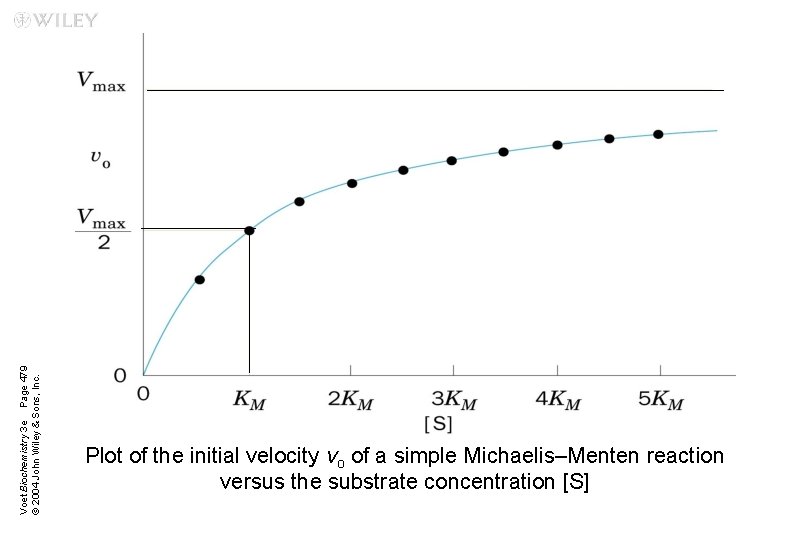
Voet Biochemistry 3 e Page 479 © 2004 John Wiley & Sons, Inc. Plot of the initial velocity vo of a simple Michaelis–Menten reaction versus the substrate concentration [S]
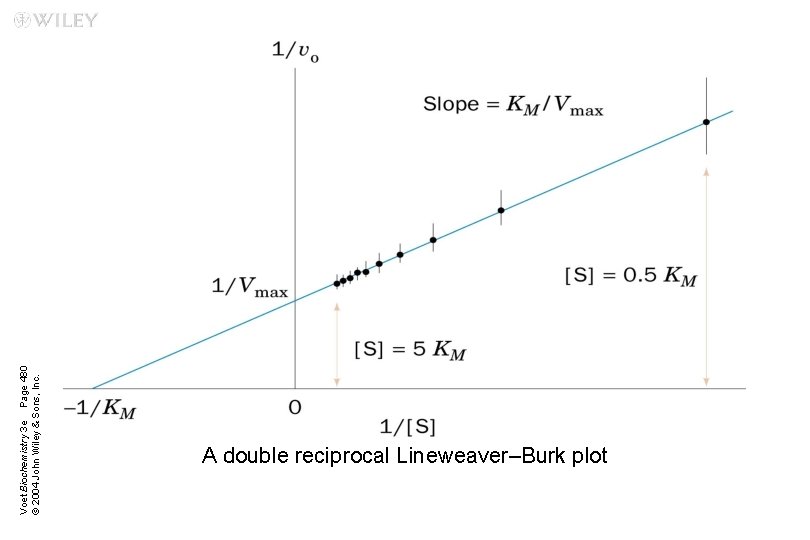
Voet Biochemistry 3 e Page 480 © 2004 John Wiley & Sons, Inc. A double reciprocal Lineweaver–Burk plot
- Slides: 41