
Enzyme Structure Classification and Mechanism of Action DR

- Slides: 35
Enzyme Structure, Classification and Mechanism of Action DR. ARNEL BANAGA SALGADO, Psy. D. , FMP (Psychology), Ed. D. , Sc. D. , RN, PGD H/P No. : 050 -799 -3803 URL: www. ifeet. org; www. arnelsalgado. com ◦ ◦ Member: Sigma Theta Tau International – Honor Society of Nursing (Constituent No. 1628977) Member: American Psychological Association (APA Roll No. 04438162) Doctor of Psychology (Psych. D. ) Fellow Program in Management (FPM – Psychology) Doctor of Science (D. Sc. ) Doctor of Education (Ed. D. ) Master of Arts in Nursing (M. A. N) Master of Arts in Teaching - Psychology (M. A. T. ) Registered Nurse (PH, MYL, UAE) Licensed Teacher (PH) Certificate in Teaching, Bachelor of Science in Nursing (BSN, PH)
Learning Objectives: At the end of the lesson, the students should be able to : 1. Define enzymes and related terms (active site, apoenzyme, holoenzyme, prosthetic group, enzyme specificity). 2. Explain the energy of activation. 3. Describe the structure of enzymes. 4. Know the Mechanism of action 5. Explain the Classification of enzymes 2/28/2021 Lecture No. 3 Enzyme Structure, classification and mechanism of action
Importance • Enzymes play an important role in Metabolism, Diagnosis, and Therapeutics. • All biochemical reactions are enzyme catalyzed in the living organism. • Level of enzyme in blood are of diagnostic importance e. g. it is a good indicator in disease such as myocardial infarction. • Enzyme can be used therapeutically such as digestive enzymes. 2/28/2021 Lecture No. 3 Enzyme Structure, classification and mechanism of action
Define enzymes (Enzymes as Biological Catalysts) • Enzymes are proteins that increase the rate of reaction by lowering the energy of activation • They catalyze nearly all the chemical reactions taking place in the cells of the body. • Not altered or consumed during reaction. • Reusable 2/28/2021 Lecture No. 3 Enzyme Structure, classification and mechanism of action
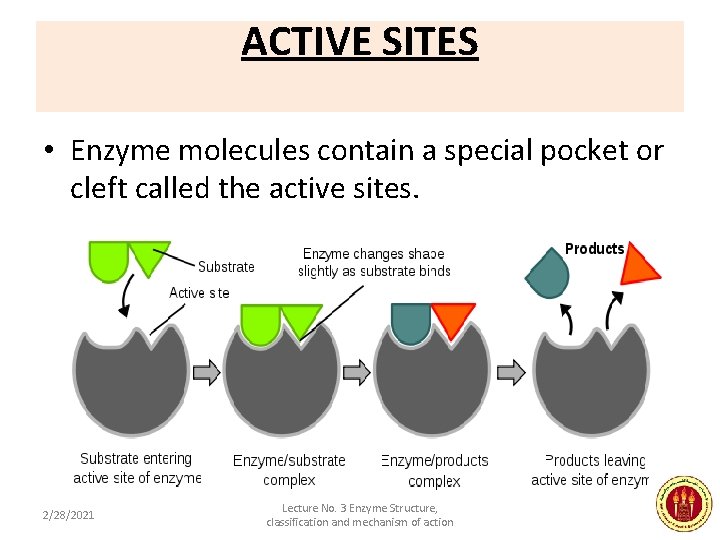
ACTIVE SITES • Enzyme molecules contain a special pocket or cleft called the active sites. 2/28/2021 Lecture No. 3 Enzyme Structure, classification and mechanism of action
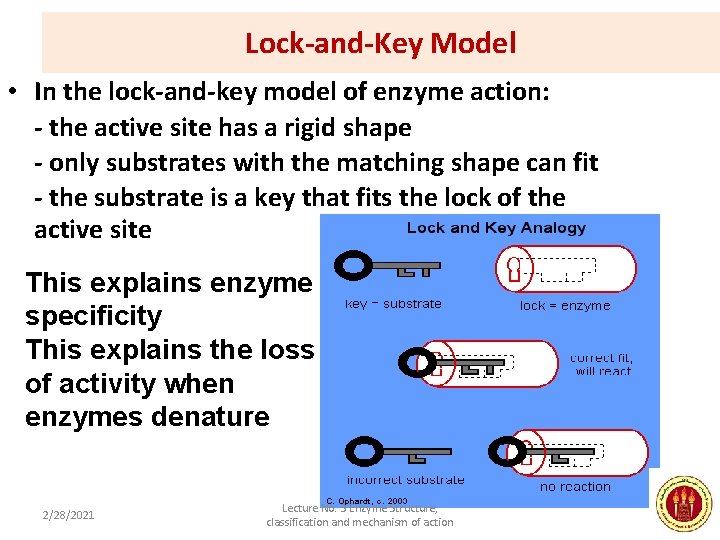
Lock-and-Key Model • In the lock-and-key model of enzyme action: - the active site has a rigid shape - only substrates with the matching shape can fit - the substrate is a key that fits the lock of the active site This explains enzyme specificity This explains the loss of activity when enzymes denature 2/28/2021 Lecture No. 3 Enzyme Structure, classification and mechanism of action
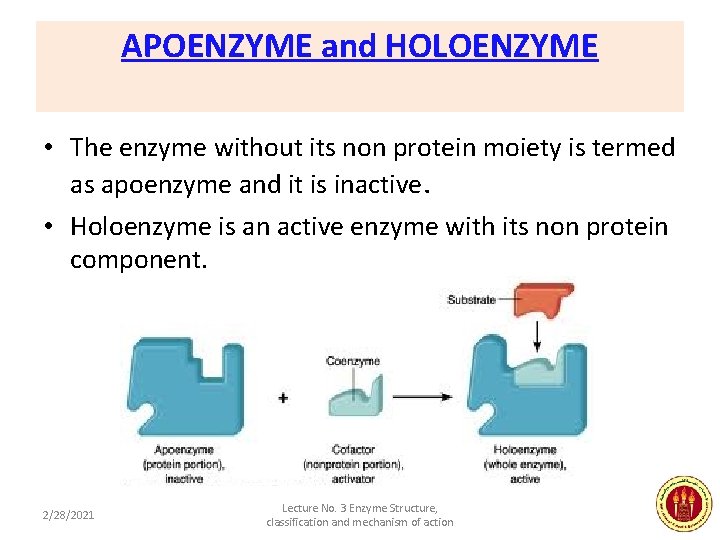
APOENZYME and HOLOENZYME • The enzyme without its non protein moiety is termed as apoenzyme and it is inactive. • Holoenzyme is an active enzyme with its non protein component. 2/28/2021 Lecture No. 3 Enzyme Structure, classification and mechanism of action
Important Terms to Understand Biochemical Nature And Activity of Enzymes • Cofactor: – A cofactor is a non-protein chemical compound that is bound (either tightly or loosely) to an enzyme and is required for catalysis. – Types of Cofactors: • Coenzymes. • Prosthetic groups. 2/28/2021 Lecture No. 3 Enzyme Structure, classification and mechanism of action
Types of Cofactors • Coenzyme: The non-protein component, loosely bound to apoenzyme by non-covalent bond. • Examples : vitamins or compound derived from vitamins. • Prosthetic group The non-protein component, tightly bound to the apoenzyme by covalent bonds is called a Prosthetic group. 2/28/2021 Lecture No. 3 Enzyme Structure, classification and mechanism of action
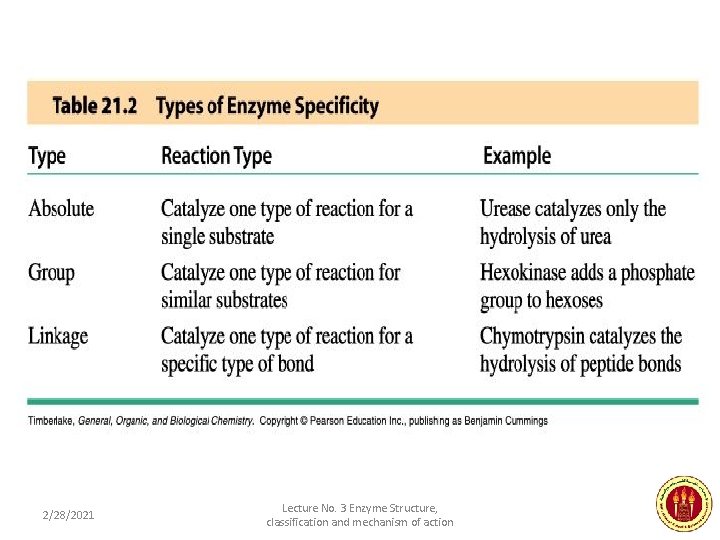
Enzyme Specificity • Enzymes have varying degrees of specificity for substrates • Enzymes may recognize and catalyze: - a single substrate - a group of similar substrates - a particular type of bond 2/28/2021 Lecture No. 3 Enzyme Structure, classification and mechanism of action
2/28/2021 Lecture No. 3 Enzyme Structure, classification and mechanism of action
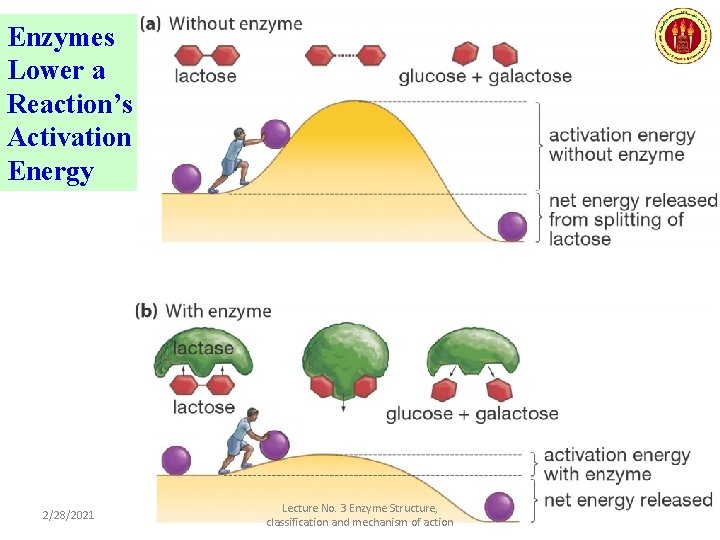
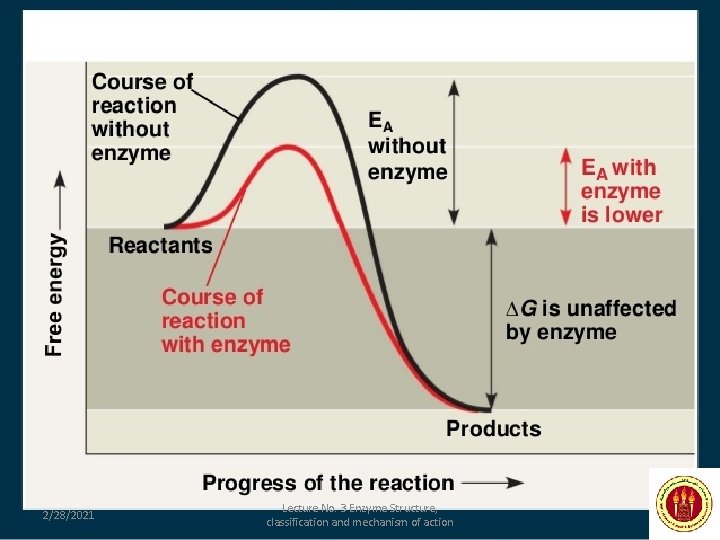
Important Terms to Understand Biochemical Nature And Activity of Enzymes Activation energy or Energy of Activation: • All chemical reactions require some amount of energy to get them started. OR • It is First push to start reaction. This energy is called activation energy. 2/28/2021 Lecture No. 3 Enzyme Structure, classification and mechanism of action
Mechanism of Action of Enzymes • Enzymes increase reaction rates by decreasing the Activation energy: • Enzyme-Substrate Interactions: ‒ Formation of Enzyme substrate complex by: ‒ Lock-and-Key Model ‒ Induced Fit Model 2/28/2021 Lecture No. 3 Enzyme Structure, classification and mechanism of action
Enzymes Lower a Reaction’s Activation Energy 2/28/2021 Lecture No. 3 Enzyme Structure, classification and mechanism of action
2/28/2021 Lecture No. 3 Enzyme Structure, classification and mechanism of action
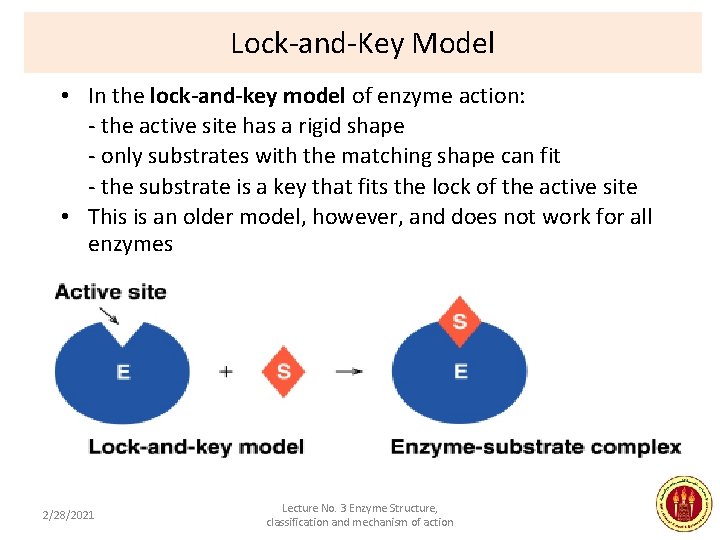
Lock-and-Key Model • In the lock-and-key model of enzyme action: - the active site has a rigid shape - only substrates with the matching shape can fit - the substrate is a key that fits the lock of the active site • This is an older model, however, and does not work for all enzymes 2/28/2021 Lecture No. 3 Enzyme Structure, classification and mechanism of action
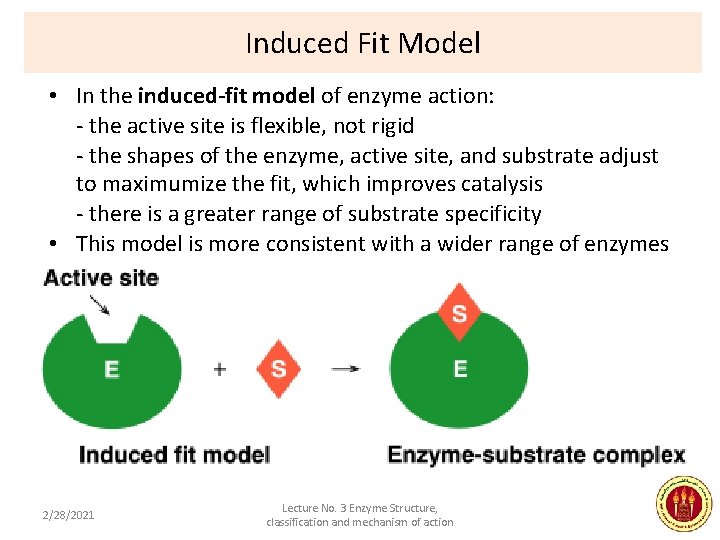
Induced Fit Model • In the induced-fit model of enzyme action: - the active site is flexible, not rigid - the shapes of the enzyme, active site, and substrate adjust to maximumize the fit, which improves catalysis - there is a greater range of substrate specificity • This model is more consistent with a wider range of enzymes 2/28/2021 Lecture No. 3 Enzyme Structure, classification and mechanism of action
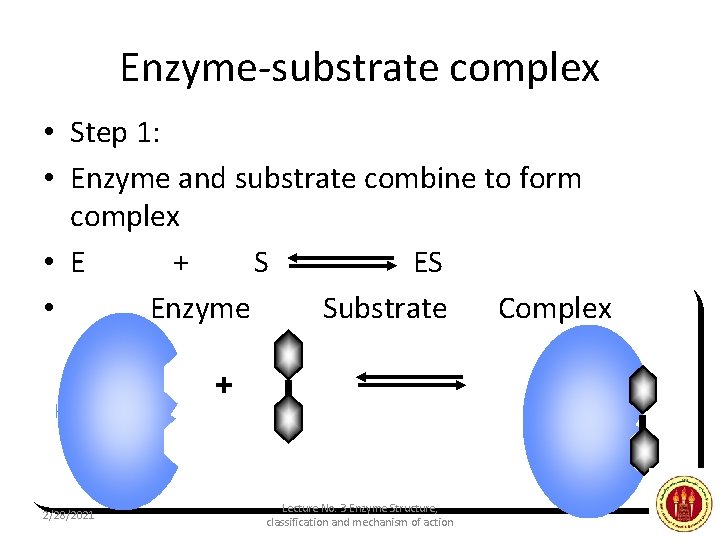
Enzyme-substrate complex • Step 1: • Enzyme and substrate combine to form complex • E + S ES • Enzyme Substrate Complex + 2/28/2021 Lecture No. 3 Enzyme Structure, classification and mechanism of action
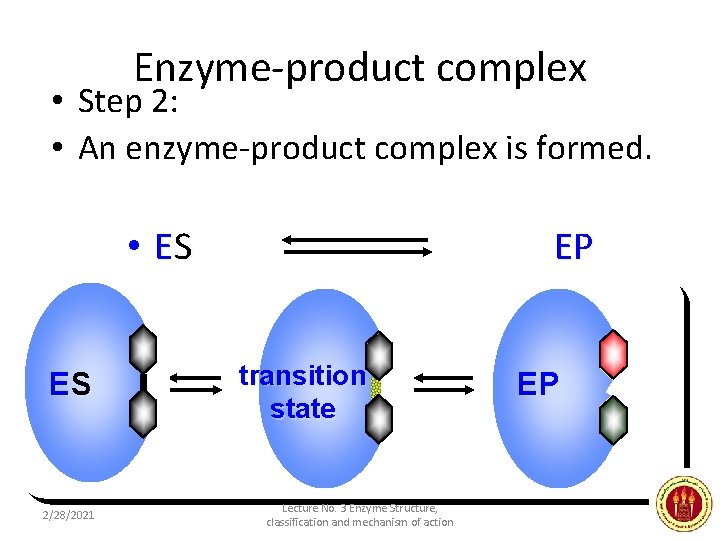
Enzyme-product complex • Step 2: • An enzyme-product complex is formed. • ES ES 2/28/2021 EP transition state Lecture No. 3 Enzyme Structure, classification and mechanism of action EP
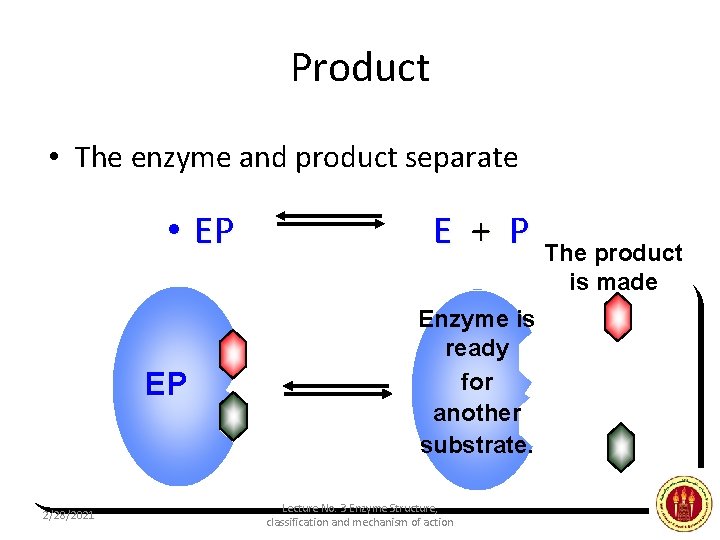
Product • The enzyme and product separate • EP EP 2/28/2021 E + P Enzyme is ready for another substrate. Lecture No. 3 Enzyme Structure, classification and mechanism of action The product is made
What Affects Enzyme Activity? • Three factors: 1. Environmental Conditions 2. Cofactors and Coenzymes 3. Enzyme Inhibitors 2/28/2021 Lecture No. 3 Enzyme Structure, classification and mechanism of action 25
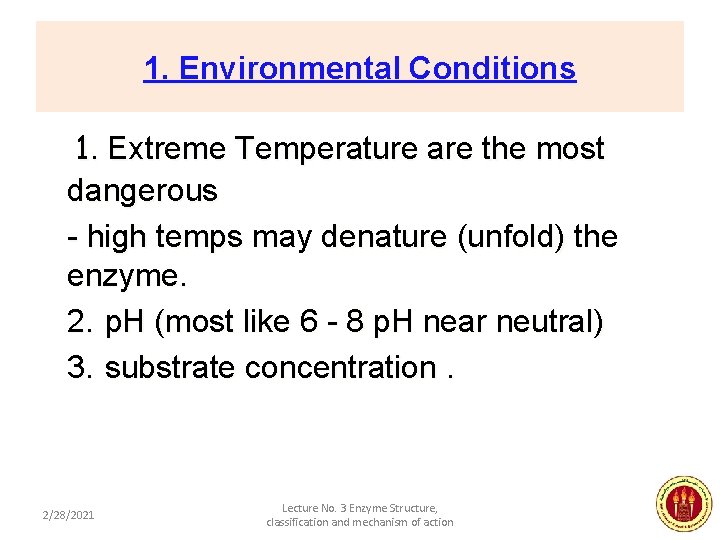
1. Environmental Conditions 1. Extreme Temperature are the most dangerous - high temps may denature (unfold) the - high temps denature (unfold) enzyme. 2. p. H (most like 6 - 8 p. H near neutral) 3. substrate concentration. 2/28/2021 Lecture No. 3 Enzyme Structure, classification and mechanism of action 26
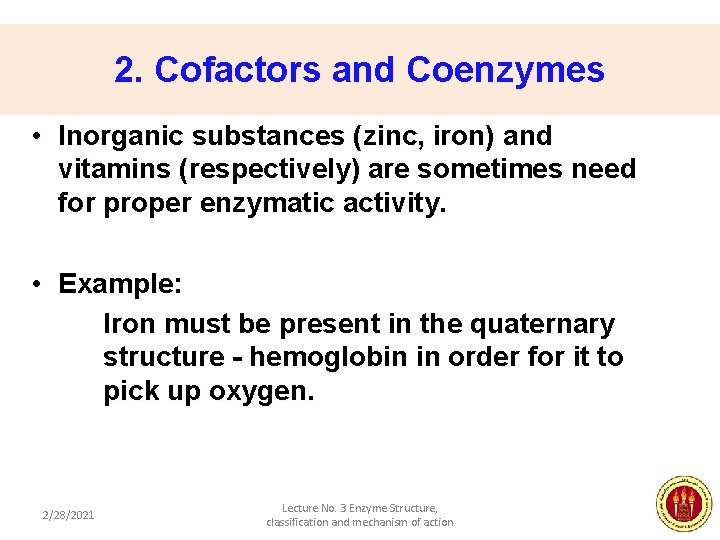
2. Cofactors and Coenzymes • Inorganic substances (zinc, iron) and vitamins (respectively) are sometimes need for proper enzymatic activity • Example: Iron must be present in the quaternary structure - hemoglobin in order for it to pick up oxygen. 2/28/2021 Lecture No. 3 Enzyme Structure, classification and mechanism of action 27
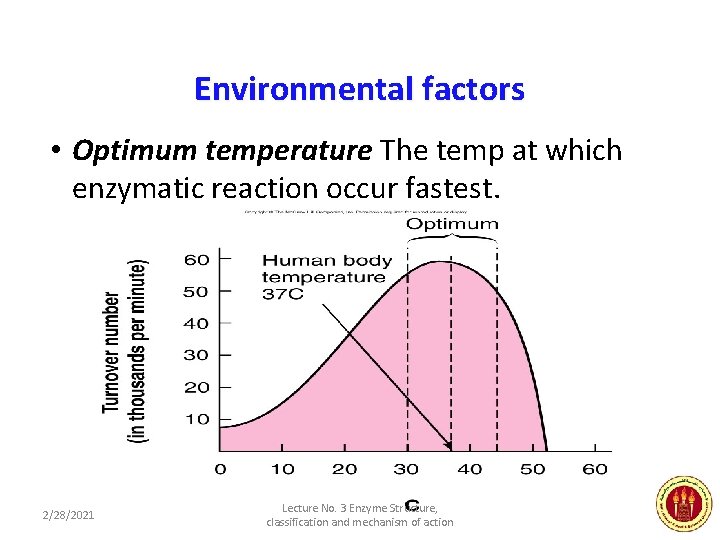
Environmental factors • Optimum temperature The temp at which enzymatic reaction occur fastest. 2/28/2021 Lecture No. 3 Enzyme Structure, classification and mechanism of action
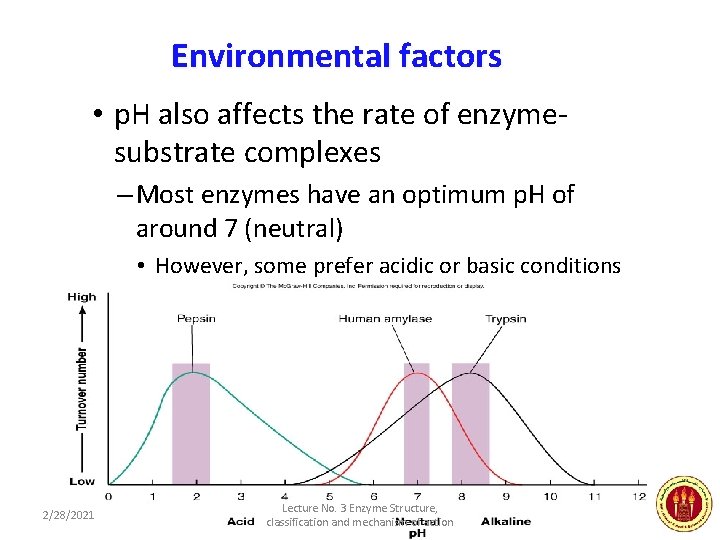
Environmental factors • p. H also affects the rate of enzymesubstrate complexes – Most enzymes have an optimum p. H of around 7 (neutral) • However, some prefer acidic or basic conditions 2/28/2021 Lecture No. 3 Enzyme Structure, classification and mechanism of action
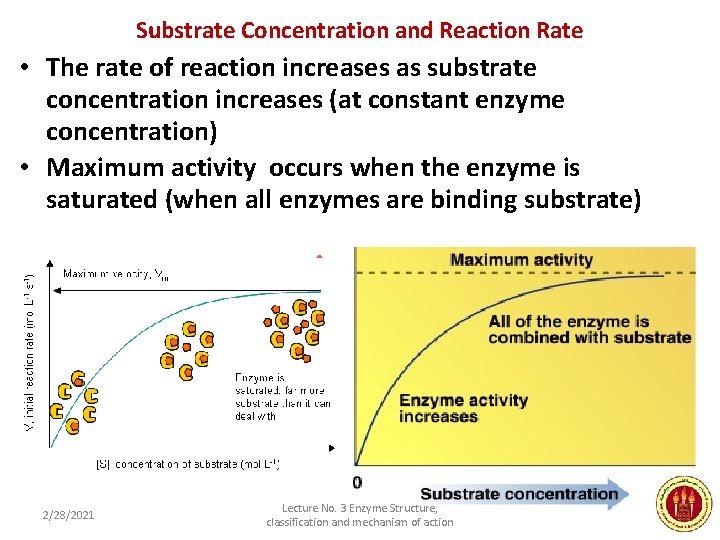
Substrate Concentration and Reaction Rate • The rate of reaction increases as substrate concentration increases (at constant enzyme concentration) • Maximum activity occurs when the enzyme is saturated (when all enzymes are binding substrate) 2/28/2021 Lecture No. 3 Enzyme Structure, classification and mechanism of action
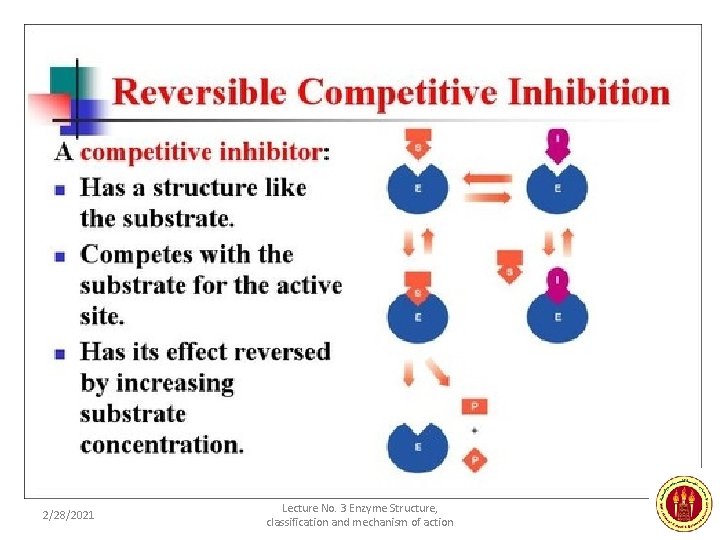
Enzyme Inhibitors • Competive - mimic substrate, may block active site, but may dislodge it. 2/28/2021 Lecture No. 3 Enzyme Structure, classification and mechanism of action
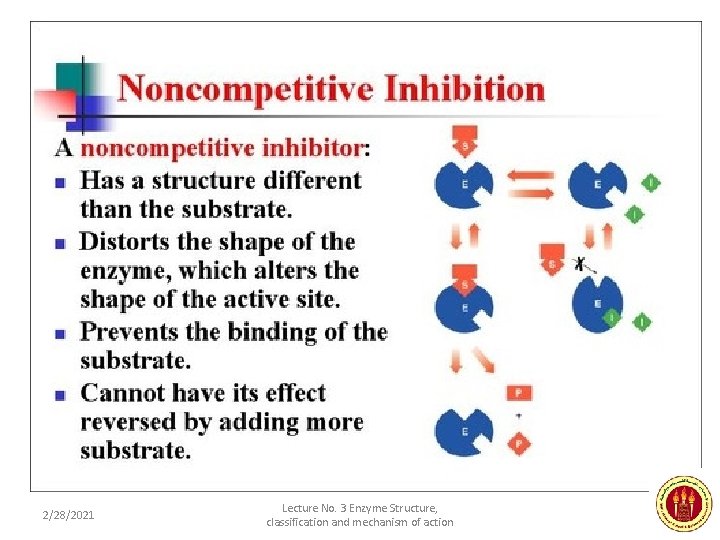
Enzyme Inhibitors • Noncompetitive 2/28/2021 Lecture No. 3 Enzyme Structure, classification and mechanism of action
Naming Enzymes • The name of an enzyme in many cases end in –ase • For example, sucrase catalyzes the hydrolysis of sucrose • The name describes the function of the enzyme For example, oxidases catalyze oxidation reactions • Sometimes common names are used, particularly for the digestion enzymes such as pepsin and trypsin • Some names describe both the substrate and the function • For example, alcohol dehydrogenase oxides ethanol 2/28/2021 Lecture No. 3 Enzyme Structure, classification and mechanism of action
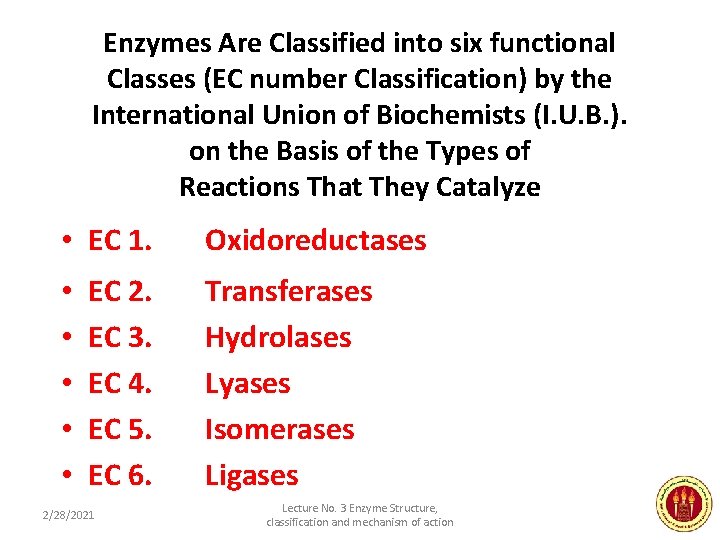
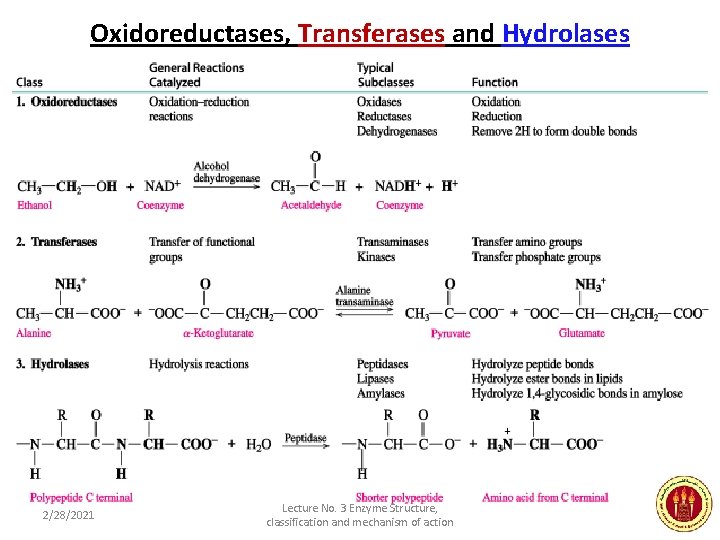
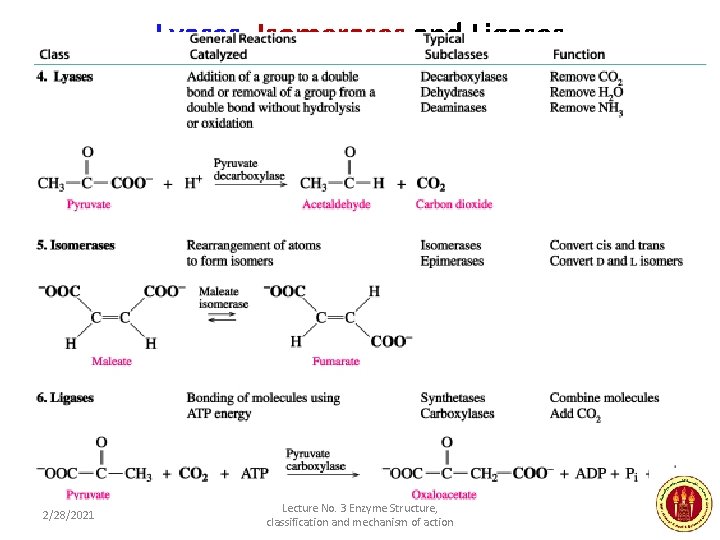
Enzymes Are Classified into six functional Classes (EC number Classification) by the International Union of Biochemists (I. U. B. ). on the Basis of the Types of Reactions That They Catalyze • EC 1. • • • EC 2. EC 3. EC 4. EC 5. EC 6. 2/28/2021 Oxidoreductases Transferases Hydrolases Lyases Isomerases Ligases Lecture No. 3 Enzyme Structure, classification and mechanism of action
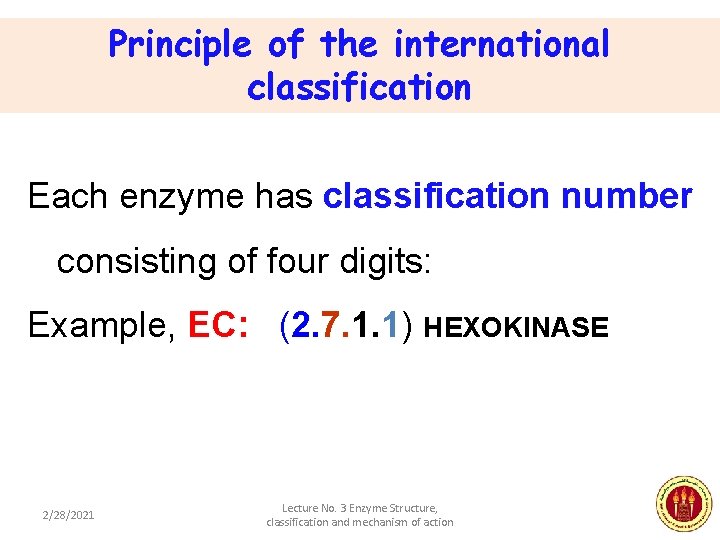
Principle of the international classification Each enzyme has classification number consisting of four digits: Example, EC: (2. 7. 1. 1) HEXOKINASE 2/28/2021 Lecture No. 3 Enzyme Structure, classification and mechanism of action
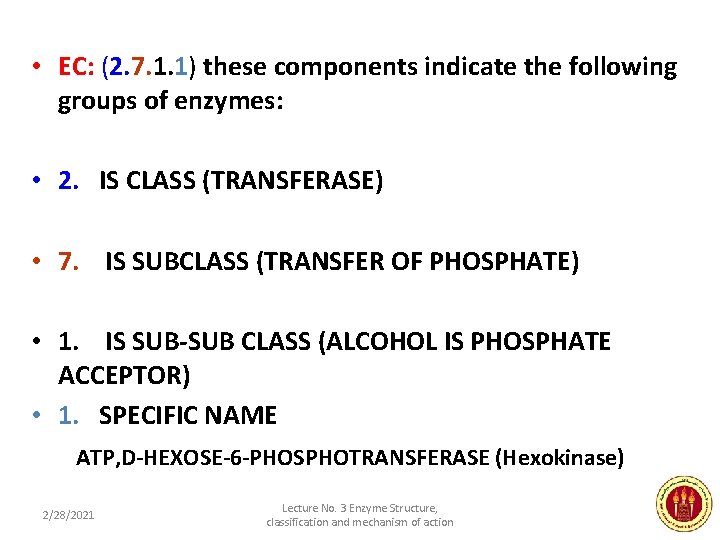
• EC: (2. 7. 1. 1) these components indicate the following groups of enzymes: • 2. IS CLASS (TRANSFERASE) • 7. IS SUBCLASS (TRANSFER OF PHOSPHATE) • 1. IS SUB-SUB CLASS (ALCOHOL IS PHOSPHATE ACCEPTOR) • 1. SPECIFIC NAME ATP, D-HEXOSE-6 -PHOSPHOTRANSFERASE (Hexokinase) 2/28/2021 Lecture No. 3 Enzyme Structure, classification and mechanism of action
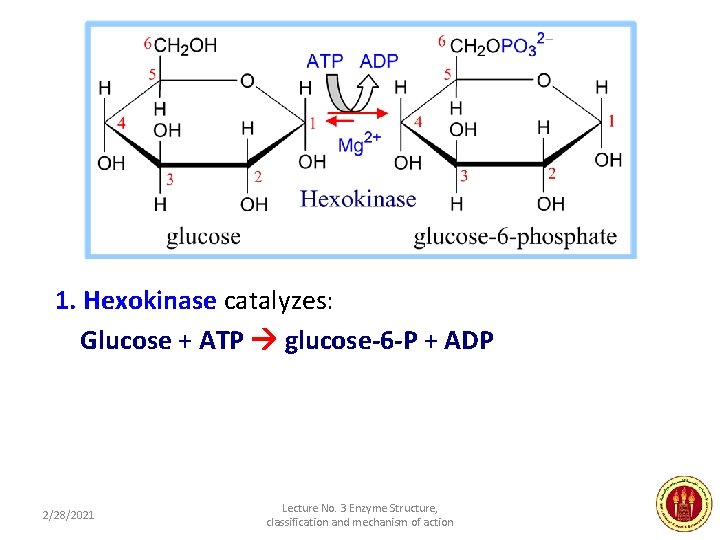
1. Hexokinase catalyzes: Glucose + ATP glucose-6 -P + ADP 2/28/2021 Lecture No. 3 Enzyme Structure, classification and mechanism of action
Oxidoreductases, Transferases and Hydrolases 2/28/2021 Lecture No. 3 Enzyme Structure, classification and mechanism of action
Lyases, Isomerases and Ligases 2/28/2021 Lecture No. 3 Enzyme Structure, classification and mechanism of action