
ENZYME LAB EFFECT OF TEMPERATURE AND PH ON
ENZYME LAB EFFECT OF TEMPERATURE AND PH ON AMYLASE’S ABILITY TO TRANSFORM STARCH INTO MALTOSE (SUGAR)

Amylase AMYLASE is an enzyme that is found in our bodies that functions to help the body in the digestion food. Amylase is found in saliva and in the pancreas. Amylase catalyzes the hydrolysis (breaking down) of starch, glycogen and related polysaccharides into more simple and readily usable forms of sugar.
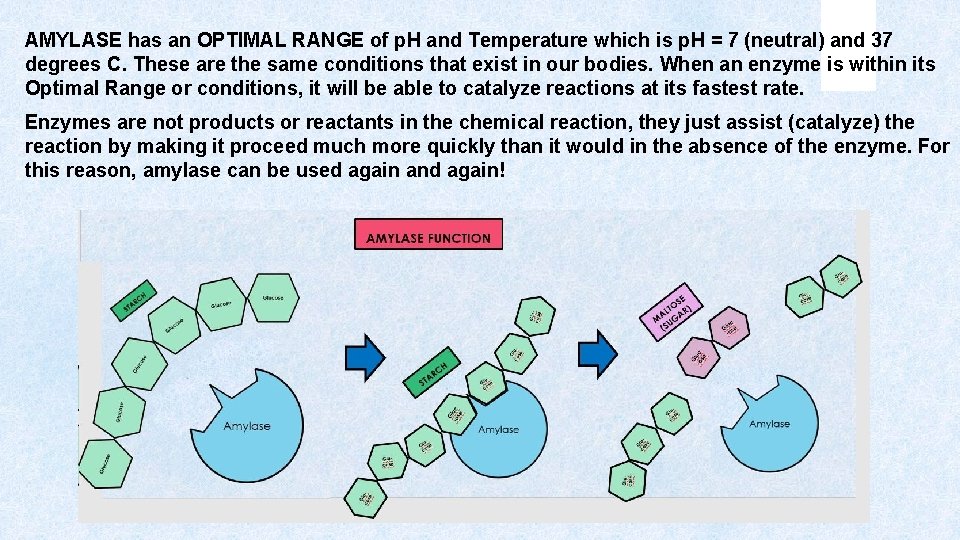
AMYLASE has an OPTIMAL RANGE of p. H and Temperature which is p. H = 7 (neutral) and 37 degrees C. These are the same conditions that exist in our bodies. When an enzyme is within its Optimal Range or conditions, it will be able to catalyze reactions at its fastest rate. Enzymes are not products or reactants in the chemical reaction, they just assist (catalyze) the reaction by making it proceed much more quickly than it would in the absence of the enzyme. For this reason, amylase can be used again and again!
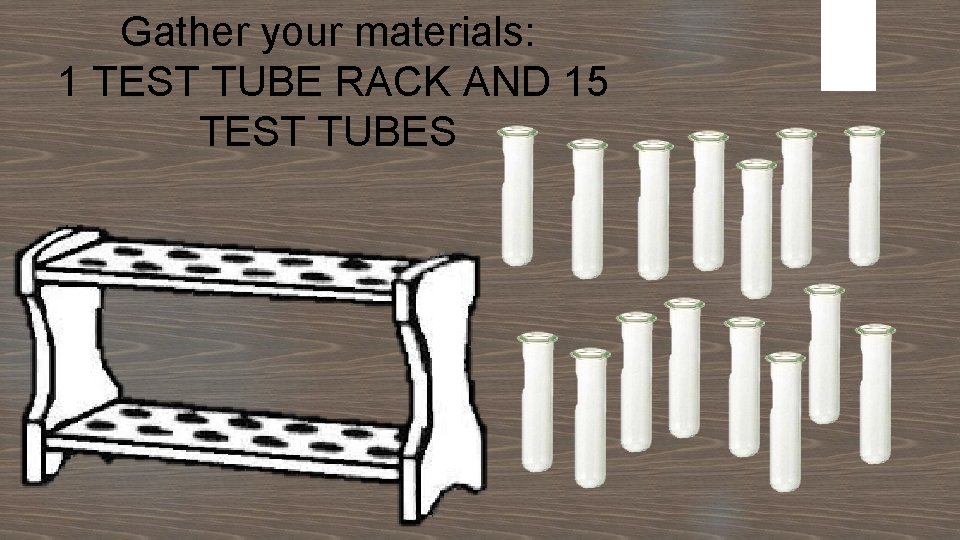
Gather your materials: 1 TEST TUBE RACK AND 15 TEST TUBES
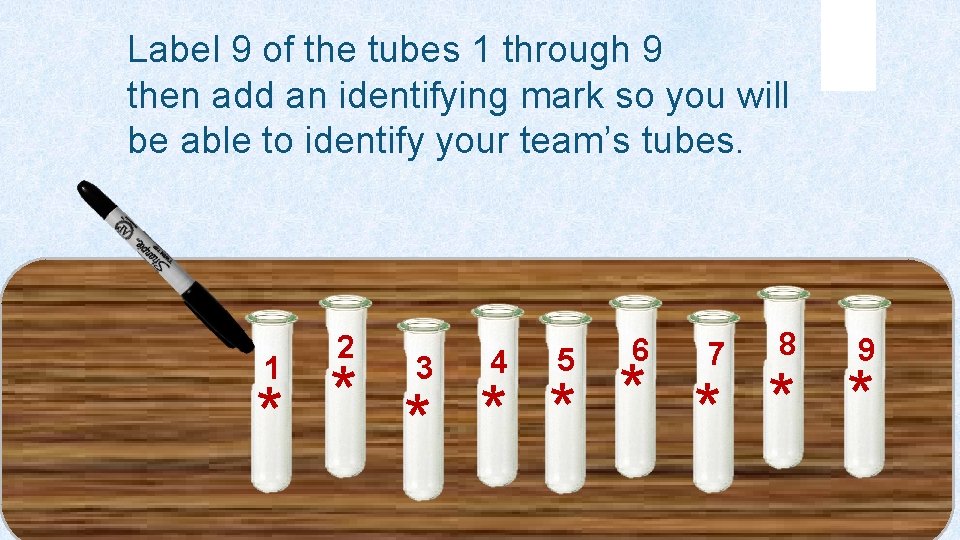
Label 9 of the tubes 1 through 9 then add an identifying mark so you will be able to identify your team’s tubes. 1 2 3 4 5 6 7 8 9 * * * * *
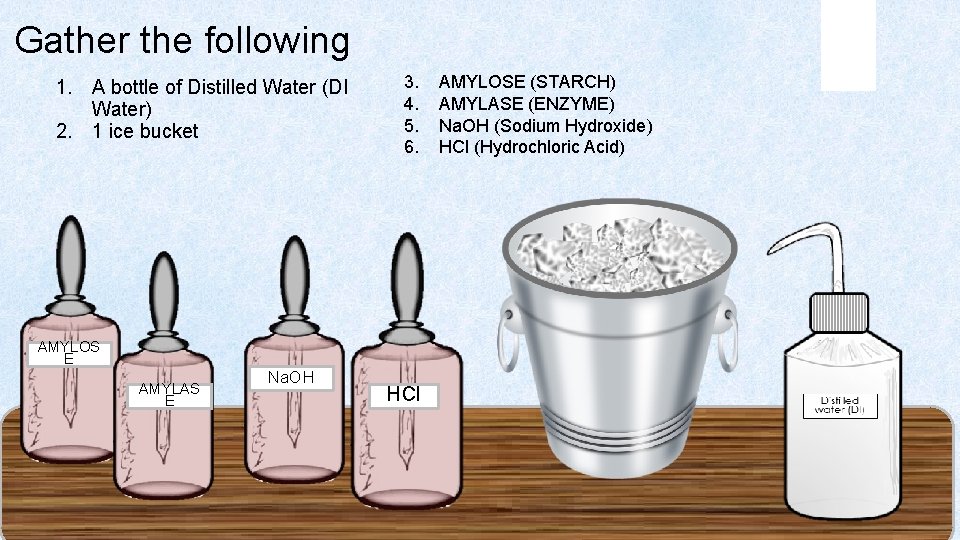
Gather the following 1. A bottle of Distilled Water (DI Water) 2. 1 ice bucket 3. AMYLOSE (STARCH) 4. AMYLASE (ENZYME) 5. Na. OH (Sodium Hydroxide) 6. HCl (Hydrochloric Acid) AMYLOS E AMYLAS E Na. OH HCl
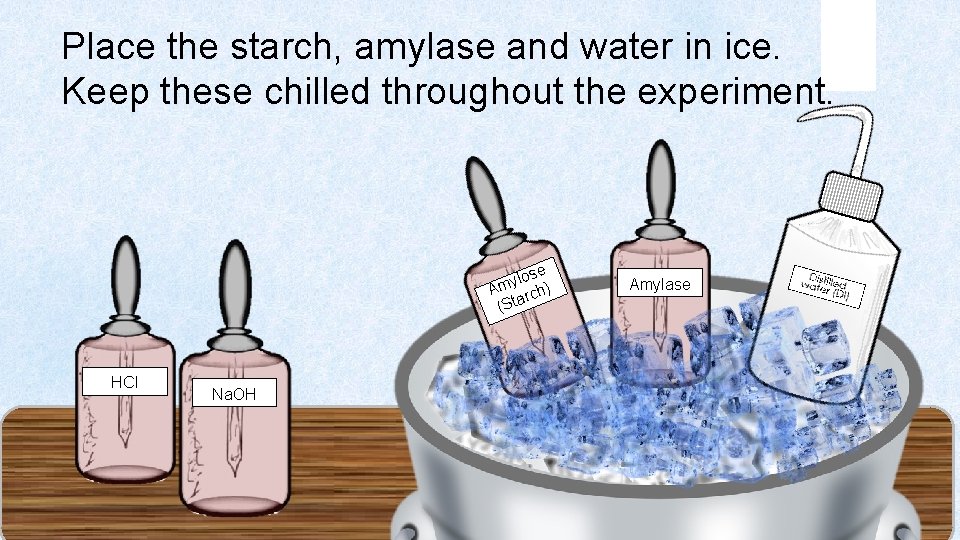
Place the starch, amylase and water in ice. Keep these chilled throughout the experiment. ose l y Am rch) (Sta Na. OH HCl Na. OH Amylase
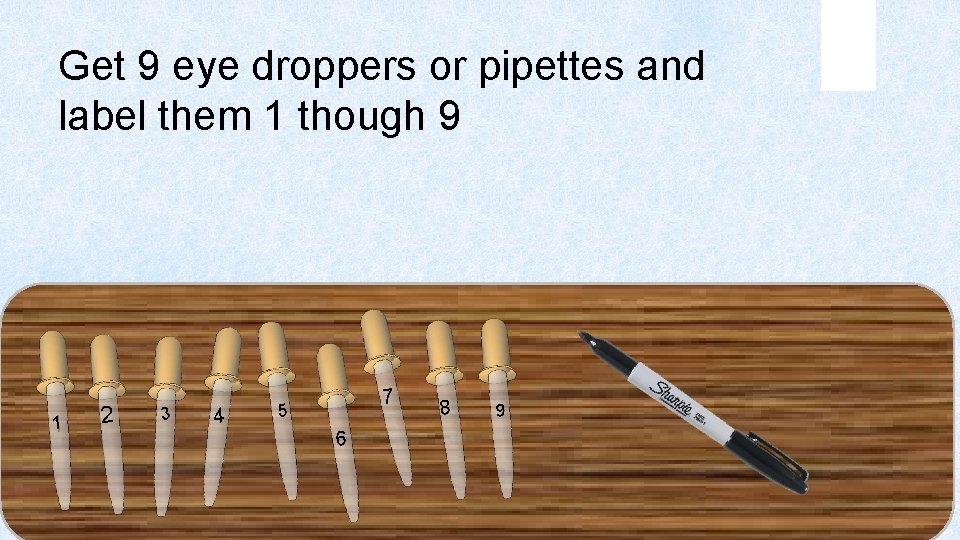
Get 9 eye droppers or pipettes and label them 1 though 9 1 1 2 3 4 7 5 6 8 9
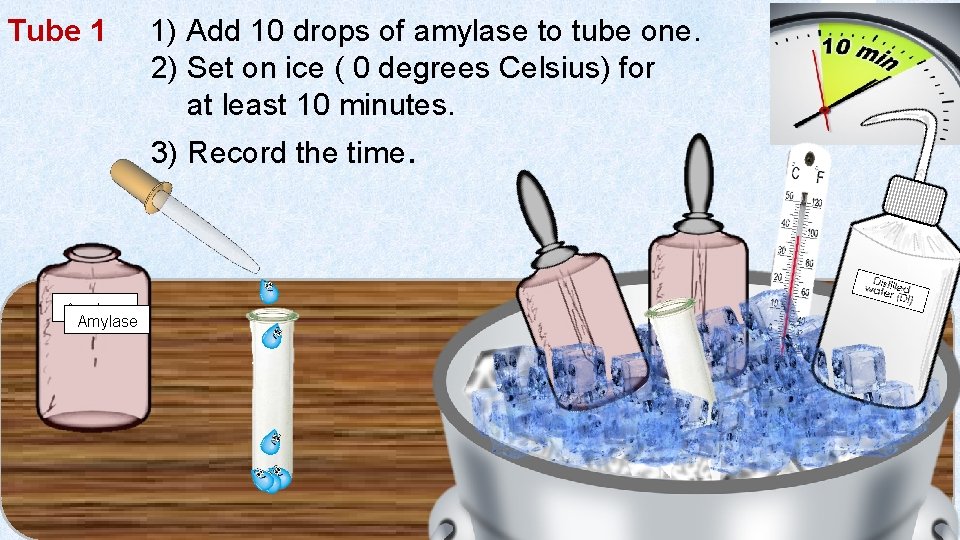
Tube 1 1) Add 10 drops of amylase to tube one. 2) Set on ice ( 0 degrees Celsius) for at least 10 minutes. 3) Record the time. Amylase 11 1
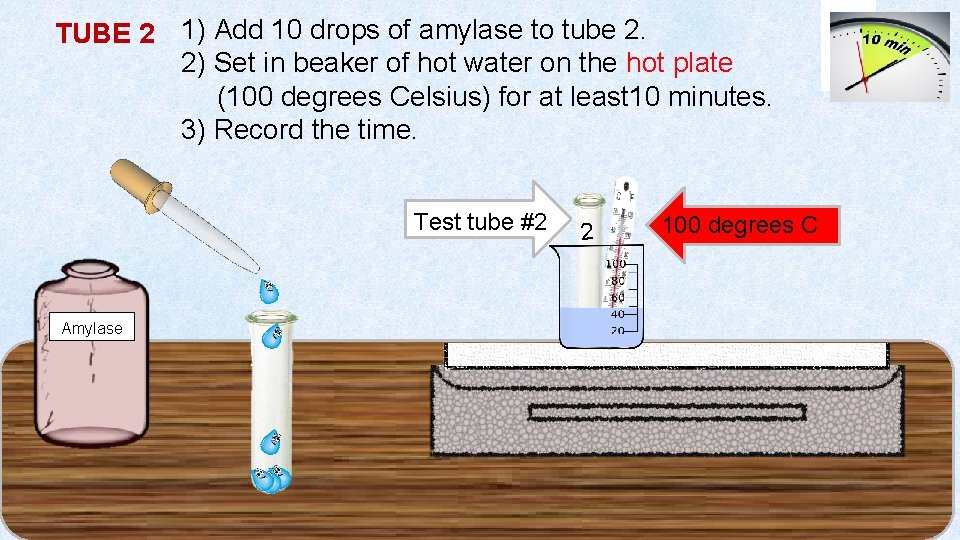
TUBE 2 1) Add 10 drops of amylase to tube 2. 2) Set in beaker of hot water on the hot plate (100 degrees Celsius) for at least 10 minutes. 3) Record the time. Test tube #2 Amylase 22 2 2 100 degrees C
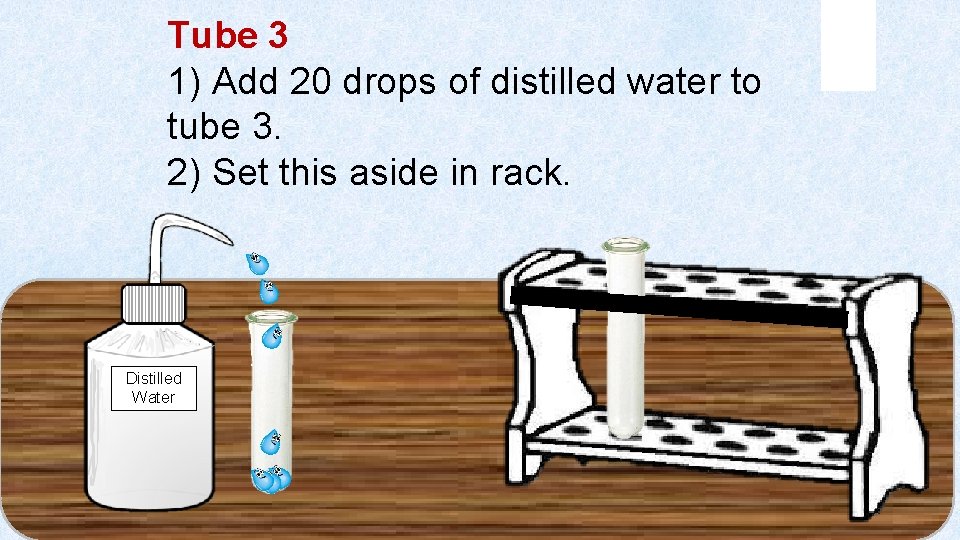
Tube 3 1) Add 20 drops of distilled water to tube 3. 2) Set this aside in rack. Distilled Water 33 *
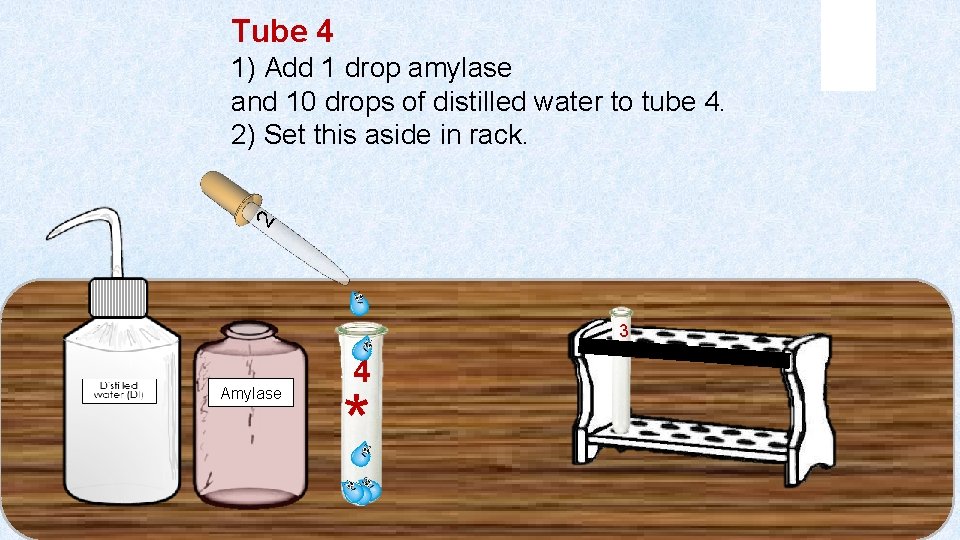
Tube 4 2 1) Add 1 drop amylase and 10 drops of distilled water to tube 4. 2) Set this aside in rack. 3 Amylase 4 *
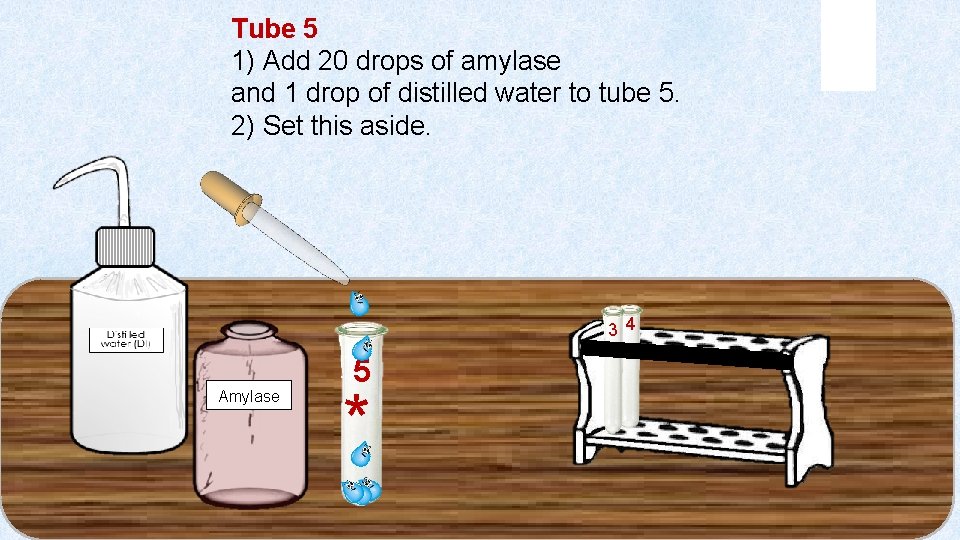
Tube 5 1) Add 20 drops of amylase and 1 drop of distilled water to tube 5. 2) Set this aside. 3 4 Amylase 5 *
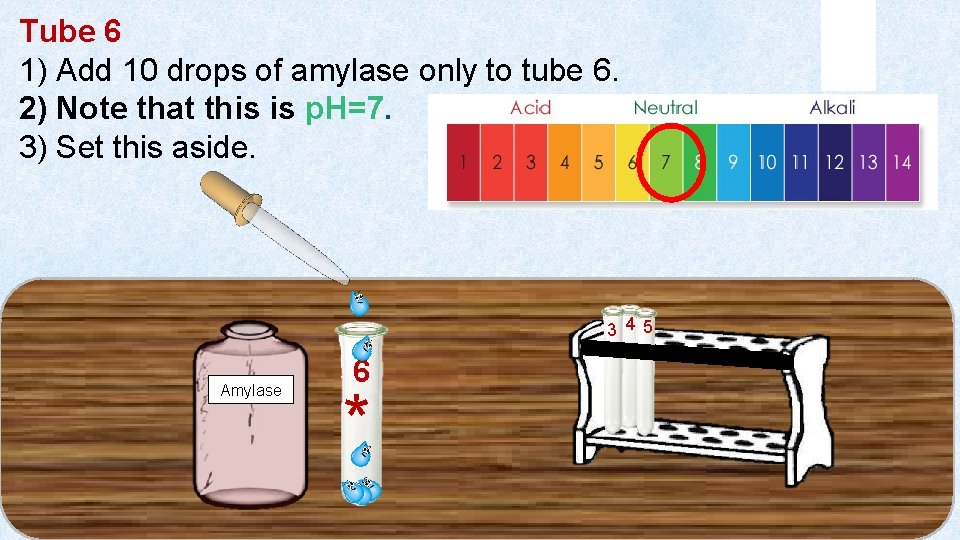
Tube 6 1) Add 10 drops of amylase only to tube 6. 2) Note that this is p. H=7. 3) Set this aside. 3 45 Amylase 6 *
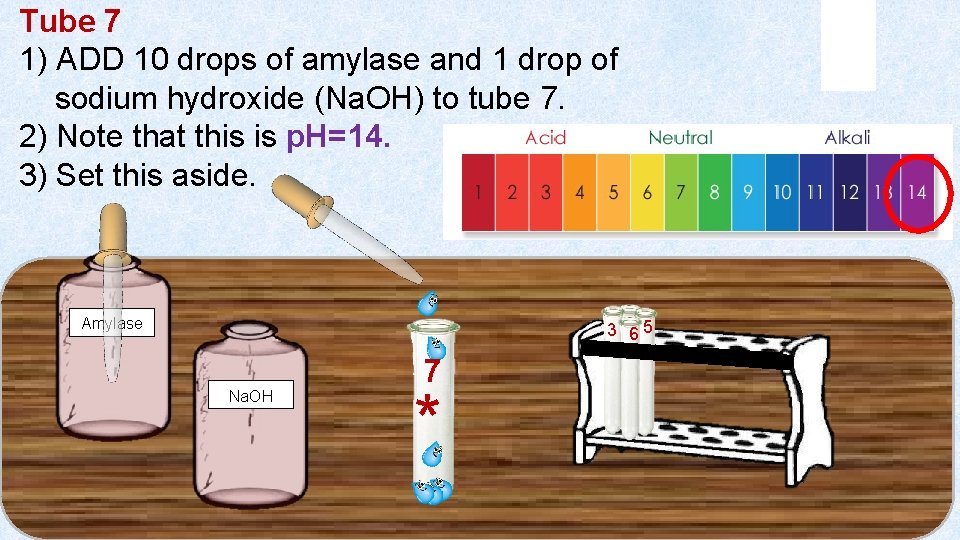
Tube 7 1) ADD 10 drops of amylase and 1 drop of sodium hydroxide (Na. OH) to tube 7. 2) Note that this is p. H=14. 3) Set this aside. 3 46 5 Amylase Na. OH 7 *
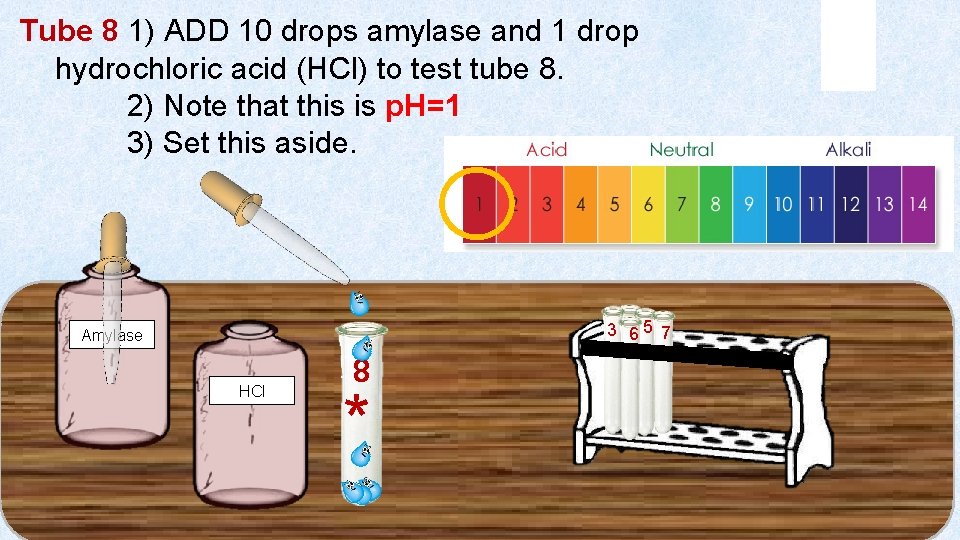
Tube 8 1) ADD 10 drops amylase and 1 drop hydrochloric acid (HCl) to test tube 8. 2) Note that this is p. H=1 3) Set this aside. 3 46 5 7 Amylase HCl 8 *
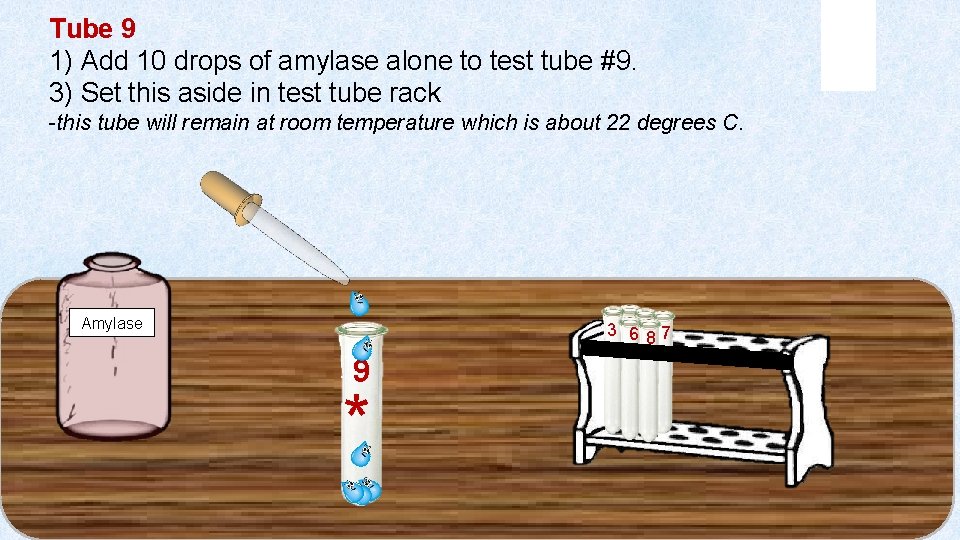
Tube 9 1) Add 10 drops of amylase alone to test tube #9. 3) Set this aside in test tube rack -this tube will remain at room temperature which is about 22 degrees C. 3 46 58 7 Amylase 9 *

TUBES 3, 4, 5, 6, 7, and 8 ONLY 1) Add 20 drops of amylose (starch) to tubes 3, 4, 5, 6, 7, and 8 ONLY (do not add to tube #9) 20 drops in EACH tube!. Amylose (starch) 33 4 5 6 7 8
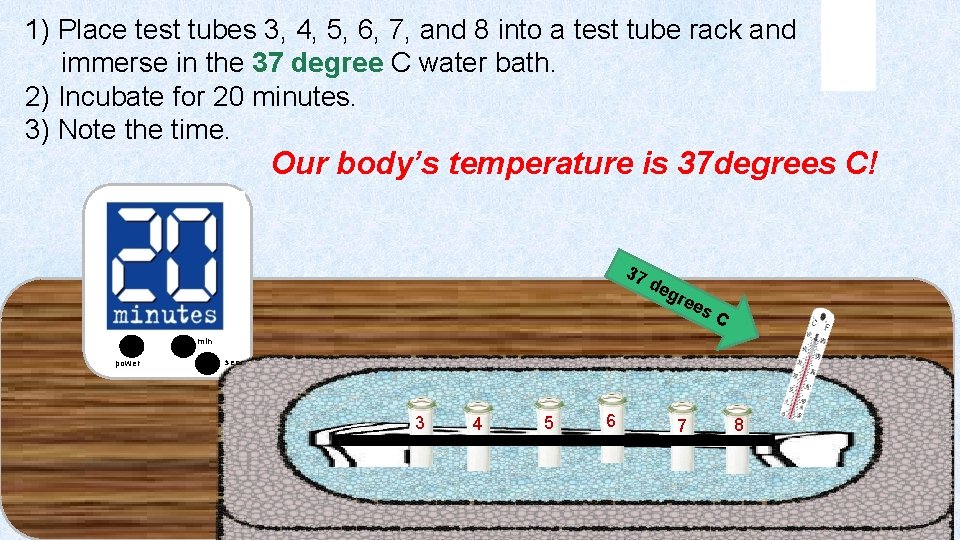
1) Place test tubes 3, 4, 5, 6, 7, and 8 into a test tube rack and immerse in the 37 degree C water bath. 2) Incubate for 20 minutes. 3) Note the time. Our body’s temperature is 37 degrees C! 37 d eg ree s C min power sec 3 4 5 6 7 8
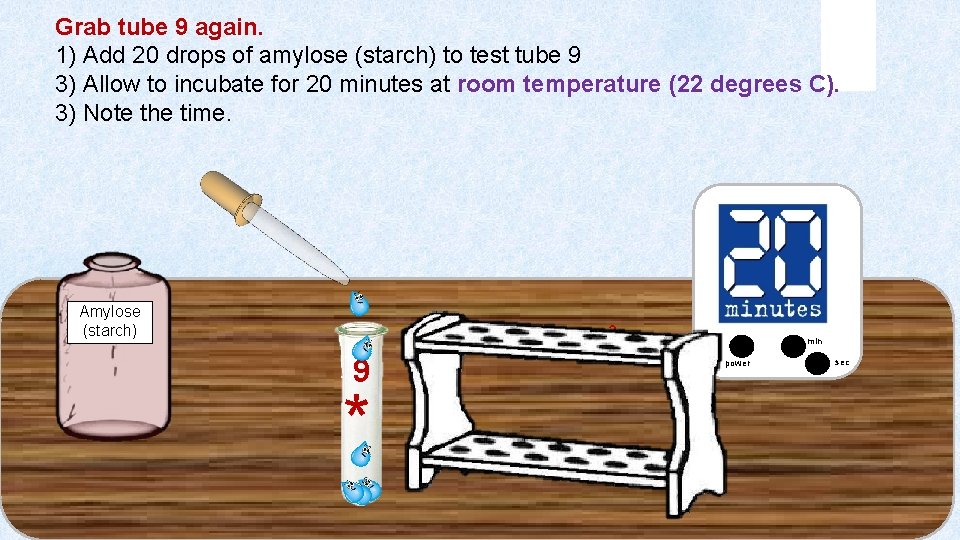
Grab tube 9 again. 1) Add 20 drops of amylose (starch) to test tube 9 3) Allow to incubate for 20 minutes at room temperature (22 degrees C). 3) Note the time. Amylose (starch) 3 9 * min power sec
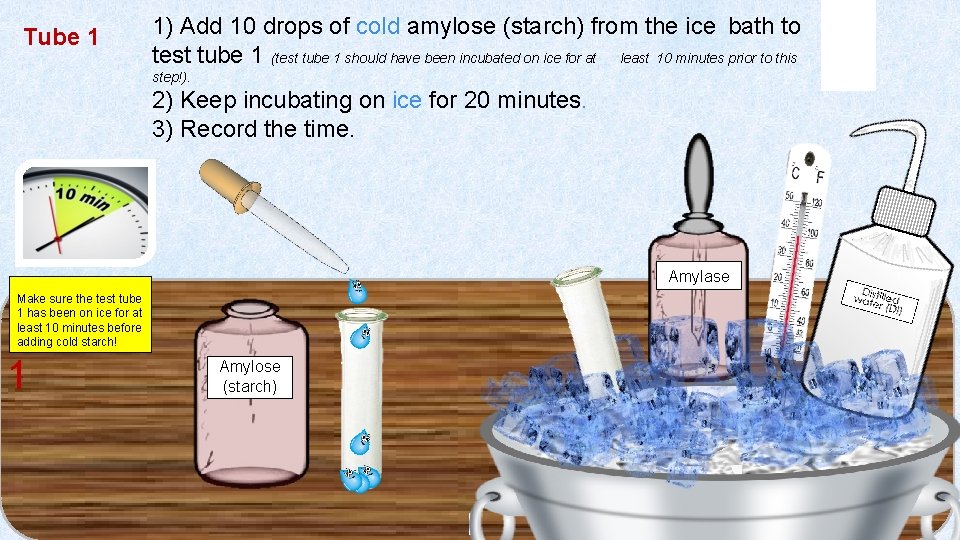
Tube 1 1) Add 10 drops of cold amylose (starch) from the ice bath to test tube 1 (test tube 1 should have been incubated on ice for at least 10 minutes prior to this step!). 2) Keep incubating on ice for 20 minutes. 3) Record the time. Amylase Make sure the test tube 1 has been on ice for at least 10 minutes before adding cold starch! 1 Amylose (starch) 1 1

TUBE 2 1) Add 20 drops of amylose (starch) to test tube 1 incubating on the hot plate at 100 degrees Celsius (test tube Make s incub ure the te a s befor ting for at t tube 1 h l e add a ing s east 10 m s been tarch inute !1 s 1 should have been incubated on ice for at least 10 minutes prior to this step!). 2) Keep incubating on hot plate for another 20 minutes. 3) Record the time. Amylose (starch) Test tube #2 100 degrees C
Let tubes 1 through 9 incubate for 20 minutes from the time starch was added min power sec While you are waiting, set up your SPOT PLATE! See next slide.
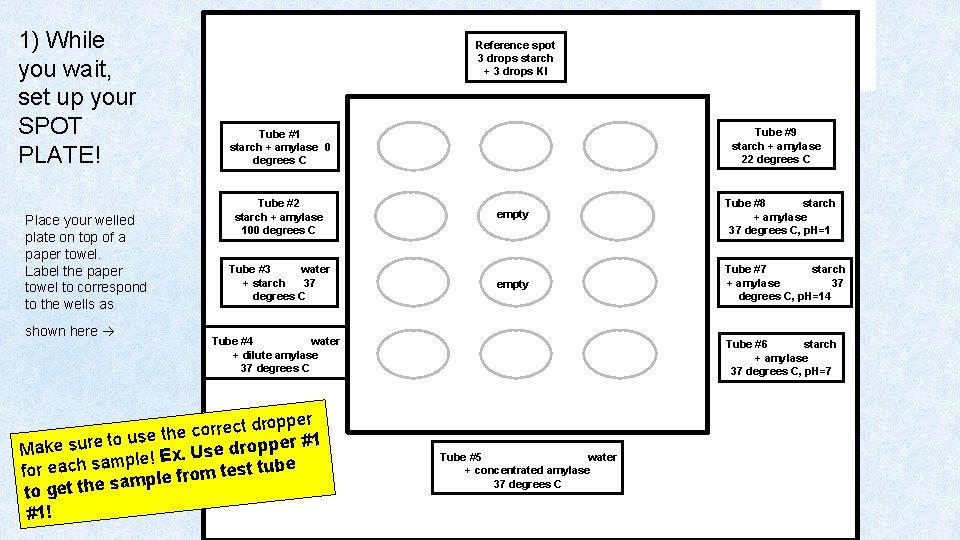
1) While you wait, set up your SPOT PLATE! Place your welled plate on top of a paper towel. Label the paper towel to correspond to the wells as shown here Reference spot 3 drops starch + 3 drops KI Tube #2 starch + amylase 100 degrees C empty Tube #8 starch + amylase 37 degrees C, p. H=1 Tube #3 water + starch 37 degrees C empty Tube #7 starch + amylase 37 degrees C, p. H=14 Tube #4 water + dilute amylase 37 degrees C per p o r d t c e r r se the co u o t e r u per #1 s p o r d Make e s U mple! Ex. a s h c a e t tube r s e fo t m o r f e sampl to get the #1! Tube #9 starch + amylase 22 degrees C Tube #1 starch + amylase 0 degrees C Tube #6 starch + amylase 37 degrees C, p. H=7 Tube #5 water + concentrated amylase 37 degrees C
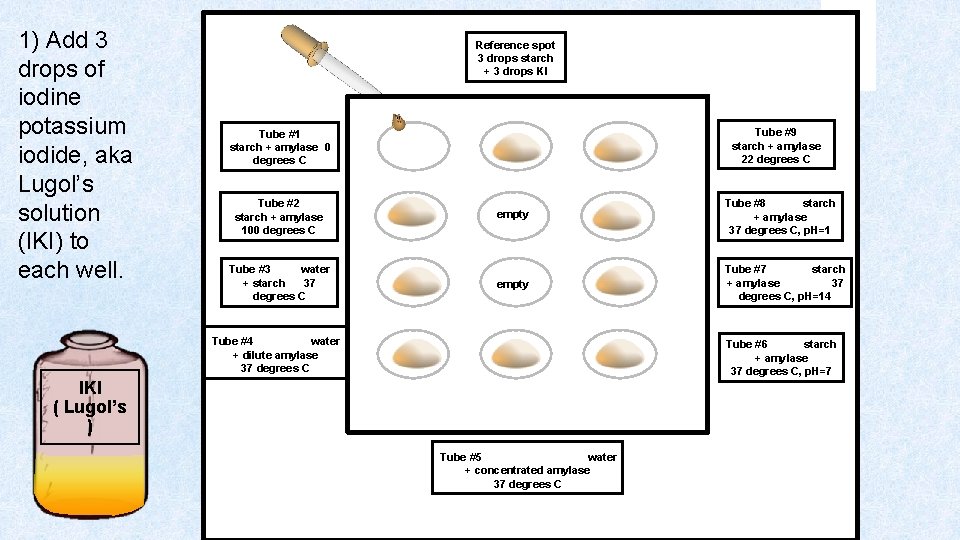
1) Add 3 drops of iodine potassium iodide, aka Lugol’s solution (IKI) to each well. Reference spot 3 drops starch + 3 drops KI Tube #9 starch + amylase 22 degrees C Tube #1 starch + amylase 0 degrees C Tube #2 starch + amylase 100 degrees C empty Tube #8 starch + amylase 37 degrees C, p. H=1 Tube #3 water + starch 37 degrees C empty Tube #7 starch + amylase 37 degrees C, p. H=14 Tube #4 water + dilute amylase 37 degrees C Tube #6 starch + amylase 37 degrees C, p. H=7 IKI ( Lugol’s ) Tube #5 water + concentrated amylase 37 degrees C
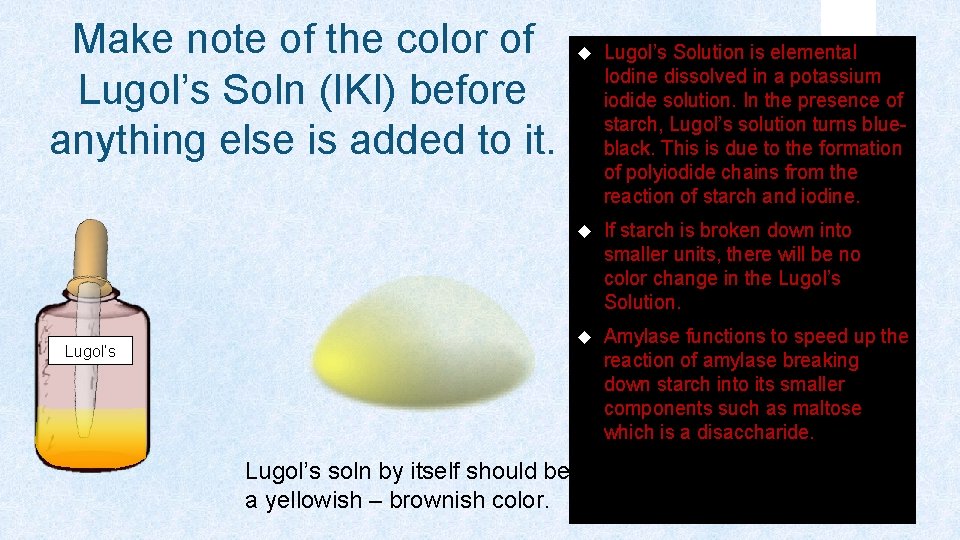
Make note of the color of Lugol’s Soln (IKI) before anything else is added to it. Lugol’s Solution is elemental Iodine dissolved in a potassium iodide solution. In the presence of starch, Lugol’s solution turns blueblack. This is due to the formation of polyiodide chains from the reaction of starch and iodine. If starch is broken down into smaller units, there will be no color change in the Lugol’s Solution. Amylase functions to speed up the reaction of amylase breaking down starch into its smaller components such as maltose which is a disaccharide. Lugol’s soln by itself should be a yellowish – brownish color.
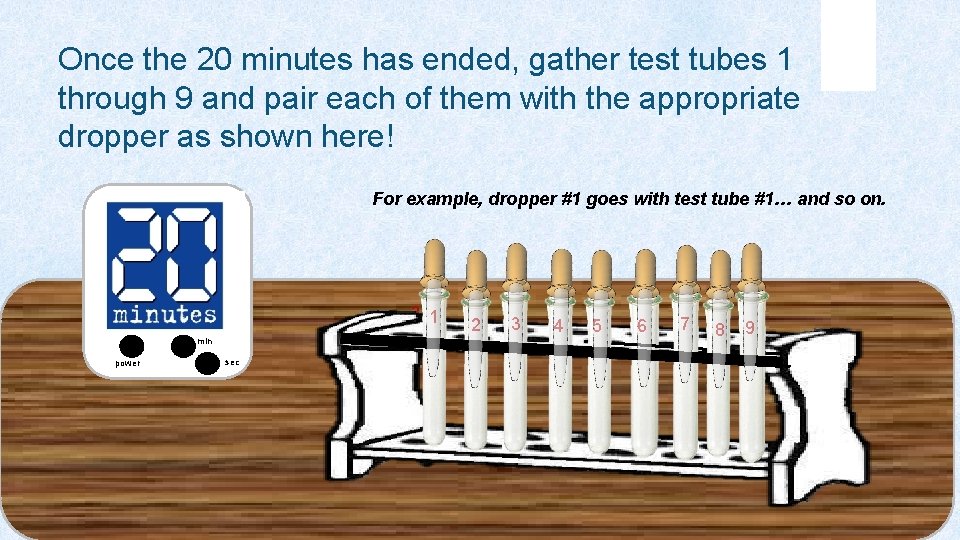
Once the 20 minutes has ended, gather test tubes 1 through 9 and pair each of them with the appropriate dropper as shown here! For example, dropper #1 goes with test tube #1… and so on. 3 1 min power sec 2 3 54 5 6 7 8 9
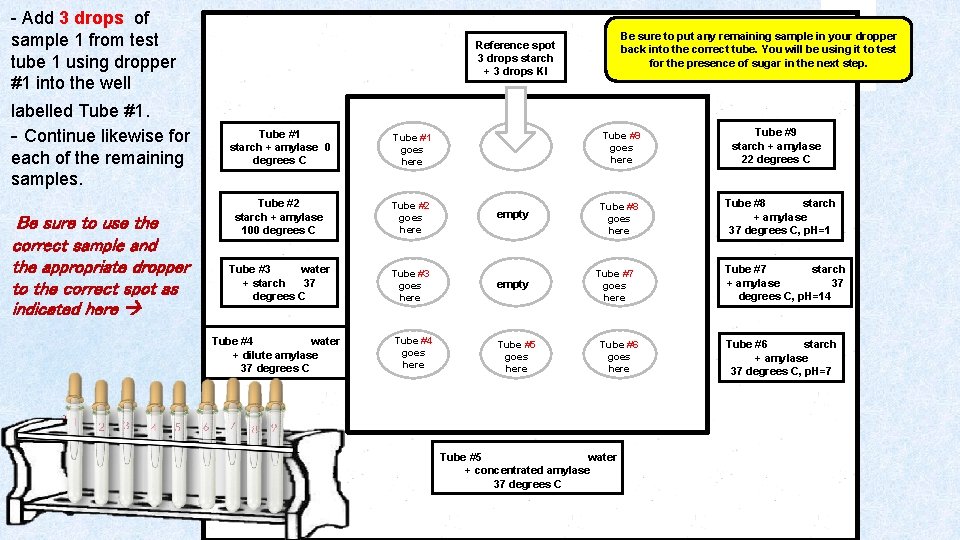
- Add 3 drops of sample 1 from test tube 1 using dropper #1 into the well labelled Tube #1. - Continue likewise for each of the remaining samples. Be sure to use the correct sample and the appropriate dropper to the correct spot as indicated here Reference spot 3 drops starch + 3 drops KI Tube #1 starch + amylase 0 degrees C Tube #1 goes here Tube #2 starch + amylase 100 degrees C Tube #2 goes here empty Tube #3 water + starch 37 degrees C Tube #3 goes here empty Tube #4 water + dilute amylase 37 degrees C Tube #4 goes here Be sure to put any remaining sample in your dropper back into the correct tube. You will be using it to test for the presence of sugar in the next step. Tube #9 goes here Tube #5 goes here Tube #8 goes here Tube #7 goes here Tube #6 goes here Tube #5 water + concentrated amylase 37 degrees C Tube #9 starch + amylase 22 degrees C Tube #8 starch + amylase 37 degrees C, p. H=1 Tube #7 starch + amylase 37 degrees C, p. H=14 Tube #6 starch + amylase 37 degrees C, p. H=7
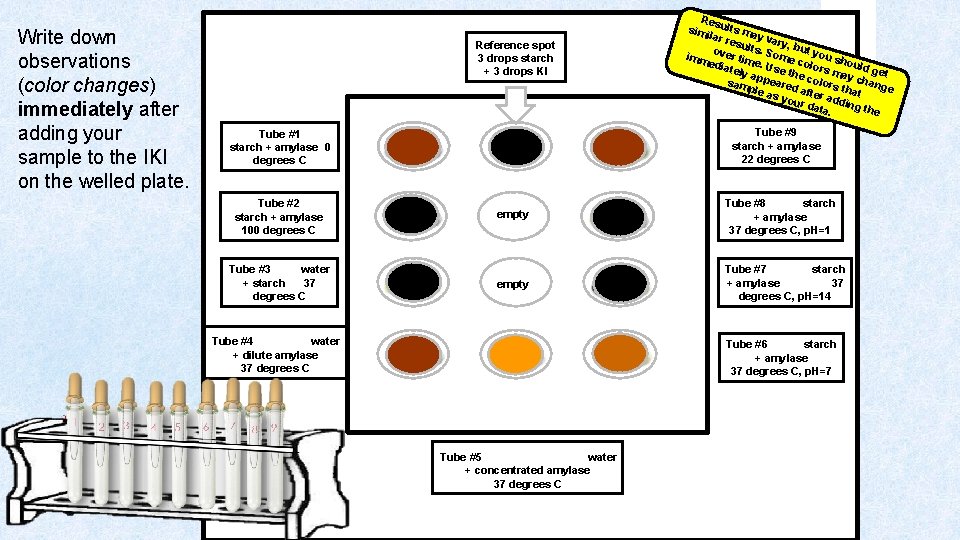
Write down observations (color changes) immediately after adding your sample to the IKI on the welled plate. Reference spot 3 drops starch + 3 drops KI Res simi ults ma lar r y esul vary, b t ut s. o imm ver tim Some c you sh ould e. U edia olor s g tely s app e the co may ch et eare l sam a o nge rs th d ple a s yo after ad at ding ur d ata. the Tube #9 starch + amylase 22 degrees C Tube #1 starch + amylase 0 degrees C Tube #2 starch + amylase 100 degrees C empty Tube #8 starch + amylase 37 degrees C, p. H=1 Tube #3 water + starch 37 degrees C empty Tube #7 starch + amylase 37 degrees C, p. H=14 Tube #4 water + dilute amylase 37 degrees C Tube #6 starch + amylase 37 degrees C, p. H=7 Tube #5 water + concentrated amylase 37 degrees C
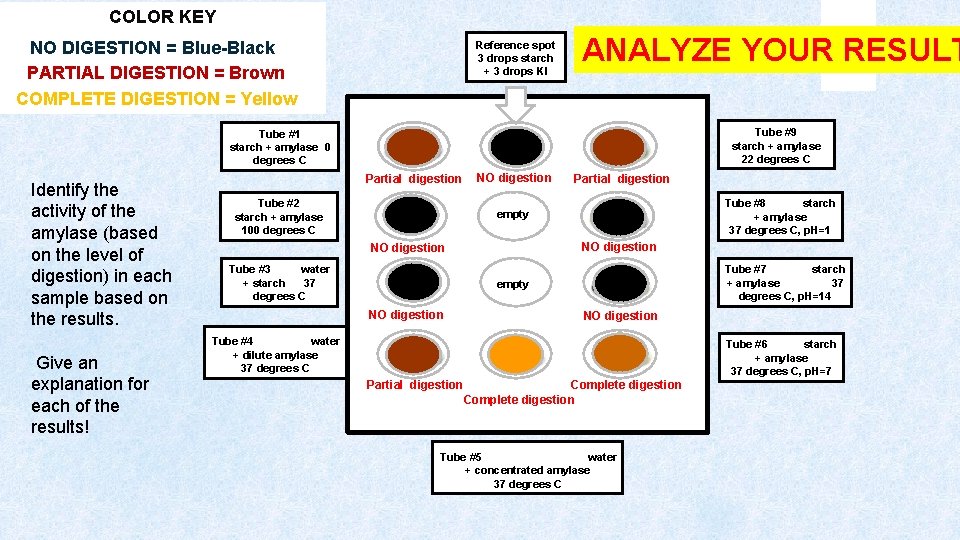
COLOR KEY NO DIGESTION = Blue-Black PARTIAL DIGESTION = Brown COMPLETE DIGESTION = Yellow Reference spot 3 drops starch + 3 drops KI ANALYZE YOUR RESULT Tube #9 starch + amylase 22 degrees C Tube #1 starch + amylase 0 degrees C Identify the activity of the amylase (based on the level of digestion) in each sample based on the results. Give an explanation for each of the results! Partial digestion Tube #2 starch + amylase 100 degrees C NO digestion Partial digestion Tube #8 starch + amylase 37 degrees C, p. H=1 empty NO digestion Tube #3 water + starch 37 degrees C Tube #7 starch + amylase 37 degrees C, p. H=14 empty NO digestion Tube #4 water + dilute amylase 37 degrees C Tube #6 starch + amylase 37 degrees C, p. H=7 Partial digestion Complete digestion Tube #5 water + concentrated amylase 37 degrees C
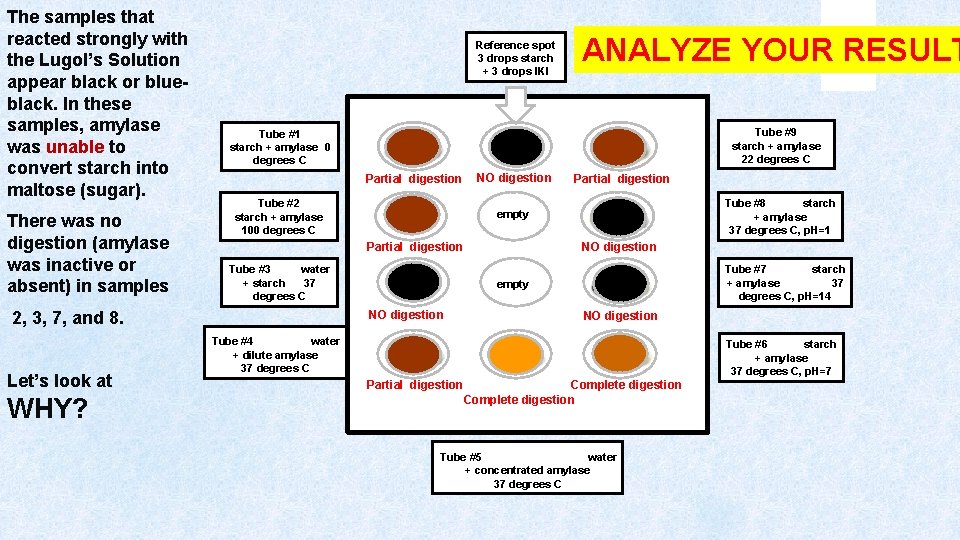
The samples that reacted strongly with the Lugol’s Solution appear black or blueblack. In these samples, amylase was unable to convert starch into maltose (sugar). There was no digestion (amylase was inactive or absent) in samples 2, 3, 7, and 8. Let’s look at WHY? Reference spot 3 drops starch + 3 drops IKI ANALYZE YOUR RESULT Tube #9 starch + amylase 22 degrees C Tube #1 starch + amylase 0 degrees C Partial digestion Tube #2 starch + amylase 100 degrees C NO digestion Partial digestion Tube #8 starch + amylase 37 degrees C, p. H=1 empty NO digestion Partial digestion Tube #3 water + starch 37 degrees C Tube #7 starch + amylase 37 degrees C, p. H=14 empty NO digestion Tube #4 water + dilute amylase 37 degrees C Tube #6 starch + amylase 37 degrees C, p. H=7 Partial digestion Complete digestion Tube #5 water + concentrated amylase 37 degrees C
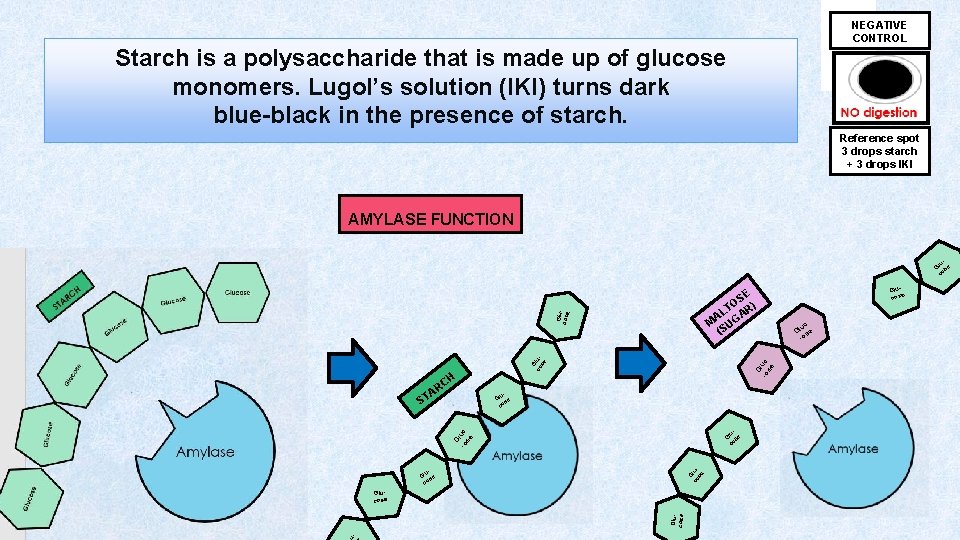
NEGATIVE CONTROL Starch is a polysaccharide that is made up of glucose monomers. Lugol’s solution (IKI) turns dark blue-black in the presence of starch. Reference spot 3 drops starch + 3 drops IKI AMYLASE FUNCTION lu G se co Gl -o uc se G co luse Glucose E S TO R) AL GA M U (S H C AR u. Gl se co lu G se co Gl -o uc se Gluco se ST G co luse Glu cos e u. Gl se co - Glucose Glu e cos uc Gl se -o
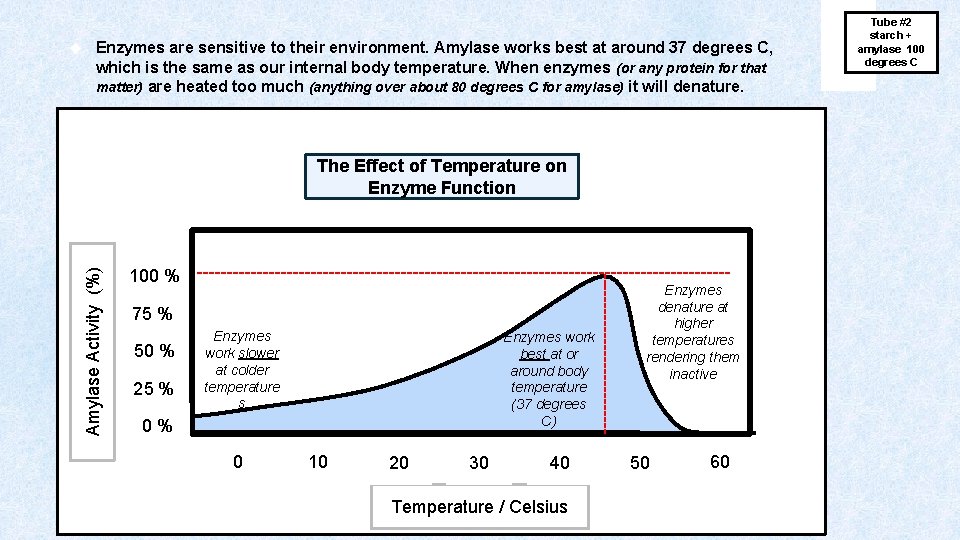
Enzymes are sensitive to their environment. Amylase works best at around 37 degrees C, which is the same as our internal body temperature. When enzymes (or any protein for that matter) are heated too much (anything over about 80 degrees C for amylase) it will denature. The Effect of Temperature on Enzyme Function 100 % --------------------------------------------75 % 50 % 25 % Enzymes work slower at colder temperature s Enzymes work best at or around body temperature (37 degrees C) 0 % 0 10 20 30 40 Temperature / Celsius -------------- Amylase Activity (%) Enzymes denature at higher temperatures rendering them inactive 50 60 Tube #2 starch + amylase 100 degrees C
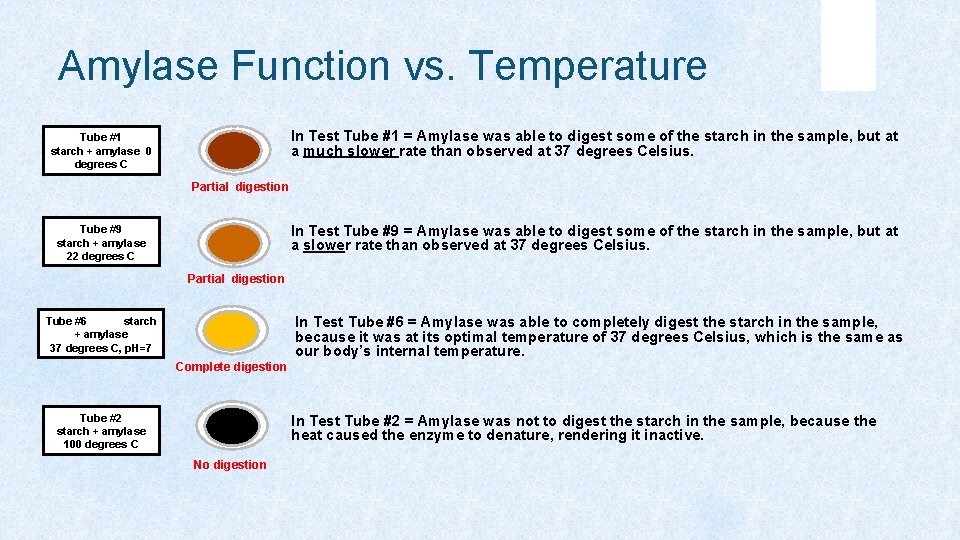
Amylase Function vs. Temperature In Test Tube #1 = Amylase was able to digest some of the starch in the sample, but at a much slower rate than observed at 37 degrees Celsius. Tube #1 starch + amylase 0 degrees C Partial digestion In Test Tube #9 = Amylase was able to digest some of the starch in the sample, but at a slower rate than observed at 37 degrees Celsius. Tube #9 starch + amylase 22 degrees C Partial digestion In Test Tube #6 = Amylase was able to completely digest the starch in the sample, because it was at its optimal temperature of 37 degrees Celsius, which is the same as our body’s internal temperature. Tube #6 starch + amylase 37 degrees C, p. H=7 Complete digestion Tube #2 starch + amylase 100 degrees C In Test Tube #2 = Amylase was not to digest the starch in the sample, because the heat caused the enzyme to denature, rendering it inactive. No digestion
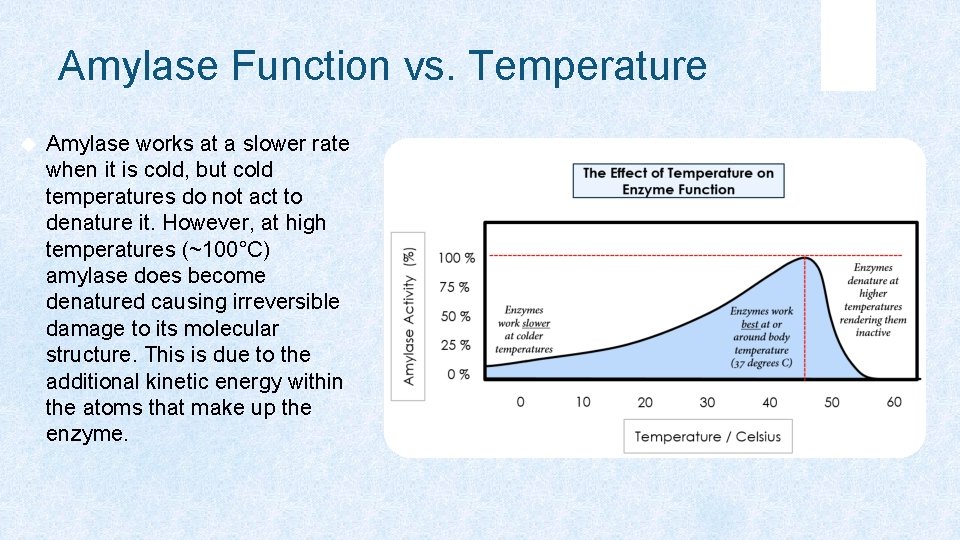
Amylase Function vs. Temperature Amylase works at a slower rate when it is cold, but cold temperatures do not act to denature it. However, at high temperatures (~100°C) amylase does become denatured causing irreversible damage to its molecular structure. This is due to the additional kinetic energy within the atoms that make up the enzyme.

Amylase Function vs. Amylase Concentration In Test Tube #3 = Amylase was not present, therefore there was no means by which starch could have been digested into sugar. Therefore, no digestion was observed. Tube #3 water + starch 37 degrees C No digestion In Test Tube #4 = Amylase was able to digest some of the starch in the sample, but at a slower rate because it was significantly diluted. Tube #4 water + dilute amylase 37 degrees C Partial digestion Tube #5 water + concentrated amylase 37 degrees C In Test Tube #6 = Amylase was able to completely digest the starch in the sample, because it was present in the sample at a high concentration. Complete digestion The function of amylase will increase with increased concentration, until the substrate become the limiting factor.

Amylase Function vs. p. H Tube #8 starch + amylase 37 degrees C, p. H=1 In Test Tube #8 = Amylase was not present, therefore there was no means by which starch could have been digested into sugar. Therefore, no digestion was observed. No digestion In Test Tube #7 = Amylase was able to digest some of the starch in the sample, but at a slower rate because it was significantly diluted. Tube #7 starch + amylase 37 degrees C, p. H=14 Partial digestion Tube #6 starch + amylase 37 degrees C, p. H=7 In Test Tube #6 = Amylase was able to completely digest the starch in the sample, because it was present in the sample at a high concentration. Complete digestion The function of amylase is best at p. H=7 (neutral) which is the p. H inside our bodies. The activity of the enzyme will decrease as the p. H is moved further away from neutral, either higher or lower. Extreme p. H (p. H=1 and p. H=14) will act to denature the enzyme rendering it inactive due to causing a significant structural change in the enzyme.
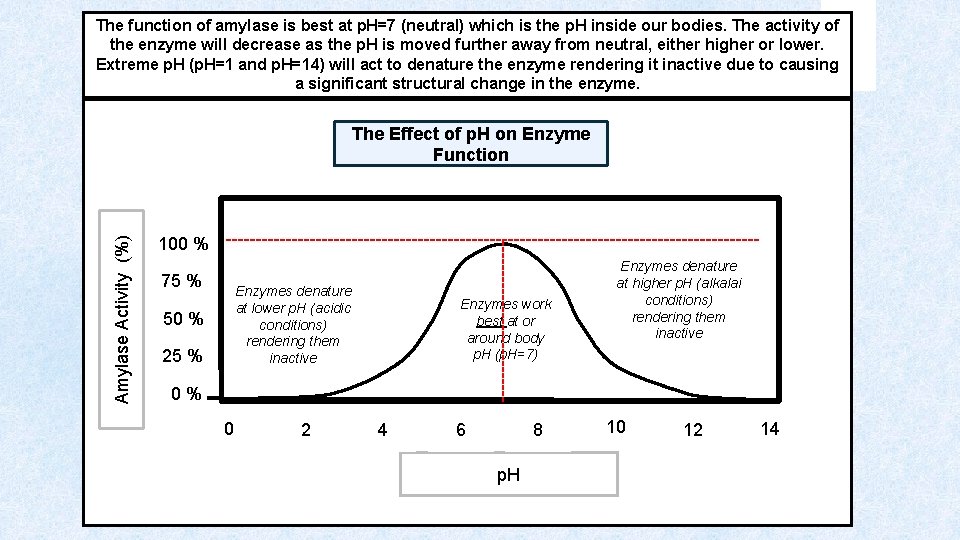
The function of amylase is best at p. H=7 (neutral) which is the p. H inside our bodies. The activity of the enzyme will decrease as the p. H is moved further away from neutral, either higher or lower. Extreme p. H (p. H=1 and p. H=14) will act to denature the enzyme rendering it inactive due to causing a significant structural change in the enzyme. 100 % --------------------------------------------75 % -------------- Amylase Activity (%) The Effect of p. H on Enzyme Function Enzymes denature at lower p. H (acidic conditions) rendering them inactive 50 % 25 % Enzymes work best at or around body p. H (p. H=7) 0 % 0 2 4 6 8 p. H Enzymes denature at higher p. H (alkalai conditions) rendering them inactive 10 12 14
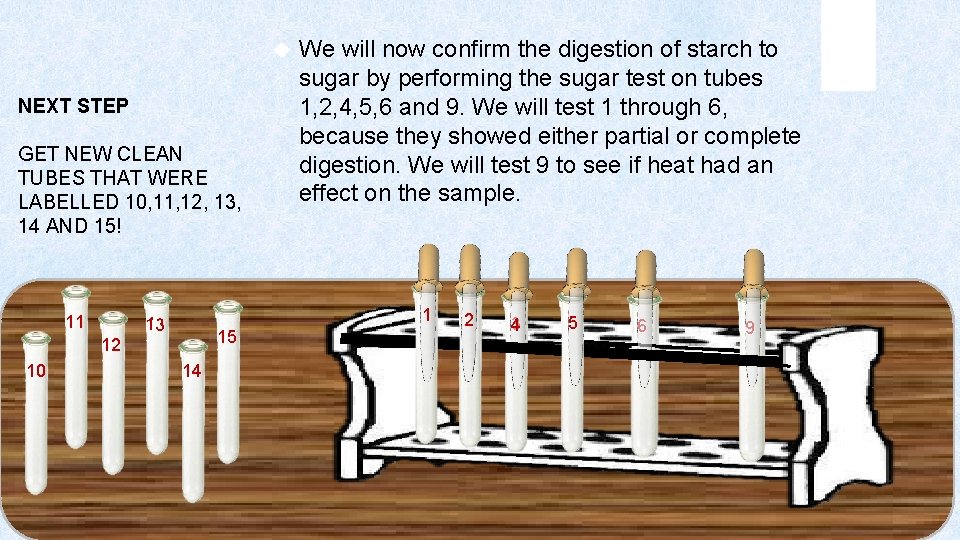
NEXT STEP GET NEW CLEAN TUBES THAT WERE LABELLED 10, 11, 12, 13, 14 AND 15! 11 1 13 15 12 10 We will now confirm the digestion of starch to sugar by performing the sugar test on tubes 1, 2, 4, 5, 6 and 9. We will test 1 through 6, because they showed either partial or complete digestion. We will test 9 to see if heat had an effect on the sample. 14 2 3 4 5 6 9
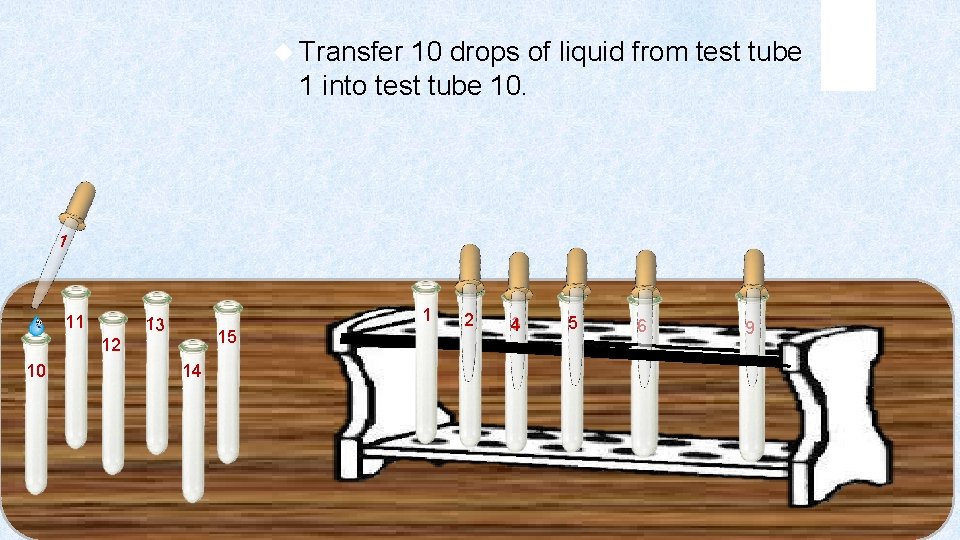
Transfer 10 drops of liquid from test tube 1 into test tube 10. 1 11 1 13 15 12 10 14 2 3 4 5 6 9
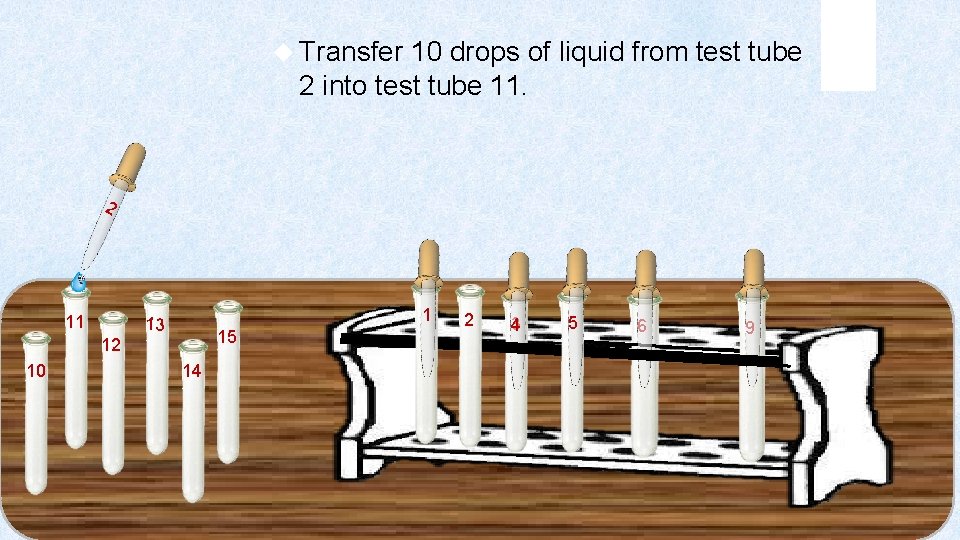
Transfer 10 drops of liquid from test tube 2 into test tube 11. 2 11 1 13 15 12 10 14 2 3 4 5 6 9
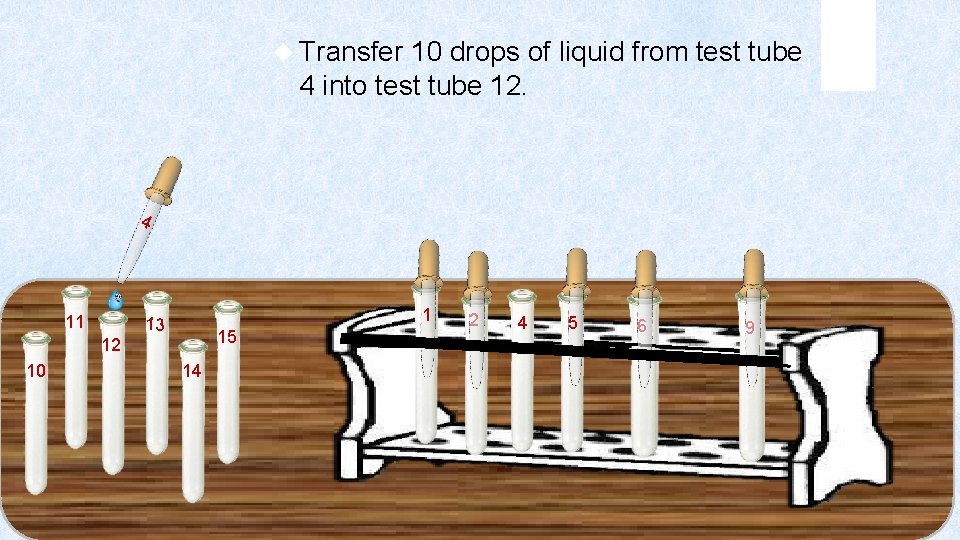
Transfer 10 drops of liquid from test tube 4 into test tube 12. 4 11 1 13 15 12 10 14 2 4 5 6 9
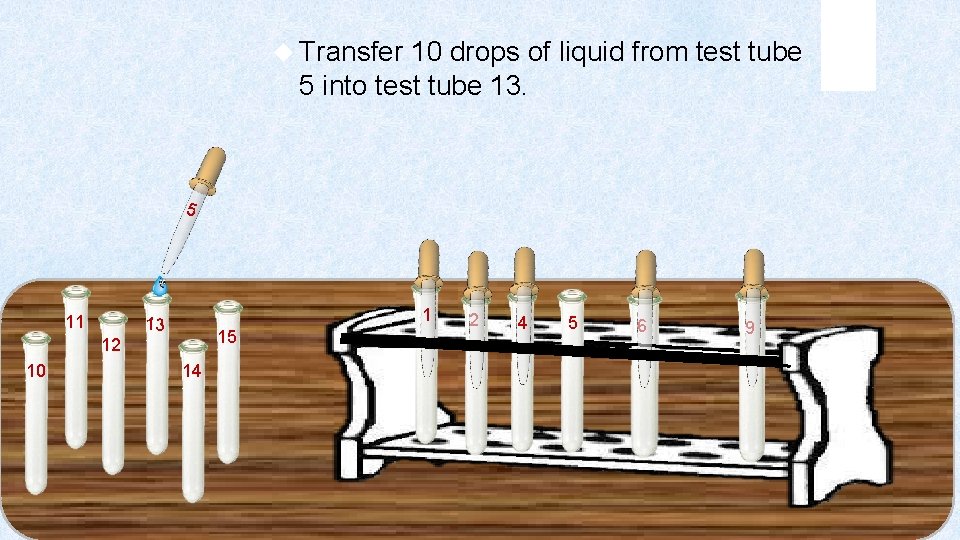
Transfer 10 drops of liquid from test tube 5 into test tube 13. 5 11 1 13 15 12 10 14 2 4 5 6 9
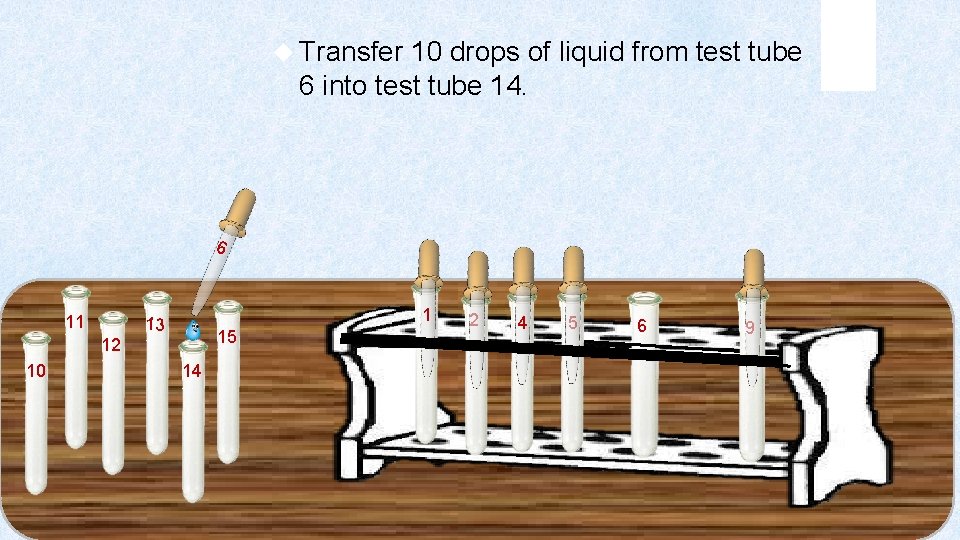
Transfer 10 drops of liquid from test tube 6 into test tube 14. 6 11 1 13 15 12 10 14 2 4 5 6 9
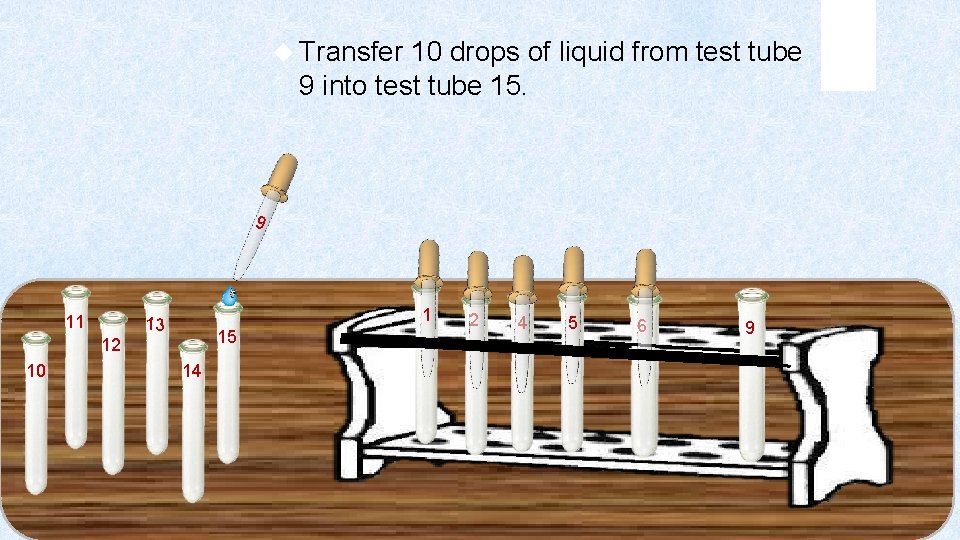
Transfer 10 drops of liquid from test tube 9 into test tube 15. 9 11 1 13 15 12 10 14 2 4 5 6 9
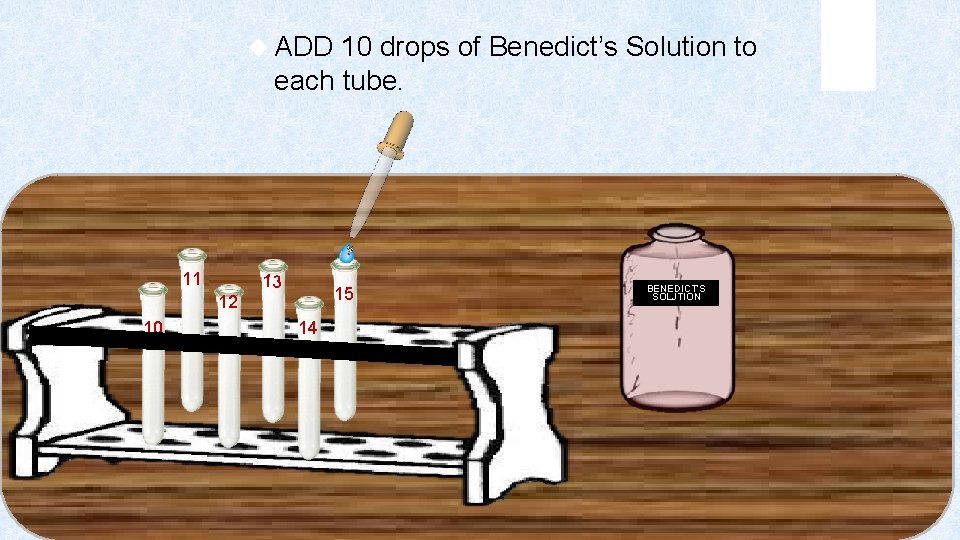
ADD 10 drops of Benedict’s Solution to each tube. 11 13 15 12 10 14 BENEDICT’S SOLJTION
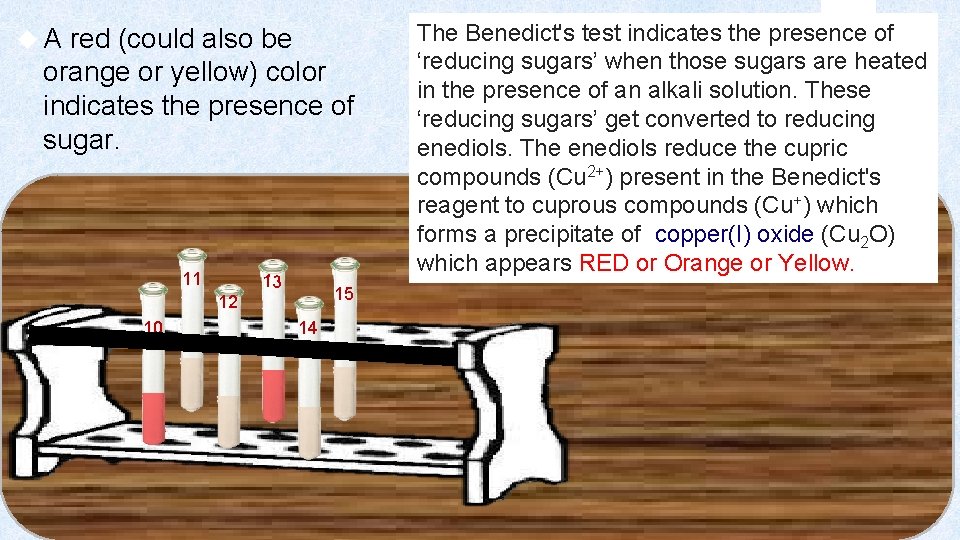
A red (could also be orange or yellow) color indicates the presence of sugar. 11 13 15 12 10 14 The Benedict's test indicates the presence of ‘reducing sugars’ when those sugars are heated in the presence of an alkali solution. These ‘reducing sugars’ get converted to reducing enediols. The enediols reduce the cupric compounds (Cu 2+) present in the Benedict's reagent to cuprous compounds (Cu+) which forms a precipitate of copper(I) oxide (Cu 2 O) which appears RED or Orange or Yellow.
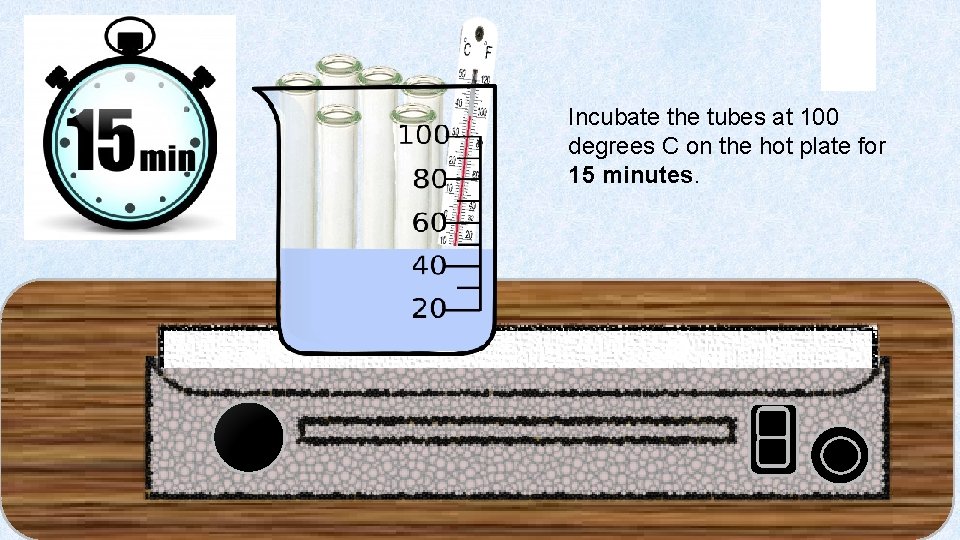
Incubate the tubes at 100 degrees C on the hot plate for 15 minutes.
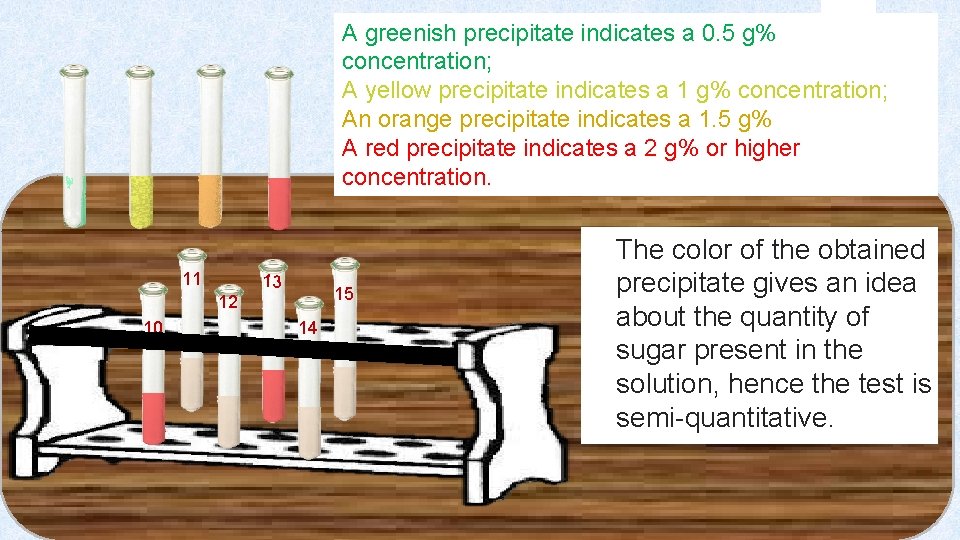
A greenish precipitate indicates a 0. 5 g% concentration; A yellow precipitate indicates a 1 g% concentration; An orange precipitate indicates a 1. 5 g% A red precipitate indicates a 2 g% or higher concentration. The color of the obtained 11 13 15 12 10 14 precipitate gives an idea about the quantity of sugar present in the solution, hence the test is semi-quantitative.
- Slides: 49