
Enzyme Kinetics Rate constants and reaction order Rate
![Michaelis-Menton Kinetics Sucrose + H 20 Glucose + Fructose Held [S] constant and varied](https://slidetodoc.com/presentation_image_h2/4cc8ff61f53f13ab8679fb956db4b16e/image-3.jpg "Michaelis-Menton Kinetics Sucrose + H 20 Glucose + Fructose Held [S] constant and varied")
![Michaelis-Menton Kinetics Sucrose + H 20 Glucose + Fructose Held [E] constant and varied](https://slidetodoc.com/presentation_image_h2/4cc8ff61f53f13ab8679fb956db4b16e/image-4.jpg "Michaelis-Menton Kinetics Sucrose + H 20 Glucose + Fructose Held [E] constant and varied")
![Michaelis-Menton Equation • Vo = Vmax [S] Km + [S] M-M equation describes the](https://slidetodoc.com/presentation_image_h2/4cc8ff61f53f13ab8679fb956db4b16e/image-5.jpg "Michaelis-Menton Equation • Vo = Vmax [S] Km + [S] M-M equation describes the")
![Steady State Assumption Steady state Assumption = [ES] is constant. The rate of ES](https://slidetodoc.com/presentation_image_h2/4cc8ff61f53f13ab8679fb956db4b16e/image-8.jpg "Steady State Assumption Steady state Assumption = [ES] is constant. The rate of ES")
![Therefore………. 1) k 1[E][S] = [ES](k-1+ kcat) 2) (k-1+ kcat) / k 1 =](https://slidetodoc.com/presentation_image_h2/4cc8ff61f53f13ab8679fb956db4b16e/image-10.jpg "Therefore………. 1) k 1[E][S] = [ES](k-1+ kcat) 2) (k-1+ kcat) / k 1 =")
![What does Km mean? 1. Km = [S] at ½ Vmax 2. Km is](https://slidetodoc.com/presentation_image_h2/4cc8ff61f53f13ab8679fb956db4b16e/image-11.jpg "What does Km mean? 1. Km = [S] at ½ Vmax 2. Km is")
![Michaelis-Menton E+S k 1 k-1 • Vo = Vmax [S] Km + [S] •](https://slidetodoc.com/presentation_image_h2/4cc8ff61f53f13ab8679fb956db4b16e/image-18.jpg "Michaelis-Menton E+S k 1 k-1 • Vo = Vmax [S] Km + [S] •")
![Lineweaver-Burke Plots (double reciprocal plots) • Plot 1/[S] vs 1/Vo • L-B equation for](https://slidetodoc.com/presentation_image_h2/4cc8ff61f53f13ab8679fb956db4b16e/image-20.jpg "Lineweaver-Burke Plots (double reciprocal plots) • Plot 1/[S] vs 1/Vo • L-B equation for")
![Lineweaver-Burke Plot of Multisubstrate Reactions Sequential Increasing [B] Ping-Pong Increasing [B] 1/Vo 1/[S] Vmax](https://slidetodoc.com/presentation_image_h2/4cc8ff61f53f13ab8679fb956db4b16e/image-26.jpg "Lineweaver-Burke Plot of Multisubstrate Reactions Sequential Increasing [B] Ping-Pong Increasing [B] 1/Vo 1/[S] Vmax")
- Slides: 34
Enzyme Kinetics
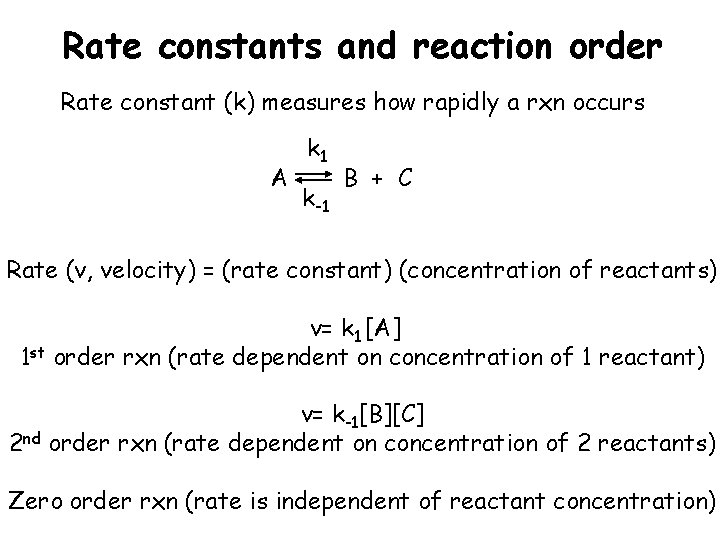
Rate constants and reaction order Rate constant (k) measures how rapidly a rxn occurs A k 1 k-1 B + C Rate (v, velocity) = (rate constant) (concentration of reactants) v= k 1 [A] 1 st order rxn (rate dependent on concentration of 1 reactant) v= k-1[B][C] 2 nd order rxn (rate dependent on concentration of 2 reactants) Zero order rxn (rate is independent of reactant concentration)
Michaelis-Menton Kinetics Sucrose + H 20 Glucose + Fructose Held [S] constant and varied the amount of enzyme added E + S <-> E + P
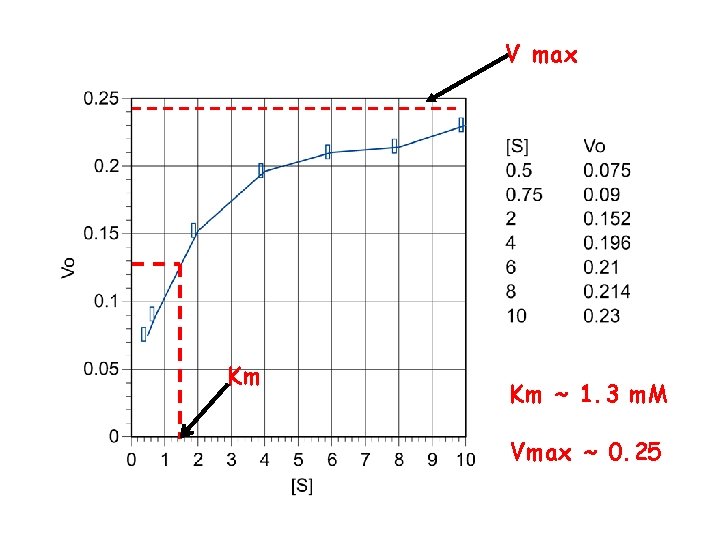
Michaelis-Menton Kinetics Sucrose + H 20 Glucose + Fructose Held [E] constant and varied the amount of substrate added V max/2 =Km (Michaelis Constant) [S] @ ½ Vmax (units moles/L=M)
Michaelis-Menton Equation • Vo = Vmax [S] Km + [S] M-M equation describes the equation of a rectangular hyperbolic curve.
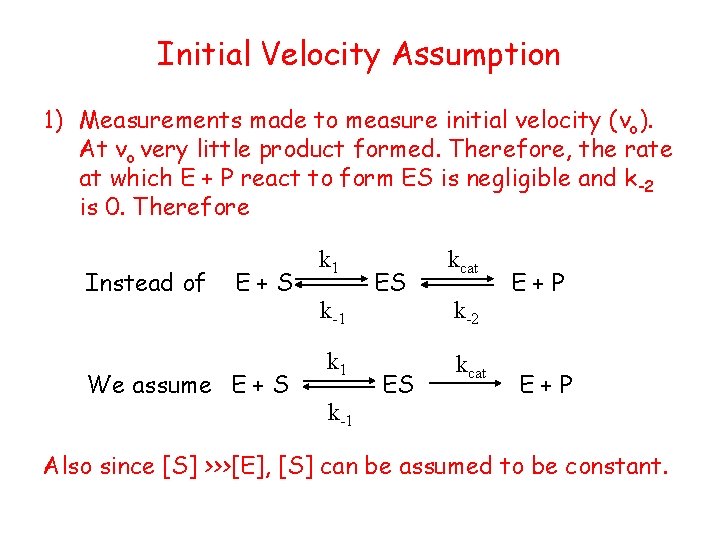
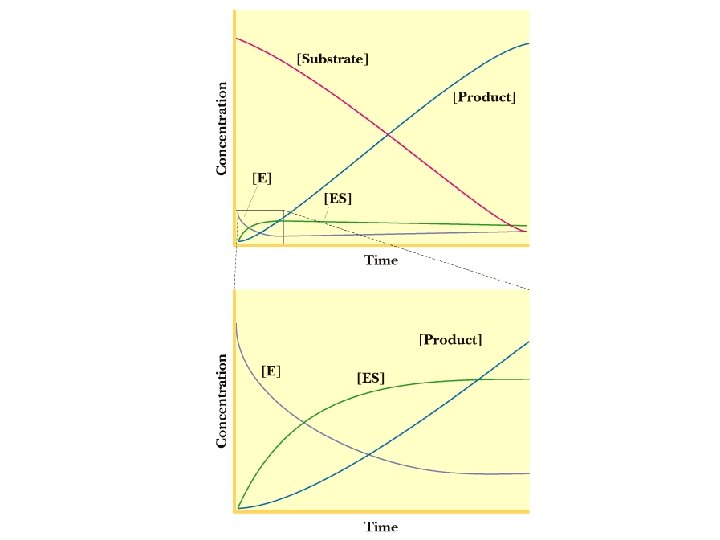
Initial Velocity Assumption 1) Measurements made to measure initial velocity (vo). At vo very little product formed. Therefore, the rate at which E + P react to form ES is negligible and k -2 is 0. Therefore Instead of E+S We assume E + S k 1 k-1 ES ES kcat k-2 kcat E+P Also since [S] >>>[E], [S] can be assumed to be constant.
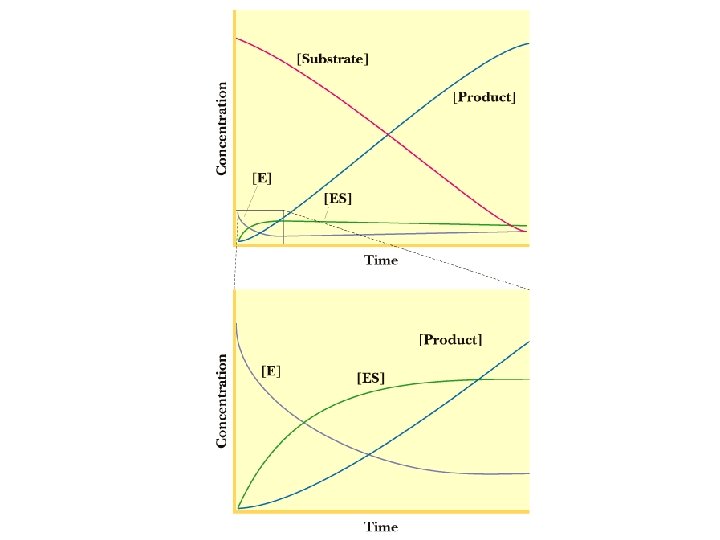
Steady State Assumption Steady state Assumption = [ES] is constant. The rate of ES formation equals the rate of ES breakdown k 1 kcat E+S ES E+P k-1 Rate of ES formation = k 1[E][S] Rate of ES break down = k-1[ES] + kcat[ES] = [ES](k-1+ kcat)
Therefore………. 1) k 1[E][S] = [ES](k-1+ kcat) 2) (k-1+ kcat) / k 1 = [E][S] / [ES] 3) (k-1+ kcat) / k 1 = Km (Michaelis constant)
What does Km mean? 1. Km = [S] at ½ Vmax 2. Km is a combination of rate constants describing the formation and breakdown of the ES complex 3. Km is usually a little higher than the physiological [S]
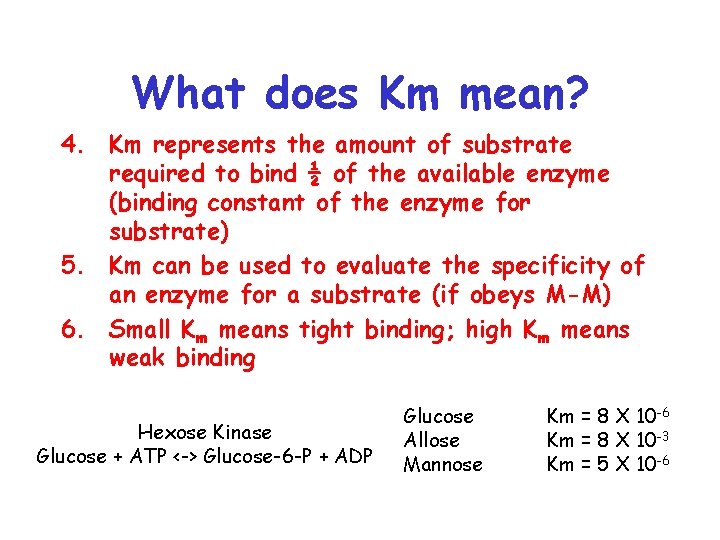
What does Km mean? 4. Km represents the amount of substrate required to bind ½ of the available enzyme (binding constant of the enzyme for substrate) 5. Km can be used to evaluate the specificity of an enzyme for a substrate (if obeys M-M) 6. Small Km means tight binding; high Km means weak binding Hexose Kinase Glucose + ATP <-> Glucose-6 -P + ADP Glucose Allose Mannose Km = 8 X 10 -6 Km = 8 X 10 -3 Km = 5 X 10 -6
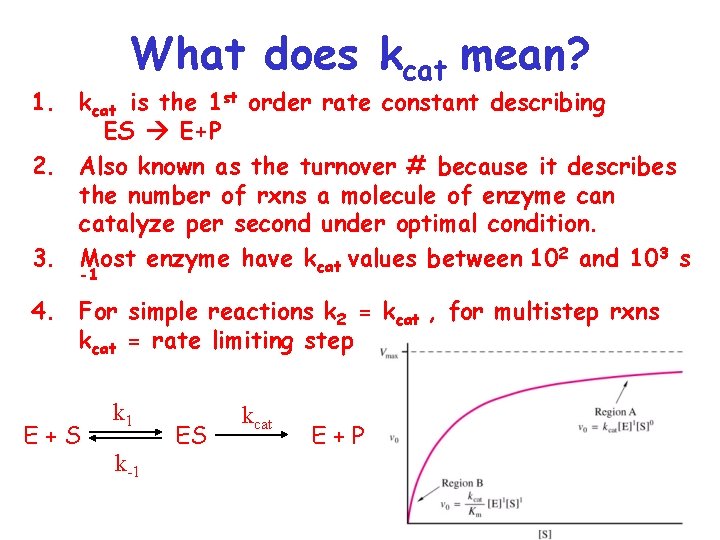
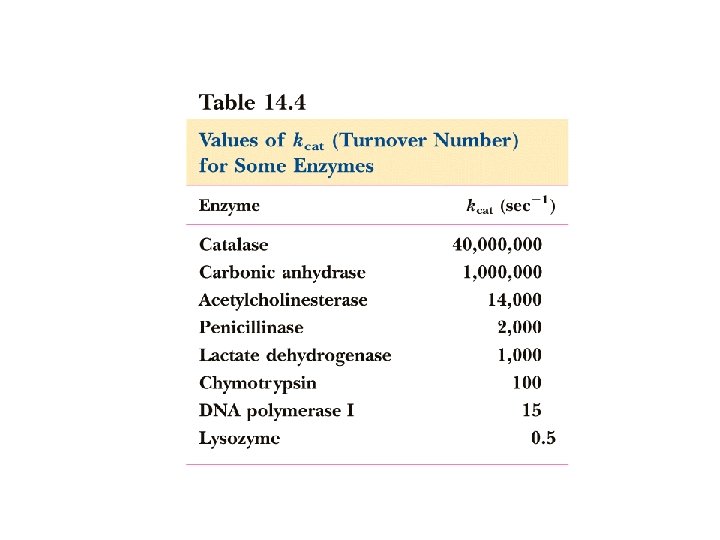
What does kcat mean? 1. kcat is the 1 st order rate constant describing ES E+P 2. Also known as the turnover # because it describes the number of rxns a molecule of enzyme can catalyze per second under optimal condition. 3. Most enzyme have kcat values between 102 and 103 s -1 4. For simple reactions k 2 = kcat , for multistep rxns kcat = rate limiting step E+S k 1 k-1 ES kcat E+P
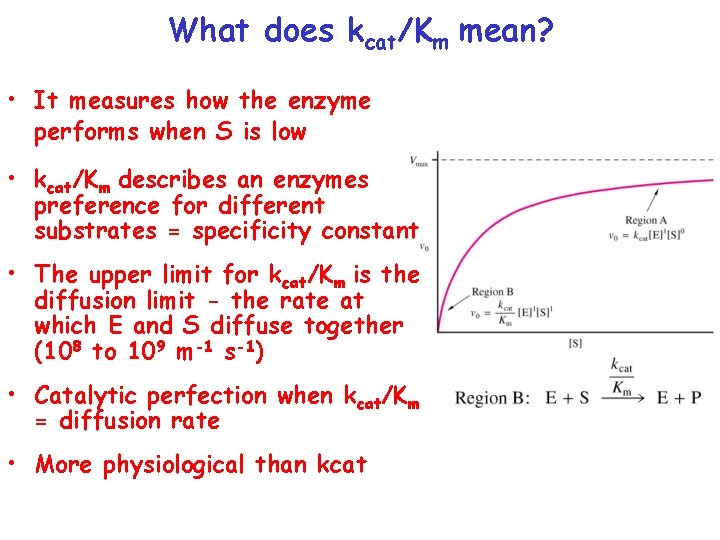
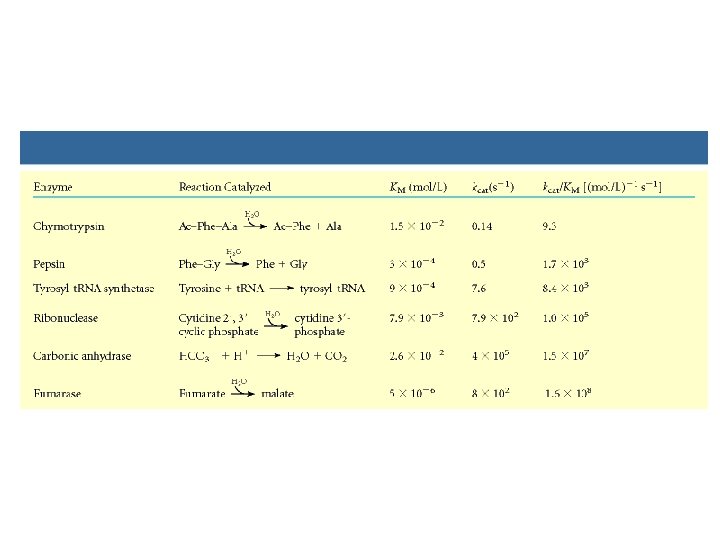
What does kcat/Km mean? • It measures how the enzyme performs when S is low • kcat/Km describes an enzymes preference for different substrates = specificity constant • The upper limit for kcat/Km is the diffusion limit - the rate at which E and S diffuse together (108 to 109 m-1 s-1) • Catalytic perfection when kcat/Km = diffusion rate • More physiological than kcat
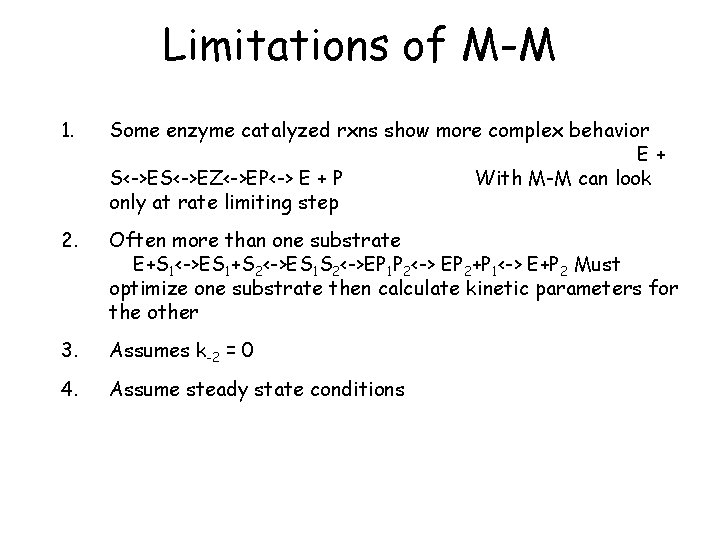
Limitations of M-M 1. Some enzyme catalyzed rxns show more complex behavior E+ S<->EZ<->EP<-> E + P With M-M can look only at rate limiting step 2. Often more than one substrate E+S 1<->ES 1+S 2<->ES 1 S 2<->EP 1 P 2<-> EP 2+P 1<-> E+P 2 Must optimize one substrate then calculate kinetic parameters for the other 3. Assumes k-2 = 0 4. Assume steady state conditions
Michaelis-Menton E+S k 1 k-1 • Vo = Vmax [S] Km + [S] • • Vmax Km Kcat/Km ES kcat E+P • Vmax • K m • kcat/Km
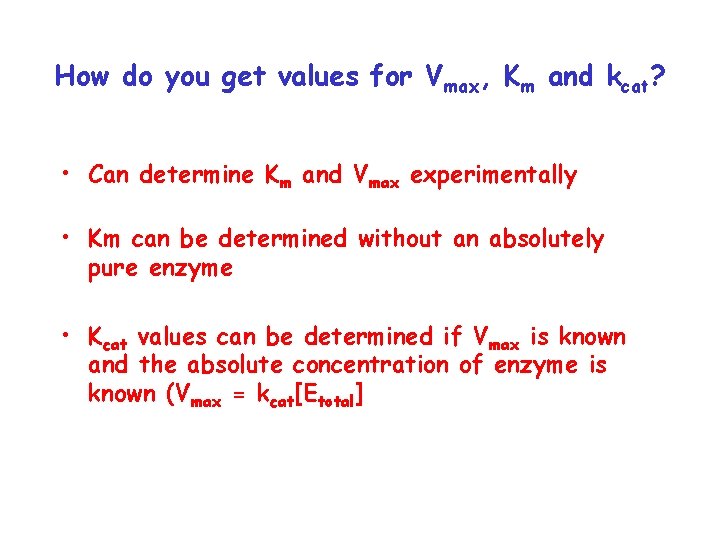
How do you get values for Vmax, Km and kcat? • Can determine Km and Vmax experimentally • Km can be determined without an absolutely pure enzyme • Kcat values can be determined if Vmax is known and the absolute concentration of enzyme is known (Vmax = kcat[Etotal]
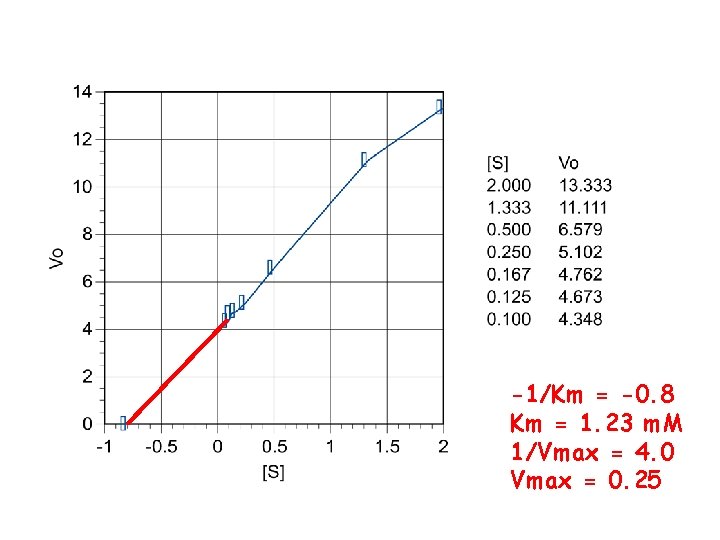
Lineweaver-Burke Plots (double reciprocal plots) • Plot 1/[S] vs 1/Vo • L-B equation for straight line • X-intercept = -1/Km • Y-intercept = 1/Vmax • Easier to extrapolate values w/ straight line vs hyperbolic curve
V max Km Km ~ 1. 3 m. M Vmax ~ 0. 25
-1/Km = -0. 8 Km = 1. 23 m. M 1/Vmax = 4. 0 Vmax = 0. 25
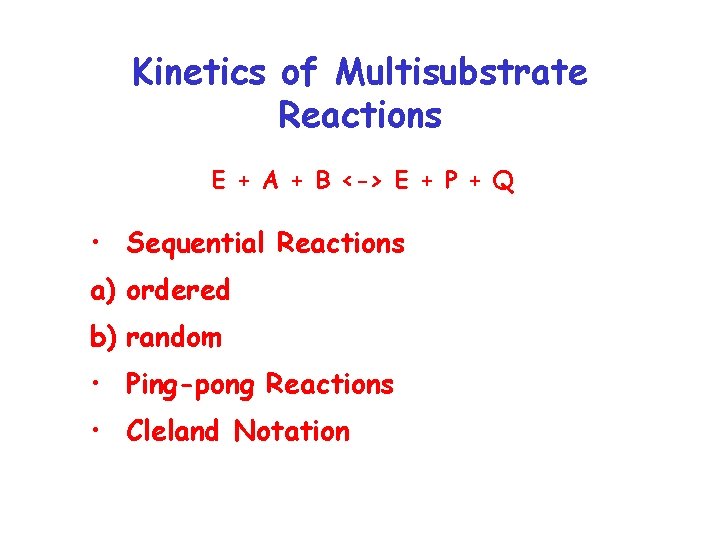
Kinetics of Multisubstrate Reactions E + A + B <-> E + P + Q • Sequential Reactions a) ordered b) random • Ping-pong Reactions • Cleland Notation
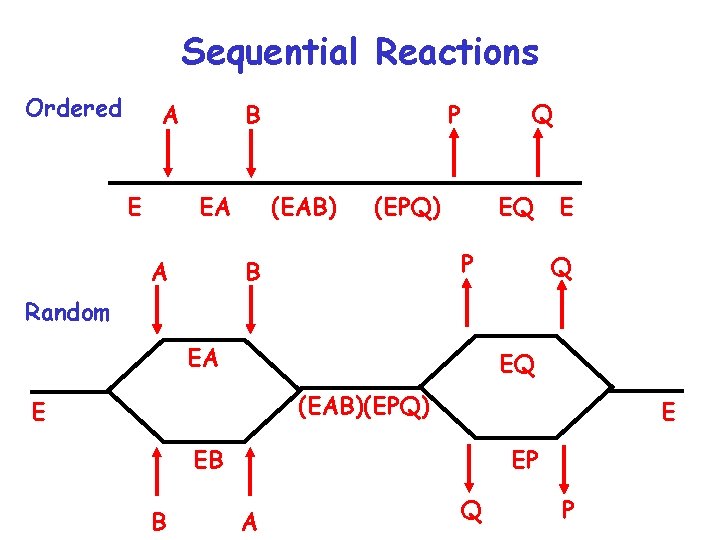
Sequential Reactions Ordered A E EA A Q P B (EAB) (EPQ) EQ P B E Q Random EA EQ (EAB)(EPQ) E E EB B EP A Q P
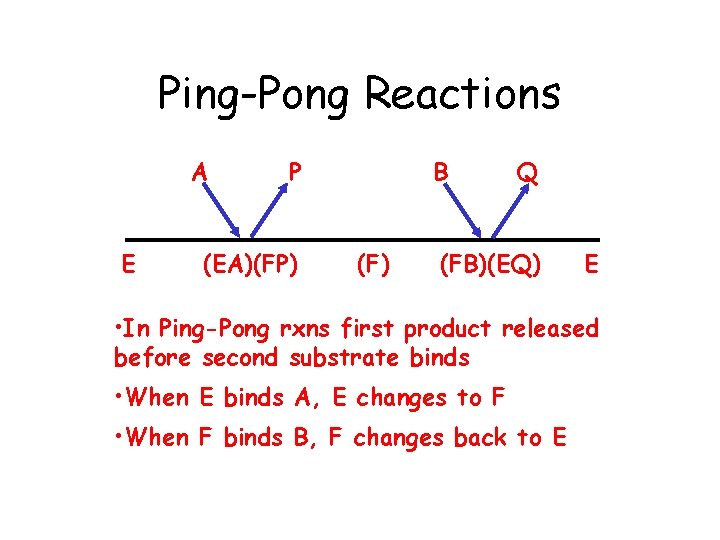
Ping-Pong Reactions A E P (EA)(FP) B (F) Q (FB)(EQ) E • In Ping-Pong rxns first product released before second substrate binds • When E binds A, E changes to F • When F binds B, F changes back to E
Lineweaver-Burke Plot of Multisubstrate Reactions Sequential Increasing [B] Ping-Pong Increasing [B] 1/Vo 1/[S] Vmax doesn’t change Km changes 1/[S] Both Vmax & Km change
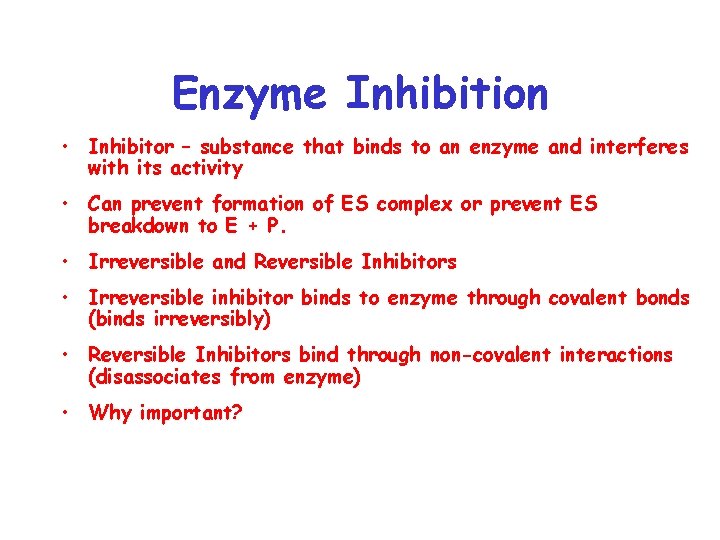
Enzyme Inhibition • Inhibitor – substance that binds to an enzyme and interferes with its activity • Can prevent formation of ES complex or prevent ES breakdown to E + P. • Irreversible and Reversible Inhibitors • Irreversible inhibitor binds to enzyme through covalent bonds (binds irreversibly) • Reversible Inhibitors bind through non-covalent interactions (disassociates from enzyme) • Why important?
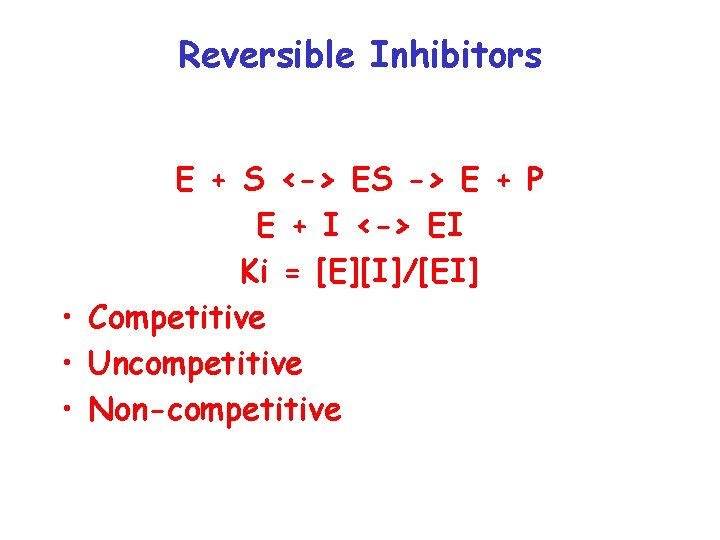
Reversible Inhibitors E + S <-> ES -> E + P E + I <-> EI Ki = [E][I]/[EI] • Competitive • Uncompetitive • Non-competitive
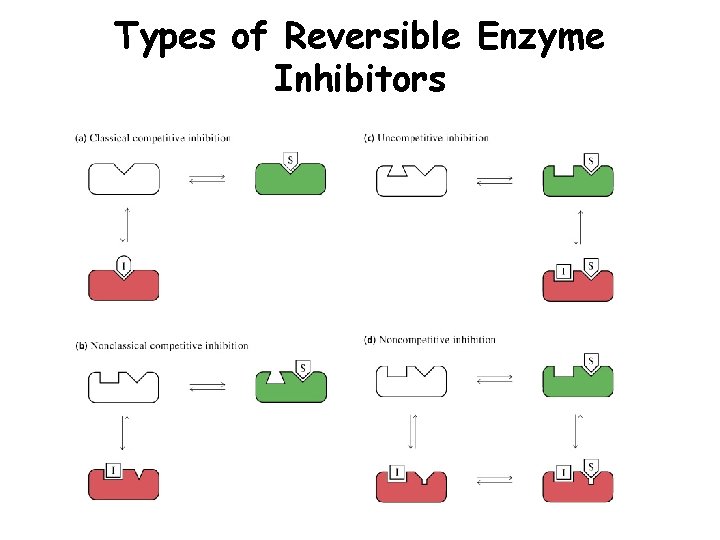
Types of Reversible Enzyme Inhibitors
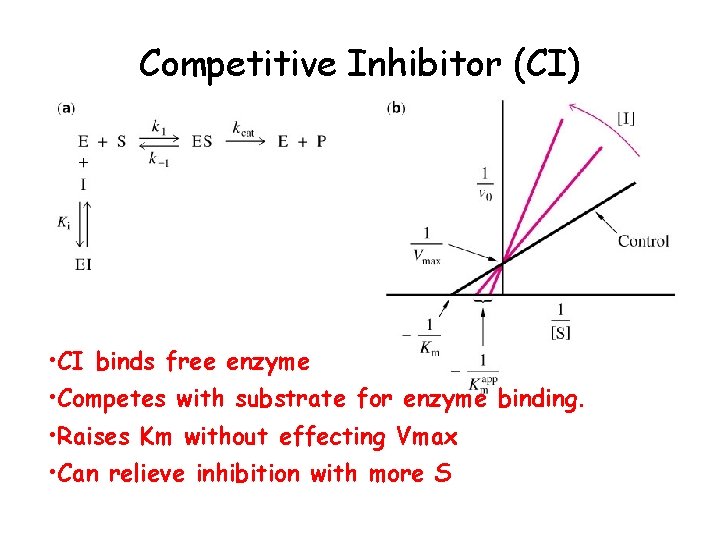
Competitive Inhibitor (CI) • CI binds free enzyme • Competes with substrate for enzyme binding. • Raises Km without effecting Vmax • Can relieve inhibition with more S
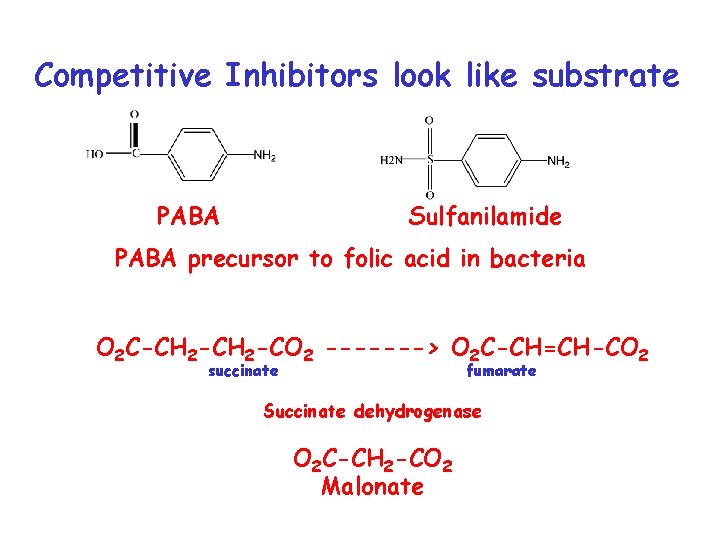
Competitive Inhibitors look like substrate PABA Sulfanilamide PABA precursor to folic acid in bacteria O 2 C-CH 2 -CO 2 -------> O 2 C-CH=CH-CO 2 succinate fumarate Succinate dehydrogenase O 2 C-CH 2 -CO 2 Malonate
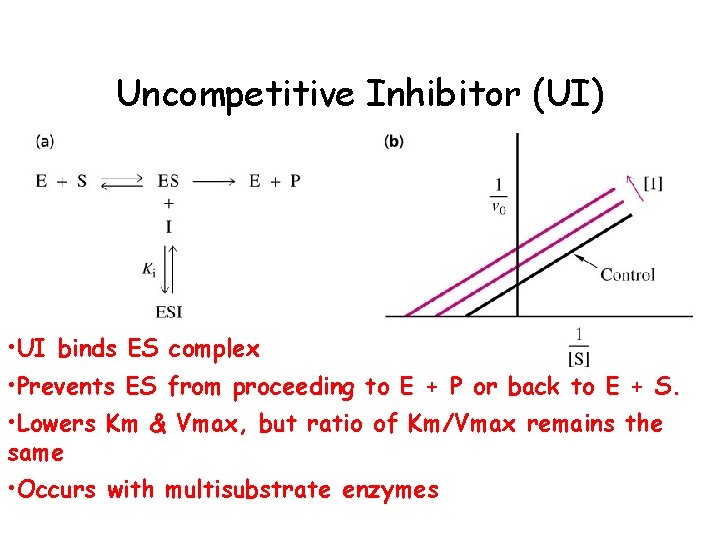
Uncompetitive Inhibitor (UI) • UI binds ES complex • Prevents ES from proceeding to E + P or back to E + S. • Lowers Km & Vmax, but ratio of Km/Vmax remains the same • Occurs with multisubstrate enzymes
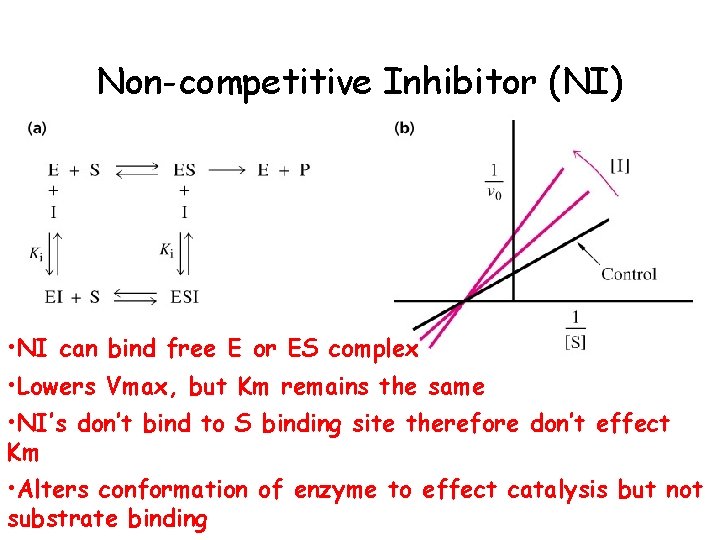
Non-competitive Inhibitor (NI) • NI can bind free E or ES complex • Lowers Vmax, but Km remains the same • NI’s don’t bind to S binding site therefore don’t effect Km • Alters conformation of enzyme to effect catalysis but not substrate binding
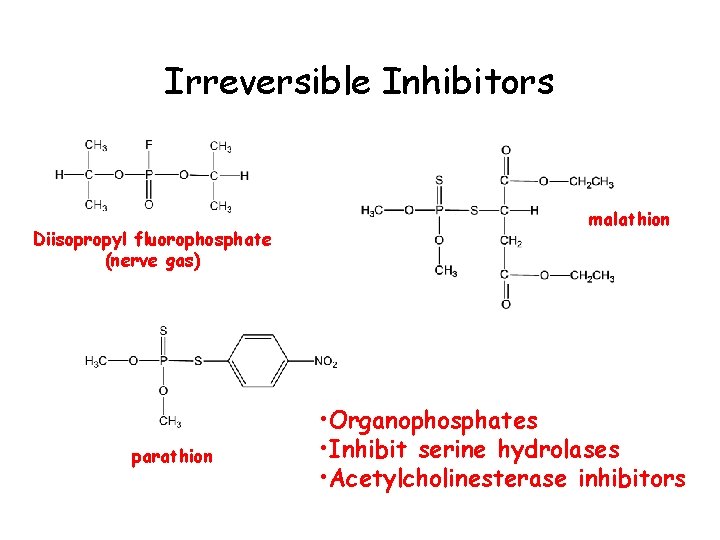
Irreversible Inhibitors Diisopropyl fluorophosphate (nerve gas) parathion malathion • Organophosphates • Inhibit serine hydrolases • Acetylcholinesterase inhibitors