
Enzyme Kinetics provides Insight into Enzyme Mechanism Chapter
![5. How to do Kinetic Measurements? 3. Determine the rate dependence on [S]. §](https://slidetodoc.com/presentation_image_h2/18ef36851351e2f85d26eeae3cc65b7f/image-8.jpg "5. How to do Kinetic Measurements? 3. Determine the rate dependence on [S]. §")
![5. How to do Kinetic Measurements? The initial velocity depends on [S] in a](https://slidetodoc.com/presentation_image_h2/18ef36851351e2f85d26eeae3cc65b7f/image-10.jpg "5. How to do Kinetic Measurements? The initial velocity depends on [S] in a")

- Slides: 51
Enzyme Kinetics provides Insight into Enzyme Mechanism Chapter 6 (Page 202 -212) 1
1. Understanding Enzyme Function Understanding what role an enzyme plays and how it executes this role requires A. Knowledge of the three-dimensional structure of the protein § Sequence homology can be very telling of the class of enzyme a protein belongs to. § The structure of the protein in complex with its substrate can highlight important AA for catalysis. B. Determining the rate of the enzyme catalyzed reaction through enzyme kinetics § Investigate how the rate is effected by experimental parameters. 2
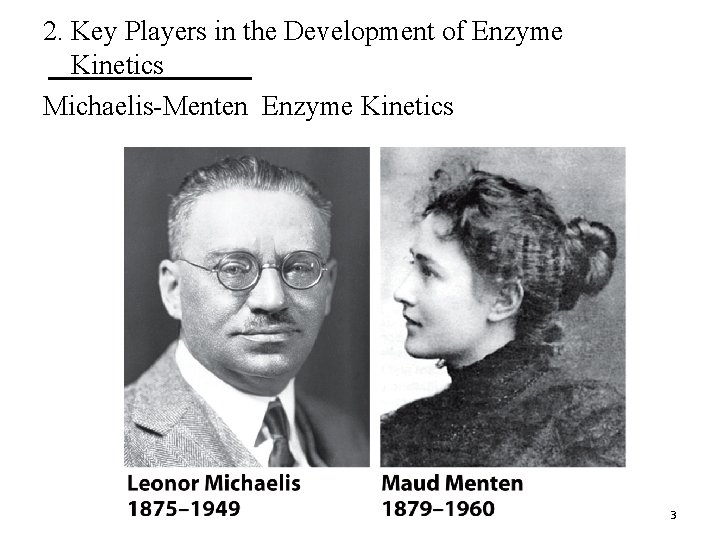
2. Key Players in the Development of Enzyme Kinetics Michaelis-Menten Enzyme Kinetics 3
3. What is Enzyme Kinetics? § Kinetics is the study of the rate at which compounds react. § The rate of enzymatic reactions is affected by: - Enzyme - Substrate - Effectors - Temperature 4
4. Why Study Enzyme Kinetics? A. Quantitative description of biocatalysis B. Determine the order of binding of substrates C. Understand catalytic mechanism D. Find effective inhibitors E. Understand regulation of activity 5
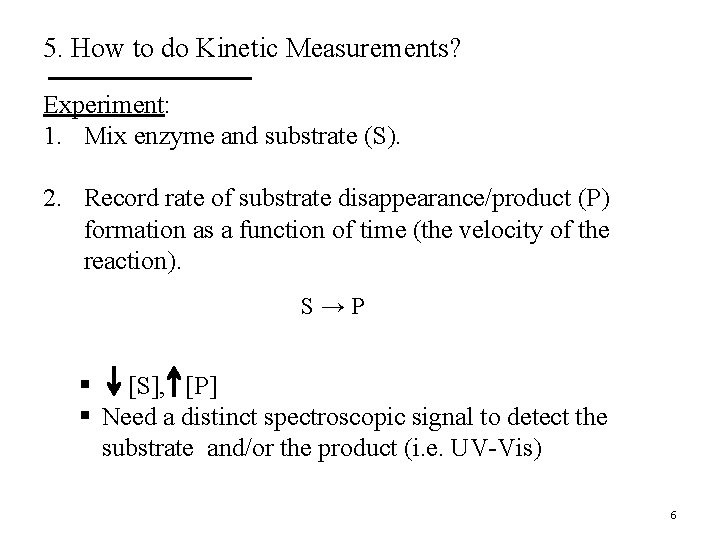
5. How to do Kinetic Measurements? Experiment: 1. Mix enzyme and substrate (S). 2. Record rate of substrate disappearance/product (P) formation as a function of time (the velocity of the reaction). S→P § [S], [P] § Need a distinct spectroscopic signal to detect the substrate and/or the product (i. e. UV-Vis) 6
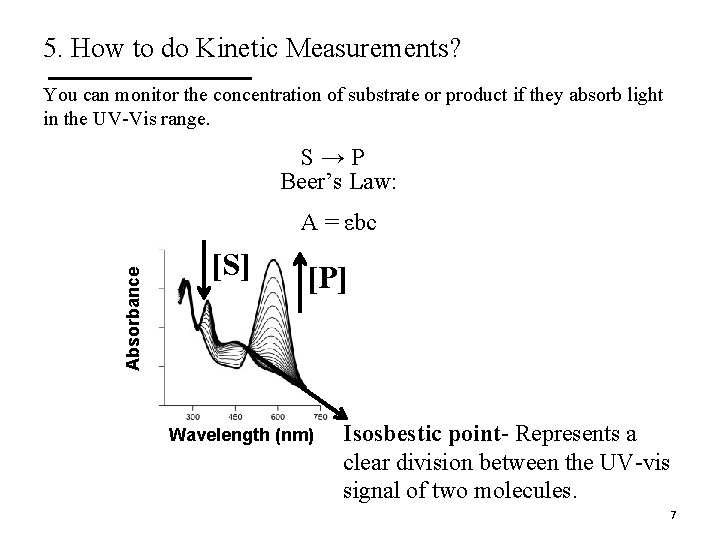
5. How to do Kinetic Measurements? You can monitor the concentration of substrate or product if they absorb light in the UV-Vis range. S→P Beer’s Law: Absorbance A = εbc [S] [P] Wavelength (nm) Isosbestic point- Represents a clear division between the UV-vis signal of two molecules. 7
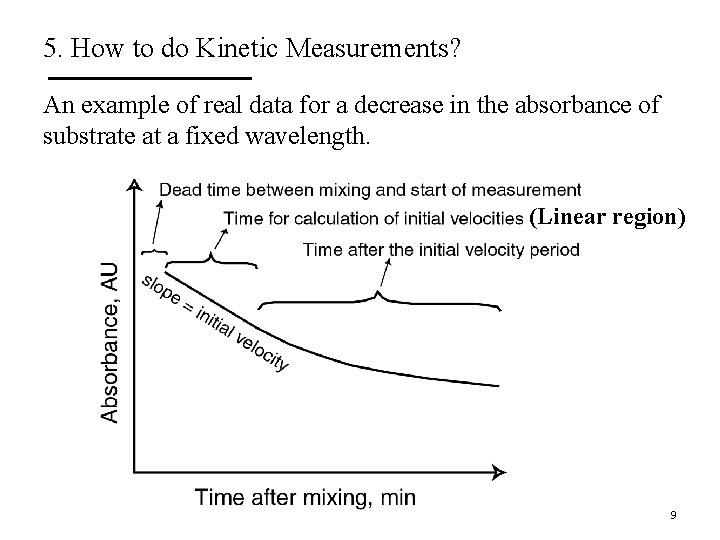
5. How to do Kinetic Measurements? 3. Determine the rate dependence on [S]. § Studying the effects of substrate concentration is complicated by the fact that [S] changes during the course of a reaction as substrate is converted to product. § In enzyme kinetics this issue has been simplified by measuring the initial rate (or initial velocity; V 0) when [S] is much greater than the concentration of enzyme. - The enzyme may be present at n. M (10 -9) quantities and the substrate at at least 5 orders of magnitude higher. - The reaction is monitored for typically the 1 st minute during which [S] changes insignificantly. 8
5. How to do Kinetic Measurements? An example of real data for a decrease in the absorbance of substrate at a fixed wavelength. (Linear region) 9
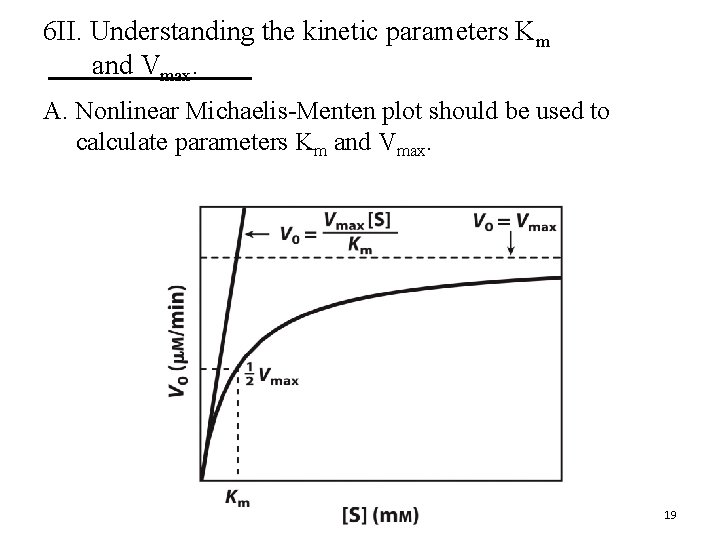
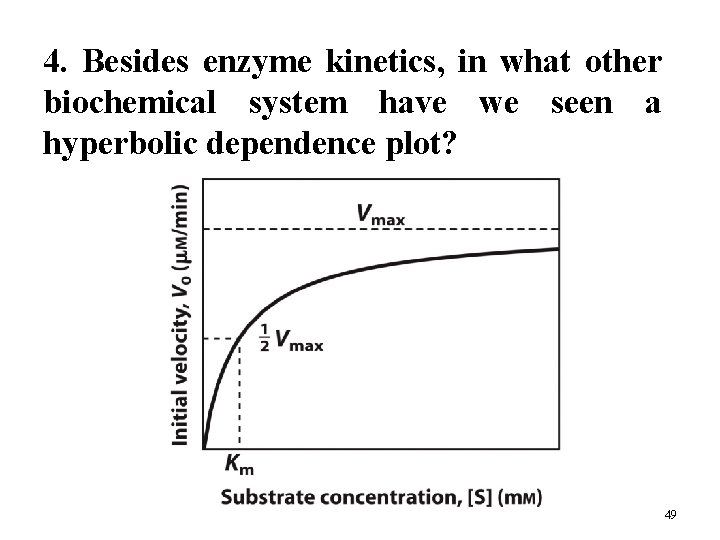
5. How to do Kinetic Measurements? The initial velocity depends on [S] in a hyperbolic manner. The plateau of the curve represents the maximum velocity, Vmax. Demonstrates saturation kinetics. 10
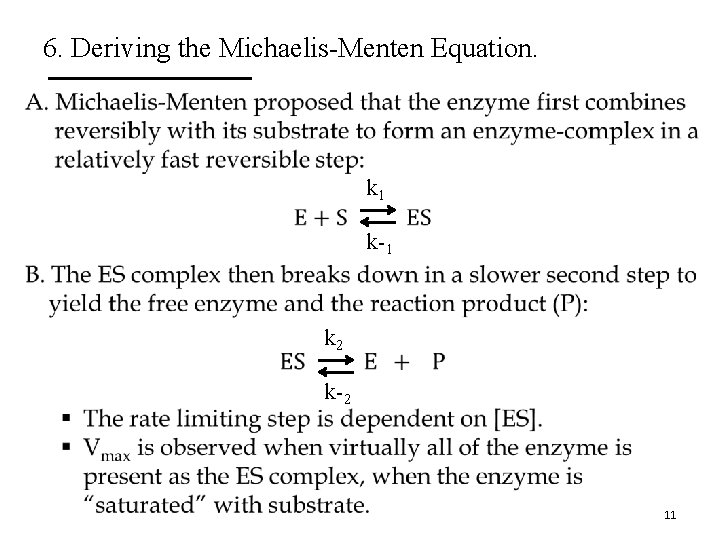
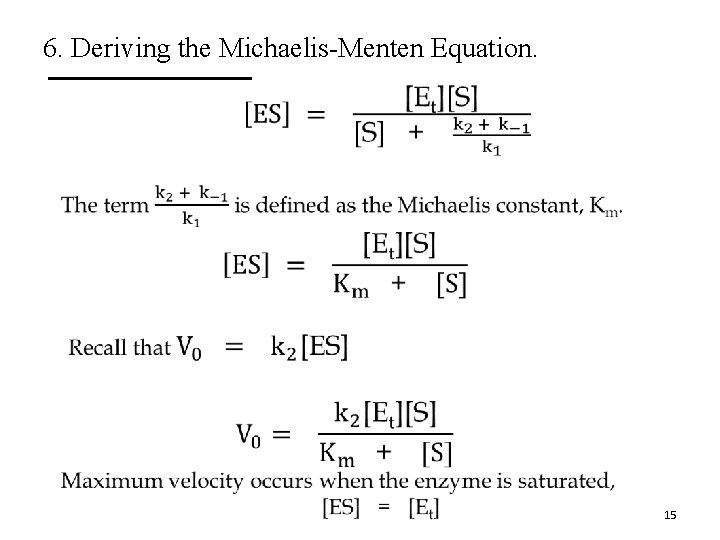
6. Deriving the Michaelis-Menten Equation. • k 1 k-1 k 2 k-2 11
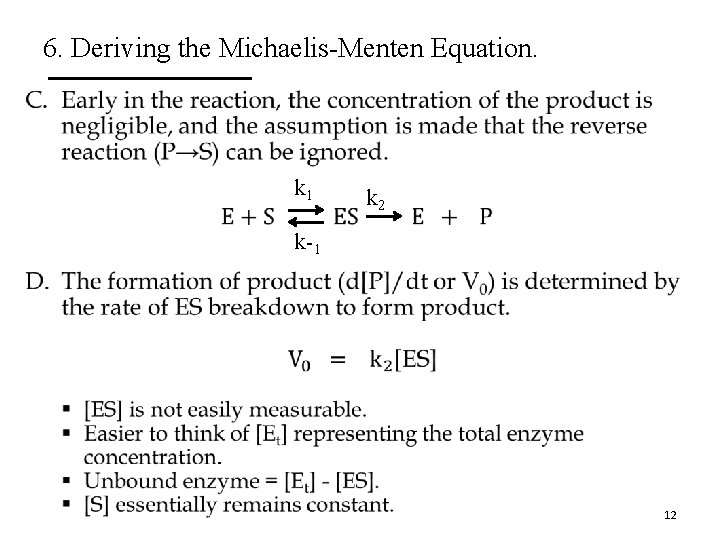
6. Deriving the Michaelis-Menten Equation. • k 1 k 2 k-1 12
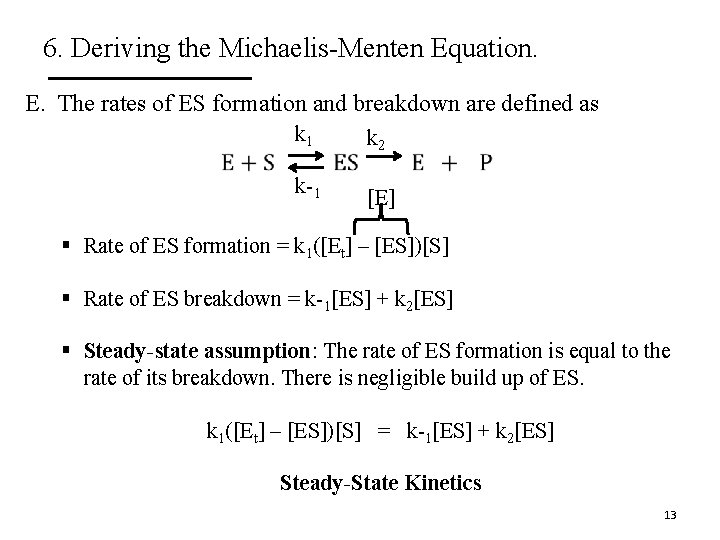
6. Deriving the Michaelis-Menten Equation. E. The rates of ES formation and breakdown are defined as k 1 k 2 k-1 [E] § Rate of ES formation = k 1([Et] – [ES])[S] § Rate of ES breakdown = k-1[ES] + k 2[ES] § Steady-state assumption: The rate of ES formation is equal to the rate of its breakdown. There is negligible build up of ES. k 1([Et] – [ES])[S] = k-1[ES] + k 2[ES] Steady-State Kinetics 13
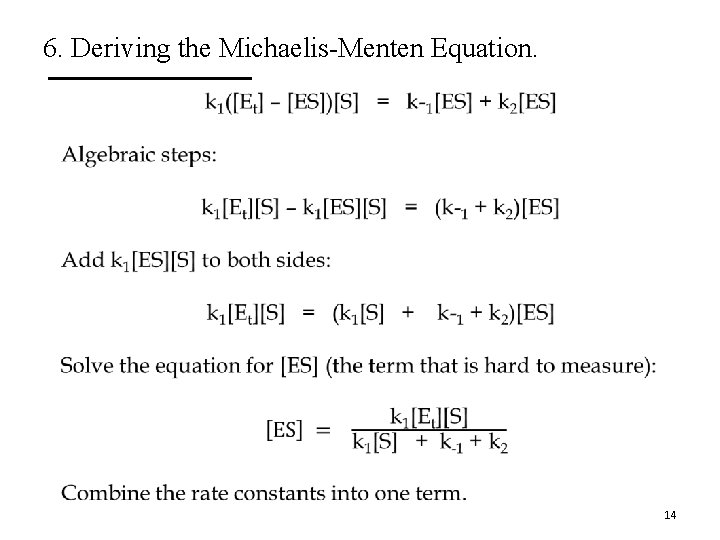
6. Deriving the Michaelis-Menten Equation. • 14
6. Deriving the Michaelis-Menten Equation. • 15
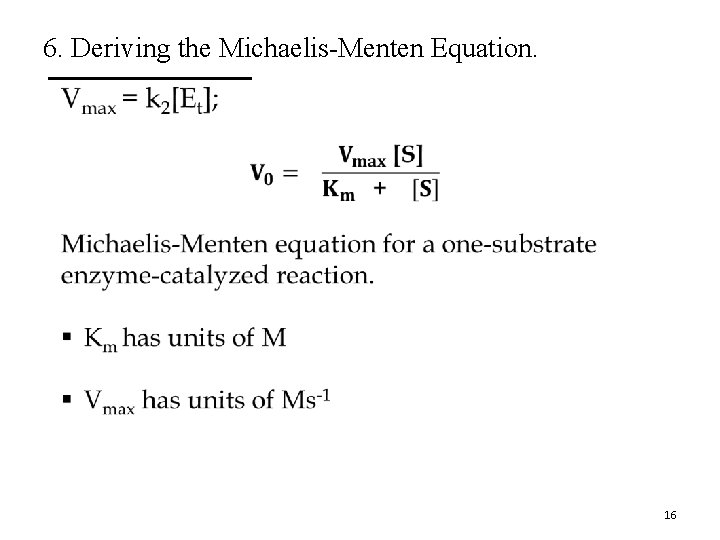
6. Deriving the Michaelis-Menten Equation. • 16
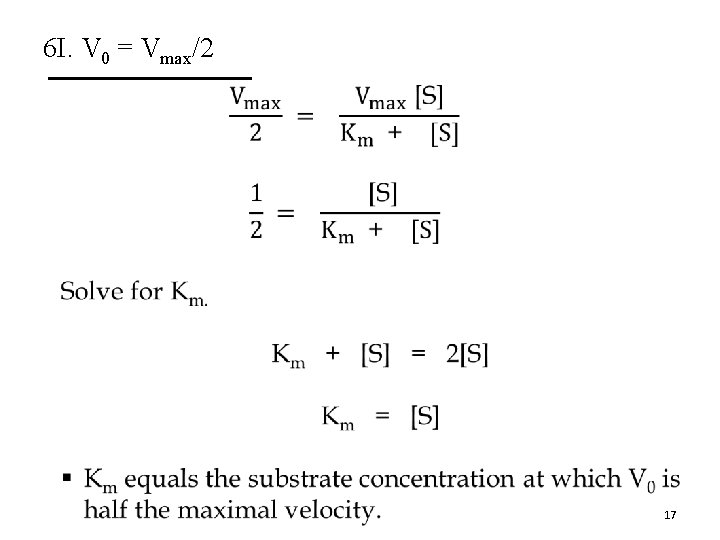
6 I. V 0 = Vmax/2 • 17
6 II. Understanding the kinetic parameters Km and Vmax. § Although derived for a simple two-step (one substrate) reaction mechanism, the Michaelis-Menten equation can be applied to enzymes that catalyze reactions with several steps. § The real meaning of Km and Vmax can differ for different enzymes. 18
6 II. Understanding the kinetic parameters Km and Vmax. A. Nonlinear Michaelis-Menten plot should be used to calculate parameters Km and Vmax. 19
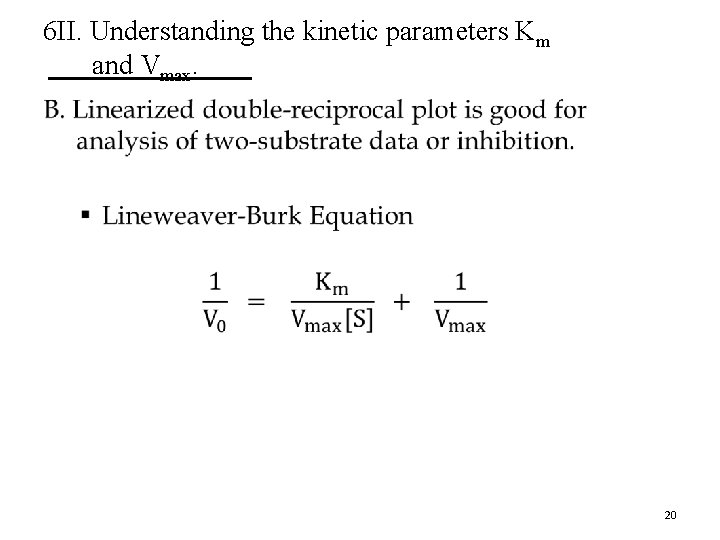
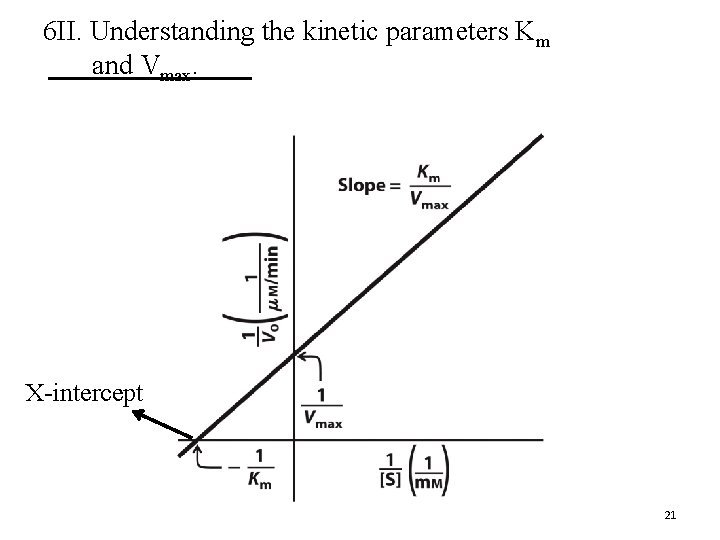
6 II. Understanding the kinetic parameters Km and Vmax. • 20
6 II. Understanding the kinetic parameters Km and Vmax. X-intercept 21
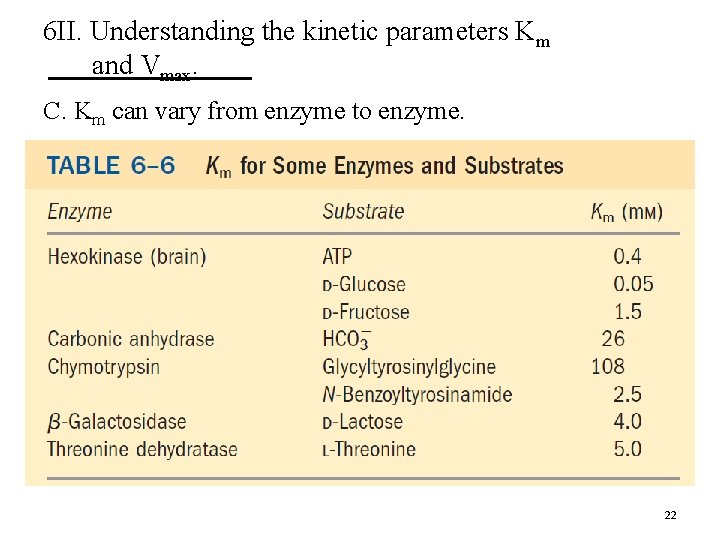
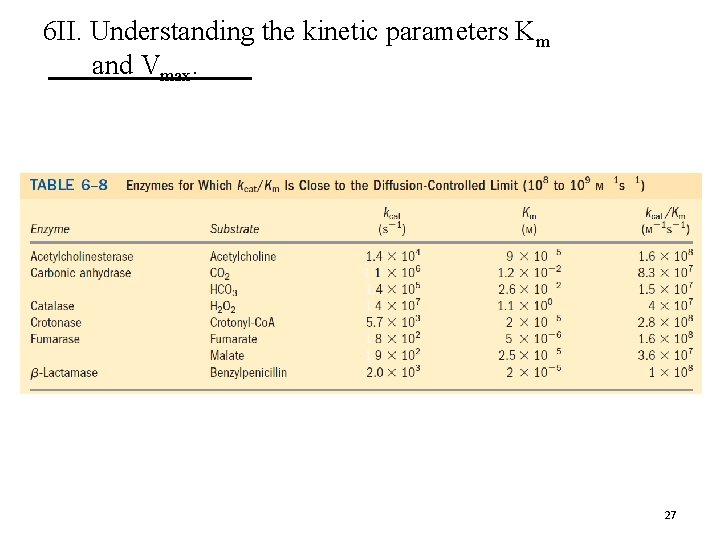
6 II. Understanding the kinetic parameters Km and Vmax. C. Km can vary from enzyme to enzyme. 22
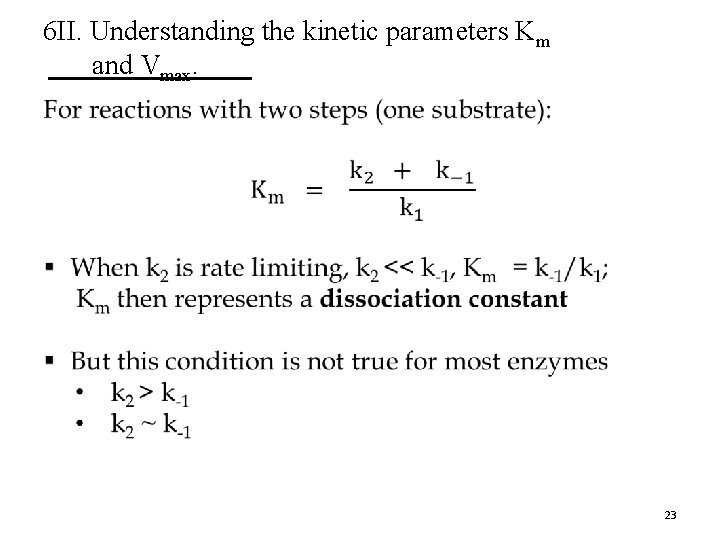
6 II. Understanding the kinetic parameters Km and Vmax. • 23
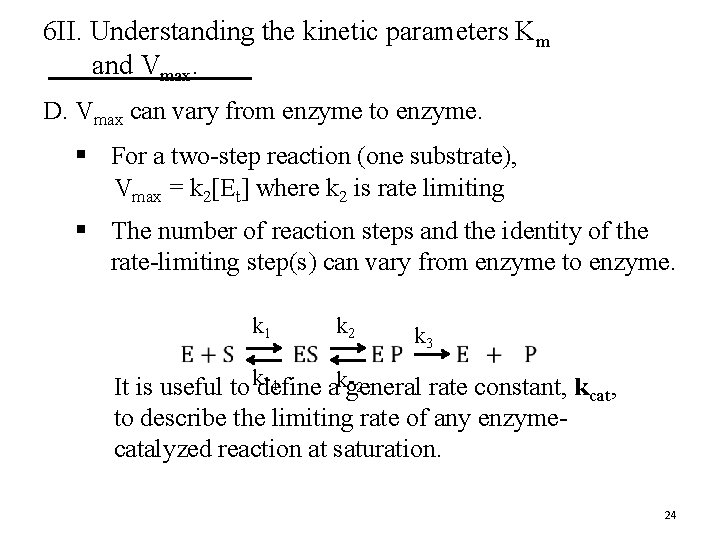
6 II. Understanding the kinetic parameters Km and Vmax. D. Vmax can vary from enzyme to enzyme. § For a two-step reaction (one substrate), Vmax = k 2[Et] where k 2 is rate limiting § The number of reaction steps and the identity of the rate-limiting step(s) can vary from enzyme to enzyme. k 1 k 2 k 3 1 2 It is useful to kdefine ak-general rate constant, kcat, to describe the limiting rate of any enzymecatalyzed reaction at saturation. 24
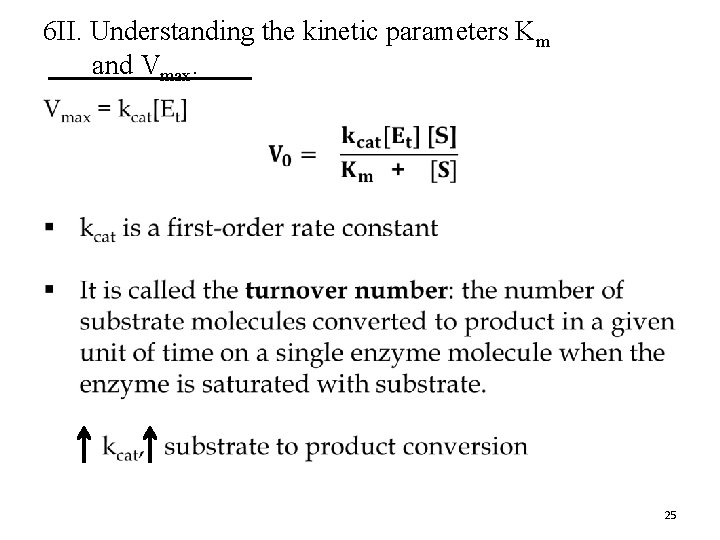
6 II. Understanding the kinetic parameters Km and Vmax. • 25
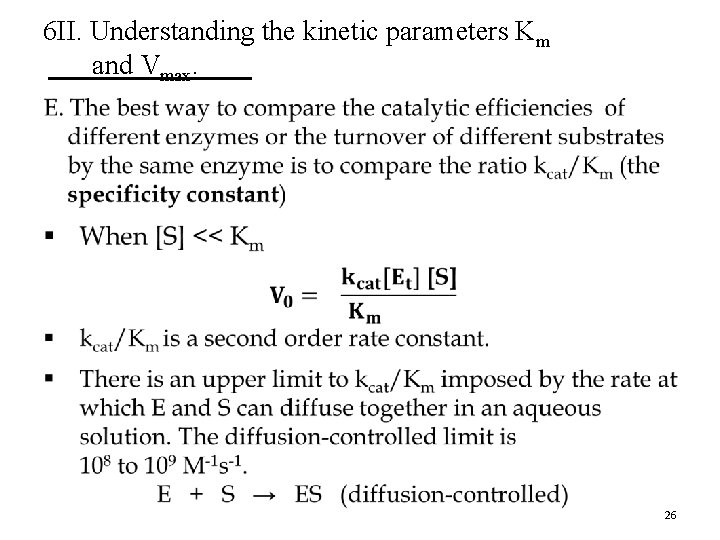
6 II. Understanding the kinetic parameters Km and Vmax. • 26
6 II. Understanding the kinetic parameters Km and Vmax. 27
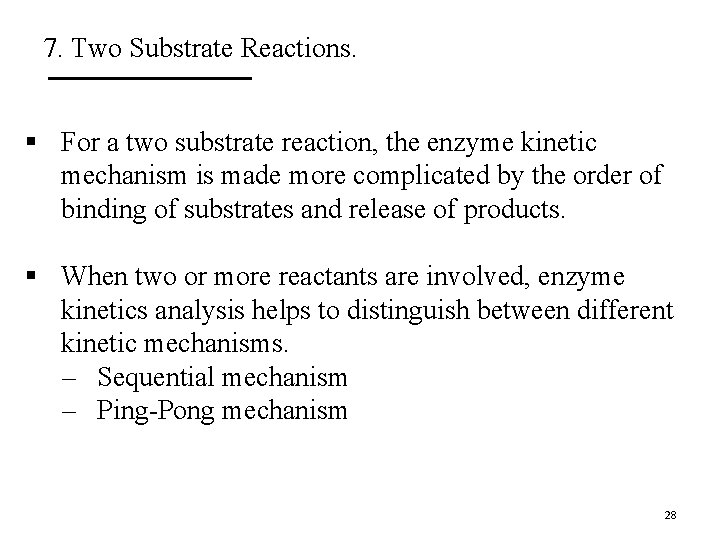
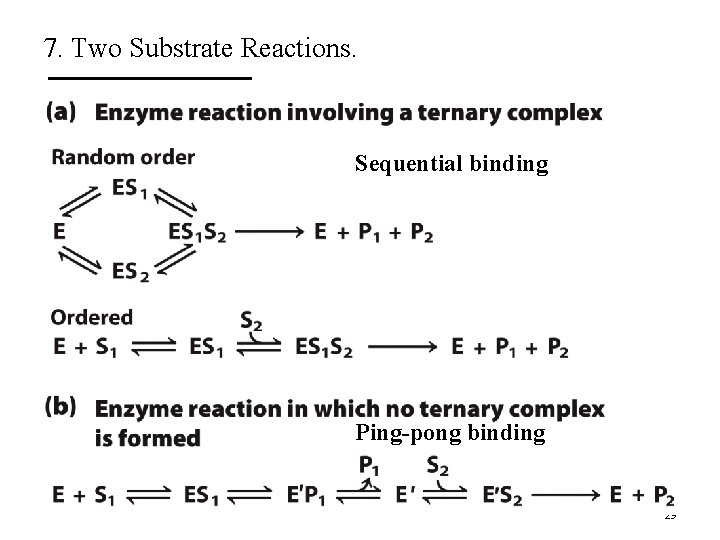
7. Two Substrate Reactions. § For a two substrate reaction, the enzyme kinetic mechanism is made more complicated by the order of binding of substrates and release of products. § When two or more reactants are involved, enzyme kinetics analysis helps to distinguish between different kinetic mechanisms. – Sequential mechanism – Ping-Pong mechanism 28
7. Two Substrate Reactions. Sequential binding Ping-pong binding 29
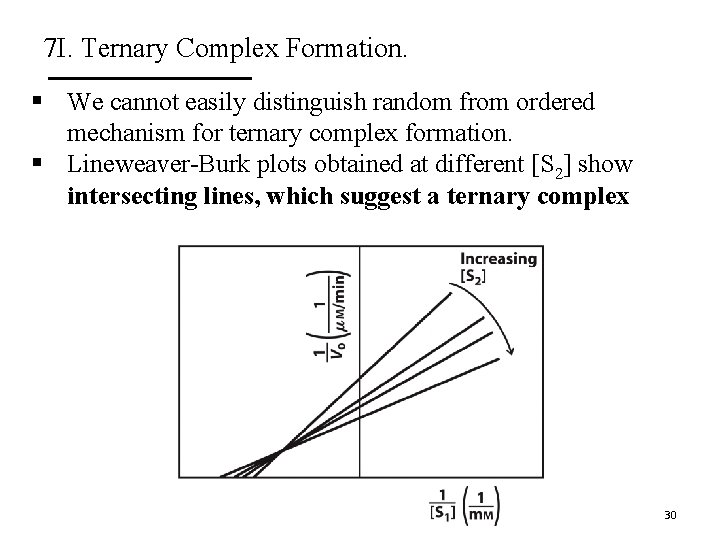
7 I. Ternary Complex Formation. § We cannot easily distinguish random from ordered mechanism for ternary complex formation. § Lineweaver-Burk plots obtained at different [S 2] show intersecting lines, which suggest a ternary complex 30
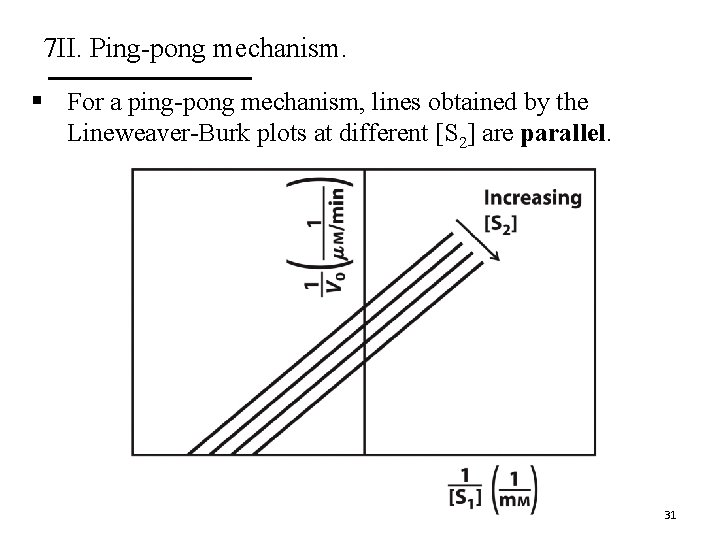
7 II. Ping-pong mechanism. § For a ping-pong mechanism, lines obtained by the Lineweaver-Burk plots at different [S 2] are parallel. 31
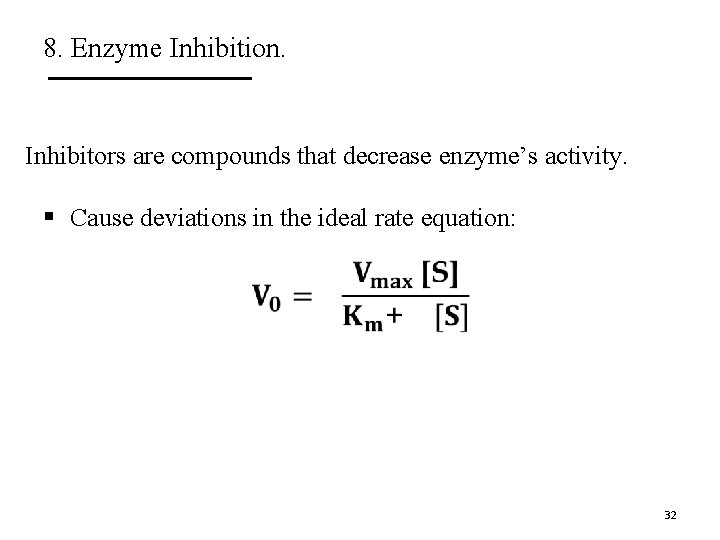
8. Enzyme Inhibition. Inhibitors are compounds that decrease enzyme’s activity. § Cause deviations in the ideal rate equation: 32
8 I. Reversible Inhibitors. Reversible inhibitors bind to and can dissociate from the enzyme. § They are often structural analogs of substrates or products. § They are often used as drugs to slow down a specific enzyme. § They bind to the free enzyme and prevent the binding of the substrate. § Or they bind to the enzyme-substrate complex and prevent the reaction. 33
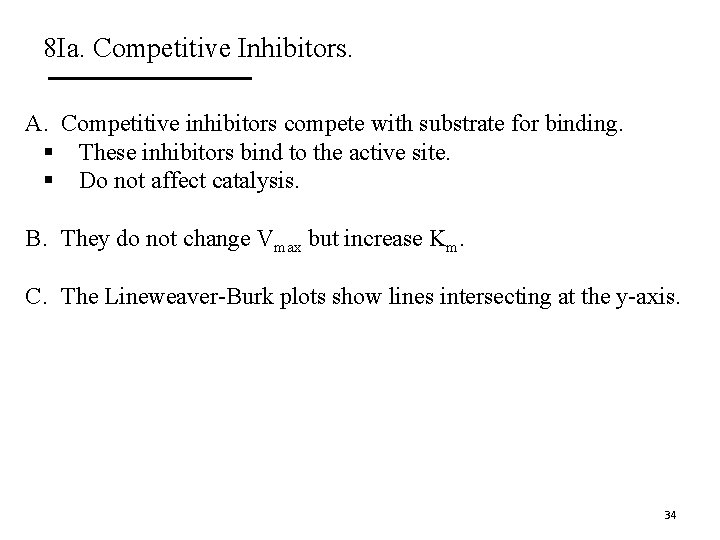
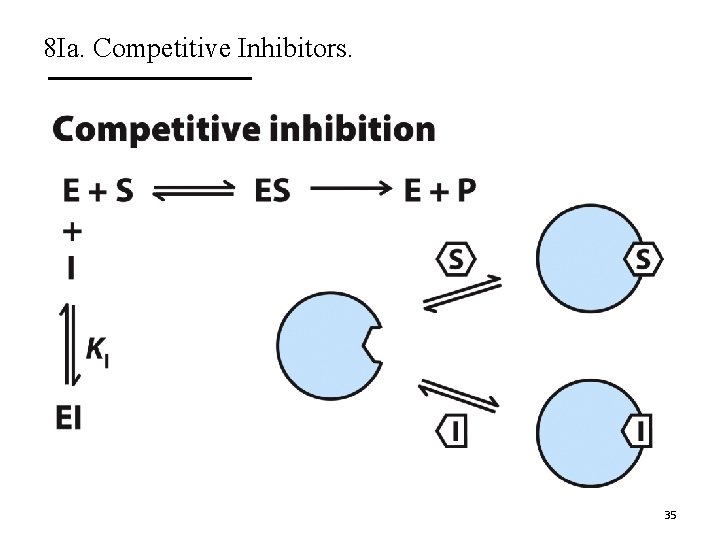
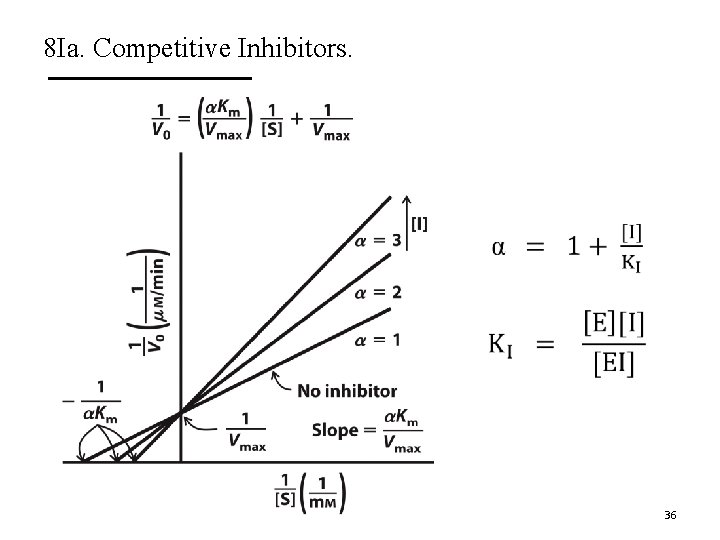
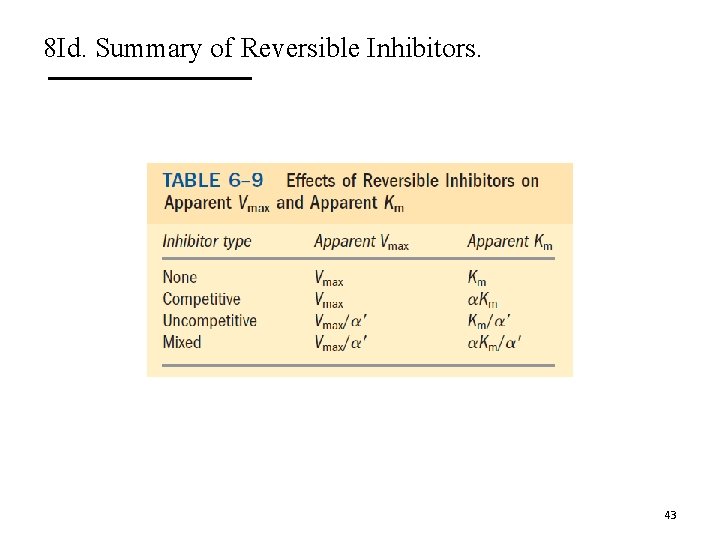
8 Ia. Competitive Inhibitors. A. Competitive inhibitors compete with substrate for binding. § These inhibitors bind to the active site. § Do not affect catalysis. B. They do not change Vmax but increase Km. C. The Lineweaver-Burk plots show lines intersecting at the y-axis. 34
8 Ia. Competitive Inhibitors. 35
8 Ia. Competitive Inhibitors. 36
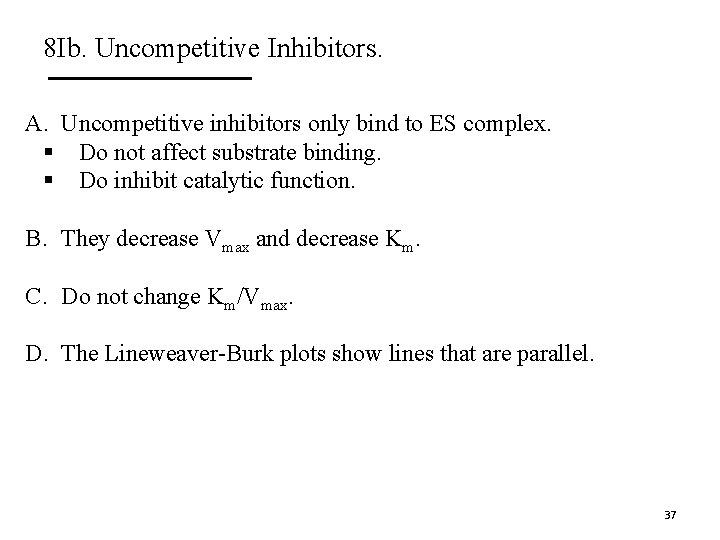
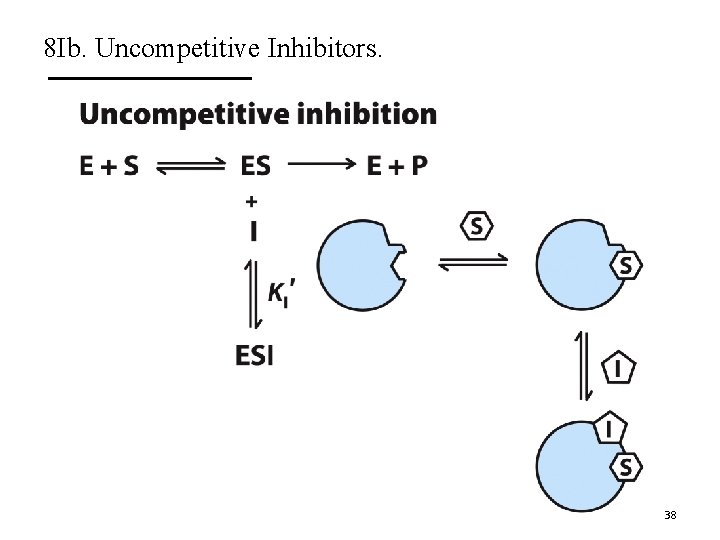
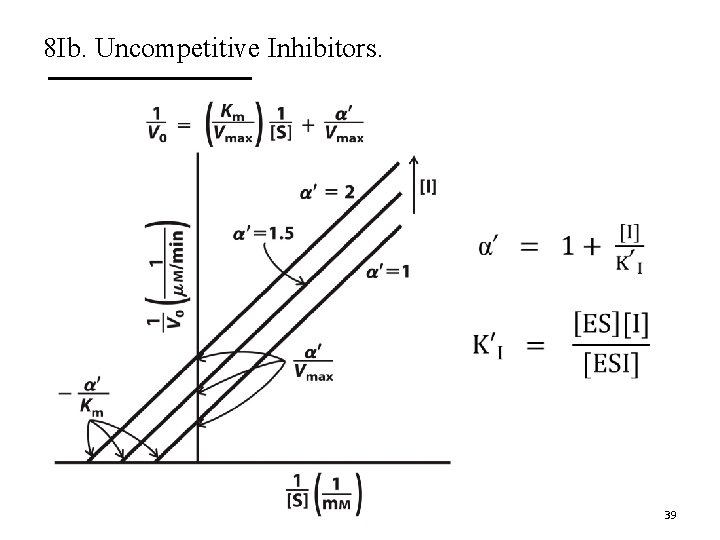
8 Ib. Uncompetitive Inhibitors. A. Uncompetitive inhibitors only bind to ES complex. § Do not affect substrate binding. § Do inhibit catalytic function. B. They decrease Vmax and decrease Km. C. Do not change Km/Vmax. D. The Lineweaver-Burk plots show lines that are parallel. 37
8 Ib. Uncompetitive Inhibitors. 38
8 Ib. Uncompetitive Inhibitors. 39
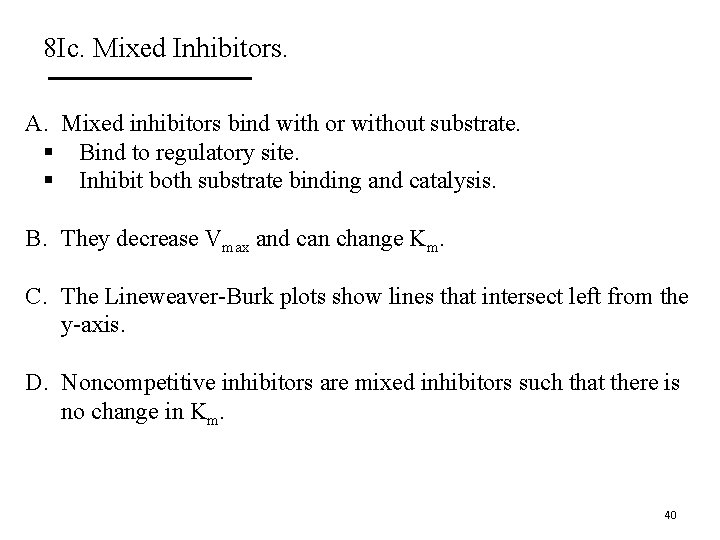
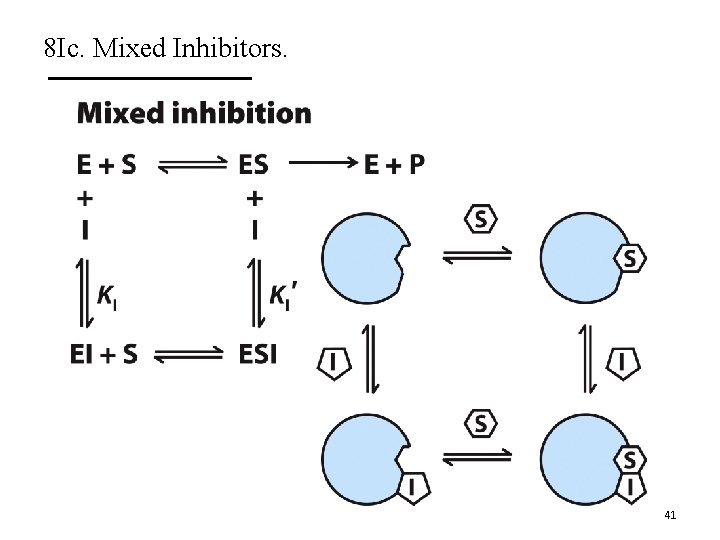
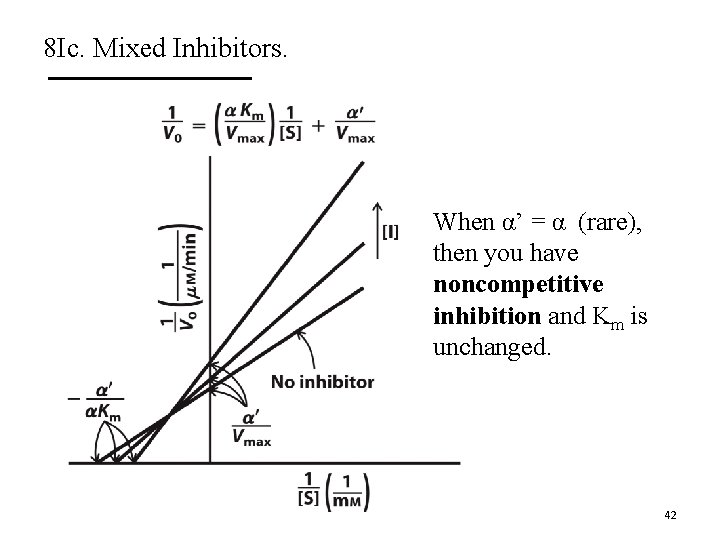
8 Ic. Mixed Inhibitors. A. Mixed inhibitors bind with or without substrate. § Bind to regulatory site. § Inhibit both substrate binding and catalysis. B. They decrease Vmax and can change Km. C. The Lineweaver-Burk plots show lines that intersect left from the y-axis. D. Noncompetitive inhibitors are mixed inhibitors such that there is no change in Km. 40
8 Ic. Mixed Inhibitors. 41
8 Ic. Mixed Inhibitors. When α’ = α (rare), then you have noncompetitive inhibition and Km is unchanged. 42
8 Id. Summary of Reversible Inhibitors. 43
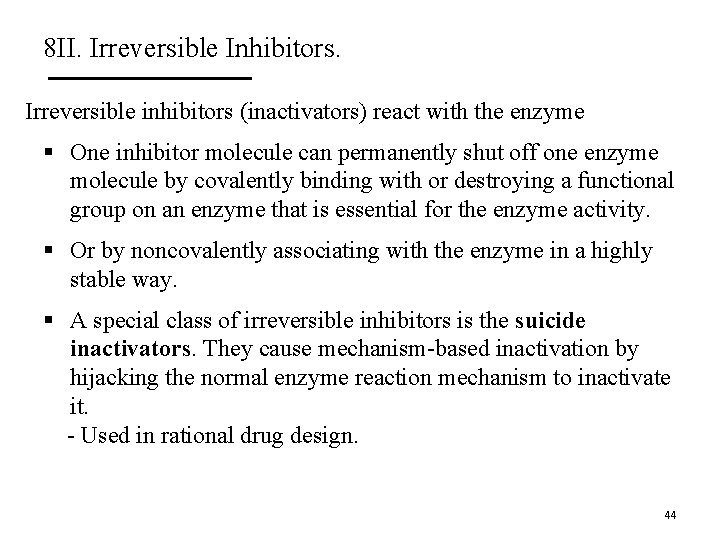
8 II. Irreversible Inhibitors. Irreversible inhibitors (inactivators) react with the enzyme § One inhibitor molecule can permanently shut off one enzyme molecule by covalently binding with or destroying a functional group on an enzyme that is essential for the enzyme activity. § Or by noncovalently associating with the enzyme in a highly stable way. § A special class of irreversible inhibitors is the suicide inactivators. They cause mechanism-based inactivation by hijacking the normal enzyme reaction mechanism to inactivate it. - Used in rational drug design. 44
Time to Pair Up into Teams of Three People Provide Brief Answers to the Following: 45
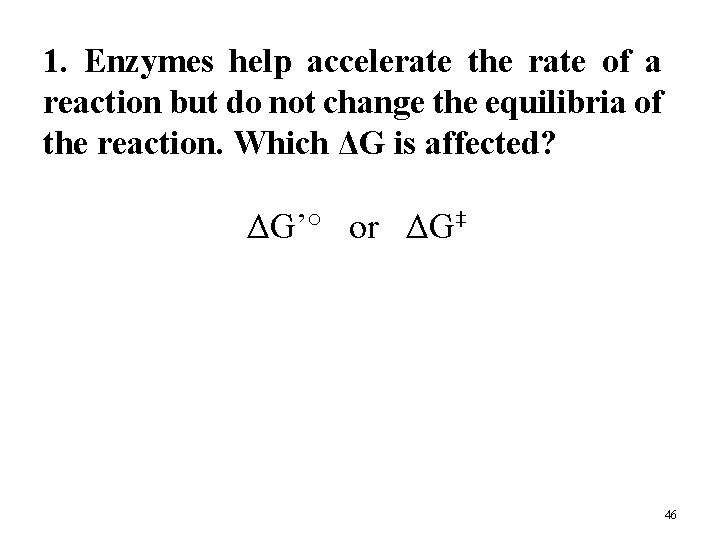
1. Enzymes help accelerate the rate of a reaction but do not change the equilibria of the reaction. Which ΔG is affected? ΔG’° or ΔG‡ 46
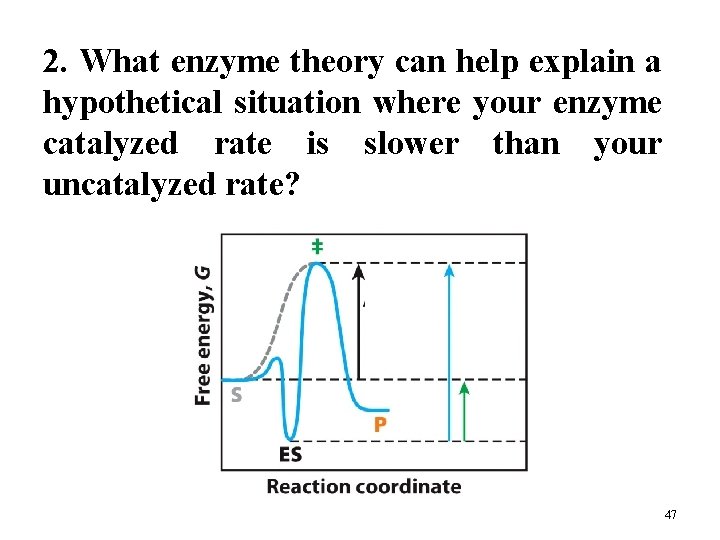
2. What enzyme theory can help explain a hypothetical situation where your enzyme catalyzed rate is slower than your uncatalyzed rate? 47
3. Why would an activation barrier for decomposition be important for the stability of biomolecules? 48
4. Besides enzyme kinetics, in what other biochemical system have we seen a hyperbolic dependence plot? 49
5. How is the steady-state assumption in enzyme kinetics similar to but not the same as a reaction at equilibrium? 50
51