
Enzyme inhibition An enzyme inhibitor is a molecule
Enzyme inhibition
ØAn enzyme inhibitor is a molecule that binds to enzymes and decreases their activity. ØThe binding of an inhibitor can stop a substrate from entering the enzyme's active site and/or hinder the enzyme from catalysing its reaction. ØInhibitor binding is either reversible or irreversible. ØIrreversible inhibitors usually react with the enzyme and change it chemically. ØThese inhibitors modify key amino acid residues needed for enzymatic activity. ØIn contrast, reversible inhibitors bind non-covalently.
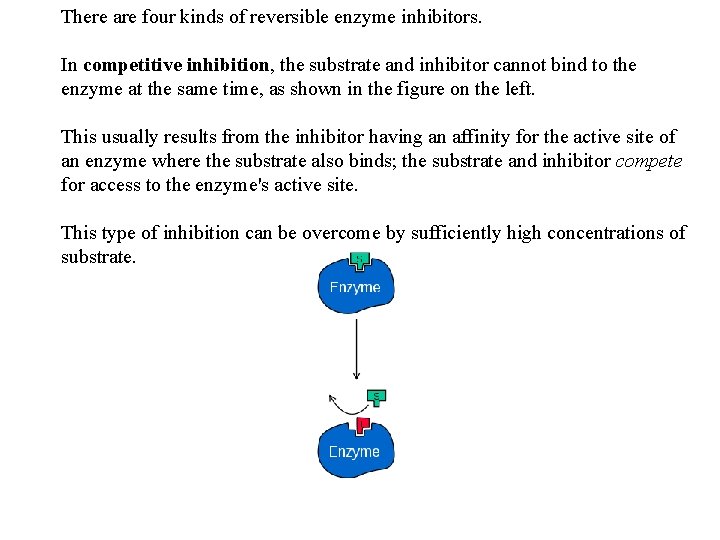
There are four kinds of reversible enzyme inhibitors. In competitive inhibition, the substrate and inhibitor cannot bind to the enzyme at the same time, as shown in the figure on the left. This usually results from the inhibitor having an affinity for the active site of an enzyme where the substrate also binds; the substrate and inhibitor compete for access to the enzyme's active site. This type of inhibition can be overcome by sufficiently high concentrations of substrate.
ØIn mixed inhibition, the inhibitor can bind to the enzyme at the same time as the enzyme's substrate. ØHowever, the binding of the inhibitor affects the binding of the substrate, and vice versa. ØThis type of inhibition can be reduced, but not overcome by increasing concentrations of substrate. ØAlthough it is possible for mixed-type inhibitors to bind in the active site, this type of inhibition generally results from an allosteric effect where the inhibitor binds to a different site on an enzyme. ØInhibitor binding to this allosteric site changes the conformation (i. e. , tertiary structure or three-dimensional shape) of the enzyme so that the affinity of the substrate for the active site is reduced.
Non-competitive inhibition is a form of mixed inhibition where the binding of the inhibitor to the enzyme reduces its activity but does not affect the binding of substrate. As a result, the extent of inhibition depends only on the concentration of the inhibitor. In uncompetitive inhibition, the inhibitor binds only to the substrateenzyme complex
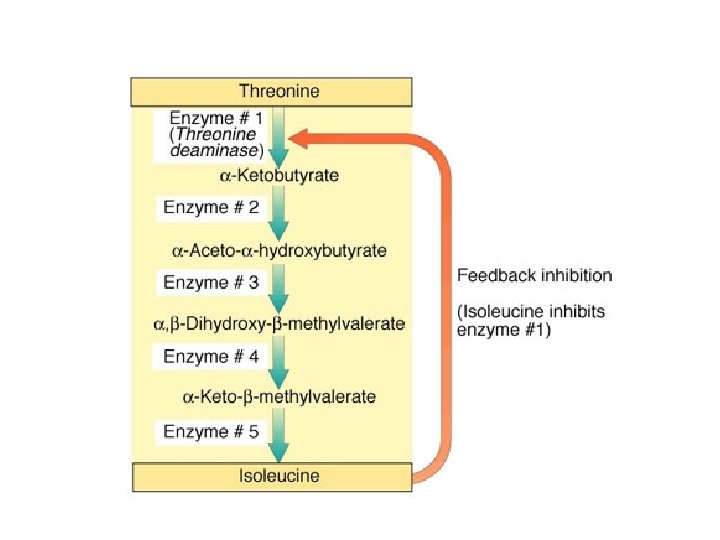
Feedback Inhibition Another kind of inhibition is called feedback inhibition. Ø In feedback inhibition, there is a second binding site on the enzyme Ø where the inhibitor binds, so that the inhibitor is not necessarily similar in structure to the substrate. ØThe absence or presence of the inhibitor at this second binding site activates or deactivates the enzyme, presumably by changing the conformation of the enzyme so that the active site is made available or unavailable to the substrate. ØThe inhibitor is usually the product of a reaction farther on down the metabolic pathway.
- Slides: 7