
Enzyme Assay Enzyme assays are done to study

- Slides: 29
Enzyme Assay Enzyme assays are done to study the kinetics of the particular enzyme from any source and the factors that affect its activity like substrate concentration, p. H and temperature Related LOs: Enzyme kinetics > Prior Viewing – IDD-32. Buffer preparation for western analysis, IDD-50 basic instrumentation > Future Viewing – IDD-17. SDS-PAGE, IDD-33. Western blot assay Course Name: Enzyme Assay Level(UG/PG): UG Author(s): Dinesh Raghu, Vinayak Pachapur Mentor: Dr. Sanjeeva Srivastava *The contents in this ppt are licensed under Creative Commons Attribution-Non. Commercial-Share. Alike 2. 5 India license
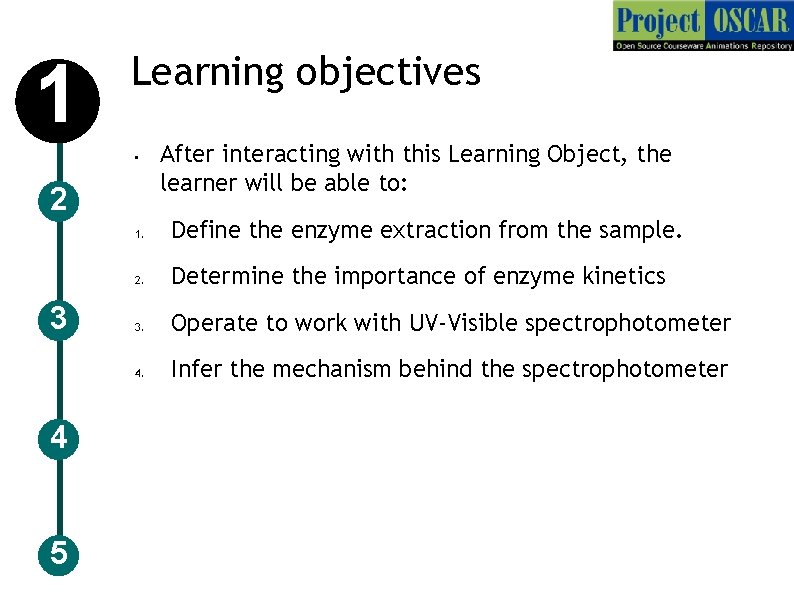
1 Learning objectives • 2 3 4 5 After interacting with this Learning Object, the learner will be able to: 1. Define the enzyme extraction from the sample. 2. Determine the importance of enzyme kinetics 3. Operate to work with UV-Visible spectrophotometer 4. Infer the mechanism behind the spectrophotometer
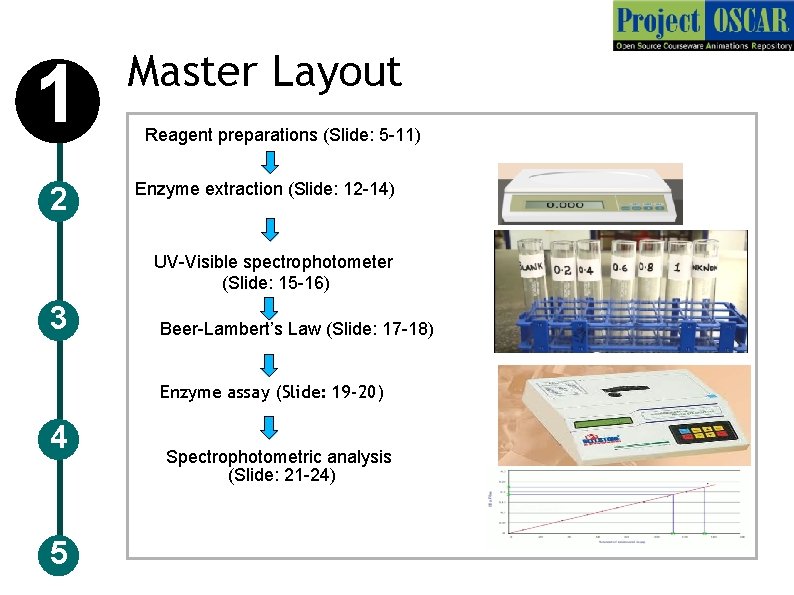
1 Master Layout 2 Enzyme extraction (Slide: 12 -14) Reagent preparations (Slide: 5 -11) UV-Visible spectrophotometer (Slide: 15 -16) 3 Beer-Lambert’s Law (Slide: 17 -18) Enzyme assay (Slide: 19 -20) 4 5 Spectrophotometric analysis (Slide: 21 -24)
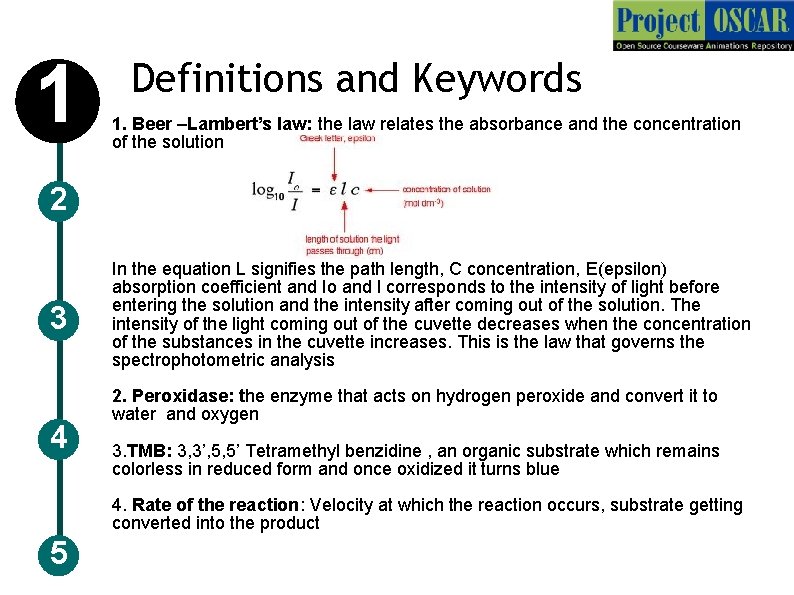
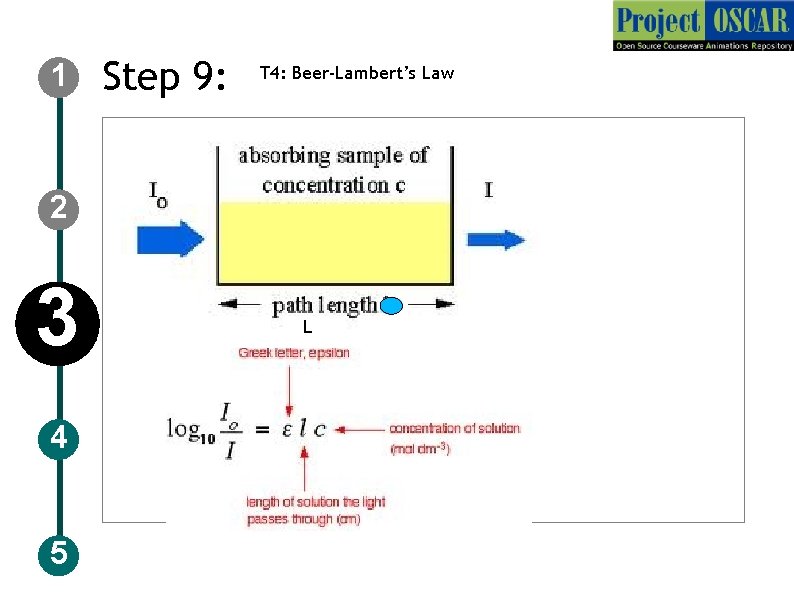
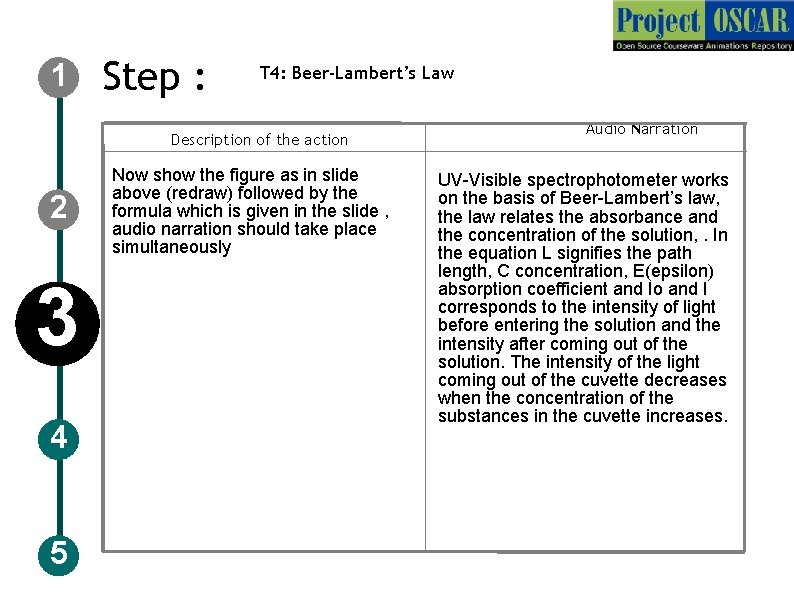
1 Definitions and Keywords 1. Beer –Lambert’s law: the law relates the absorbance and the concentration of the solution 2 3 4 In the equation L signifies the path length, C concentration, E(epsilon) absorption coefficient and Io and I corresponds to the intensity of light before entering the solution and the intensity after coming out of the solution. The intensity of the light coming out of the cuvette decreases when the concentration of the substances in the cuvette increases. This is the law that governs the spectrophotometric analysis 2. Peroxidase: the enzyme that acts on hydrogen peroxide and convert it to water and oxygen 3. TMB: 3, 3’, 5, 5’ Tetramethyl benzidine , an organic substrate which remains colorless in reduced form and once oxidized it turns blue 4. Rate of the reaction: Velocity at which the reaction occurs, substrate getting converted into the product 5
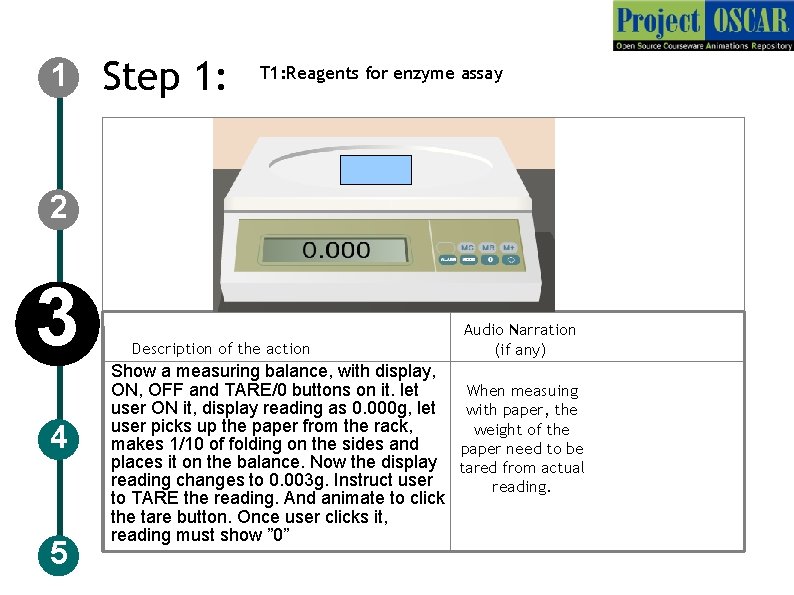
1 Step 1: T 1: Reagents for enzyme assay 2 3 4 5 Description of the action Audio Narration (if any) Show a measuring balance, with display, ON, OFF and TARE/0 buttons on it. let When measuing user ON it, display reading as 0. 000 g, let with paper, the user picks up the paper from the rack, weight of the makes 1/10 of folding on the sides and paper need to be places it on the balance. Now the display tared from actual reading changes to 0. 003 g. Instruct user reading. to TARE the reading. And animate to click the tare button. Once user clicks it, reading must show ” 0”
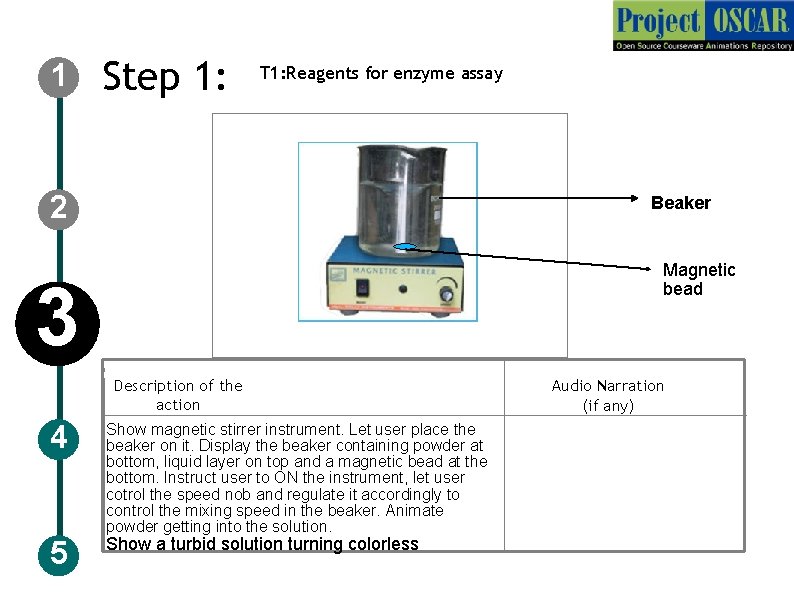
1 Step 1: T 1: Reagents for enzyme assay 2 Beaker Magnetic bead 3 Description of the action 4 5 Show magnetic stirrer instrument. Let user place the beaker on it. Display the beaker containing powder at bottom, liquid layer on top and a magnetic bead at the bottom. Instruct user to ON the instrument, let user cotrol the speed nob and regulate it accordingly to control the mixing speed in the beaker. Animate powder getting into the solution. Show a turbid solution turning colorless Audio Narration (if any)
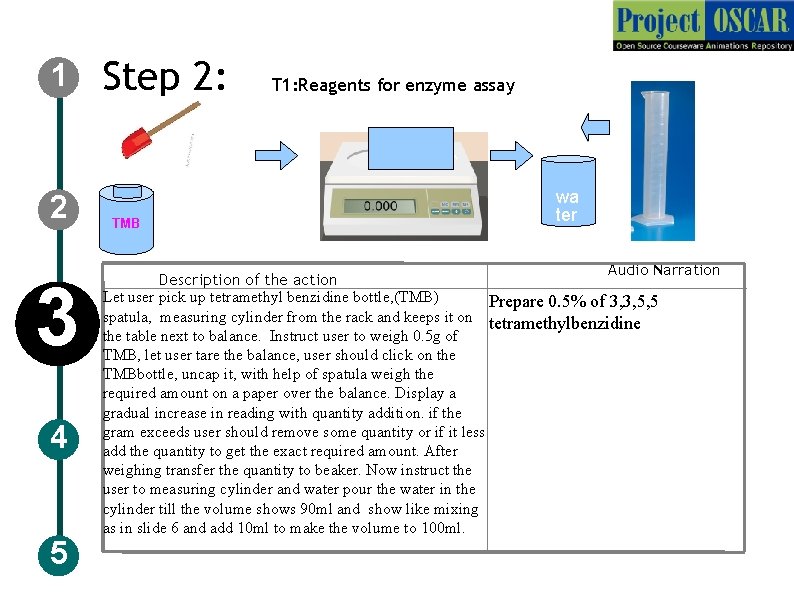
1 2 3 4 5 Step 2: TMB T 1: Reagents for enzyme assay wa ter Audio Narration Description of the action Let user pick up tetramethyl benzidine bottle, (TMB) Prepare 0. 5% of 3, 3, 5, 5 spatula, measuring cylinder from the rack and keeps it on tetramethylbenzidine the table next to balance. Instruct user to weigh 0. 5 g of TMB, let user tare the balance, user should click on the TMBbottle, uncap it, with help of spatula weigh the required amount on a paper over the balance. Display a gradual increase in reading with quantity addition. if the gram exceeds user should remove some quantity or if it less add the quantity to get the exact required amount. After weighing transfer the quantity to beaker. Now instruct the user to measuring cylinder and water pour the water in the cylinder till the volume shows 90 ml and show like mixing as in slide 6 and add 10 ml to make the volume to 100 ml.
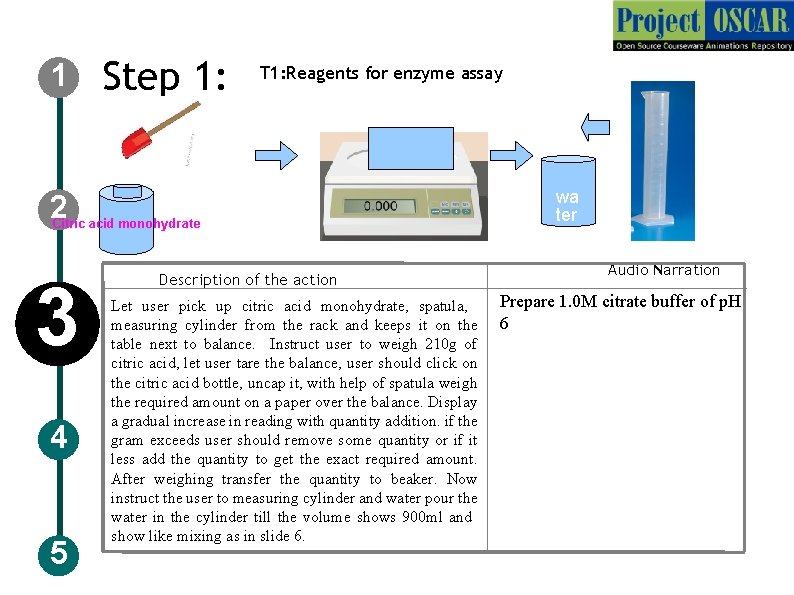
1 Step 1: T 1: Reagents for enzyme assay 2 Citric acid monohydrate 3 4 5 Description of the action Let user pick up citric acid monohydrate, spatula, measuring cylinder from the rack and keeps it on the table next to balance. Instruct user to weigh 210 g of citric acid, let user tare the balance, user should click on the citric acid bottle, uncap it, with help of spatula weigh the required amount on a paper over the balance. Display a gradual increase in reading with quantity addition. if the gram exceeds user should remove some quantity or if it less add the quantity to get the exact required amount. After weighing transfer the quantity to beaker. Now instruct the user to measuring cylinder and water pour the water in the cylinder till the volume shows 900 ml and show like mixing as in slide 6. wa ter Audio Narration Prepare 1. 0 M citrate buffer of p. H 6
1 Step 2: T 1: Reagents for enzyme assay 2 3 4 5 STD 1 Description of the action Display standard p. H bottles and p. H instrument and deionized water, discard placed on a table. Instruct user to caliberate the instrument. Let user ON the instrument. Initially for the p. H rod is dipped in water, when user clicks on read button, display must show a reading “ 7”. Now show like taking out the rod and washing it with deionized-water, let user cleans the rod with tissue. Now pick the STD 1, uncap it, dip the cleaned rod into the solution, user must click read button with display showing “ 4”. now clean the rod and repeat the step to note down the reading for STD 2 and now the display should show “ 9”. STD 2 Audio Narration Before the p. H reading, p. H instrument need to be calibrated with standards. Once with STD 1 at p. H 4 and with STD 2 at p. H 9.
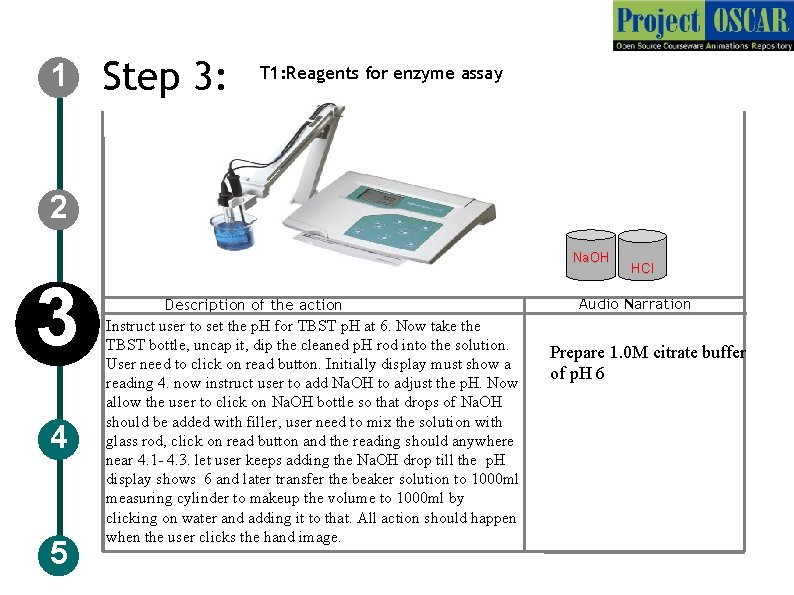
1 Step 3: T 1: Reagents for enzyme assay 2 Na. OH 3 4 5 Description of the action Instruct user to set the p. H for TBST p. H at 6. Now take the TBST bottle, uncap it, dip the cleaned p. H rod into the solution. User need to click on read button. Initially display must show a reading 4. now instruct user to add Na. OH to adjust the p. H. Now allow the user to click on Na. OH bottle so that drops of Na. OH should be added with filler, user need to mix the solution with glass rod, click on read button and the reading should anywhere near 4. 1 - 4. 3. let user keeps adding the Na. OH drop till the p. H display shows 6 and later transfer the beaker solution to 1000 ml measuring cylinder to makeup the volume to 1000 ml by clicking on water and adding it to that. All action should happen when the user clicks the hand image. HCl Audio Narration Prepare 1. 0 M citrate buffer of p. H 6
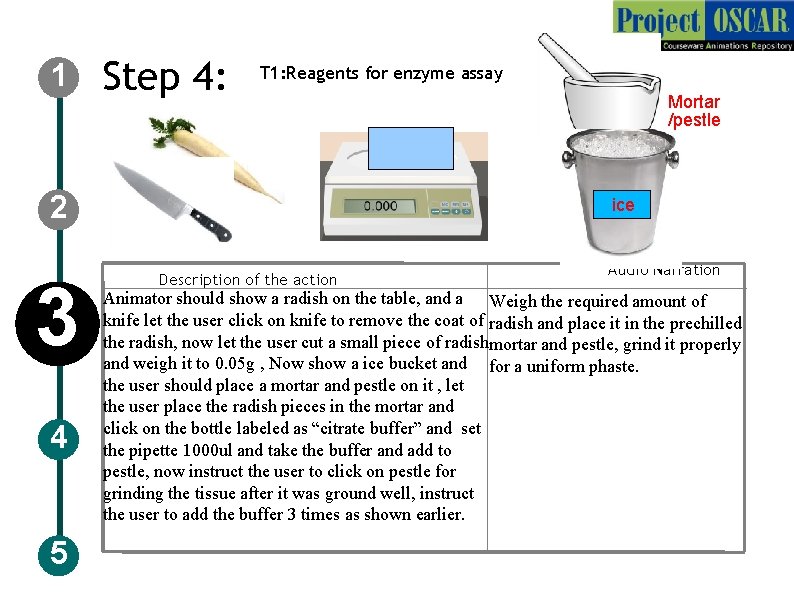
1 Step 4: T 1: Reagents for enzyme assay 2 3 4 5 Mortar /pestle ice Description of the action Audio Narration Animator should show a radish on the table, and a Weigh the required amount of knife let the user click on knife to remove the coat of radish and place it in the prechilled the radish, now let the user cut a small piece of radishmortar and pestle, grind it properly and weigh it to 0. 05 g , Now show a ice bucket and for a uniform phaste. the user should place a mortar and pestle on it , let the user place the radish pieces in the mortar and click on the bottle labeled as “citrate buffer” and set the pipette 1000 ul and take the buffer and add to pestle, now instruct the user to click on pestle for grinding the tissue after it was ground well, instruct the user to add the buffer 3 times as shown earlier.
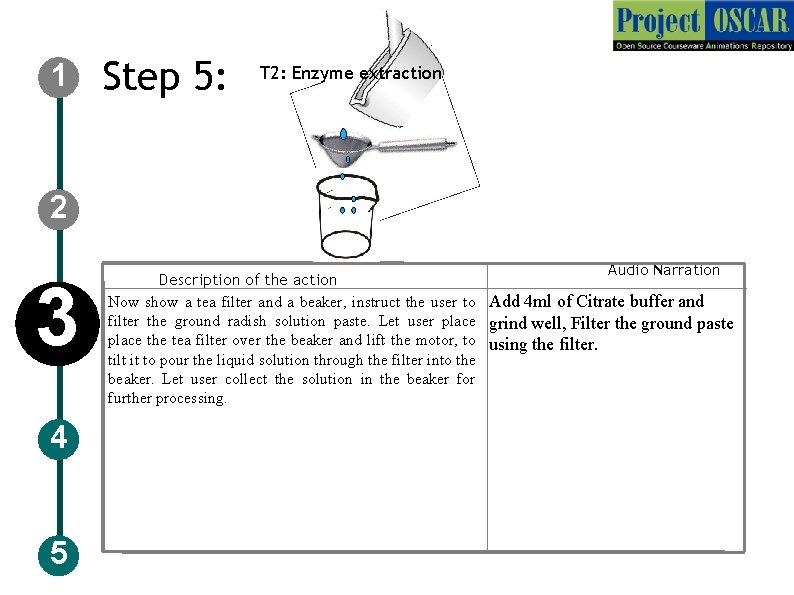
1 Step 5: T 2: Enzyme extraction 2 3 4 5 Audio Narration Description of the action Now show a tea filter and a beaker, instruct the user to Add 4 ml of Citrate buffer and filter the ground radish solution paste. Let user place grind well, Filter the ground paste place the tea filter over the beaker and lift the motor, to using the filter. tilt it to pour the liquid solution through the filter into the beaker. Let user collect the solution in the beaker for further processing.
1 2 3 4 5 Step 6: T 2: Enzyme extraction Description of the action Now instruct the user to take the measuring cylinder and citrate buffer, animate like the user pouring the citrate buffer to the cylinder till the volume reaches 96 ml and add to the beaker with radish extract. Audio Narration Make up the volume of the extract to 100 ml using the buffer such that the extract contains 100 units of enzyme/ml of the buffer
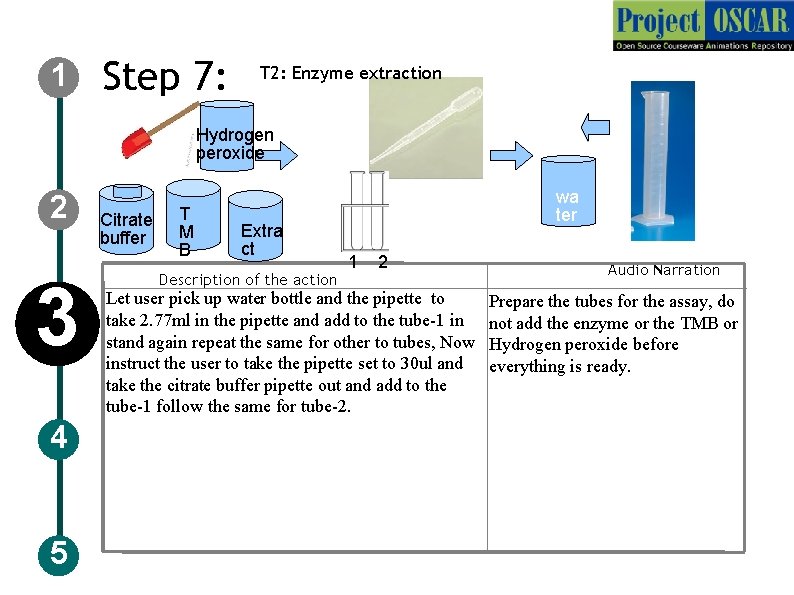
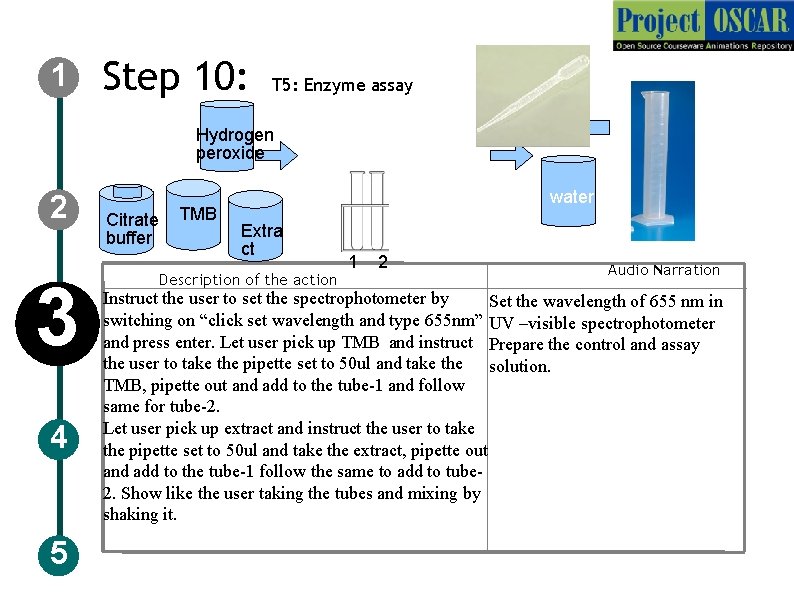
1 Step 7: T 2: Enzyme extraction Hydrogen peroxide 2 3 4 5 Citrate buffer T M B Extra ct Description of the action wa ter 1 2 Let user pick up water bottle and the pipette to take 2. 77 ml in the pipette and add to the tube-1 in stand again repeat the same for other to tubes, Now instruct the user to take the pipette set to 30 ul and take the citrate buffer pipette out and add to the tube-1 follow the same for tube-2. Audio Narration Prepare the tubes for the assay, do not add the enzyme or the TMB or Hydrogen peroxide before everything is ready.
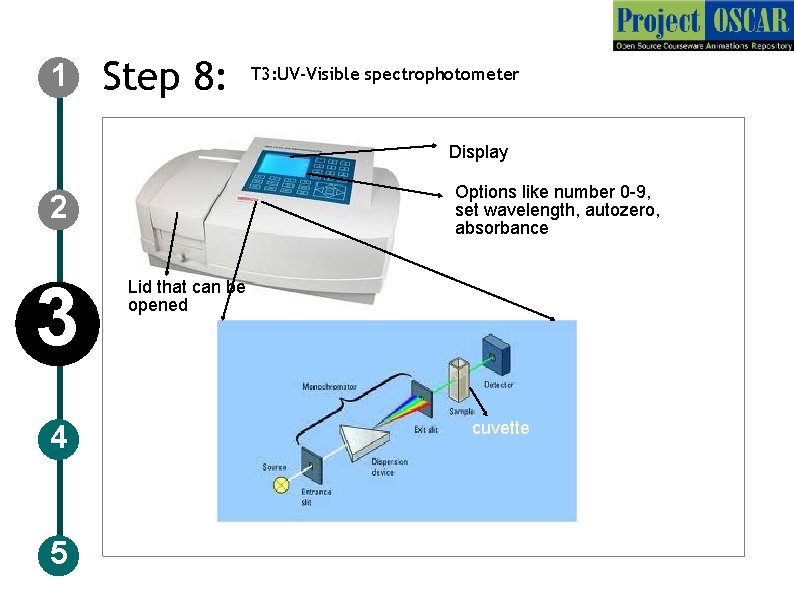
1 Step 8: T 3: UV-Visible spectrophotometer Display Options like number 0 -9, set wavelength, autozero, absorbance 2 3 4 5 Lid that can be opened cuvette
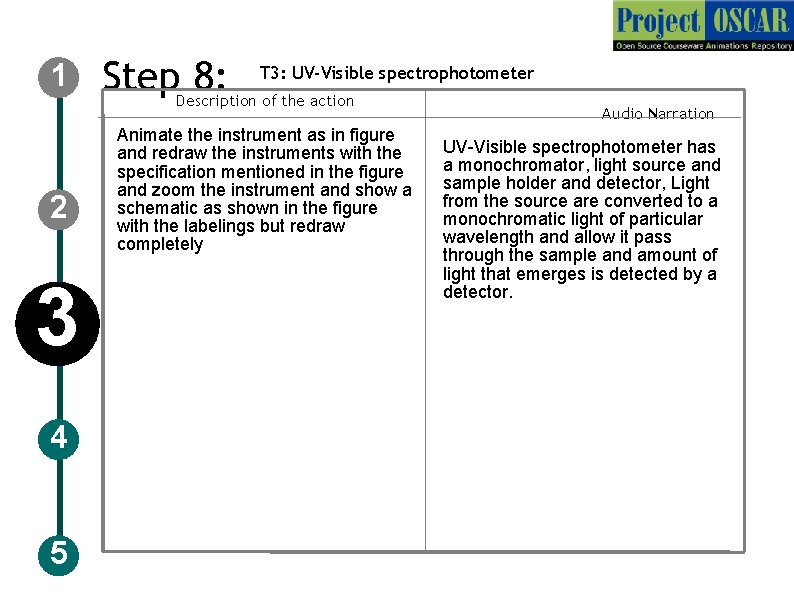
1 2 3 4 5 Step 8: T 3: UV-Visible spectrophotometer Description of the action Animate the instrument as in figure and redraw the instruments with the specification mentioned in the figure and zoom the instrument and show a schematic as shown in the figure with the labelings but redraw completely Audio Narration UV-Visible spectrophotometer has a monochromator, light source and sample holder and detector, Light from the source are converted to a monochromatic light of particular wavelength and allow it pass through the sample and amount of light that emerges is detected by a detector.
1 Step 9: T 4: Beer-Lambert’s Law 2 3 4 5 L
1 Step : T 4: Beer-Lambert’s Law Description of the action 2 3 4 5 Now show the figure as in slide above (redraw) followed by the formula which is given in the slide , audio narration should take place simultaneously Audio Narration UV-Visible spectrophotometer works on the basis of Beer-Lambert’s law, the law relates the absorbance and the concentration of the solution, . In the equation L signifies the path length, C concentration, E(epsilon) absorption coefficient and Io and I corresponds to the intensity of light before entering the solution and the intensity after coming out of the solution. The intensity of the light coming out of the cuvette decreases when the concentration of the substances in the cuvette increases.
1 Step 10: T 5: Enzyme assay Hydrogen peroxide 2 3 4 5 Citrate buffer TMB water Extra ct Description of the action 1 2 Audio Narration Instruct the user to set the spectrophotometer by Set the wavelength of 655 nm in switching on “click set wavelength and type 655 nm” UV –visible spectrophotometer and press enter. Let user pick up TMB and instruct Prepare the control and assay the user to take the pipette set to 50 ul and take the solution. TMB, pipette out and add to the tube-1 and follow same for tube-2. Let user pick up extract and instruct the user to take the pipette set to 50 ul and take the extract, pipette out and add to the tube-1 follow the same to add to tube 2. Show like the user taking the tubes and mixing by shaking it.
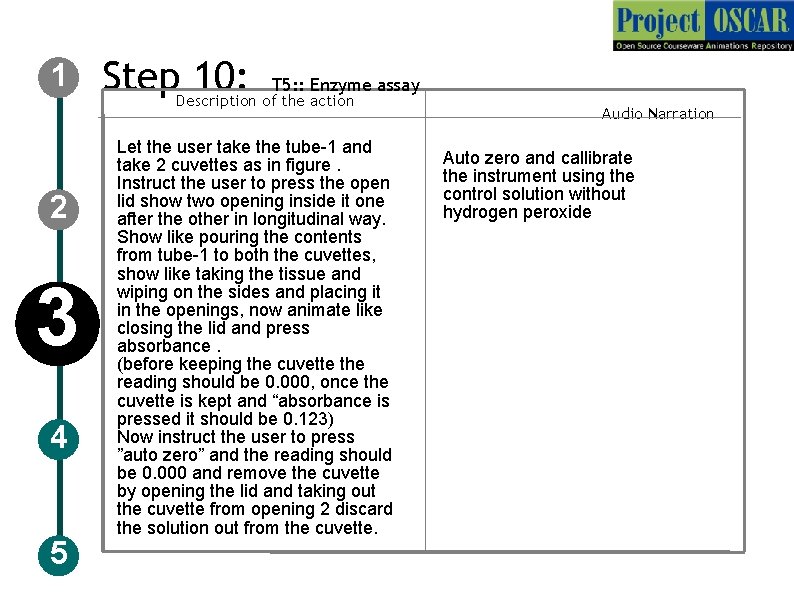
1 2 3 4 5 Step 10: T 5: : Enzyme assay Description of the action Let the user take the tube-1 and take 2 cuvettes as in figure. Instruct the user to press the open lid show two opening inside it one after the other in longitudinal way. Show like pouring the contents from tube-1 to both the cuvettes, show like taking the tissue and wiping on the sides and placing it in the openings, now animate like closing the lid and press absorbance. (before keeping the cuvette the reading should be 0. 000, once the cuvette is kept and “absorbance is pressed it should be 0. 123) Now instruct the user to press ”auto zero” and the reading should be 0. 000 and remove the cuvette by opening the lid and taking out the cuvette from opening 2 discard the solution out from the cuvette. Audio Narration Auto zero and callibrate the instrument using the control solution without hydrogen peroxide
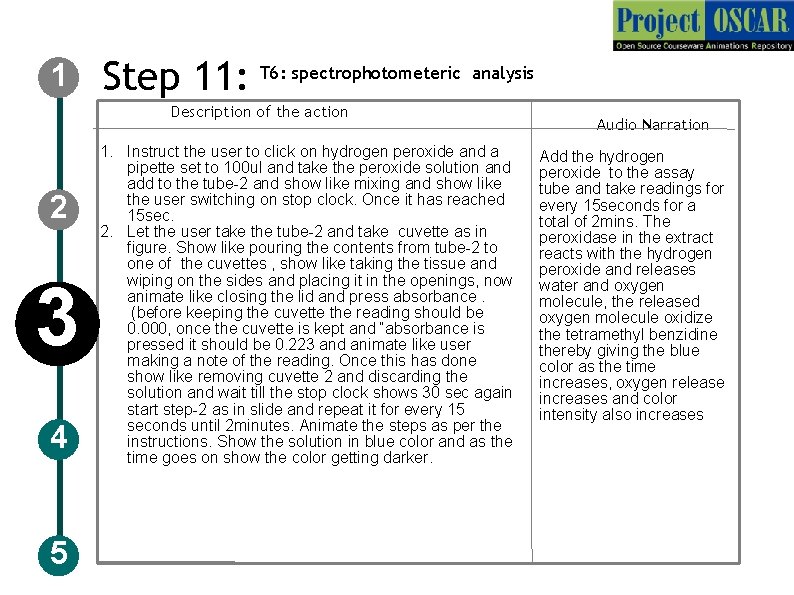
1 Step 11: T 6: spectrophotometeric analysis Description of the action 2 3 4 5 1. Instruct the user to click on hydrogen peroxide and a pipette set to 100 ul and take the peroxide solution and add to the tube-2 and show like mixing and show like the user switching on stop clock. Once it has reached 15 sec. 2. Let the user take the tube-2 and take cuvette as in figure. Show like pouring the contents from tube-2 to one of the cuvettes , show like taking the tissue and wiping on the sides and placing it in the openings, now animate like closing the lid and press absorbance. (before keeping the cuvette the reading should be 0. 000, once the cuvette is kept and “absorbance is pressed it should be 0. 223 and animate like user making a note of the reading. Once this has done show like removing cuvette 2 and discarding the solution and wait till the stop clock shows 30 sec again start step-2 as in slide and repeat it for every 15 seconds until 2 minutes. Animate the steps as per the instructions. Show the solution in blue color and as the time goes on show the color getting darker. Audio Narration Add the hydrogen peroxide to the assay tube and take readings for every 15 seconds for a total of 2 mins. The peroxidase in the extract reacts with the hydrogen peroxide and releases water and oxygen molecule, the released oxygen molecule oxidize the tetramethyl benzidine thereby giving the blue color as the time increases, oxygen release increases and color intensity also increases
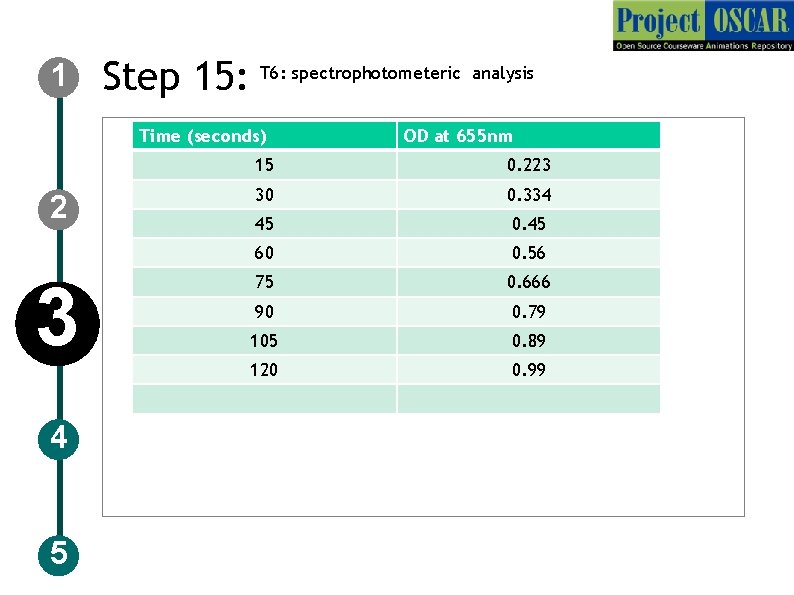
1 Step 15: T 6: spectrophotometeric analysis Time (seconds) 2 3 4 5 OD at 655 nm 15 0. 223 30 0. 334 45 0. 45 60 0. 56 75 0. 666 90 0. 79 105 0. 89 120 0. 99
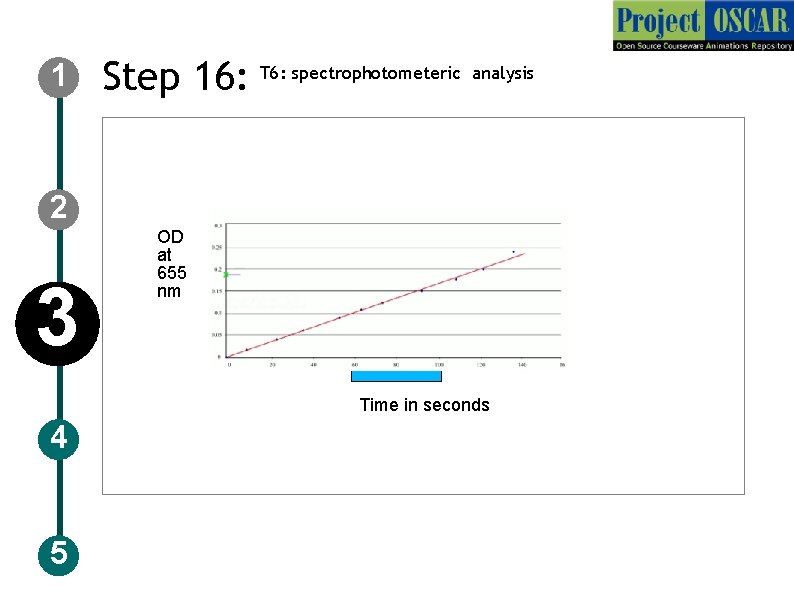
1 Step 16: T 6: spectrophotometeric analysis 2 3 OD at 655 nm Time in seconds 4 5
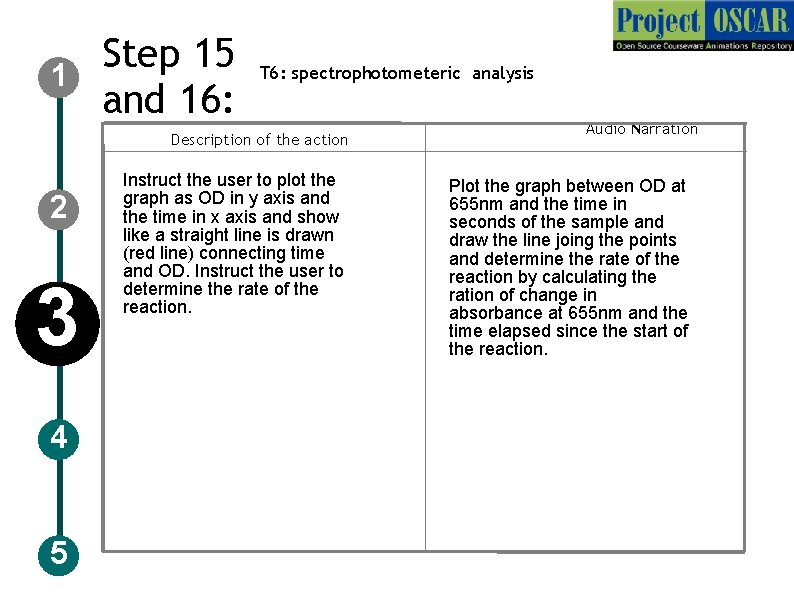
1 Step 15 and 16: T 6: spectrophotometeric analysis Description of the action 2 3 4 5 Instruct the user to plot the graph as OD in y axis and the time in x axis and show like a straight line is drawn (red line) connecting time and OD. Instruct the user to determine the rate of the reaction. Audio Narration Plot the graph between OD at 655 nm and the time in seconds of the sample and draw the line joing the points and determine the rate of the reaction by calculating the ration of change in absorbance at 655 nm and the time elapsed since the start of the reaction.
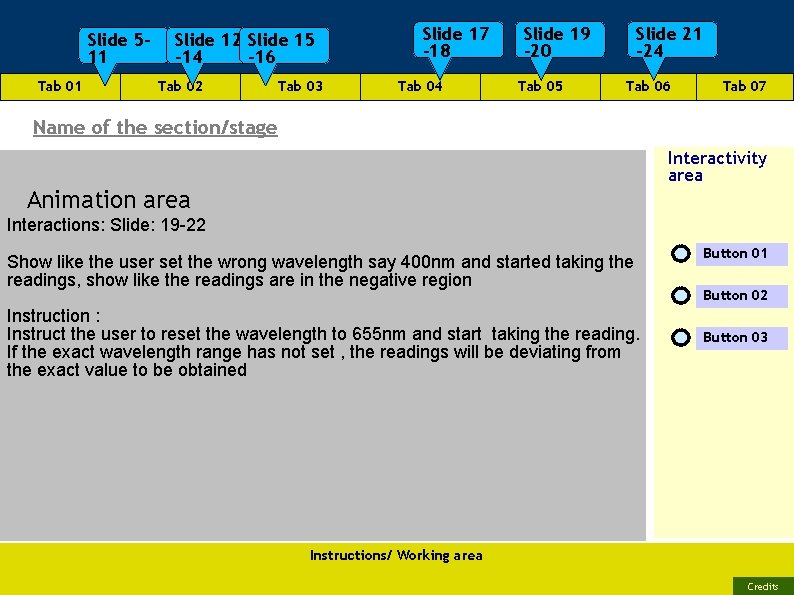
Slide 511 Tab 01 Slide 12 Slide 15 -14 -16 Tab 02 Tab 03 Slide 17 -18 Tab 04 Slide 19 -20 Tab 05 Slide 21 -24 Tab 06 Tab 07 Name of the section/stage Interactivity area Animation area Interactions: Slide: 19 -22 Show like the user set the wrong wavelength say 400 nm and started taking the readings, show like the readings are in the negative region Instruction : Instruct the user to reset the wavelength to 655 nm and start taking the reading. If the exact wavelength range has not set , the readings will be deviating from the exact value to be obtained Button 01 Button 02 Button 03 Instructions/ Working area Credits
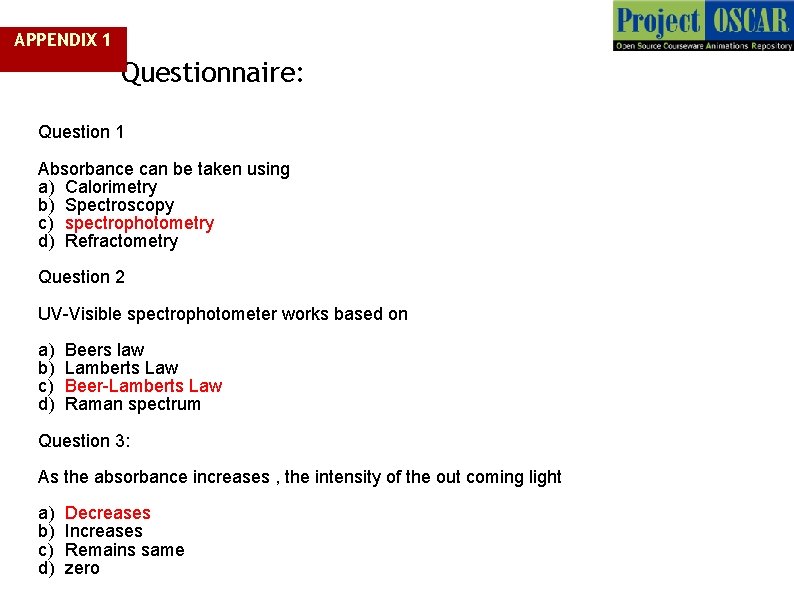
APPENDIX 1 Questionnaire: Question 1 Absorbance can be taken using a) Calorimetry b) Spectroscopy c) spectrophotometry d) Refractometry Question 2 UV-Visible spectrophotometer works based on a) b) c) d) Beers law Lamberts Law Beer-Lamberts Law Raman spectrum Question 3: As the absorbance increases , the intensity of the out coming light a) b) c) d) Decreases Increases Remains same zero
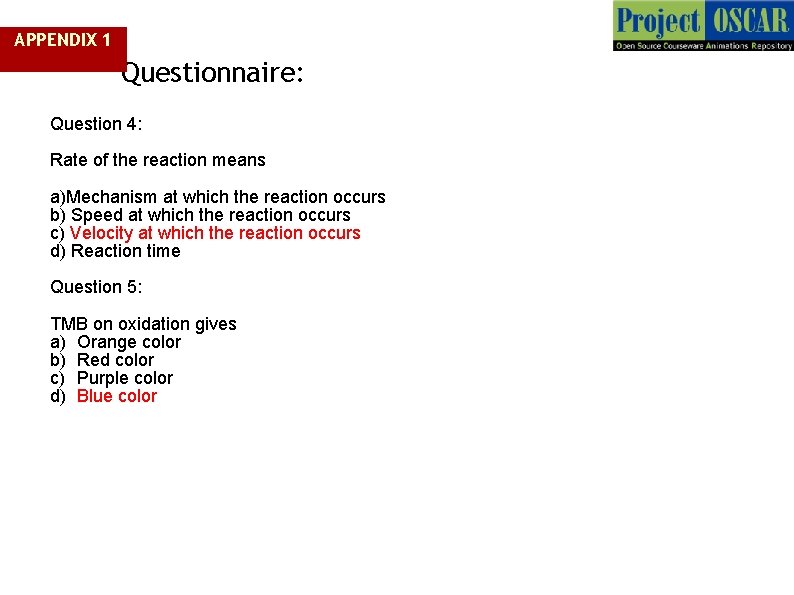
APPENDIX 1 Questionnaire: Question 4: Rate of the reaction means a)Mechanism at which the reaction occurs b) Speed at which the reaction occurs c) Velocity at which the reaction occurs d) Reaction time Question 5: TMB on oxidation gives a) Orange color b) Red color c) Purple color d) Blue color
APPENDIX 2 Links for further reading Reference websites: 1. http: //www. indiana. edu/~l 113/independent_pr ojects/addlprocedures/AP-VEnzymes. pdf 2. http: //www. fondriest. com/pdf/thermo_colorime ter_theory. pdf Book Biochemistry by Voet & Voet, 3 rd edition
APPENDIX 3 Summary The method mostly involves the study of kinetics of the enzyme reactionn. Steps involved are preparation of control and assay tube, preparation of citrate buffer, TMB, enzyme extract and hydrogen peroxide addition, spectrophotometric analysis.