
ENVISIONS TOPIC 14 AREA Lesson 14 1 CCSS

- Slides: 163
ENVISIONS TOPIC 14 AREA
Lesson 14 -1 CCSS 3. MD. 5, 3. MD. 6 COVERING REGIONS
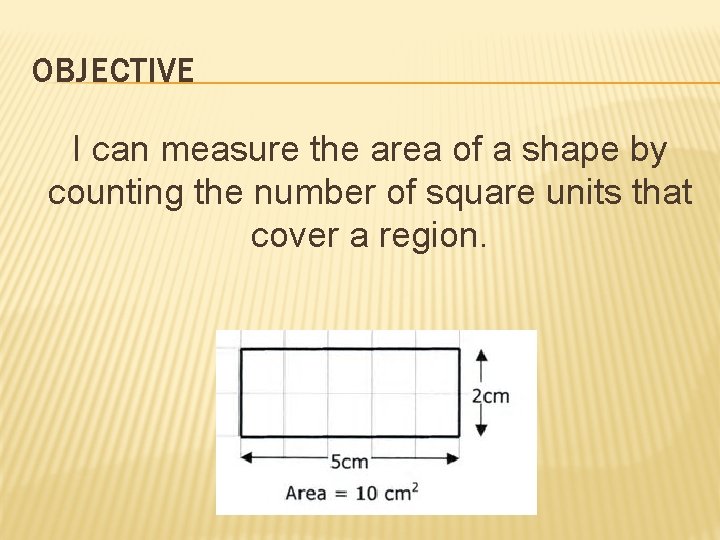
OBJECTIVE I can measure the area of a shape by counting the number of square units that cover a region.
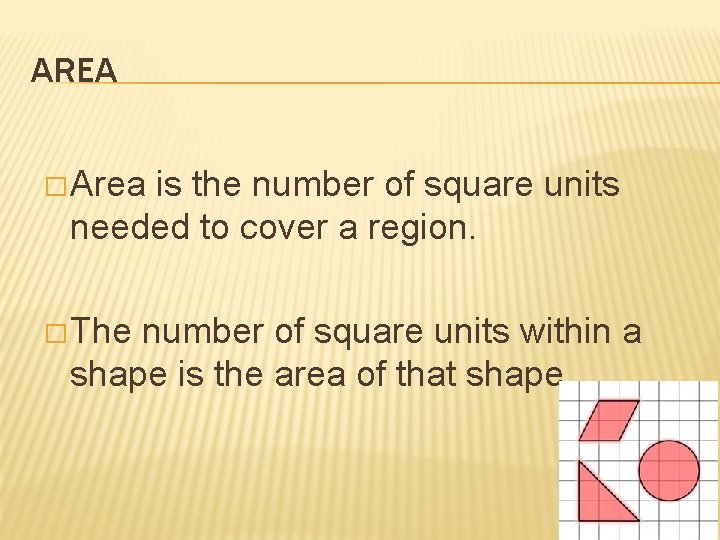
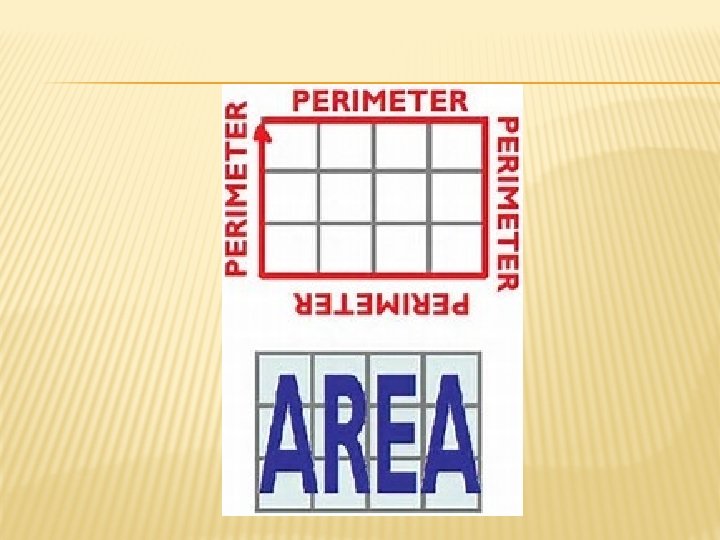
AREA � Area is the number of square units needed to cover a region. � The number of square units within a shape is the area of that shape.
SET THE PURPOSE You have already learned to measure the perimeter of a shape. The perimeter is the number of units around the edges of a shape. Today, you will learn how to measure the number of square units needed to cover the shape.
THINK AND WRITE � When might you need to find out how many square units are needed to cover a shape? � How much carpet is needed to cover an area or how much space is needed for a pool.
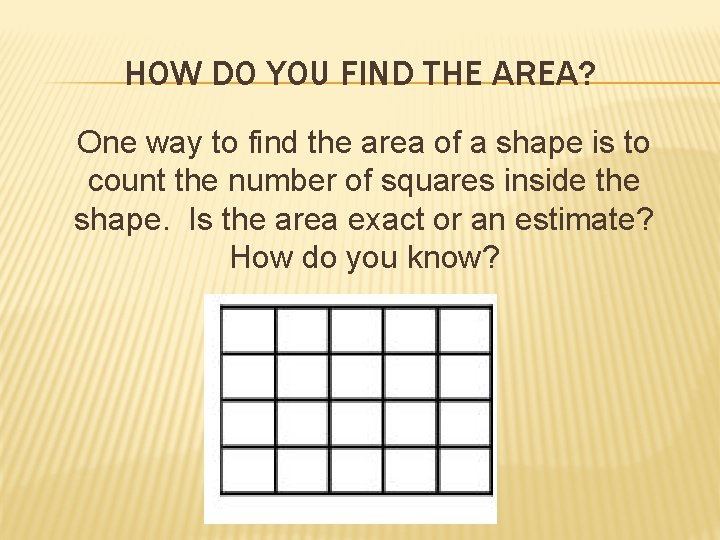
HOW DO YOU FIND THE AREA? One way to find the area of a shape is to count the number of squares inside the shape. Is the area exact or an estimate? How do you know?
POSE THE PROBLEM On your grid paper, draw a rectangle. Use grid lines for the side of the rectangle. Also, look at the circle that is already drawn. Work with your partner to find the number of square units inside each shape.
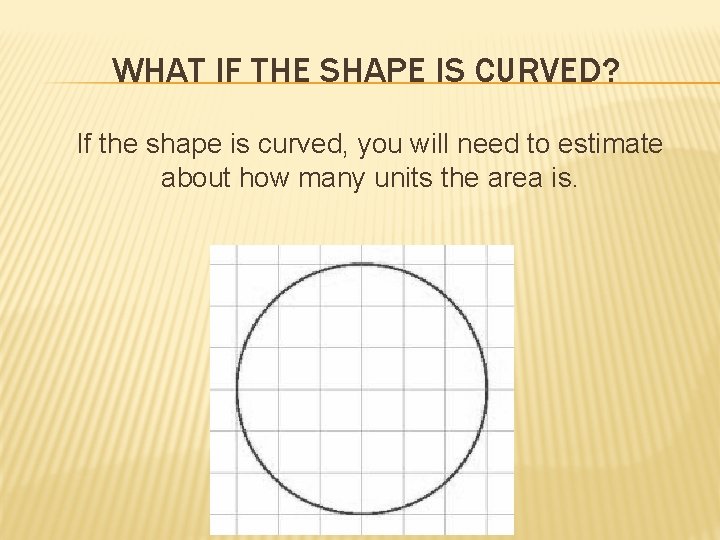
WHAT IF THE SHAPE IS CURVED? If the shape is curved, you will need to estimate about how many units the area is.
AREA OF A CIRCLE How can we measure the area of this circle? First count the number of boxes inside the circle. How do we count the areas that are not a full unit? Estimate the area. What is the area of the circle in square units? Is it exact or an estimate? How do you know?
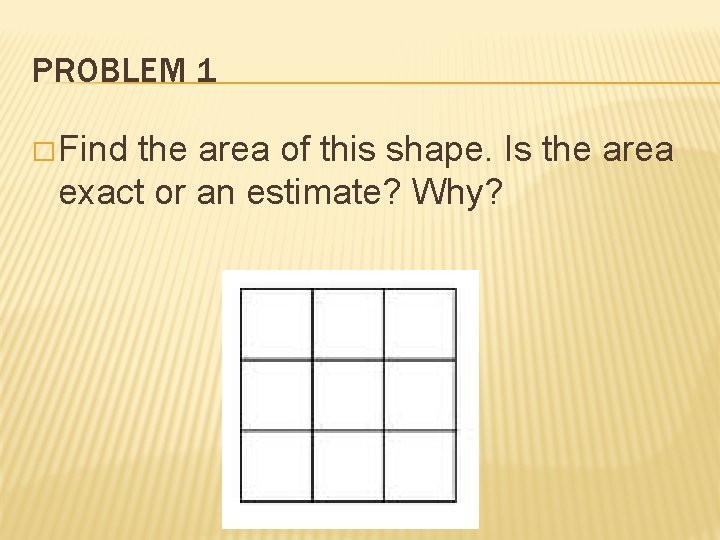
PROBLEM 1 � Find the area of this shape. Is the area exact or an estimate? Why?
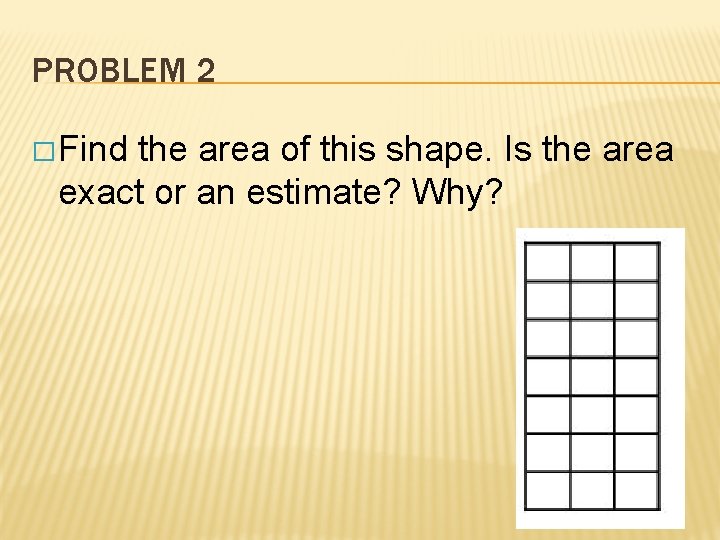
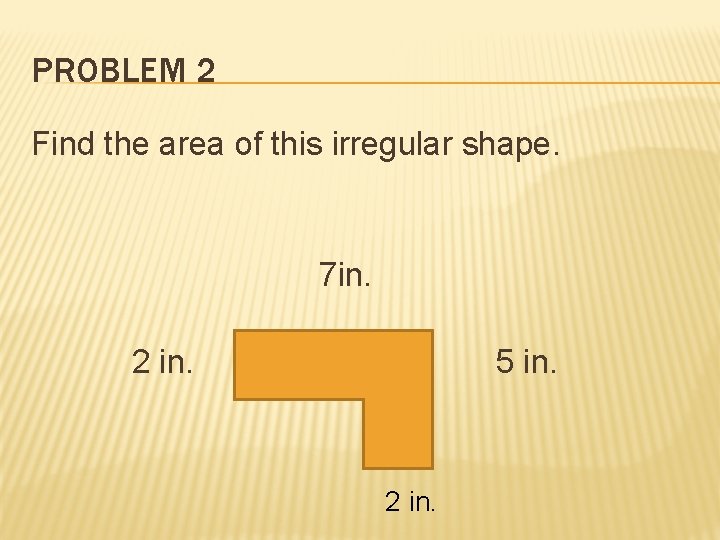
PROBLEM 2 � Find the area of this shape. Is the area exact or an estimate? Why?
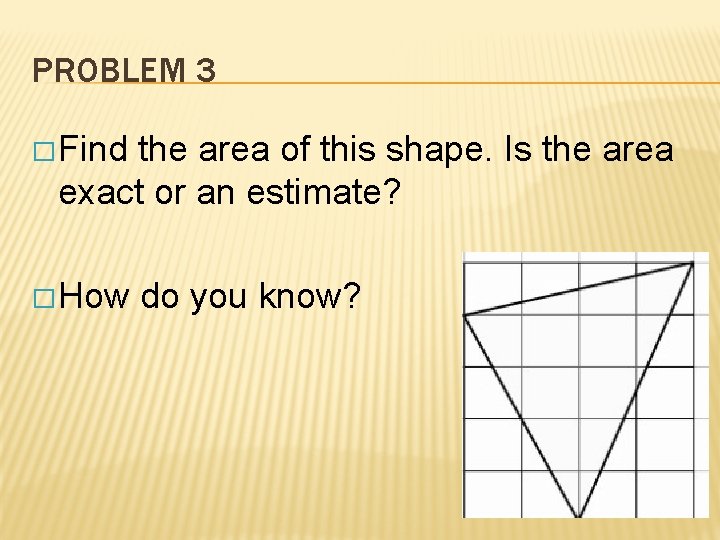
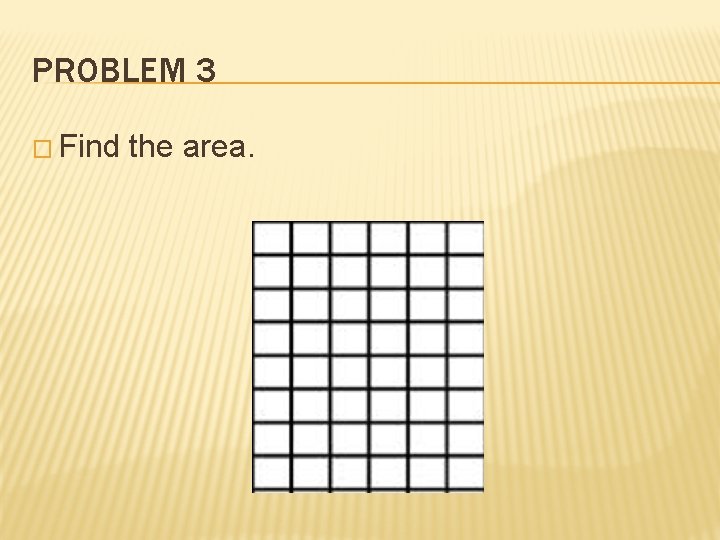
PROBLEM 3 � Find the area of this shape. Is the area exact or an estimate? � How do you know?
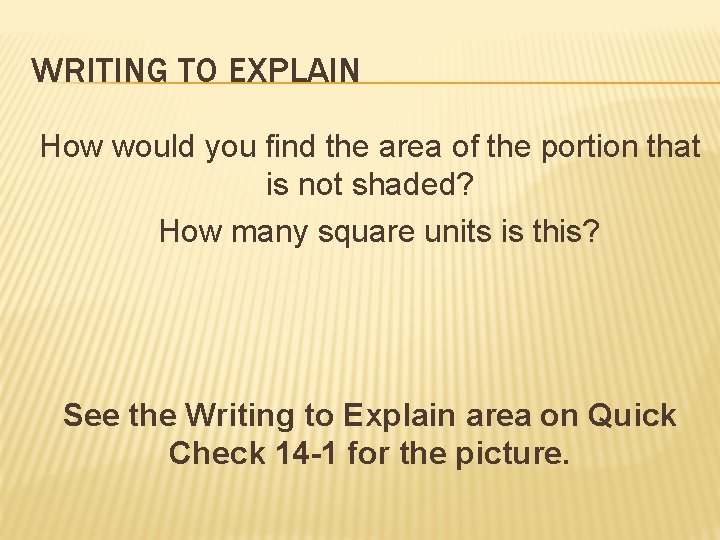
WRITING TO EXPLAIN How would you find the area of the portion that is not shaded? How many square units is this? See the Writing to Explain area on Quick Check 14 -1 for the picture.
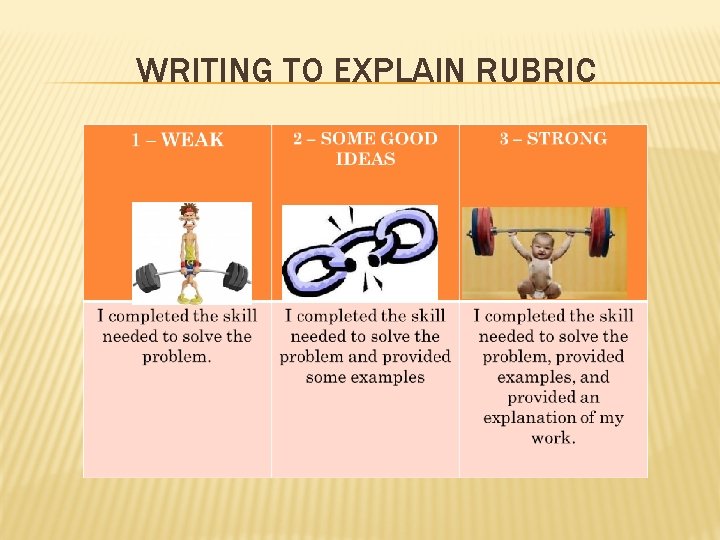
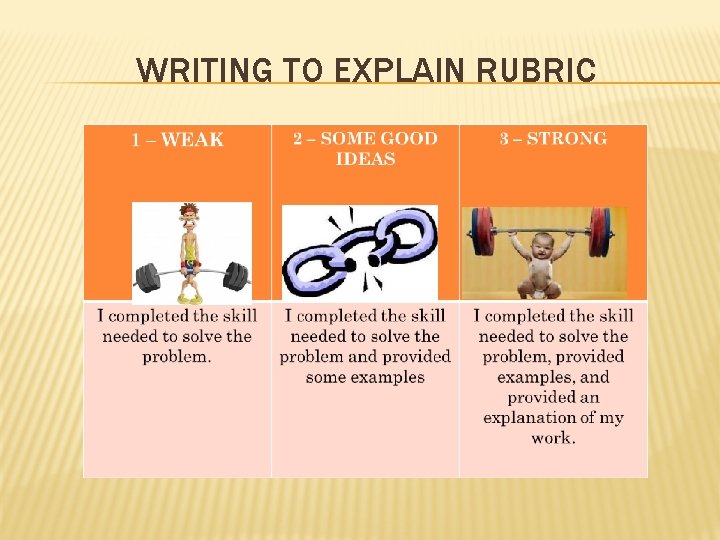
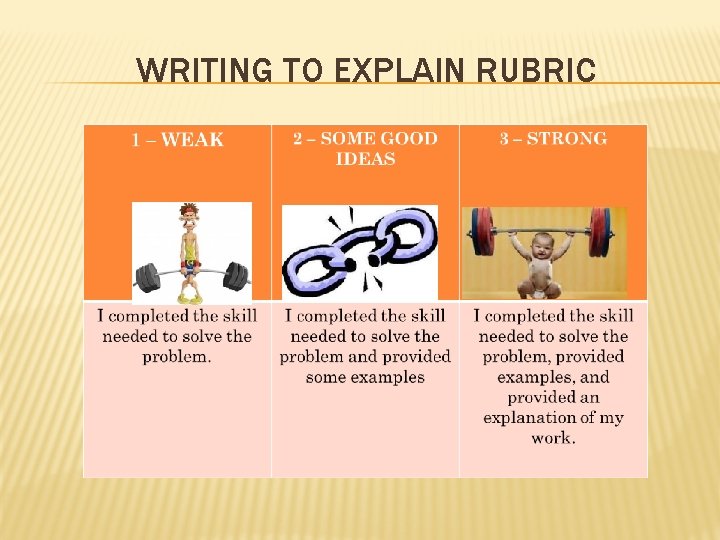
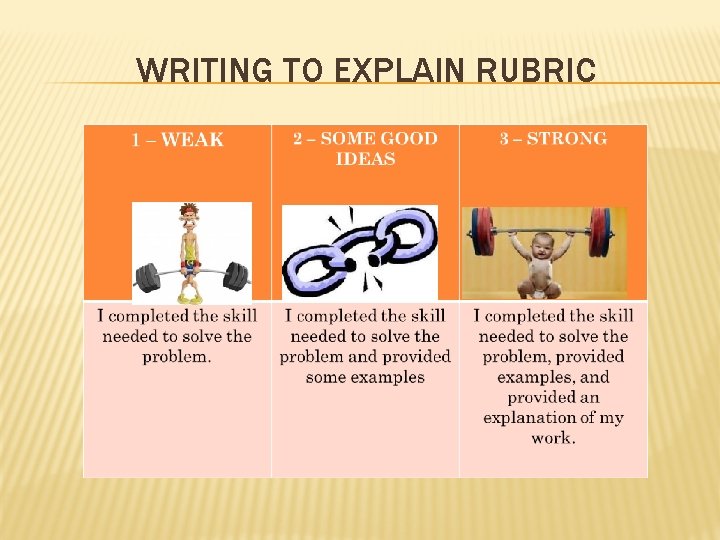
WRITING TO EXPLAIN RUBRIC
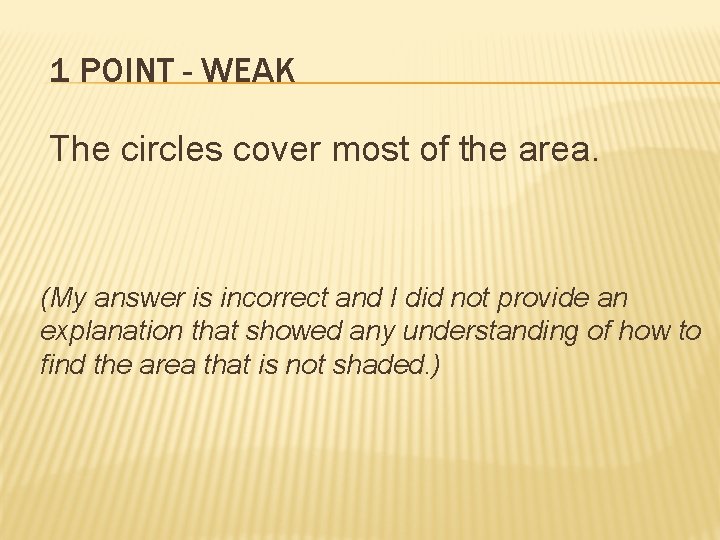
1 POINT - WEAK The circles cover most of the area. (My answer is incorrect and I did not provide an explanation that showed any understanding of how to find the area that is not shaded. )
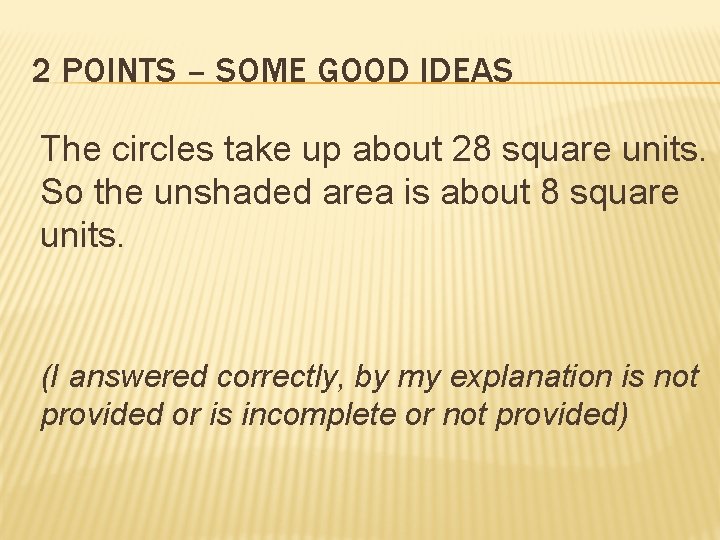
2 POINTS – SOME GOOD IDEAS The circles take up about 28 square units. So the unshaded area is about 8 square units. (I answered correctly, by my explanation is not provided or is incomplete or not provided)
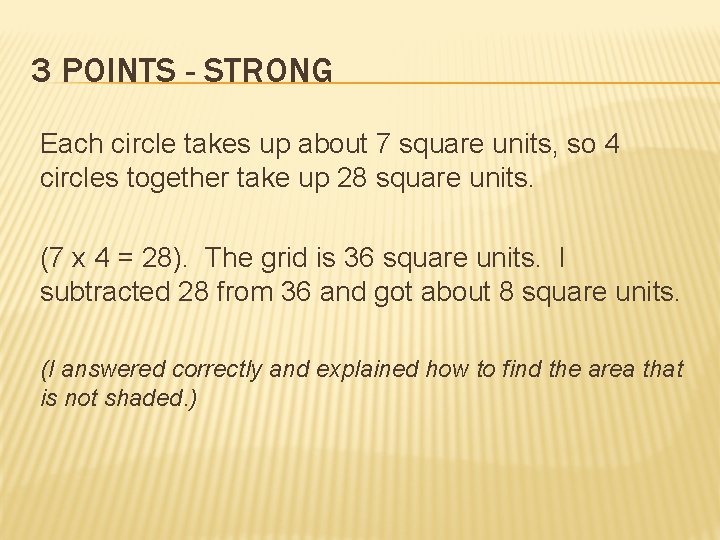
3 POINTS - STRONG Each circle takes up about 7 square units, so 4 circles together take up 28 square units. (7 x 4 = 28). The grid is 36 square units. I subtracted 28 from 36 and got about 8 square units. (I answered correctly and explained how to find the area that is not shaded. )
Lesson 14 -2 3. MD. 5. a, b AREA AND UNITS
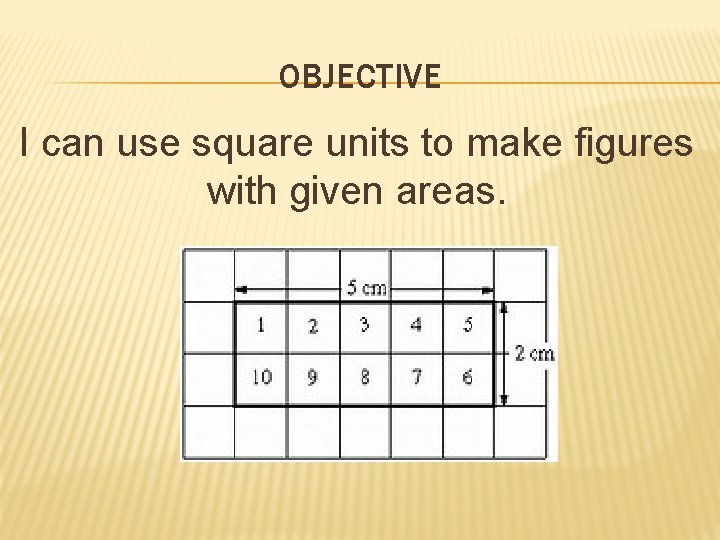
OBJECTIVE I can use square units to make figures with given areas.
VOCABULARY �A square unit is a square that has sides that are each 1 unit long. �A square inch is a square that has sides that are each 1 inch long. It is an example of a square unit. � Based on these definitions, what is a square centimeter? A square foot?
SET THE PURPOSE You know that the area of a region is the amount of surface that it covers. Area can be measured by covering an object with square units. Today, you will learn what types of units are used to describe area and how to use them.
CONNECT Why do you use square units instead of some other shape to measure area? Squares are used because they fit together well without any spaces or overlaps.
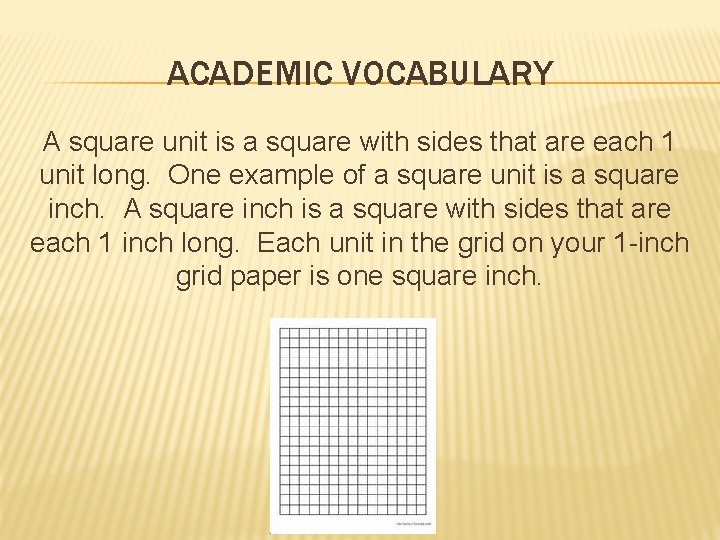
ACADEMIC VOCABULARY A square unit is a square with sides that are each 1 unit long. One example of a square unit is a square inch. A square inch is a square with sides that are each 1 inch long. Each unit in the grid on your 1 -inch grid paper is one square inch.
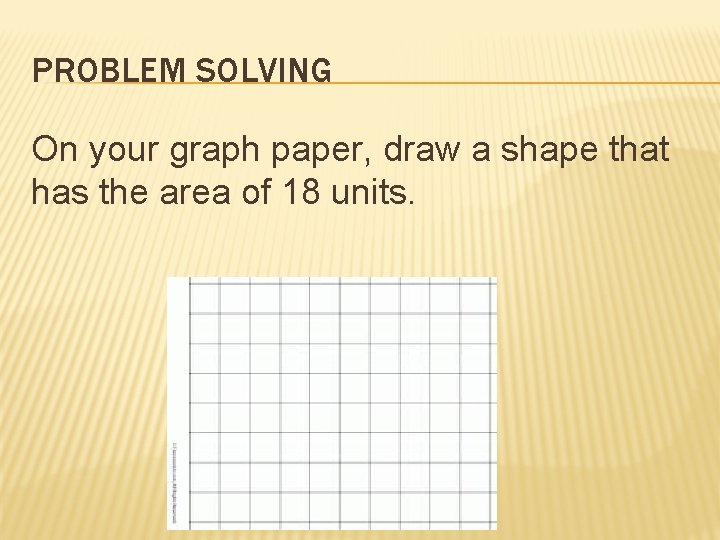
PROBLEM SOLVING On your graph paper, draw a shape that has the area of 18 units.
PROBLEM SOLVING: SQUARE INCHES � Draw a shape that is 20 square inches in area. What tool would help you do this? � Now draw a shape with the area of 16 square inches.
PROBLEM SOLVING: SQUARE CENTIMETERS � Using your ruler, draw a shape that has the area of 32 square centimeters. � Now draw a shape that has an area of 8 square centimeters.
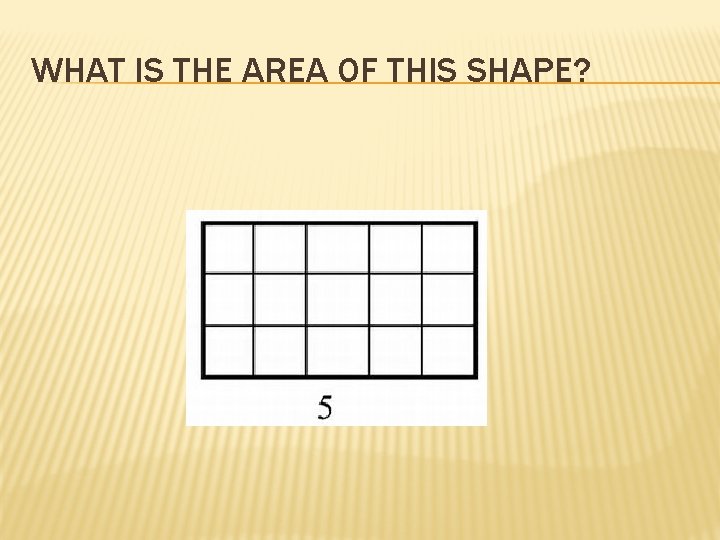
WHAT IS THE AREA OF THIS SHAPE?
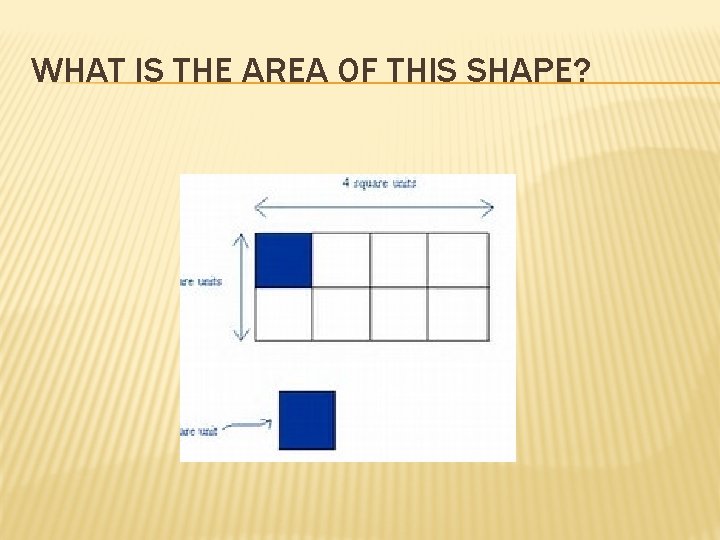
WHAT IS THE AREA OF THIS SHAPE?
WRITING TO EXPLAIN Diego is planning to make party invitations. He wants each invitation card to have an area of 24 square units. Should he use square centimeters or square inches as his unit? Use 1 -inch grid paper and centimeter grid paper to draw shapes to help you decide. Explain your answer.
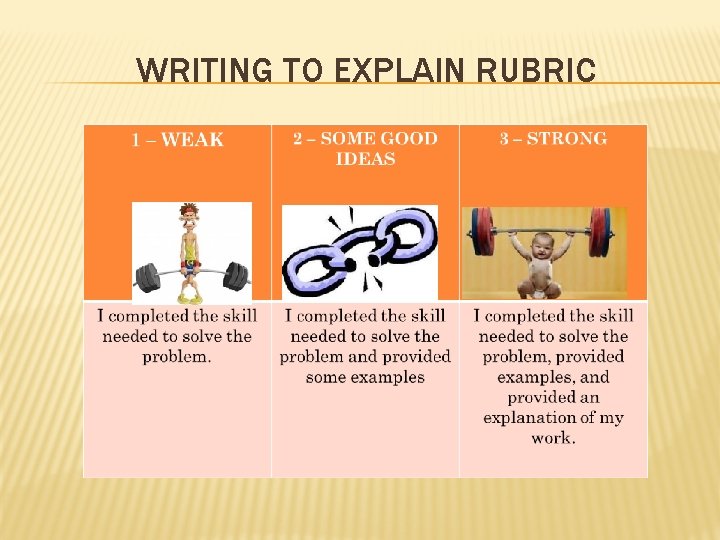
WRITING TO EXPLAIN RUBRIC
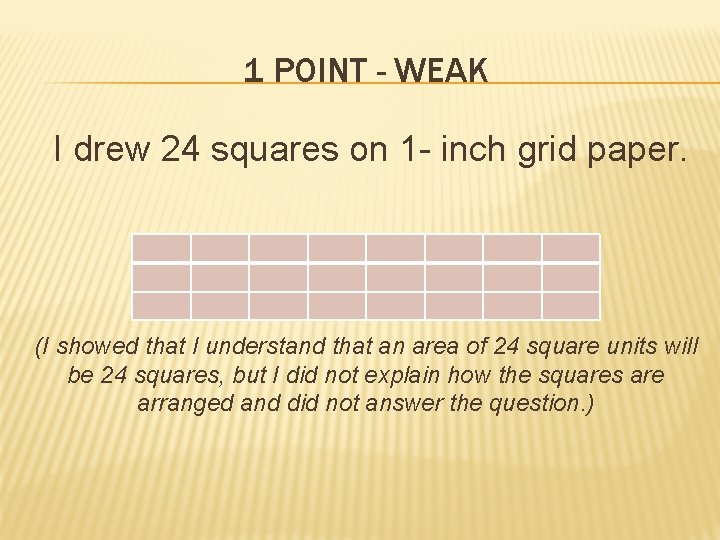
1 POINT - WEAK I drew 24 squares on 1 - inch grid paper. (I showed that I understand that an area of 24 square units will be 24 squares, but I did not explain how the squares are arranged and did not answer the question. )
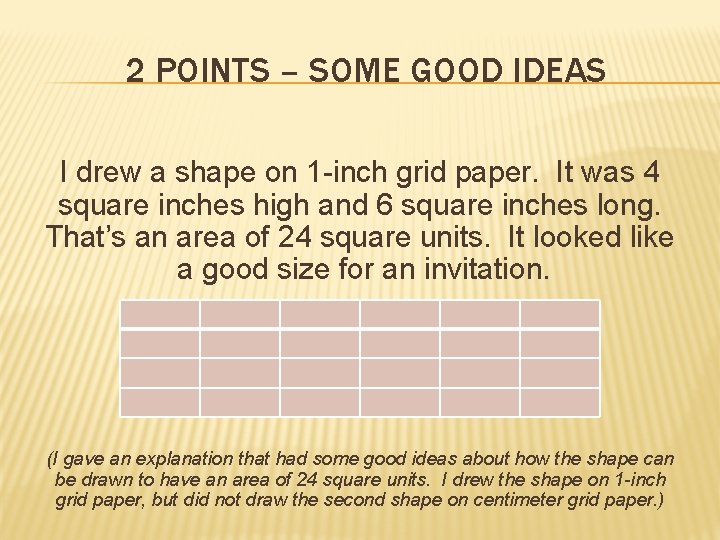
2 POINTS – SOME GOOD IDEAS I drew a shape on 1 -inch grid paper. It was 4 square inches high and 6 square inches long. That’s an area of 24 square units. It looked like a good size for an invitation. (I gave an explanation that had some good ideas about how the shape can be drawn to have an area of 24 square units. I drew the shape on 1 -inch grid paper, but did not draw the second shape on centimeter grid paper. )
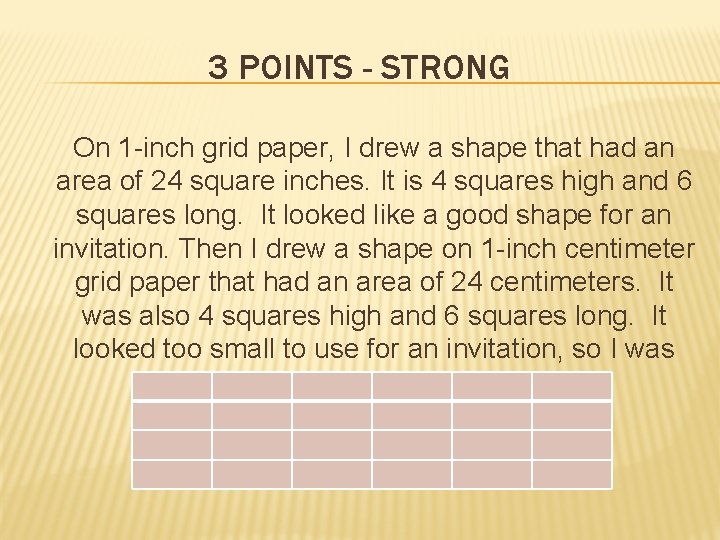
3 POINTS - STRONG On 1 -inch grid paper, I drew a shape that had an area of 24 square inches. It is 4 squares high and 6 squares long. It looked like a good shape for an invitation. Then I drew a shape on 1 -inch centimeter grid paper that had an area of 24 centimeters. It was also 4 squares high and 6 squares long. It looked too small to use for an invitation, so I was sure that my answer was right.
Lesson 14 -3 CCSS 3. MD. 6 STANDARD UNITS
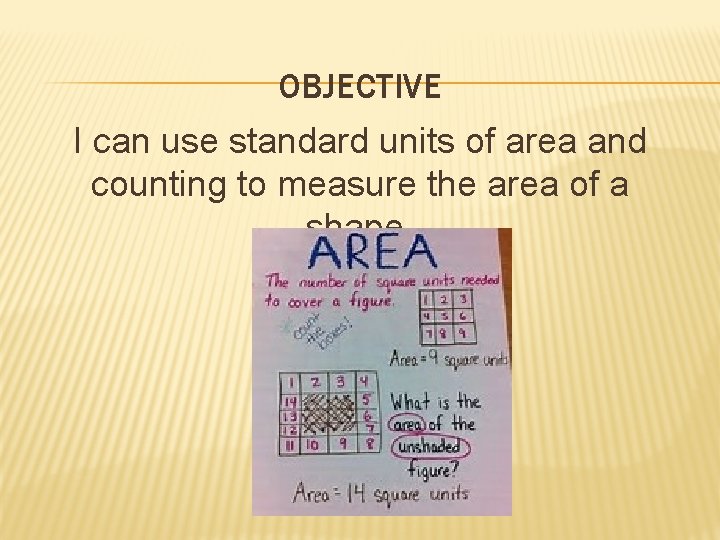
OBJECTIVE I can use standard units of area and counting to measure the area of a shape.
SET THE PURPOSE You have learned to count square units to find the area of a shape. Today, you will learn how to use standard units to find the area of a shape.
THINK AND WRITE What are some standard units of length? List as many as you can think of.
VOCABULARY �A square unit is a square that has sides that are each 1 unit long. �A square inch is a square that has sides that are each 1 inch long. It is an example of a square unit. � Based on these definitions, what is a square centimeter? A square foot?
STANDARD UNITS AND AREA � Remember that area measures the amount of space covered by a shape (inside). � When we measure area, we use square units. So, if we measure area in inches, the unit is square inches or sq. in. � What unit would we use to measure the area in feet? Yards? Meters?
LINK TO PRIOR KNOWLEDGE How can you use the grids to find the area of the index card I gave each of you? Count or estimate the squares the card covers by counting or estimating the squares inside the outline of the card.
LINK TO PRIOR KNOWLEDGE What is the area of the card in small square units? What is the area of the card in large square units? Did the card cover the same number of small units and large units? No. Why not?
LINK TO PRIOR KNOWLEDGE Suppose you are describing the size of the card to someone who cannot see it or the grid you used to find its area. If you say that the area is 15 large square units, will the person be able to visualize its size? Explain. So, when you find the area of a shape. It is helpful to use standard units of measure. Look at one of the small squares you used to measure the area of the card. The length of each side is 1 centimeter. So the area of the square is 1 square centimeter?
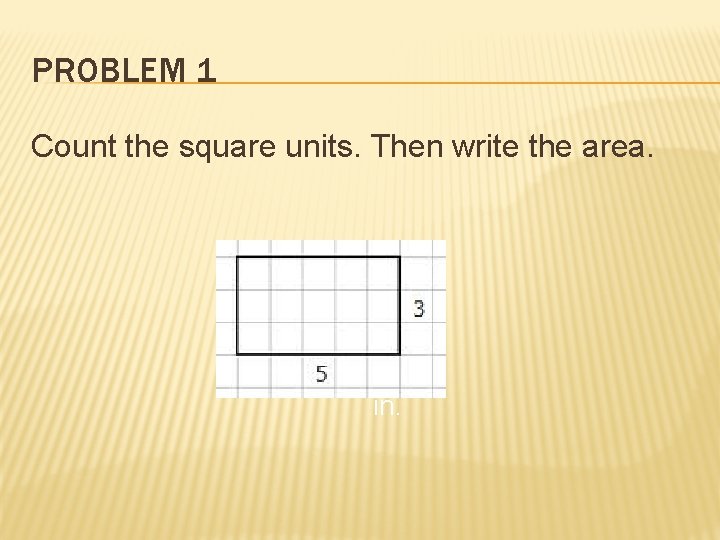
PROBLEM 1 Count the square units. Then write the area. in.
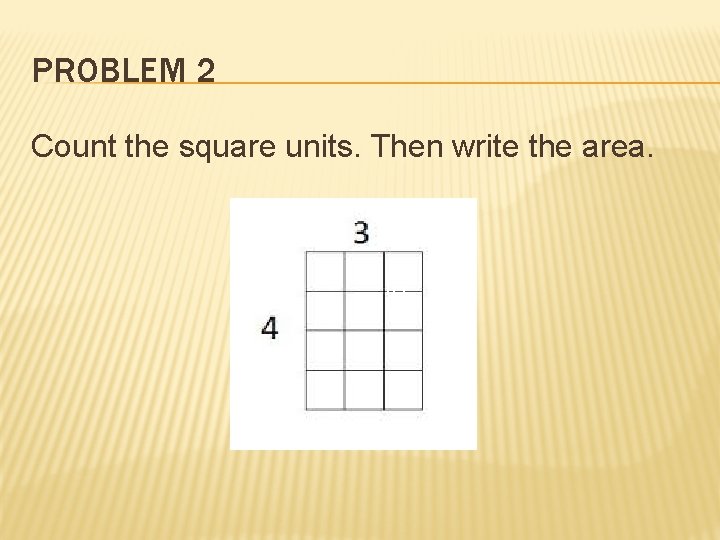
PROBLEM 2 Count the square units. Then write the area. in.
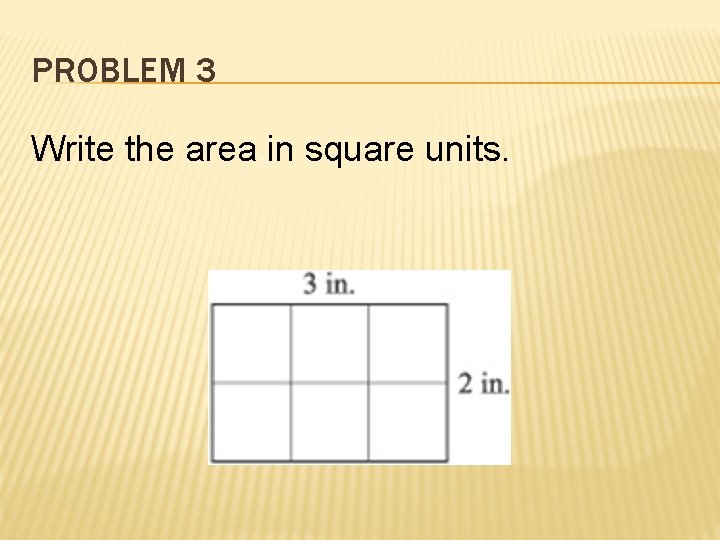
PROBLEM 3 Write the area. in square units.
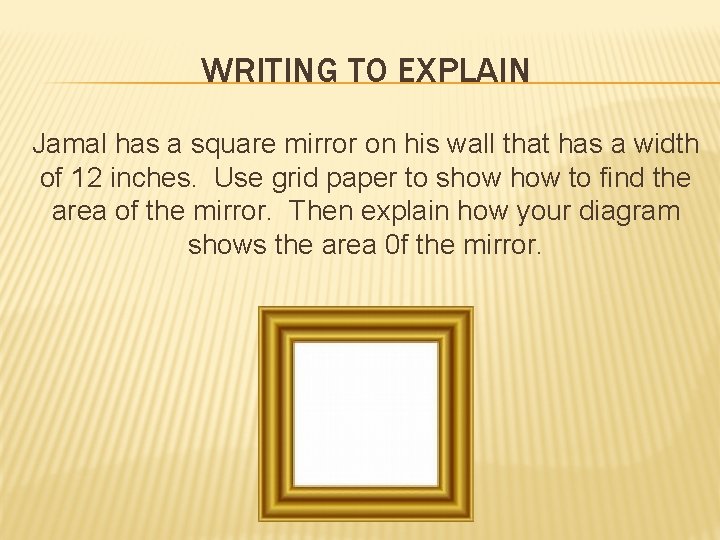
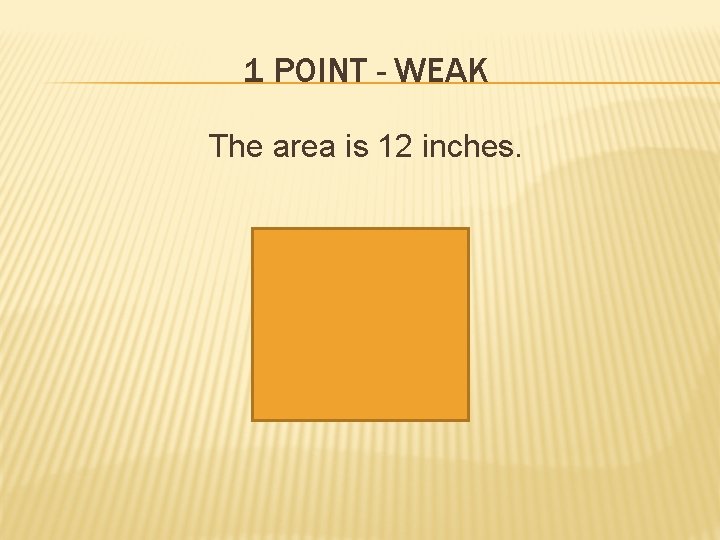
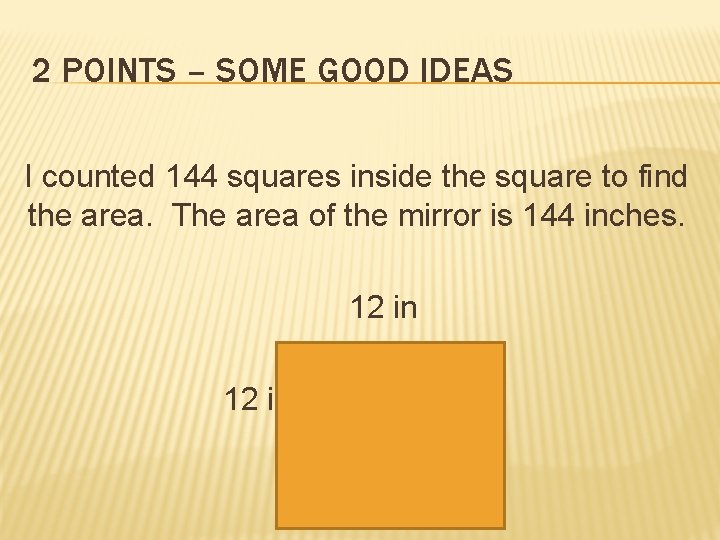
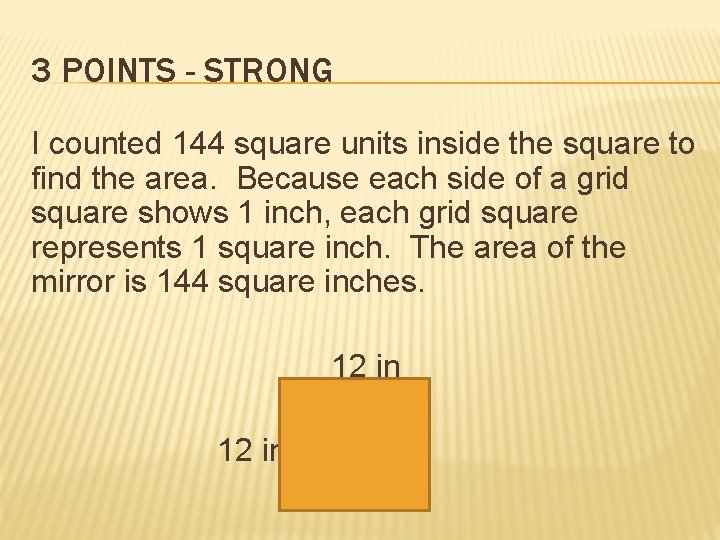
WRITING TO EXPLAIN Jamal has a square mirror on his wall that has a width of 12 inches. Use grid paper to show to find the area of the mirror. Then explain how your diagram shows the area 0 f the mirror.
1 POINT - WEAK The area is 12 inches.
2 POINTS – SOME GOOD IDEAS I counted 144 squares inside the square to find the area. The area of the mirror is 144 inches. 12 in
3 POINTS - STRONG I counted 144 square units inside the square to find the area. Because each side of a grid square shows 1 inch, each grid square represents 1 square inch. The area of the mirror is 144 square inches. 12 in
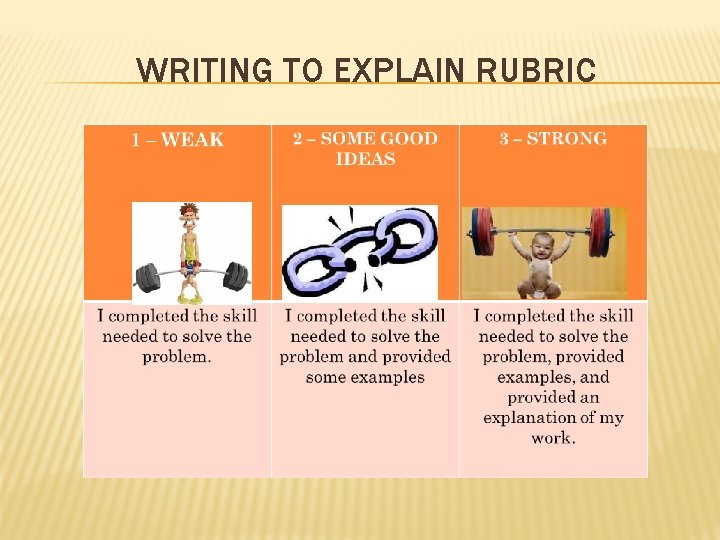
WRITING TO EXPLAIN RUBRIC
Lesson 14 -4 CCSS 3. MD. 7. a, b AREA OF SQUARES AND RECTANGLES
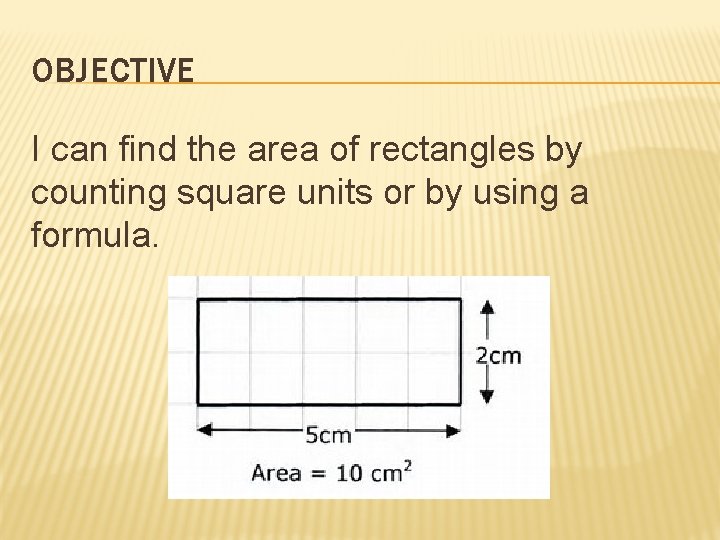
OBJECTIVE I can find the area of rectangles by counting square units or by using a formula.
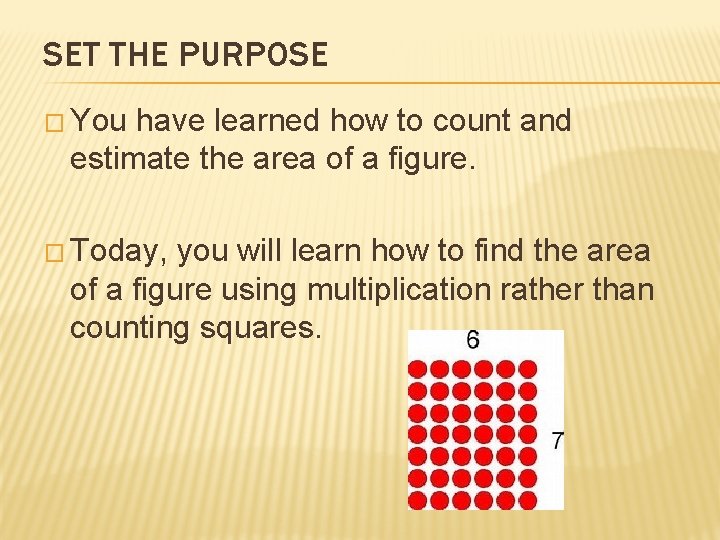
SET THE PURPOSE � You have learned how to count and estimate the area of a figure. � Today, you will learn how to find the area of a figure using multiplication rather than counting squares.
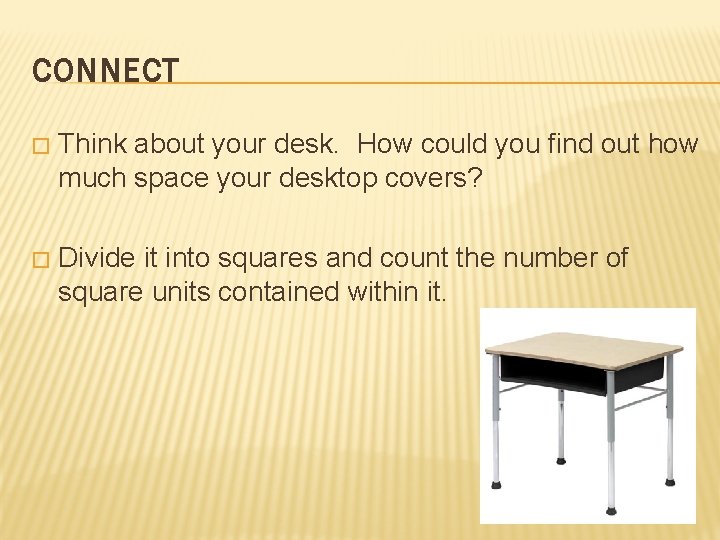
CONNECT � Think about your desk. How could you find out how much space your desktop covers? � Divide it into squares and count the number of square units contained within it.
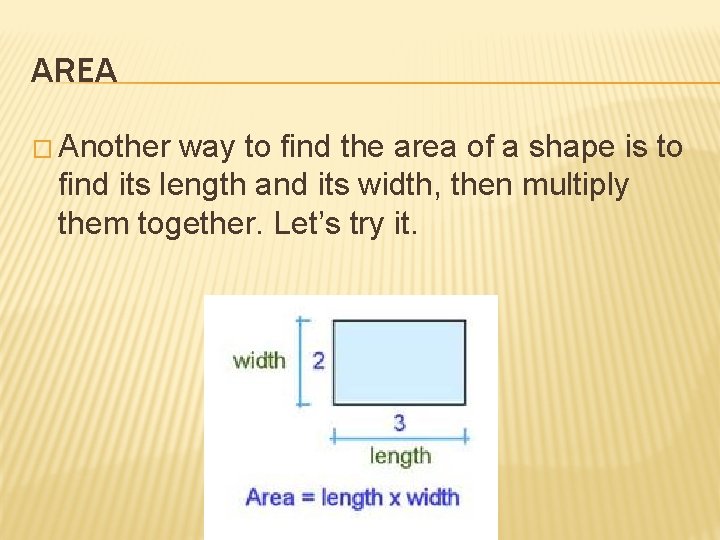
AREA � Another way to find the area of a shape is to find its length and its width, then multiply them together. Let’s try it.
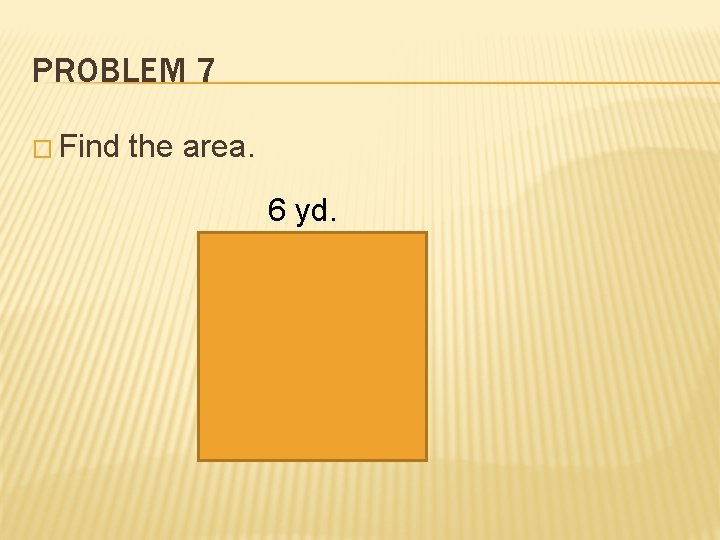
POSE THE PROBLEM � Jorge is carpeting a room that is shaped like a square. One wall of the room is 6 yards long. How many square yards of carpet will Jorge need? Use grid paper to solve the problem. � Let’s share some solutions.
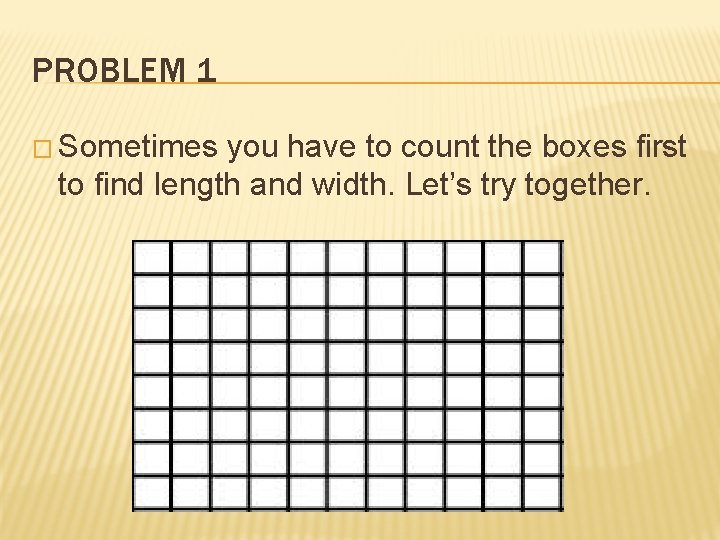
PROBLEM 1 � Sometimes you have to count the boxes first to find length and width. Let’s try together.
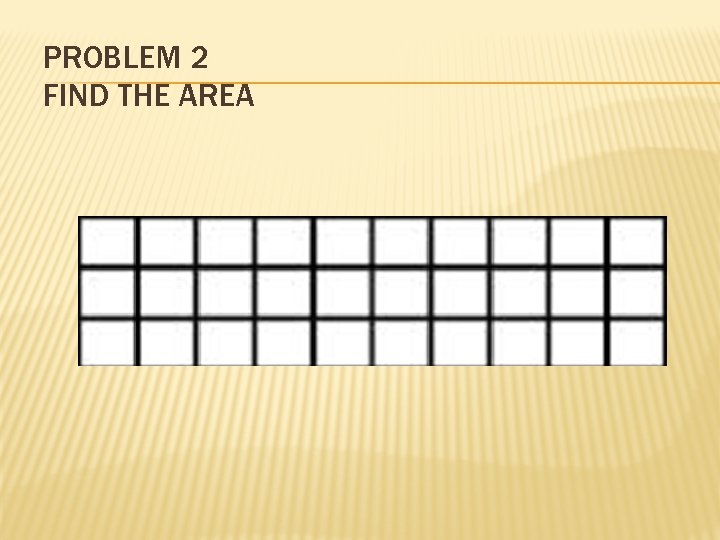
PROBLEM 2 FIND THE AREA
PROBLEM 3 � Find the area.
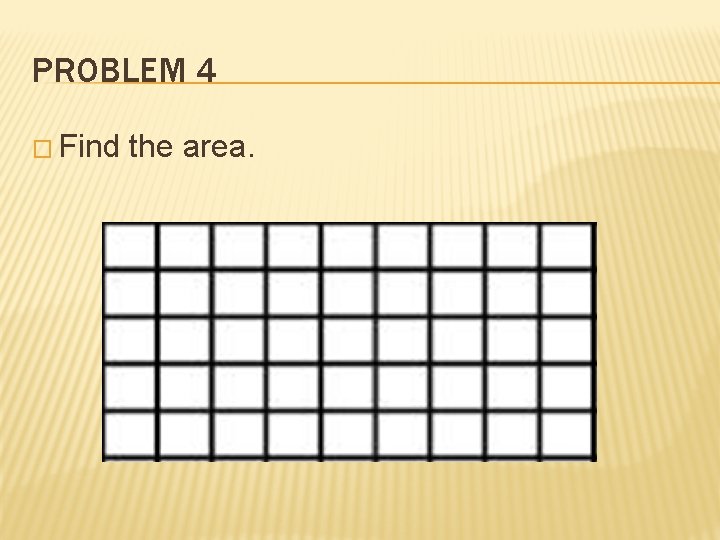
PROBLEM 4 � Find the area.
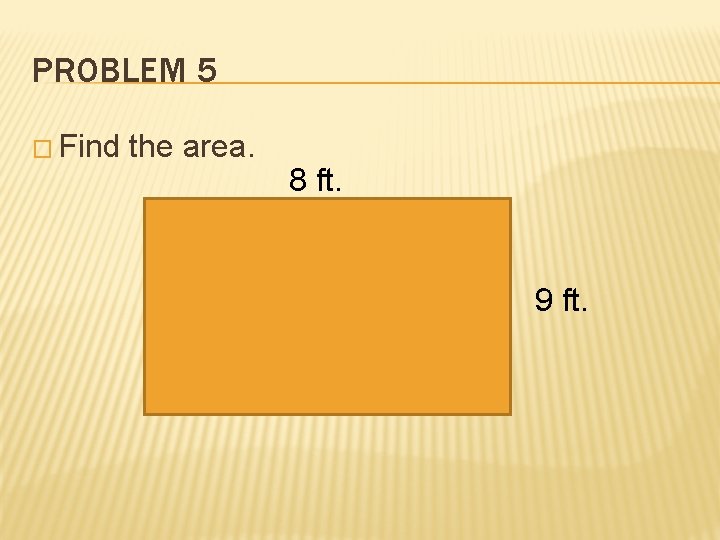
PROBLEM 5 � Find the area. 8 ft. 9 ft.
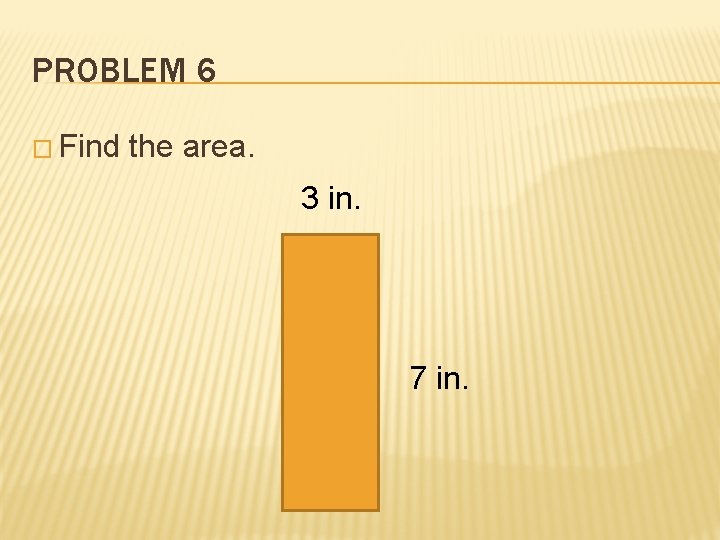
PROBLEM 6 � Find the area. 3 in. 7 in.
PROBLEM 7 � Find the area. 6 yd.
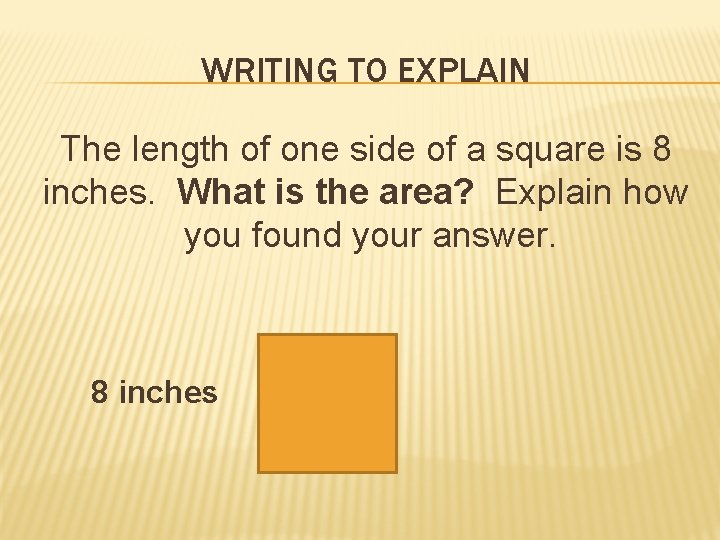
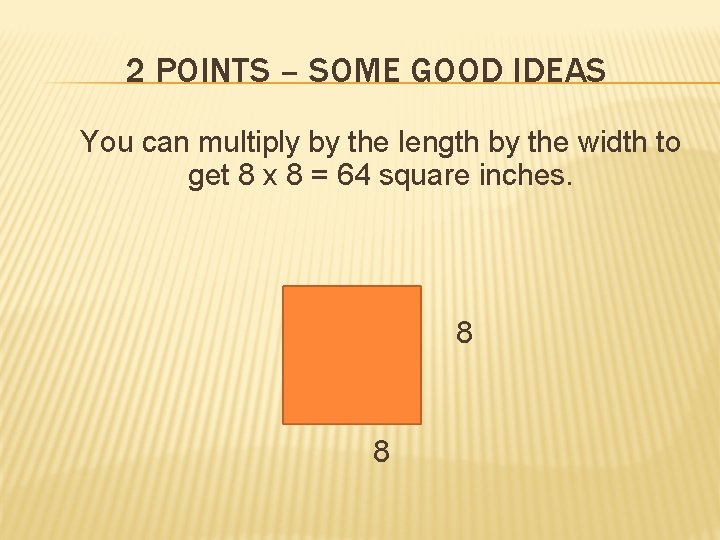
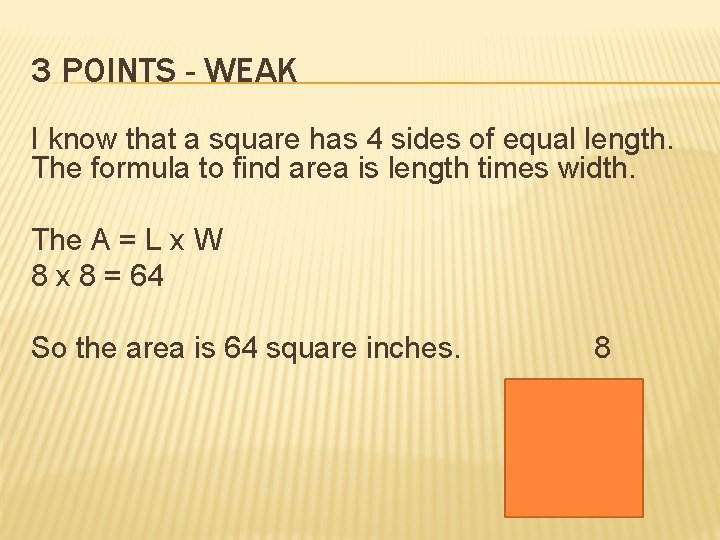
WRITING TO EXPLAIN The length of one side of a square is 8 inches. What is the area? Explain how you found your answer. 8 inches
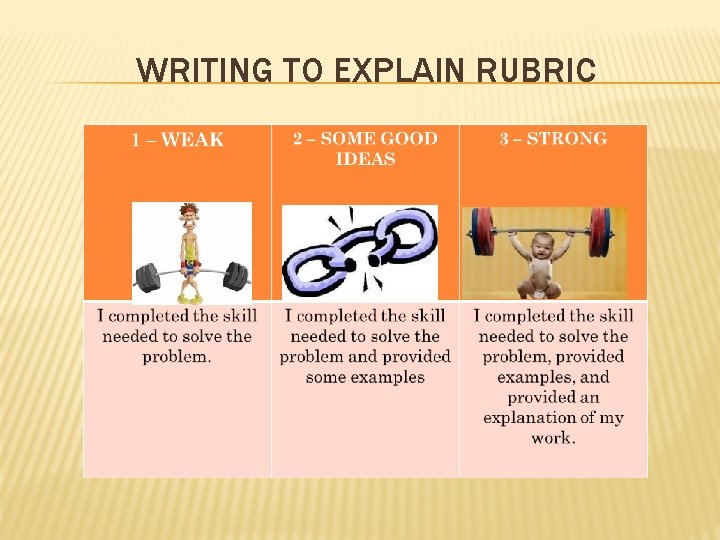
WRITING TO EXPLAIN RUBRIC
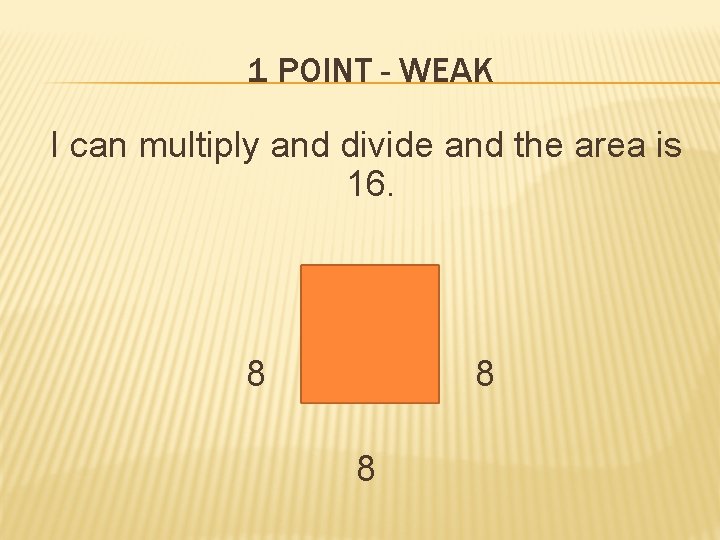
1 POINT - WEAK I can multiply and divide and the area is 16. 8 8 8
2 POINTS – SOME GOOD IDEAS You can multiply by the length by the width to get 8 x 8 = 64 square inches. 8 8 8
3 POINTS - WEAK I know that a square has 4 sides of equal length. The formula to find area is length times width. The A = L x W 8 x 8 = 64 So the area is 64 square inches. 8 8
Lesson 14 -5 CCSS 3. MD. 7. c AREA AND THE DISTRIBUTIVE PROPERTY
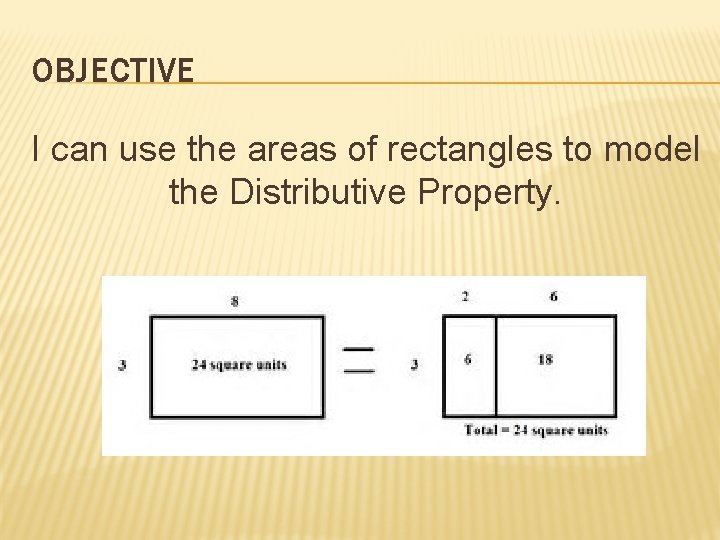
OBJECTIVE I can use the areas of rectangles to model the Distributive Property.
DISTRIBUTIVE PROPERTY Let’s recall the Distributive Property of Multiplication: If you have a large multiplication problem, you can break it into 2 smaller, easier facts and solve. Example: 8 X 9 = (5 X 9) + (3 X 9)
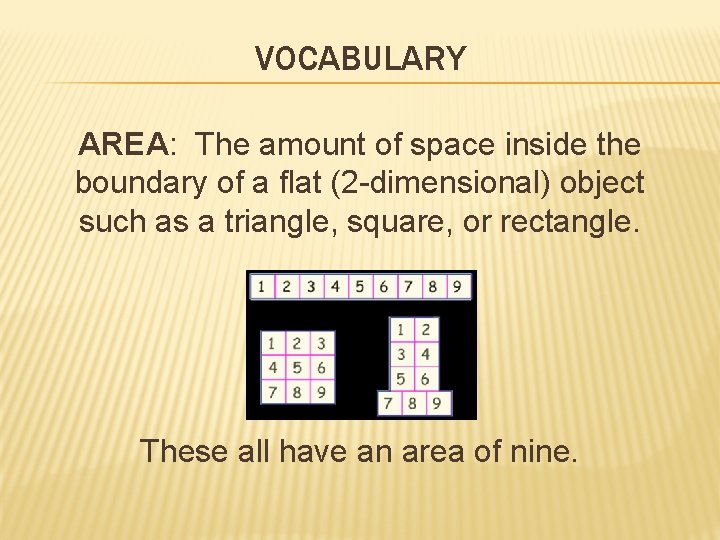
VOCABULARY AREA: The amount of space inside the boundary of a flat (2 -dimensional) object such as a triangle, square, or rectangle. These all have an area of nine.
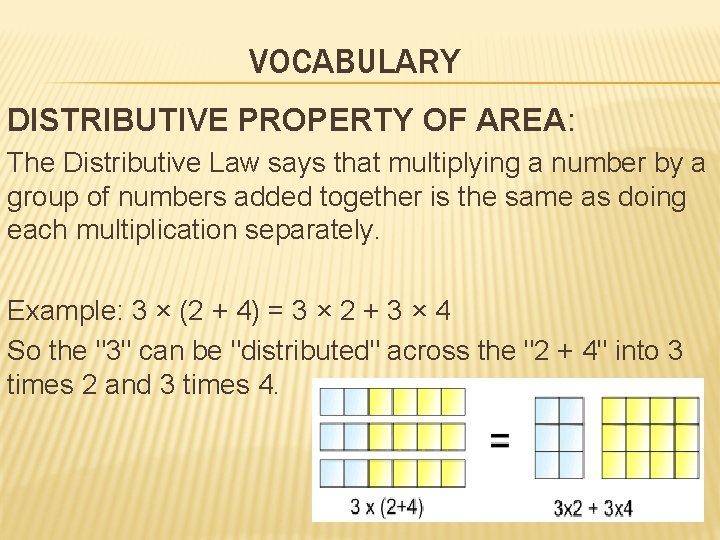
VOCABULARY DISTRIBUTIVE PROPERTY OF AREA: The Distributive Law says that multiplying a number by a group of numbers added together is the same as doing each multiplication separately. Example: 3 × (2 + 4) = 3 × 2 + 3 × 4 So the "3" can be "distributed" across the "2 + 4" into 3 times 2 and 3 times 4.
SET THE PURPOSE You have learned that the area of a rectangle is the product of its length and its width. Today, you will learn how breaking apart rectangles can help you understand the Distributive Property.
CONNECT When you cut a large rectangle into small pieces, does it change the total area? Explain your answer. No, as long as you do not remove any of the original pieces you do not lose any area.
AREA AND THE DISTRIBUTIVE PROPERTY You know that you can find the area of a square or rectangle by multiplying length X width. How can you use the distributive property to help?
POSE THE PROBLEM The new reading area in the library is shaped like a rectangle that is 8 feet by 9 feet. Mrs. Wallace has a rectangular piece of carpet that is 8 feet by 5 feet for the reading area. What part of the reading area will be left uncarpeted? What will be the area of the carpeted part? What do you notice about the sum of the areas of the carpeted and the uncarpeted parts of the reading area?
LINK TO PRIOR KNOWLEDGE What do you already know about finding the area of a rectangle? You multiply the length and the width to find the area.
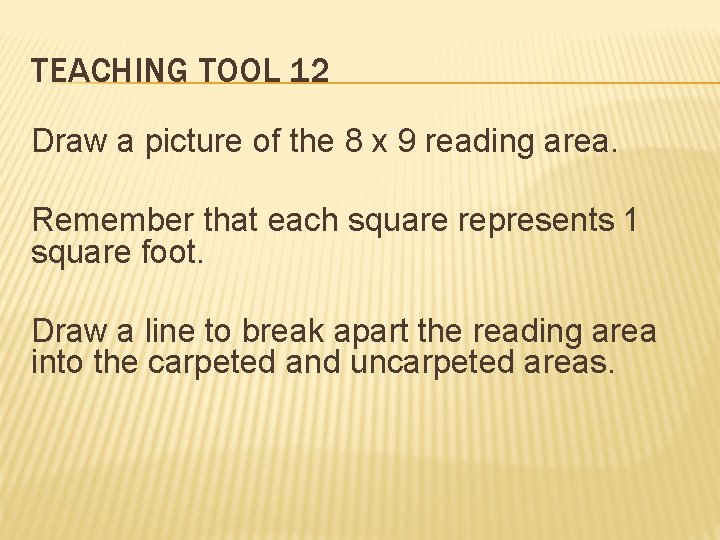
TEACHING TOOL 12 Draw a picture of the 8 x 9 reading area. Remember that each square represents 1 square foot. Draw a line to break apart the reading area into the carpeted and uncarpeted areas.
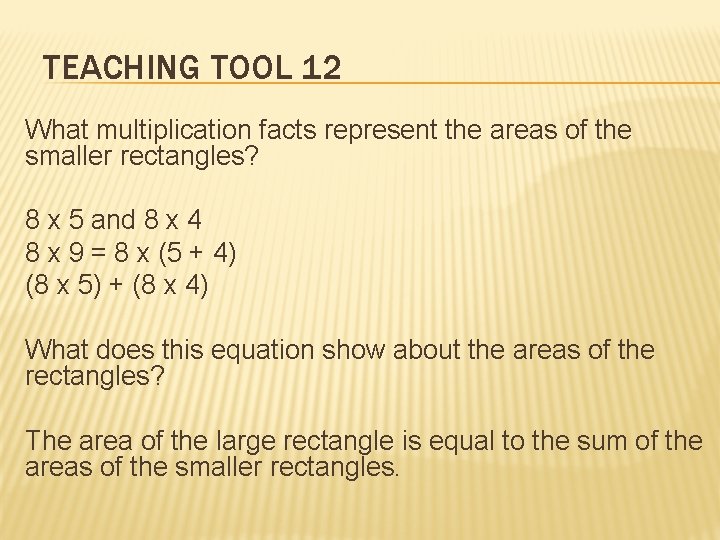
TEACHING TOOL 12 What multiplication facts represent the areas of the smaller rectangles? 8 x 5 and 8 x 4 8 x 9 = 8 x (5 + 4) (8 x 5) + (8 x 4) What does this equation show about the areas of the rectangles? The area of the large rectangle is equal to the sum of the areas of the smaller rectangles.
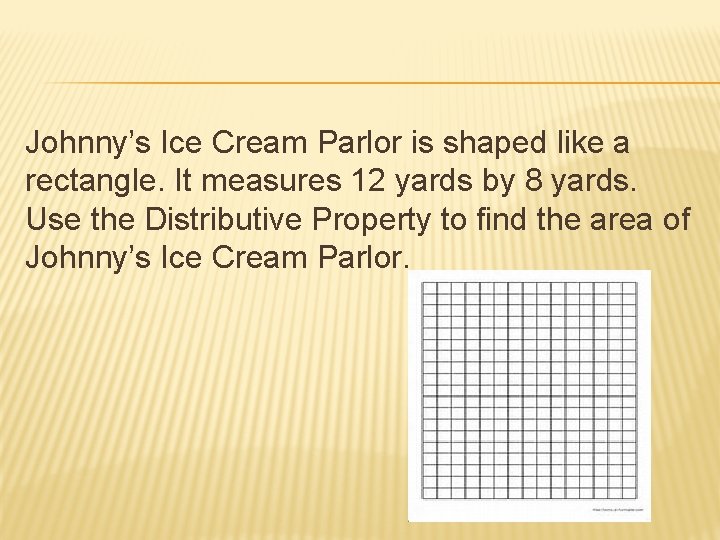
Johnny’s Ice Cream Parlor is shaped like a rectangle. It measures 12 yards by 8 yards. Use the Distributive Property to find the area of Johnny’s Ice Cream Parlor.
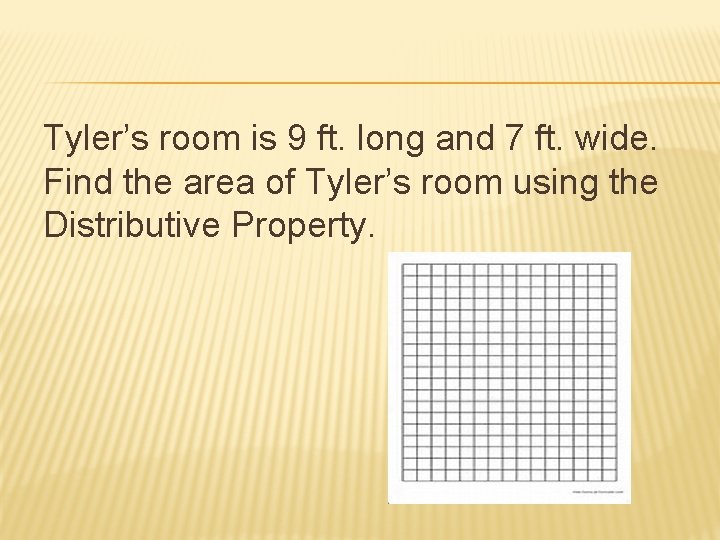
Tyler’s room is 9 ft. long and 7 ft. wide. Find the area of Tyler’s room using the Distributive Property.
Chelsea’s patio is 8 ft. long and 12 ft. wide. Use the Distributive Property to find the area of Chelsea’s patio.
WRITING TO EXPLAIN Jan has a 5 x 8 cardboard rectangle. She wants to divide it into two smaller rectangles. Use the grid below to show she could do it. Is the area of the 5 x 8 rectangle equal to the sum of the areas of the two small rectangles? Write an equation to show you know?
WRITING TO EXPLAIN RUBRIC
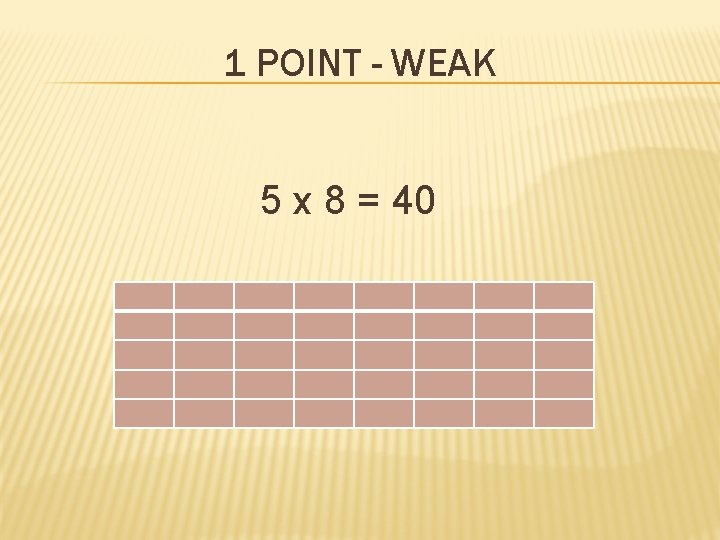
1 POINT - WEAK 5 x 8 = 40
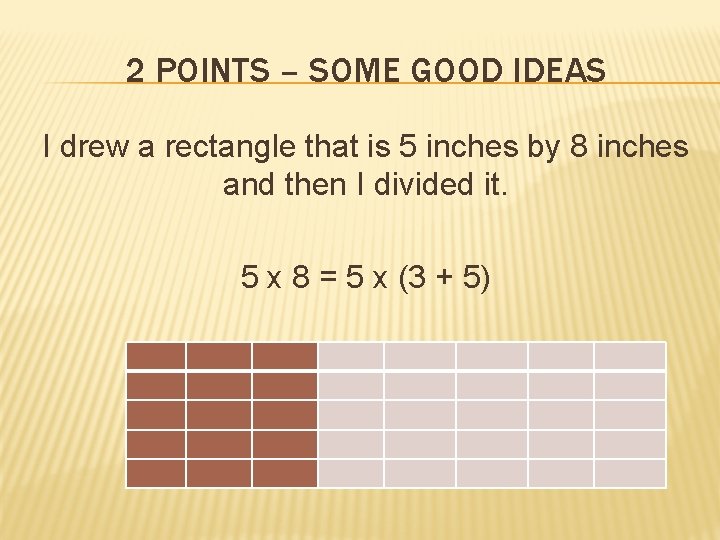
2 POINTS – SOME GOOD IDEAS I drew a rectangle that is 5 inches by 8 inches and then I divided it. 5 x 8 = 5 x (3 + 5)
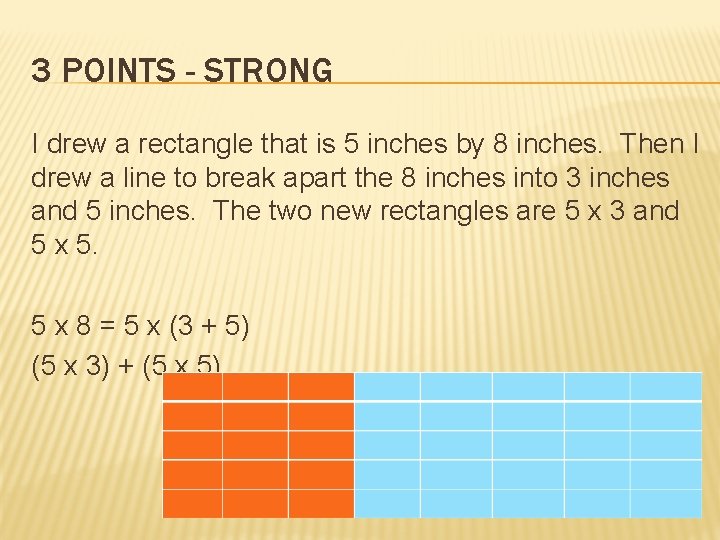
3 POINTS - STRONG I drew a rectangle that is 5 inches by 8 inches. Then I drew a line to break apart the 8 inches into 3 inches and 5 inches. The two new rectangles are 5 x 3 and 5 x 5. 5 x 8 = 5 x (3 + 5) (5 x 3) + (5 x 5)
Lesson 14 -6 CCSS 3. MD. 6, 3. MD. 7 PROBLEM SOLVING: SOLVE A SIMPLER PROBLEM
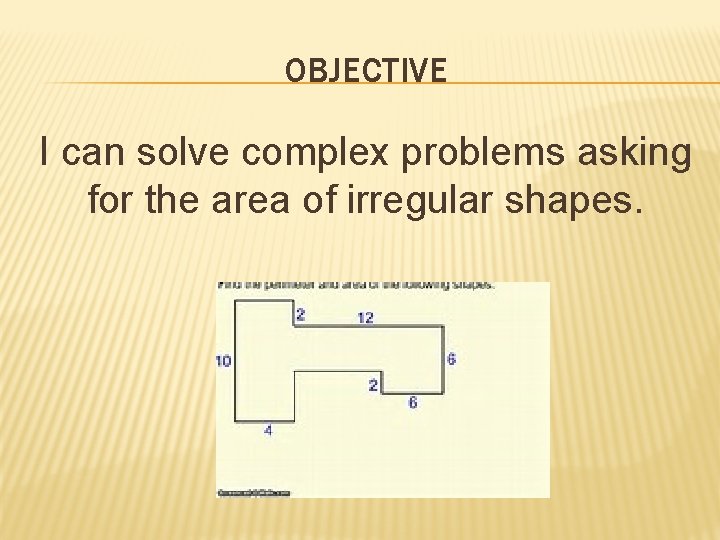
OBJECTIVE I can solve complex problems asking for the area of irregular shapes.
SET THE PURPOSE You know that you can solve a problem by understanding what you are asked to find and making a plan. Today, you will learn how solving a simpler problem can help you solve other problems.
CONNECT Have you ever solved smaller problems before you were able to solve a big problem? What did you do? Practice one verse of a song before learning the whole song, put together parts of a model car, or put a puzzle together.
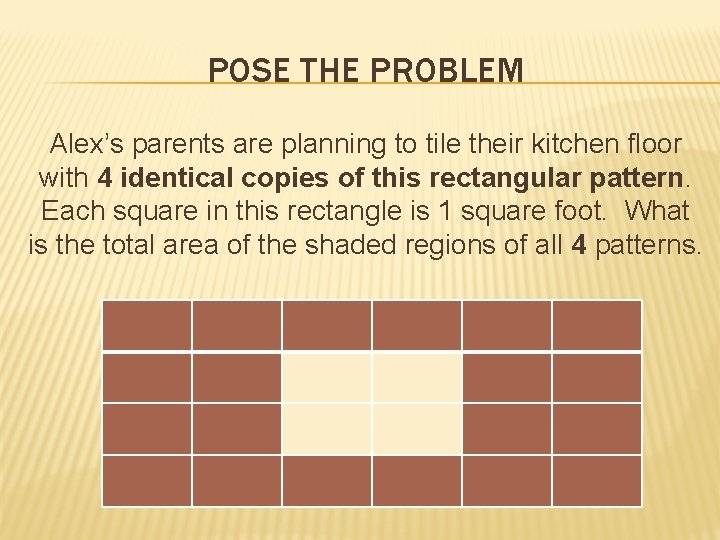
POSE THE PROBLEM Alex’s parents are planning to tile their kitchen floor with 4 identical copies of this rectangular pattern. Each square in this rectangle is 1 square foot. What is the total area of the shaded regions of all 4 patterns.
STEPS TO SOLVING � Step 1: Find the area of the total shape. � Step 2: Find the area of the smaller shape within the shape. � Step 3: Subtract the smaller shape from the total shape to find the area of the shaded region. � Step 4: Now, multiply the area of the region by the number of patterns, tiles, etc. to find the final answer.
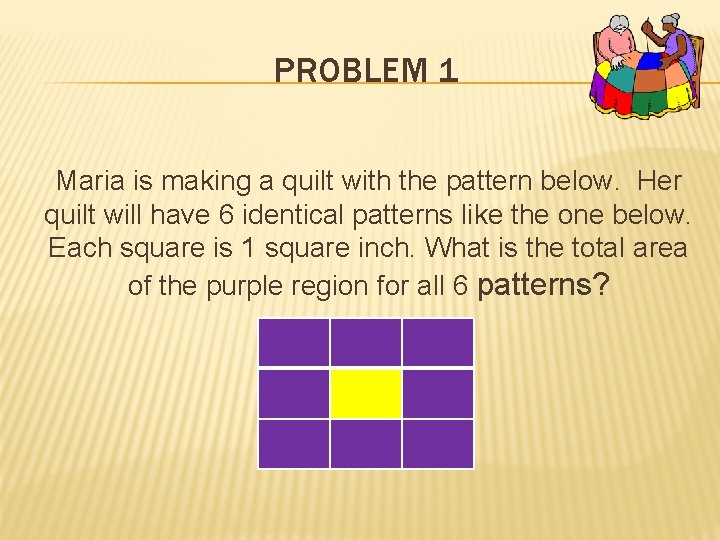
PROBLEM 1 Maria is making a quilt with the pattern below. Her quilt will have 6 identical patterns like the one below. Each square is 1 square inch. What is the total area of the purple region for all 6 patterns?
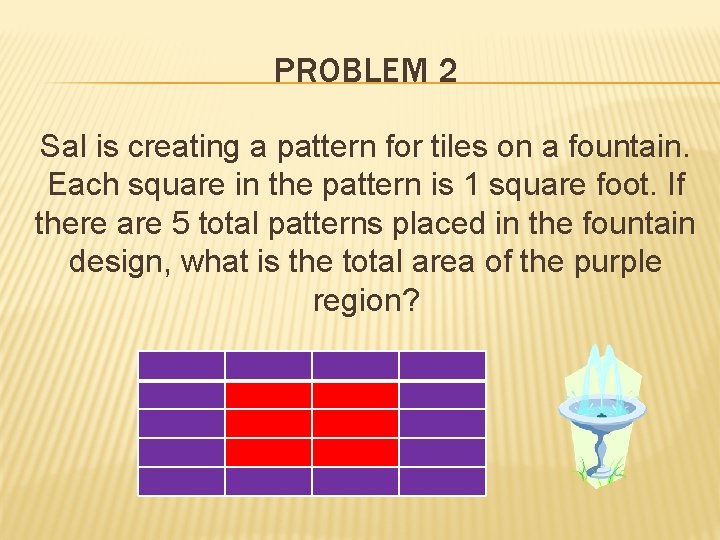
PROBLEM 2 Sal is creating a pattern for tiles on a fountain. Each square in the pattern is 1 square foot. If there are 5 total patterns placed in the fountain design, what is the total area of the purple region?
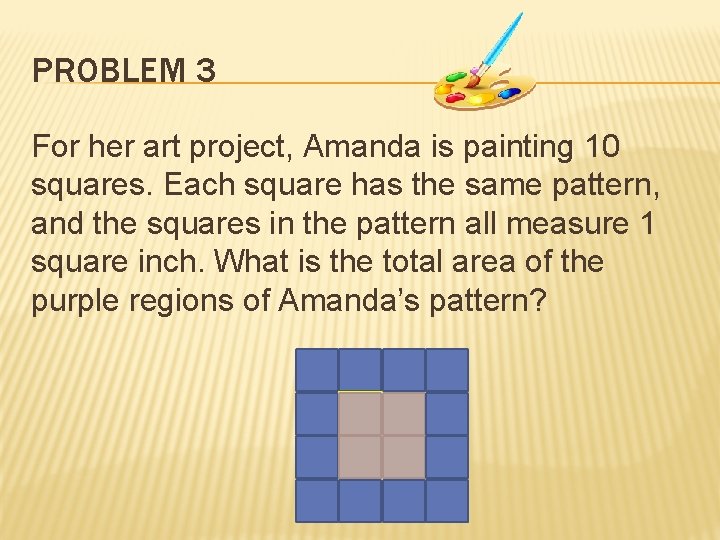
PROBLEM 3 For her art project, Amanda is painting 10 squares. Each square has the same pattern, and the squares in the pattern all measure 1 square inch. What is the total area of the purple regions of Amanda’s pattern?
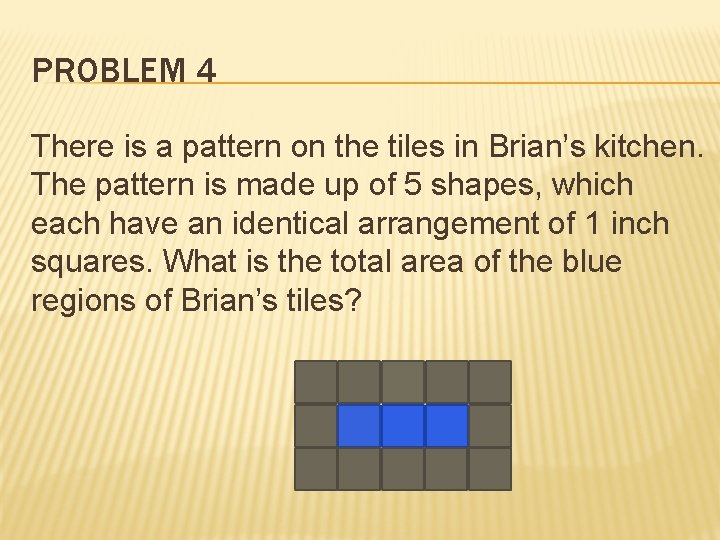
PROBLEM 4 There is a pattern on the tiles in Brian’s kitchen. The pattern is made up of 5 shapes, which each have an identical arrangement of 1 inch squares. What is the total area of the blue regions of Brian’s tiles?
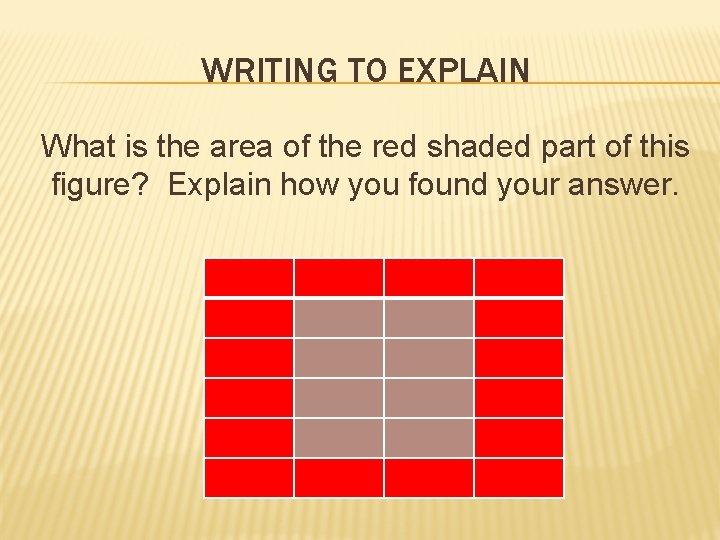
WRITING TO EXPLAIN What is the area of the red shaded part of this figure? Explain how you found your answer.
WRITING TO EXPLAIN RUBRIC
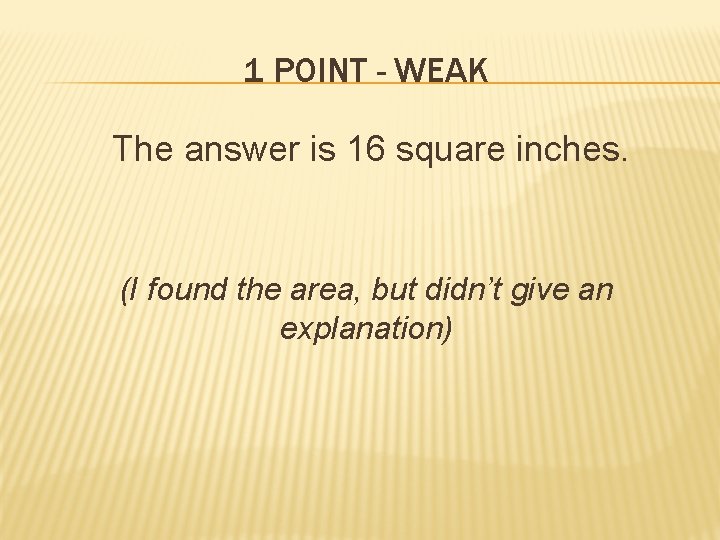
1 POINT - WEAK The answer is 16 square inches. (I found the area, but didn’t give an explanation)
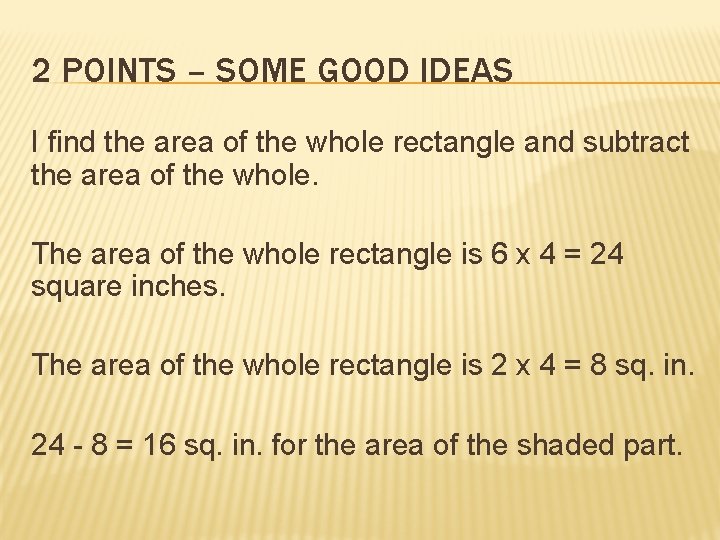
2 POINTS – SOME GOOD IDEAS I find the area of the whole rectangle and subtract the area of the whole. The area of the whole rectangle is 6 x 4 = 24 square inches. The area of the whole rectangle is 2 x 4 = 8 sq. in. 24 - 8 = 16 sq. in. for the area of the shaded part.
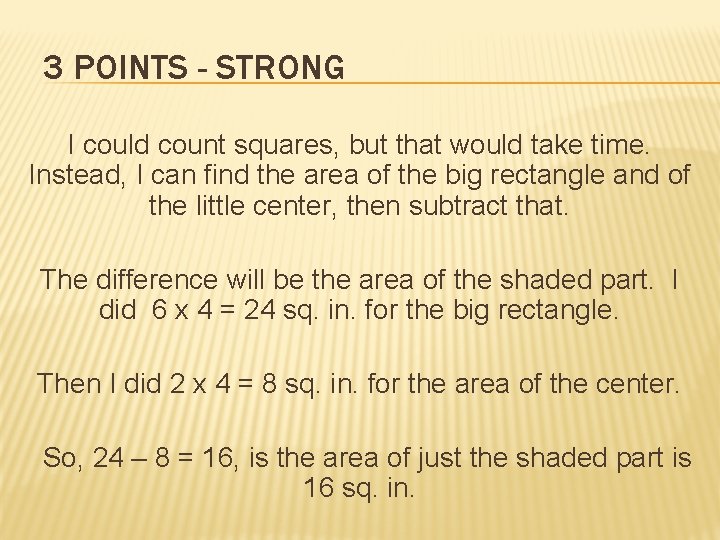
3 POINTS - STRONG I could count squares, but that would take time. Instead, I can find the area of the big rectangle and of the little center, then subtract that. The difference will be the area of the shaded part. I did 6 x 4 = 24 sq. in. for the big rectangle. Then I did 2 x 4 = 8 sq. in. for the area of the center. So, 24 – 8 = 16, is the area of just the shaded part is 16 sq. in.
Lesson 14 -7 CCSS 3. MD. 7. d AREA OF IRREGULAR SHAPES
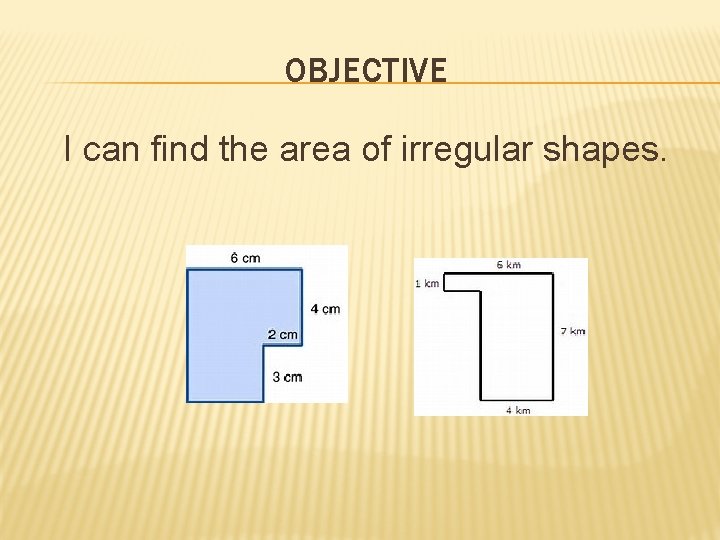
OBJECTIVE I can find the area of irregular shapes.
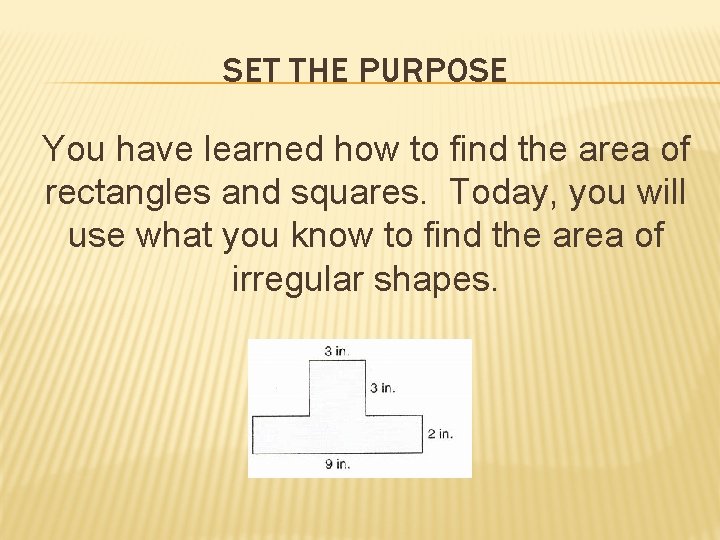
SET THE PURPOSE You have learned how to find the area of rectangles and squares. Today, you will use what you know to find the area of irregular shapes.
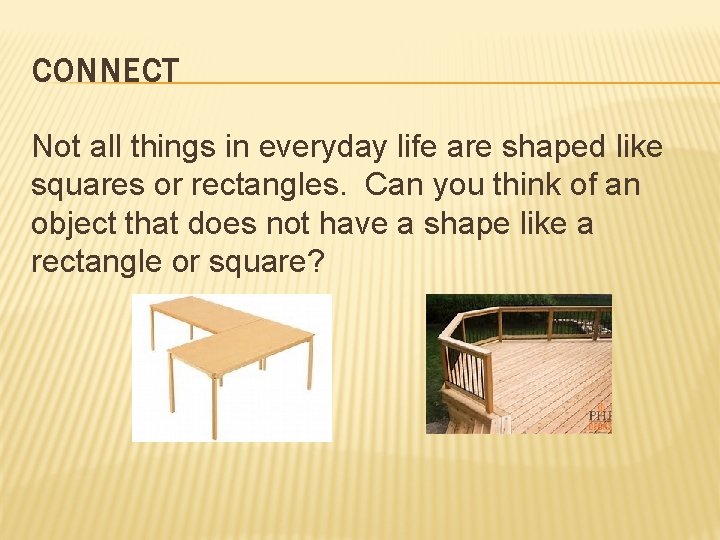
CONNECT Not all things in everyday life are shaped like squares or rectangles. Can you think of an object that does not have a shape like a rectangle or square?
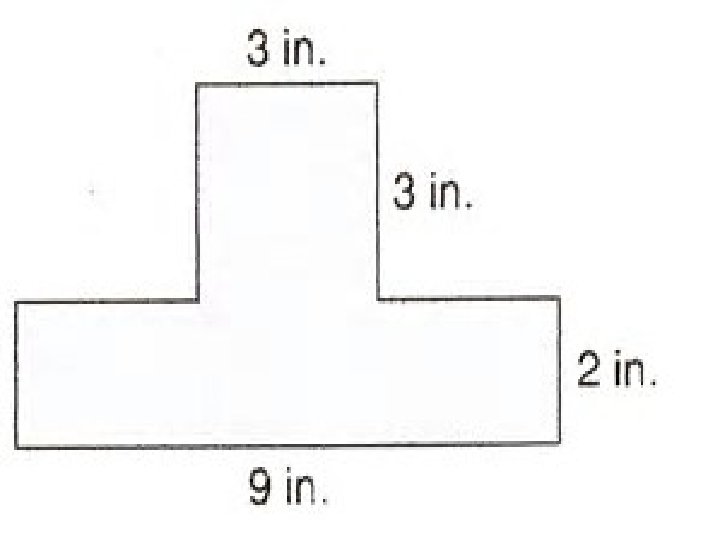
DISCUSSION How can you find the area of your desk without counting squares? Divide it into rectangles and squares, and find the area of each. Then add the area of each figure you found. There are many ways to divide this shape into rectangles and squares. What is one way? Let’s take another look and try it.
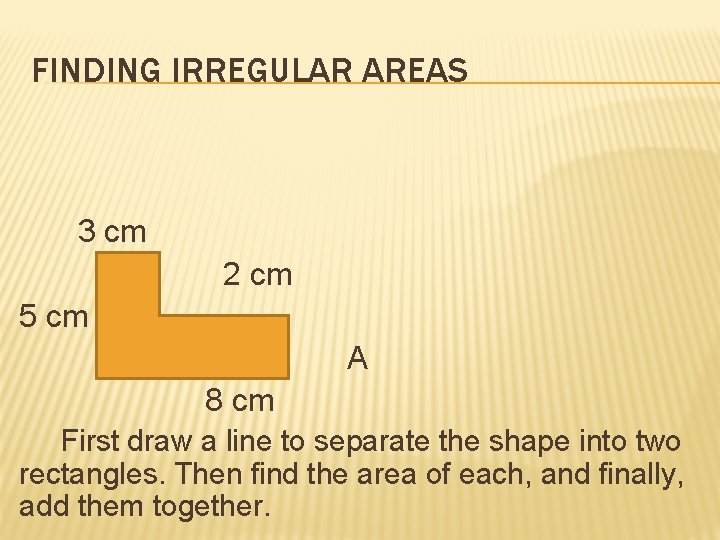
FINDING IRREGULAR AREAS 3 cm 2 cm 5 cm A 8 cm First draw a line to separate the shape into two rectangles. Then find the area of each, and finally, add them together.
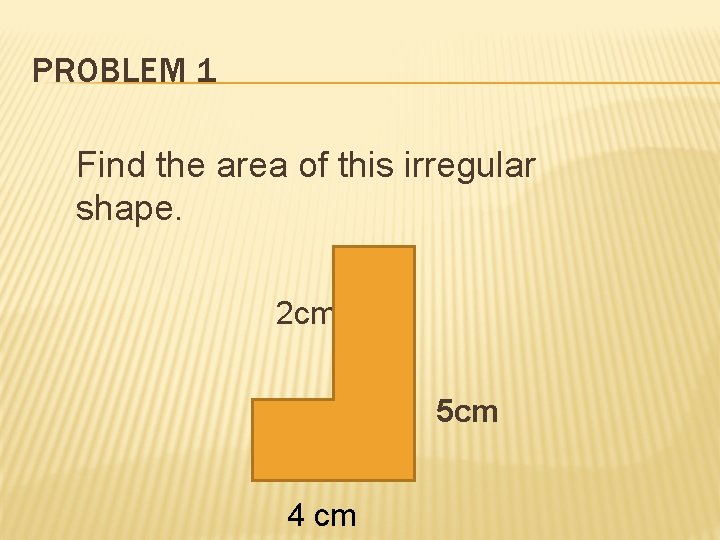
PROBLEM 1 Find the area of this irregular shape. 2 cm 5 cm 4 cm
PROBLEM 2 Find the area of this irregular shape. 7 in. 2 in. 5 in. 2 in.
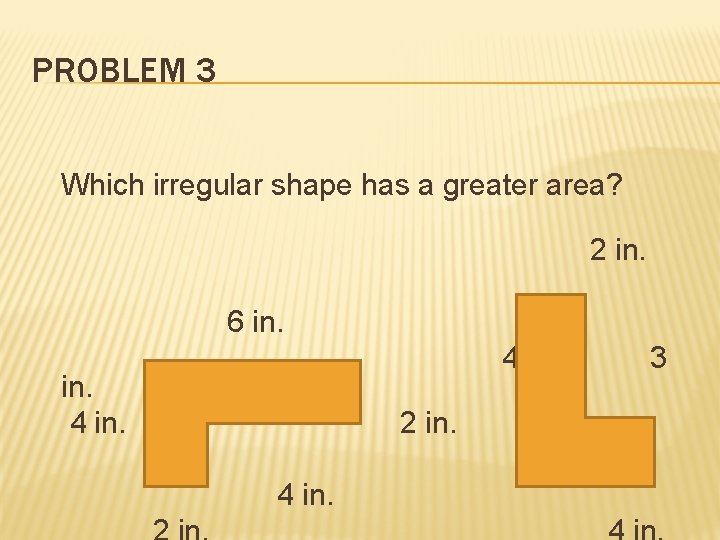
PROBLEM 3 Which irregular shape has a greater area? 2 in. 6 in. 4 in. 2 in. 4 in. 3
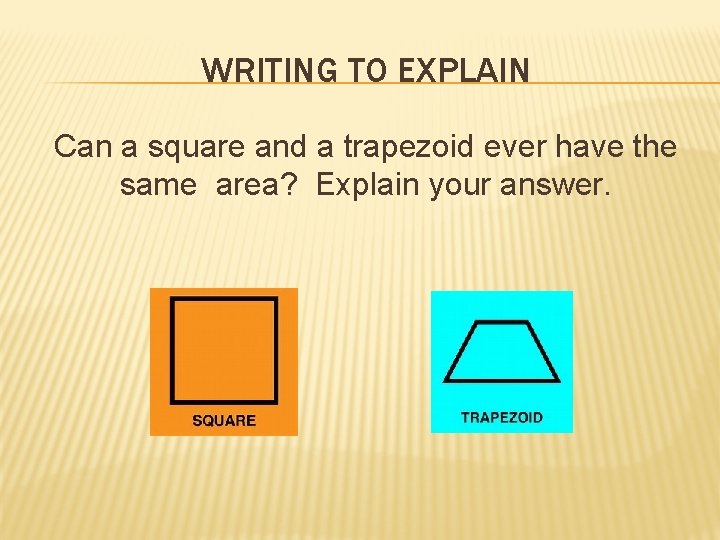
WRITING TO EXPLAIN Can a square and a trapezoid ever have the same area? Explain your answer.
WRITING TO EXPLAIN RUBRIC
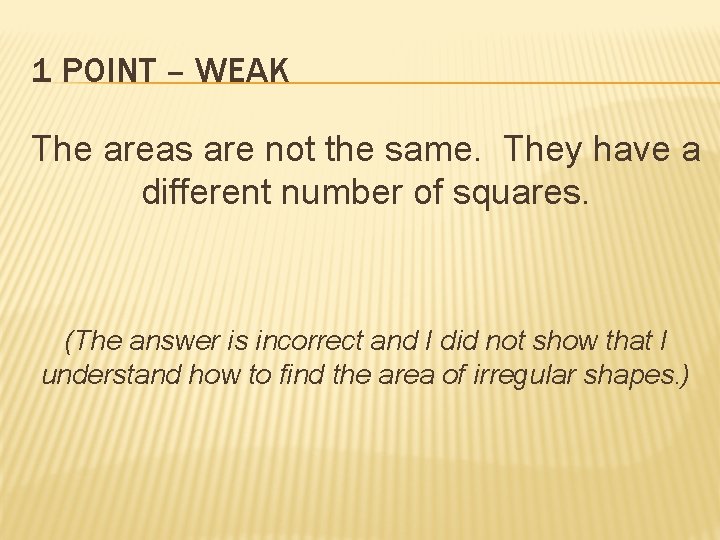
1 POINT – WEAK The areas are not the same. They have a different number of squares. (The answer is incorrect and I did not show that I understand how to find the area of irregular shapes. )
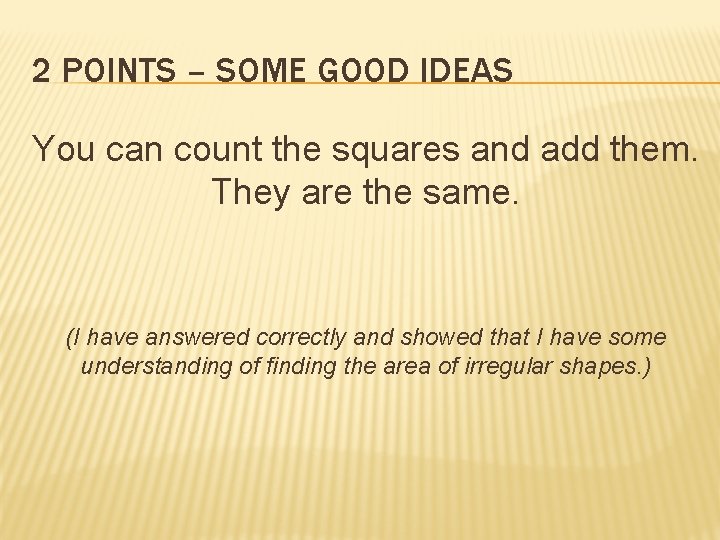
2 POINTS – SOME GOOD IDEAS You can count the squares and add them. They are the same. (I have answered correctly and showed that I have some understanding of finding the area of irregular shapes. )
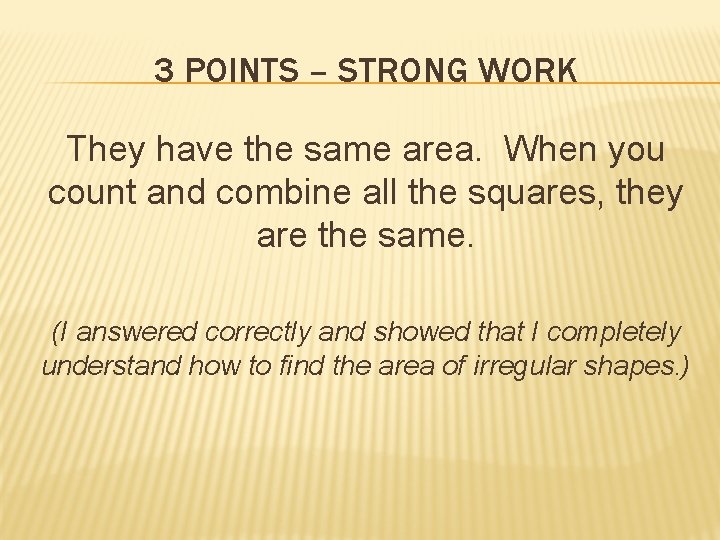
3 POINTS – STRONG WORK They have the same area. When you count and combine all the squares, they are the same. (I answered correctly and showed that I completely understand how to find the area of irregular shapes. )
Lesson 14 -8 CCSS 3. MD. 7. b, 3. MD. 8 SAME AREA, DIFFERENT PERIMETER
OBJECTIVE I can compare different rectangles with the same area to discover the change in perimeter.
SET THE PURPOSE You have found the perimeter and area of rectangles. Today, you will learn how rectangles with the same area can have different perimeters.
CONNECT Suppose you want to make a rectangle out of a piece of string. Could you make differently shaped rectangles using the full length of the piece of string? Yes, some could be longer and thinner and others shorter and wider.
POSE THE PROBLEM Draw 3 different rectangles with an area of 12 square units. Find the perimeter of each rectangle. Compare the perimeters. Discuss your work with a partner.
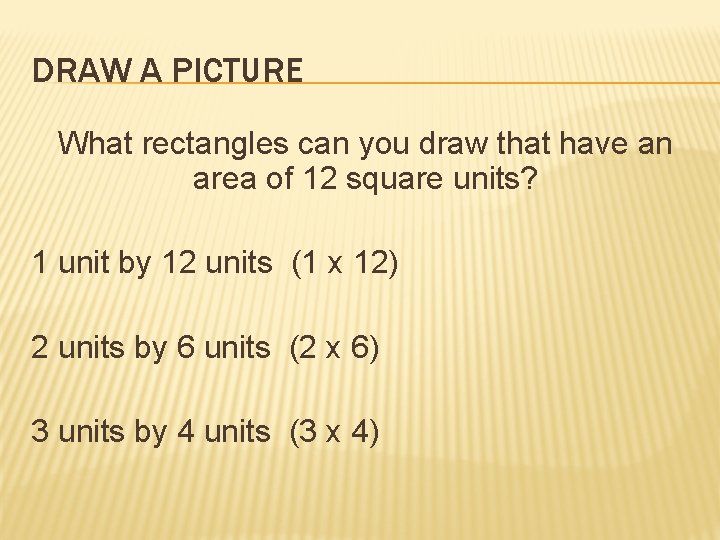
DRAW A PICTURE What rectangles can you draw that have an area of 12 square units? 1 unit by 12 units (1 x 12) 2 units by 6 units (2 x 6) 3 units by 4 units (3 x 4)
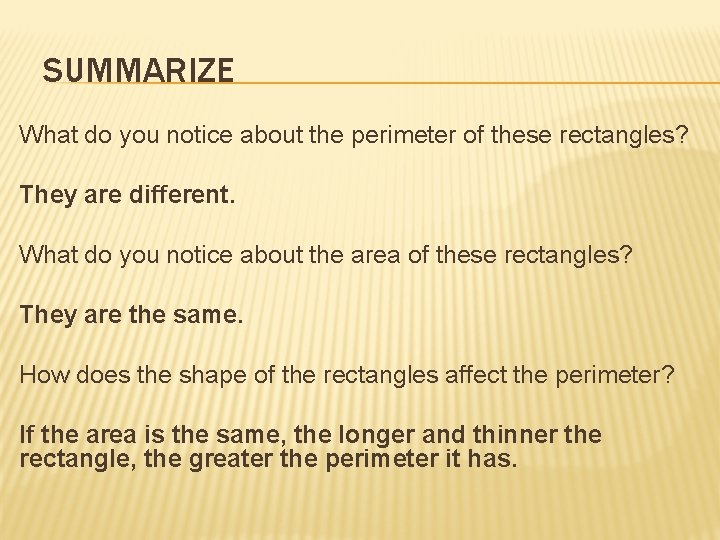
SUMMARIZE What do you notice about the perimeter of these rectangles? They are different. What do you notice about the area of these rectangles? They are the same. How does the shape of the rectangles affect the perimeter? If the area is the same, the longer and thinner the rectangle, the greater the perimeter it has.
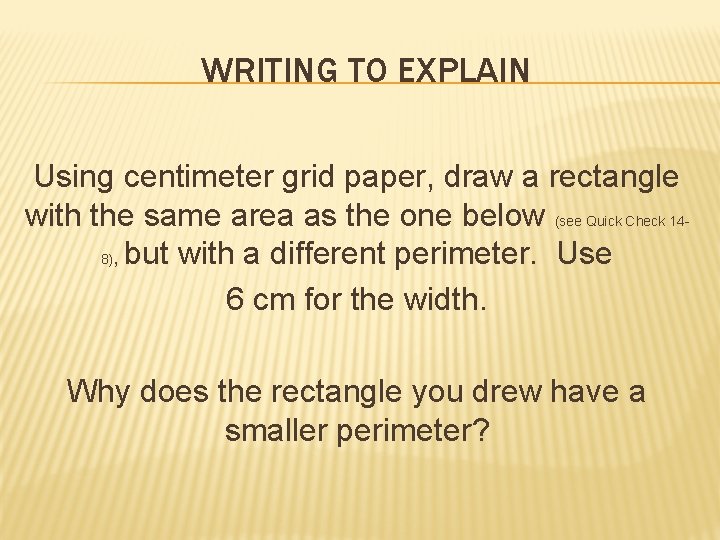
WRITING TO EXPLAIN Using centimeter grid paper, draw a rectangle with the same area as the one below (see Quick Check 148), but with a different perimeter. Use 6 cm for the width. Why does the rectangle you drew have a smaller perimeter?
WRITING TO EXPLAIN RUBRIC
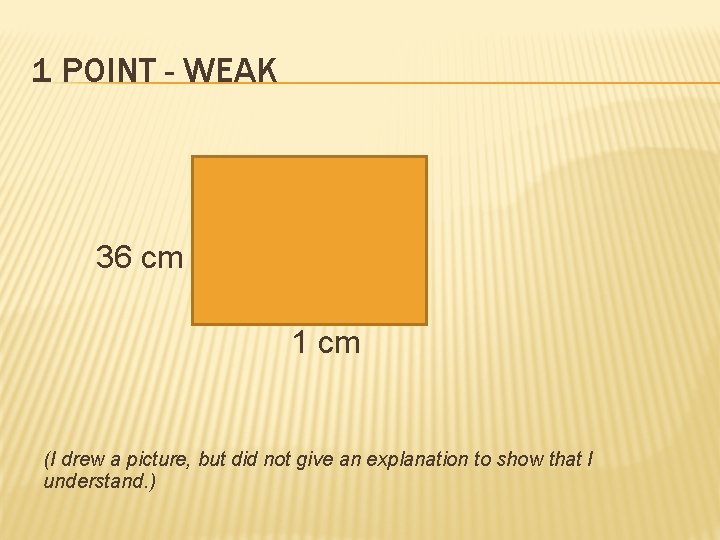
1 POINT - WEAK 36 cm 1 cm (I drew a picture, but did not give an explanation to show that I understand. )
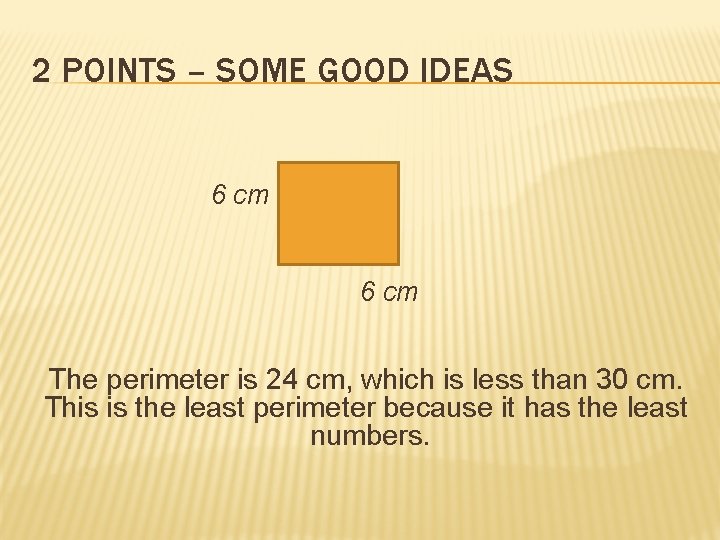
2 POINTS – SOME GOOD IDEAS 6 cm The perimeter is 24 cm, which is less than 30 cm. This is the least perimeter because it has the least numbers.
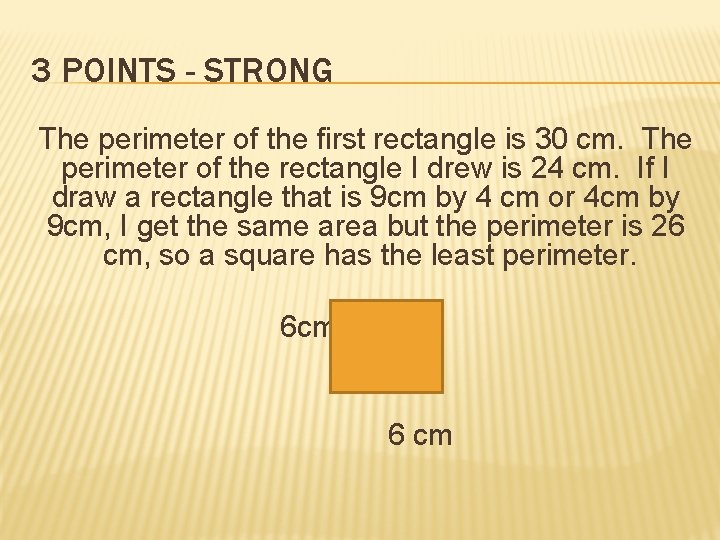
3 POINTS - STRONG The perimeter of the first rectangle is 30 cm. The perimeter of the rectangle I drew is 24 cm. If I draw a rectangle that is 9 cm by 4 cm or 4 cm by 9 cm, I get the same area but the perimeter is 26 cm, so a square has the least perimeter. 6 cm 6 cm
Lesson 14 -9 CCSS 3. G. 2, 3. MD. 5 EQUAL AREAS AND FRACTIONS
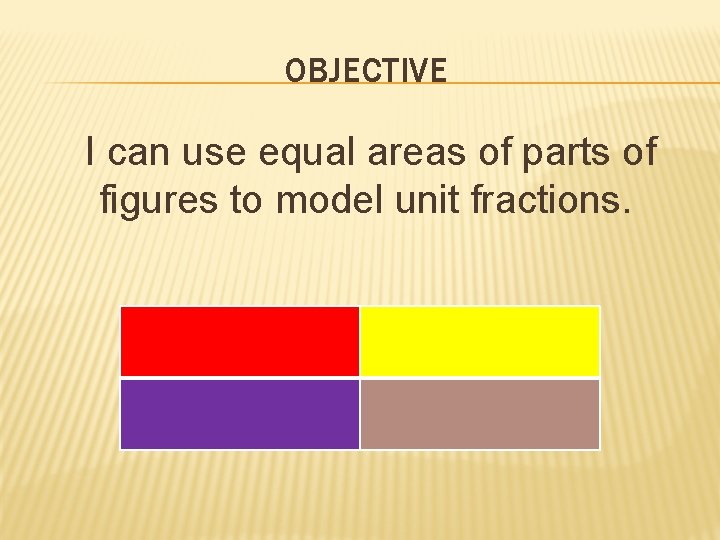
OBJECTIVE I can use equal areas of parts of figures to model unit fractions.
SET THE PURPOSE When you divide an area into equal parts, each equal part is a unit fraction. For example, if you divide a rectangle into 4 equal parts, each part is 1/4.
Today, you will learn how you can use area to find if a region has been divided into equal parts, even if the parts are not the same shape. You will also learn whether or not you can use the same unit fraction to describe each part.
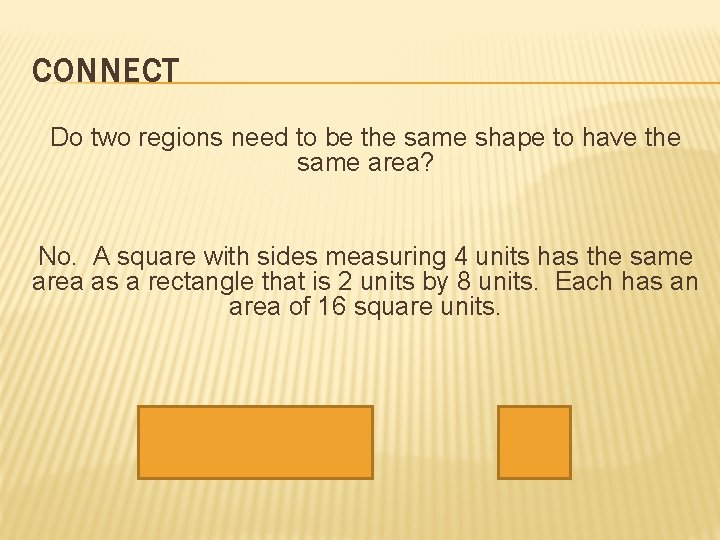
CONNECT Do two regions need to be the same shape to have the same area? No. A square with sides measuring 4 units has the same area as a rectangle that is 2 units by 8 units. Each has an area of 16 square units.
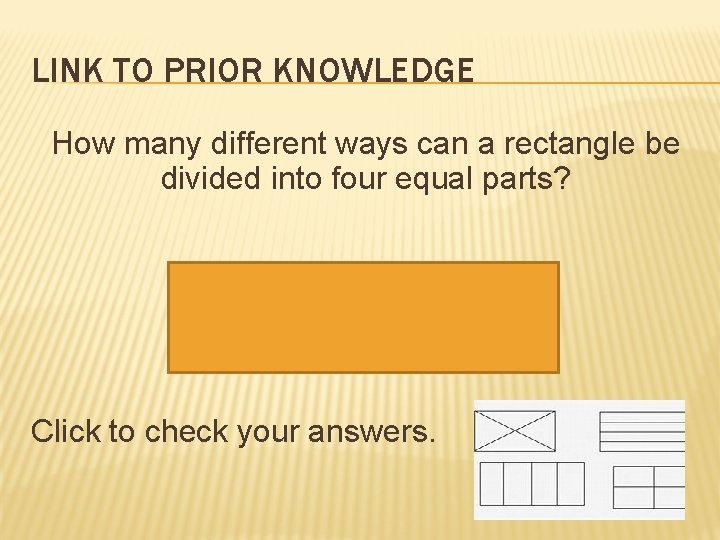
LINK TO PRIOR KNOWLEDGE How many different ways can a rectangle be divided into four equal parts? Click to check your answers.
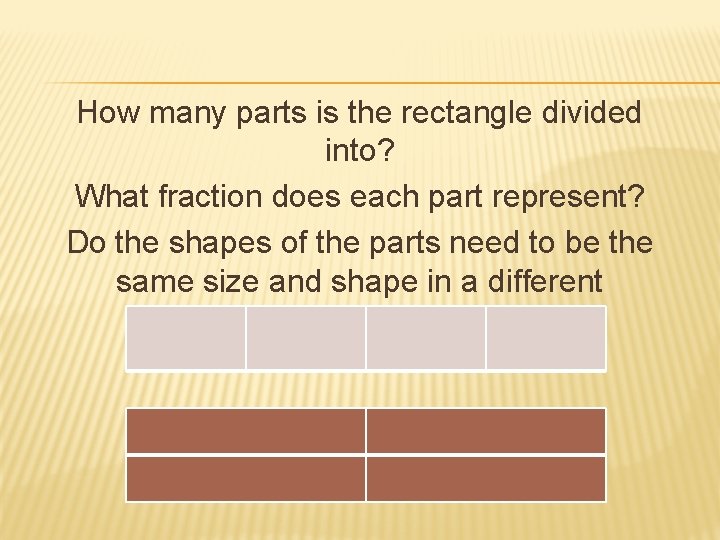
How many parts is the rectangle divided into? What fraction does each part represent? Do the shapes of the parts need to be the same size and shape in a different rectangle?
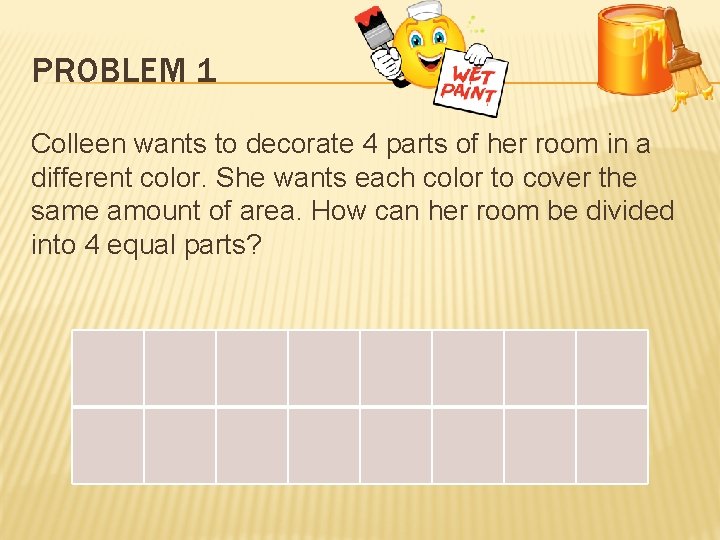
PROBLEM 1 Colleen wants to decorate 4 parts of her room in a different color. She wants each color to cover the same amount of area. How can her room be divided into 4 equal parts?
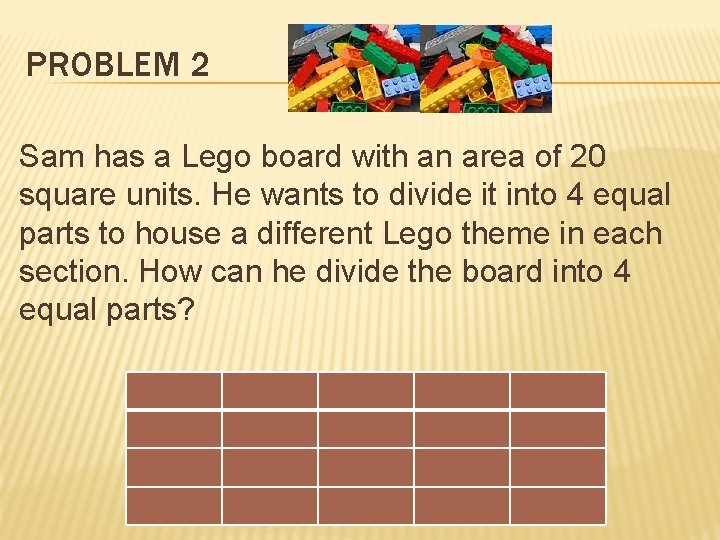
PROBLEM 2 Sam has a Lego board with an area of 20 square units. He wants to divide it into 4 equal parts to house a different Lego theme in each section. How can he divide the board into 4 equal parts?
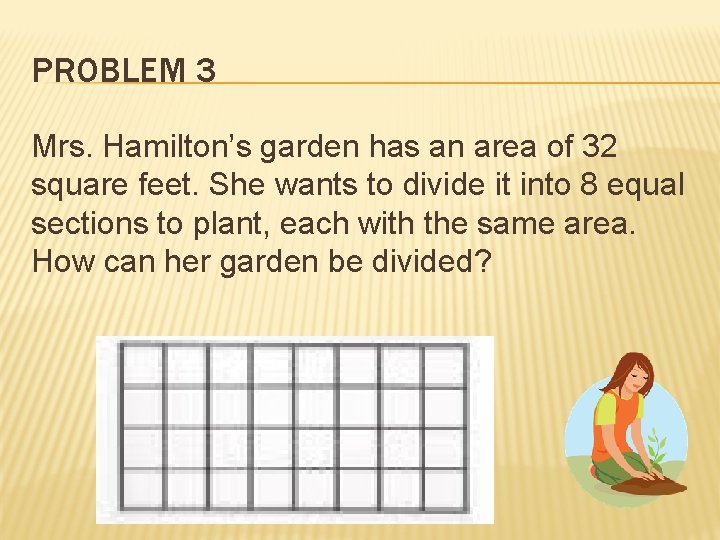
PROBLEM 3 Mrs. Hamilton’s garden has an area of 32 square feet. She wants to divide it into 8 equal sections to plant, each with the same area. How can her garden be divided?
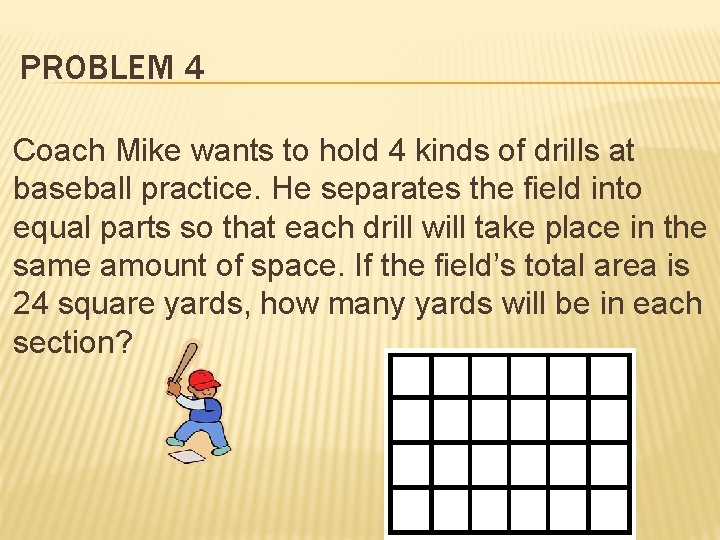
PROBLEM 4 Coach Mike wants to hold 4 kinds of drills at baseball practice. He separates the field into equal parts so that each drill will take place in the same amount of space. If the field’s total area is 24 square yards, how many yards will be in each section?
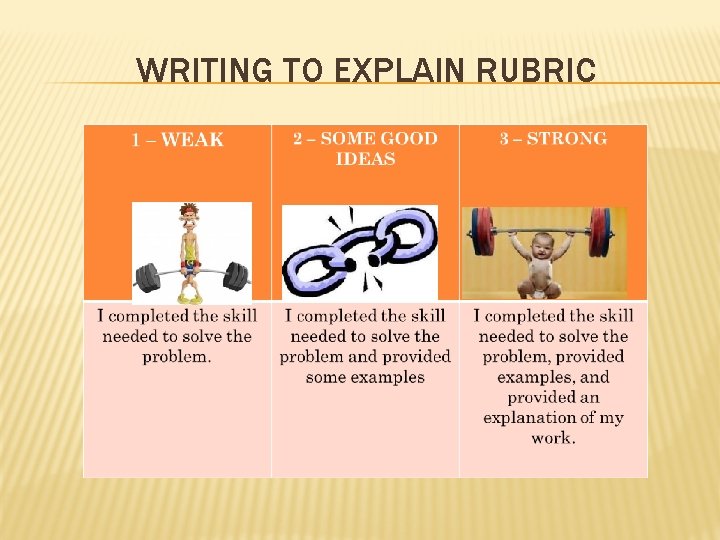
WRITING TO EXPLAIN RUBRIC
WRITING TO EXPLAIN Two classmates were each asked to separate a 4 x 6 rectangle into 6 equal parts. They separated the rectangle in different ways. Use the grid paper to show two different ways they could have separated the rectangle. Then write the fraction that shows the area of each part. Is the fraction the same or both rectangles? Why or why not?
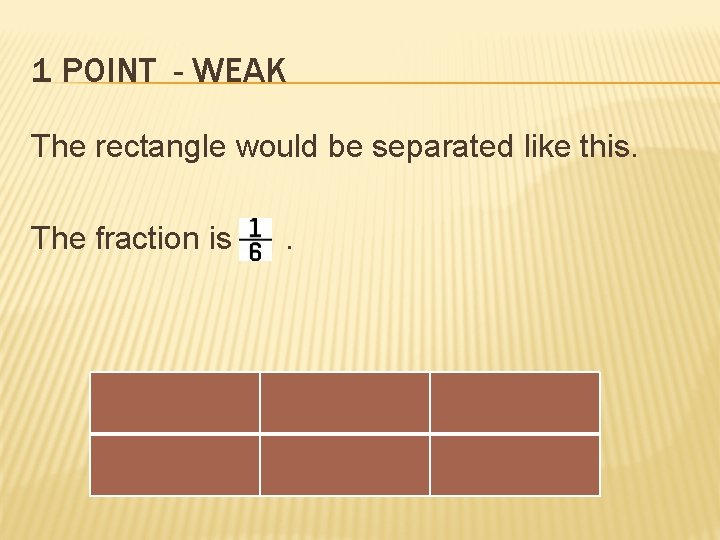
1 POINT - WEAK The rectangle would be separated like this. The fraction is .
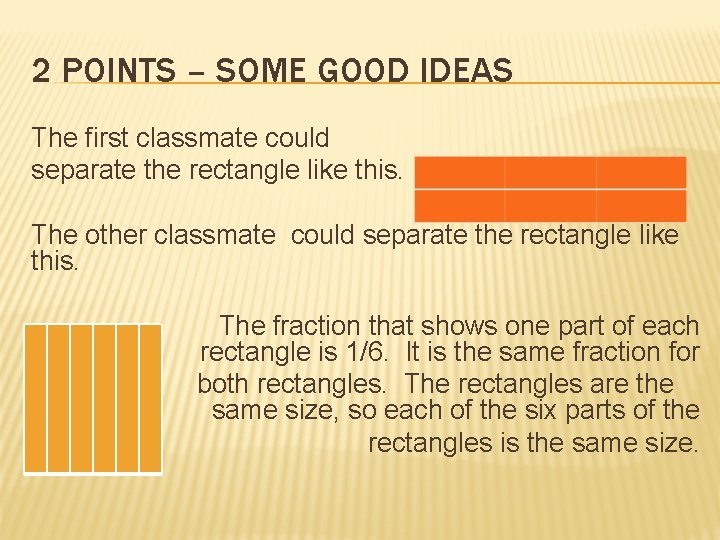
2 POINTS – SOME GOOD IDEAS The first classmate could separate the rectangle like this. The other classmate could separate the rectangle like this. The fraction that shows one part of each rectangle is 1/6. It is the same fraction for both rectangles. The rectangles are the same size, so each of the six parts of the rectangles is the same size.
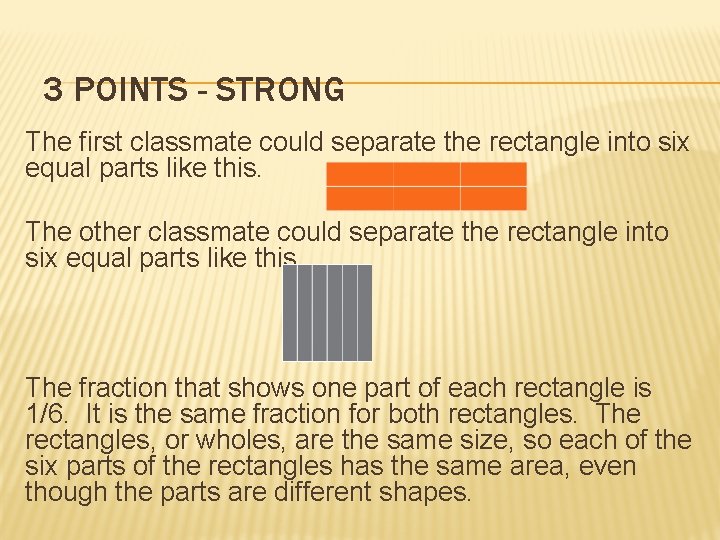
3 POINTS - STRONG The first classmate could separate the rectangle into six equal parts like this. The other classmate could separate the rectangle into six equal parts like this. The fraction that shows one part of each rectangle is 1/6. It is the same fraction for both rectangles. The rectangles, or wholes, are the same size, so each of the six parts of the rectangles has the same area, even though the parts are different shapes.
Lesson 14 -10 CCSS 3. MD. 5 PROBLEM SOLVING: SELECTING APPROPRIATE MEASUREMENT UNITS AND TOOLS
OBJECTIVE I can select appropriate units and tools for measuring the area of given items.
SET THE PURPOSE � You have learned to use different units SET THEtools PURPOSE and to measure length, and you have solved problems involving area. � Today, you will learn how to choose appropriate measurement units and tools to measure area.
MEASURING AREA � Remember that area is measured in square units. If you would measure an item in inches, you would measure its area in square inches. � Make sure you choose a unit that is smaller than the item you are choosing to measure but not so small that it would take too long to measure it.
POSE THE PROBLEM � List 2 things that you would measure the area in square inches or square centimeters. � List 2 things that you would measure the area in square feet or square meters. � List 2 things that you would measure the area in square miles or square kilometers.
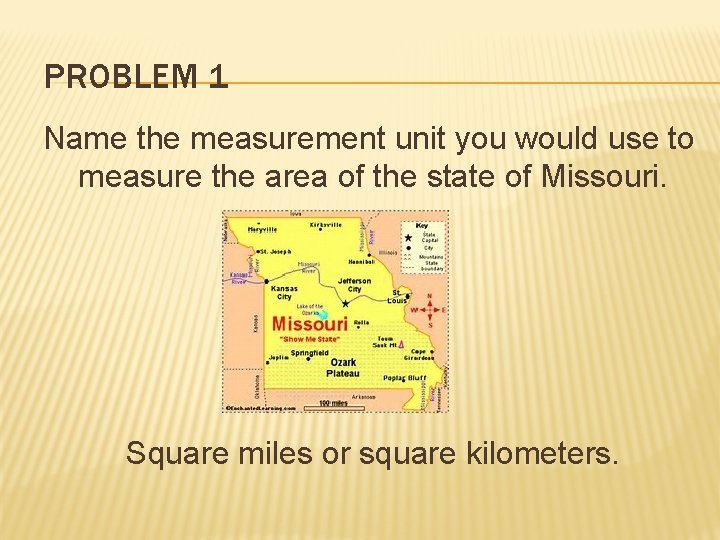
PROBLEM 1 Name the measurement unit you would use to measure the area of the state of Missouri. Square miles or square kilometers.
PROBLEM 2 Name the measurement unit you would use to measure the area of your desk. Square inches or square centimeters.
PROBLEM 3 Name the measurement unit you would use to measure the area of your classroom. Square feet or square meters.
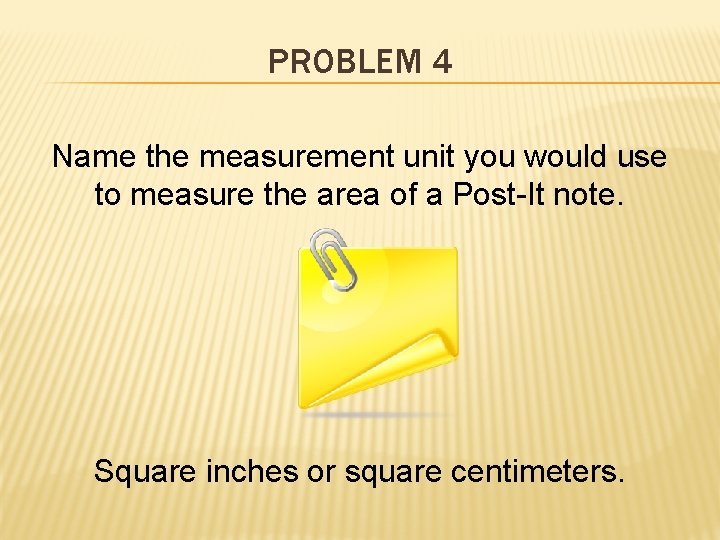
PROBLEM 4 Name the measurement unit you would use to measure the area of a Post-It note. Square inches or square centimeters.
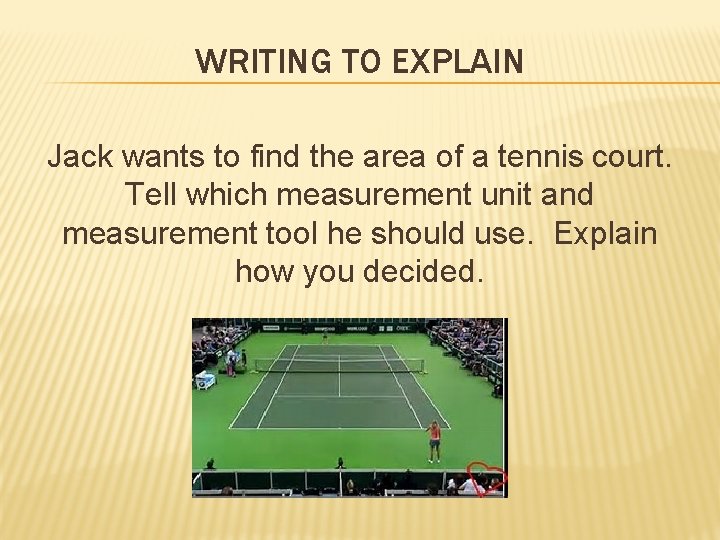
WRITING TO EXPLAIN Jack wants to find the area of a tennis court. Tell which measurement unit and measurement tool he should use. Explain how you decided.
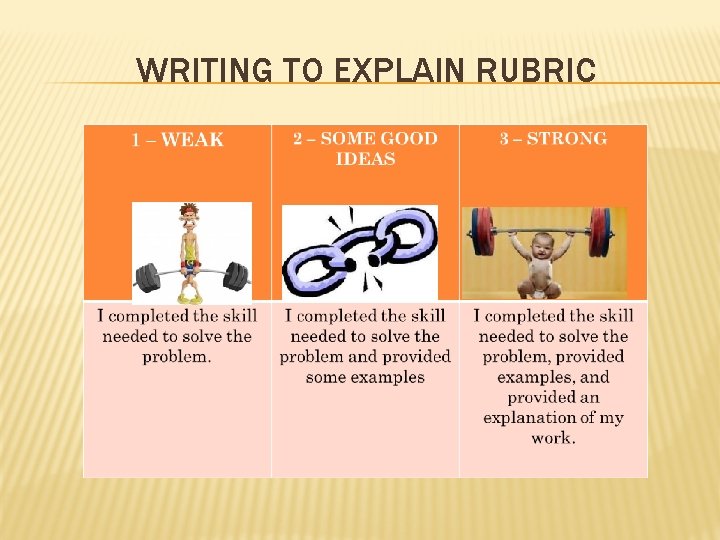
WRITING TO EXPLAIN RUBRIC
1 POINT - WEAK Jack needs to measure how wide the tennis court is. (I showed little or no understanding of selecting appropriate measurement units or tools for measuring area. )
2 POINTS – SOME GOOD IDEAS Brett should measure the tennis court in square feet with a yardstick. (I selected an appropriate measurement unit and tool for measuring the area of a tennis court, but I did not provide an explanation for the my selections. )
3 POINTS - STRONG Units of area smaller than a tennis court are square inches, square centimeters, square feet, and square meters. Square inches and square centimeters are very small compared to the court. Square feet and square meters are larger. So, Brett should use a yardstick or a meter stick to measure the sides of the court to find its area in square feet or square meters.