
Envisia Learning 360 Feedback Tools and Interpretation Guide
Envisia Learning 360° Feedback Tools and Interpretation Guide
Who we are… Envisia Learning is a leader in providing innovative assessment products, services, and other Internet based resources that are responsive to the unique needs of consultants and coaches and the individuals they serve throughout the world. We are committed to building strong, mutually beneficial, and enduring relationships with a focus on providing superior customer service, high-quality products, and excellent price value to our Customers.
Our Approach… Envisia Learning has developed an approach to customer assignments, which is characterized by: § A thorough understanding of the current needs of our customers before proceeding at each stage of the assignment § A mutual understanding between the customer and the consultants of the objectives, work processes, timing and results § Providing appropriate opportunities for participation by those affected by the project § A thorough review of project plans with the customer § A commitment to customer satisfaction that the mutually agreed upon desired results have been met
About Customer Support… § Toll-free customer support line to talk to our customer service support staff or Industrial/Organizational Psychologist at (800) 335 -0779 § Coach/Consultant online administration of their own 360 feedback projects § Branding our tools with your logo - regardless of how much or how often you buy for online administration and reporting § Free trials to your potential clients to support your marketing efforts! § No requirement of certification programs or fees as a requirement to purchase any product in the View. Suite 360 § Free resources to help you utilize our tools using the best practices § Ability to monitor rater activity and generate progress reports for all View. Suite 360 projects
Proven Range of Products based upon… Long-term research, knowledge and experience of published specialists 360° Feedback Personality, Career & Stress Assessment Survey Solutions Web-Based Performance Learning Solutions

Multi-Rater Feedback Definition MULTI-RATER / 360° FEEDBACK IS DEFINED AS: A systematic process of data collection and feedback from relevant observers (e. g. , Supervisors, Direct Reports, Peers, Team Members, Customers) targeting job-relevant competencies required for effective performance on the job.
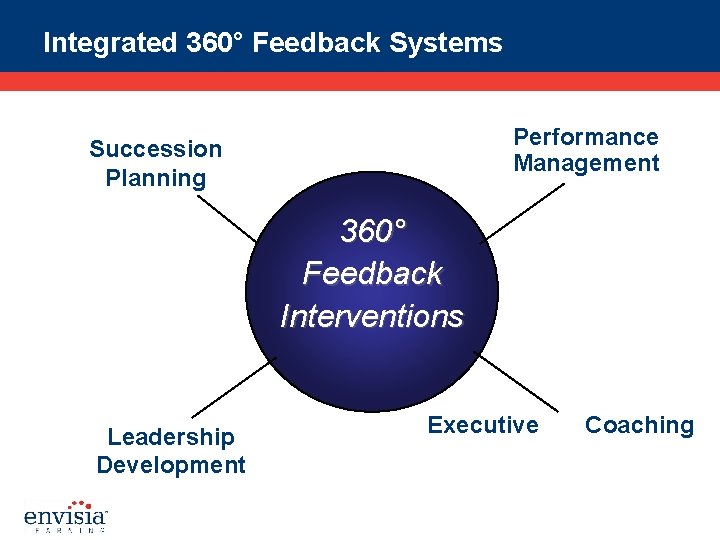
Integrated 360° Feedback Systems Performance Management Succession Planning 360° Feedback Interventions Leadership Development Executive Coaching
Introducing View. Suite 360 Comprises: § Executive. View 360 § Leader. View 360 § Manager. View 360 § Performance. View 360 § Team. View 360 § Emotional Intelligence. View 360
Executive. View 360 § Purpose Assessment of 22 senior executive competencies in the areas of Performance Leadership, Change Leadership, Interpersonal Leadership and Personal Leadership based on succession planning executive profiling § Outcome Development of senior executives Enhanced awarness of board members, peers and direct reports Improve communication and relationships with others § Audience Senior executives and senior management
Executive. View 360 Performance Leadership Interpersonal Leadership § § § § Visionary Leadership Drive for Results Technological Leadership Financial Leadership Cross Functional Versatility Depth of Industry Knowledge Political Leadership Strategic Problem Analysis Decision Making Change Leadership § § § Entrepreneurial Leadership Driving Strategic Direction Driving Change Build Strategic Relationships Empowering Others Team Building Interpersonal Effectiveness Oral Communication/Presentation Influence/Negotiation Coaching/Talent Development Personal Leadership § § § Self-Development Adaptability/Flexibility Engenders Trust Respondents: Self, Board, Peers, Reports, Team Members
Manager. View 360 § Purpose Analysis of managerial strengths and developmental needs measuring 20 Leadership, Interpersonal, Communication and Problem Solving competency areas based on job analyses of managers in diverse industries § Outcome Improved communication & performance Enhanced supervisory and management skills Increased productivity § Audience Supervisors up to senior managers
Manager. View 360 Communication Interpersonal § § § § § Listening Written Communication Vision/Goal Setting Two-Way Feedback Oral Presentation Oral Communication Task Management § § § Planning/Organizing Follow-Up Performance Management Delegation Performance Review Recognizing Performance § § § Team Development Interpersonal Sensitivity Negotiation/Conflict Management Coaching/Employee Development Leadership/Influence Employee Involvement Problem Solving § § Strategic Problem Analysis Decisiveness/Judgment Respondents: Self, Boss, Reports, Peers
Performance. View 360 § Purpose Analysis of individual strengths and developmental needs measuring 14 Task Management, Interpersonal/Team, and Communication competencies § Outcome Improved communication & performance Enhanced interpersonal and task/project management skills Increased productivity § Audience Independent Contributors and Non-Managers
Performance. View 360 Communication Interpersonal/Team § § § § Listening Two-Way Feedback Written Communication Oral Presentation § § Collaboration Interpersonal Sensitivity Conflict Management/Negotiation Team Support Leadership/Influence Task Management § § Planning/Organizing Task/Project Management Problem Solving Decisiveness/Judgment Respondents: Self, Supervisor, Peers, Team Members
Leader. View 360 § Purpose Assessment of 7 critical leadership competencies § Outcome Development of senior staff Enable a self development strategy Refine work processes Improve communication and relationships with others § Audience Middle and senior management
Leader. View 360 Competencies Participants: § § § § Managers Planning Problem-Solving Controlling Self Management Managing Relationships Communicating Leading Respondents: Self, Boss, Reports, Peers
Team. View 360 § Purpose Measures each individual's scores compared to the team members and the teams' overall average scores within 7 major competencies § Outcome Understanding and enhancing team effectiveness and performance § Audience Teams
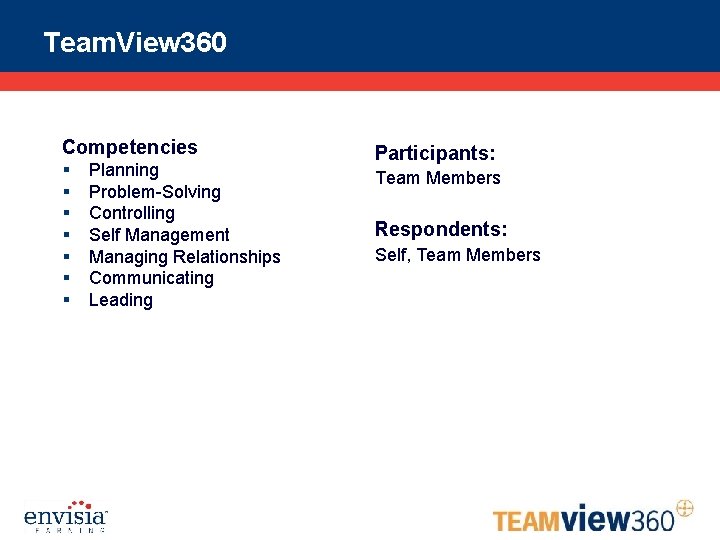
Team. View 360 Competencies § § § § Planning Problem-Solving Controlling Self Management Managing Relationships Communicating Leading Participants: Team Members Respondents: Self, Team Members
Emotional Intelligence. View 360 § Purpose Assessment of 17 Emotional Intelligence Competencies based on the latest emotional intelligence model § Outcome Increase effectiveness in self management, relationship management and communication competencies § To be used with All Employees
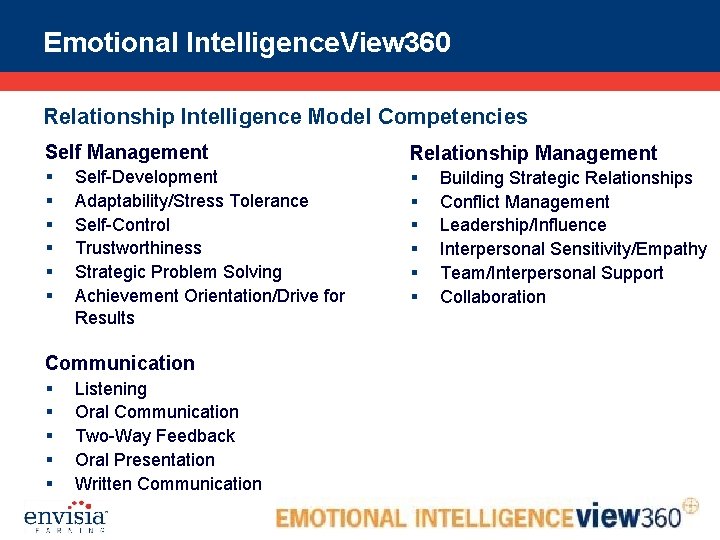
Emotional Intelligence. View 360 Relationship Intelligence Model Competencies Self Management Relationship Management § Self-Development § Adaptability/Stress Tolerance § • Self-Development Self-Control • Empathy § • Adaptability/Stress • Trustworthiness Organizational Awareness • Service Orientation § Tolerance Strategic Problem Solving § Achievement Orientation/Drive for • Self-Control Results § § § • Trustworthiness • Strategic Problem Communication Solving § Listening • Achievement § Oral Communication Orientation § § § Two-Way Feedback Oral Presentation Written Communication Building Strategic Relationships Conflict Management Leadership/Influence Interpersonal Sensitivity/Empathy Team/Interpersonal Support Collaboration
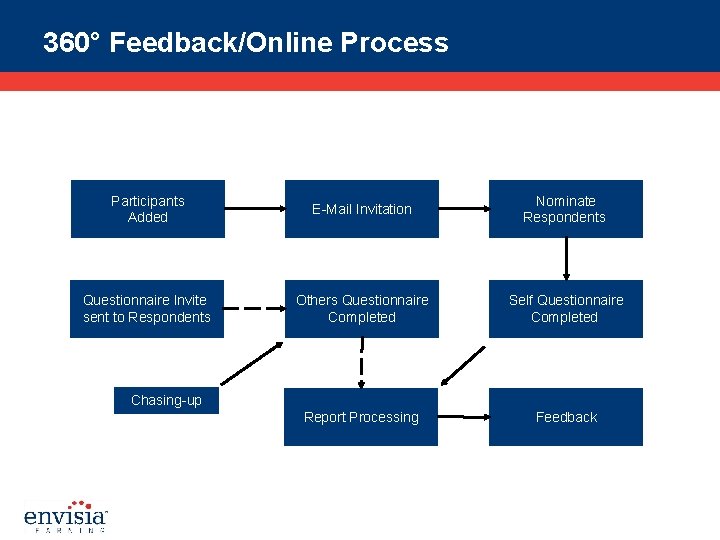
360° Feedback/Online Process Participants Added E-Mail Invitation Nominate Respondents Questionnaire Invite sent to Respondents Others Questionnaire Completed Self Questionnaire Completed Report Processing Feedback Chasing-up
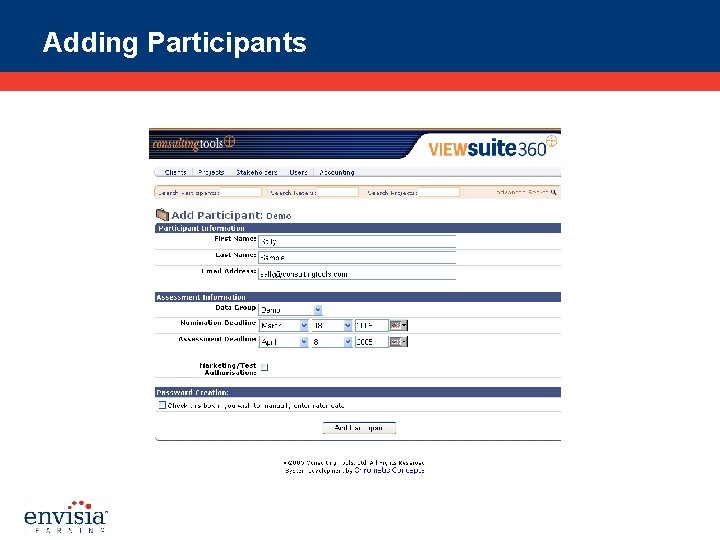
Adding Participants
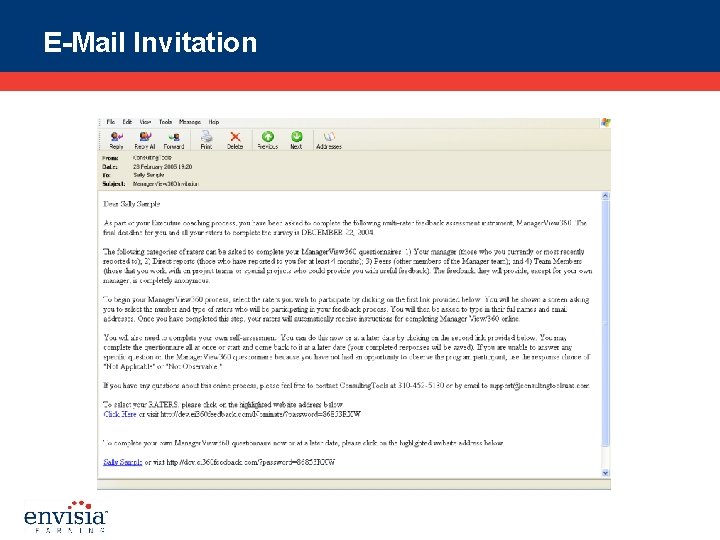
E-Mail Invitation
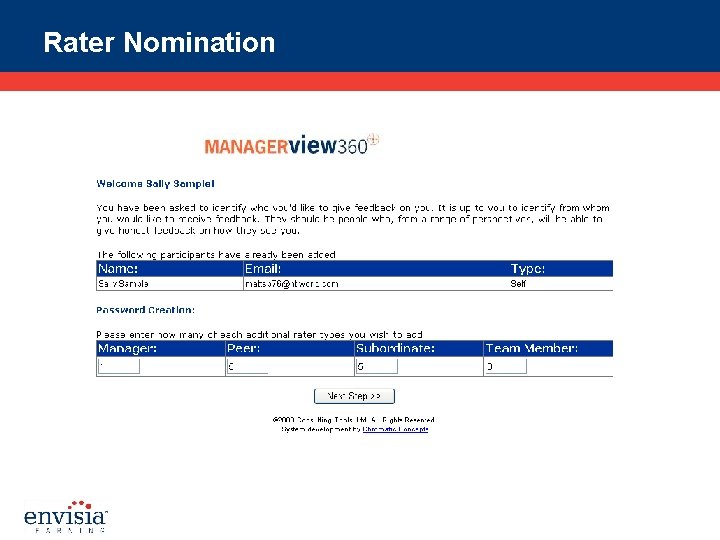
Rater Nomination
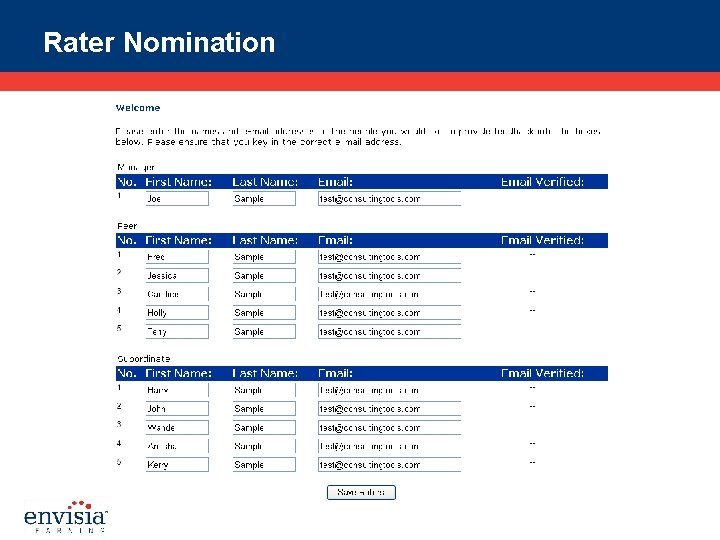
Rater Nomination
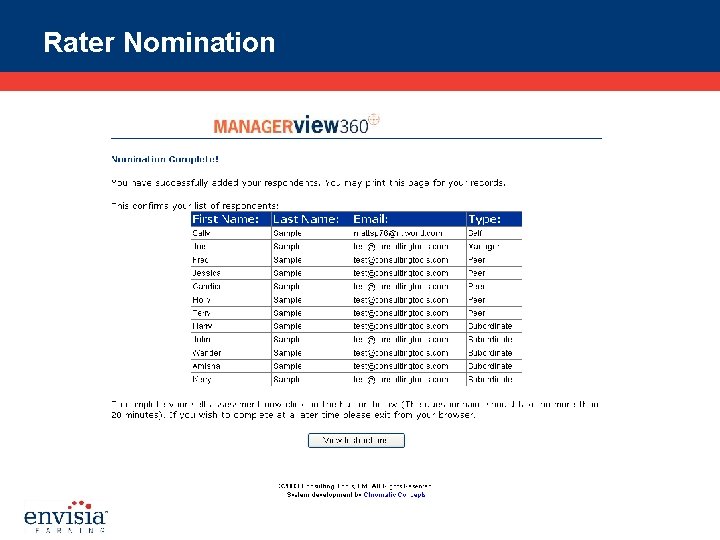
Rater Nomination
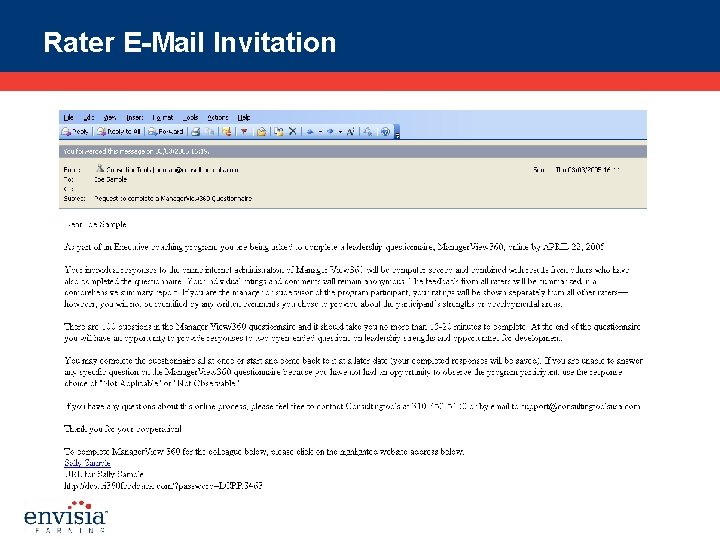
Rater E-Mail Invitation
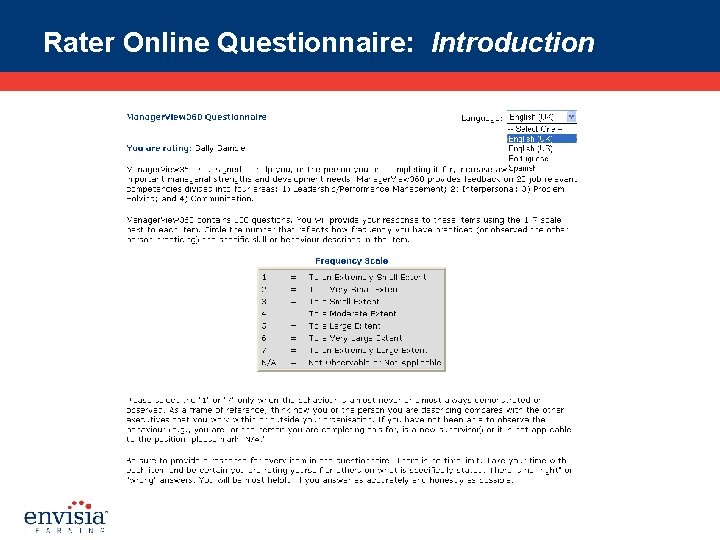
Rater Online Questionnaire: Introduction
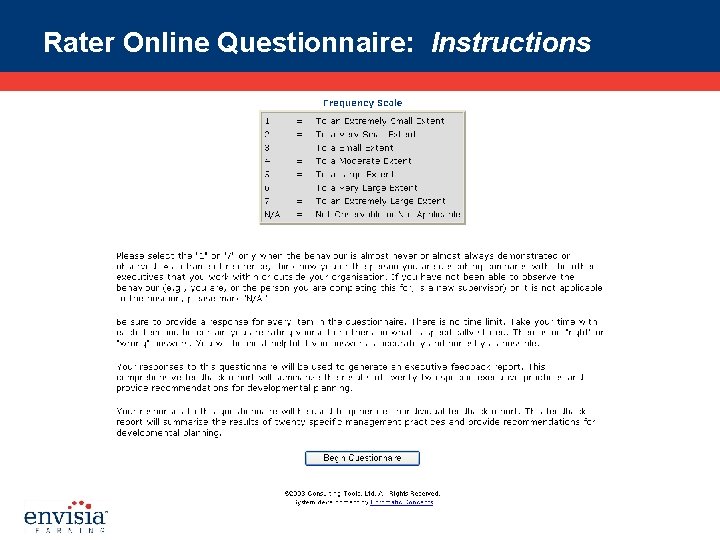
Rater Online Questionnaire: Instructions
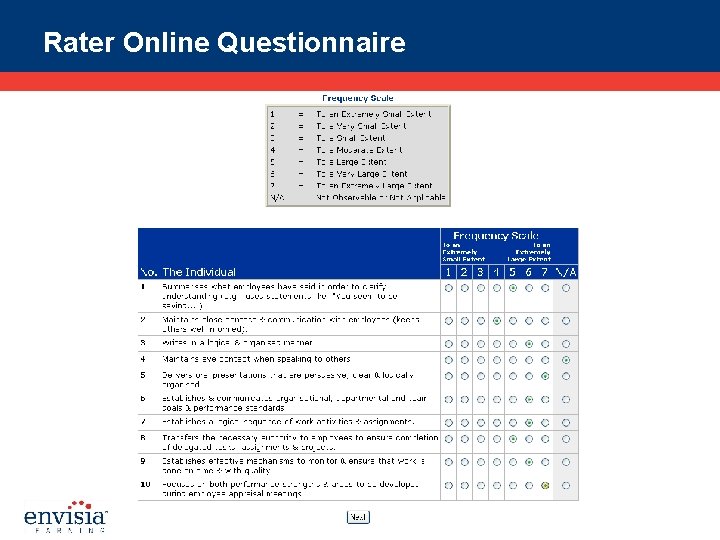
Rater Online Questionnaire
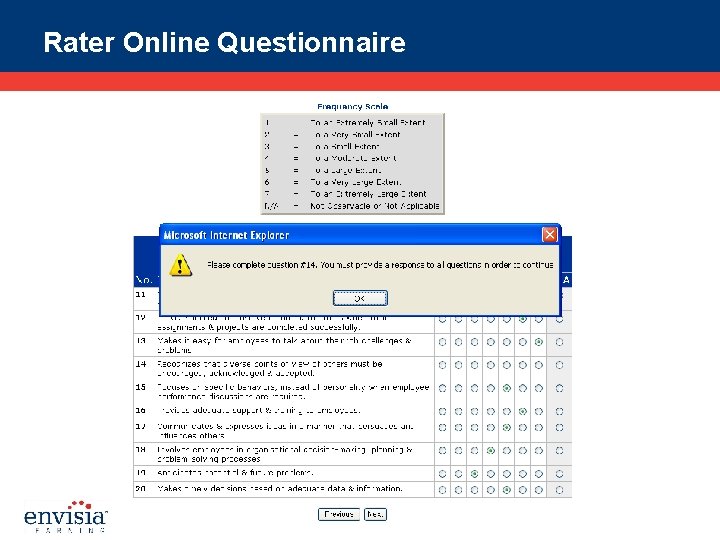
Rater Online Questionnaire
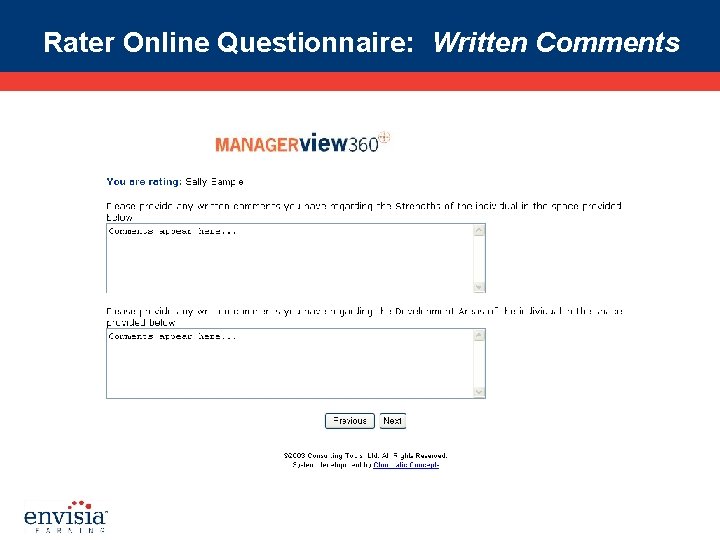
Rater Online Questionnaire: Written Comments
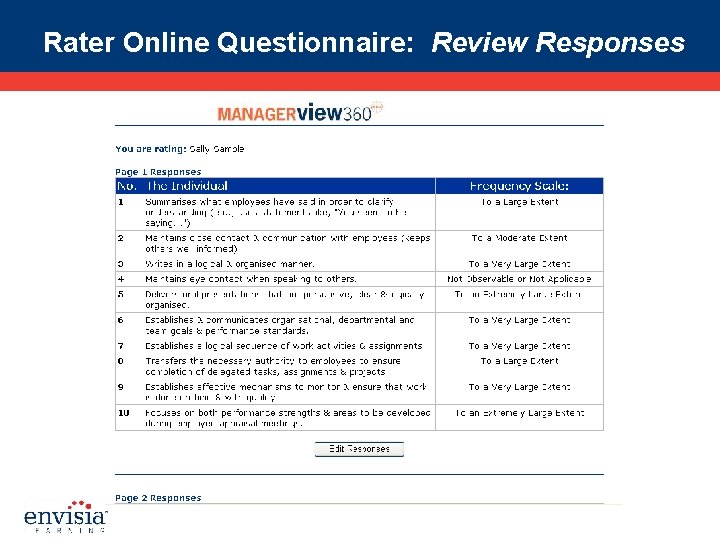
Rater Online Questionnaire: Review Responses
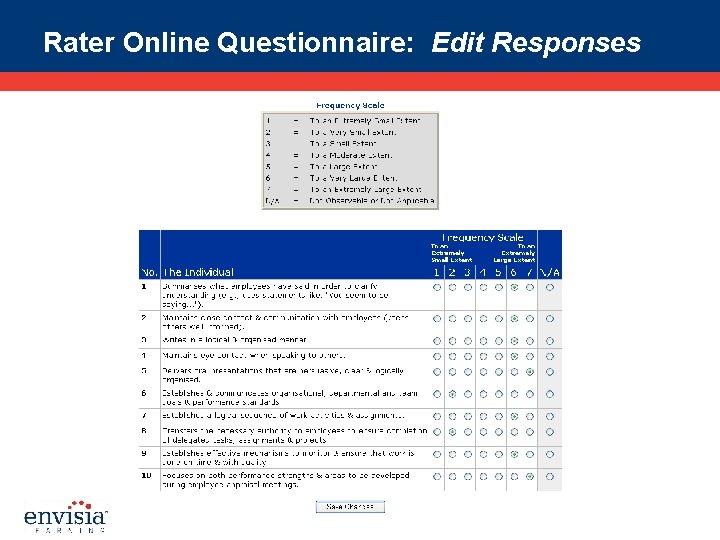
Rater Online Questionnaire: Edit Responses
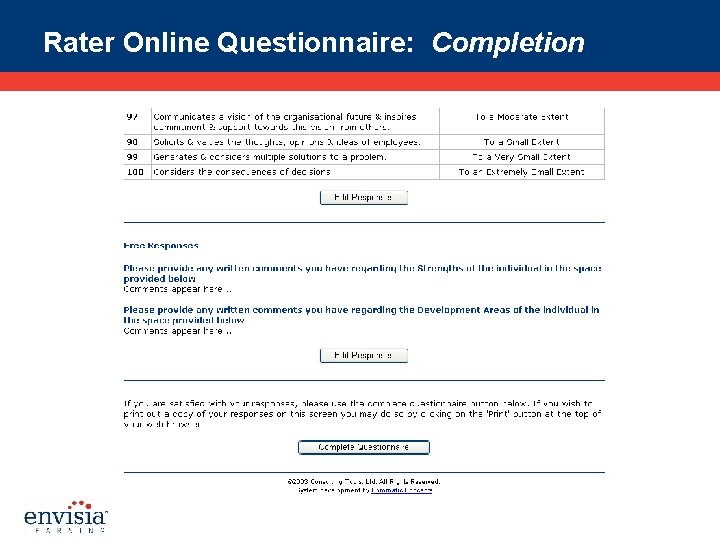
Rater Online Questionnaire: Completion
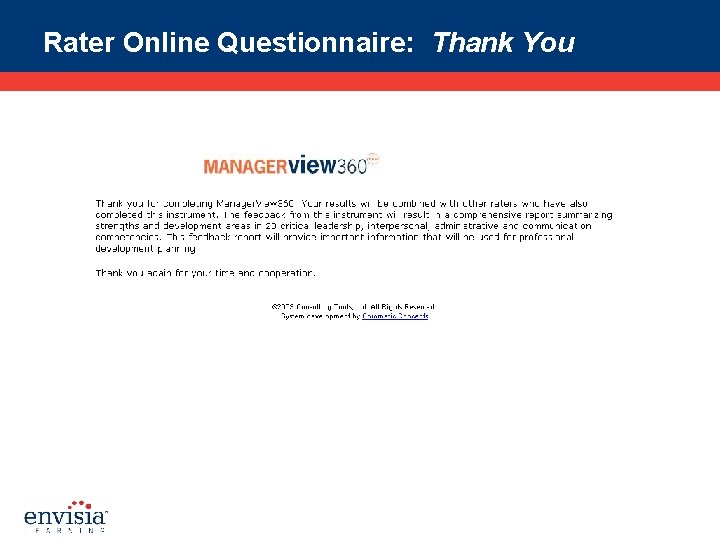
Rater Online Questionnaire: Thank You
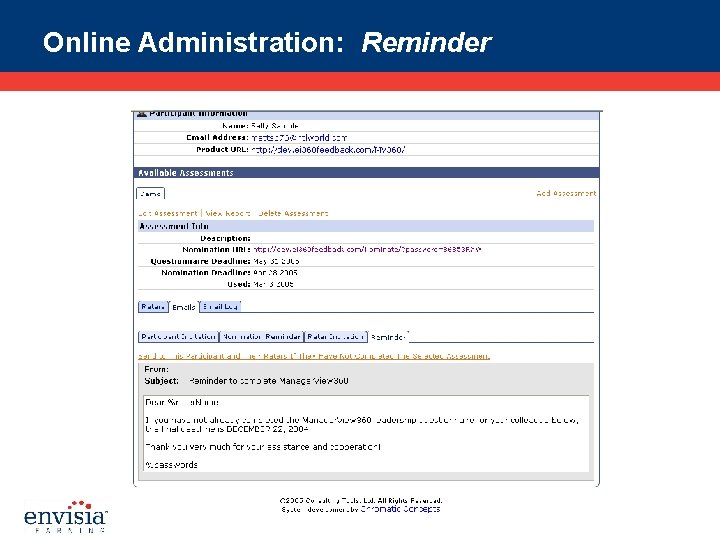
Online Administration: Reminder
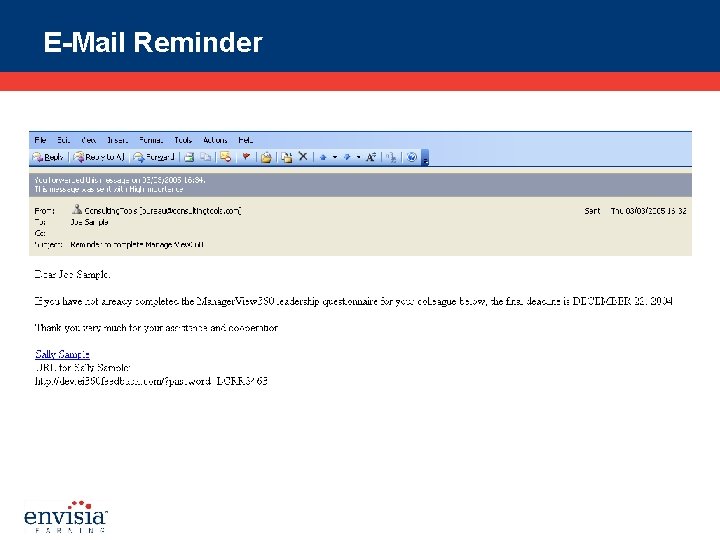
E-Mail Reminder
Steps in Feedback Report Interpretation 1. Introduce the 360 tools to be used in the coaching or development program and their competencies 2. Briefly describe what will be included in the feedback reports 3. Briefly review confidentiality in the process and reports 4. Distribute the reports and discuss each of the sections separately 5. Review the number and type of raters who provided feedback 6. The proceed through the different sections of the report emphasising some “key points”
View. Suite 360 Report Features 1. Group (composite) reports to highlight team strengths and development areas 2. Time series reports to compare and contrast changes when the View. Suite 360 questionnaires are used over time 3. Company specific norms, Consulting. Tools national norms or average scores 4. Line or bar graphs comparing self to other ratings 5. Statistical measure of rater agreement to assist in the interpretation 6. Option of “Johari Window” summary graphs (online reports only) 7. Option of rater distribution for most/least frequent tables (online reports only) 8. Options of how free response items (open ended questions) are summarised 9. Customised narrative for Manager. View 360 and Performance. View 360 10. Branding of consultant/client logo on the report
View. Suite 360 Feedback Process Objectives To identify skill strengths to enhance and leverage job performance To provide participants with feedback about developmental opportunities To facilitate the implementation of a professional development action plan
Feedback Report Components § Graphical Comparisons § Most and Least Frequently Observed Behaviours § Narrative Interpretation with Developmental Recommendations for each competency measured § Summary of Average Scores by Rater Category § Statistical Measure of Rater Agreement § Written Comments § Developmental Action Plan
Confidentiality of the Feedback Process Key Points § No raters are identified except for the boss in the feedback report § Online administration uses passwords to protect confidentiality (Internet administration) § No graphs are shown unless at least two raters respond in a rater category (e. g. , peers) § The summary feedback report is shared only with the respondent and is intended for development purposes only § The respondent decides how much of the summary feedback report he/she wants to share with others
Graph Section Key Points § Graphs (line or bar) will utilise either average scores or Consulting. Tools norms (standardised scores) § The first graph is an overview of the major performance factors. The others that follow summarise self and other perceptions on each of the separate competencies § The legend at the bottom of the graph will summarise rater groups and the number of raters § The symbol “AP” is used for anonymity protection and indicates that less than 2 raters have completed the questionnaires in this rater category § The normalised (standardised) scores reported are z-scores with “ 0” being the average score, or t-scores with “ 50” being the average score for those in the Consulting. Tools database § 68% of all participants will score between a z-score of +1 and -1 (one standard deviation above and below the mean) § Percentile scores are shown on the opposite axis for ease of interpretation § Normative score differences on a competency between raters of. 50 or more might be considered as meaningful perceptual differences
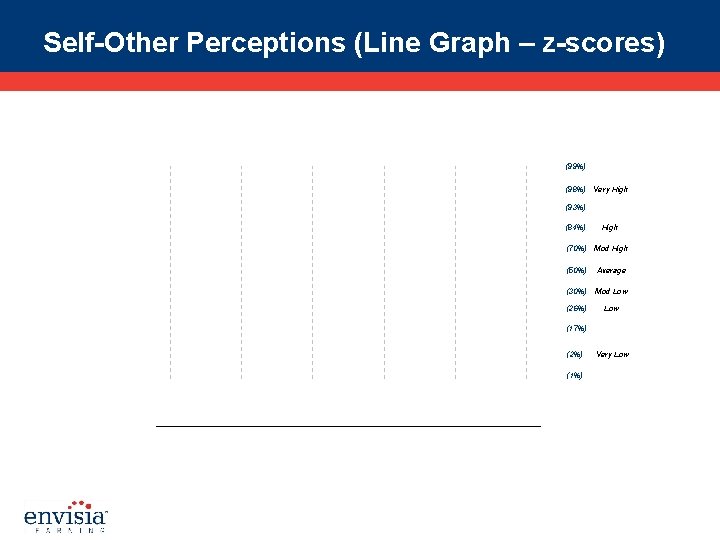
Self-Other Perceptions (Line Graph – z-scores) (99%) (98%) Very High (93%) (84%) High (70%) Mod High (50%) Average (30%) Mod Low (26%) Low (17%) (2%) (1%) Very Low
Self-Other Perceptions (Line Graph – t-scores) (99%) (98%) Very High (93%) (84%) High (70%) Mod High (50%) Average (30%) Mod Low (26%) Low (17%) (2%) (1%) Very Low
Self-Other Perceptions (Line Graph – avg-scores)
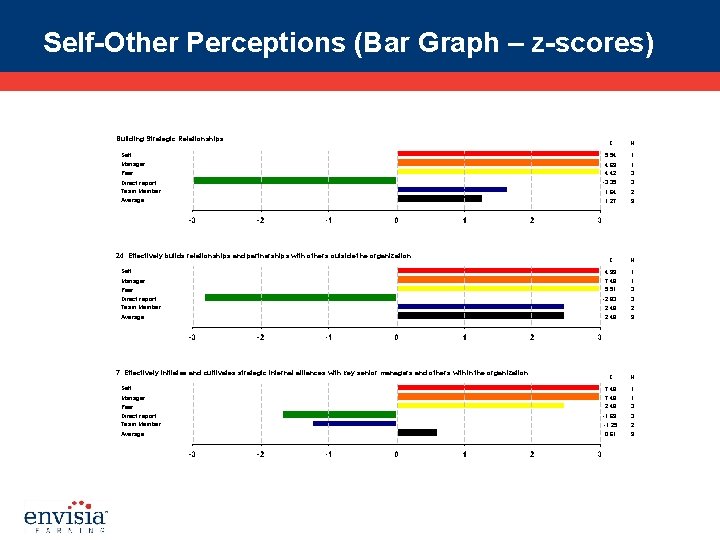
Self-Other Perceptions (Bar Graph – z-scores) Building Strategic Relationships Z N Self 5. 54 1 Manager Peer 4. 69 4. 42 1 3 Direct report Team Member -3. 35 3 1. 64 1. 27 2 9 Average 24. Effectively builds relationships and partnerships with others outside the organization Z N Self 4. 99 1 Manager Peer 7. 48 5. 51 1 3 Direct report Team Member -2. 83 3 2. 48 2 9 Average 7. Effectively initiates and cultivates strategic internal alliances with key senior managers and others within the organization Z N Self 7. 48 1 Manager Peer 7. 48 2. 48 1 3 Direct report Team Member -1. 69 3 -1. 25 0. 61 2 9 Average
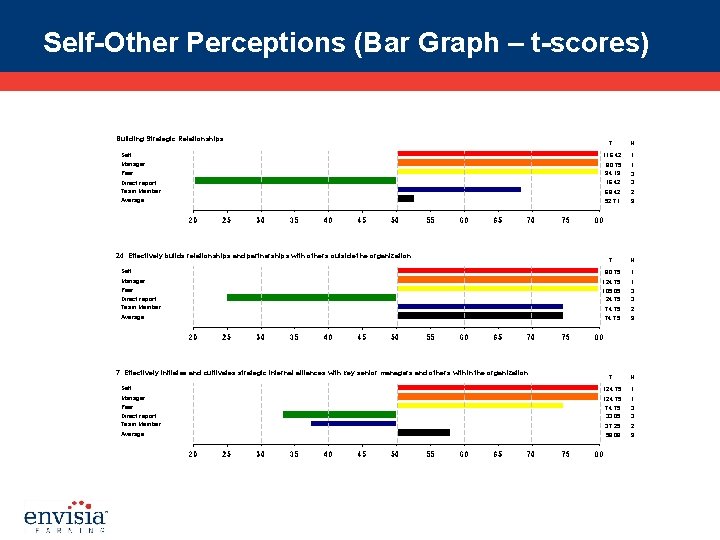
Self-Other Perceptions (Bar Graph – t-scores) Building Strategic Relationships Self Manager Peer Direct report Team Member Average 24. Effectively builds relationships and partnerships with others outside the organization Self Manager Peer Direct report Team Member Average 7. Effectively initiates and cultivates strategic internal alliances with key senior managers and others within the organization T N 116. 42 1 80. 75 94. 19 16. 42 1 3 3 68. 42 52. 71 2 9 T N 80. 75 1 124. 75 105. 05 24. 75 1 3 3 74. 75 2 9 T N Self 124. 75 1 Manager Peer 124. 75 74. 75 33. 05 1 3 3 37. 25 58. 08 2 9 Direct report Team Member Average
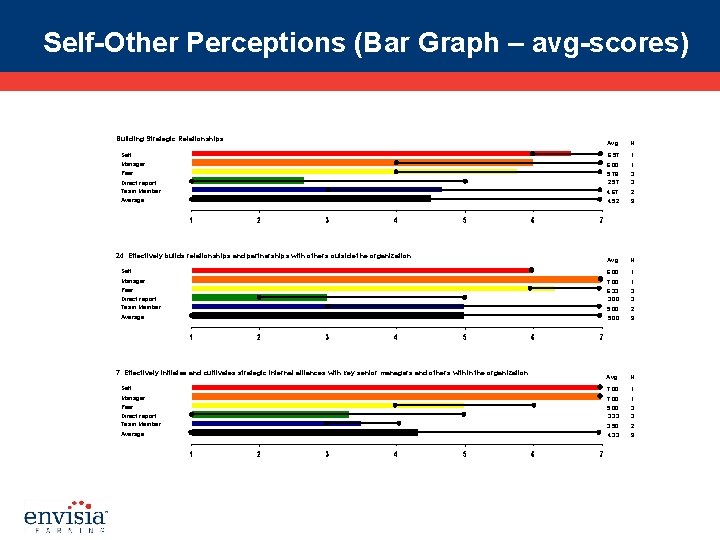
Self-Other Perceptions (Bar Graph – avg-scores) Building Strategic Relationships Avg N Self 6. 57 1 Manager Peer 6. 00 5. 78 2. 57 1 3 3 4. 67 4. 52 2 9 Direct report Team Member Average 24. Effectively builds relationships and partnerships with others outside the organization Avg N Self 6. 00 1 Manager Peer 7. 00 6. 33 3. 00 1 3 3 5. 00 2 9 Direct report Team Member Average 7. Effectively initiates and cultivates strategic internal alliances with key senior managers and others within the organization Avg N Self 7. 00 1 Manager Peer 7. 00 5. 00 3. 33 1 3 3 3. 50 4. 33 2 9 Direct report Team Member Average
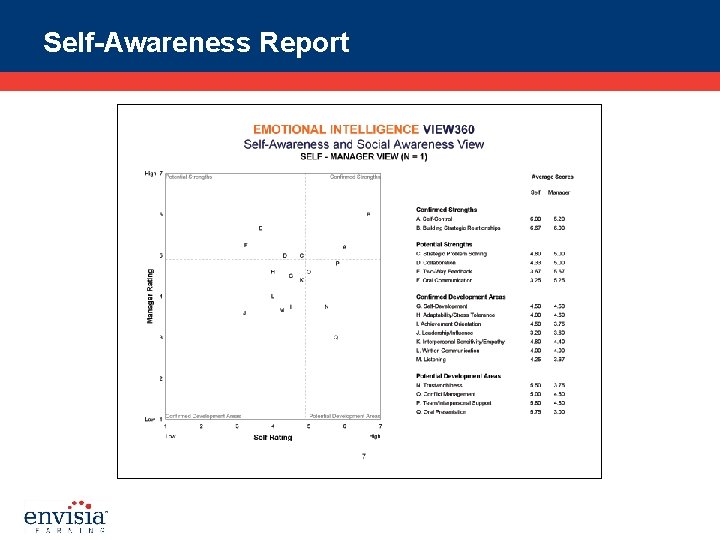
Self-Awareness Report
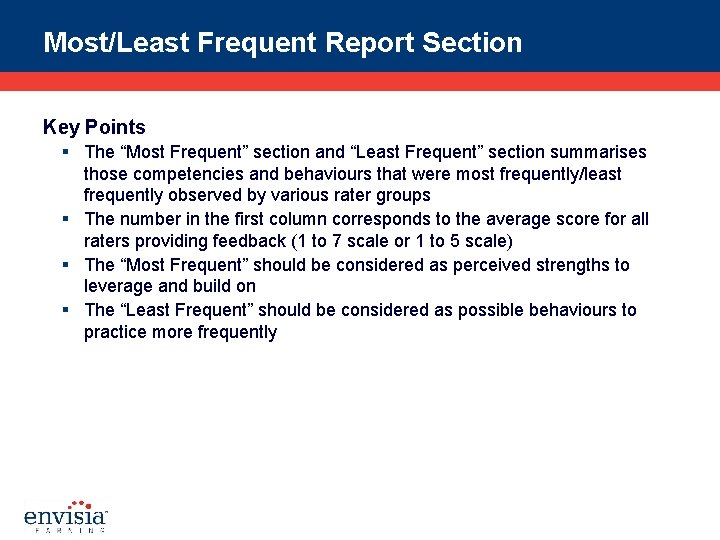
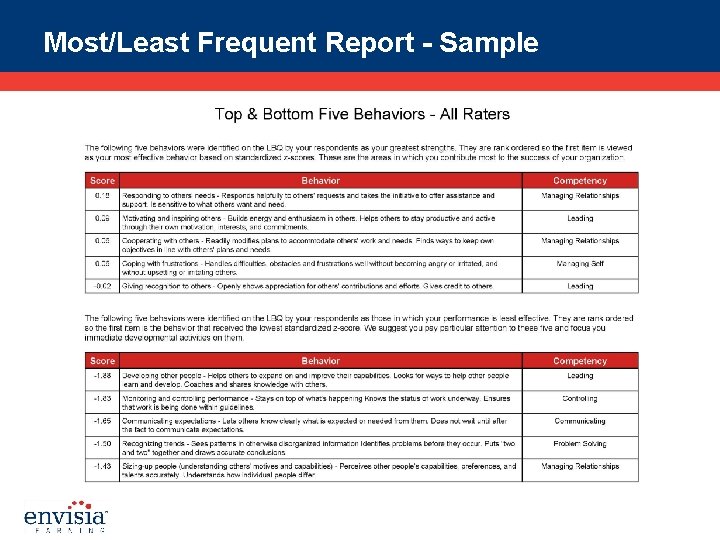
Most/Least Frequent Report Section Key Points § The “Most Frequent” section and “Least Frequent” section summarises those competencies and behaviours that were most frequently/least frequently observed by various rater groups § The number in the first column corresponds to the average score for all raters providing feedback (1 to 7 scale or 1 to 5 scale) § The “Most Frequent” should be considered as perceived strengths to leverage and build on § The “Least Frequent” should be considered as possible behaviours to practice more frequently
Most/Least Frequent Report - Sample
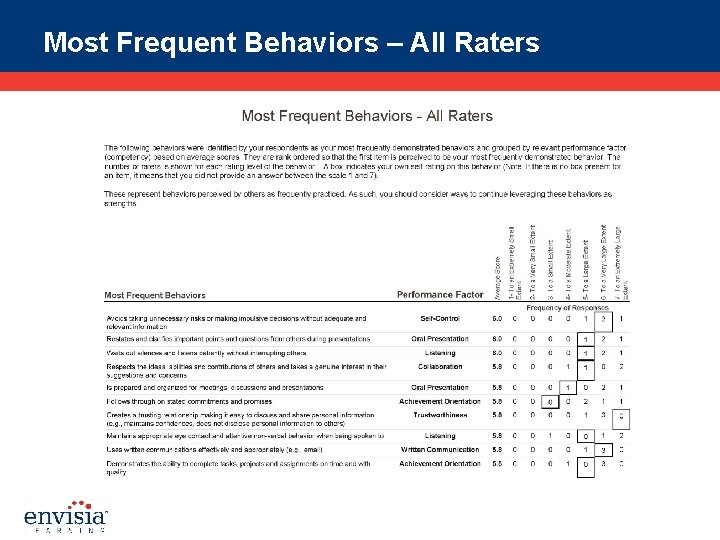
Most Frequent Behaviors – All Raters
Item Behavior Report Key Points § Each question is summarized and categorised in its appropriate competency § Average scores across all raters are reported for each competency and question § A statistical measure of rater agreement based on the standard deviation is reported as a percentage - a score less than 50% suggests that the raters providing feedback had enough disagreement to warrant a cautious interpretation of the average score reported (e. g. , raters had diverse perceptions and rated the participant quite differently on that question or competency) § An overall average of all raters is calculated in the last column
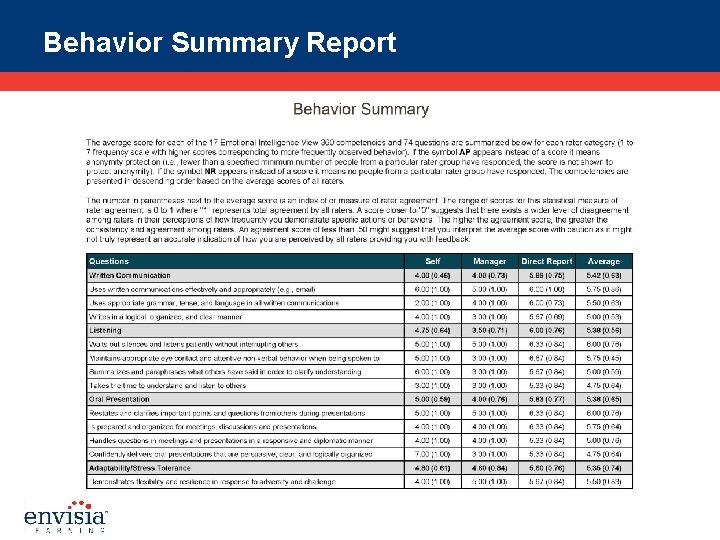
Behavior Summary Report
Written Comments Section Key Points § Comments are randomly listed by all raters who volunteered to share written perceptions § Comments are provided verbatim from the online questionnaire - no editing § Some comments are specific, behavioural and constructive - others may be less useful or hard to understand § It is important to focus on themes that emerge, rather than, to dwell on any one individual comment

Sample – Comments Section
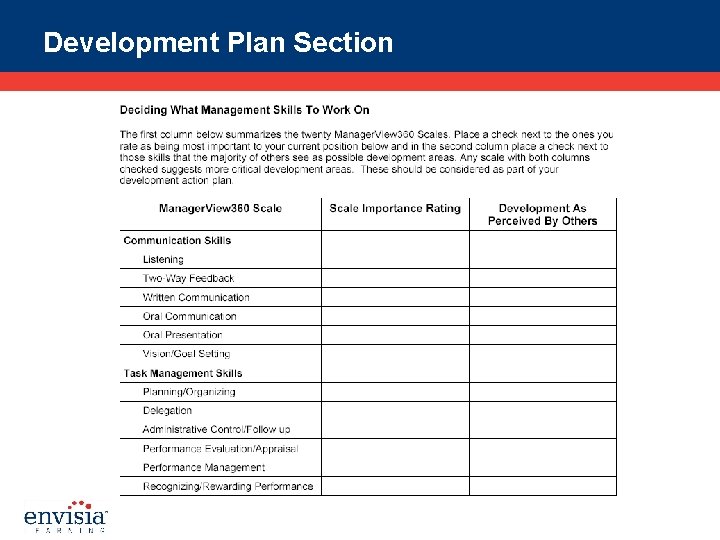
Development Plan Section Key Points § The View. Suite 360 tools provide developmental planning worksheets to summarize strengths and development areas to initiate a development plan § Participants should be encouraged to complete these pages and commit to enhancing at least one strength and focusing on one developmental area as a result of this 360 degree feedback process § Research suggests that when these developmental plans are based on SMART objectives (specific, measurable, achievable, realistic, time based) and in writing they are more likely to achieve desired results
Development Plan Section
“Our life transformation is in exact proportion to the amount of truth we can take without running away. ” -Vernon Howard
Description of the Talent Accelerator § The Talent Accelerator is a web-based professional development tool to help you understand your online assessments and assist you in implementing a plan for your professional development § The Talent Accelerator will provide you with a guided process for developmental planning based on “Best Practices” of how people change § The online tool is designed to help translate awareness from all of our assessments into lasting behavior change
Components of the Talent Accelerator § Development Resource Library: The Talent Accelerator resource library provides a comprehensive source of readings, websites, media, and suggestions to facilitate your development. § Feedback Reports: The Talent Accelerator provides you with an electronic copy of your assessment summary report. § Development Suggestions: For each assessment tool, specific developmental suggestions or tips are provided for you to try on the job to enhance your effectiveness § Development Planning “Wizard”: Our development “wizard” will walk you through your assessment report and provide a structured way to allowing you to focus on those behaviors that are most important § Automated Reminders: Talent Accelerator allows you to set select how often you want the system to send you reminders about due dates on your development plan (Preference Tab)
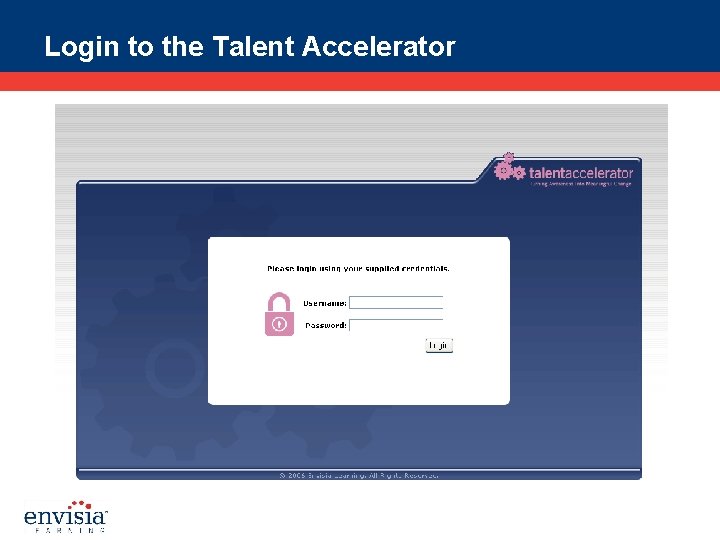
Login to the Talent Accelerator
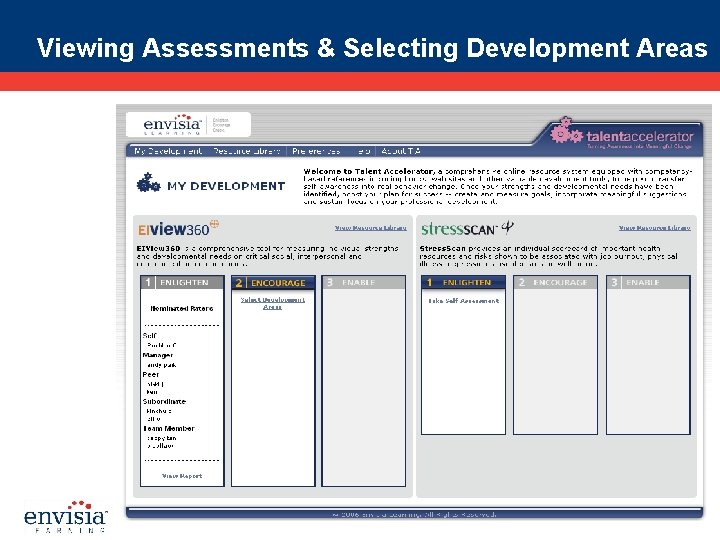
Viewing Assessments & Selecting Development Areas
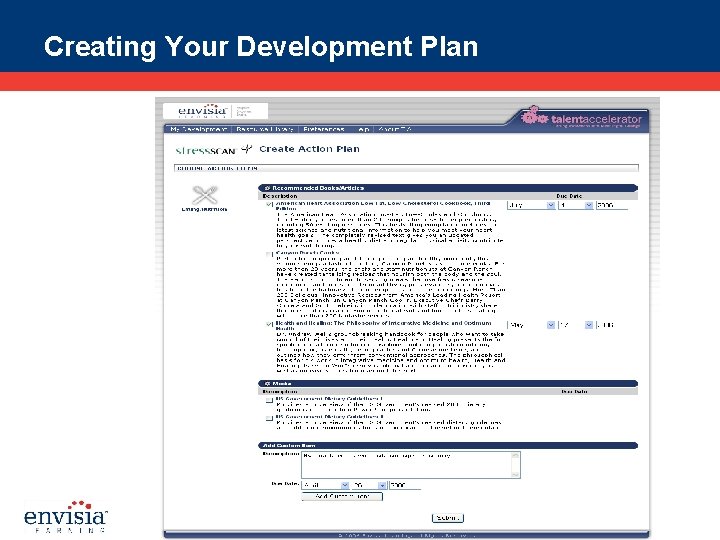
Creating Your Development Plan
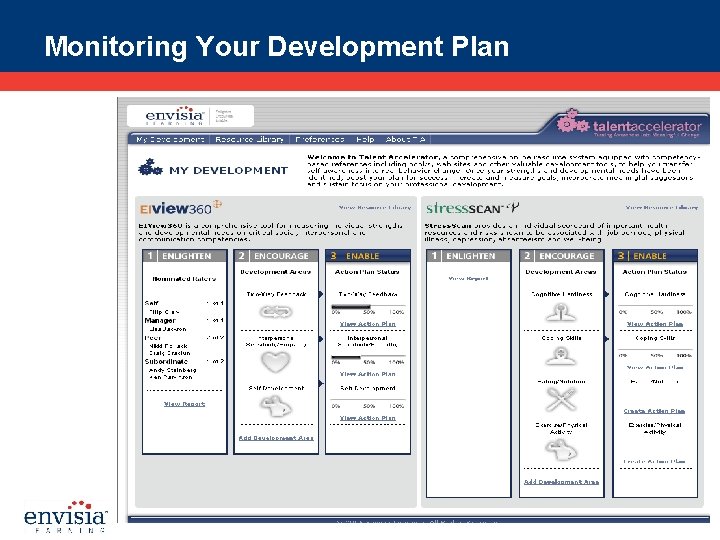
Monitoring Your Development Plan
Feedback Report Questions to Consider § Do I understand my View. Suite 360 summary feedback report? § Does it seem accurate/valid? § Is the feedback similar or different for the different rater groups? § What are my perceived strengths to leverage for future success? § Are the areas perceived by others for development relevant to my current or future position? § Am I motivated to change?
Next Steps for Participants Using Our Products 1. Review your summary feedback report 2. Thank those who have provided you with feedback 3. Obtain additional feedback from your manager, direct reports, peers and team members 4. Identify specific developmental goals 5. Draft a development plan 6. Meet with your manager to finalise your plan 7. Implement your development plan 8. Track and monitor progress 9. Re-assess View. Suite 360 tools in 10 -12 months
About Our Co-Founder… Dr. Kenneth M. Nowack is a licensed psychologist and Chief Research Officer of Envisia Learning. He has over twenty years of experience as an executive coach and in the development and validation of assessment instruments, organizational climate surveys, questionnaires, simulations, and tests. He received his B. S. and M. S. degrees in Educational Psychology at the University of California, Davis, and his Ph. D. in Counseling Psychology from the University of California, Los Angeles. Dr. Nowack has conducted research and published extensively in the areas of behavioral medicine, 360 -degree feedback, executive coaching, assessment centers, training needs assessment, and evaluation. Dr. Nowack is a member in Daniel Goleman's Consortium for Research on Emotional Intelligence in Organizations: http: //www. eiconsortium. org/membership_consortium. htm
Selected References § § § § Nowack, K. (2005). Longitudinal evaluation of a 360 degree feedback program: Implications for best practices. Paper presented at the 20 th Annual Conference of the Society for Industrial and Organizational Psychology, Los Angeles, March 2005 Nowack, K. , (2002). Does 360 degree feedback negatively effect company performance: Feedback varies with your point of view. HR Magazine, Volume 47 (6), June 2002. Work. Training Magazine Nowack, K. and Heller, B. (December, 2001). Making Executive Coaching Work. Training Magazine www. trainingmag. com Nowack, K. , Hartley, J. & Bradley, W. (1999). Evaluating results of your 360 -degree feedback intervention. Training and Development, 53, 48 -53. Nowack, K. (1999). 360 -Degree feedback. In DG Langdon, KS Whiteside, & MM Mc. Kenna (Eds. ), Intervention: 50 Performance Technology Tools, San Francisco, Jossey-Bass, Inc. , pp. 34 -46. Wimer, S. and Nowack, K. (1998). How to benefit from 360 -degree feedback. Executive Excellence, Volume 15, No. 10, 16. Wimer, S. and Nowack, K. (1988). Thirteen common mistakes in implementing multirater feedback systems. Training and Development, 52, 69 -80.
Selected References (Continued) § § § Nowack, K. M. (1997). Self-ratings as a predictor of assessment center performance. Journal of Social Behavior and Personality, 12 (5), 145 -166. Nowack, K. (1997). Manager View/360. In Fleenor, J. & Leslie, J. (Eds. ). Feedback to managers: A review and comparison of sixteen multi-rater feedback instruments (3 rd edition). Center for Creative Leadership, Greensboro, NC. Nowack, K. and Wimer, S. (1997). Coaching for human performance. Training and Development. Volume 51, No. 10, 28 -32. Nowack, K. (1994). The secrets of succession: Focusing on development in succession planning systems. Training & Development Journal, 48, 49 -54. Nowack, K. (1992). Self-assessment and rater-assessment as a dimension of management development. Human Resources Development Quarterly, 3, 141 -155. Nowack, K. (1993). 360 -Degree feedback: It takes two to know one. Training & Development Journal, 47, 69 -72.
Further Information Please visit our website at … www. envisialearning. com
- Slides: 73