
Environmentally Friendly Linkage System is Showcase among Engineering


- Slides: 17
Environmentally Friendly Linkage System is Showcase among Engineering Projects in Kai Tak Development
Outline • 1) Objective • 2) Introduction • 3) Methodology • 4) Findings & discussion • 5) Conclusion • 6) Limitations
Objective Critically review and explore the engineering projects in KTD to select a truly excellent project as showcase in order to promote awareness and enhance presence of the engineering industry
Introduction • Kai Tak Development (KTD) is a huge and highly complex development project spanning a total planning area of over 320 hectares covering the exairport site together with the adjoining hinterland districts of Kowloon City, Wong Tai Sin and Kwun Tong • In accordance with approved Environmental Impact Assessment and Environmental Management & Audit (EM&A), Environmental Team (ET) and Independent Environmental Checker (IEC) are required to undertake the overall EM&A and environmental issues for KTD as a whole
Introduction • To ensure ET carries out their duties e. g. certifying contractors environmental works with due care, IEC is in place to review and audit the works completed by the ET • Ka Shing Management Consultant Limited is commissioned by client to undertake an assignment (Kai Tak Development – Independent Environmental Checker for Environmental Monitoring & Audit Work)
Methodology • Desktop research is adopted for this study • Collecting existent relevant and related information adopt for this research study • Efforts have been made to ensure that the collections are based on the best available and impartial information among KTD engineering projects • Data and information are collected via 3 steps
Methodology 1) Selection Criteria • According to judging criteria of the Association of Consulting Engineers of Hong Kong, engineering characteristics of the project are: • Engineering Excellence • Innovation • Creativity sustainability 2) Language • Language in information are English only
Methodology 3) Projects Selection • Selects projects in KTD only Content analysis is adopted for analytical tool • Content analysis is one of research techniques for the objective, systematic and quantitative description of manifest content of communication
Methodology • Objectivity requires that analysis is based on explicitly formulated rules which allow two or more researchers to obtain the same results from the same data • A systematic analysis requested that inclusion or exclusion of categories is done according to consistently applied rules in order to avoid biasing the results
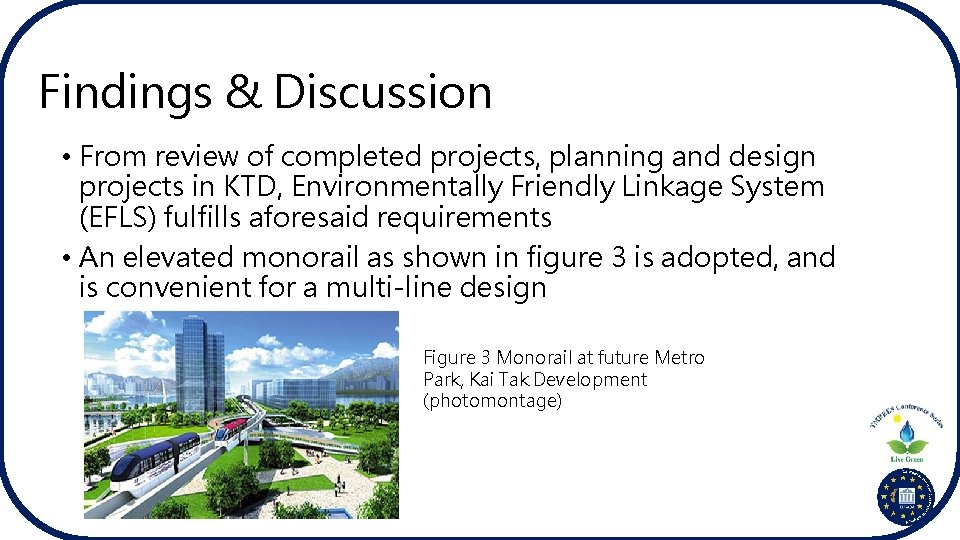
Findings & Discussion • From review of completed projects, planning and design projects in KTD, Environmentally Friendly Linkage System (EFLS) fulfills aforesaid requirements • An elevated monorail as shown in figure 3 is adopted, and is convenient for a multi-line design Figure 3 Monorail at future Metro Park, Kai Tak Development (photomontage)
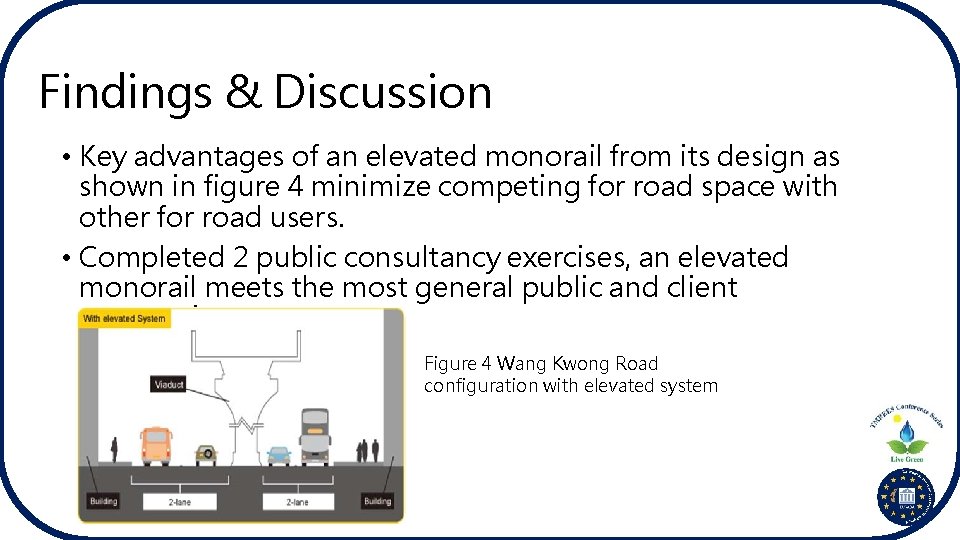
Findings & Discussion • Key advantages of an elevated monorail from its design as shown in figure 4 minimize competing for road space with other for road users. • Completed 2 public consultancy exercises, an elevated monorail meets the most general public and client expectations Figure 4 Wang Kwong Road configuration with elevated system
Findings & Discussion • Considering innovation and creativity, EFLS is application of new and improved technologies where will lead greater efficiency and economy • The financial and economic returns of the proposed EFLS would not be satisfactory if treated solely as transport infrastructure • Financial performance and economic return for the EFLS is conservative and does not take into account additional journeys generated by a revitalized Kowloon East with many diverse new attractions and activities
Findings & Discussion • Monorail, is green public transport, operates on an elevated dedicated corridor under a fully automated system from a sustainability angle and is not affected by road traffic, offering a reliable and on-time service • Monorail is commonly adopted as daily public transport system in many cities. Through saving passengers’ travelling time and attracting more passengers, despite its high estimated construction cost, the system can still bring positive benefit to society e. g. carbon reduction, efficiency and etc
Conclusion • Relationship between engineering projects and environmental protection in KTD is drawn as a direction for this study • The methodology in selection criteria for sources collections are English only and cover relevant documents review • Analytical tool is content analysis. Findings in relation to objective of this study stated in introduction are concluded
Conclusion • A key strength of this study is its systematic nature, drawing on a wide range of sources and documents, and using consistent methods for data extraction and synthesis • A variety of approaches are utilised to present the findings according to systematic review standards
Limitations • Most of information bases on observations and secondary data • One methodological limitation is that all selected sources in English, and therefore relevant literature published in other languages, in particular Spanish and Chinese, could have been inevitably missed • Future studies should consider that by further using quantitative data collections and analysis methods will be more comprehensive to study the overall situation
Thank You