
Environmental Toolbox Technical Module Spill Prevention and Response
Environmental Toolbox
Technical Module Spill Prevention and Response Planning

Objectives • Understand the importance for spill prevention and response planning • Know the key steps in spill prevention and response planning • Be familiar with common spill countermeasures • Know the training and equipment requirements • Be familiar with basic spill response procedures for minor and major spills 3
What is a Hazardous Material (HM) Spill? • A release of a HM into the air, soil, and/or water • Usually accidental • Can pose a hazard to human health, property, or the environment • In base camp operations, most spills involve petroleum, oil and lubricant (POL) products 4
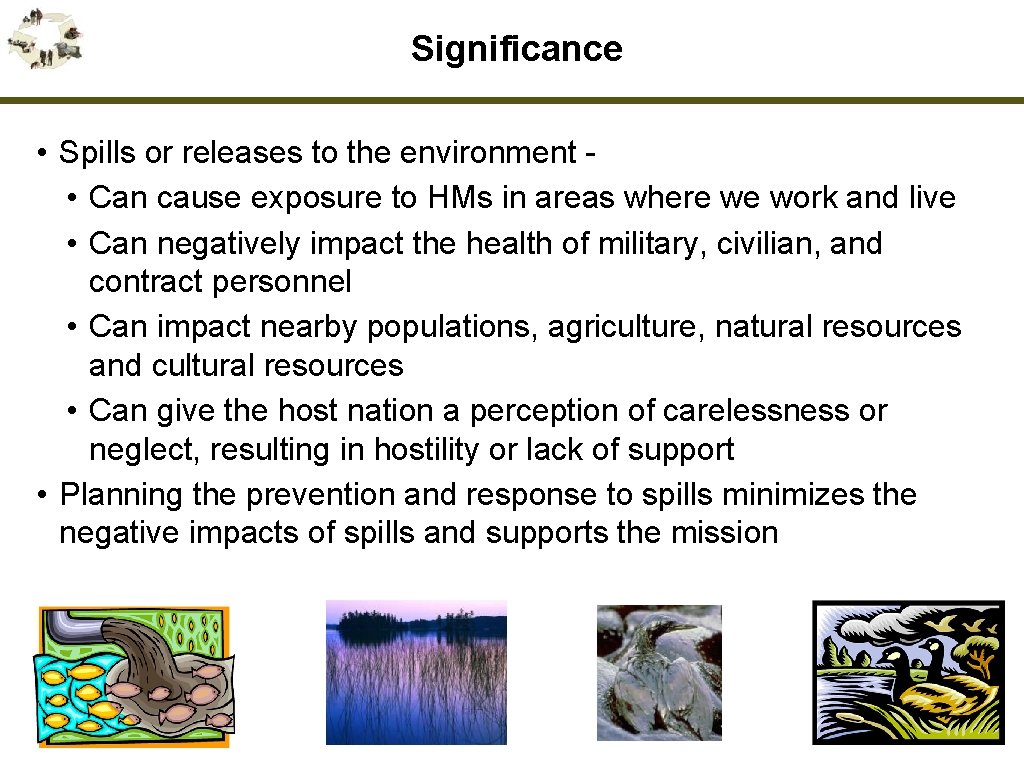
Significance • Spills or releases to the environment • Can cause exposure to HMs in areas where we work and live • Can negatively impact the health of military, civilian, and contract personnel • Can impact nearby populations, agriculture, natural resources and cultural resources • Can give the host nation a perception of carelessness or neglect, resulting in hostility or lack of support • Planning the prevention and response to spills minimizes the negative impacts of spills and supports the mission 5
Environmental Officer (EO) Responsibilities during Pre-Deployment/Planning • Research whethere are spill response capabilities currently available in the host nation • Research whether local industries might have spills that could impact the base camp • Research where there are vulnerable populations or areas • Ensure spill response equipment and personal protective equipment (PPE) is included in load plan • Ensure personnel training and/or certification is current 6
EO Responsibilities during Deployment • Coordinate development of spill prevention and response plan with responsible parties in the command • Work with the command to budget for countermeasure equipment, PPE, response equipment, and disposal costs • Ensure PPE is available and suitable for the types of spills that might occur • Ensure personnel are trained by conducting periodic drills • Act as a member of the spill response team as described in plan • Ensure spill residues are properly packaged, labeled, and disposed • Ensure each spill and associated response is well-documented to include disposal method and after-action reports (record keeping) • Include spill information on Environmental Conditions Reports 7 (ECR)
EO Responsibilities during Transfer/Closure • Ensure corrective actions were documented • Ensure spill records are transferred to new unit, organization, or host nation 8
EO Responsibilities during Re-Deployment/Lessons Learned • Document lessons learned, trends, and corrective actions • Provide feedback to training and doctrine developers back home so that they can incorporate lessons learned 9
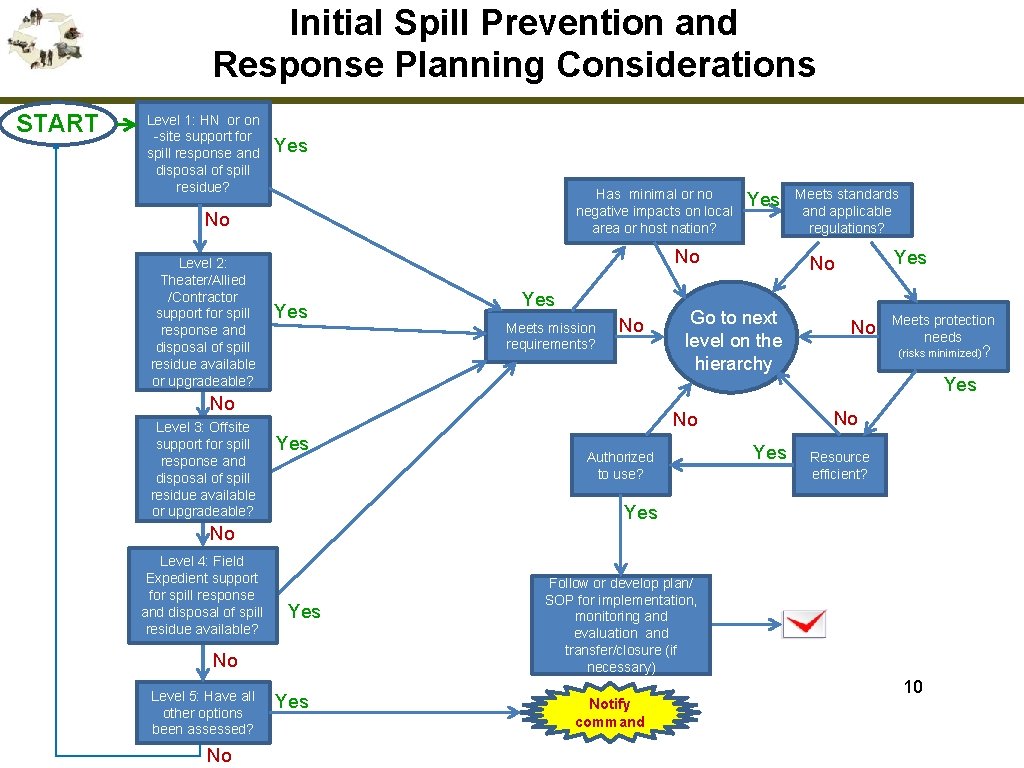
Initial Spill Prevention and Response Planning Considerations START Level 1: HN or on -site support for spill response and disposal of spill residue? Yes Has minimal or no negative impacts on local area or host nation? No Level 2: Theater/Allied /Contractor support for spill response and disposal of spill residue available or upgradeable? No Yes Meets mission requirements? No Yes No Go to next level on the hierarchy No Meets protection needs (risks minimized)? No Authorized to use? Yes Resource efficient? Yes No Level 5: No Have all other options been assessed? Yes No No No Level 4: Field Expedient support for spill response and disposal of spill residue available? Meets standards and applicable regulations? Yes No Level 3: Offsite support for spill response and disposal of spill residue available or upgradeable? Yes Follow or develop plan/ SOP for implementation, monitoring and evaluation and transfer/closure (if necessary) Notify command 10
Spill Prevention and Response Planning Coordination • Effective spill planning cannot be done by the EO alone • Spill planning requires a team effort to include But not limited to) personnel from: § Plans and Operations § Safety Office § Logistics § Public Affairs § Fire Department § Security and/or military police § Medical/Preventive Medicine 11 § Engineer/Heavy equipment operations
Steps to Spill Prevention and Response Planning • Review of existing information • Risk analysis • Assessment of preparedness, prevention, and response controls • Completion of Spill Prevention and Response Plan • Maintenance of a dynamic program 12

Review of Existing Information • Environmental Baseline Survey (EBS) and other plans • Websites • Command guidelines • Facility plans 13
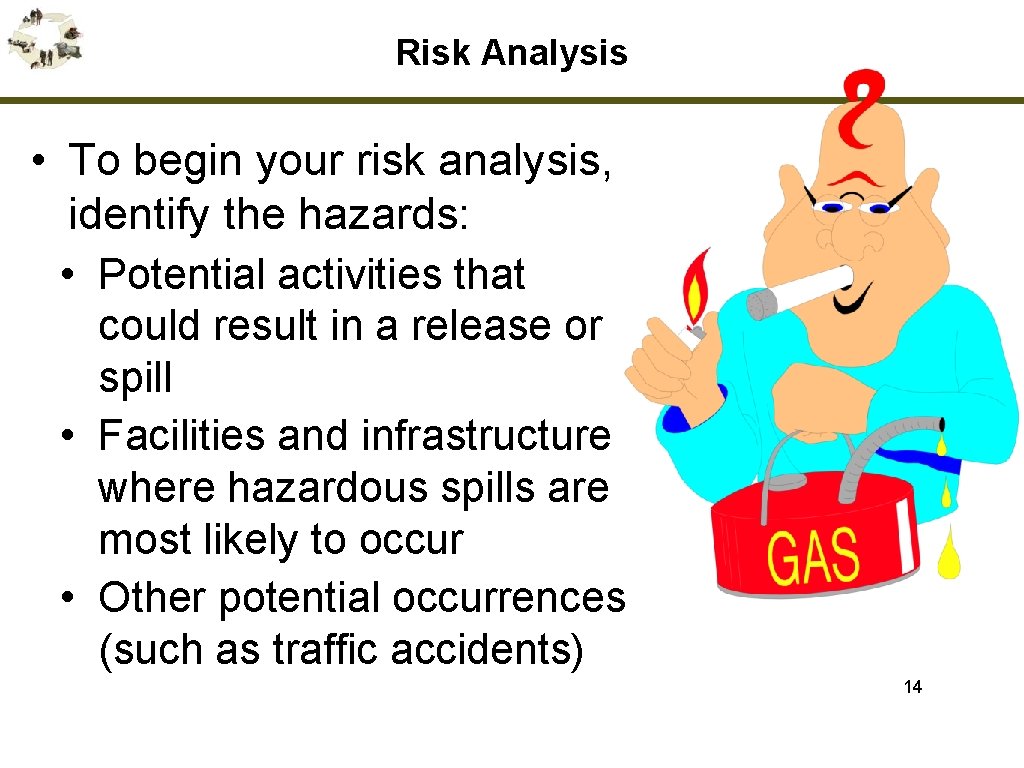
Risk Analysis • To begin your risk analysis, identify the hazards: • Potential activities that could result in a release or spill • Facilities and infrastructure where hazardous spills are most likely to occur • Other potential occurrences (such as traffic accidents) 14
Analysis of Vulnerability • Analysis of vulnerability focuses on high potential spill impacts: • To the mission • Inside and outside the base camp • Extent of area that may be impacted (via air, water, or soil) • Populations that may be affected • Property that may be damaged • Environmental resources that may be impacted 15
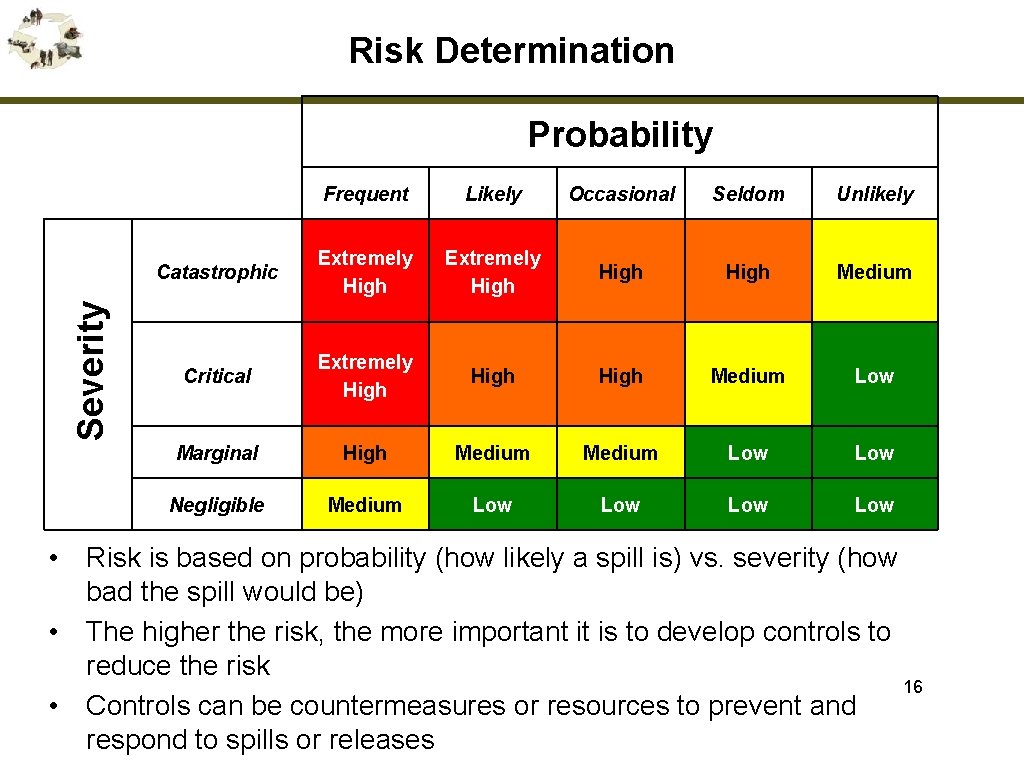
Risk Determination Severity Probability Frequent Likely Occasional Seldom Unlikely Catastrophic Extremely High Medium Critical Extremely High Medium Low Marginal High Medium Low Negligible Medium Low Low • Risk is based on probability (how likely a spill is) vs. severity (how bad the spill would be) • The higher the risk, the more important it is to develop controls to reduce the risk 16 • Controls can be countermeasures or resources to prevent and respond to spills or releases
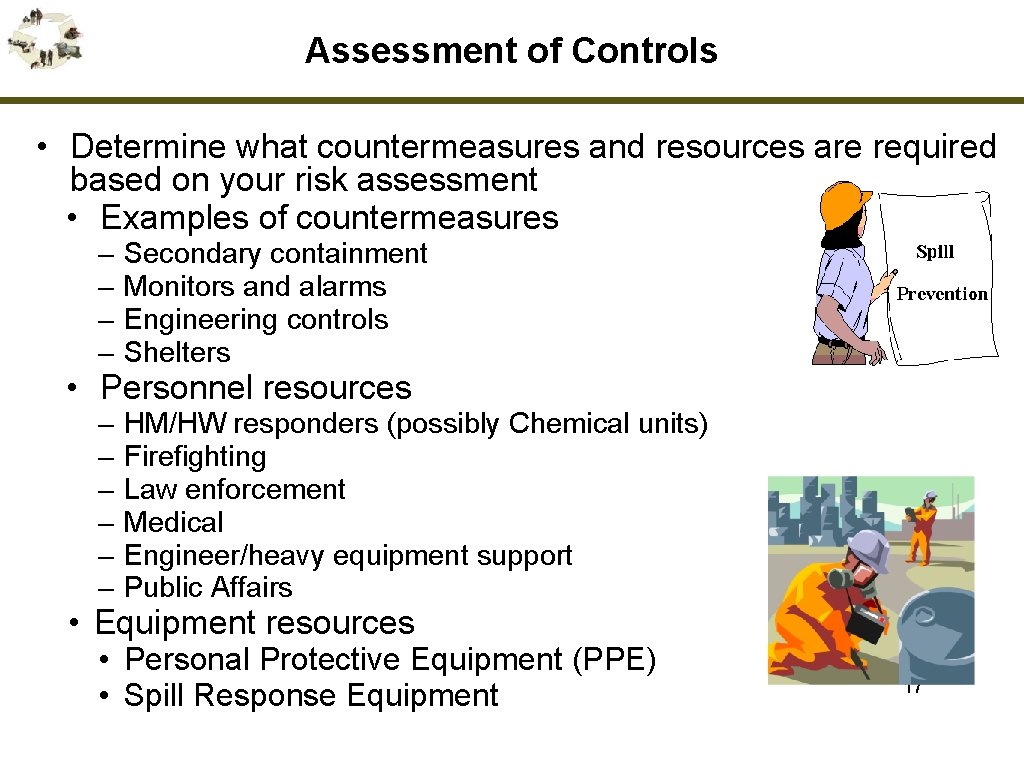
Assessment of Controls • Determine what countermeasures and resources are required based on your risk assessment • Examples of countermeasures – – Secondary containment Monitors and alarms Engineering controls Shelters • Personnel resources – – – HM/HW responders (possibly Chemical units) Firefighting Law enforcement Medical Engineer/heavy equipment support Public Affairs • Equipment resources • Personal Protective Equipment (PPE) • Spill Response Equipment 17
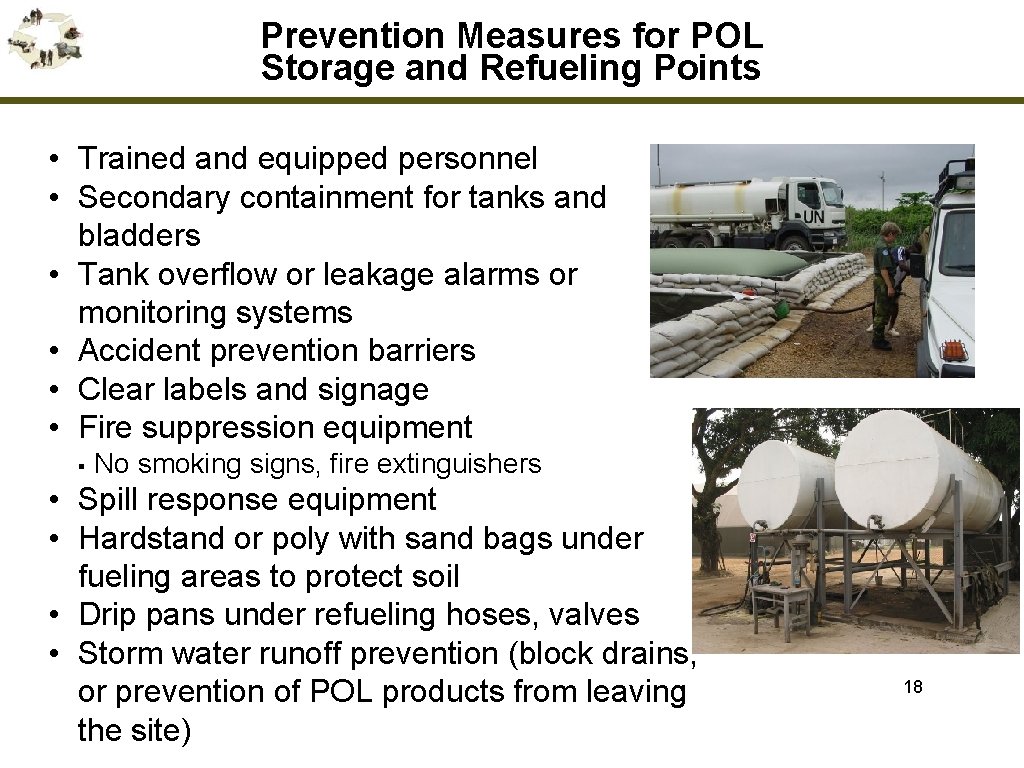
Prevention Measures for POL Storage and Refueling Points • Trained and equipped personnel • Secondary containment for tanks and bladders • Tank overflow or leakage alarms or monitoring systems • Accident prevention barriers • Clear labels and signage • Fire suppression equipment § No smoking signs, fire extinguishers • Spill response equipment • Hardstand or poly with sand bags under fueling areas to protect soil • Drip pans under refueling hoses, valves • Storm water runoff prevention (block drains, or prevention of POL products from leaving the site) 18
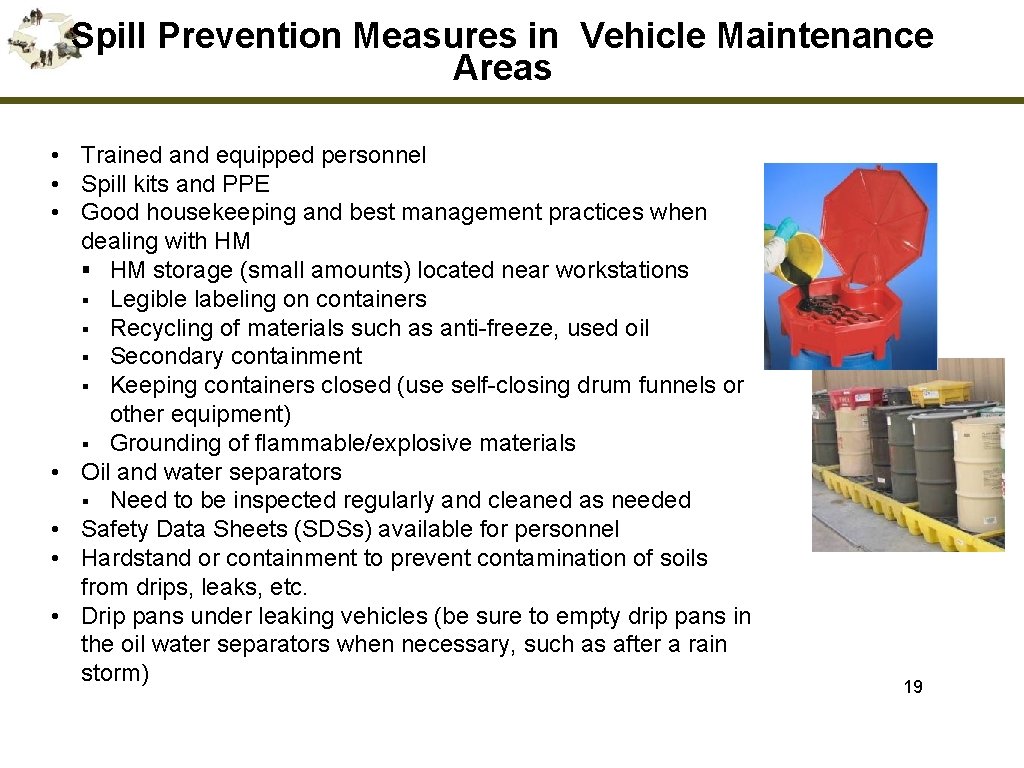
Spill Prevention Measures in Vehicle Maintenance Areas • Trained and equipped personnel • Spill kits and PPE • Good housekeeping and best management practices when dealing with HM § HM storage (small amounts) located near workstations § Legible labeling on containers § Recycling of materials such as anti-freeze, used oil § Secondary containment § Keeping containers closed (use self-closing drum funnels or other equipment) § Grounding of flammable/explosive materials • Oil and water separators § Need to be inspected regularly and cleaned as needed • Safety Data Sheets (SDSs) available for personnel • Hardstand or containment to prevent contamination of soils from drips, leaks, etc. • Drip pans under leaking vehicles (be sure to empty drip pans in the oil water separators when necessary, such as after a rain storm) 19
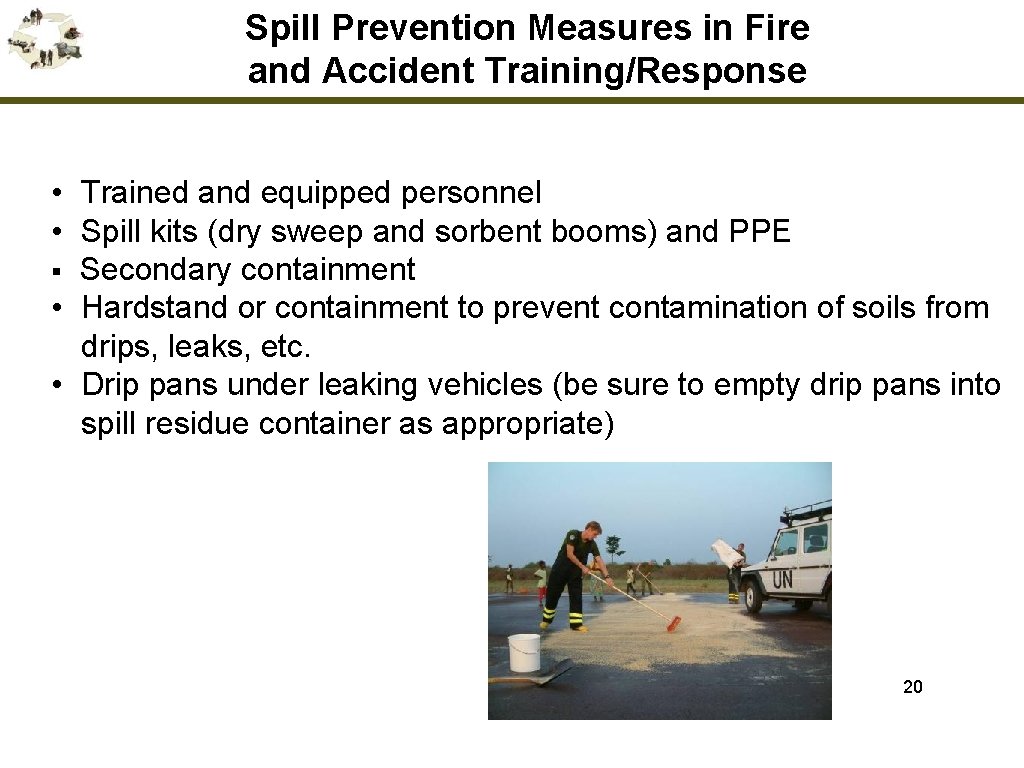
Spill Prevention Measures in Fire and Accident Training/Response • Trained and equipped personnel • Spill kits (dry sweep and sorbent booms) and PPE § Secondary containment • Hardstand or containment to prevent contamination of soils from drips, leaks, etc. • Drip pans under leaking vehicles (be sure to empty drip pans into spill residue container as appropriate) 20
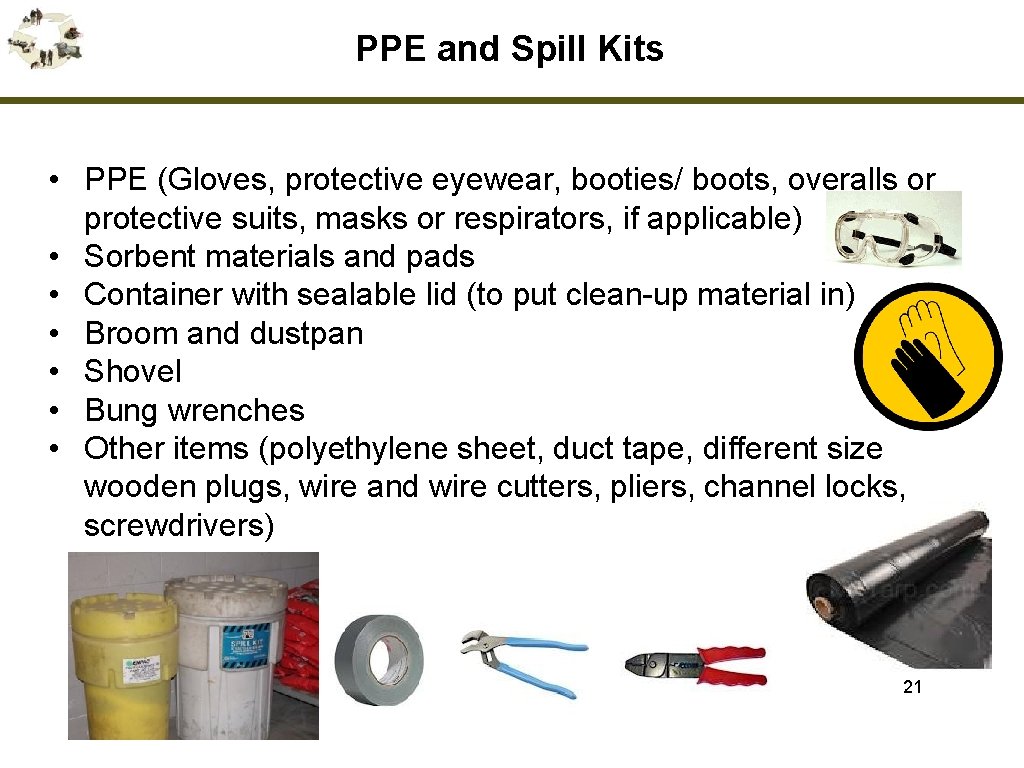
PPE and Spill Kits • PPE (Gloves, protective eyewear, booties/ boots, overalls or protective suits, masks or respirators, if applicable) • Sorbent materials and pads • Container with sealable lid (to put clean-up material in) • Broom and dustpan • Shovel • Bung wrenches • Other items (polyethylene sheet, duct tape, different size wooden plugs, wire and wire cutters, pliers, channel locks, screwdrivers) 21
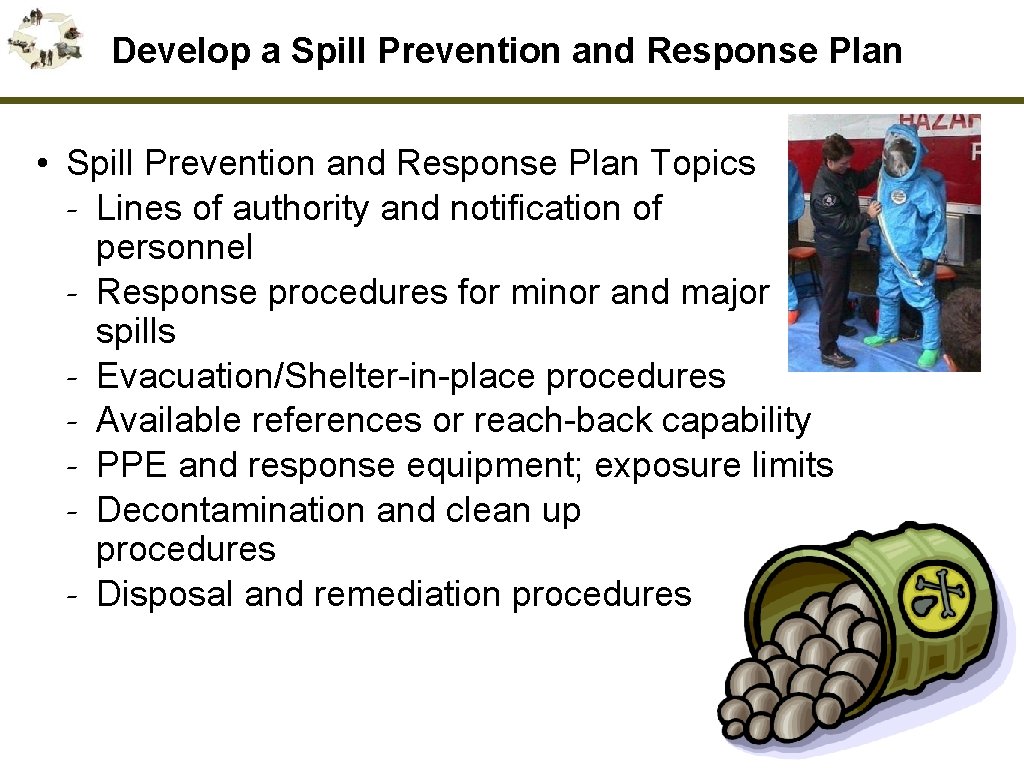
Develop a Spill Prevention and Response Plan • Spill Prevention and Response Plan Topics ‐ Lines of authority and notification of personnel ‐ Response procedures for minor and major spills ‐ Evacuation/Shelter-in-place procedures ‐ Available references or reach-back capability ‐ PPE and response equipment; exposure limits ‐ Decontamination and clean up procedures ‐ Disposal and remediation procedures 22
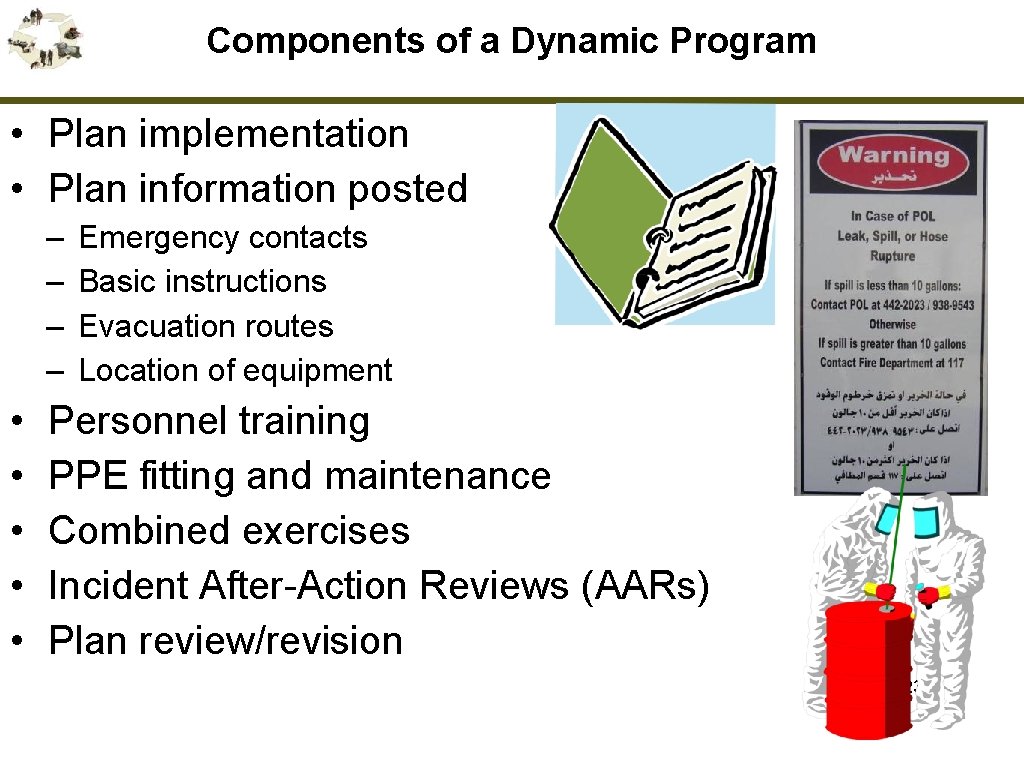
Components of a Dynamic Program • Plan implementation • Plan information posted – – • • • Emergency contacts Basic instructions Evacuation routes Location of equipment Personnel training PPE fitting and maintenance Combined exercises Incident After-Action Reviews (AARs) Plan review/revision 23
Program Recommendations • Periodically request that units submit information on their HM inventories, hazardous waste (HW) accumulation areas, and diagrams of their areas • Share new information with law enforcement, medical services, fire fighting units, and chemical units • Inspect countermeasures routinely for proper use and integrity • Practice drills (table top and live) with all involved personnel at least annually and when there are changes in personnel or base camp conditions 24
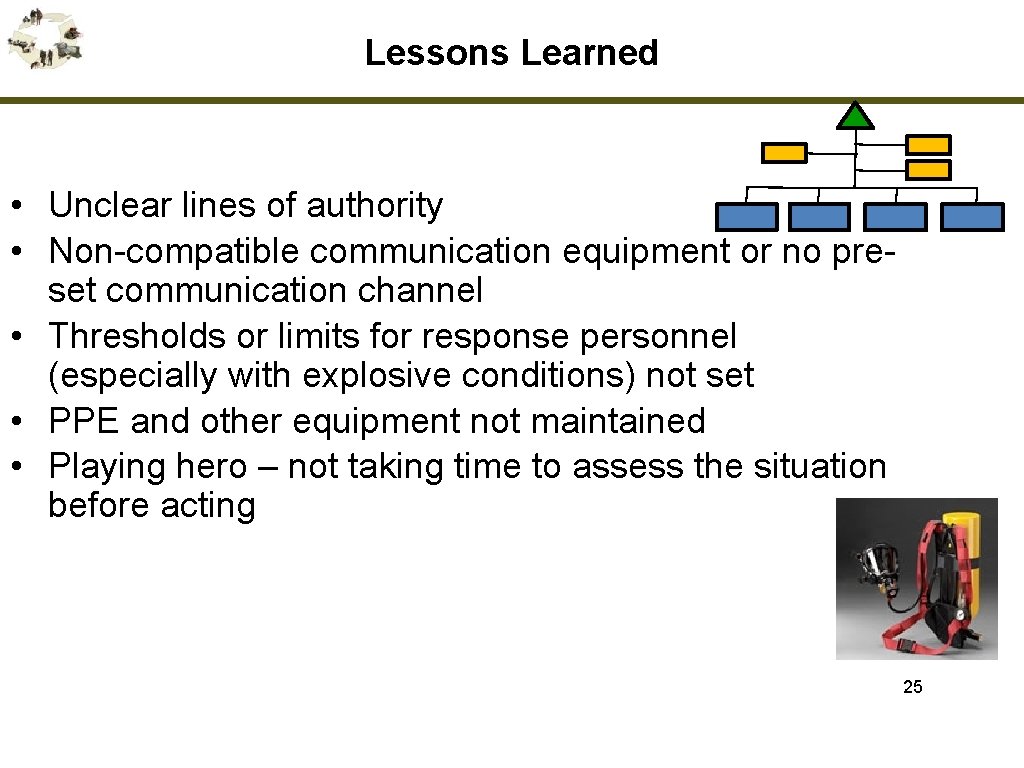
Lessons Learned • Unclear lines of authority • Non-compatible communication equipment or no preset communication channel • Thresholds or limits for response personnel (especially with explosive conditions) not set • PPE and other equipment not maintained • Playing hero – not taking time to assess the situation before acting 25
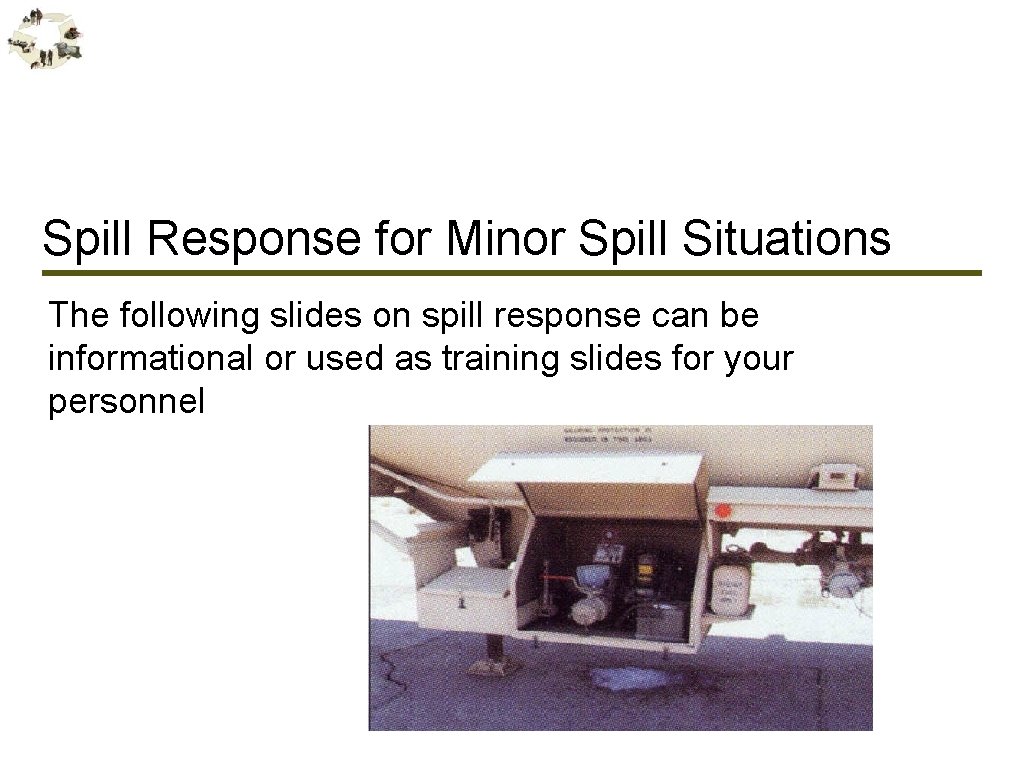
Spill Response for Minor Spill Situations The following slides on spill response can be informational or used as training slides for your personnel
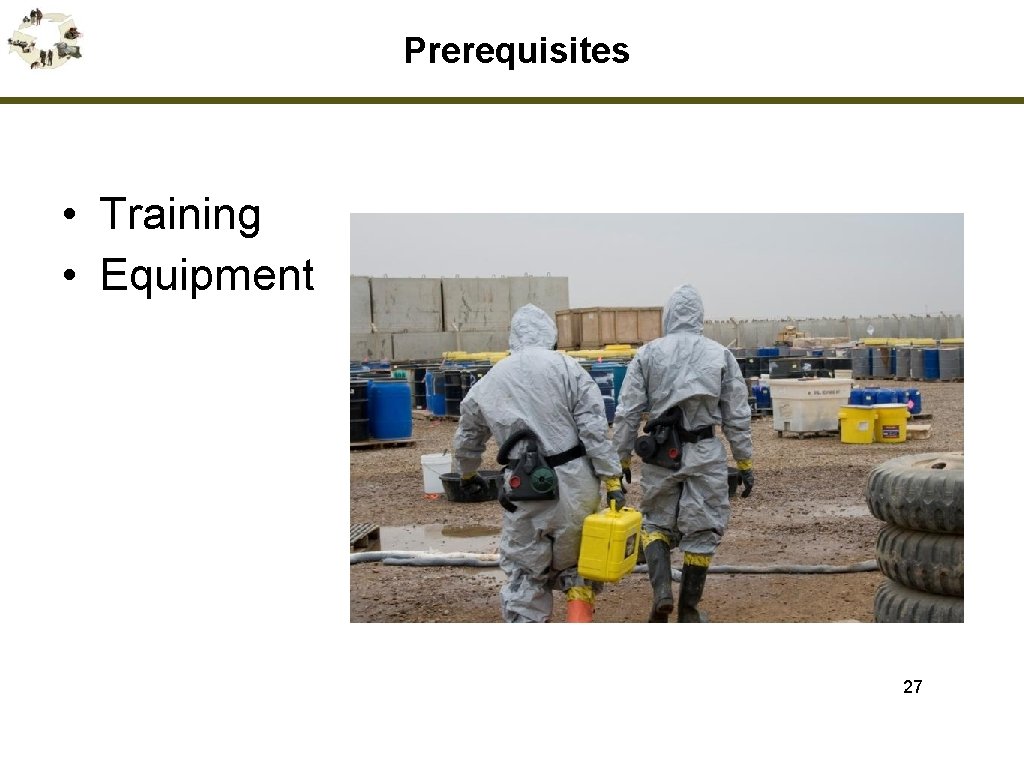
Prerequisites • Training • Equipment 27
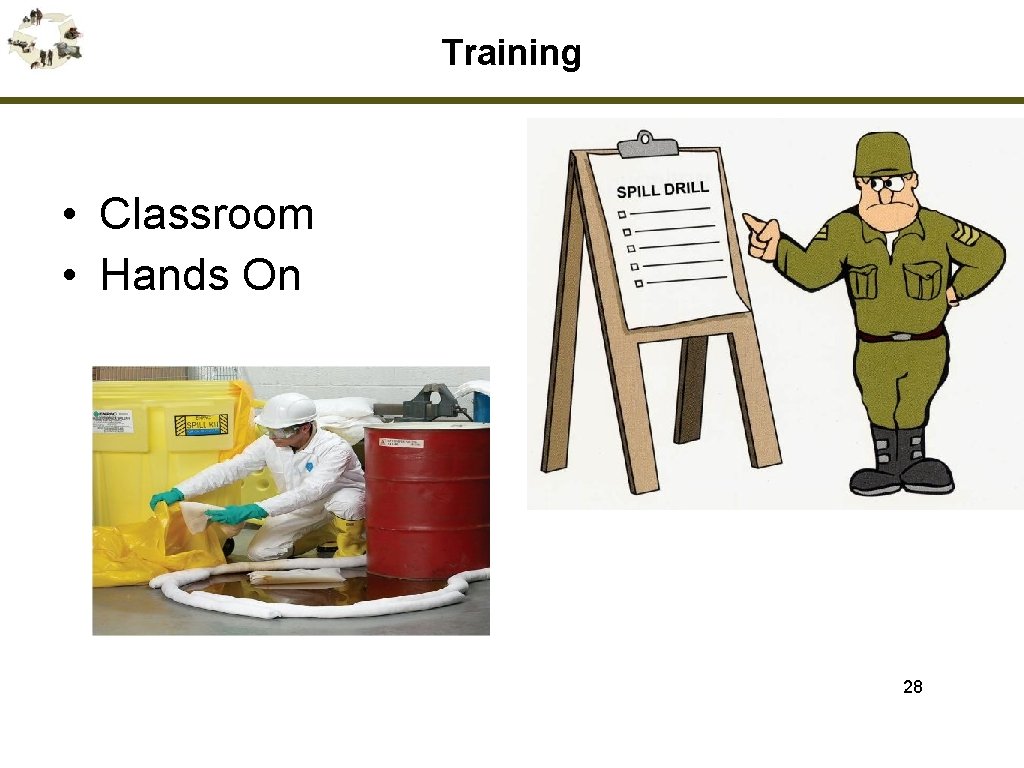
Training • Classroom • Hands On 28
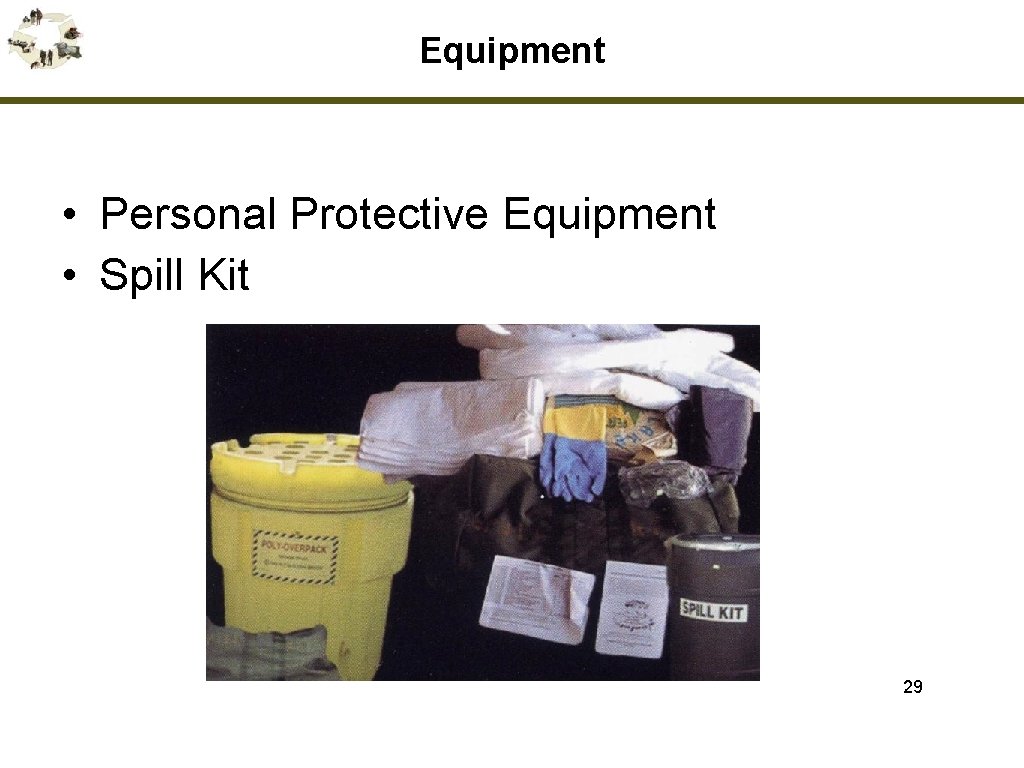
Equipment • Personal Protective Equipment • Spill Kit 29
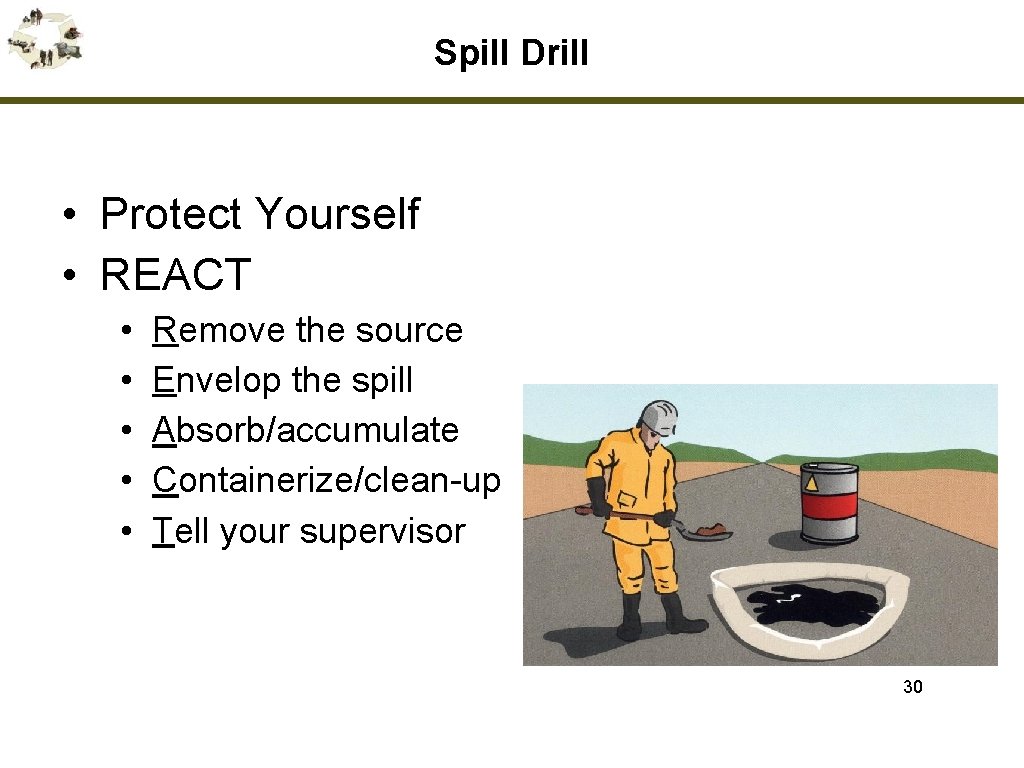
Spill Drill • Protect Yourself • REACT • • • Remove the source Envelop the spill Absorb/accumulate Containerize/clean-up Tell your supervisor 30
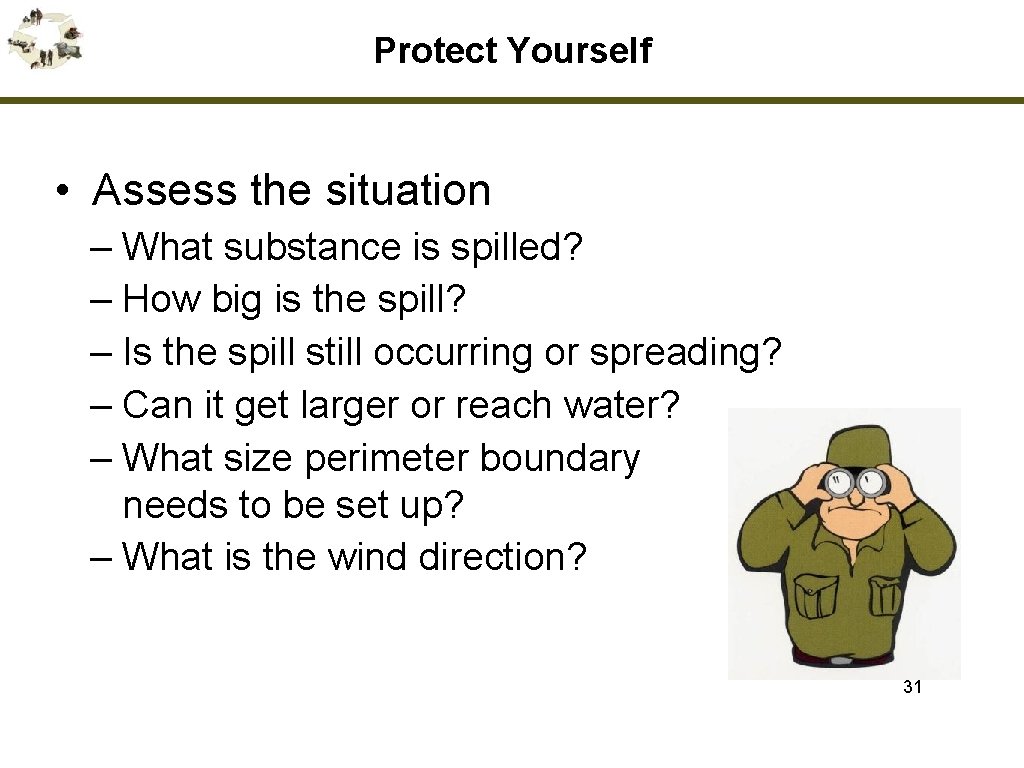
Protect Yourself • Assess the situation – What substance is spilled? – How big is the spill? – Is the spill still occurring or spreading? – Can it get larger or reach water? – What size perimeter boundary needs to be set up? – What is the wind direction? 31
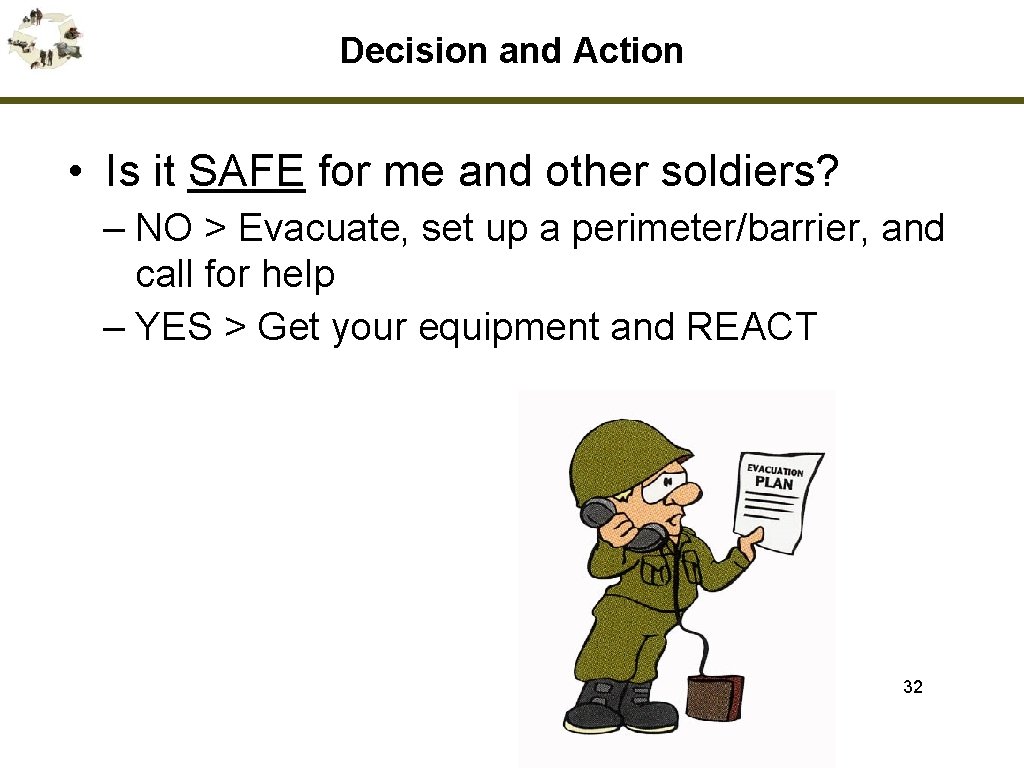
Decision and Action • Is it SAFE for me and other soldiers? – NO > Evacuate, set up a perimeter/barrier, and call for help – YES > Get your equipment and REACT 32
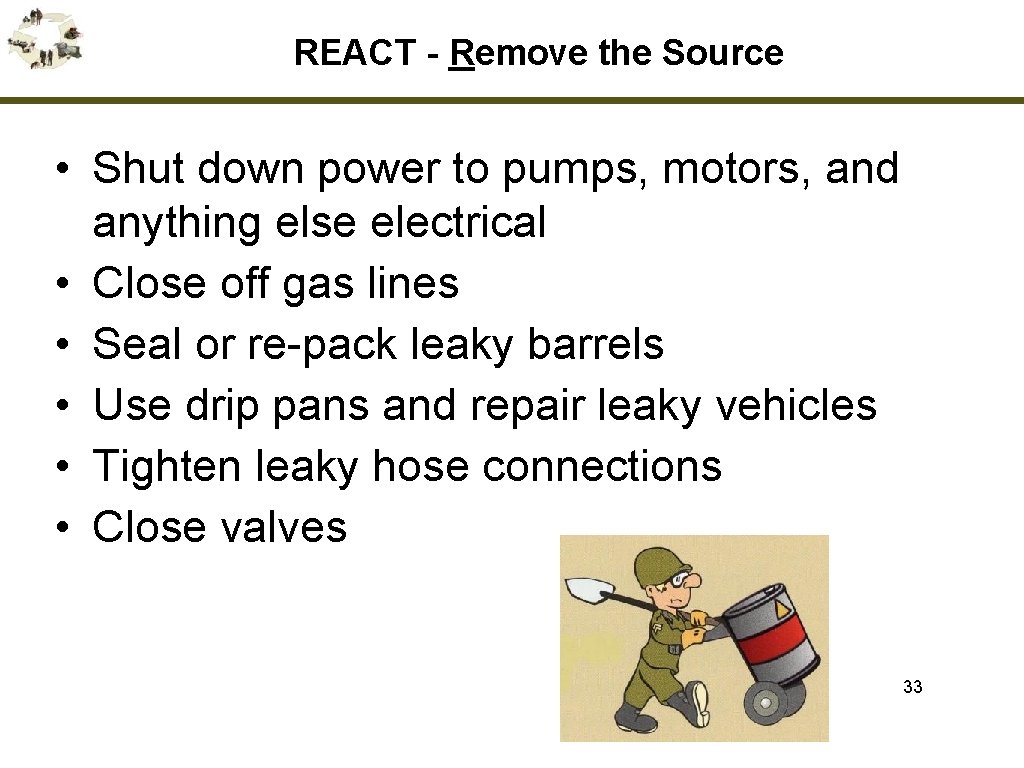
REACT - Remove the Source • Shut down power to pumps, motors, and anything else electrical • Close off gas lines • Seal or re-pack leaky barrels • Use drip pans and repair leaky vehicles • Tighten leaky hose connections • Close valves 33
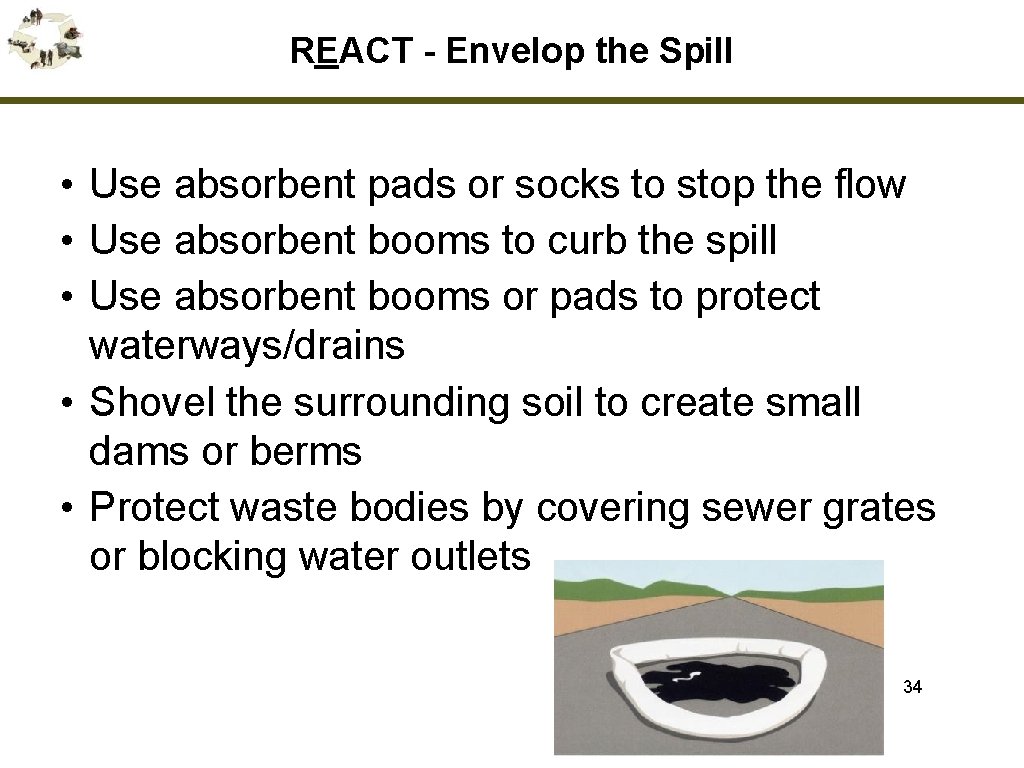
REACT - Envelop the Spill • Use absorbent pads or socks to stop the flow • Use absorbent booms to curb the spill • Use absorbent booms or pads to protect waterways/drains • Shovel the surrounding soil to create small dams or berms • Protect waste bodies by covering sewer grates or blocking water outlets 34
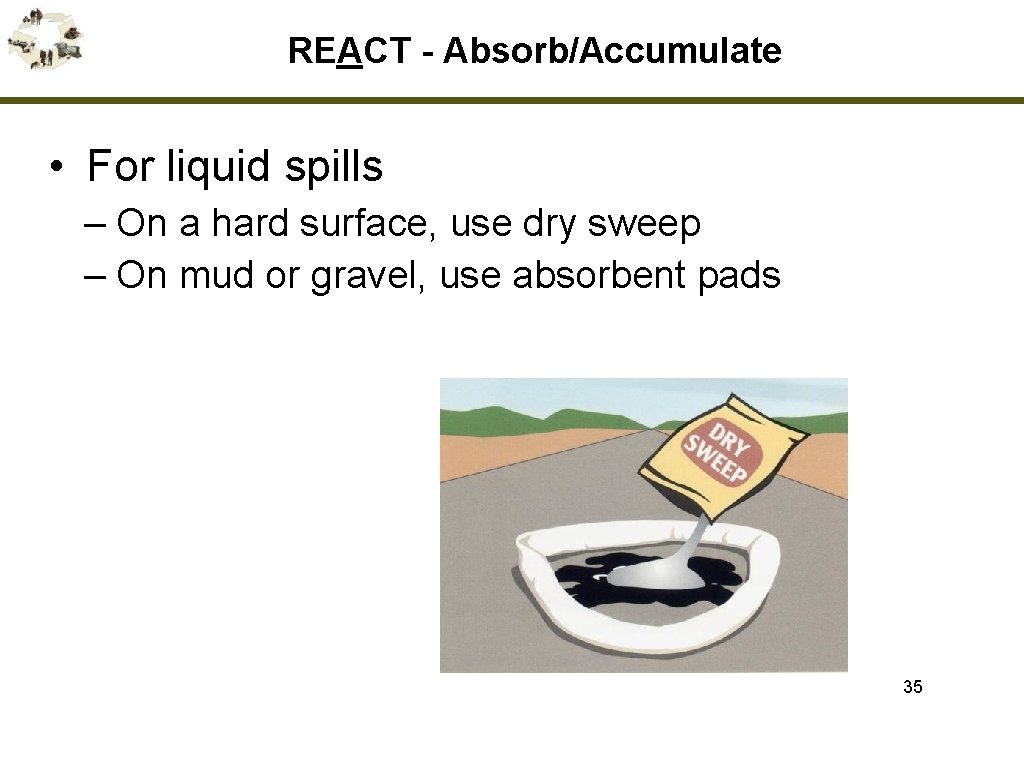
REACT - Absorb/Accumulate • For liquid spills – On a hard surface, use dry sweep – On mud or gravel, use absorbent pads 35
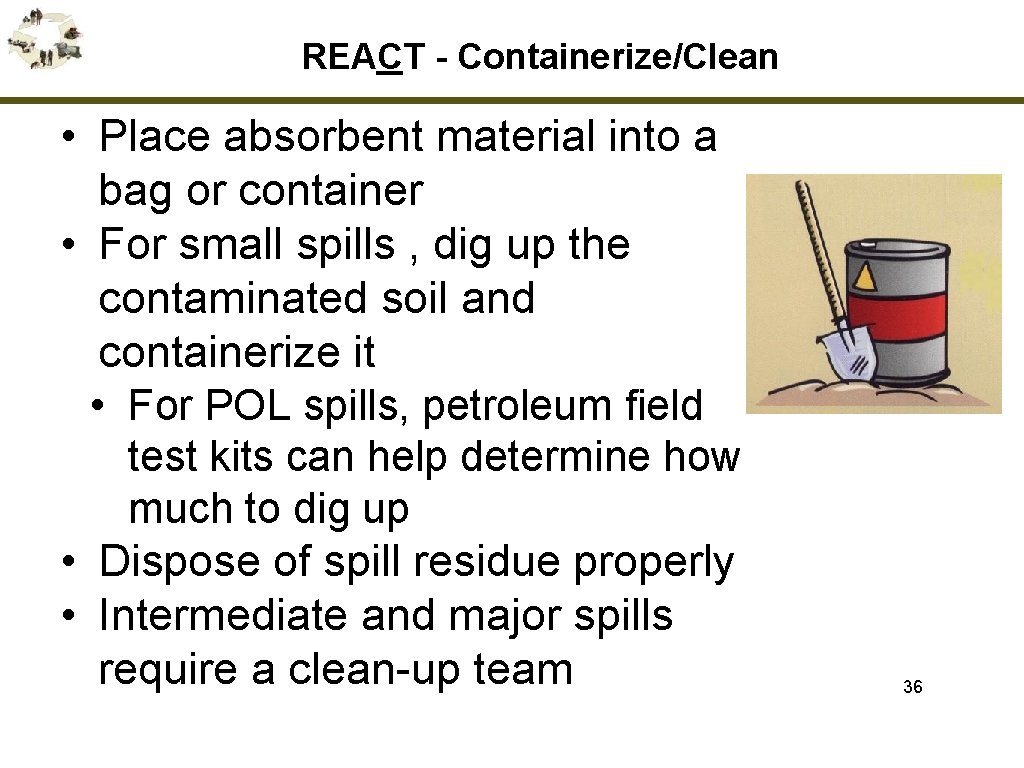
REACT - Containerize/Clean • Place absorbent material into a bag or container • For small spills , dig up the contaminated soil and containerize it • For POL spills, petroleum field test kits can help determine how much to dig up • Dispose of spill residue properly • Intermediate and major spills require a clean-up team 36
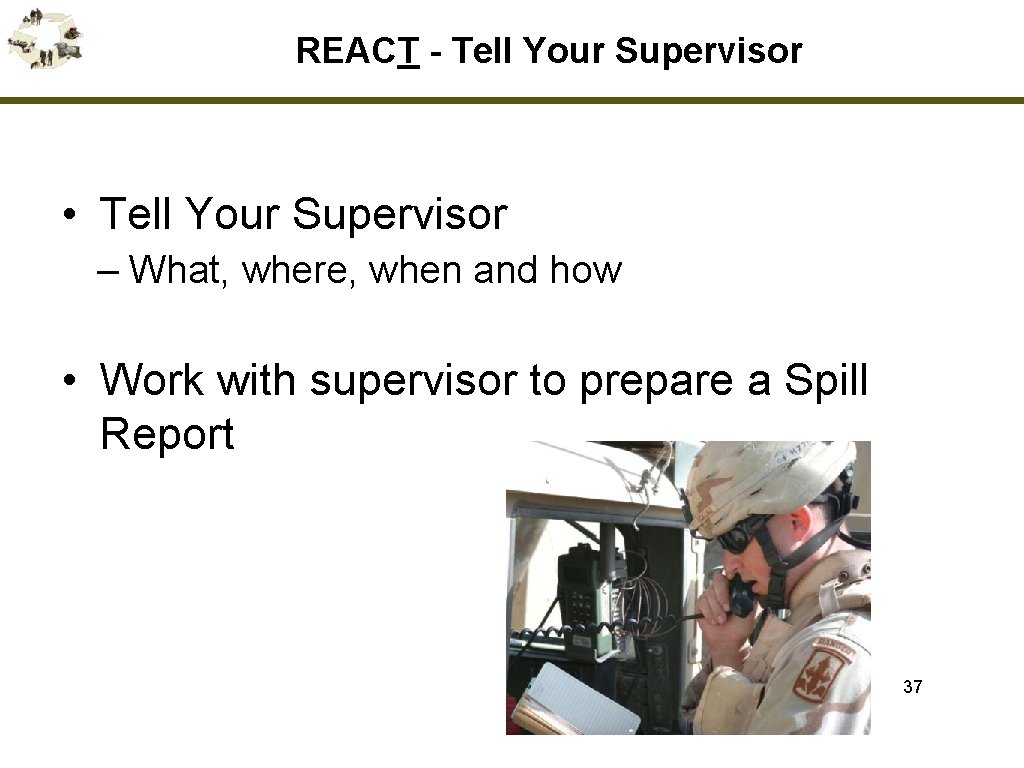
REACT - Tell Your Supervisor • Tell Your Supervisor – What, where, when and how • Work with supervisor to prepare a Spill Report 37
Spill Report • • • Contact information Date, time, and location of spill What and how much was spilled? What action was taken? What damage occurred? What additional assistance/action is needed? 38
Spill Response for Major Spill Situations
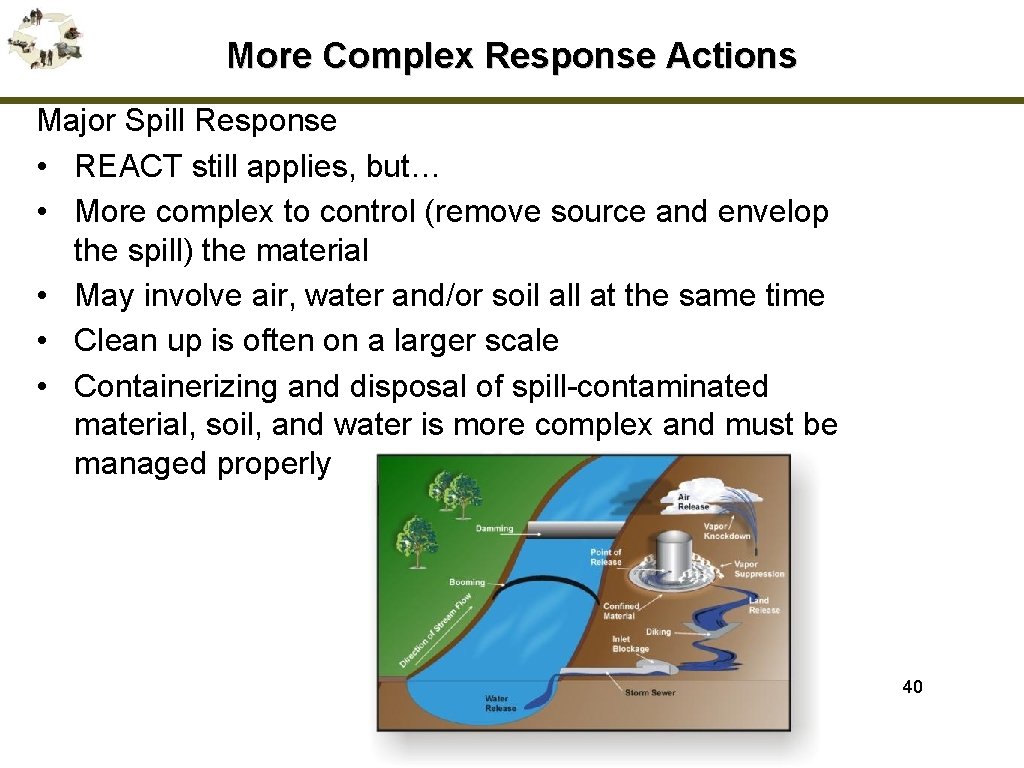
More Complex Response Actions Major Spill Response • REACT still applies, but… • More complex to control (remove source and envelop the spill) the material • May involve air, water and/or soil all at the same time • Clean up is often on a larger scale • Containerizing and disposal of spill-contaminated material, soil, and water is more complex and must be managed properly 40
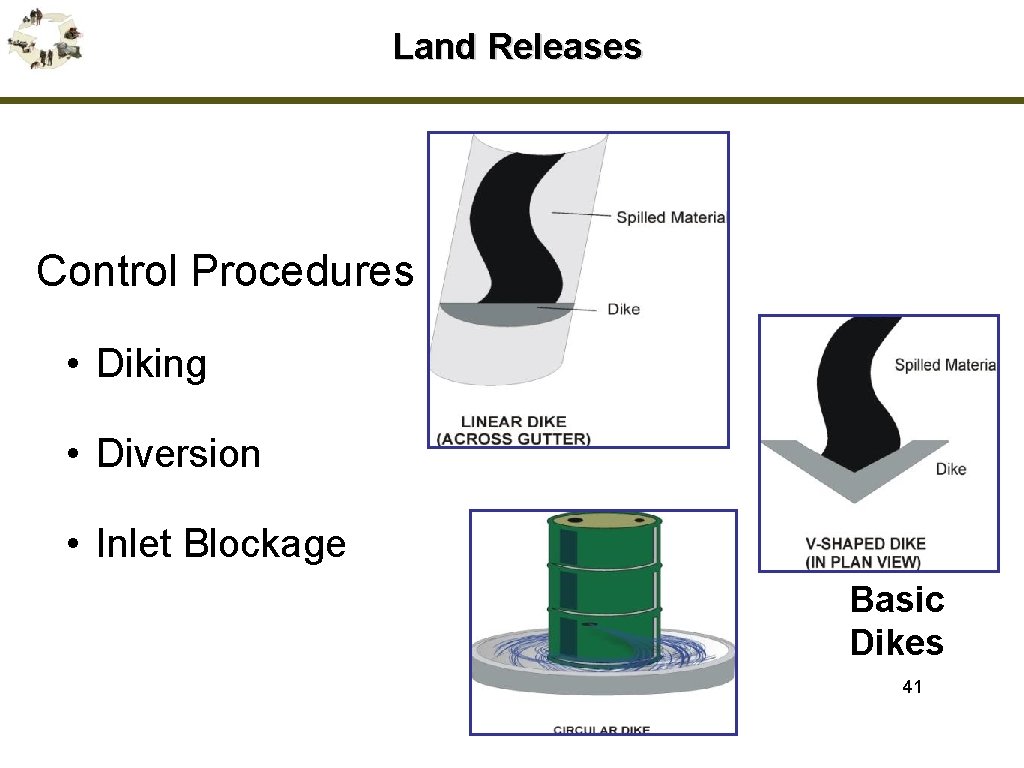
Land Releases Control Procedures • Diking • Diversion • Inlet Blockage Basic Dikes 41
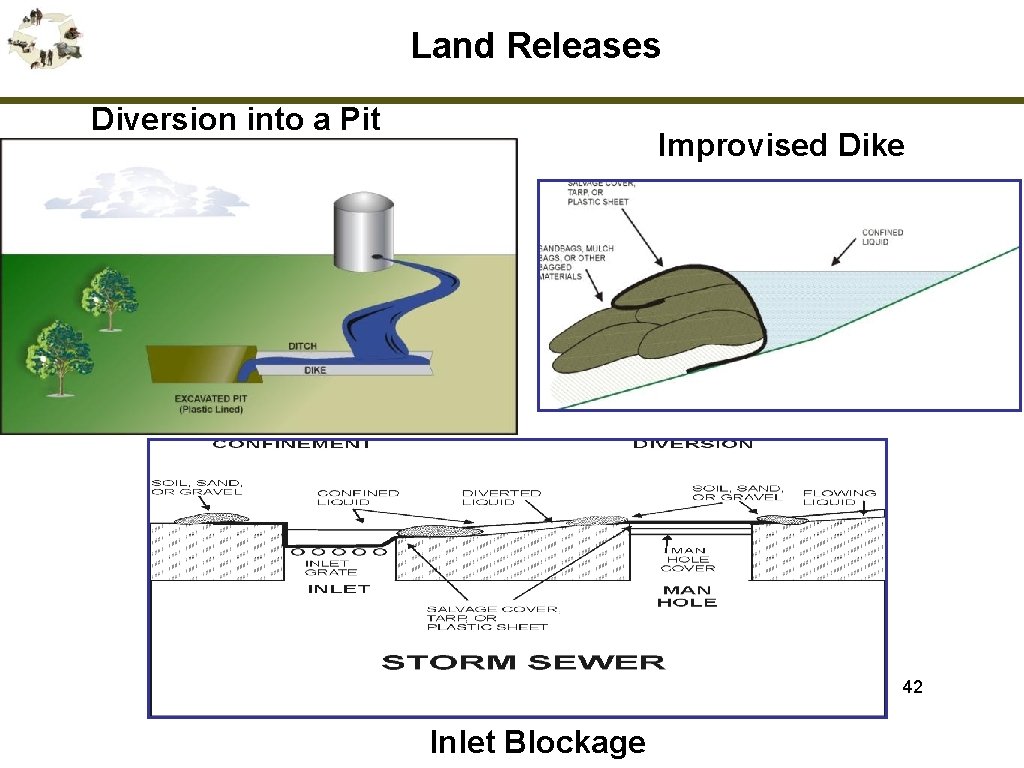
Land Releases Diversion into a Pit Improvised Dike 42 Inlet Blockage
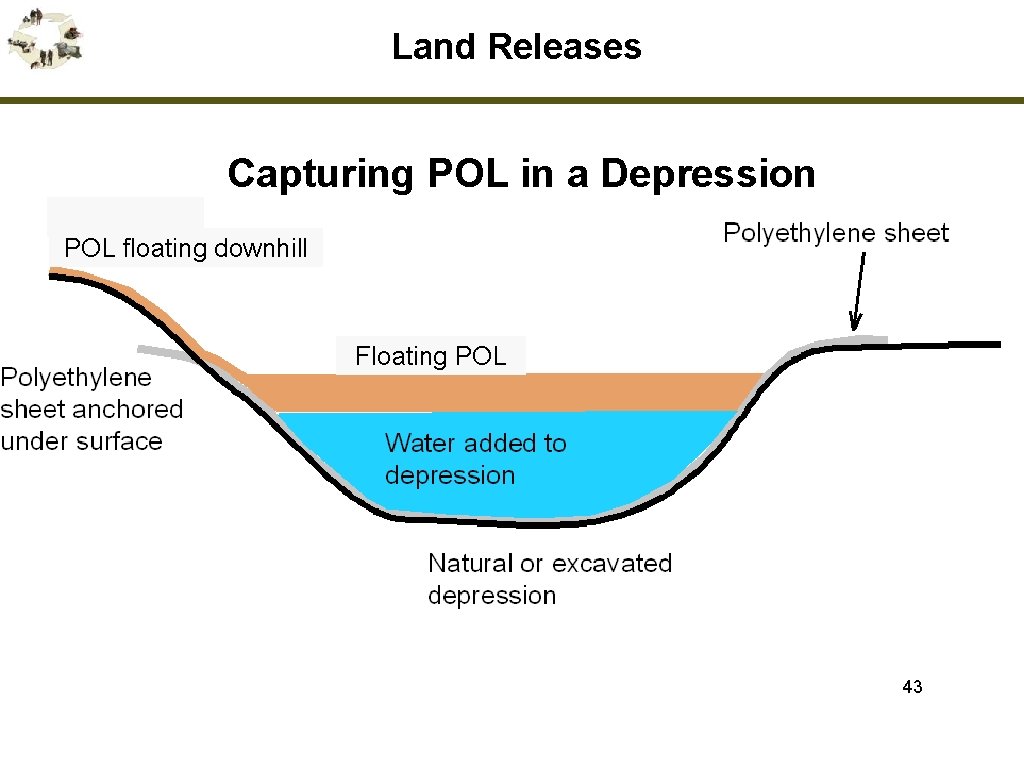
Land Releases Capturing POL in a Depression POL floating downhill Floating POL 43
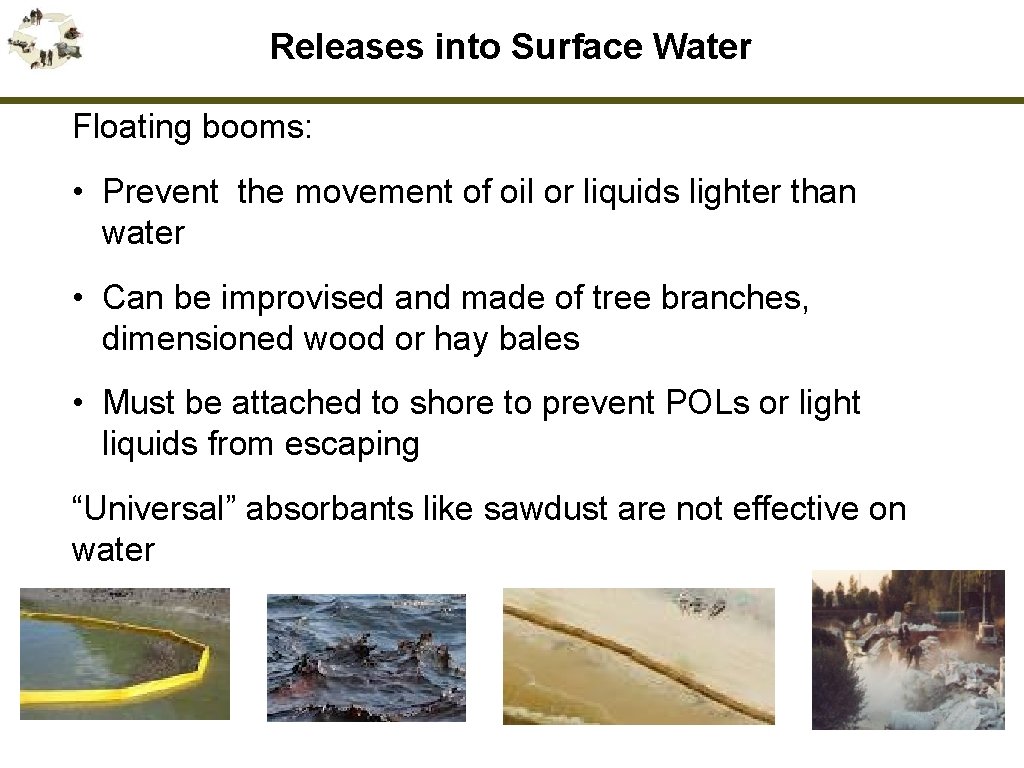
Releases into Surface Water Floating booms: • Prevent the movement of oil or liquids lighter than water • Can be improvised and made of tree branches, dimensioned wood or hay bales • Must be attached to shore to prevent POLs or light liquids from escaping “Universal” absorbants like sawdust are not effective on water 44
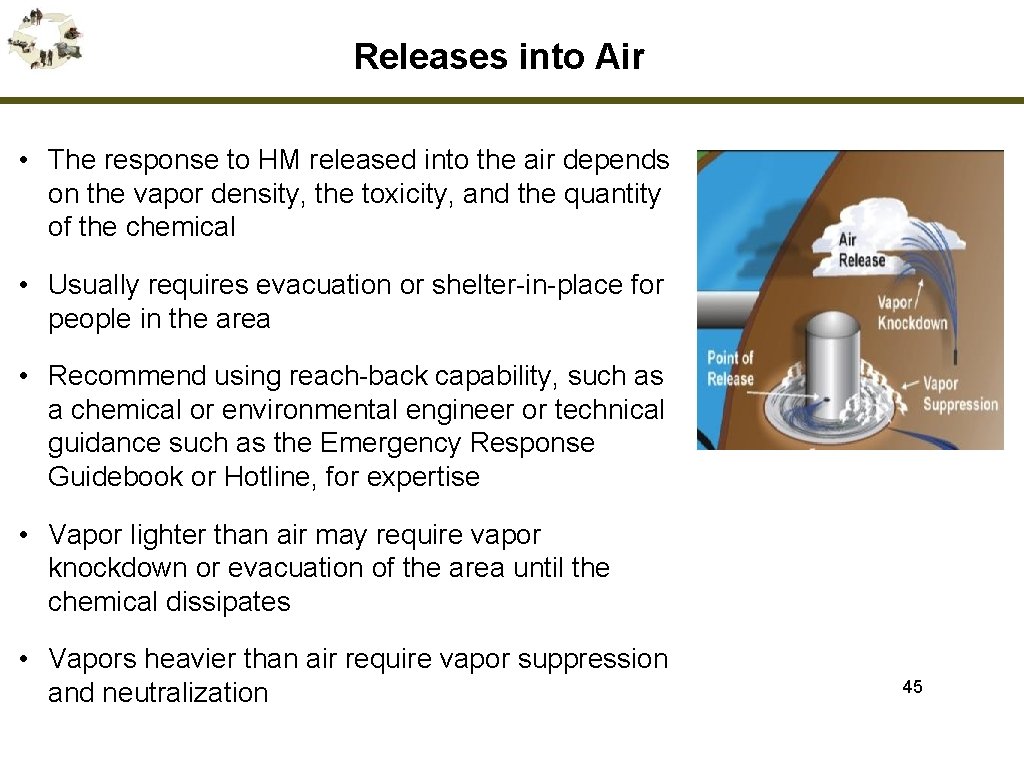
Releases into Air • The response to HM released into the air depends on the vapor density, the toxicity, and the quantity of the chemical • Usually requires evacuation or shelter-in-place for people in the area • Recommend using reach-back capability, such as a chemical or environmental engineer or technical guidance such as the Emergency Response Guidebook or Hotline, for expertise • Vapor lighter than air may require vapor knockdown or evacuation of the area until the chemical dissipates • Vapors heavier than air require vapor suppression and neutralization 45
Remediating POL-Contaminated Soils • Bioremediation • Soil composting, soil farming, landfarming • No need to add micro-organisms • Phytoremediation • Using plants to break down POL in soils • Gasoline is harder to degrade than diesel and lubricants • Gasoline is toxic to flora and micro-organisms • However, surface spills of gasoline usually vaporize • Polycyclic aromatic hydrocarbons (PAHs) are more difficult to remediate • Halogenated hydrocarbons are very difficult to remediate 46
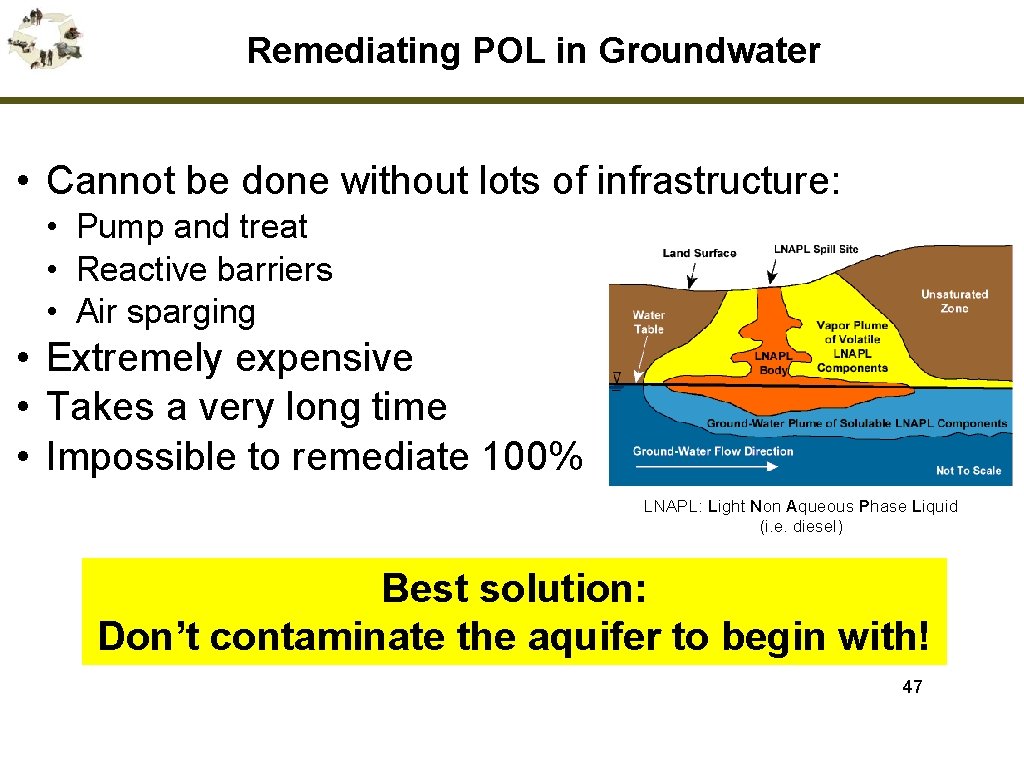
Remediating POL in Groundwater • Cannot be done without lots of infrastructure: • Pump and treat • Reactive barriers • Air sparging • Extremely expensive • Takes a very long time • Impossible to remediate 100% LNAPL: Light Non Aqueous Phase Liquid (i. e. diesel) Best solution: Don’t contaminate the aquifer to begin with! 47
Conclusions • Spill Prevention and Response Planning is the best way to prevent or minimize contamination of soil, air, and water • Spill Prevention and Response Planning and plan implementation are a team effort • Spill Prevention and Response Programs are an important part of mission readiness and force health protection • Effective spill response protects the people and environment of the surrounding area, helping to build good relations 48
- Slides: 48