
Environmental Toolbox General Awareness Training Module Environmental Officer
Environmental Toolbox
General Awareness Training Module Environmental Officer
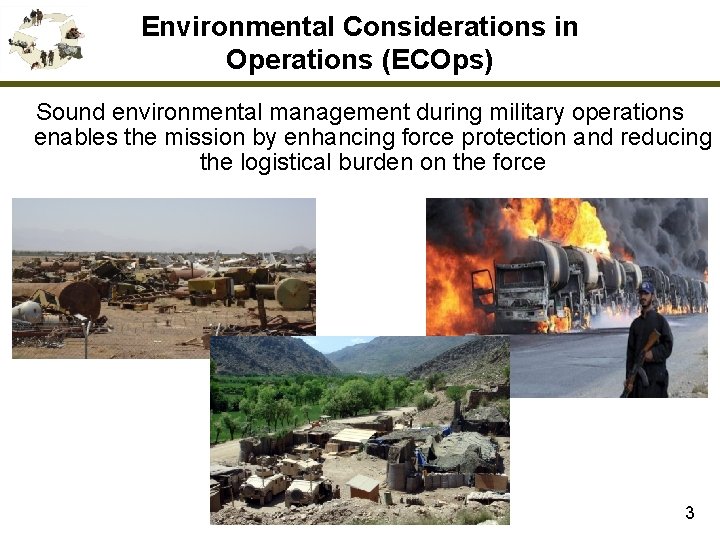
Environmental Considerations in Operations (ECOps) Sound environmental management during military operations enables the mission by enhancing force protection and reducing the logistical burden on the force 3
Overview of This Briefing • Environmental officer’s objectives • Why environmental considerations matter • Environmental officer responsibilities during: • Planning, pre-deployment • Deployment • Rotation of forces • Redeployment, post-deployment • Examples of good and bad practices • Listing of technical modules on specific topics 4
Definition Environmental Considerations in Operations are measures or processes put in place to avoid or minimize potentially adverse environmental impacts during military operations. Focus areas addressed in this toolbox*: • • • Solid waste management Hazardous material and hazardous waste management Water and wastewater management Spill prevention and response planning Natural resource and cultural property protection ECOps helps you to use your resources in a wise manner to better support your mission *Note: while energy use is not addressed specifically in this toolbox, it is important for everyone to use energy responsibly! 5
Why ECOps Matters • Enhances force protection • Protects soldier health • Reduces risk to supply convoys • Reduces logistical requirements and costs • Reduces legal and financial liability • Promotes sustainability • For the current mission • For future deployments • For the host nation • Potential geopolitical impacts • Wins hearts and minds (psychological operations, PSYOPS) 6
Environmental Officer’s Objectives • Integrate ECOps into plans and procedures within the camp • Advocate for and execute ECOps at the tactical level • Assist the commander in mission accomplishment by • sustaining readiness and supporting mission execution • protecting the safety and health of deploying troops, host nation troops, civilian personnel, and local nationals • facilitating coalition and international cooperation and interoperability • ensuring legal compliance • strengthening civil relations, and • promoting efficient use of and conservation of valuable natural resources 7
Laws and Regulations • International laws and treaties • Agreements pertaining to deploying forces such as Status of Forces Agreements (SOFAs) • Own nation’s laws • Host nation laws • UN, NATO, EU, or coalition command standards – who controls the space? • Mission regulations Compare and understand what governs the current operation. Be prepared to implement the highest applicable environmental standard. 8
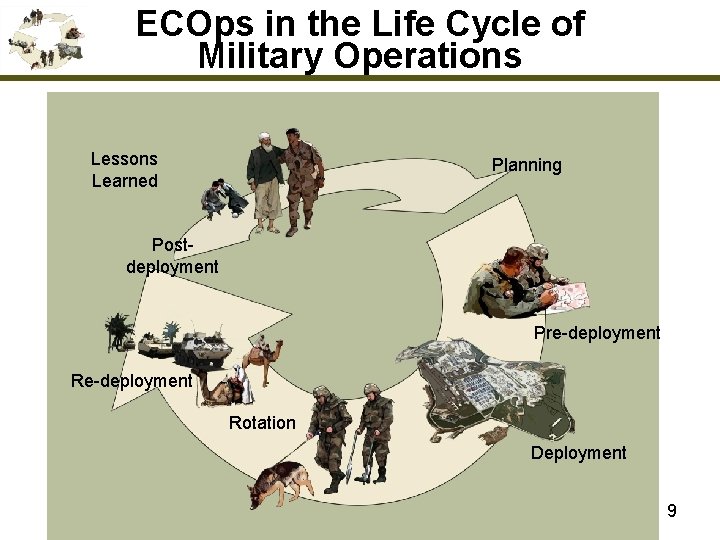
ECOps in the Life Cycle of Military Operations Lessons Learned Planning Postdeployment Pre-deployment Rotation Deployment 9
Strategic Level Planning The environmental annex of the Operation Plan (OPLAN) is based on an analysis of: • Legal framework • Critical environmental aspects that could constrain the effective achievement of the mission • Critical environmental aspects that could affect force protection or increase financial risks • The EO must be familiar with this environmental guidance to incorporate into pre-deployment planning 10
Pre-Deployment • When your unit is the initial entry unit • Include environmental capability in recce/advance party • Conduct Environmental Baseline Survey (EBS). This influences site selection, camp layout, feasible environmental systems • Understand mission, duration, population, quality of life. This determines environmental systems that will be implemented • When your unit assumes responsibility from a previous unit • • Review EBS Review master plan, standard operating procedures (SOPs) Review contracts and existing documentation Review intelligence reports You should ensure all forces are informed about their environmental responsibilities 11
Pre-Deployment • Plan for your end state: will base be closed/transferred or rotated with replacement unit? • Plan for surges or drawdowns • Flexible systems • Scalable for changes in mission • Obtain information about the host country and local community from your own government or open sources • Friendly country or hostile? This affects force protection and security requirements Understand respect • Existing infrastructure for military use local cultural and • Local materials, methods environmental norms and conditions • Technical skills labor pool • Community relations, economic impact 12
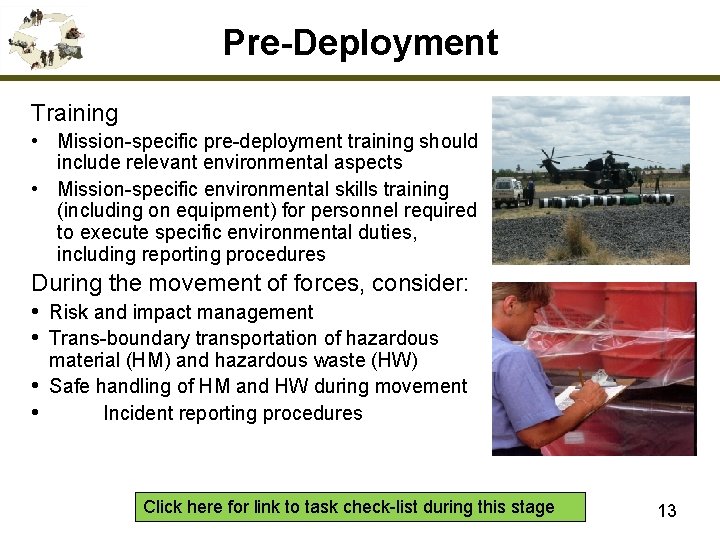
Pre-Deployment Training • Mission-specific pre-deployment training should include relevant environmental aspects • Mission-specific environmental skills training (including on equipment) for personnel required to execute specific environmental duties, including reporting procedures During the movement of forces, consider: • Risk and impact management • Trans-boundary transportation of hazardous material (HM) and hazardous waste (HW) • Safe handling of HM and HW during movement • Incident reporting procedures Click here for link to task check-list during this stage 13
Deployment • Complete a detailed EBS at the specific site selected • Develop detailed planning for day-to-day operations and requirements of the base • • • Solid waste management Hazardous material and hazardous waste management Water and wastewater management Spill prevention and response planning Natural resource and cultural property protection • Create situation-driven plans and SOPs, which can make up an overall environmental management plan • Facilitate the Environmental Management Board (EMB) • Update environmental intelligence 14
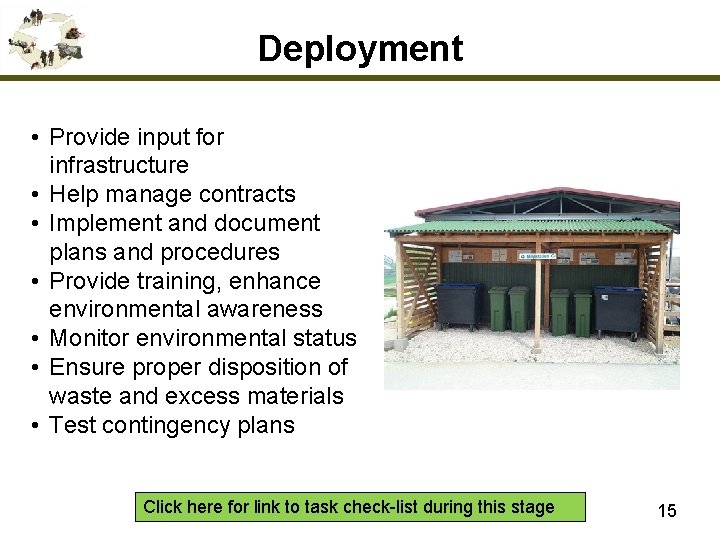
Deployment • Provide input for infrastructure • Help manage contracts • Implement and document plans and procedures • Provide training, enhance environmental awareness • Monitor environmental status • Ensure proper disposition of waste and excess materials • Test contingency plans Click here for link to task check-list during this stage 15
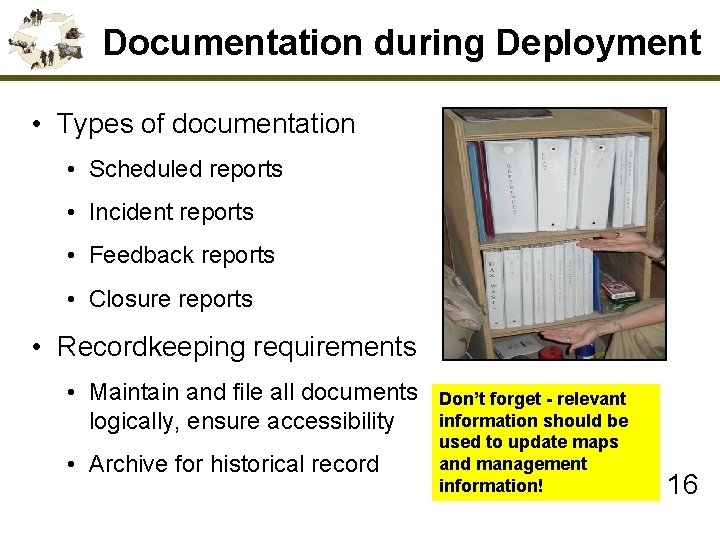
Documentation during Deployment • Types of documentation • Scheduled reports • Incident reports • Feedback reports • Closure reports • Recordkeeping requirements • Maintain and file all documents logically, ensure accessibility • Archive for historical record Don’t forget - relevant information should be used to update maps and management information! 16
Rotation of Forces • Units moving into or out of the area of operations are in one of three states: mobilization, handing and taking over, or demobilization • Proper “Handing and Taking Over” requires good communication • Plan for surge capacity • Procedures must be completely understood by relieving forces • Must be a structured process • Documentation is critical to ensure continuity Click here for link to task check-list during this stage 17
Rotation of Forces During “handing and taking over, ” environmental documentation and records developed by the initial deploying force or follow-on units will be turned over to the relieving EO. They should be relevant, well organized and easily accessible. These records include: Operations and Fragmentary Orders Management Plans SOPs Contingency Plans Reports and Management Information (e. g. , EBS) Environmental Risk Analyses Management Directives/Duty Sheets/Command Delegations Logistics, Assets and Stores tracking (e. g. , HM in/out flow) Contracts The job is not over until the paperwork is passed to the relieving unit! 18
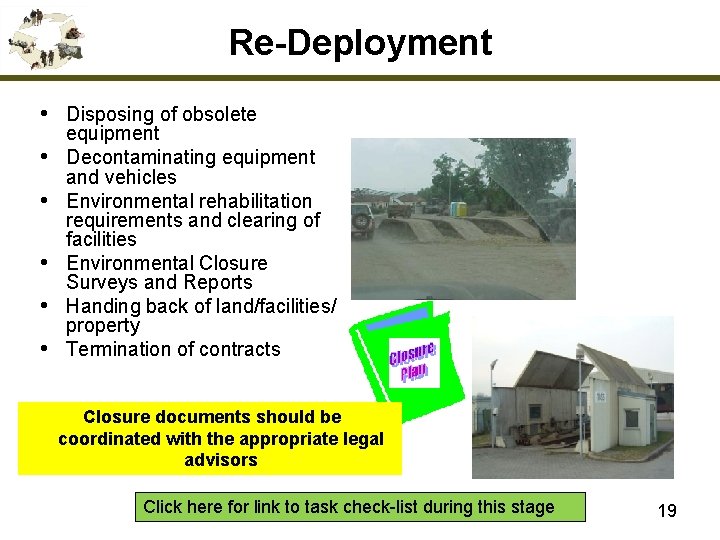
Re-Deployment • Disposing of obsolete • • • equipment Decontaminating equipment and vehicles Environmental rehabilitation requirements and clearing of facilities Environmental Closure Surveys and Reports Handing back of land/facilities/ property Termination of contracts Closure documents should be coordinated with the appropriate legal advisors Click here for link to task check-list during this stage 19
Post-Deployment and Lessons Learned • Conduct lessons learned or After Action Review; provide report • Document what worked well and what did not work well • Make recommendations for future improvements • Forward information to training developers for inclusion in future pre-deployment training 20
Good and Bad Examples The following slides show a number of pictures of both good and bad environmental practices, from camp setup to handling different kinds of wastes to protecting natural resources and cultural property
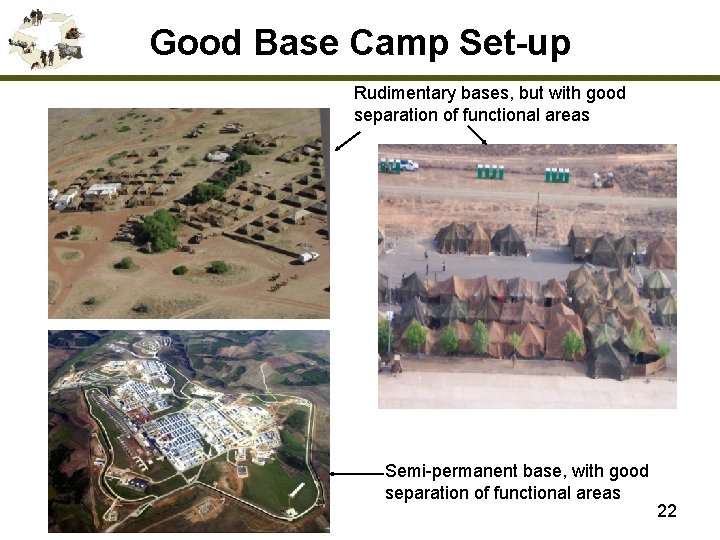
Good Base Camp Set-up Rudimentary bases, but with good separation of functional areas Semi-permanent base, with good separation of functional areas 22
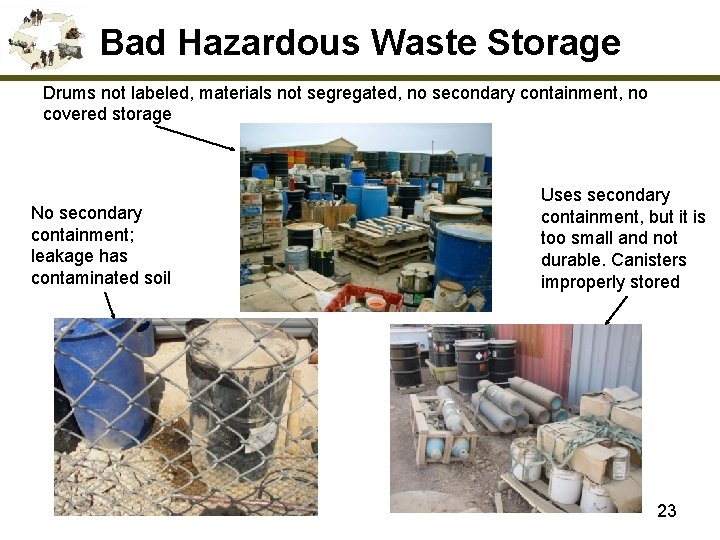
Bad Hazardous Waste Storage Drums not labeled, materials not segregated, no secondary containment, no covered storage No secondary containment; leakage has contaminated soil Uses secondary containment, but it is too small and not durable. Canisters improperly stored 23
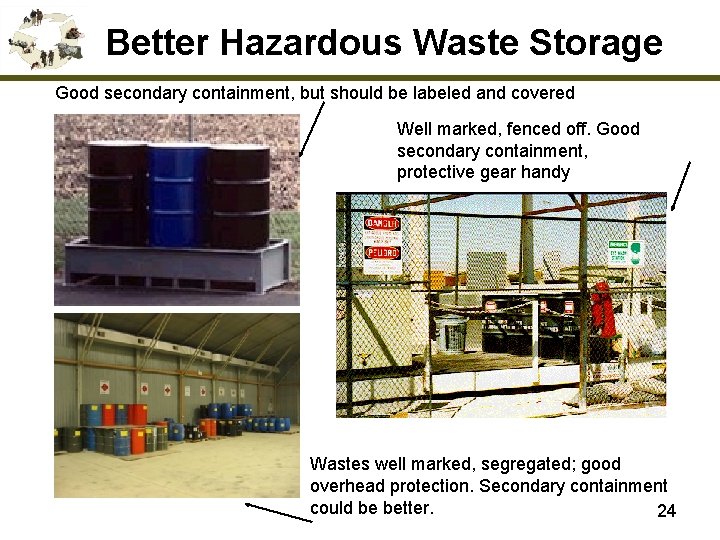
Better Hazardous Waste Storage Good secondary containment, but should be labeled and covered Well marked, fenced off. Good secondary containment, protective gear handy Wastes well marked, segregated; good overhead protection. Secondary containment could be better. 24
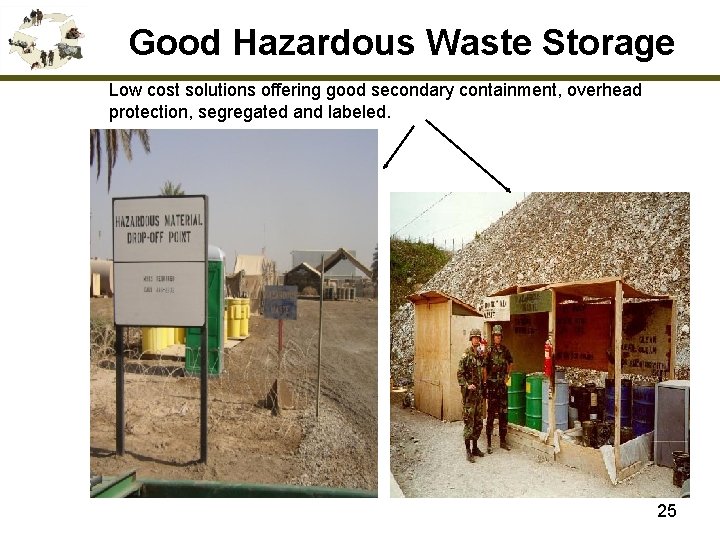
Good Hazardous Waste Storage Low cost solutions offering good secondary containment, overhead protection, segregated and labeled. 25
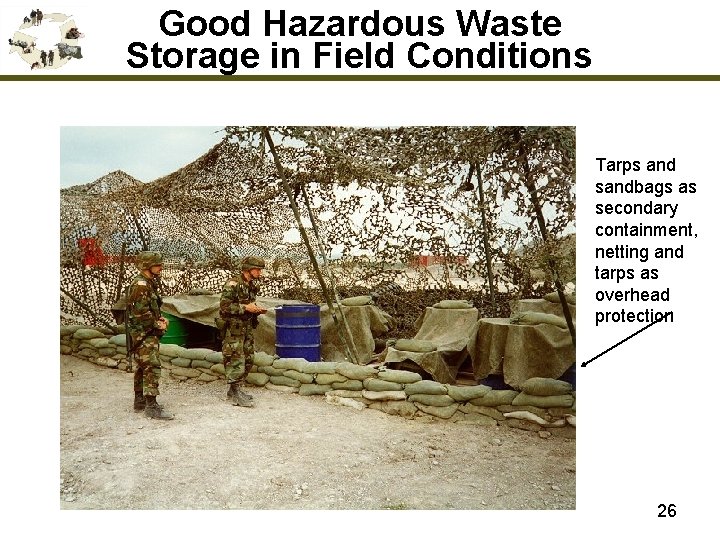
Good Hazardous Waste Storage in Field Conditions Tarps and sandbags as secondary containment, netting and tarps as overhead protection 26
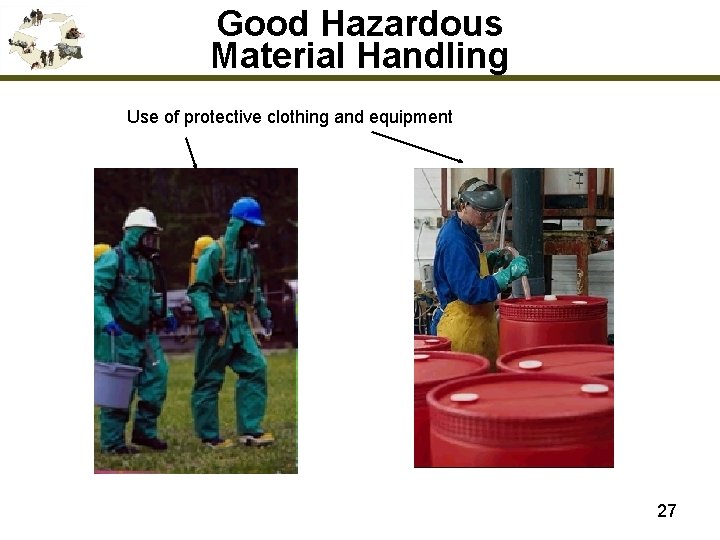
Good Hazardous Material Handling Use of protective clothing and equipment 27
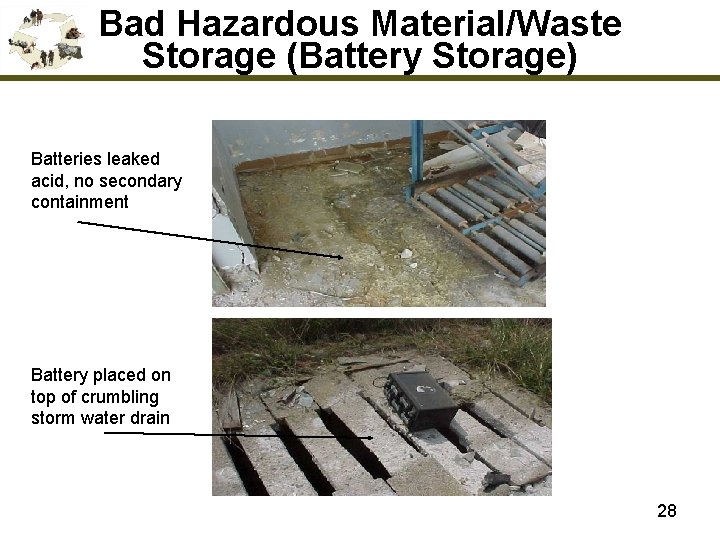
Bad Hazardous Material/Waste Storage (Battery Storage) Batteries leaked acid, no secondary containment Battery placed on top of crumbling storm water drain 28
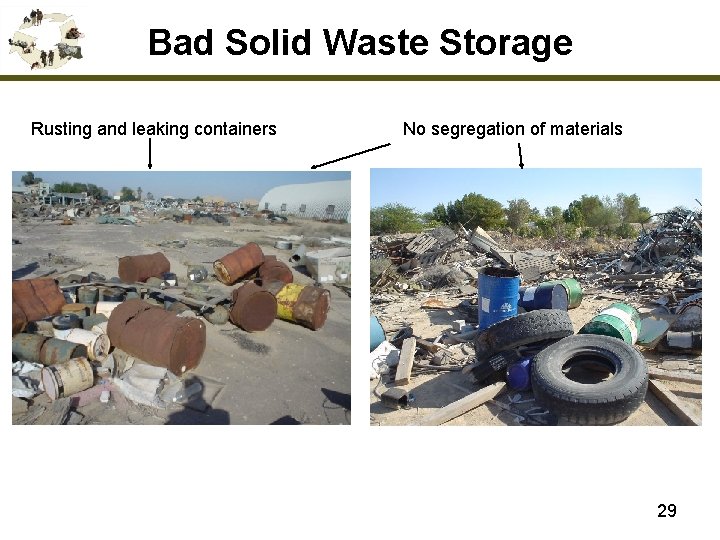
Bad Solid Waste Storage Rusting and leaking containers No segregation of materials 29
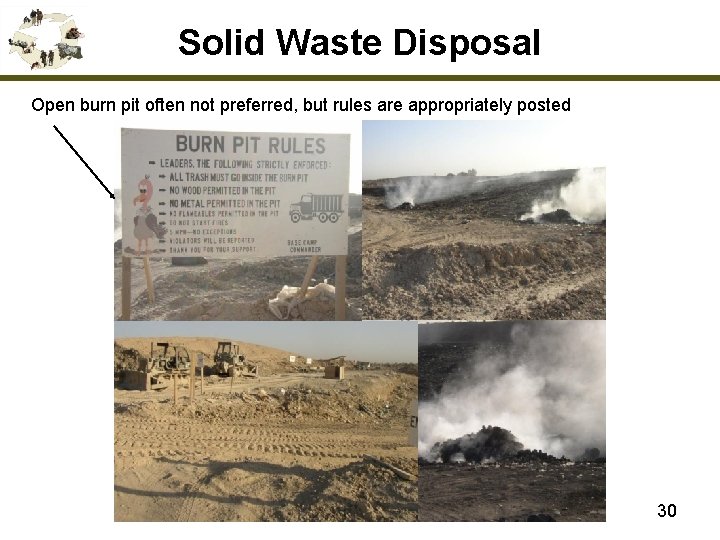
Solid Waste Disposal Open burn pit often not preferred, but rules are appropriately posted 30
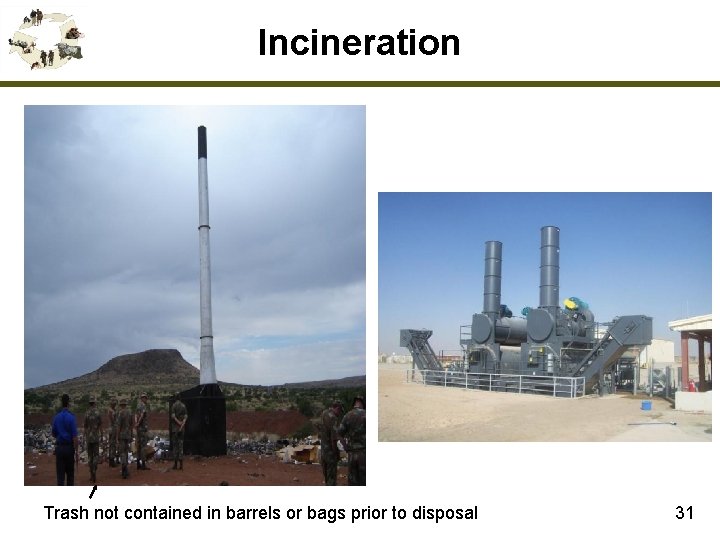
Incineration Trash not contained in barrels or bags prior to disposal 31
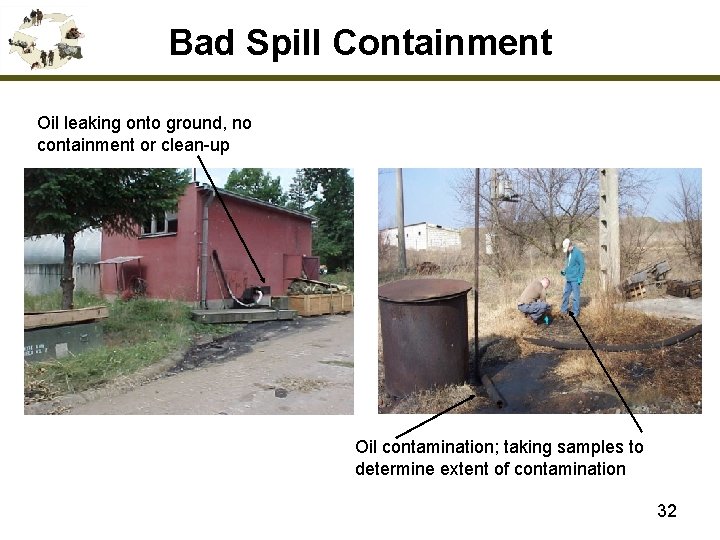
Bad Spill Containment Oil leaking onto ground, no containment or clean-up Oil contamination; taking samples to determine extent of contamination 32
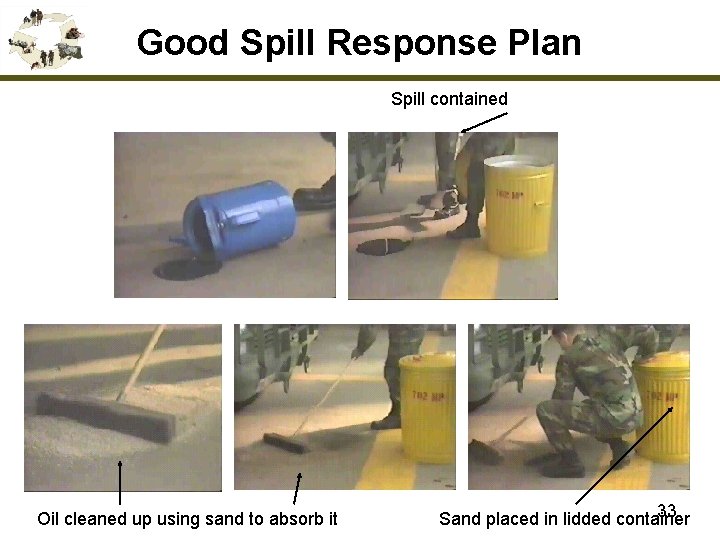
Good Spill Response Plan Spill contained Oil cleaned up using sand to absorb it 33 Sand placed in lidded container
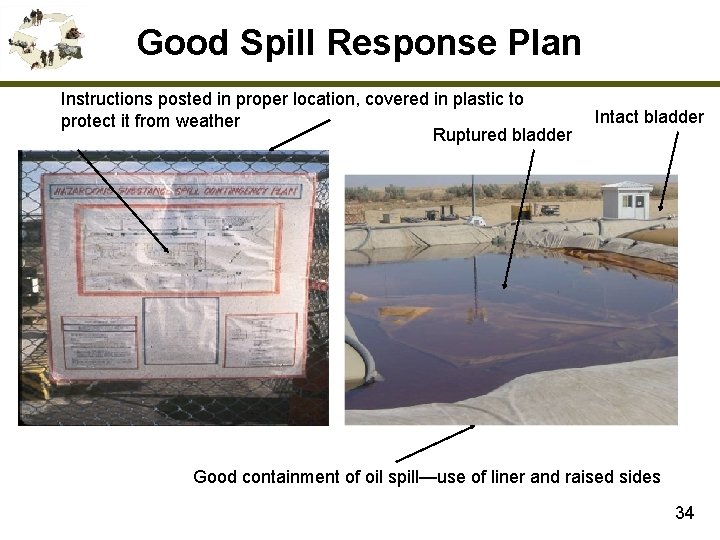
Good Spill Response Plan Instructions posted in proper location, covered in plastic to protect it from weather Ruptured bladder Intact bladder Good containment of oil spill—use of liner and raised sides 34
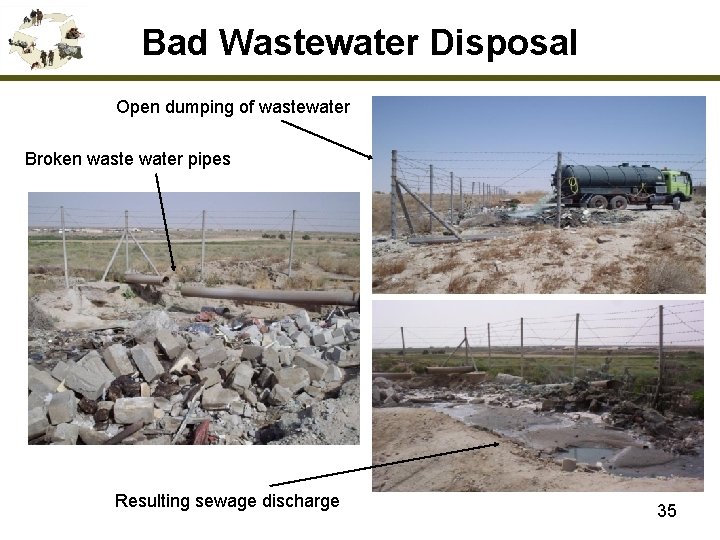
Bad Wastewater Disposal Open dumping of wastewater Broken waste water pipes Resulting sewage discharge 35
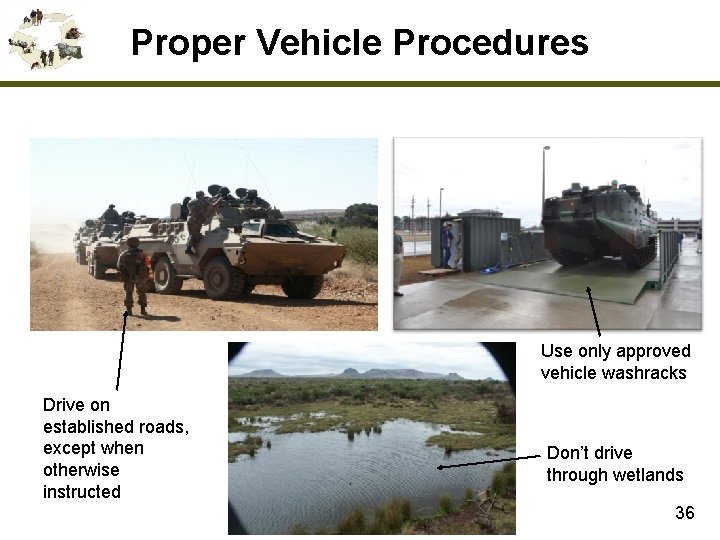
Proper Vehicle Procedures Use only approved vehicle washracks Drive on established roads, except when otherwise instructed Don’t drive through wetlands 36
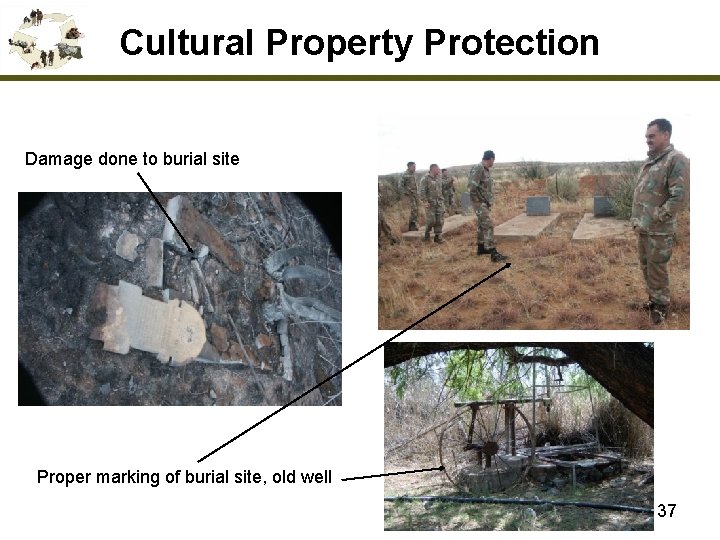
Cultural Property Protection Damage done to burial site Proper marking of burial site, old well 37
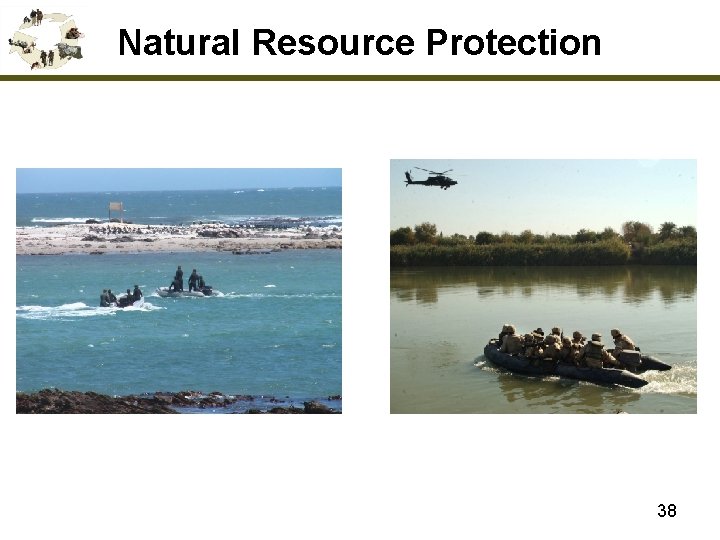
Natural Resource Protection 38
Technical Modules • Detailed modules on the following subjects are available in the technical module section of this toolbox: • • • Solid waste management Hazardous material and hazardous waste management Water and wastewater management Spill prevention and response planning Cultural property protection Natural resource protection 39
Conclusion Your actions as an environmental officer will have contributed to the mission’s goals and its success by • reducing adverse impacts to the health of the force and the local population • reducing adverse impacts to the environment • enhancing the reputation of your military and your nation 40
EO TASK LISTS The following slides include the EO task lists by the operational phase. 41
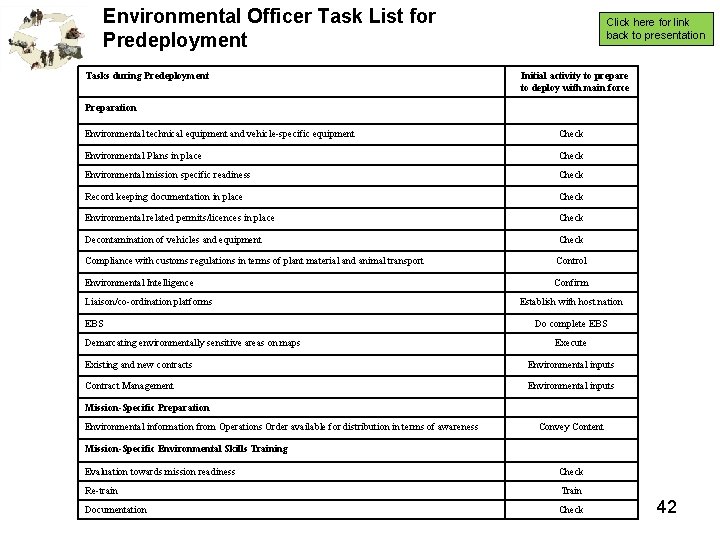
Environmental Officer Task List for Predeployment Tasks during Predeployment Click here for link back to presentation Initial activity to prepare to deploy with main force Preparation Environmental technical equipment and vehicle-specific equipment Check Environmental Plans in place Check Environmental mission specific readiness Check Record keeping documentation in place Check Environmental related permits/licences in place Check Decontamination of vehicles and equipment Check Compliance with customs regulations in terms of plant material and animal transport Control Environmental Intelligence Confirm Liaison/co-ordination platforms EBS Demarcating environmentally sensitive areas on maps Establish with host nation Do complete EBS Execute Existing and new contracts Environmental inputs Contract Management Environmental inputs Mission-Specific Preparation Environmental information from Operations Order available for distribution in terms of awareness Convey Content Mission-Specific Environmental Skills Training Evaluation towards mission readiness Check Re-train Train Documentation Check 42
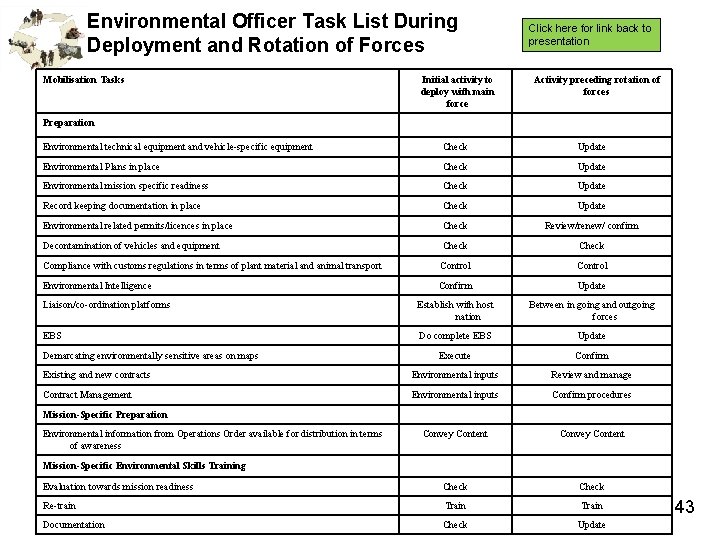
Environmental Officer Task List During Deployment and Rotation of Forces Mobilisation Tasks Initial activity to deploy with main force Click here for link back to presentation Activity preceding rotation of forces Preparation Environmental technical equipment and vehicle-specific equipment Check Update Environmental Plans in place Check Update Environmental mission specific readiness Check Update Record keeping documentation in place Check Update Environmental related permits/licences in place Check Review/renew/ confirm Decontamination of vehicles and equipment Check Compliance with customs regulations in terms of plant material and animal transport Control Environmental Intelligence Confirm Update Liaison/co-ordination platforms Establish with host nation Between in going and outgoing forces EBS Do complete EBS Update Execute Confirm Existing and new contracts Environmental inputs Review and manage Contract Management Environmental inputs Confirm procedures Convey Content Evaluation towards mission readiness Check Re-train Train Documentation Check Update Demarcating environmentally sensitive areas on maps Mission-Specific Preparation Environmental information from Operations Order available for distribution in terms of awareness Mission-Specific Environmental Skills Training 43
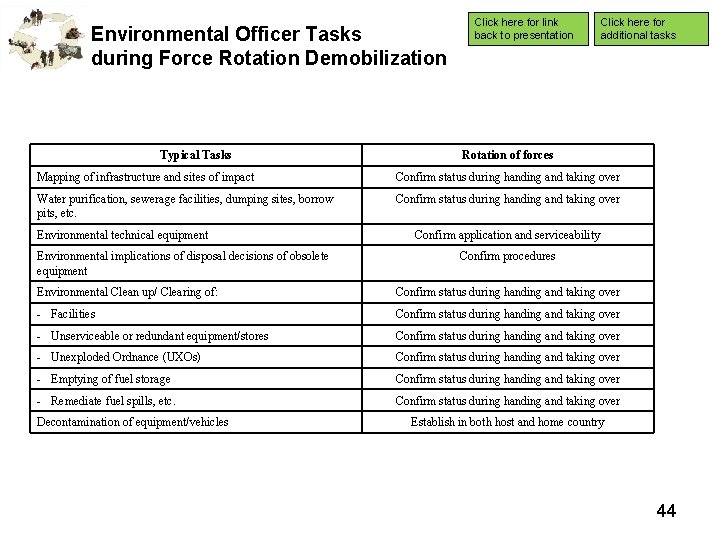
Environmental Officer Tasks during Force Rotation Demobilization Typical Tasks Click here for link back to presentation Click here for additional tasks Rotation of forces Mapping of infrastructure and sites of impact Confirm status during handing and taking over Water purification, sewerage facilities, dumping sites, borrow pits, etc. Confirm status during handing and taking over Environmental technical equipment Environmental implications of disposal decisions of obsolete equipment Confirm application and serviceability Confirm procedures Environmental Clean up/ Clearing of: Confirm status during handing and taking over - Facilities Confirm status during handing and taking over - Unserviceable or redundant equipment/stores Confirm status during handing and taking over - Unexploded Ordnance (UXOs) Confirm status during handing and taking over - Emptying of fuel storage Confirm status during handing and taking over - Remediate fuel spills, etc. Confirm status during handing and taking over Decontamination of equipment/vehicles Establish in both host and home country 44
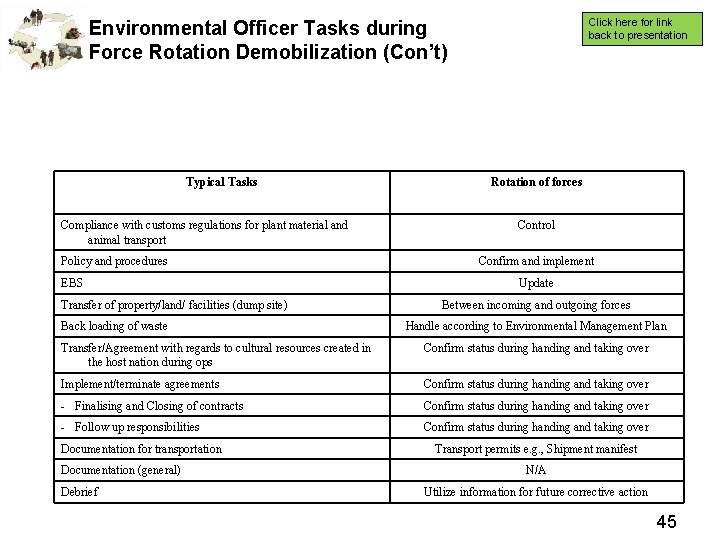
Click here for link back to presentation Environmental Officer Tasks during Force Rotation Demobilization (Con’t) Typical Tasks Compliance with customs regulations for plant material and animal transport Policy and procedures EBS Transfer of property/land/ facilities (dump site) Back loading of waste Rotation of forces Control Confirm and implement Update Between incoming and outgoing forces Handle according to Environmental Management Plan Transfer/Agreement with regards to cultural resources created in the host nation during ops Confirm status during handing and taking over Implement/terminate agreements Confirm status during handing and taking over - Finalising and Closing of contracts Confirm status during handing and taking over - Follow up responsibilities Confirm status during handing and taking over Documentation for transportation Documentation (general) Debrief Transport permits e. g. , Shipment manifest N/A Utilize information for future corrective action 45
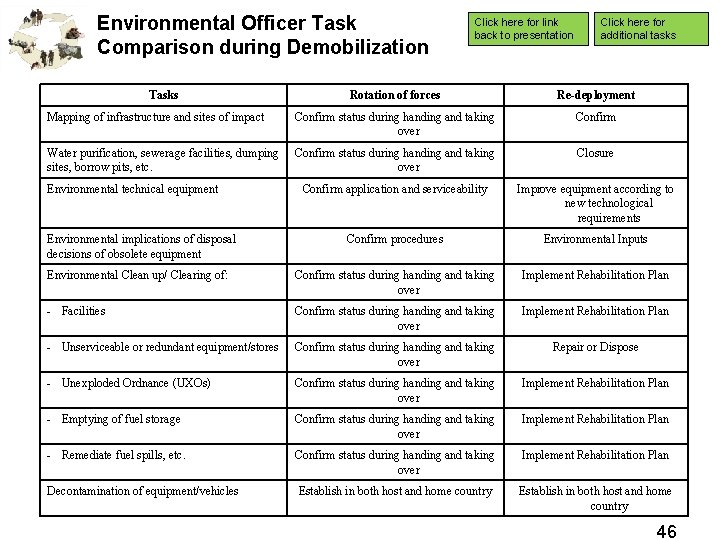
Environmental Officer Task Comparison during Demobilization Tasks Click here for link back to presentation Click here for additional tasks Rotation of forces Re-deployment Mapping of infrastructure and sites of impact Confirm status during handing and taking over Confirm Water purification, sewerage facilities, dumping sites, borrow pits, etc. Confirm status during handing and taking over Closure Confirm application and serviceability Improve equipment according to new technological requirements Confirm procedures Environmental Inputs Environmental Clean up/ Clearing of: Confirm status during handing and taking over Implement Rehabilitation Plan - Facilities Confirm status during handing and taking over Implement Rehabilitation Plan - Unserviceable or redundant equipment/stores Confirm status during handing and taking over Repair or Dispose - Unexploded Ordnance (UXOs) Confirm status during handing and taking over Implement Rehabilitation Plan - Emptying of fuel storage Confirm status during handing and taking over Implement Rehabilitation Plan - Remediate fuel spills, etc. Confirm status during handing and taking over Implement Rehabilitation Plan Decontamination of equipment/vehicles Establish in both host and home country Environmental technical equipment Environmental implications of disposal decisions of obsolete equipment 46
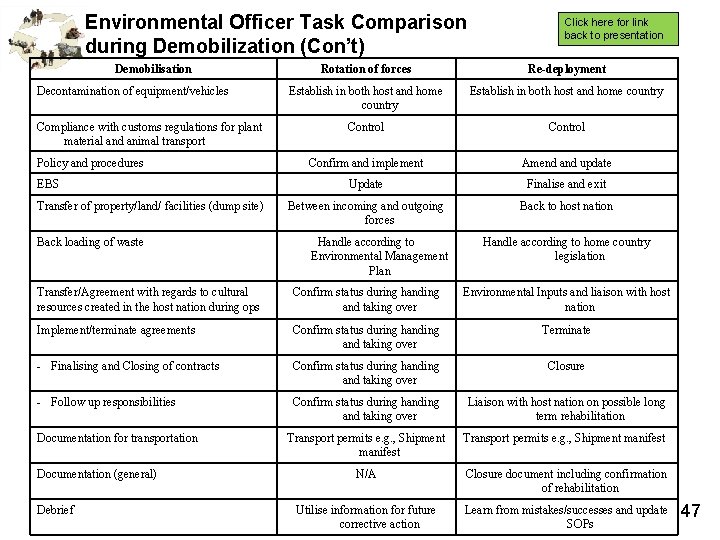
Environmental Officer Task Comparison during Demobilization (Con’t) Demobilisation Decontamination of equipment/vehicles Compliance with customs regulations for plant material and animal transport Policy and procedures EBS Transfer of property/land/ facilities (dump site) Back loading of waste Click here for link back to presentation Rotation of forces Re-deployment Establish in both host and home country Control Confirm and implement Amend and update Update Finalise and exit Between incoming and outgoing forces Back to host nation Handle according to Environmental Management Plan Handle according to home country legislation Transfer/Agreement with regards to cultural resources created in the host nation during ops Confirm status during handing and taking over Environmental Inputs and liaison with host nation Implement/terminate agreements Confirm status during handing and taking over Terminate - Finalising and Closing of contracts Confirm status during handing and taking over Closure - Follow up responsibilities Confirm status during handing and taking over Liaison with host nation on possible long term rehabilitation Transport permits e. g. , Shipment manifest N/A Closure document including confirmation of rehabilitation Utilise information for future corrective action Learn from mistakes/successes and update SOPs Documentation for transportation Documentation (general) Debrief 47
- Slides: 47