
Environmental Systems Topic 2 The Ecosystem Eco Structure
- Slides: 17
Environmental Systems Topic 2 The Ecosystem Eco. Structure Assessment Statements: 2. 1. 2 -2. 1. 3; 2. 1. 6 -2. 1. 7; 2. 4. 1 -2. 4. 2
Ecosphere • ecology: study of relationships between organisms & their environment. scope, in terms of levels of organization: • organism: any form of life • population: a group of interacting Realm individuals of same species of • community: populations of different species Ecology in given area • ecosystem: community + non–living environment • ecosphere: (=biosphere) all of Earth's ecosystems
Ecosystem • Definition: a community of different species interacting with one another & with… • Examples?
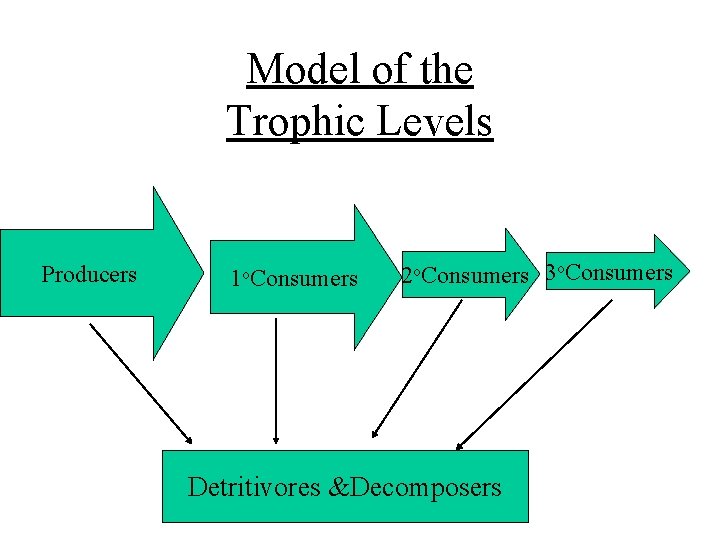
The Biotic Components of an ecosystem can be separated into what are known as Trophic Levels So what the heck is a Trophic Level?
A Trophic Level is…. The position that an organism occupies in a food chain, or a group of organisms in a community that occupy the same position in food chains.
Two Main Categories of Trophic Levels • 1. Producers (also called ______ = "self –feeders") make their own food from compounds obtained in the environment – Usually by what process? – Some bacteria use what other process? • 2) Consumers (also called _______ "other–feeders") get their energy & nutrients by feeding on other organisms or their remains. – Use what process to make energy?
Types of Consumers • primary consumers: (=herbivores) feed directly on ________; • secondary consumers: (=carnivores) feed on _________; • tertiary consumers: (=top carnivores)feed only on carnivores; • omnivores: consumers that feed on ___________ • scavengers: feed on _____ organisms
More Consumers • detritivores: feed on detritus (partially decomposed organic matter, such as leaf litter & animal dung) (ex: worms, beetles, etc. ) • decomposers: consumers that complete the breakdown & recycling of organic materials from the remains & wastes of other organisms (ex: Fungus, Bacteria) • What is the difference between these?
Model of the Trophic Levels Producers 1 o. Consumers 2 o. Consumers 3 o. Consumers Detritivores &Decomposers
Food Chains and Food Webs What is the difference?
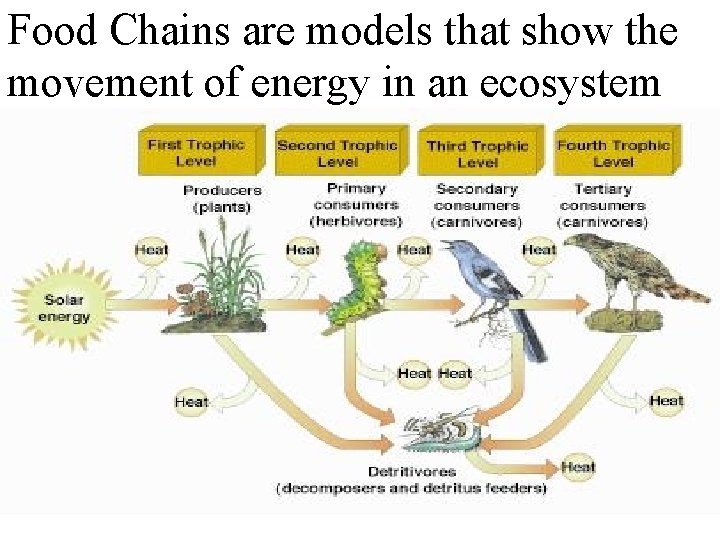
Food Chains are models that show the movement of energy in an ecosystem
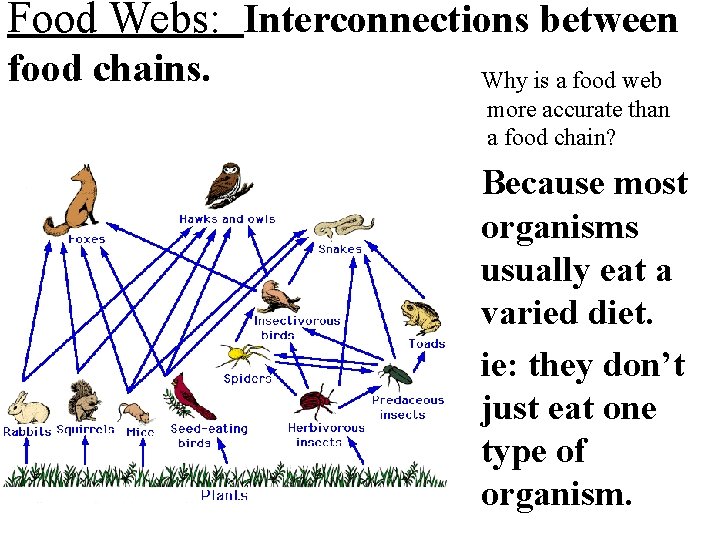
Food Webs: Interconnections between food chains. Why is a food web more accurate than a food chain? Because most organisms usually eat a varied diet. ie: they don’t just eat one type of organism.
Habitat vs Niche • habitat: the actual location where an organism lives. – habitat is like "address" of an organism; • Niche: the functional role of a species in an ecosystem. Includes: – interactions with living (biotic) & nonliving (abiotic) components of ecosytem; – role in flow of energy & cycling of matter. – Niche is like the occupation of an organism
Population Interactions • Predation – • Symbiosis – – Parasitism - Interaction in which one species (a parasite) lives in or on another (host) and obtains nourishment from it. • Ex: – Mutualism - an association in which both species derive benefit. • Ex: – Commensalism - one member benefits and the other neither benefits or is harmed.
Competition • A common demand by two or more organisms. • Organisms compete for…?
Two Types of Competition • Intraspecific Competition - Competition between members of the same species. – An example? • Interspecific Competition - competition between different species – An example? • Which type of competition is the most intense? Why?
What is a Biome? • Region inhabited by certain types of plants and animals due to which two abiotic factors? • Examples of Biomes?