
Environmental Sustainability Interconnected Systems Rob Bernard Chief Environmental
Environmental Sustainability: Interconnected Systems Rob Bernard Chief Environmental Strategist Microsoft Corporation
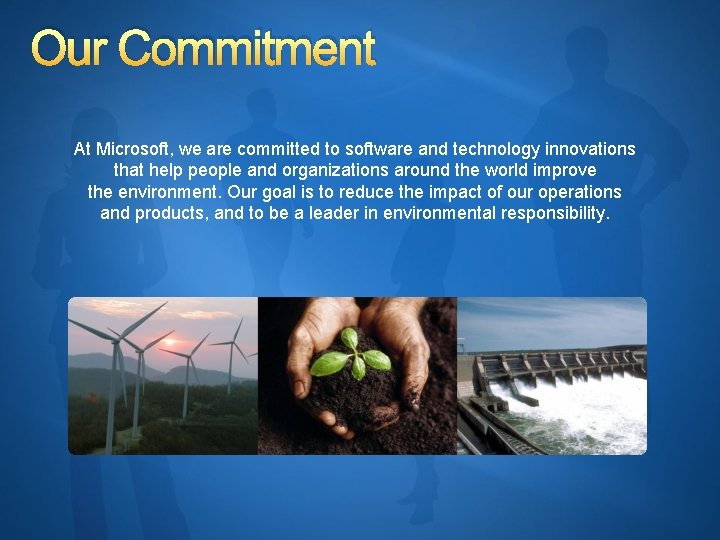
Our Commitment At Microsoft, we are committed to software and technology innovations that help people and organizations around the world improve the environment. Our goal is to reduce the impact of our operations and products, and to be a leader in environmental responsibility.
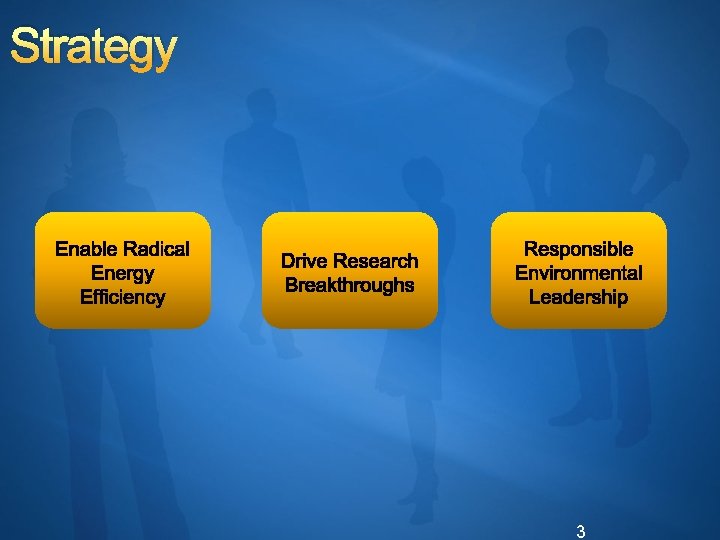
Strategy 3
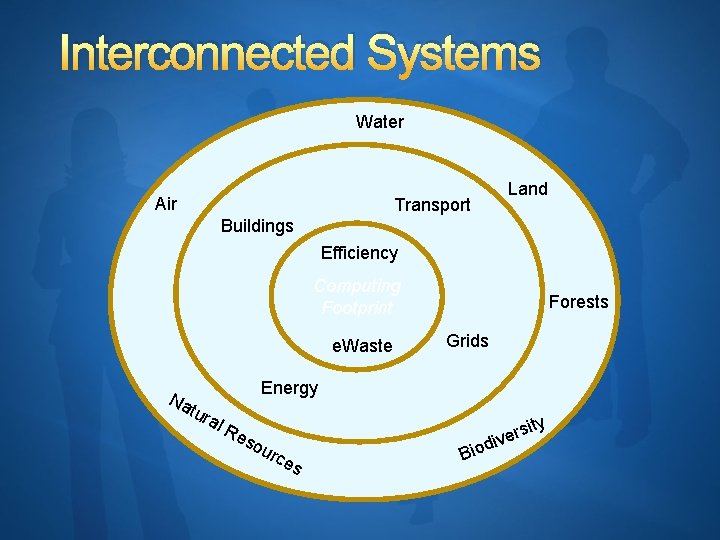
Interconnected Systems Water Air Land Transport Buildings Efficiency Computing Footprint e. Waste Forests Grids Energy Na tur a l R es ou rce rs dive s Bio ity

Interconnected Systems Water Air Land Transport Buildings Efficiency Computing Footprint e. Waste Na Forests Grids tur a Energy ity l R es ou rce rs dive s Bio
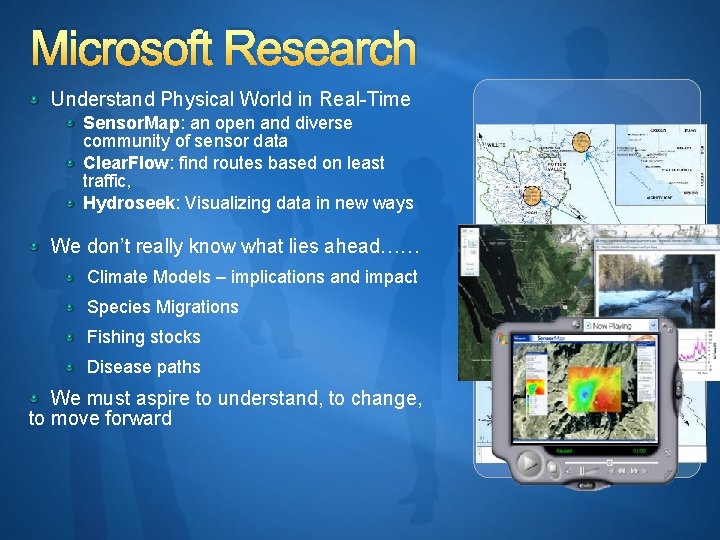
Microsoft Research Understand Physical World in Real-Time Sensor. Map: an open and diverse community of sensor data Clear. Flow: find routes based on least traffic, Hydroseek: Visualizing data in new ways We don’t really know what lies ahead…… Climate Models – implications and impact Species Migrations Fishing stocks Disease paths We must aspire to understand, to change, to move forward
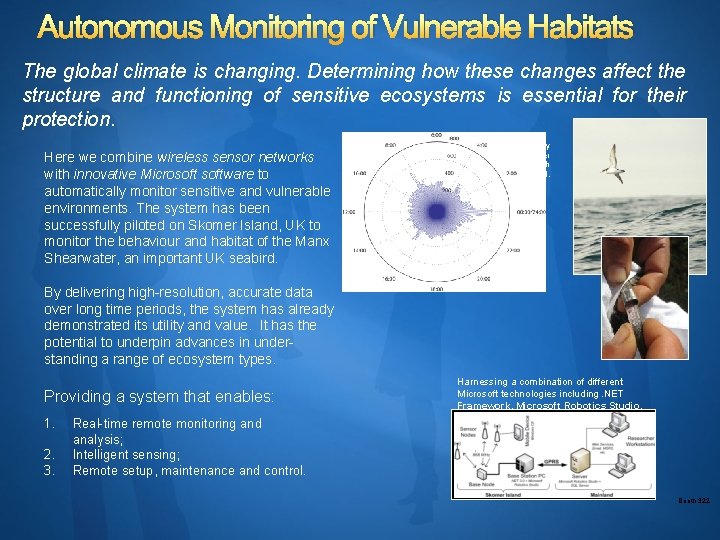
Autonomous Monitoring of Vulnerable Habitats The global climate is changing. Determining how these changes affect the structure and functioning of sensitive ecosystems is essential for their protection. Here we combine wireless sensor networks with innovative Microsoftware to automatically monitor sensitive and vulnerable environments. The system has been successfully piloted on Skomer Island, UK to monitor the behaviour and habitat of the Manx Shearwater, an important UK seabird. Daily activity of colony over 2 month period. By delivering high-resolution, accurate data over long time periods, the system has already demonstrated its utility and value. It has the potential to underpin advances in understanding a range of ecosystem types. Providing a system that enables: 1. 2. 3. Real-time remote monitoring and analysis; Intelligent sensing; Remote setup, maintenance and control. Harnessing a combination of different Microsoft technologies including. NET Framework, Microsoft Robotics Studio, Windows CE, SQL Server, IIS, etc. Booth 322
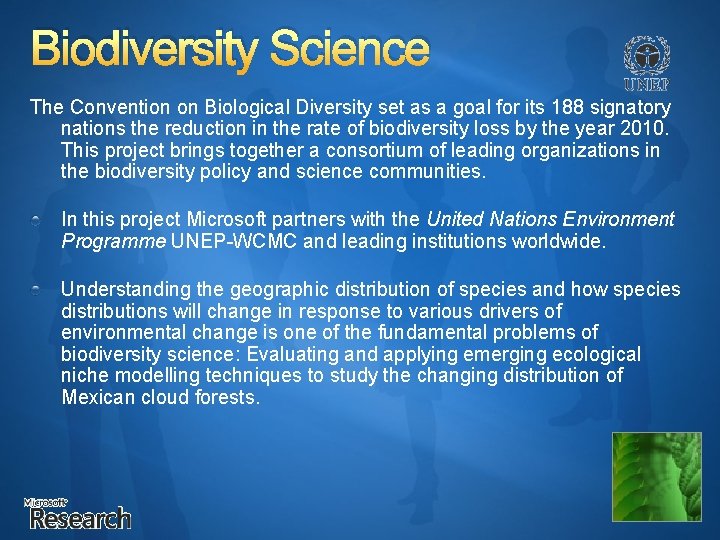
Biodiversity Science The Convention on Biological Diversity set as a goal for its 188 signatory nations the reduction in the rate of biodiversity loss by the year 2010. This project brings together a consortium of leading organizations in the biodiversity policy and science communities. In this project Microsoft partners with the United Nations Environment Programme UNEP-WCMC and leading institutions worldwide. Understanding the geographic distribution of species and how species distributions will change in response to various drivers of environmental change is one of the fundamental problems of biodiversity science: Evaluating and applying emerging ecological niche modelling techniques to study the changing distribution of Mexican cloud forests.
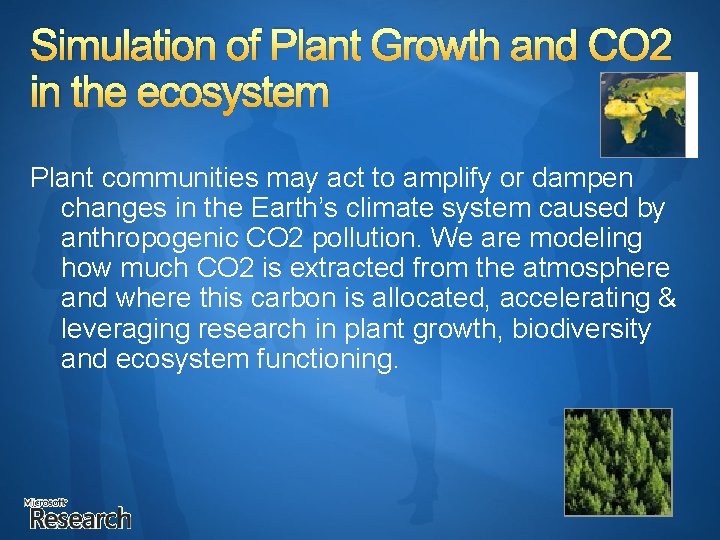
Simulation of Plant Growth and CO 2 in the ecosystem Plant communities may act to amplify or dampen changes in the Earth’s climate system caused by anthropogenic CO 2 pollution. We are modeling how much CO 2 is extracted from the atmosphere and where this carbon is allocated, accelerating & leveraging research in plant growth, biodiversity and ecosystem functioning.
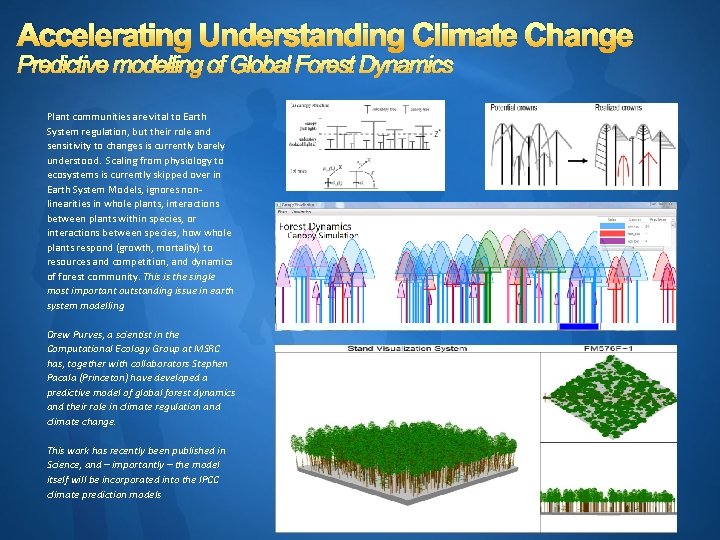
Accelerating Understanding Climate Change Predictive modelling of Global Forest Dynamics Plant communities are vital to Earth System regulation, but their role and sensitivity to changes is currently barely understood. Scaling from physiology to ecosystems is currently skipped over in Earth System Models, ignores nonlinearities in whole plants, interactions between plants within species, or interactions between species, how whole plants respond (growth, mortality) to resources and competition, and dynamics of forest community. This is the single most important outstanding issue in earth system modelling Drew Purves, a scientist in the Computational Ecology Group at MSRC has, together with collaborators Stephen Pacala (Princeton) have developed a predictive model of global forest dynamics and their role in climate regulation and climate change. This work has recently been published in Science, and – importantly – the model itself will be incorporated into the IPCC climate prediction models
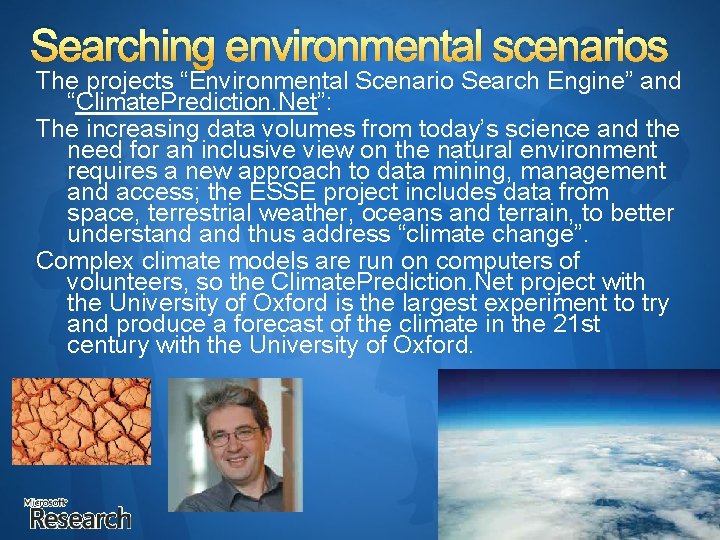
Searching environmental scenarios The projects “Environmental Scenario Search Engine” and “Climate. Prediction. Net”: The increasing data volumes from today’s science and the need for an inclusive view on the natural environment requires a new approach to data mining, management and access; the ESSE project includes data from space, terrestrial weather, oceans and terrain, to better understand thus address “climate change”. Complex climate models are run on computers of volunteers, so the Climate. Prediction. Net project with the University of Oxford is the largest experiment to try and produce a forecast of the climate in the 21 st century with the University of Oxford.
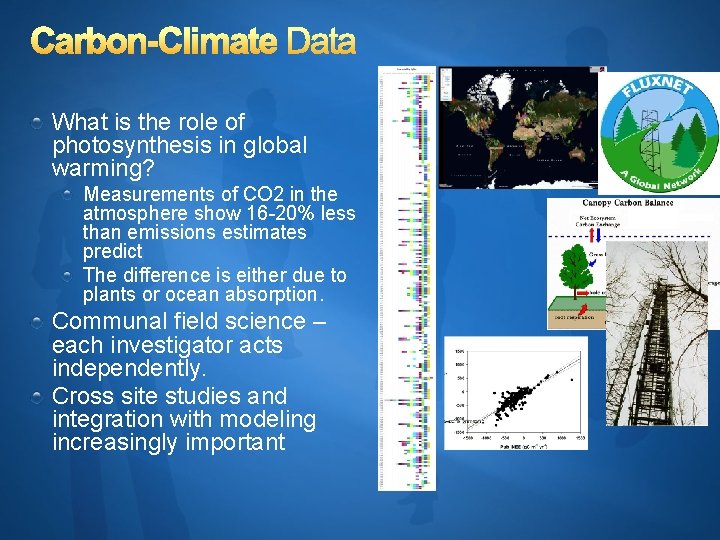
What is the role of photosynthesis in global warming? Measurements of CO 2 in the atmosphere show 16 -20% less than emissions estimates predict The difference is either due to plants or ocean absorption. Communal field science – each investigator acts independently. Cross site studies and integration with modeling increasingly important
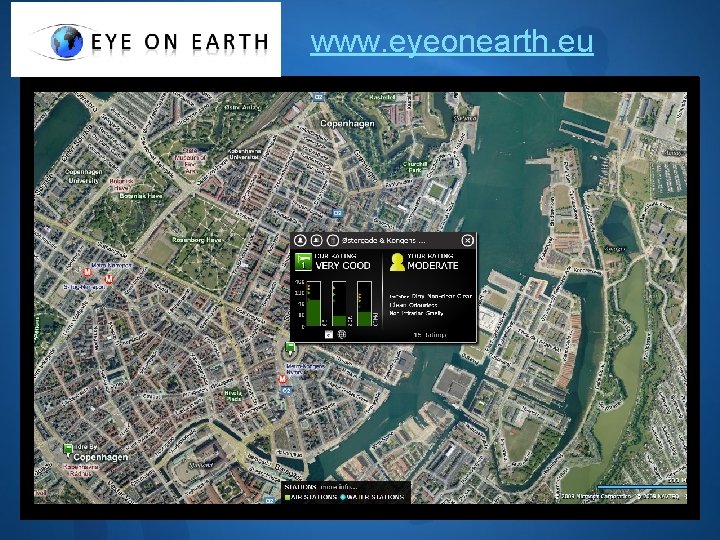
www. eyeonearth. eu

Visit us at: www. microsoft. com/environment © 2008 Microsoft Corporation. All rights reserved. Microsoft, Windows Vista and other product names are or may be registered trademarks and/or trademarks in the U. S. and/or other countries. The information herein is for informational purposes only and represents the current view of Microsoft Corporation as of the date of this presentation. Because Microsoft must respond to changing market conditions, it should not be interpreted to be a commitment on the part of Microsoft, and Microsoft cannot guarantee the accuracy of any information provided after the date of this presentation. MICROSOFT MAKES NO WARRANTIES, EXPRESS, IMPLIED OR STATUTORY, AS TO THE INFORMATION IN THIS PRESENTATION.
- Slides: 14