
Environmental Sustainability Analysis of Biodiesel Production A Comparative
Environmental Sustainability Analysis of Biodiesel Production - A Comparative Analysis of Different Production Schemes. I. T. Herrmann, Hauschild M. , and Birkved M. - Technical University of Denmark, Denmark. - Section for Quantitative Sustainability Assessment. May 4, 2009
Agenda 1. 2. 3. 4. 5. 6. 2 Introduction - Sustainability Environmental Life Cycle Assessment (LCA) LCA Model of Biodiesel Method Results Discussion and Outlook DTU Management Engineering, Technical University of Denmark Biodiesel 4. May 2009

1. Introduction - Sustainability • Environmental • Economic • Social Environmental Economic Social Sustainability 3 DTU Management Engineering, Technical University of Denmark Biodiesel 4. May 2009
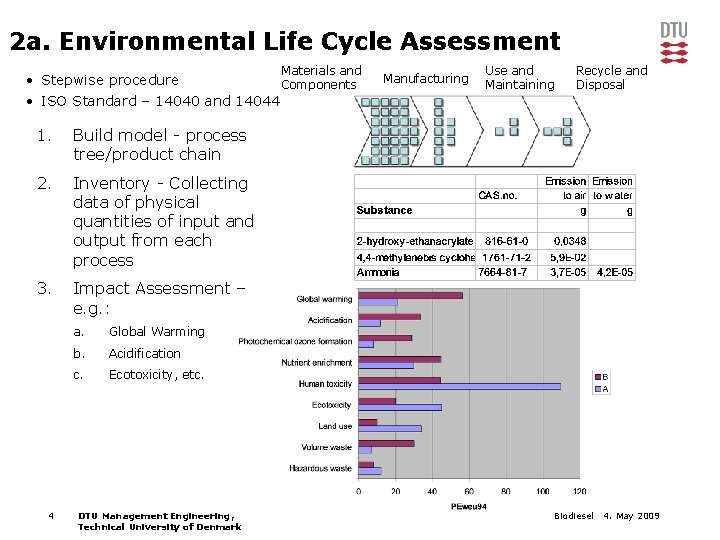
2 a. Environmental Life Cycle Assessment Materials and • Stepwise procedure Components • ISO Standard – 14040 and 14044 1. Build model - process tree/product chain 2. Inventory - Collecting data of physical quantities of input and output from each process 3. Impact Assessment – e. g. : 4 a. Global Warming b. Acidification c. Ecotoxicity, etc. DTU Management Engineering, Technical University of Denmark Manufacturing Use and Maintaining Recycle and Disposal Biodiesel 4. May 2009
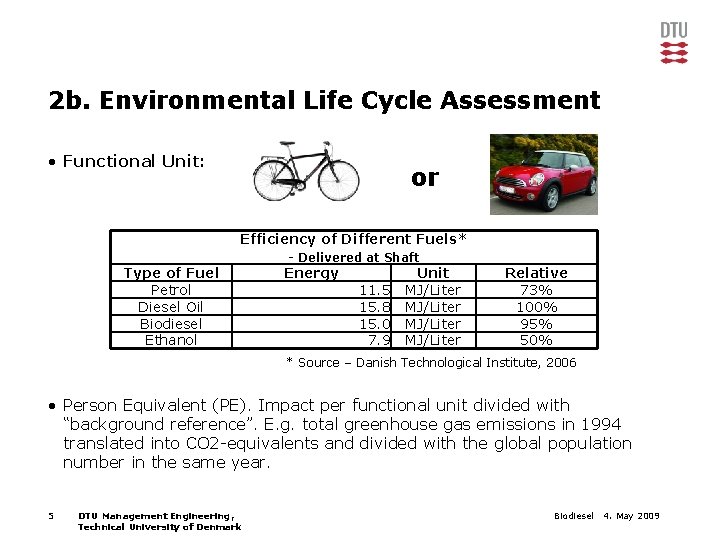
2 b. Environmental Life Cycle Assessment • Functional Unit: or Efficiency of Different Fuels* Type of Fuel Petrol Diesel Oil Biodiesel Ethanol - Delivered at Shaft Energy 11. 5 15. 8 15. 0 7. 9 Unit MJ/Liter Relative 73% 100% 95% 50% * Source – Danish Technological Institute, 2006 • Person Equivalent (PE). Impact per functional unit divided with “background reference”. E. g. total greenhouse gas emissions in 1994 translated into CO 2 -equivalents and divided with the global population number in the same year. 5 DTU Management Engineering, Technical University of Denmark Biodiesel 4. May 2009
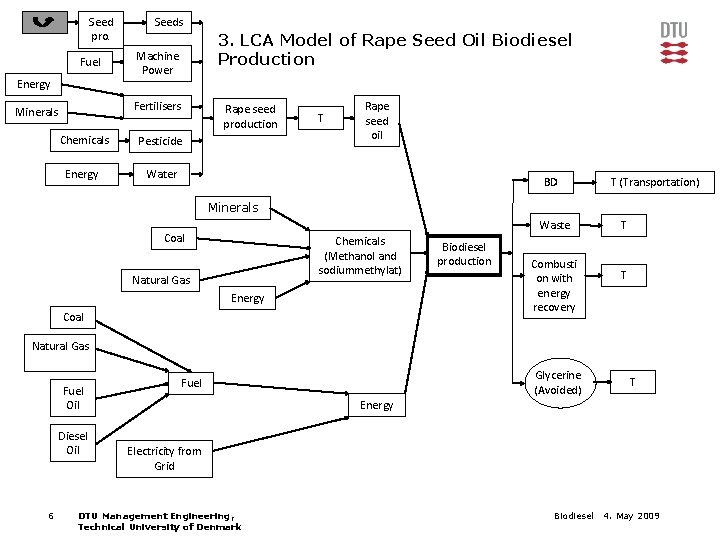
Seed pro. Fuel Energy Seeds 3. LCA Model of Rape Seed Oil Biodiesel Production Machine Power Fertilisers Minerals Chemicals Pesticide Energy Water Rape seed production T Rape seed oil BD T (Transportation) Minerals Waste Coal Chemicals (Methanol and sodiummethylat) Natural Gas Energy Coal Biodiesel production Combusti on with energy recovery T T Natural Gas Fuel Oil Diesel Oil 6 Glycerine (Avoided) Fuel T Energy Electricity from Grid DTU Management Engineering, Technical University of Denmark Biodiesel 4. May 2009
4. Method • Using “Sima. Pro” Program. • For this initial analysis we have used the “Ecoinvent” database and a few data from the our stakeholders. • For life cycle impact assessment we have used the EDIP 97 method with the normalization reference year 1994. 7 DTU Management Engineering, Technical University of Denmark Biodiesel 4. May 2009
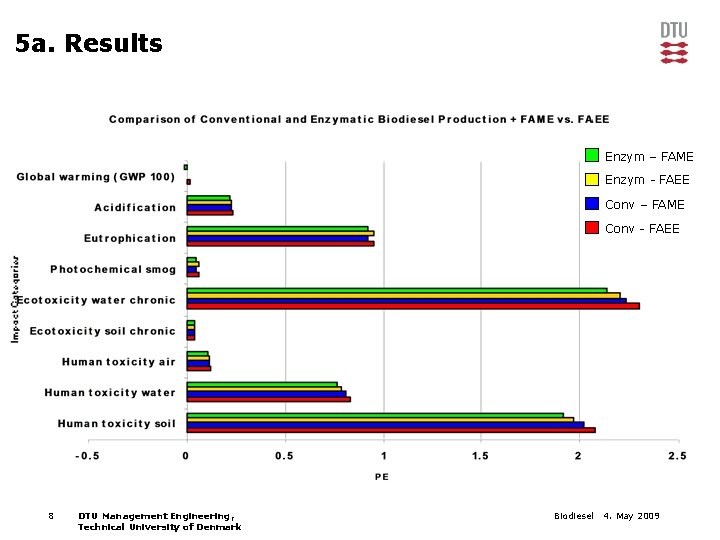
5 a. Results Enzym – FAME Enzym - FAEE Conv – FAME Conv - FAEE 8 DTU Management Engineering, Technical University of Denmark Biodiesel 4. May 2009
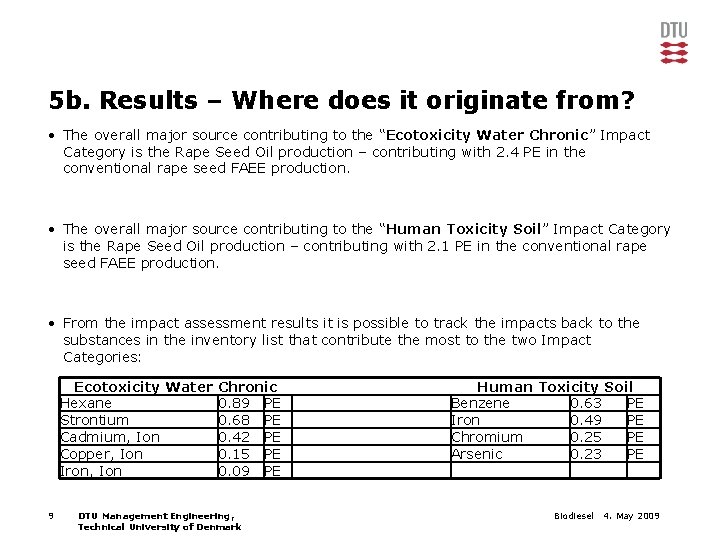
5 b. Results – Where does it originate from? • The overall major source contributing to the “Ecotoxicity Water Chronic” Impact Category is the Rape Seed Oil production – contributing with 2. 4 PE in the conventional rape seed FAEE production. • The overall major source contributing to the “Human Toxicity Soil” Impact Category is the Rape Seed Oil production – contributing with 2. 1 PE in the conventional rape seed FAEE production. • From the impact assessment results it is possible to track the impacts back to the substances in the inventory list that contribute the most to the two Impact Categories: Ecotoxicity Water Chronic Hexane 0. 89 PE Strontium 0. 68 PE Cadmium, Ion 0. 42 PE Copper, Ion 0. 15 PE Iron, Ion 0. 09 PE 9 DTU Management Engineering, Technical University of Denmark Human Toxicity Soil Benzene 0. 63 PE Iron 0. 49 PE Chromium 0. 25 PE Arsenic 0. 23 PE Biodiesel 4. May 2009
6. Discussion and Outlook • Main source of difference • Data uncertainties • Uncertainties of final results • Improved model • More accurate data • Different methods 10 DTU Management Engineering, Technical University of Denmark Biodiesel 4. May 2009
- Slides: 10