
Environmental Subsidies and Similar Transfers Progress report on
Environmental Subsidies and Similar Transfers: Progress report on data collection (point 8 of the agenda) Eurostat – Unit E 2 Georgia Dimitropoulou Georgia. Dimitropoulou@ec. europa. eu Joint meeting of the working groups Environmental accounts and Monetary environmental statistics and accounts Luxembourg, 14 May 2018
Outline • Background • Findings of 2017 data collection • • Data availability Coherence with COFOG and EPEA data A need to clarify the reporting convention First results • Plans for the 2018 data collection • Conclusions
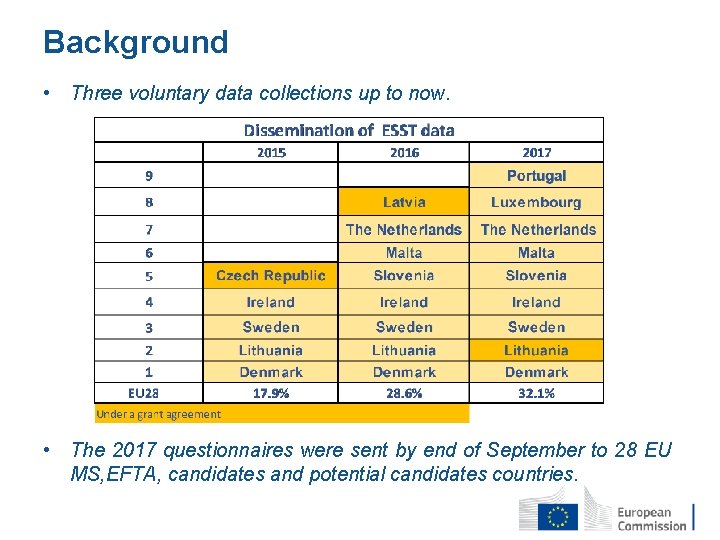
Background • Three voluntary data collections up to now. • The 2017 questionnaires were sent by end of September to 28 EU MS, EFTA, candidates and potential candidates countries.
Findings from the 2017 ESST data collection
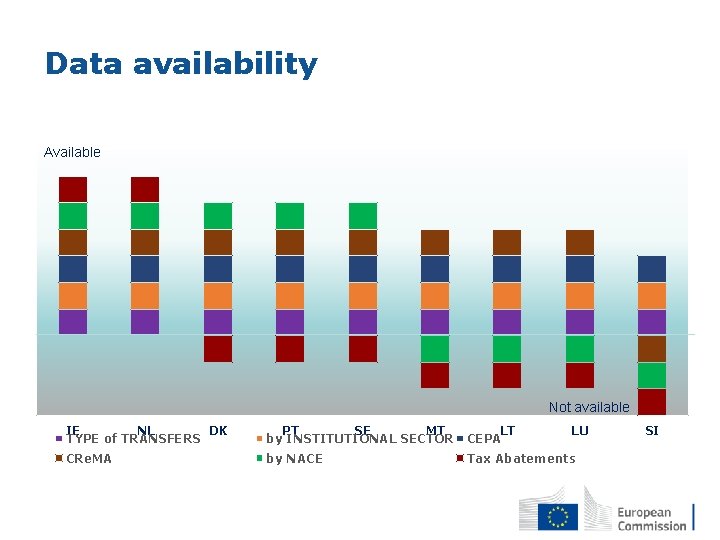
Data availability Available Not available IE NL DK TYPE of TRANSFERS PT SE MT by INSTITUTIONAL SECTOR LT CEPA LU CRe. MA by NACE Tax Abatements SI
Coherence with COFOG and EPEA • Large discrepancies between ESST CEPA totals and COFOG data. • Eurostat encourages the reporting countries to explain the reasons for discrepancies with COFOG in the metadata sheet of the questionnaire. • Small discrepancies between ESST data and EPEA data • • For most countries: coherence For those countries with differences: they are mainly due to reporting consolidation conventions for ESST and EPEA or due to data vintage.
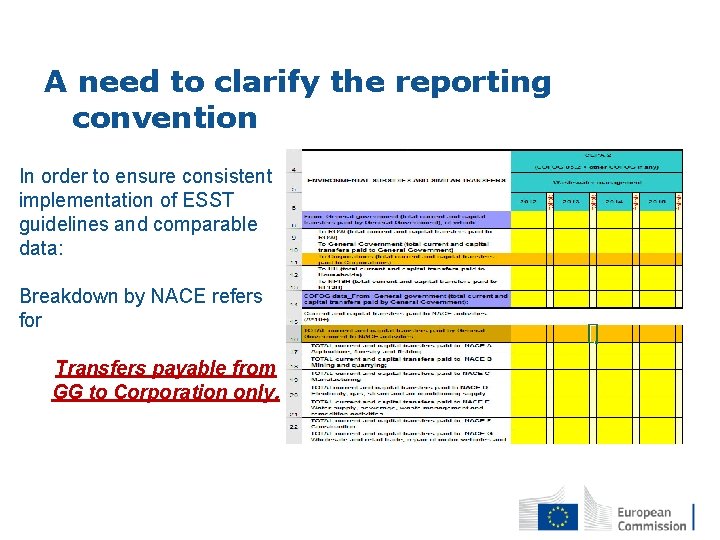
A need to clarify the reporting convention In order to ensure consistent implementation of ESST guidelines and comparable data: Breakdown by NACE refers for Transfers payable from GG to Corporation only.
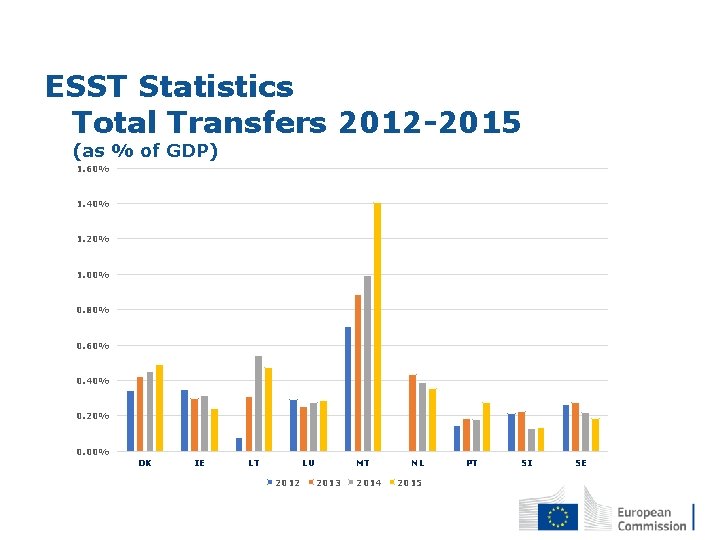
ESST Statistics Total Transfers 2012 -2015 (as % of GDP) 1. 60% 1. 40% 1. 20% 1. 00% 0. 80% 0. 60% 0. 40% 0. 20% 0. 00% DK IE LT LU 2012 MT 2013 2014 NL 2015 PT SI SE
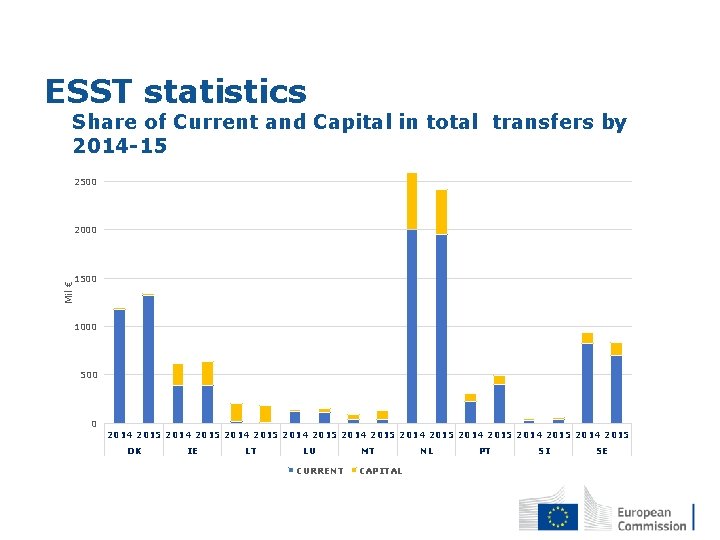
ESST statistics Share of Current and Capital in total transfers by 2014 -15 2500 2000 Mil € 1500 1000 500 0 2014 2015 2014 2015 2014 2015 DK IE LT LU CURRENT MT CAPITAL NL PT SI SE
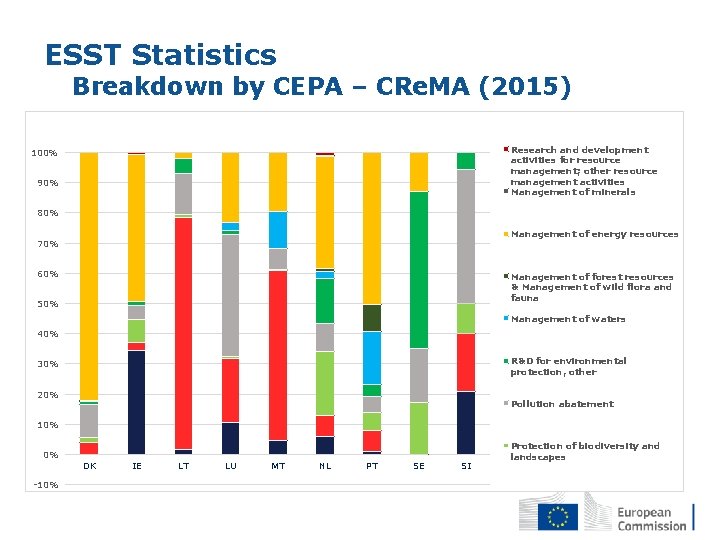
ESST Statistics Breakdown by CEPA – CRe. MA (2015) Research and development activities for resource management; other resource management activities Management of minerals 100% 90% 80% Management of energy resources 70% 60% Management of forest resources & Management of wild flora and fauna 50% Management of waters 40% R&D for environmental protection, other 30% 20% Pollution abatement 10% 0% -10% DK IE LT LU MT NL PT SE SI Protection of biodiversity and landscapes
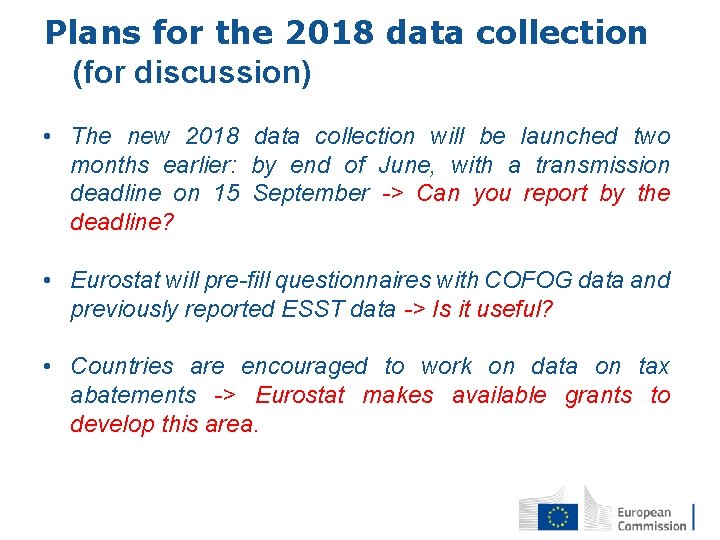
Plans for the 2018 data collection (for discussion) • The new 2018 data collection will be launched two months earlier: by end of June, with a transmission deadline on 15 September -> Can you report by the deadline? • Eurostat will pre-fill questionnaires with COFOG data and previously reported ESST data -> Is it useful? • Countries are encouraged to work on data on tax abatements -> Eurostat makes available grants to develop this area.
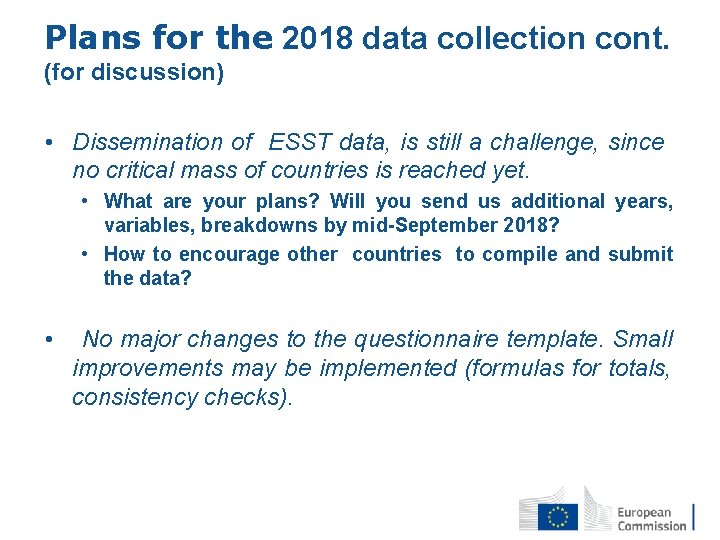
Plans for the 2018 data collection cont. (for discussion) • Dissemination of ESST data, is still a challenge, since no critical mass of countries is reached yet. • What are your plans? Will you send us additional years, variables, breakdowns by mid-September 2018? • How to encourage other countries to compile and submit the data? • No major changes to the questionnaire template. Small improvements may be implemented (formulas for totals, consistency checks).
Conclusions The Working Group members are requested to: • Comment on the new deadline for the 2018 ESST data transmission (mid-September proposed by Eurostat); • Report in the 2018 data collection the breakdown by NACE only for the transfers payable by general government to corporations (and not for total transfers); • Provide feedback on whether prefilling of the ESST questionnaires by Eurostat is useful and should continue; • Comment on difficulties in providing the breakdown of transfers by NACE and reporting data on tax abatements; • Inform the Working Group of intentions and efforts made to develop or improve the completeness and quality of ESST data for their countries; • Share views and proposals on how to increase the number of reporting countries and the completeness of the datasets to achieve a critical mass for future data dissemination.
- Slides: 13