
ENVIRONMENTAL STUDIES Natural Resources Environmental Studies 2 e

- Slides: 49
ENVIRONMENTAL STUDIES & Natural Resources Environmental Studies, 2 e © Oxford University Press 2011 All rights reserved
Environment Definition: The complex set of physical, geographic, biological, social, cultural and political conditions that surround an individual or organism and that ultimately determines its form and nature of its survival. 1) All factors living and nonliving that affect an individual organism or population at any point in the life cycle. 2) Set of circumstances surrounding a particular occurrence. 3) All the things that surrounds us. Environmental Studies, 2 e © Oxford University Press 2011 All rights reserved
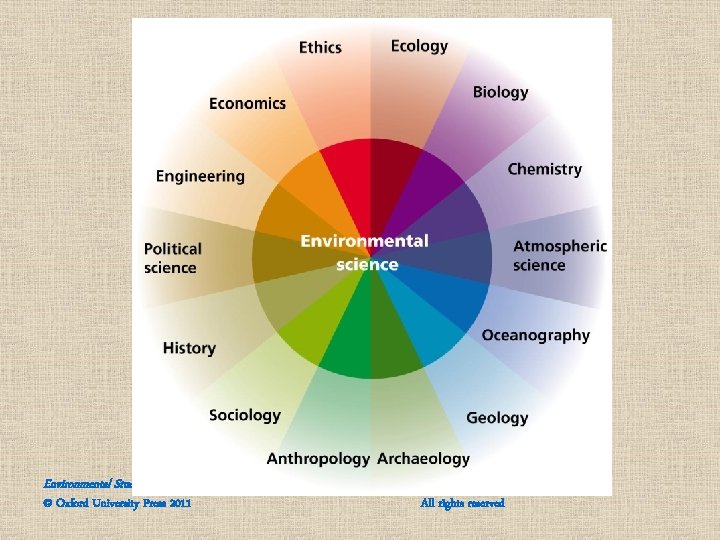
Environmental Science An interdisciplinary branch of science that investigates questions related to the human population, resources, and damages caused by pollution and disturbance. Environmental science is integrative and involves complex biology, chemistry, politics, sociology, geology, agriculture, economics. Environmental Studies, 2 e © Oxford University Press 2011 All rights reserved
Environment is of two types: Natural Environment Man - Made Environmental Studies, 2 e © Oxford University Press 2011 All rights reserved
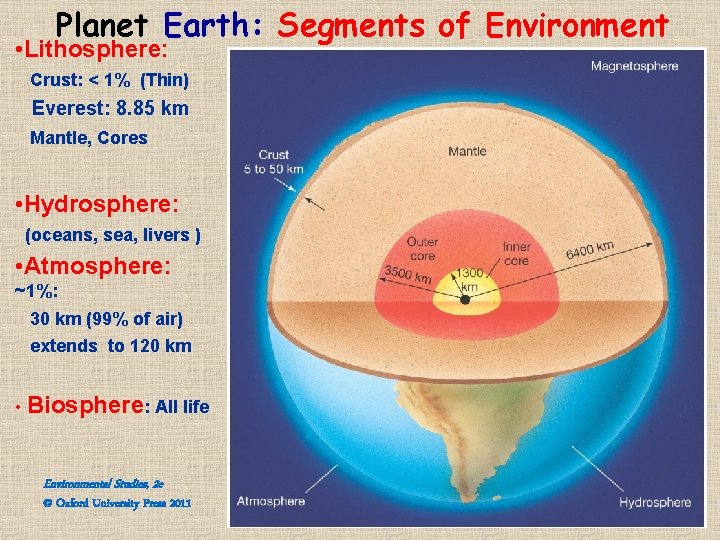
Planet Earth: Segments of Environment • Lithosphere: Crust: < 1% (Thin) Everest: 8. 85 km Mantle, Cores • Hydrosphere: (oceans, sea, livers ) • Atmosphere: ~1%: 30 km (99% of air) extends to 120 km • Biosphere: All life Environmental Studies, 2 e © Oxford University Press 2011 All rights reserved
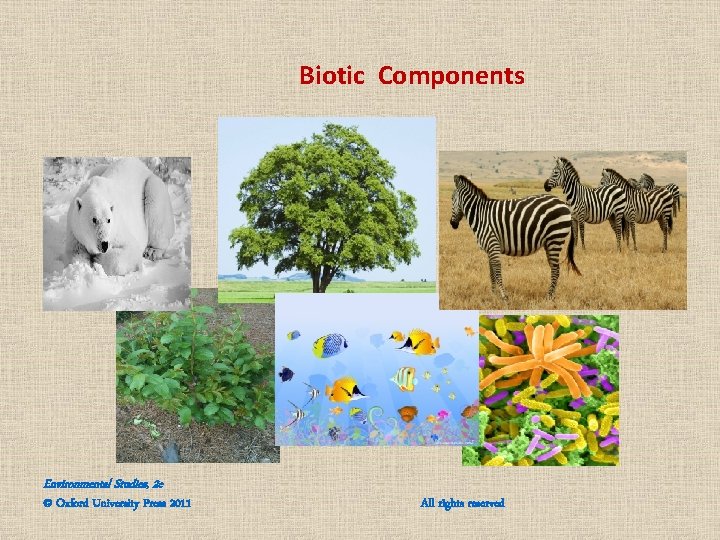
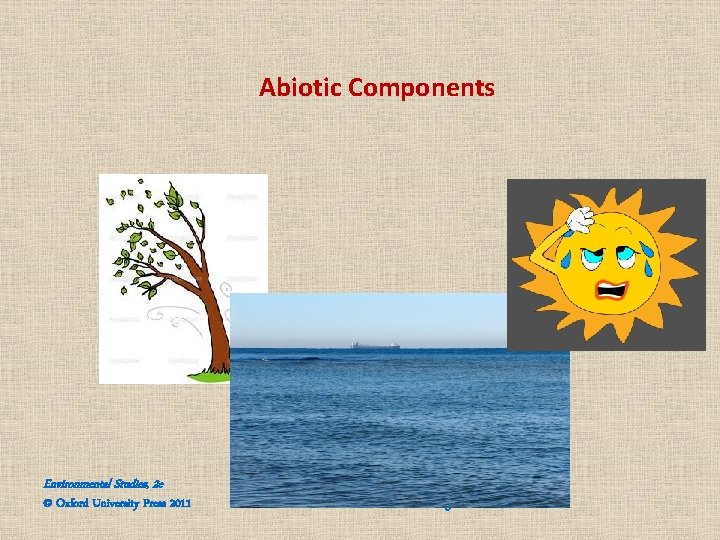
Components of Environment • (I)Biotic (Living things) • Animals, • plants, forests, • fungi, etc. Environmental Studies, 2 e © Oxford University Press 2011 (ii) Abiotic (Nonliving things) Air, water, soil, clouds, rock All rights reserved
Biotic Components Environmental Studies, 2 e © Oxford University Press 2011 All rights reserved
Abiotic Components Environmental Studies, 2 e © Oxford University Press 2011 All rights reserved
Humans and the world around us • Humans change the environment, often in ways not fully understood • We depend completely on the environment for survival • Increased wealth, health, mobility, leisure time • But, natural systems have been degraded - i. e. , pollution, erosion and species extinction • Environmental changes threaten long-term health and survival • Environmental science is the study of: • How the natural world works • How the environment affects humans and vice versa Environmental Studies, 2 e © Oxford University Press 2011 All rights reserved
Objective of This Course • Develop a concern for our environment. • Begin to act at your own level to protect the environment as we all live in. Environmental Studies, 2 e © Oxford University Press 2011 All rights reserved
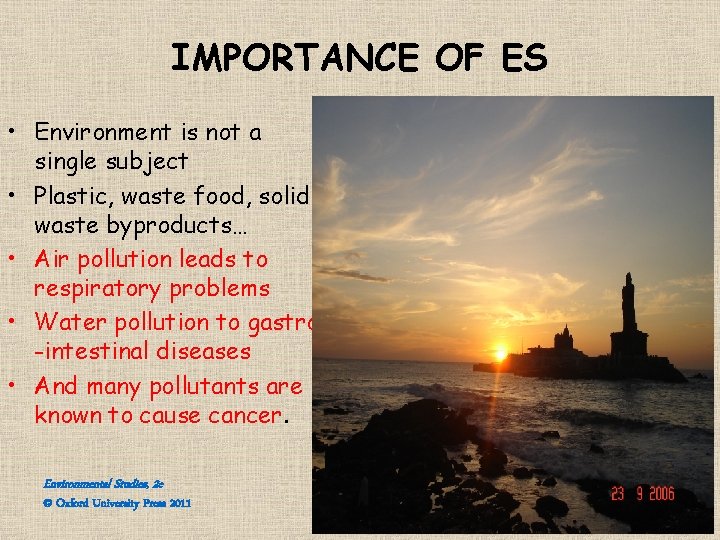
IMPORTANCE OF ES • Environment is not a single subject • Plastic, waste food, solid waste byproducts… • Air pollution leads to respiratory problems • Water pollution to gastro -intestinal diseases • And many pollutants are known to cause cancer. Environmental Studies, 2 e © Oxford University Press 2011 All rights reserved
Scope and Importance • We live in natural surrounding (forest, river, mountain, etc. ). Resources: renewable (forest and water) and nonrenewable (minerals and oil). • Due to increase in population these resources are getting depleted gradually. • There is a need to understand make ourselves aware of our natural assets and get concerned about our environment and sustainable utilize the resources. • Scope of environmental studies is very wide and nearly covers some aspects of every major discipline (biology, chemistry, physics, geography, resource management, economy, etc. ). Environmental Studies, 2 e © Oxford University Press 2011 All rights reserved
Importance • Water, air, soil, forests are all part of our life support systems. Without them life itself would be impossible. • Natural resources are limited in nature and continue to shrink and may be get depleted if not utilized in a sustainable manner. • Almost every act of human beings cause some effect on environment: solid waste, water pollution, air pollution, soil pollution , etc. And these have ill-effect on human health. • Individual efforts together with the public and also government actions are needed to protect our environment from further more degradation and safeguard Environmental Studies, 2 e it. © Oxford University Press 2011 All rights reserved
THE MULTIDISCIPLINARY NATURE OF ENVIRONMENTAL STUDIES Environmental. Studies, , 2 e 2 e Environmental Oxford. University. Press 2011 ©©Oxford All rights reserved
Environmental Studies, 2 e © Oxford University Press 2011 All rights reserved
Need for Public Awareness • Earth’s resources are dwindling and our environment is being increasingly degraded by human activities and hence something needs to be done. • Government alone cannot perform all the clean-up functions. • Individual/group efforts in their own every possible way has to be made to protect our environment. • Mass public awareness: newspapers, radio, television strongly influences public opinion on conserving our environment. Environmental Studies, 2 e © Oxford University Press 2011 All rights reserved
Objectives of Public Awareness • To identify various plants, animals and other endangered components of environment • To take appropriate decisions regarding the use of natural resources (use in sustainable manner) • To adopt appropriate ways/methods to solve existing environmental problems Environmental Studies, 2 e © Oxford University Press 2011 All rights reserved
Methods for Public Awareness • • Environmental education Through media Through organizing seminars & conferences Entertainment Science centres Involvement of youth Through print, broadcast and internet Environmental Studies, 2 e © Oxford University Press 2011 All rights reserved
ECOLOGY How does “Environment” differ from “Ecology” Environmental Studies, 2 e © Oxford University Press 2011 All rights reserved
Ecology (Greek word: Okologie; meaning: “place to live”) “Physical, biological and socio cultural adaptations” Branch of science that deals with the scientific study of the interrelationships between living organisms with respect to each other and to their surroundings. Environmental Studies, 2 e © Oxford University Press 2011 All rights reserved
« Natural Resources » Environmental Studies, 2 e © Oxford University Press 2011 All rights reserved
What are natural resources? • A natural resource may be defined as any material given to us by nature which can be transformed in a way that it becomes more valuable and useful for human being or life on earth. Natural resources sustain human life. • Every man-made product is composed of natural resources • http: //www. youtube. com/watch? v=crs 2 e 2 KW FT 0 • http: //www. youtube. com/watch? v=a_6 M 3 CNZ Rk. UStudies, 2 e Environmental © Oxford University Press 2011 All rights reserved
For example: Ø wood is used for making furniture. Ø Yarn obtained from cotton is used for weaving cloth. Ø Likewise, various machine, tools and household goods are made of metals. Ø Now furniture, clothes, machine, tools are more valuable than their raw form i. e. like wood, cotton and metal, respectively. Environmental Studies, 2 e © Oxford University Press 2011 All rights reserved
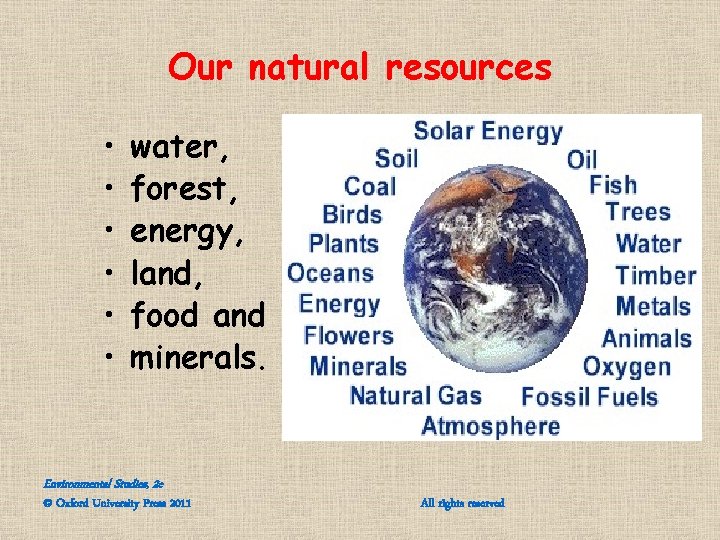
Our natural resources • • • water, forest, energy, land, food and minerals. Environmental Studies, 2 e © Oxford University Press 2011 All rights reserved
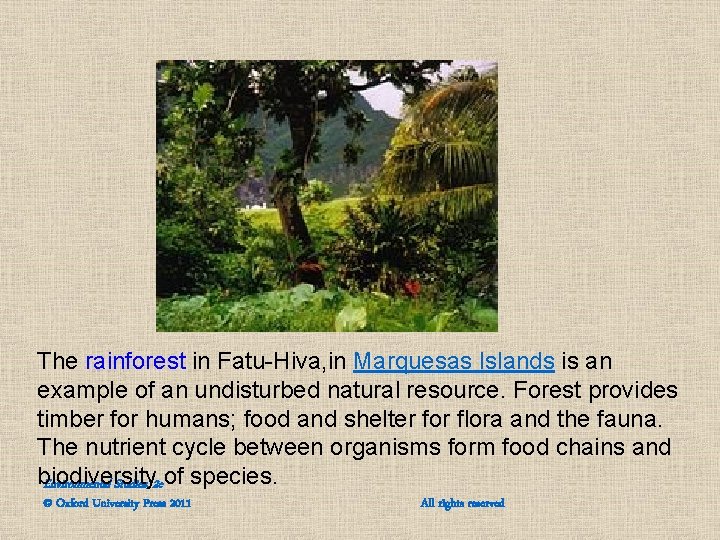
The rainforest in Fatu-Hiva, in Marquesas Islands is an example of an undisturbed natural resource. Forest provides timber for humans; food and shelter for flora and the fauna. The nutrient cycle between organisms form food chains and biodiversity Environmental Studies, 2 e of species. © Oxford University Press 2011 All rights reserved
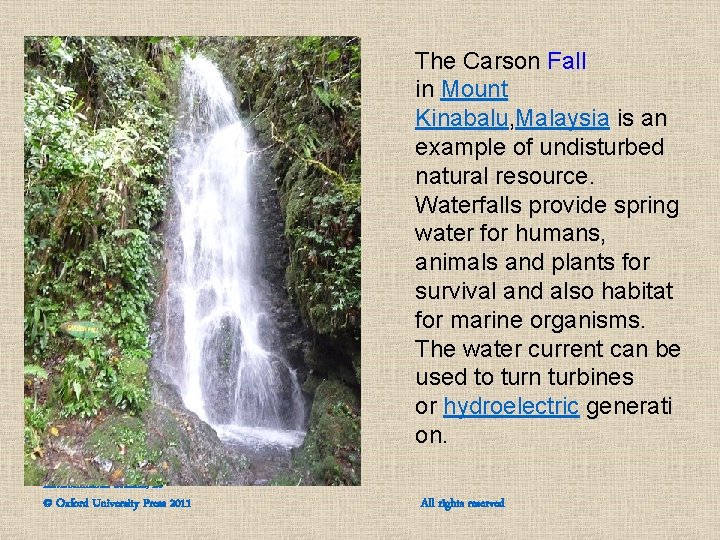
The Carson Fall in Mount Kinabalu, Malaysia is an example of undisturbed natural resource. Waterfalls provide spring water for humans, animals and plants for survival and also habitat for marine organisms. The water current can be used to turn turbines or hydroelectric generati on. Environmental Studies, 2 e © Oxford University Press 2011 All rights reserved
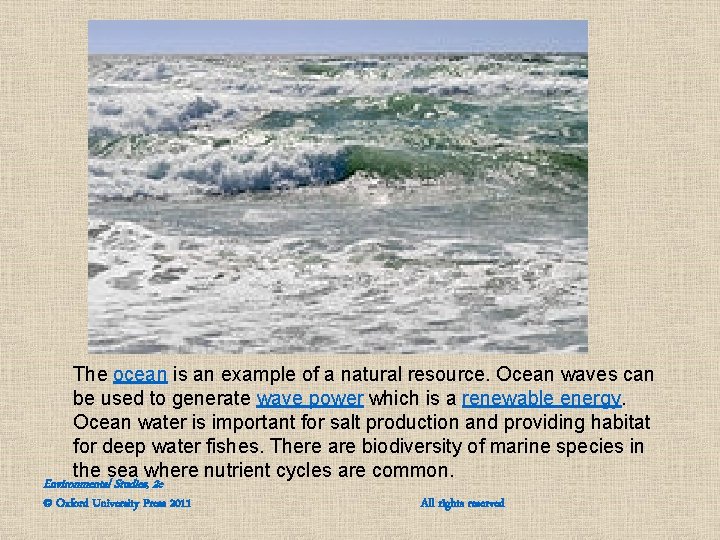
The ocean is an example of a natural resource. Ocean waves can be used to generate wave power which is a renewable energy. Ocean water is important for salt production and providing habitat for deep water fishes. There are biodiversity of marine species in the sea where nutrient cycles are common. Environmental Studies, 2 e © Oxford University Press 2011 All rights reserved
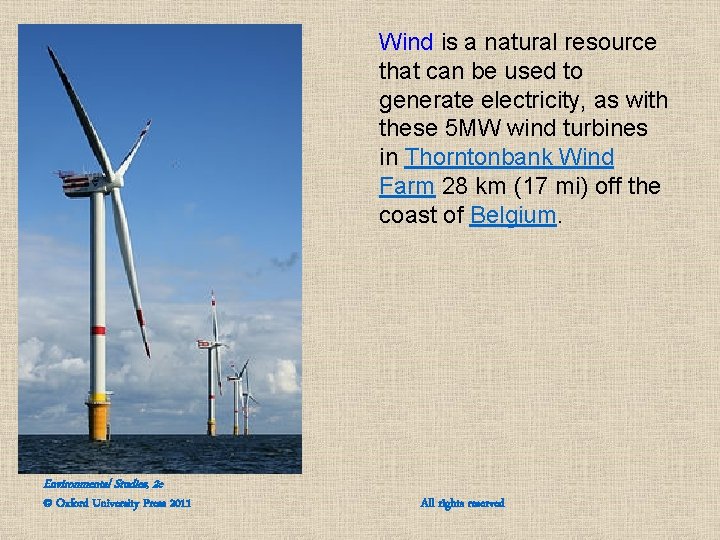
Wind is a natural resource that can be used to generate electricity, as with these 5 MW wind turbines in Thorntonbank Wind Farm 28 km (17 mi) off the coast of Belgium. Environmental Studies, 2 e © Oxford University Press 2011 All rights reserved
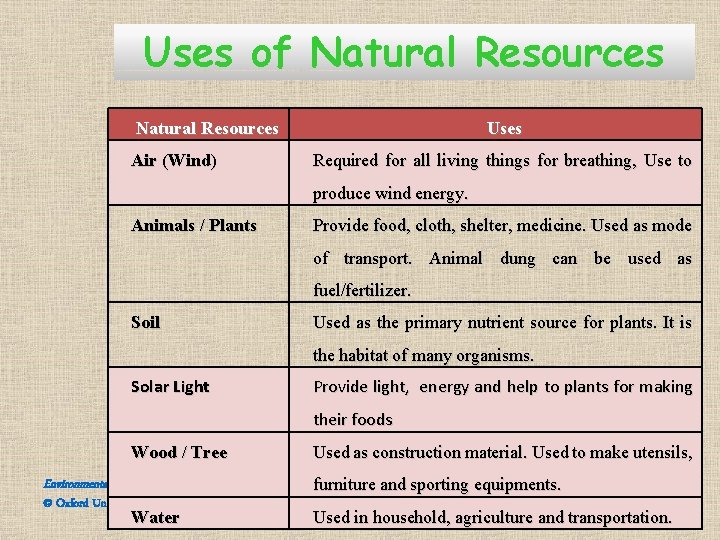
Uses of Natural Resources Air (Wind) Uses Required for all living things for breathing, Use to produce wind energy. Animals / Plants Provide food, cloth, shelter, medicine. Used as mode of transport. Animal dung can be used as fuel/fertilizer. Soil Used as the primary nutrient source for plants. It is the habitat of many organisms. Solar Light Provide light, energy and help to plants for making their foods Wood / Tree Environmental Studies, 2 e © Oxford University Press 2011 Water Used as construction material. Used to make utensils, furniture and sporting equipments. All rights reserved Used in household, agriculture and transportation.
Classification of Natural Resources • Natural Resources on the basis of Origin: • (1) Biotic Resources: • The Resources that are derived from the living world (animals, plants). • e. g. , Wood, Humus, Manure etc. • (2) Abiotic Resources • The Resources that are derived from the non-living world (land, water and air). Environmental Studies, 2 e © Oxford University Press 2011 All rights reserved
Natural Resources on the basis of continual utility: (1) Renewable Resources: These resources can be replenished (refilled) by naturally. Resources, which can be renewed along with their exploitation, are always available for use. Hence they are called renewable resources. Some of these resources, like sunlight, air, wind, etc. , are continuously available and their quantity is noticeably affected by human consumption. e. g. , Plants, animals, solar energy, wind energy etc. (2) Non-renewable Resources: The natural resources that can not be replenished naturally. e. g. , Coal, minearls, petroleum, fossil fuels etc. Their stock is limited in nature. Once they are used in unlimited way, they cannot be easily replaced. Thus, their exploitation at large scale will result in their fast depletion that may cause serious problem for future generations. Environmental Studies, 2 e © Oxford University Press 2011 All rights reserved
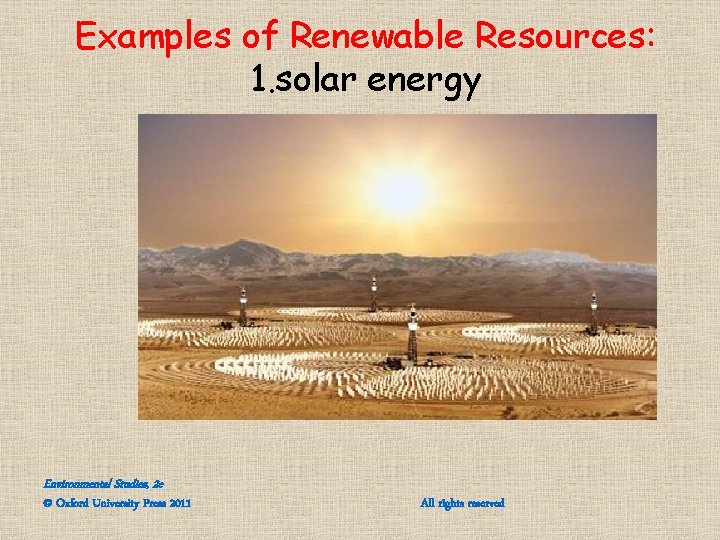
Examples of Renewable Resources: 1. solar energy Environmental Studies, 2 e © Oxford University Press 2011 All rights reserved
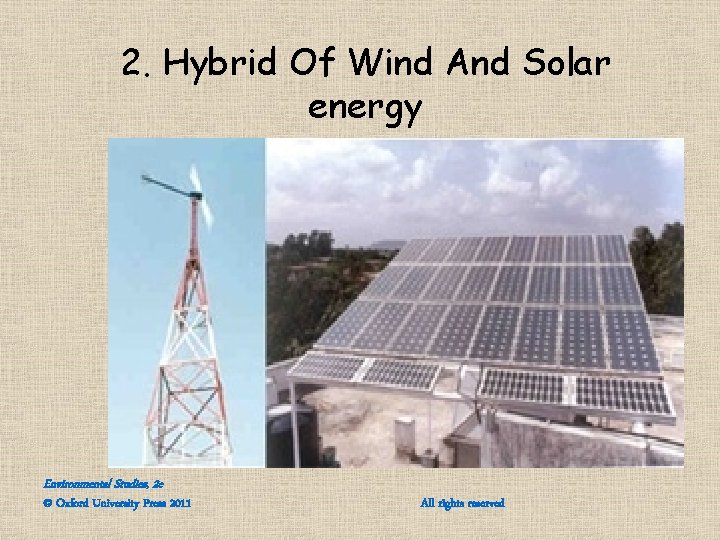
2. Hybrid Of Wind And Solar energy Environmental Studies, 2 e © Oxford University Press 2011 All rights reserved
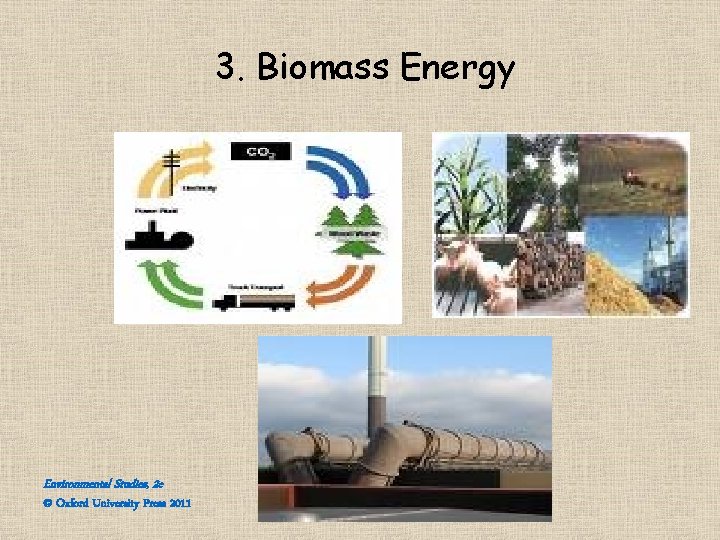
3. Biomass Energy Environmental Studies, 2 e © Oxford University Press 2011 All rights reserved
Examples of Non-renewable Resources ØCOAL ØOIL ØNATURAL GAS ØOIL SHALE AND TAR SANDS ØNUCLEAR POWER Over 85% of the energy used in the world is from nonrenewable supplies Most developed nations are dependent on non-renewable energy sources such as fossil fuels (coal and oil) and nuclear power. Industrialized societies depend on non-renewable energy Environmental Studies, 2 e sources. © Oxford University Press 2011 All rights reserved
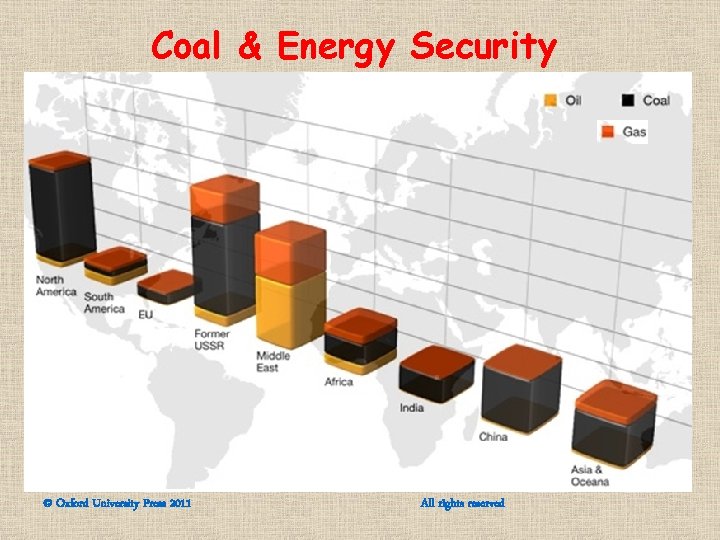
Coal & Energy Security Environmental Studies, 2 e © Oxford University Press 2011 All rights reserved
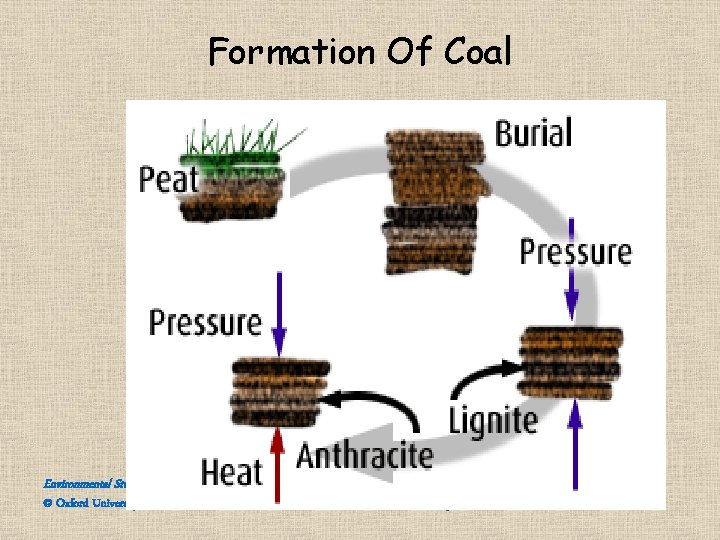
COAL • Coal is the most abundant fossil fuel in the world with an estimated reserve of one trillion metric tons. • world's coal reserves exist in Eastern Europe, Asia and considerable amount in United States. • Coal formed slowly over millions of years from the buried remains of ancient submerged Environmental Studies, 2 e plants © Oxford University Press 2011 All rights reserved
Formation Of Coal Environmental Studies, 2 e © Oxford University Press 2011 All rights reserved
Types of coal • Coal are formed due to differences in the pressure and temperature during formation. • Peat coal • Lignite coal. about 50% carbon , highest water 50%, low amounts of smog-causing sulfur. • Bituminous coal about 85% carbon and 3% water • Anthracite coal almost 100% carbon , hardest form of coal. Environmental Studies, 2 e © Oxford University Press 2011 All rights reserved
Use Of Coal • Coal is used to produce 50% of the electricity in the United States. • used for heating and cooking in less developed countries while rural areas of developed countries. Environmental Studies, 2 e © Oxford University Press 2011 All rights reserved
OIL • Crude oil or liquid petroleum, is a fossil fuel that is refined into many different energy products. • Oil forms underground in rock such as shale, which is rich in organic materials. Wells are drilled into these oil reservoirs to remove the gas and oil. • e. g. , Gasoline, diesel, petrol fuel, jet fuel, heating oil etc. Environmental Studies, 2 e © Oxford University Press 2011 All rights reserved
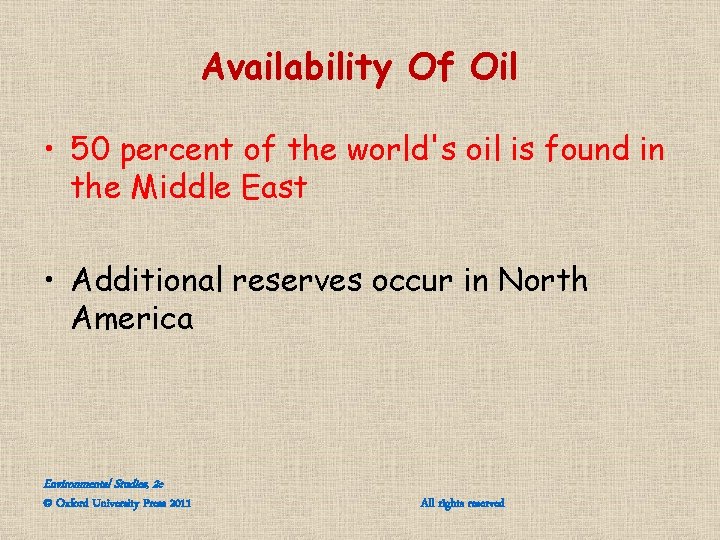
Availability Of Oil • 50 percent of the world's oil is found in the Middle East • Additional reserves occur in North America Environmental Studies, 2 e © Oxford University Press 2011 All rights reserved
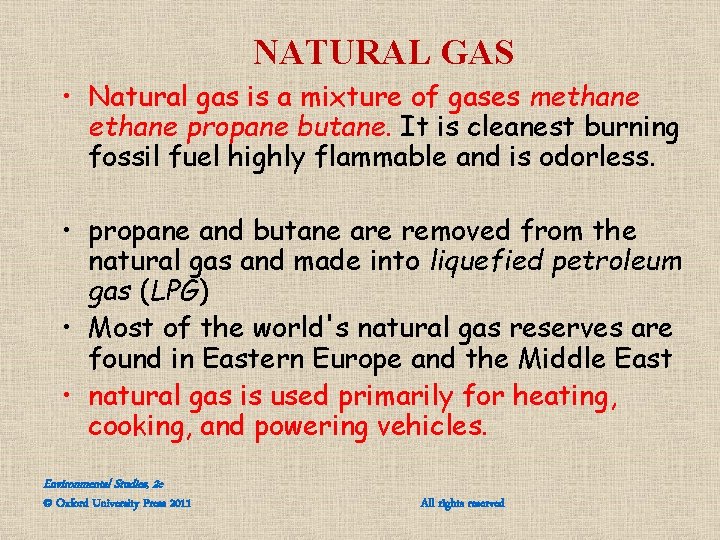
NATURAL GAS • Natural gas is a mixture of gases methane propane butane. It is cleanest burning fossil fuel highly flammable and is odorless. • propane and butane are removed from the natural gas and made into liquefied petroleum gas (LPG) • Most of the world's natural gas reserves are found in Eastern Europe and the Middle East • natural gas is used primarily for heating, cooking, and powering vehicles. Environmental Studies, 2 e © Oxford University Press 2011 All rights reserved
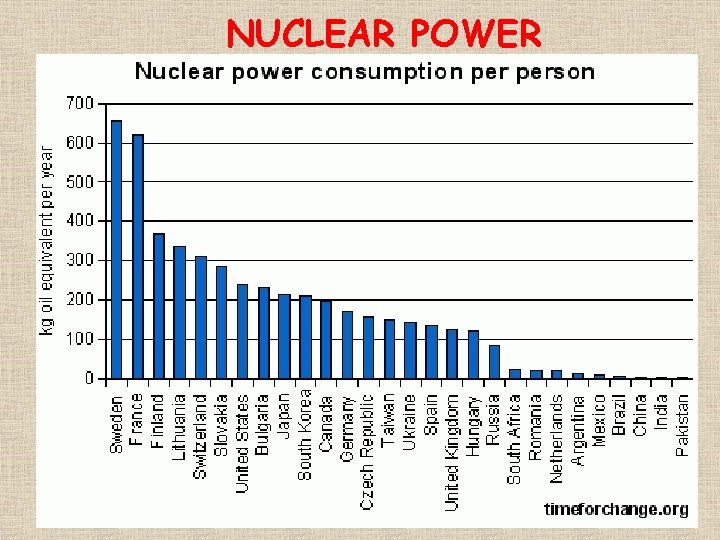
NUCLEAR POWER Environmental Studies, 2 e © Oxford University Press 2011 All rights reserved
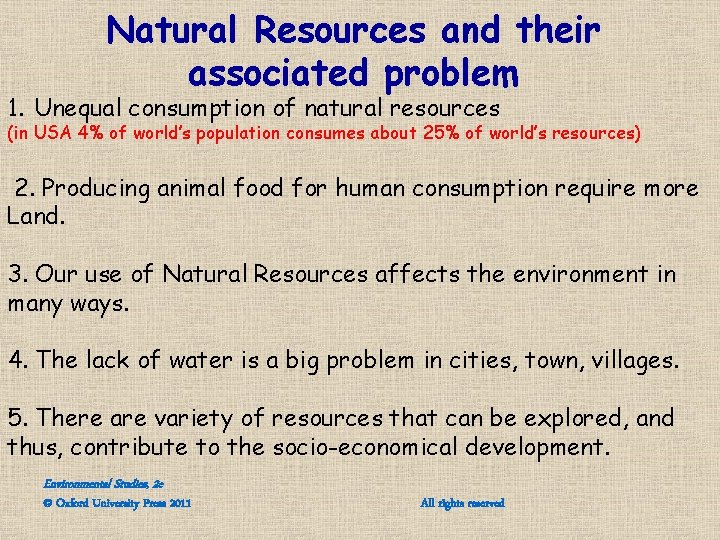
Natural Resources and their associated problem 1. Unequal consumption of natural resources (in USA 4% of world’s population consumes about 25% of world’s resources) 2. Producing animal food for human consumption require more Land. 3. Our use of Natural Resources affects the environment in many ways. 4. The lack of water is a big problem in cities, town, villages. 5. There are variety of resources that can be explored, and thus, contribute to the socio-economical development. Environmental Studies, 2 e © Oxford University Press 2011 All rights reserved
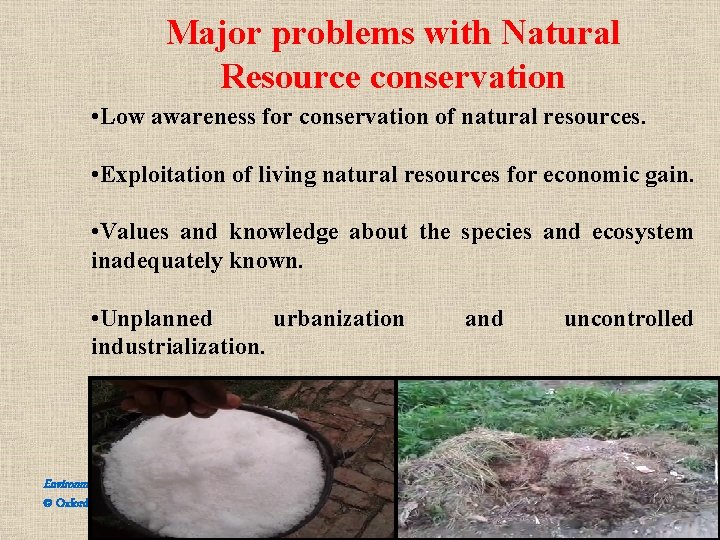
Major problems with Natural Resource conservation • Low awareness for conservation of natural resources. • Exploitation of living natural resources for economic gain. • Values and knowledge about the species and ecosystem inadequately known. • Unplanned urbanization industrialization. Environmental Studies, 2 e © Oxford University Press 2011 and All rights reserved uncontrolled
Major Natural Resource threats • Habitat destruction • Extension of agriculture • Filling up of wetlands • Conversion of rich bio-diversity site for human settlement and industrial development • Uncontrolled commercial exploitation Environmental Studies, 2 e © Oxford University Press 2011 All rights reserved
Environmental Public Education and Awareness • Environmental education and awareness is increasingly being promoted as a tool in managing our environment. • In the 20 th century serious environmental concerns like pollution, climate change, biodiversity, etc have triggered great concern about the relationship between humanity and the environment • In 1978 UNESCO Declaration, mentioned the need for environmental education. This Declaration Convention defined environmental education as “ a process of developing a world population that is aware of and concerned about the total environment and its associated problems, and which has the knowledge, skills, attitudes, motivation and commitment to work individually and collectively towards solution of current Environmental Studies, and 2 e problems the prevention of new ones”. © Oxford University Press 2011 All rights reserved
Contd. . In recent years, the depletion of natural resources has become a major focus of governments and organizations such as the United Nations (UN). In the UN's Agenda 21 Section Two, which outlines the necessary steps to be taken by countries to sustain their natural resources. The depletion of natural resources is considered to be a sustainable development issue. The term sustainable development has many interpretations, most notably the Brundtland Commission's 'to ensure that it meets the needs of the present without compromising the ability of future generations to meet their own needs. Environmental Studies, 2 e © Oxford University Press 2011 All rights reserved