
Environmental Stewardship Tool Training Objectives By the end
Environmental Stewardship Tool
Training Objectives By the end of the session, participants will understand: • Why we promote Environmental Stewardship in development and humanitarian programming • What the tool intends to do • When to use the tool • Who should use the tool • How to use the tool • Practice using the tool using a scenario from development or humanitarian context
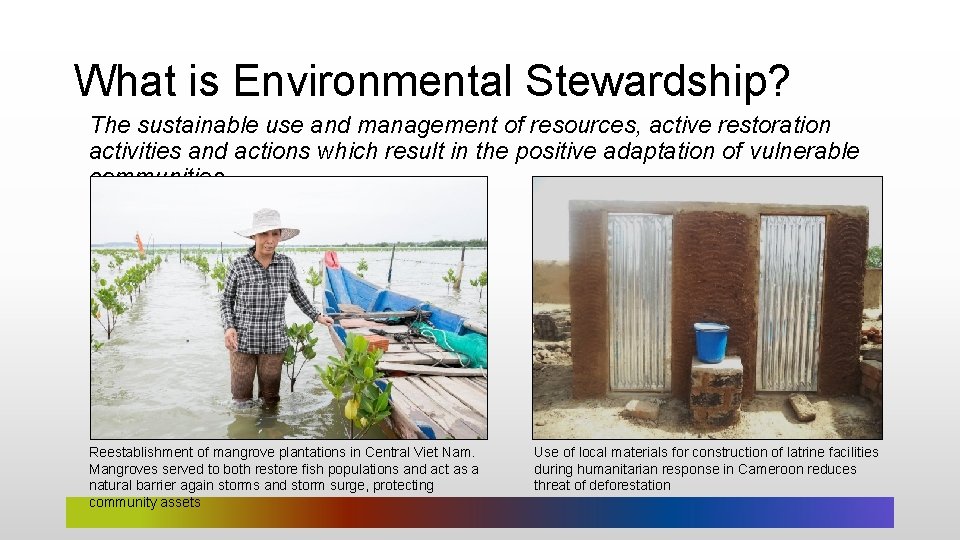
What is Environmental Stewardship? The sustainable use and management of resources, active restoration activities and actions which result in the positive adaptation of vulnerable communities Reestablishment of mangrove plantations in Central Viet Nam. Mangroves served to both restore fish populations and act as a natural barrier again storms and storm surge, protecting community assets Use of local materials for construction of latrine facilities during humanitarian response in Cameroon reduces threat of deforestation
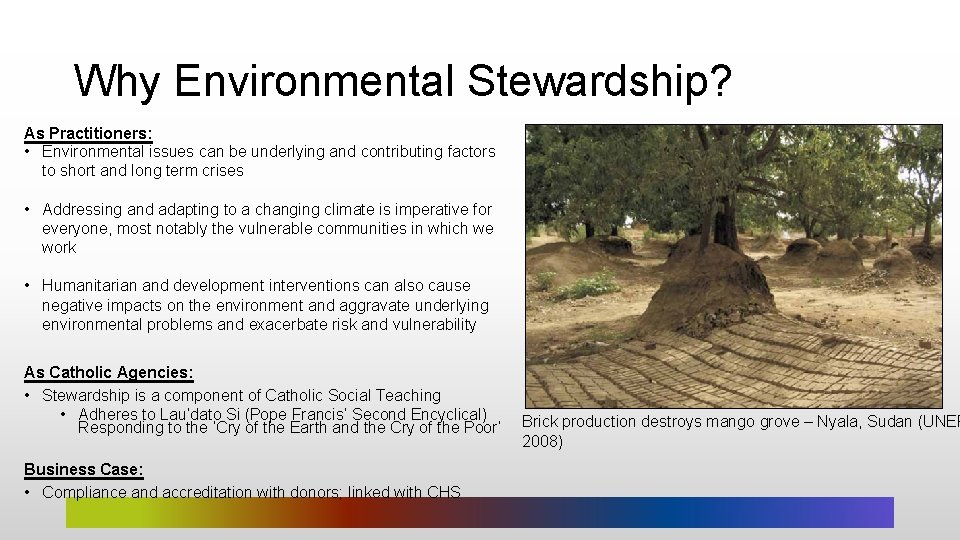
Why Environmental Stewardship? As Practitioners: • Environmental issues can be underlying and contributing factors to short and long term crises • Addressing and adapting to a changing climate is imperative for everyone, most notably the vulnerable communities in which we work • Humanitarian and development interventions can also cause negative impacts on the environment and aggravate underlying environmental problems and exacerbate risk and vulnerability As Catholic Agencies: • Stewardship is a component of Catholic Social Teaching • Adheres to Lau’dato Si (Pope Francis’ Second Encyclical) Responding to the ‘Cry of the Earth and the Cry of the Poor’ Business Case: • Compliance and accreditation with donors; linked with CHS Brick production destroys mango grove – Nyala, Sudan (UNEP 2008)

Environmental Stewardship Tool (EST) background • Finalized in May 2019, the EST was developed as part of the DRR/Resilience Coordination Initiative at Caritas Australia, CAFOD, CRS and Trocaire • EST was developed by DRR/Resilience Coordination Group • 3 rounds of review by over 30 CI agency focal points for DRR, Food/Livelihoods, Security, M&E, Protection, Shelter/Settlements, WASH along with project managers, heads of programmes, M&E staff • Piloted in 6 countries (Australia, DRC, Rwanda, Kenya, India, Indonesia)

Environmental Stewardship Tool (EST) – What is it? • Excel tool which allows for rapid identification of environmental impacts of natural and manmade systems along with safeguarding issues within areas of programme activities • Identifies what these environmental impacts look like in the specific context • Registers the level of “risk” each of these impacts may have (low, medium and high) • Provides sectors specific guidance (DRR, Food Security/Livelihoods, Shelter/Settlements, WASH) as to how programme activities can mitigate the risk identified • The tool should be used to facilitate a conversation with the Project Design Team about potential negatives environmental impacts and strategies to address them

Limitations of the EST Tool. • It is not an EIA, but a precursor to the EIA process. • The EST won’t give you the right or wrong answers but will give you an indication of the issues to further explore on environment impacts of the proposed interventions. • It is only an internal organisational tool. Other national environmental regulations have to be complied with. • While the tool can flag potential policy and advocacy issues, it does not offer guidance on how to address these
EST – Who uses it and when? • Generally used during the programme design phase by the design team once a draft results framework or draft activities have already been identified. • Estimated time: Between 1 – 4 hours depending on context and size of programme • Programme Design Team: The programme design team may consist of but is not limited to agency/partner staff along with government representatives, community members, or anyone else involved in the design/implementation of the programme

Getting familiar with the tool… Take some time to get familiar with the tool, focus on looking only at: • Risk Identification (Tier 1) • Risk Profiling (Tier 2) • Risk Register and Mitigation (Tier 3)
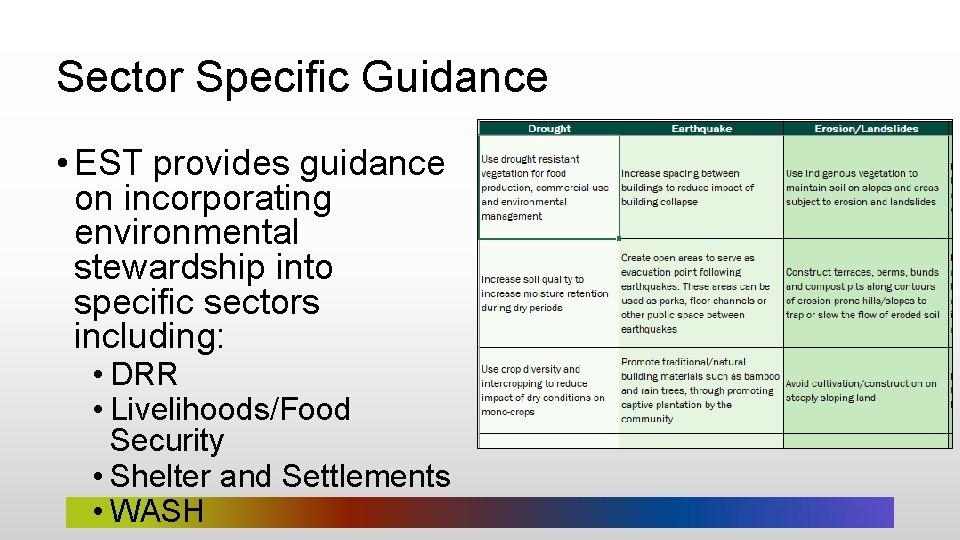
Sector Specific Guidance • EST provides guidance on incorporating environmental stewardship into specific sectors including: • DRR • Livelihoods/Food Security • Shelter and Settlements • WASH
Protection Mainstreaming and the EST • Protection Mainstreaming is the process of incorporating protection principles and promoting meaningful access, safety and dignity in all humanitarian aid and development activities. • The EST includes guidance on protection, specifically relating to: • Relevant questions to consider when categorizing risks under Tier 2 • Relevant questions to consider when developing mitigation activities from Tier 3 • Additional guidance providing from the Guide to Facilitating Community Led Disaster Risk Management (CLDRM) which aims to promote Inclusion, Leadership and Accountability
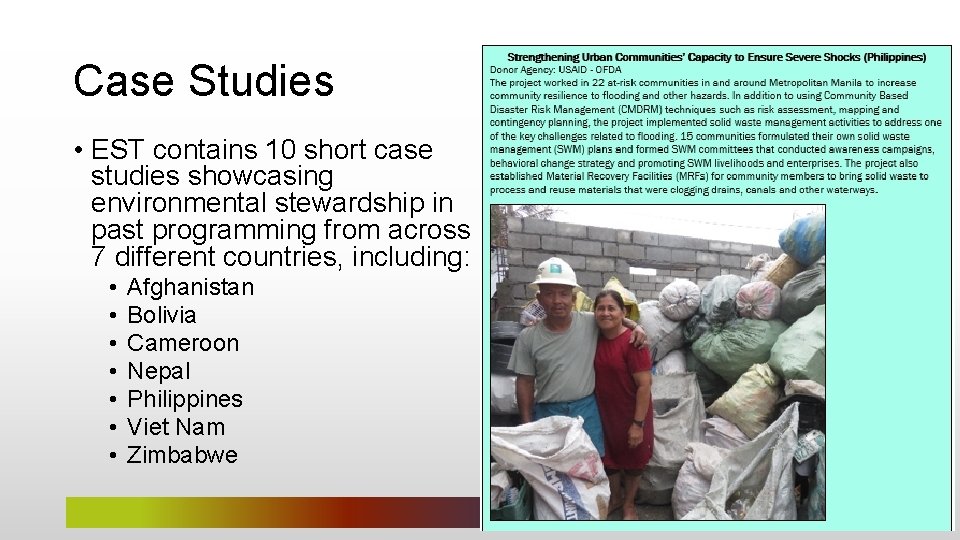
Case Studies • EST contains 10 short case studies showcasing environmental stewardship in past programming from across 7 different countries, including: • • Afghanistan Bolivia Cameroon Nepal Philippines Viet Nam Zimbabwe
Applying the EST to a real world scenario… • In small groups, do the following: 1. Select one of the scenario hand outs, they are from: a) Livelihoods Programme (development context – rural) b) Shelter and WASH Programmne (humanitarian response context) c) WASH and DRR Programme (humanitarian recovery context urban) 2. Familiarize yourself with the scenario 3. Work on one computer using the EST to analyze the scenario 4. Present your findings and your experience using the tool to the overall group
Applying to other contexts, closing • What are the benefits/opportunities of using the EST in your work? • What specific challenges do you see in applying the EST in your work? • Other questions or clarifications regarding the EST? • What is next after such a process?
THANK YOU!!!
- Slides: 15