
Environmental Security Technology Certification Program ESTCP Funding Opportunities

- Slides: 30
Environmental Security Technology Certification Program ESTCP Funding Opportunities January 17, 2008 Dr. Jeffrey Marqusee Director, ESTCP.
Department of Defense’s Environmental Technology Programs • Basic and Applied Research • Demonstration/Validation
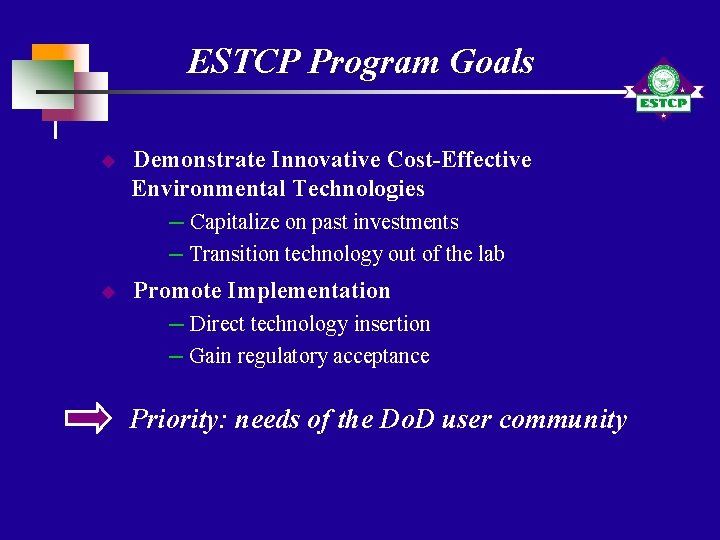
ESTCP Program Goals u Demonstrate Innovative Cost-Effective Environmental Technologies ─ Capitalize on past investments ─ Transition technology out of the lab u Promote Implementation ─ Direct technology insertion ─ Gain regulatory acceptance Priority: needs of the Do. D user community
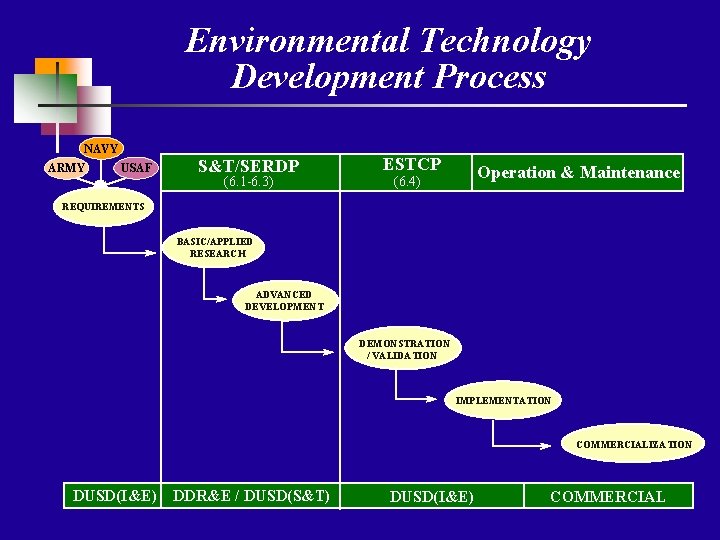
Environmental Technology Development Process NAVY ARMY USAF S&T/SERDP (6. 1 -6. 3) ESTCP Operation & Maintenance (6. 4) REQUIREMENTS BASIC/APPLIED RESEARCH ADVANCED DEVELOPMENT DEMONSTRATION / VALIDATION IMPLEMENTATION COMMERCIALIZATION DUSD(I&E) DDR&E / DUSD(S&T) DUSD(I&E) COMMERCIAL
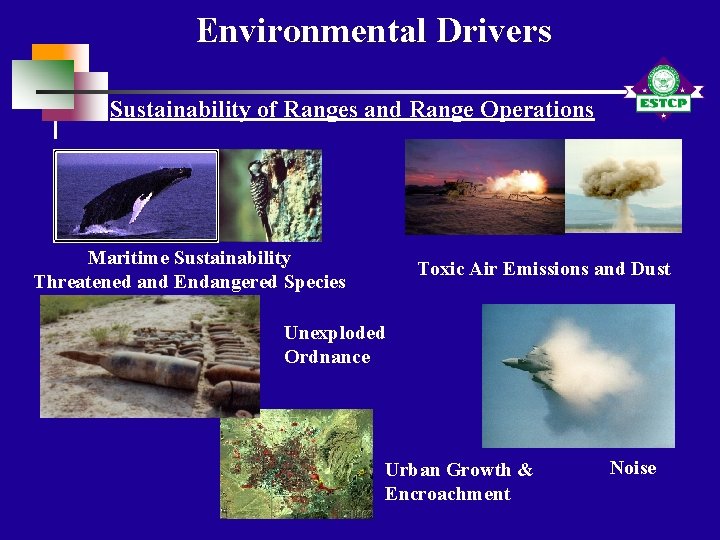
Environmental Drivers Sustainability of Ranges and Range Operations Maritime Sustainability Threatened and Endangered Species Toxic Air Emissions and Dust Unexploded Ordnance Urban Growth & Encroachment Noise
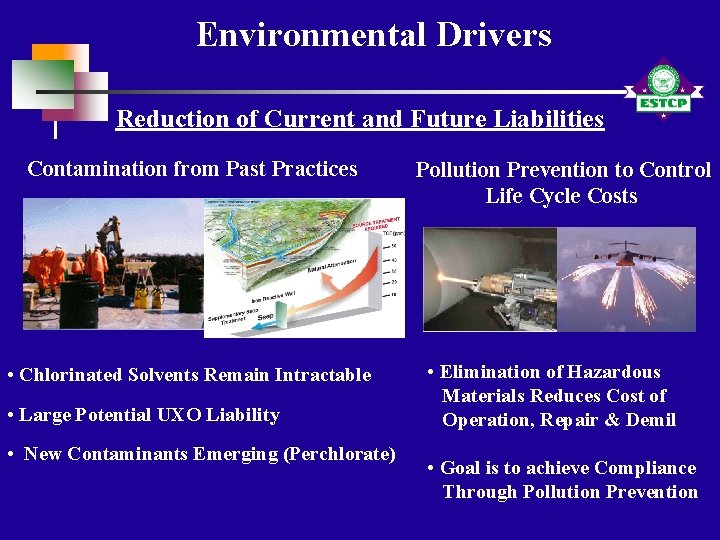
Environmental Drivers Reduction of Current and Future Liabilities Contamination from Past Practices • Chlorinated Solvents Remain Intractable • Large Potential UXO Liability • New Contaminants Emerging (Perchlorate) Pollution Prevention to Control Life Cycle Costs • Elimination of Hazardous Materials Reduces Cost of Operation, Repair & Demil • Goal is to achieve Compliance Through Pollution Prevention
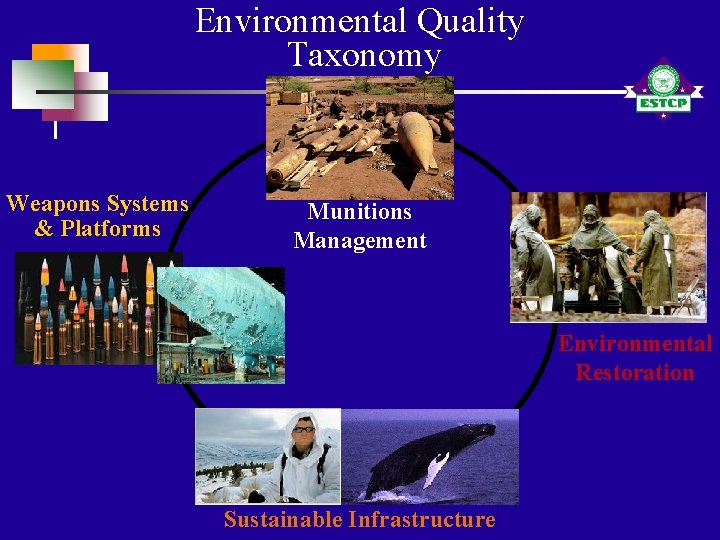
Environmental Quality Taxonomy Weapons Systems & Platforms Munitions Management Environmental Restoration Sustainable Infrastructure
ESTCP Methodology u Partner With Stakeholders and Test at Do. D Facilities ─ Developer, regulators, end-user ─ Direct transition u Validate Operational Cost and Performance ─ Independent test and evaluation ─ Satisfy regulatory and user communities u Identify Do. D Market Opportunities ─ Technology transfer across federal and private sector
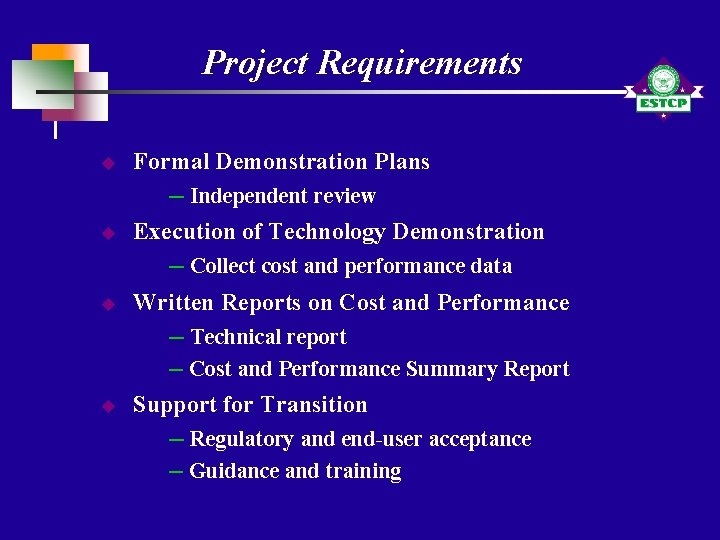
Project Requirements u Formal Demonstration Plans ─ Independent review u Execution of Technology Demonstration ─ Collect cost and performance data u Written Reports on Cost and Performance ─ Technical report ─ Cost and Performance Summary Report u Support for Transition ─ Regulatory and end-user acceptance ─ Guidance and training
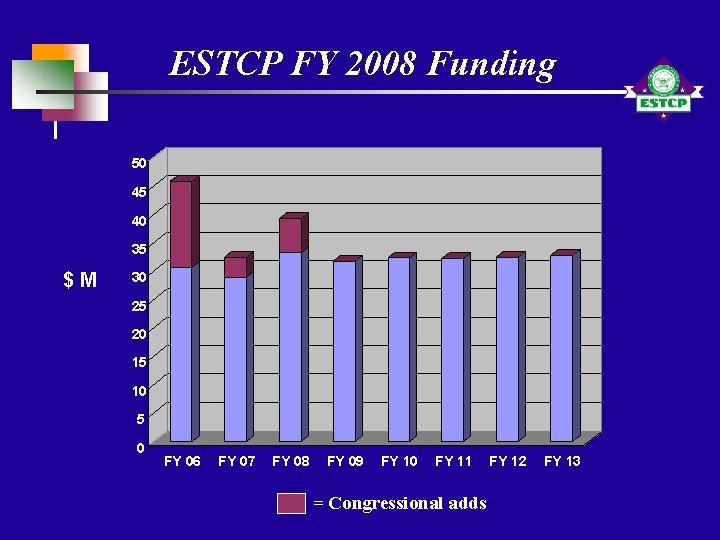
ESTCP FY 2008 Funding 50 45 40 35 $M 30 25 20 15 10 5 0 FY 06 FY 07 FY 08 FY 09 FY 10 FY 11 = Congressional adds FY 12 FY 13
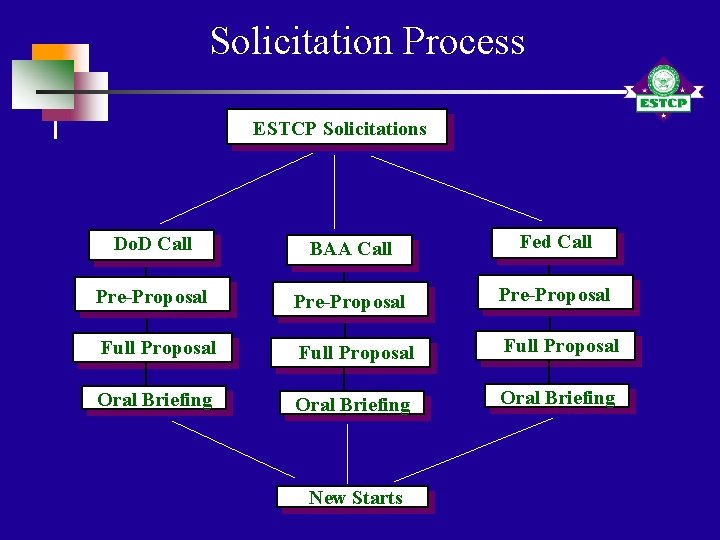
Solicitation Process ESTCP Solicitations Do. D Call BAA Call Fed Call Pre-Proposal Full Proposal Oral Briefing New Starts
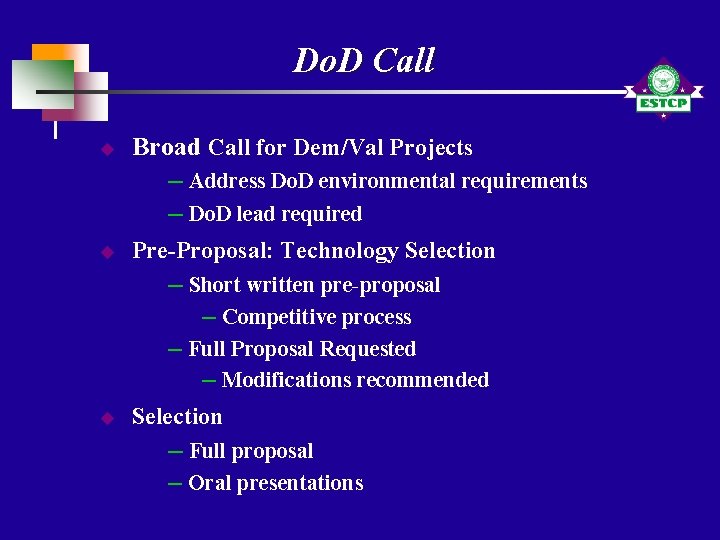
Do. D Call u Broad Call for Dem/Val Projects ─ Address Do. D environmental requirements ─ Do. D lead required u Pre-Proposal: Technology Selection ─ Short written pre-proposal ─ Competitive process ─ Full Proposal Requested ─ Modifications recommended u Selection ─ Full proposal ─ Oral presentations
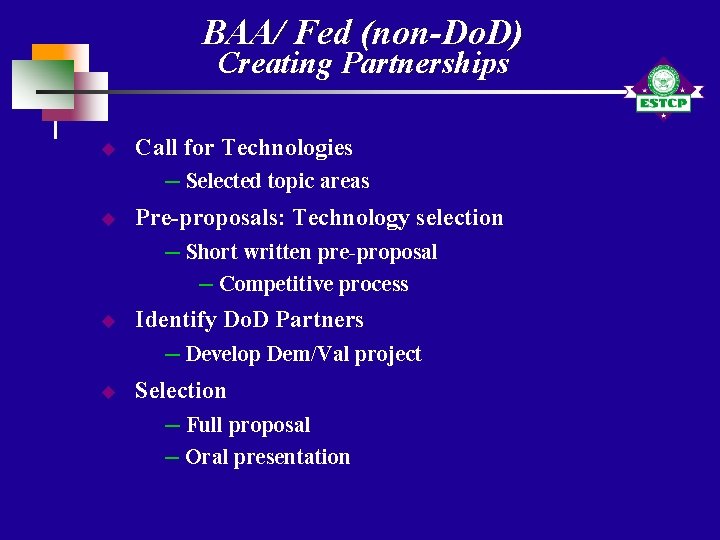
BAA/ Fed (non-Do. D) Creating Partnerships u Call for Technologies ─ Selected topic areas u Pre-proposals: Technology selection ─ Short written pre-proposal ─ Competitive process u Identify Do. D Partners ─ Develop Dem/Val project u Selection ─ Full proposal ─ Oral presentation
FY 2008 Solicitation
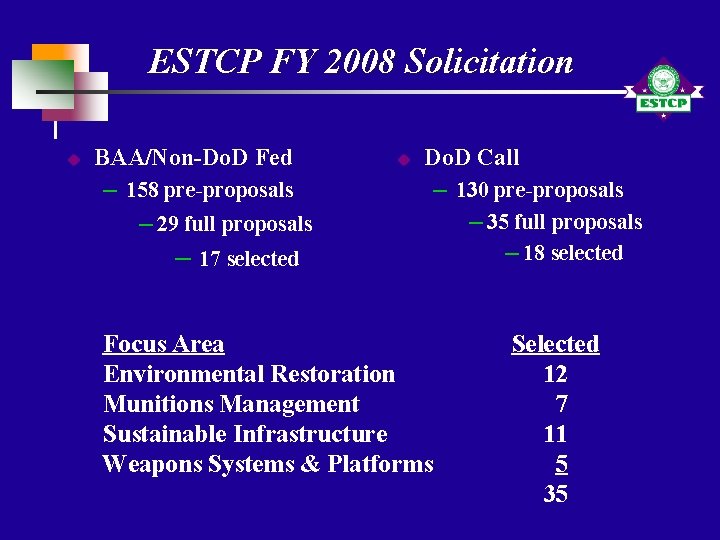
ESTCP FY 2008 Solicitation u BAA/Non-Do. D Fed u Do. D Call ─ 158 pre-proposals ─ 29 full proposals ─ 17 selected Focus Area Environmental Restoration Munitions Management Sustainable Infrastructure Weapons Systems & Platforms ─ 130 pre-proposals ─ 35 full proposals ─ 18 selected Selected 12 7 11 5 35
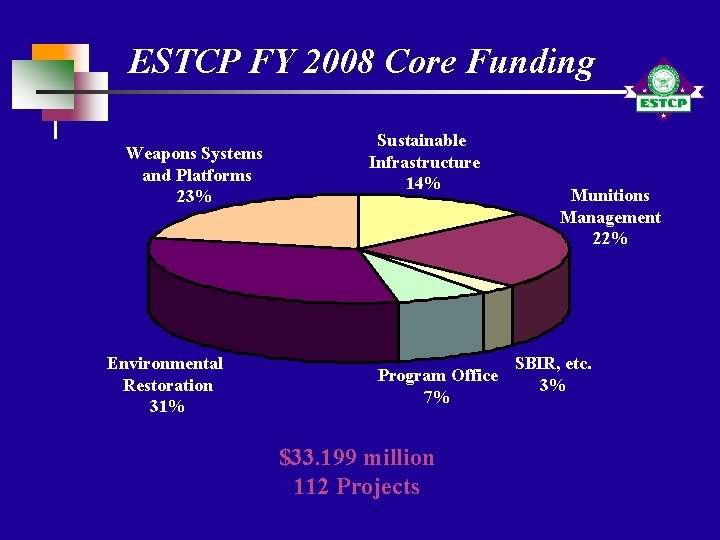
ESTCP FY 2008 Core Funding Weapons Systems and Platforms 23% Environmental Restoration 31% Sustainable Infrastructure 14% Program Office 7% $33. 199 million 112 Projects Munitions Management 22% SBIR, etc. 3%
FY 2009 Solicitation
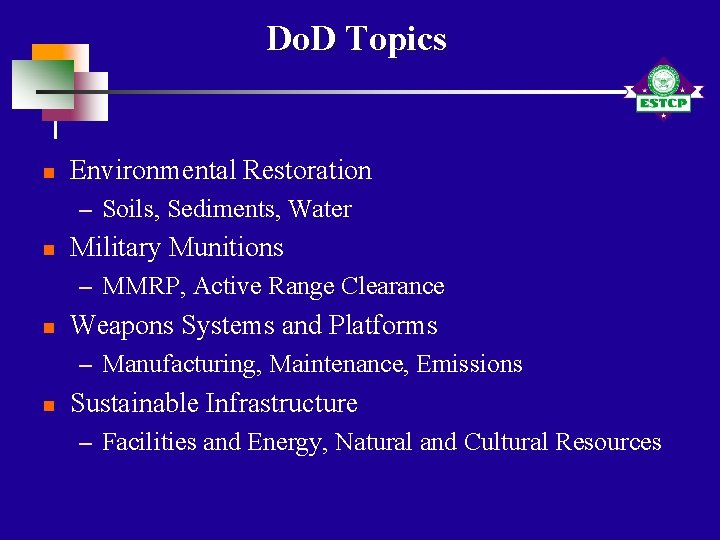
Do. D Topics n Environmental Restoration ─ n Military Munitions ─ n MMRP, Active Range Clearance Weapons Systems and Platforms ─ n Soils, Sediments, Water Manufacturing, Maintenance, Emissions Sustainable Infrastructure ─ Facilities and Energy, Natural and Cultural Resources
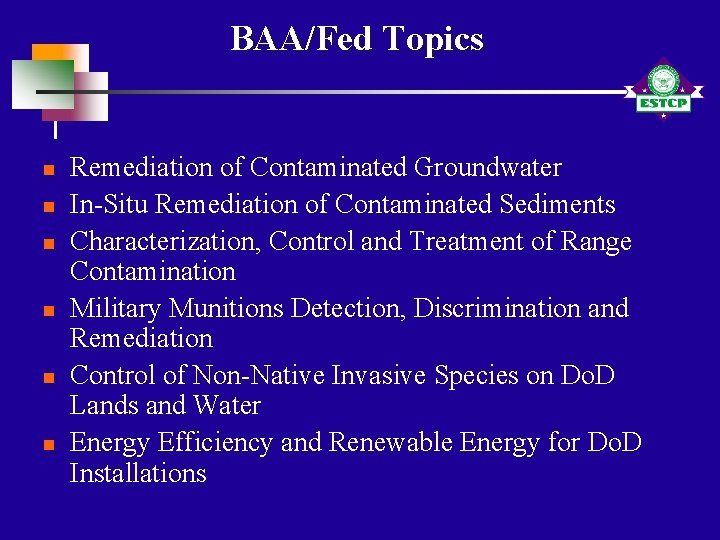
BAA/Fed Topics n n n Remediation of Contaminated Groundwater In-Situ Remediation of Contaminated Sediments Characterization, Control and Treatment of Range Contamination Military Munitions Detection, Discrimination and Remediation Control of Non-Native Invasive Species on Do. D Lands and Water Energy Efficiency and Renewable Energy for Do. D Installations
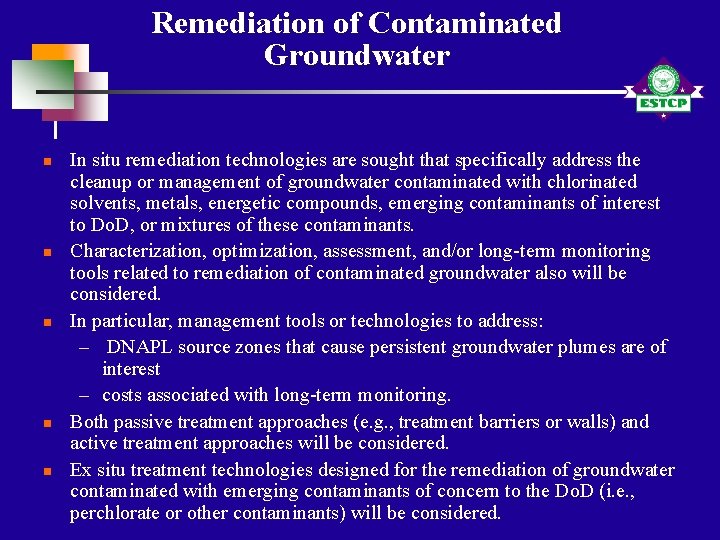
Remediation of Contaminated Groundwater n n n In situ remediation technologies are sought that specifically address the cleanup or management of groundwater contaminated with chlorinated solvents, metals, energetic compounds, emerging contaminants of interest to Do. D, or mixtures of these contaminants. Characterization, optimization, assessment, and/or long-term monitoring tools related to remediation of contaminated groundwater also will be considered. In particular, management tools or technologies to address: ─ DNAPL source zones that cause persistent groundwater plumes are of interest ─ costs associated with long-term monitoring. Both passive treatment approaches (e. g. , treatment barriers or walls) and active treatment approaches will be considered. Ex situ treatment technologies designed for the remediation of groundwater contaminated with emerging contaminants of concern to the Do. D (i. e. , perchlorate or other contaminants) will be considered.
In-Situ Remediation of Contaminated Sediments n n In situ remediation technologies are sought that specifically address the remediation or management of sediments contaminated with polycyclic aromatic hydrocarbons (PAHs), polychlorinated biphenyls (PCBs), heavy metals, or mixtures containing these contaminants. Contaminated marine, estuarine, brackish, and fresh water sediments are of interest.
Characterization, Control and Treatment of Range Contamination n Management tools and technologies are sought to cost effectively and more accurately delineate munitions constituent source zones and contaminant loading on test and training ranges. Treatment and control technologies are sought that specifically address the remediation or containment of range-related contaminants and residue such as metals, energetics (RDX, HMX, TNT, DNT, picric acid), propellants such as perchlorate, or mixtures containing these contaminants in soils. ESTCP hosted a workshop on Do. D Operational Range Assessment and Management. Proposers are encouraged to review the summary report for additional details on the critical demonstration needs ─ www. estcp. org/Technology/upload/RAWorkshop. RDTENeeds. Rpt. pdf
Military Munitions Detection, Discrimination and Remdiation n Detection and Discrimination: Technologies are needed that can detect and discriminate munitions ranging from 20 mm projectiles to 2000 lb. bombs from other items in the sub-surface. A single technology need not be applicable to all possible ordnance types, nor all possible site conditions. ─ ─ ─ n Integrated systems (hand held, man-portable, vehicle towed, or airborne) Systems that are cued by other survey technologies which can cost effectively, noninvasively interrogate the suspected item Signal processing technologies Supporting technologies including but not limited to geolocation, reacquisition of anomalies and quality assurance/quality control tools Technologies applicable to detection and discrimination of munitions in underwater environments, particularly in water depths from 15 to 100 feet. Remediation: Technologies are needed that can cost-effectively remediate single munitions items whose location and depth have been identified; clear heavily contaminated areas where identification of individual isolated items is not feasible or cost effective; or treat scrap material, to make it safe for disposal.
Control of Non-Native Invasive Species on Do. D Lands and Water n n Control is defined broadly to include eradication and other management approaches that contain, reduce, or eliminate NIS populations. Do. D waters include freshwater and marine ecosystems managed by Do. D, but ship-based ballast water exchange and control technologies are outside the scope of this solicitation. The method of control can include any viable biological, chemical, mechanical, cultural, or integrated approach that is ready for implementation-scale demonstration. ESTCP in particular seeks technologies and methodologies that avoid or minimize non-target impacts and are consistent with ecosystem-based approaches to natural resources management.
Energy Efficiency and Renewable Energy for Do. D Installations n n Innovative technologies and methods are sought to improve energy efficiency and increase the use of renewable energy on Do. D installations. Technologies of interest include but are not restricted to: ─ ─ ─ 1) innovative energy efficient lighting, heating, and air conditioning, and other technologies to support sustainable building design and operations to reduce energy demand for all types of Do. D buildings, including historic properties 2) renewable energy sources at various power levels 3) supporting technologies such as energy storage and control technologies to manage these resources
FY 2009 Solicitation -Dates- n n n ESTCP Solicitation Released January 10, 2008 Pre-proposal Due: March 13, 2008 4 PM EST ─ Pre-proposals received after this time will not be reviewed ─ Pre-proposals sent via fax or electronic mail will be rejected Full Proposal Requested June 2008 ─ n Oral Briefing in Arlington, VA September 2008 ─ ─ n Full Proposal Due: August 7, 2008 4 PM EST Selection October 2008 Project Initiation March 2009 Visit the ESTCP Web Site for Solicitation Details www. estcp. org/opportunities
Selection Criteria Relevance (Pass / Fail) Appropriate for Demonstration (Pass/Fail) • Technical Merit • Cost/Benefit • Technology Transfer • Cost
Hallmarks of a Competitive Proposal - Clearly address a Do. D Environmental Need - Well defined demonstration/validation questions - Provide significant benefit - reduced costs - improved performance - Technically sound - Detailed technology description - Detailed technical approach
Internet Resources www. estcp. org
Thank You After viewing the links to additional resources, please complete our online feedback form. Thank You Links to Additional Resources Feedback Form 30