
Environmental Science Timeline Presentations Warm Up Bring out
Environmental Science Timeline Presentations!
Warm Up: Bring out your Environmental Science timeline project. Take 5 -6 minutes to put finishing touches on your project, ask any questions, and be prepared to share your Environmental Science event.
Reminders! Next Monday is our Unit 1 Test! Please study! AMP Hours are Tuesdays/Thursdays 3: 30 -4: 30 PM Remember to check on btpatelscience. weebly. com to see what we did each week to make up missing work.
Environmental Science Environmental Ethics and Economics
Warm Up: On your paper, please answer the following: 1. If you were an employer or the head of a major company, what would you focus more on- the safety of your workers or the profit of your company? Why? 2. Would you consider the United States as a first world, developed country? Why or why not?
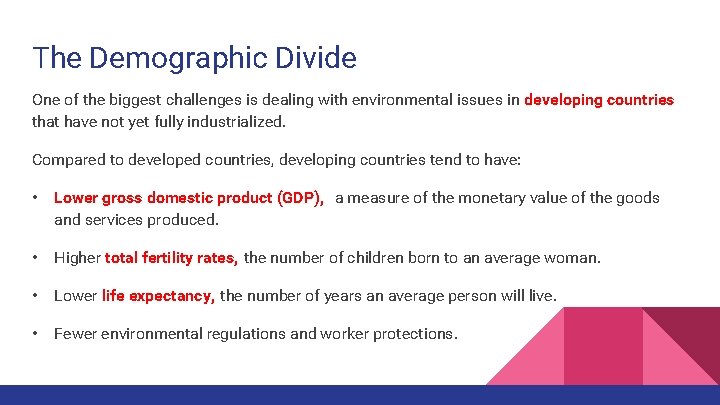
The Demographic Divide One of the biggest challenges is dealing with environmental issues in developing countries that have not yet fully industrialized. Compared to developed countries, developing countries tend to have: • Lower gross domestic product (GDP), a measure of the monetary value of the goods and services produced. • Higher total fertility rates, the number of children born to an average woman. • Lower life expectancy, the number of years an average person will live. • Fewer environmental regulations and worker protections.
Observation/Question T-Chart Observations Questions
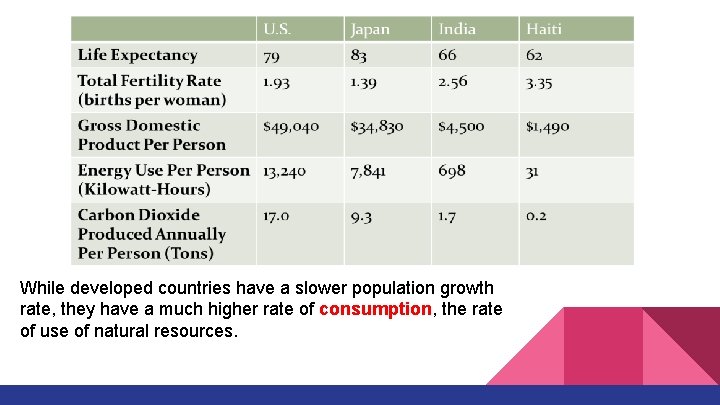
While developed countries have a slower population growth rate, they have a much higher rate of consumption, the rate of use of natural resources.
Economics and the Environment Economic principles has a huge influence in environmental decision-making. Supply and demand predicts that the cost of a resource will increase when demand is high or supply is low. Cost-Benefit Analysis: the question: Does the benefit of doing something justify the economic cost? Many companies use human labor in developing countries as a way to reduce their own costs of production and the final price tag of their products. • These workers face harsh, dangerous conditions. (hidden costs)
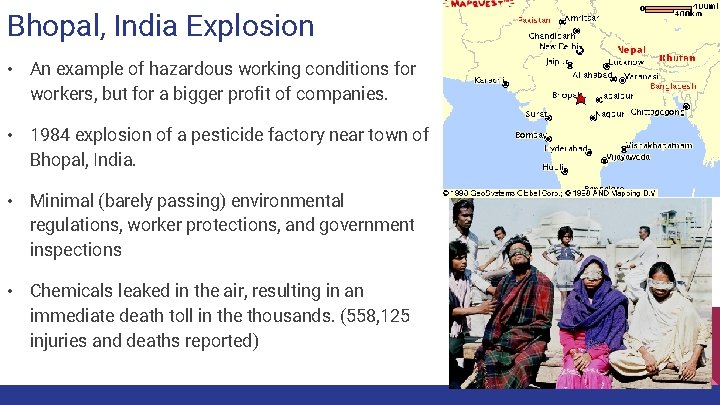
Bhopal, India Explosion • An example of hazardous working conditions for workers, but for a bigger profit of companies. • 1984 explosion of a pesticide factory near town of Bhopal, India. • Minimal (barely passing) environmental regulations, worker protections, and government inspections • Chemicals leaked in the air, resulting in an immediate death toll in the thousands. (558, 125 injuries and deaths reported)

The Yes Men Fix the World Documentary
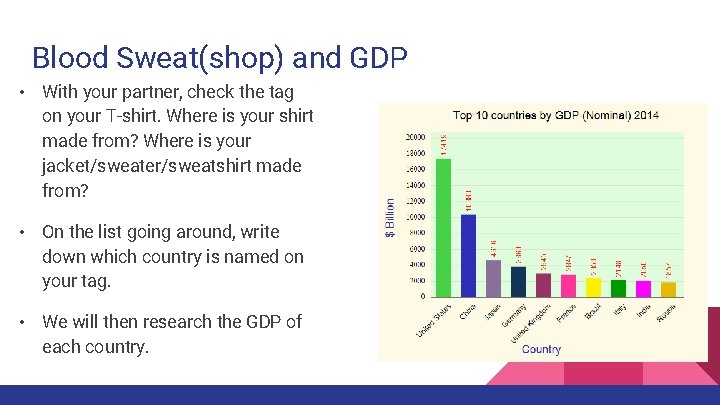
Blood Sweat(shop) and GDP • With your partner, check the tag on your T-shirt. Where is your shirt made from? Where is your jacket/sweater/sweatshirt made from? • On the list going around, write down which country is named on your tag. • We will then research the GDP of each country.
Exit Slip 1. What was your takeaway from the documentary on Yes Men Saves the World? 2. What is GDP?
Reminders! Next Monday is our Unit 1 Test! Please study! HOMEWORK: Bhopal India Journal due by next class period AMP Hours is Today (Tuesday) and Thursday 3: 30 -4: 30 PM Remember to check on btpatelscience. weebly. com to see what we did each week to make up missing work.
Environmental Science Ecological Footprint, World Views
Warm Up: On your paper, please answer the following: 1. What are some things that you still are struggling with regards to what we talked about this past week? 2. How do you travel to and from places a majority of the time, and do you think your method of transportation “helps” or “hurts” the environment? Why do you think so?
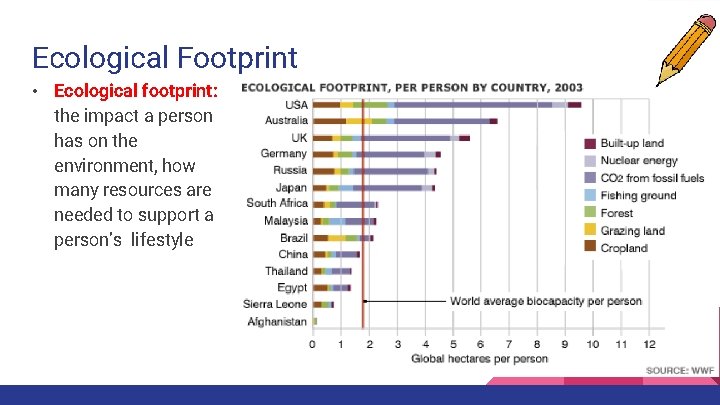
Ecological Footprint • Ecological footprint: the impact a person has on the environment, how many resources are needed to support a person’s lifestyle
Ecological Footprint Activity! In pairs, work together to discover your ecological footprint! 1) What are some things that you have noticed? 2) What questions do you have? 3) How big is your ecological footprint?
World Views • There are three main perspectives on how we deal with environmental issues perspectives, such as pollution, resource overconsumption, loss of biodiversity.
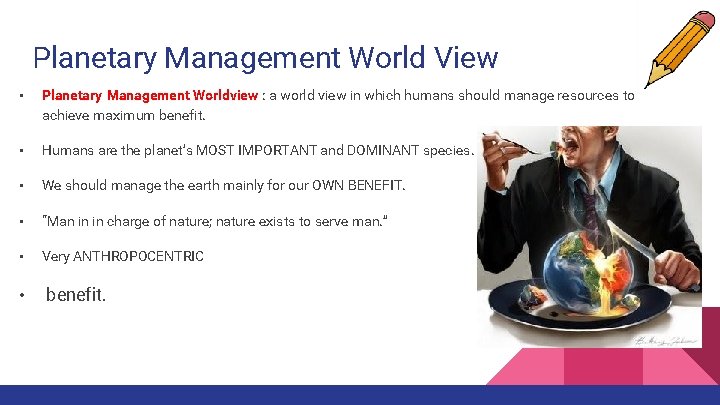
Planetary Management World View • Planetary Management Worldview : a world view in which humans should manage resources to achieve maximum benefit. • Humans are the planet’s MOST IMPORTANT and DOMINANT species. • We should manage the earth mainly for our OWN BENEFIT. • “Man in in charge of nature; nature exists to serve man. ” • Very ANTHROPOCENTRIC • benefit.
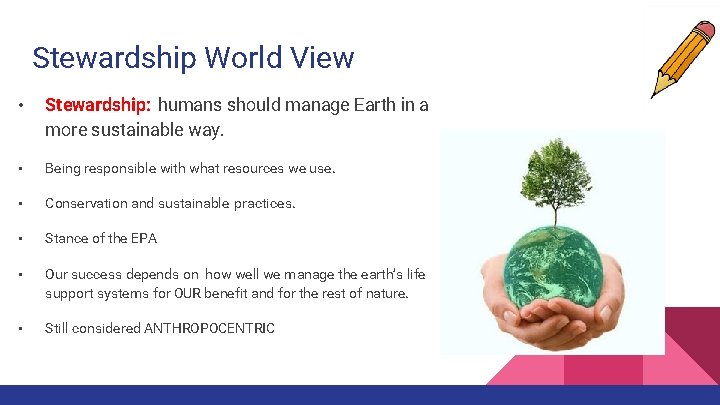
Stewardship World View • Stewardship: humans should manage Earth in a more sustainable way. • Being responsible with what resources we use. • Conservation and sustainable practices. • Stance of the EPA • Our success depends on how well we manage the earth’s life support systems for OUR benefit and for the rest of nature. • Still considered ANTHROPOCENTRIC
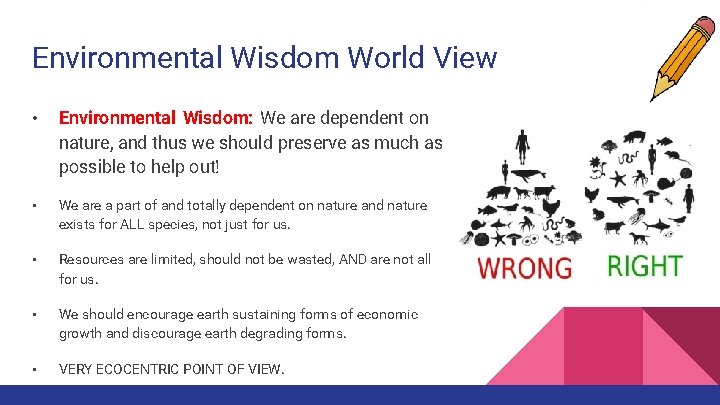
Environmental Wisdom World View • Environmental Wisdom: We are dependent on nature, and thus we should preserve as much as possible to help out! • We are a part of and totally dependent on nature and nature exists for ALL species, not just for us. • Resources are limited, should not be wasted, AND are not all for us. • We should encourage earth sustaining forms of economic growth and discourage earth degrading forms. • VERY ECOCENTRIC POINT OF VIEW.
Closed Systems Each of these worldviews acknowledges that the Earth is a closed system, meaning matter does not enter or leave it in large amounts. • Resources are finite. • Wastes do not “go away”. These understandings form the basis for understanding and solving each of the issues within environmental science.

Three Corners What view do you stand with and why?
Reminders! Monday is our Unit 1 Test! Please study! HOMEWORK: Please make sure everything is included for your binder check! All missing assignments are due Friday, or it will be considered as a “zero” in the gradebook. AMP Hours is Today (Thursday) 3: 30 -4: 30 PM Remember to check on btpatelscience. weebly. com to see what we did each week to make up missing work.
- Slides: 25