
Environmental Science Do Now 9 20 17 Directions
- Slides: 17
Environmental Science Do Now 9 -20 -17 Directions: Take out your Do Now sheet. • 1) What is meant by the phrase biogeochemical cycle? • 2) Why is the sun an important part of the hydrological cycle? • 3) Give any three reservoirs for the hydrological cycle. • 4) Give any three reservoirs for the carbon cycle. • 5) Why do plants take in carbon dioxide? • 6) Why do plants and animals give off carbon dioxide? • 7) Give any three types of precipitation. • 8) Explain how factories and combustion play a role in the carbon cycle.
Environmental Science Do Now 9 -20 -17 Key Directions: Take out your Do Now sheet. • 1) What is meant by the phrase biogeochemical cycle? • 2) Why is the sun an important part of the hydrological cycle? • 3) Give any three reservoirs for the hydrological cycle. • 4) Give any three reservoirs for the carbon cycle. • 5) Why do plants take in carbon dioxide? • 6) Why do plants and animals give off carbon dioxide? • 7) Give any three types of precipitation. • 8) Explain how factories and combustion play a role in the carbon cycle.
Engage – Answer both on a clean sheet of paper • Why is nitrogen important to living things? • Why is phosphorus important to living things?
Explore • Students will watch the “Phosphorus Cycle” and will write down one unique characteristic for this cycle. Source: https: //www. youtube. com/watch? v=c 5 Kqwh. X 1 dvk
Explain Biogeochemical Cycles: Water, Carbon, Nitrogen and Phosphorus Cycles PPT (students will copy the notes)
Extend • Students will complete the POGIL on Nutrient Cycles: Nitrogen Cycle section ONLY! ONLY • Kahoot Games on Biogeochemical cycles & the Earth’s spheres • Goal: Students must answer 70% of the questions correct (14/20 & 21/30) 14 21
Evaluate Exit Ticket Questions: • Explain how water is cycled throughout the Earth. • Explain how carbon is cycled throughout the Earth. • Explain how nitrogen is cycled throughout the Earth. • Explain how phosphorus is cycled throughout the Earth.
Biogeochemical Cycles Environmental Science Unit 1: Introduction to Environmental Science September 19, 2017
Biogeochemical Cycles describe the flow of essential elements from the environment through living organisms and back into the environment.
Nitrogen Cycle
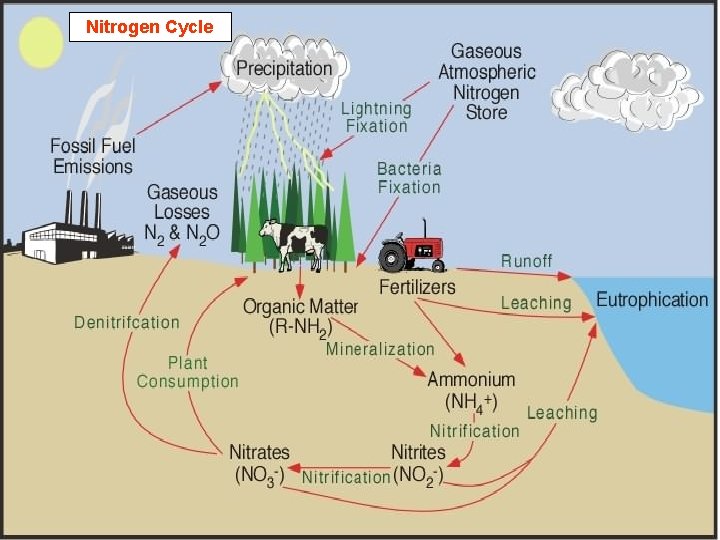
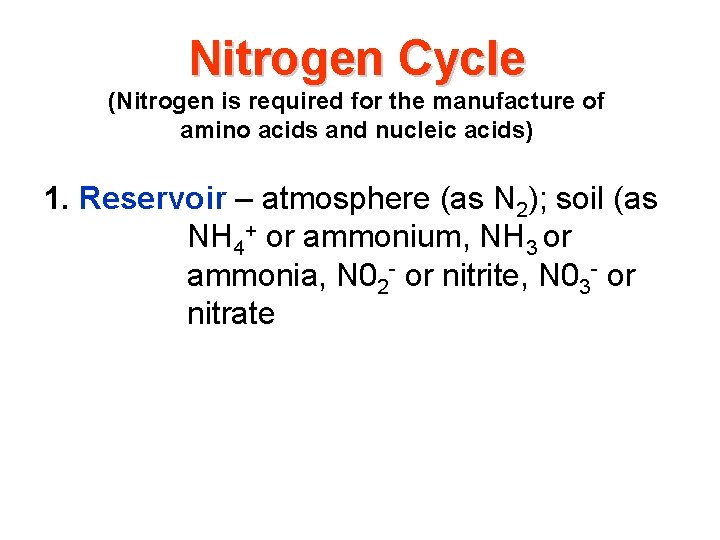
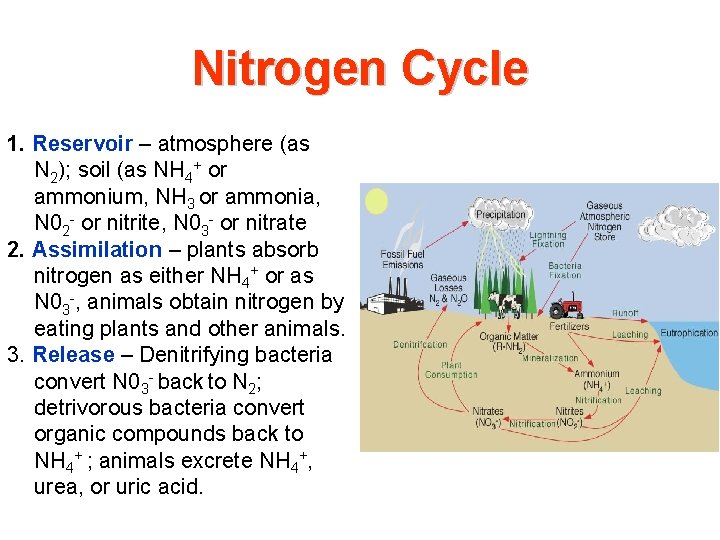
Nitrogen Cycle (Nitrogen is required for the manufacture of amino acids and nucleic acids) 1. Reservoir – atmosphere (as N 2); soil (as NH 4+ or ammonium, NH 3 or ammonia, N 02 - or nitrite, N 03 - or nitrate
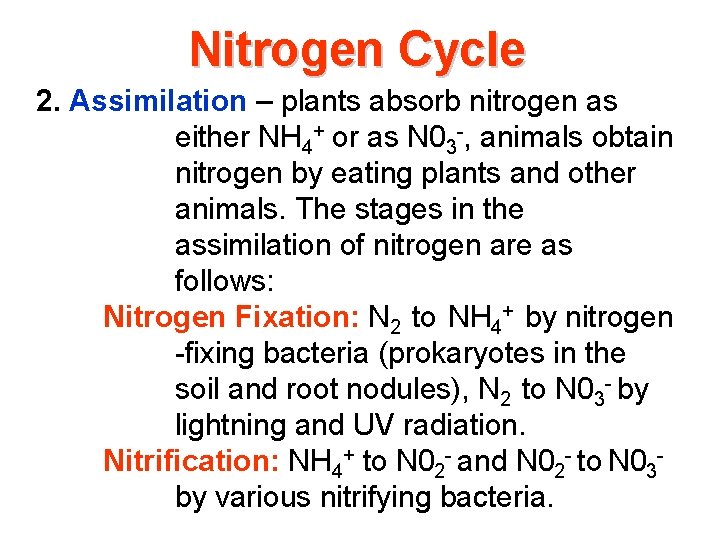
Nitrogen Cycle 2. Assimilation – plants absorb nitrogen as either NH 4+ or as N 03 -, animals obtain nitrogen by eating plants and other animals. The stages in the assimilation of nitrogen are as follows: Nitrogen Fixation: N 2 to NH 4+ by nitrogen -fixing bacteria (prokaryotes in the soil and root nodules), N 2 to N 03 - by lightning and UV radiation. Nitrification: NH 4+ to N 02 - and N 02 - to N 03 by various nitrifying bacteria.
Nitrogen Cycle 3. Release – Denitrifying bacteria convert N 03 - back to N 2 (denitrification); detrivorous (decomposing) bacteria convert organic compounds back to NH 4+ (ammonification); animals excrete NH 4+ (or NH 3) urea, or uric acid.
Nitrogen Cycle 1. Reservoir – atmosphere (as N 2); soil (as NH 4+ or ammonium, NH 3 or ammonia, N 02 - or nitrite, N 03 - or nitrate 2. Assimilation – plants absorb nitrogen as either NH 4+ or as N 03 -, animals obtain nitrogen by eating plants and other animals. 3. Release – Denitrifying bacteria convert N 03 - back to N 2; detrivorous bacteria convert organic compounds back to NH 4+ ; animals excrete NH 4+, urea, or uric acid.
Phosphorus Cycle
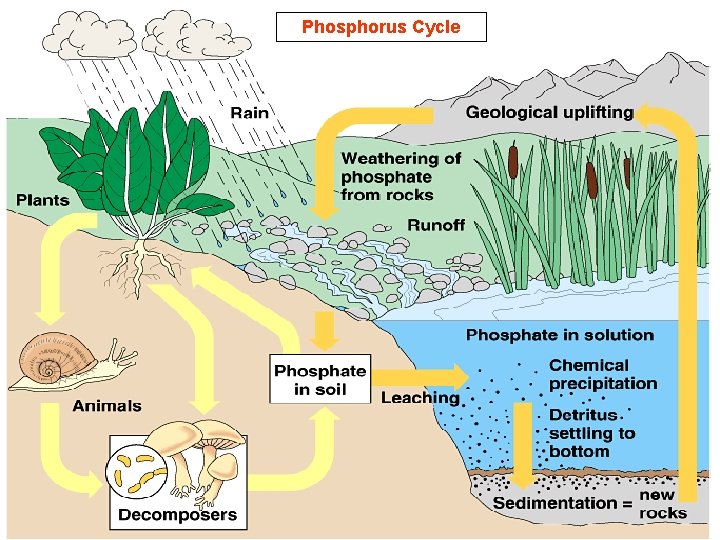
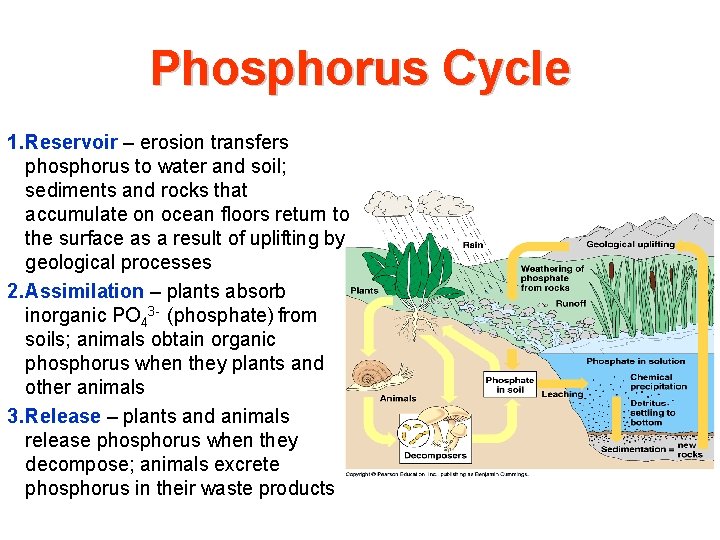
Phosphorus Cycle (Phosphorus is required for the manufacture of ATP and all nucleic acids) 1. Reservoir – erosion transfers phosphorus to water and soil; sediments and rocks that accumulate on ocean floors return to the surface as a result of uplifting by geological processes 2. Assimilation – plants absorb inorganic PO 43(phosphate) from soils; animals obtain organic phosphorus when they plants and other animals 3. Release – plants and animals release phosphorus when they decompose; animals excrete phosphorus in their waste products
Phosphorus Cycle 1. Reservoir – erosion transfers phosphorus to water and soil; sediments and rocks that accumulate on ocean floors return to the surface as a result of uplifting by geological processes 2. Assimilation – plants absorb inorganic PO 43 - (phosphate) from soils; animals obtain organic phosphorus when they plants and other animals 3. Release – plants and animals release phosphorus when they decompose; animals excrete phosphorus in their waste products