
Environmental Science 15 e MILLERSPOOLMAN G TYLER MILLER


- Slides: 18
Environmental Science, 15 e MILLER/SPOOLMAN G. TYLER MILLER | SCOTT E. SPOOLMAN 12 Geology and Nonrenewable Mineral Resources © 2016 Cengage Learning. All Rights Reserved.
Core Case Study: The Crucial Importance of Rare Earth Metals • There are 17 rare earth metals – – Used in the manufacturing of high tech products that are providing current economic growth • Products include: liquid crystal display flat screens for computers and TVs, fluorescent and LED light bulbs, and many other essential technologies – even satellites © 2016 Cengage Learning. All Rights Reserved.
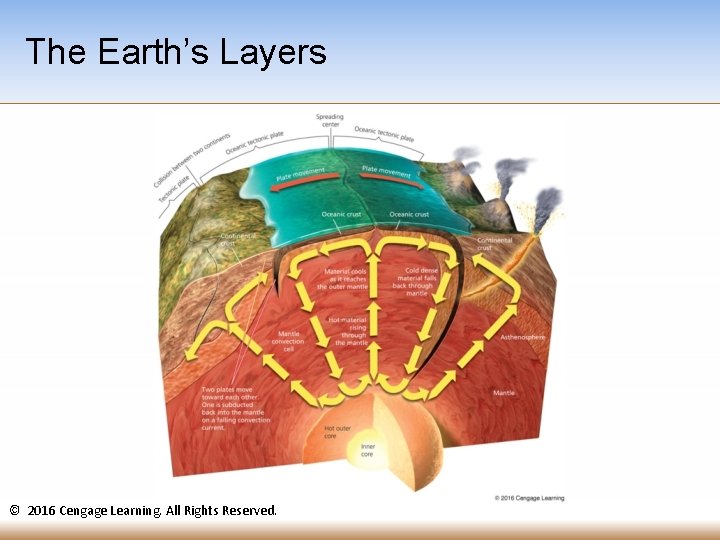
Earth: A Dynamic Planet • When the earth cooled, three zones were created: the core, the mantle and the crust – Core: two types, an inner core (a hot, solid sphere) and an outer core (molten liquid rock) – Mantle: thick semi-solid liquid with the ability to flow over geologic time • The uppermost mantle is solid (lithosphere), below which is a partially melted zone that flows (asthenosphere) – Crust: thin, outermost layer (lithosphere) • Rare earth minerals are found in the lithosphere © 2016 Cengage Learning. All Rights Reserved.
The Earth’s Layers © 2016 Cengage Learning. All Rights Reserved.
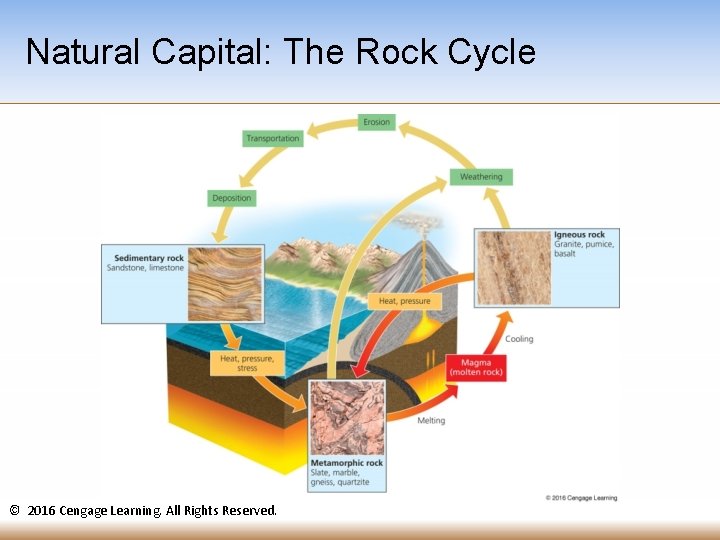
What Are Minerals and Rocks? • Minerals are naturally occurring, chemical elements or inorganic compounds (solids) with regularly arranged atoms or ions • Rocks: solid collections of one or more minerals in the earth’s crust – Sedimentary rocks (sandstones, shale) • Sediments compacted and cemented into rock – Igneous rocks (granite, lava rock) • Cooled magma and lava – Metamorphic rocks (slate, marble) • Exposed and altered by high pressures and temperatures © 2016 Cengage Learning. All Rights Reserved.
Recycling of the Earth’s Rocks • Rock cycle: the interaction of physical and chemical processes that work to change rocks from one kind to another – Recycling processes: erosion, melting, metamorphism • The rock cycle is the slowest earth cycle, taking millions of years to recycle – so these resources are nonrenewable © 2016 Cengage Learning. All Rights Reserved.
Natural Capital: The Rock Cycle © 2016 Cengage Learning. All Rights Reserved.
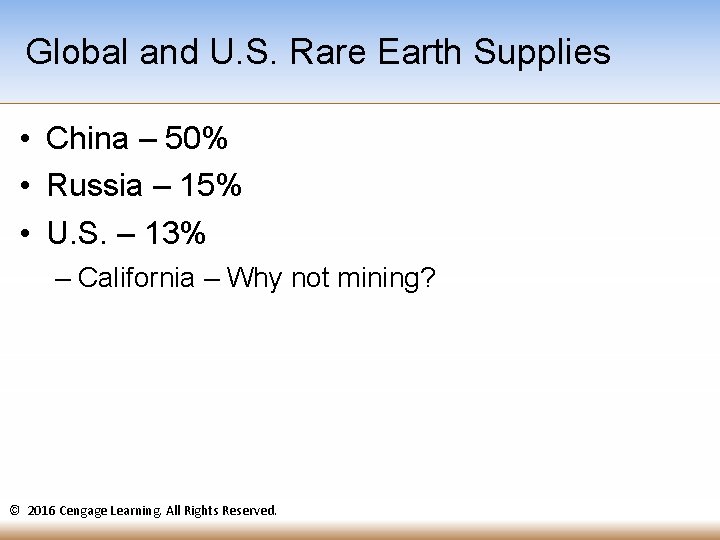
Global and U. S. Rare Earth Supplies • China – 50% • Russia – 15% • U. S. – 13% – California – Why not mining? © 2016 Cengage Learning. All Rights Reserved.
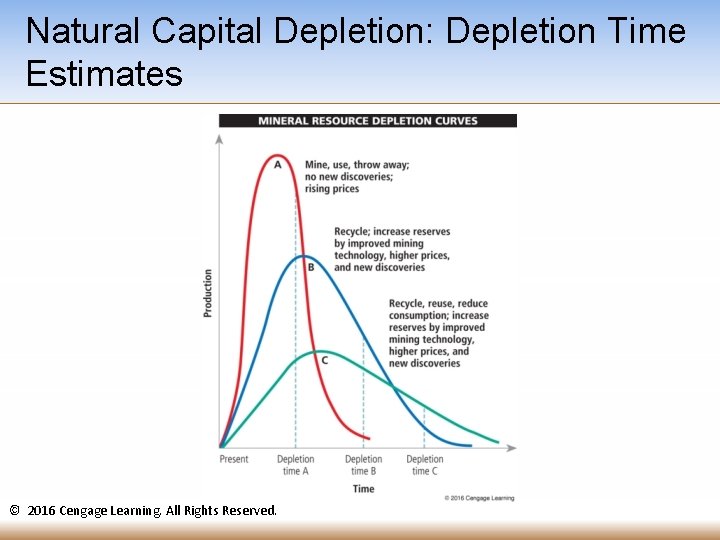
Economic Depletion of Nonrenewable Mineral Resources • Reserves: resource deposits that can be profitably extracted – Expand when new geographic sites are found, when prices increase, or when extraction of previously expensive reserves becomes profitable – Actual or potential supply and consumption rate control future supplies – Depletion time: time to use up 80% of available resources at a given rate of use © 2016 Cengage Learning. All Rights Reserved.
Natural Capital Depletion: Depletion Time Estimates © 2016 Cengage Learning. All Rights Reserved.
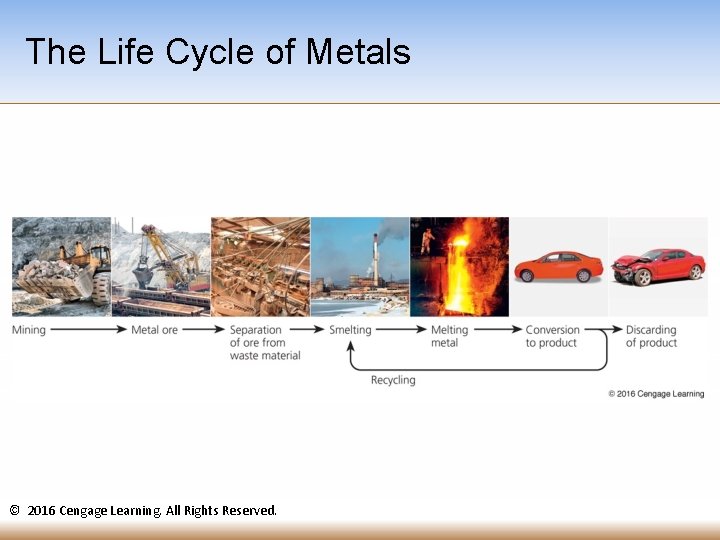
The Life Cycle of Metals © 2016 Cengage Learning. All Rights Reserved.
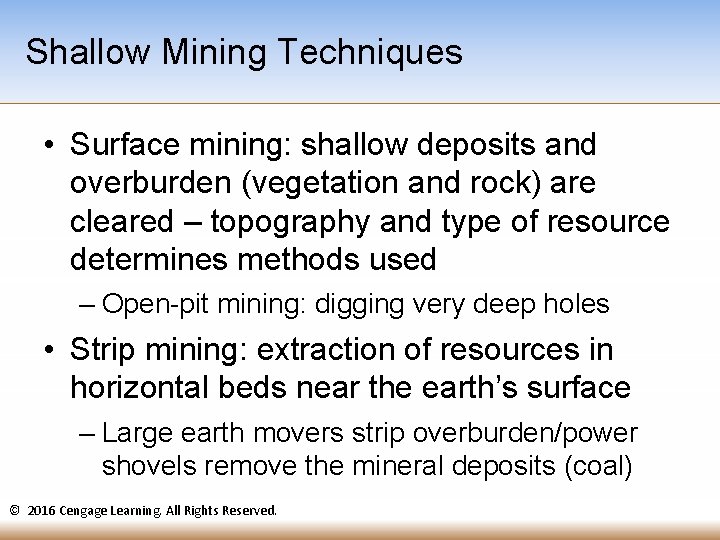
Shallow Mining Techniques • Surface mining: shallow deposits and overburden (vegetation and rock) are cleared – topography and type of resource determines methods used – Open-pit mining: digging very deep holes • Strip mining: extraction of resources in horizontal beds near the earth’s surface – Large earth movers strip overburden/power shovels remove the mineral deposits (coal) © 2016 Cengage Learning. All Rights Reserved.
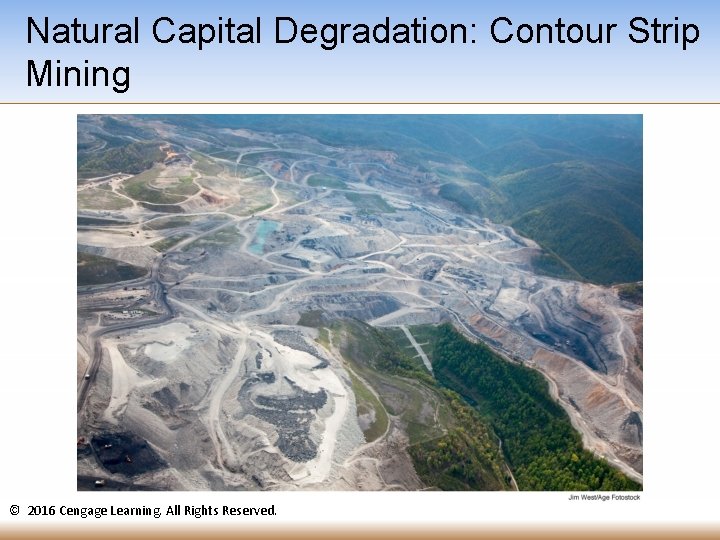
More Techniques: Surface and Subsurface Mining • Contour strip mining: process that terrace sides of mountains, often for mining coal – Overburden from each new terrace is dumped on the one below • Mountaintop mining: removing of mountaintop with explosives – Used in the Appalachians – very destructive • Subsurface mining: deep shafts are dug into the earth to remove the minerals © 2016 Cengage Learning. All Rights Reserved.
Natural Capital Degradation: Contour Strip Mining © 2016 Cengage Learning. All Rights Reserved.
Mining Produces Solid Wastes • Surface and subsurface mining produces ¾ of all solid wastes – a major cause of air and water pollution – Pollutes 40% of the western mountain watersheds in the U. S. – Responsible for 50% of the toxic chemicals released into the atmosphere – Severe environmental impacts occur where regulations and enforcement are not followed © 2016 Cengage Learning. All Rights Reserved.
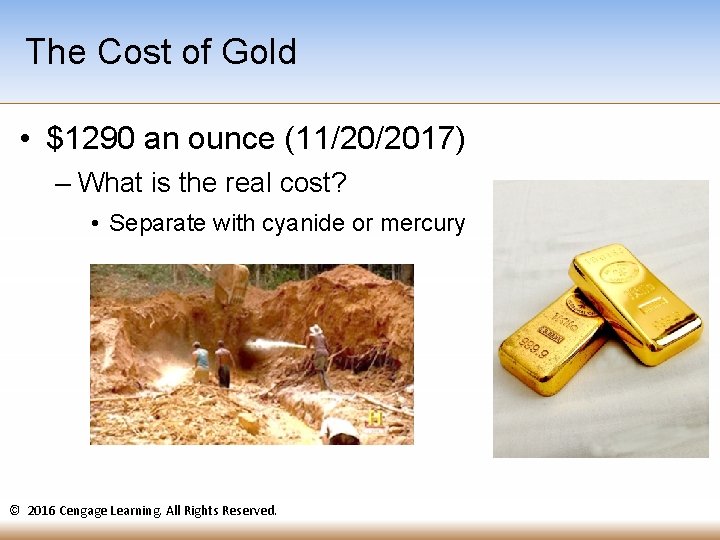
The Cost of Gold • $1290 an ounce (11/20/2017) – What is the real cost? • Separate with cyanide or mercury © 2016 Cengage Learning. All Rights Reserved.
Processing Ores Have Harmful Environmental Effects • Mining produces tailings: waste rock leftover after the ore has been extracted – Tailings are left in piles, when blown by wind or washed out by rainfall they contaminate topsoil, surface water, and groundwater • Smelting: when heat and chemicals are used to extract the ores – sulfur dioxide – Huge quantities of air pollution can result from this process © 2016 Cengage Learning. All Rights Reserved.
Additional Case Study: A Scarcity of Rare Metals is Hindering Green Technologies • Some green technologies are not used due to shortages of rare earth minerals – Materials are not reused because it is chemically easier and cheaper to extract them from ore deposits than to remove them from manufactured products – Every year 49 million tons of e-waste – from cell phones to refrigerators – accumulates in urban trash (less than 10% is recycled) © 2016 Cengage Learning. All Rights Reserved.