
Environmental Science 15 e MILLERSPOOLMAN G TYLER MILLER
- Slides: 30
Environmental Science, 15 e MILLER/SPOOLMAN G. TYLER MILLER | SCOTT E. SPOOLMAN 10 Food Production and the Environment © 2016 Cengage Learning. All Rights Reserved.
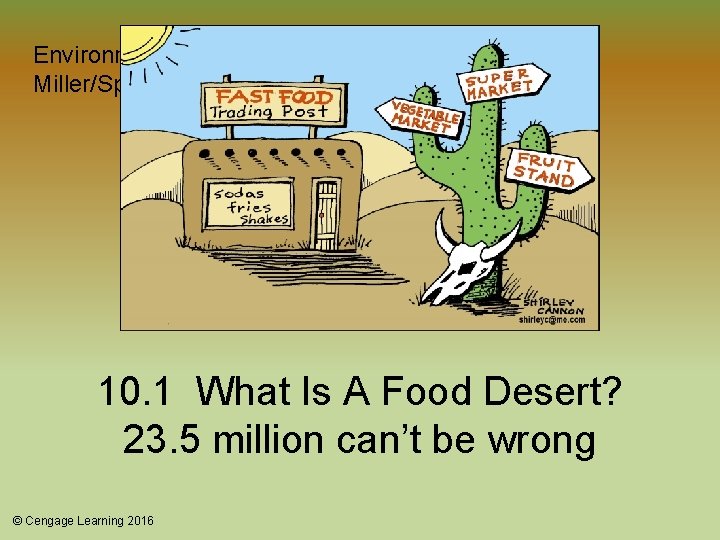
Environmental Science | 15 e Miller/Spoolman 10. 1 What Is A Food Desert? 23. 5 million can’t be wrong © 2016 Cengage Learning. All Rights Reserved. © Cengage Learning 2016
What Is Food Security and Why Is It Difficult To Attain? Food security is the condition under which all or most the people in a population have daily access to enough nutritious food to live active and healthy lives Poverty is the root cause ½ of the world’s people live on $2. 25 a day (50% spent on food) 1/6 of the world’s people live $1. 25 a day (70% spent on food) U. S spend about 7% on food on average © 2016 Cengage Learning. All Rights Reserved.
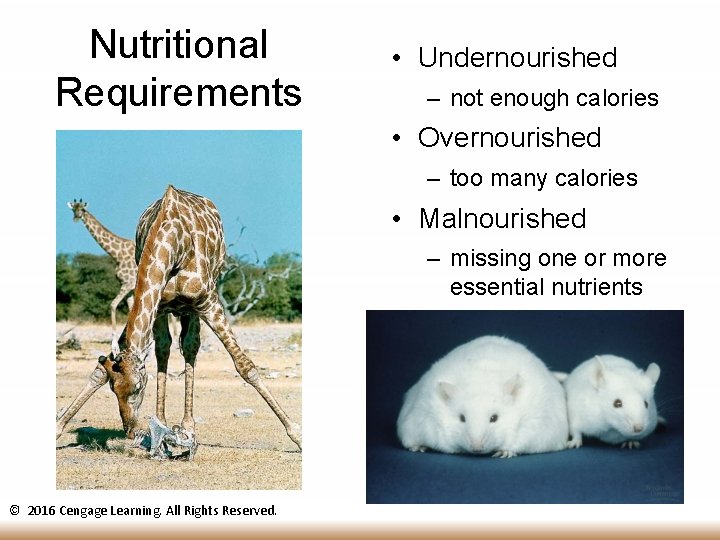
Nutritional Requirements • Undernourished – not enough calories • Overnourished – too many calories • Malnourished – missing one or more essential nutrients © 2016 Cengage Learning. All Rights Reserved.
Industrialized and Traditional Crop Production • Industrialized/high input agriculture: heavy equipment, fossil fuel, commercial fertilizer/pesticides, and money (monoculture: growing one to two crops) – Food supply vulnerable to disease • Traditional/low input agriculture: solar energy and human labor to grow a crop that will feed a family with no surplus (polyculture: growing several crops) © 2016 Cengage Learning. All Rights Reserved.
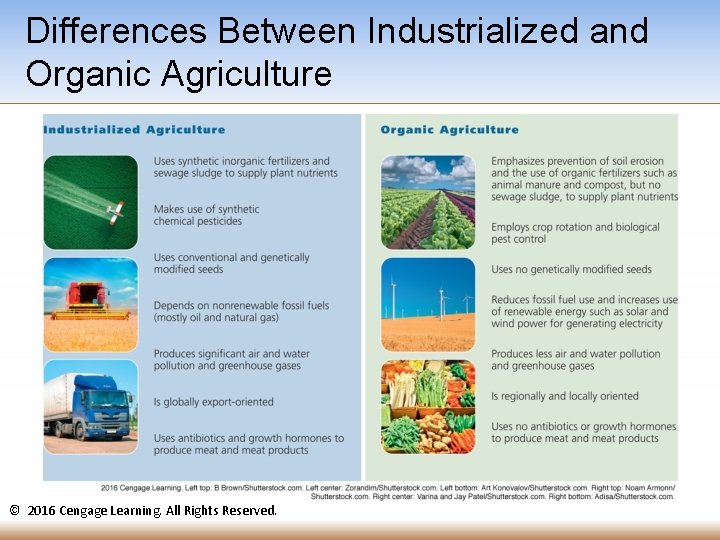
Differences Between Industrialized and Organic Agriculture © 2016 Cengage Learning. All Rights Reserved.
Industrialized Food Production in US • Since 1960, US has more than doubled the yields of key crops – 38% is fed to livestock © 2016 Cengage Learning. All Rights Reserved. • China and India are more productive than the United States (if measured by people fed per acre)
Organic Agriculture • Organic agriculture: crops grown without the use of synthetic pesticides and inorganic fertilizers, or genetic engineering • Labels – 100 % organic - These products contain only organically produced ingredients and processing aids. By law they can display the USDA Organic seal. – Organic - these products contain at least 95% organically produced ingredients. – Made with organic ingredients - packaging must contain at least 70% organic ingredients. – Natural - meaningless © 2016 Cengage Learning. All Rights Reserved.
The Green Revolution • Green revolution: higher yields from existing cropland – Plant monocultures of selectively bred crops – Large amounts of water; synthetic fertilizers and pesticides – Multiple cropping © 2016 Cengage Learning. All Rights Reserved.
Industrialized Food Production Requires Huge Inputs of Energy • Large inputs of energy are needed to grow, store, process, package, transport, refrigerate, and cook plants and animals – In the U. S. , 10 units of fossil fuel energy are needed to produce 1 unit of food energy – Fishing fleets use 12. 5 units of energy to produce 1 unit of energy from seafood – Industrialized food production is dependent on fossil fuel, resulting in a net energy loss © 2016 Cengage Learning. All Rights Reserved.
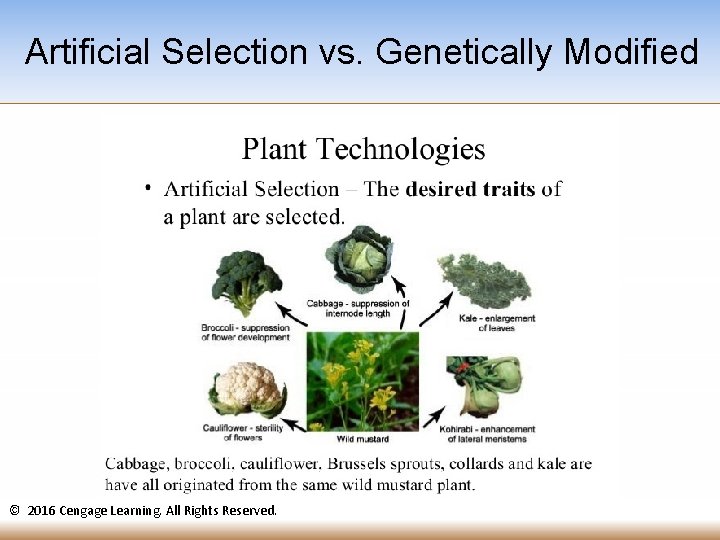
Artificial Selection vs. Genetically Modified © 2016 Cengage Learning. All Rights Reserved.
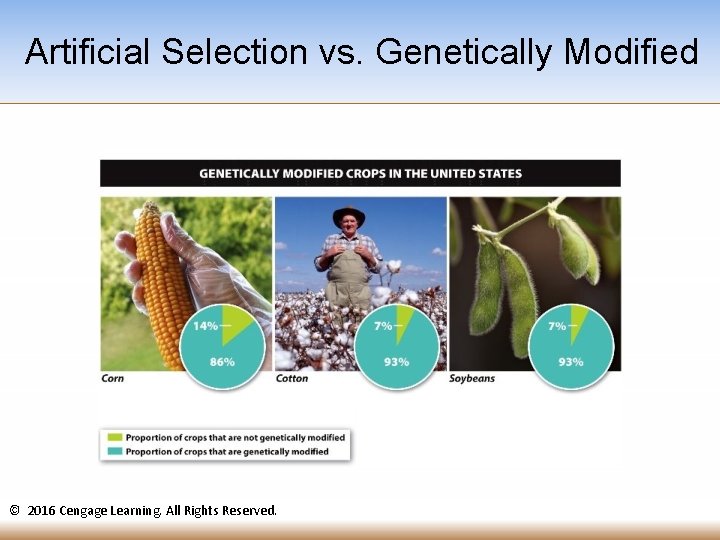
Artificial Selection vs. Genetically Modified © 2016 Cengage Learning. All Rights Reserved.
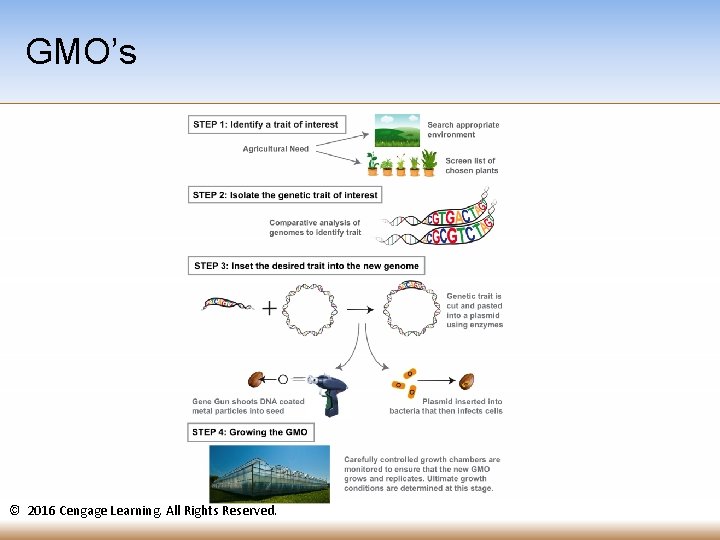
GMO’s © 2016 Cengage Learning. All Rights Reserved.
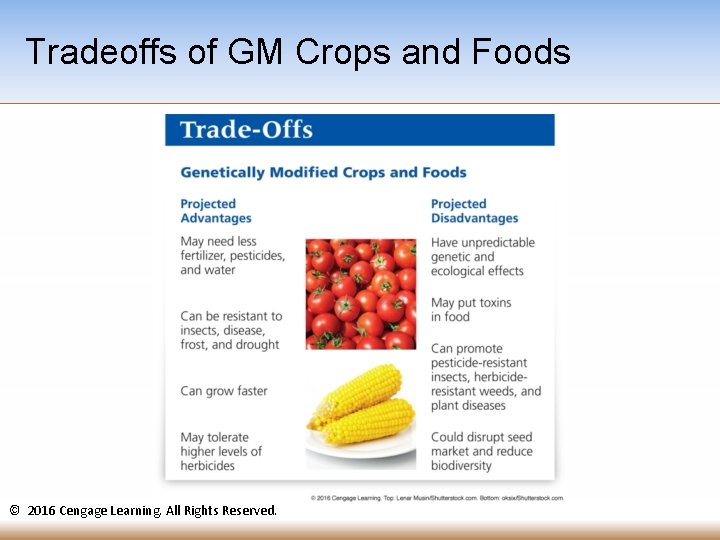
Tradeoffs of GM Crops and Foods © 2016 Cengage Learning. All Rights Reserved.
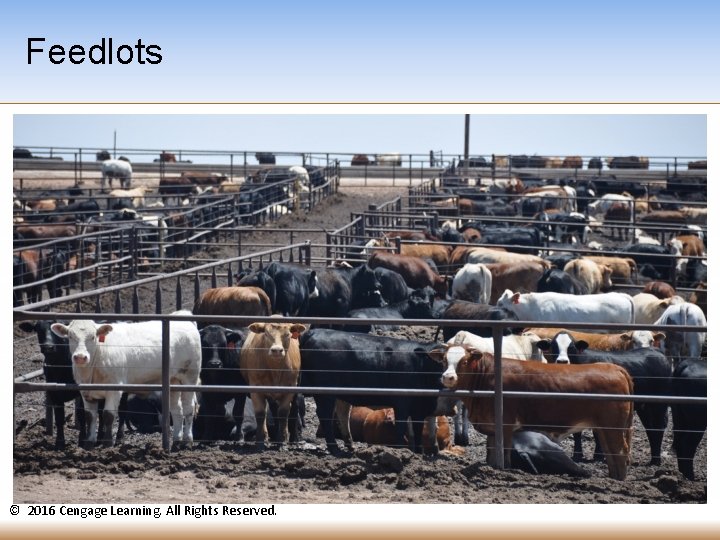
Feedlots © 2016 Cengage Learning. All Rights Reserved.
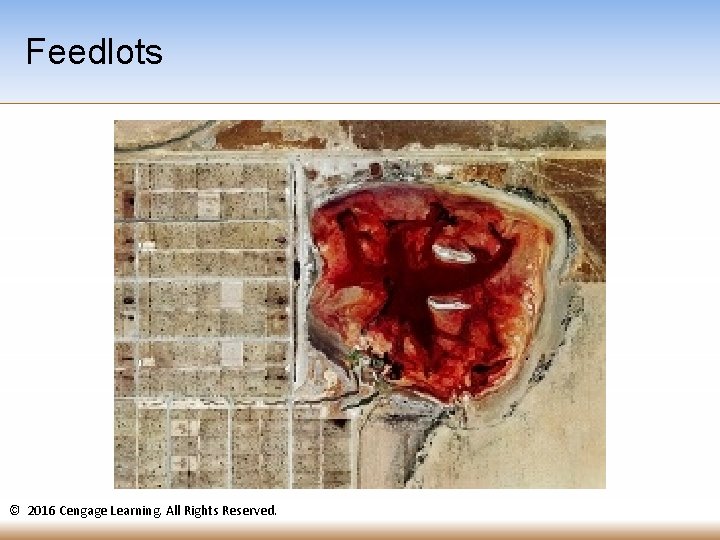
Feedlots © 2016 Cengage Learning. All Rights Reserved.
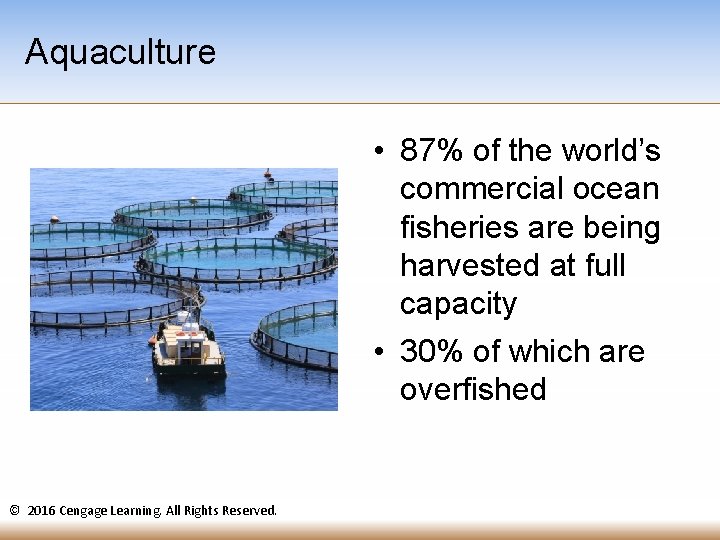
Aquaculture • 87% of the world’s commercial ocean fisheries are being harvested at full capacity • 30% of which are overfished © 2016 Cengage Learning. All Rights Reserved.
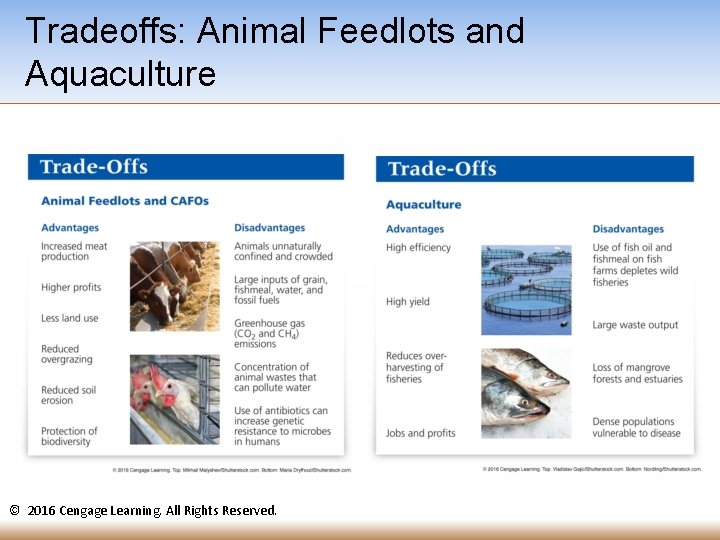
Tradeoffs: Animal Feedlots and Aquaculture © 2016 Cengage Learning. All Rights Reserved.
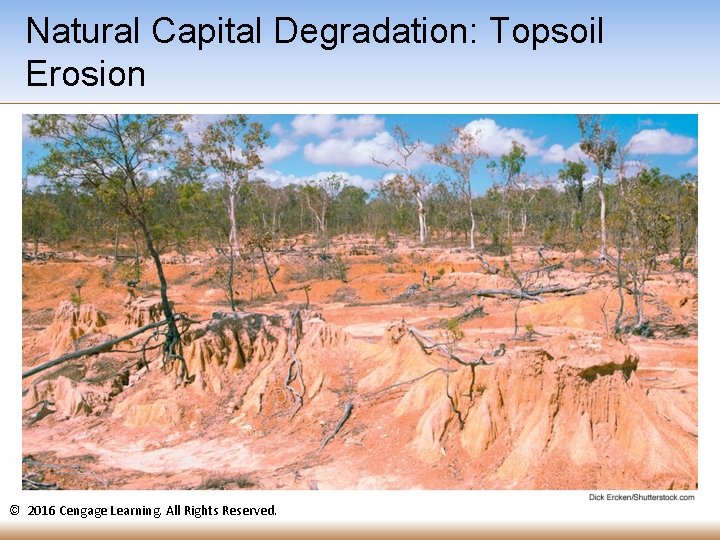
Topsoil Erosion Is a Serious Problem in Parts of the World • Topsoil (the fertile top layer of many soils), is a significant natural capital component because it stores water and nutrients needed by plants • Topsoil renewal is one of the earth’s most important ecosystem services – Topsoil nutrients recycle endlessly as long as they are not removed faster than natural processes replace them © 2016 Cengage Learning. All Rights Reserved.
Natural Capital Degradation: Topsoil Erosion © 2016 Cengage Learning. All Rights Reserved.
Soil Erosion • The movement of soil from one place to another by nature and by human activity – Flowing water (the largest cause of soil erosion) carries away soil loosened by rainfall – Wind loosens and blows away topsoil particles – from flat land in dry climates – Farming, deforestation, and overgrazing exposes land hastens soil erosion © 2016 Cengage Learning. All Rights Reserved.
Harmful Affects of Soil Erosion • Loss of soil fertility through the depletion of plant nutrients in topsoil • Topsoil pollution of surface waters can kill fish and clog reservoirs and lakes – Increased if it contains pesticide residues – biomagnified through food webs • Erosion releases the soil’s carbon content, which alters the carbon cycle, adding to atmospheric levels of CO 2 © 2016 Cengage Learning. All Rights Reserved.
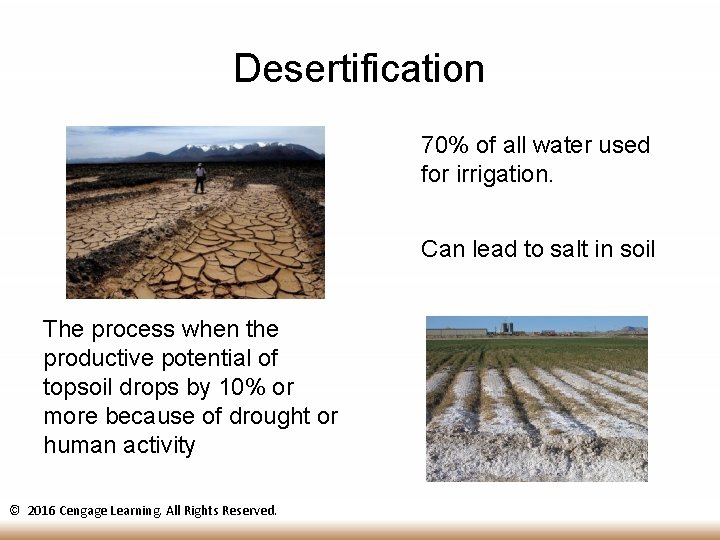
Desertification 70% of all water used for irrigation. Can lead to salt in soil The process when the productive potential of topsoil drops by 10% or more because of drought or human activity © 2016 Cengage Learning. All Rights Reserved.
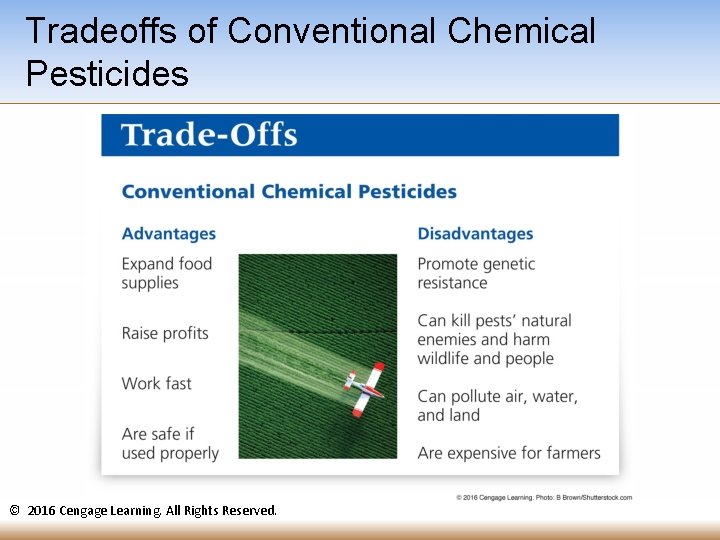
Nature Controls the Populations of Most Pests • Natural enemies control the populations of most pest species – This free ecosystem service is an important part of earth’s natural capital • Humans upset the checks and balances of natural pest control when we clear forests and grasslands, plant monoculture crops, and use synthetic chemicals to kill pests © 2016 Cengage Learning. All Rights Reserved.
Tradeoffs of Conventional Chemical Pesticides © 2016 Cengage Learning. All Rights Reserved.
Protective Laws and Treaties • Pesticide usage is regulated by: – Environmental Protection Agency (EPA), U. S. Department of Agriculture (USDA), and the Food and Drug Administration (FDA) under the Federal Insecticide, Fungicide and Rodenticide Act (FIFRA) • Unfortunately adequate funding has not been provided for effective management and enforcement of FIFRA © 2016 Cengage Learning. All Rights Reserved.
Alternatives to Synthetic Pesticide Use • Crop rotation/adjusting planting time starves pests/allows enemies to eat them • Polyculture provides homes for pest’s enemies • Implant genetic resistance • Biological control: use natural enemies – Natural pheromones (insect perfume) • Can lure pests into traps • Can attracted natural enemies into crop fields © 2016 Cengage Learning. All Rights Reserved.
More Alternatives to Synthetic Pesticide Usage • Integrated pest management (IPM) – use of a coordinated combination of cultivation, biological and chemical tools © 2016 Cengage Learning. All Rights Reserved.
10. 5 How Can We Improve Food Security? • Reducing poverty and malnutrition, producing food more sustainably, and relying on locally sourced food will improve food security © 2016 Cengage Learning. All Rights Reserved.
The Government’s Role in Improving Food Production and Security • Controlling food prices vs. food subsides • Implementing health measures • Aid local, sustainable, organic food production and distribution • Educate farmers • Encourage Community Supported Agriculture (CSA) programs © 2016 Cengage Learning. All Rights Reserved.