
Environmental Science 1 e SUSTAINING YOUR WORLD G

- Slides: 39
Environmental Science, 1 e SUSTAINING YOUR WORLD G. TYLER MILLER | SCOTT E. SPOOLMAN 1 The Environment and Sustainability © 2017 Cengage Learning. All Rights Reserved.
Case Study: The Greening of American Schools • Many schools across the United States are taking sustainability seriously. – Green building design – Waste recycling and repurposing – Curricula that include environmental science and sustainability themes • In what other ways are people and businesses increasing energy efficiency and reducing environmental impact? © 2017 Cengage Learning. All Rights Reserved.
Sustainability Defined • The ability of Earth’s natural systems and human cultural systems to survive, flourish into the long-term future © 2017 Cengage Learning. All Rights Reserved.
1. 1 What Are Some Key Factors of Sustainability? • Life on Earth: – Has been sustained for 3. 8 billion years by solar energy, biodiversity, and nutrient cycling – Depends on energy from the sun and natural capital provided by Earth – Can been preserved by shifting toward fullcost pricing and win-win solutions © 2017 Cengage Learning. All Rights Reserved.
Environmental Science Is a Study of Connections in Nature • What is the environment? – Everything around us, living and nonliving • What is environmental science? – Interdisciplinary study of how humans interact with the environment (draws on engineering, natural sciences, social sciences, ethics) • Environmentalism: – A social movement dedicated to sustaining Earth’s life-support system © 2017 Cengage Learning. All Rights Reserved.
What Are the Goals of Environmental Science? • Study the ecology of organisms in their ecosystems. • Learn how life on Earth has survived and thrived. • Understand how humans interact with the environment. • Find ways to deal with environmental problems and live more sustainably. © 2017 Cengage Learning. All Rights Reserved.
Scientific Factors of Sustainability • Solar Energy – Supplies nutrients, directly and indirectly • Biodiversity – Provides ecosystem services and adaptability • Nutrient cycling – Cycling of life-giving nutrients/chemicals between organisms and environment © 2017 Cengage Learning. All Rights Reserved.
Social Factors of Sustainability • Economics – Full-cost pricing to include environmental and health costs of producing goods/services • Political Science – Win-win solutions to environmental problems • Ethics – A responsibility to protect Earth for future generations © 2017 Cengage Learning. All Rights Reserved.
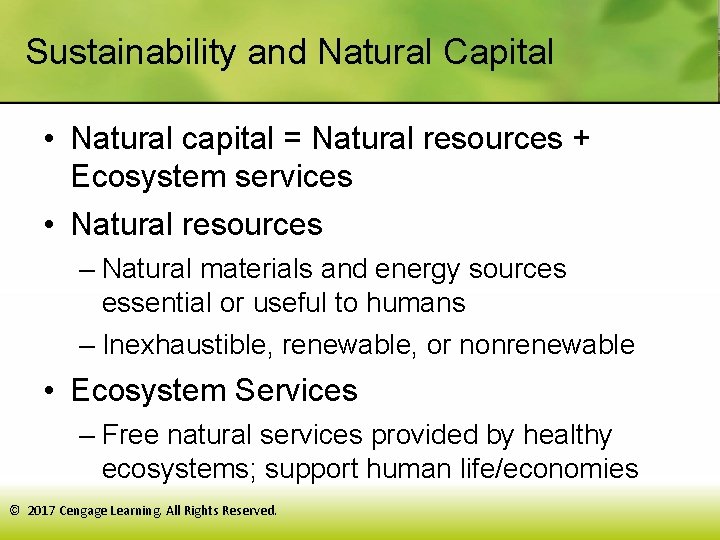
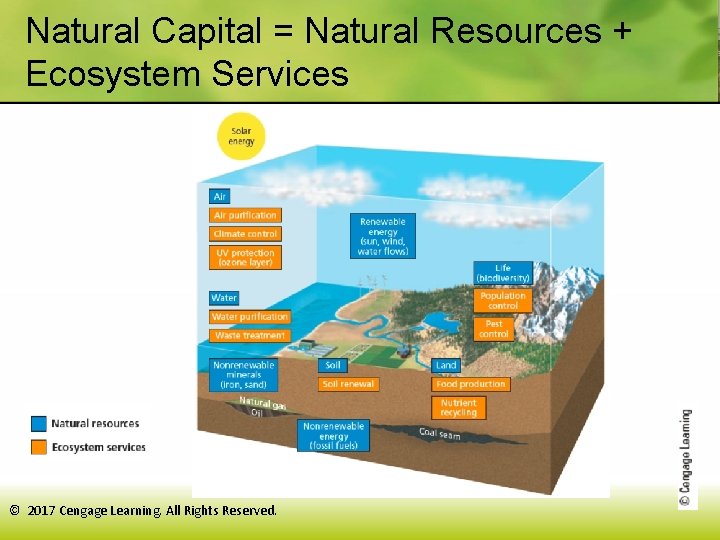
Sustainability and Natural Capital • Natural capital = Natural resources + Ecosystem services • Natural resources – Natural materials and energy sources essential or useful to humans – Inexhaustible, renewable, or nonrenewable • Ecosystem Services – Free natural services provided by healthy ecosystems; support human life/economies © 2017 Cengage Learning. All Rights Reserved.
Natural Capital = Natural Resources + Ecosystem Services © 2017 Cengage Learning. All Rights Reserved.
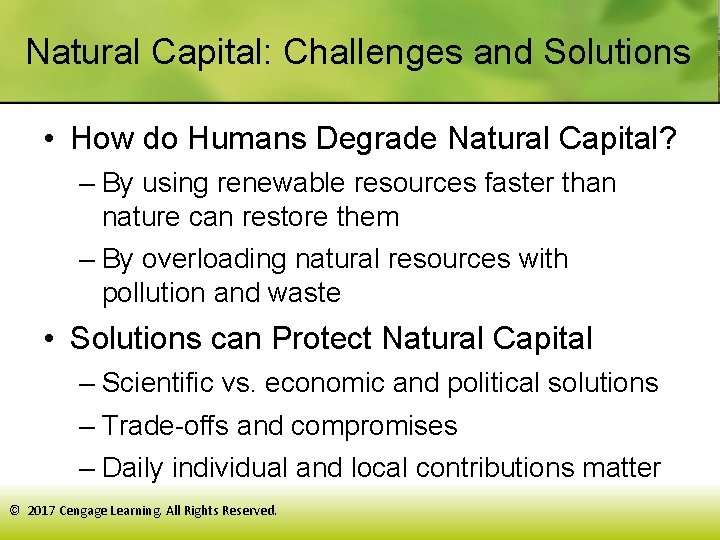
Natural Capital: Challenges and Solutions • How do Humans Degrade Natural Capital? – By using renewable resources faster than nature can restore them – By overloading natural resources with pollution and waste • Solutions can Protect Natural Capital – Scientific vs. economic and political solutions – Trade-offs and compromises – Daily individual and local contributions matter © 2017 Cengage Learning. All Rights Reserved.
1. 2 How Are Our Ecological Footprints Affecting Earth? • Humans have the power to degrade or sustain Earth’s life-support system. • Over time, growth of ecological footprints depletes and degrades Earth’s natural capital. • Is there any good news? © 2017 Cengage Learning. All Rights Reserved.
Many People Have a Better Quality of Life • Humans have learned to transform raw materials into useful goods and services. • Globally, life spans are increasing; infant mortality is decreasing. – Improved food supply, air/water quality, access to education, disease prevention • Some species and ecosystems are being successfully protected. • Technology is improving communication. © 2017 Cengage Learning. All Rights Reserved.
Humans Are Living Unsustainably • Environmental Degradation – Waste, depletion, degradation of natural capital – Tragedy of the commons: large numbers of people exploit a shared/open access resource unsustainably • Human activities have overused about 60% of Earth’s ecosystem services, mainly since 1950. © 2017 Cengage Learning. All Rights Reserved.
Countries Differ in Resource Use and Environmental Impact • More-developed countries – 17% of world’s population (United States, Canada, Japan, Australia, Western Europe) • Less-developed countries – 83% of world’s population • Middle-income, moderately developed countries (China, Brazil, Thailand, Mexico) • Low income, least-developed countries (Congo, Haiti) © 2017 Cengage Learning. All Rights Reserved.
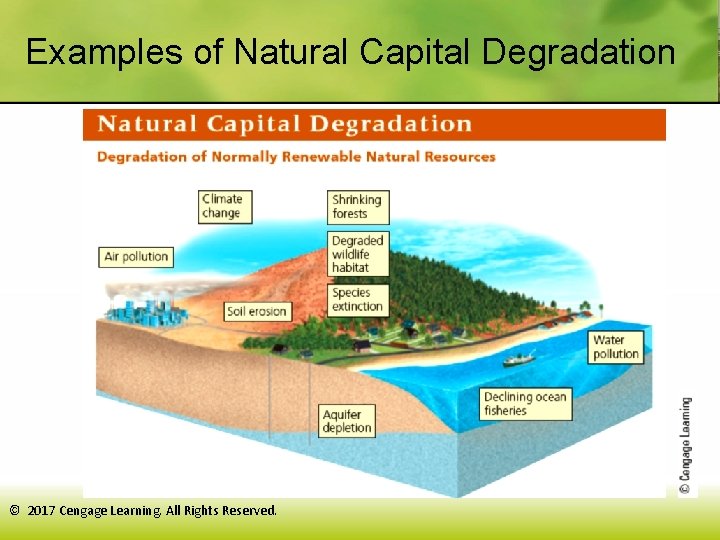
Examples of Natural Capital Degradation © 2017 Cengage Learning. All Rights Reserved.
Pollution Causes Environmental Problems • Pollution: contamination of the environment by any polluting substance (pollutant)—such as chemicals, noise, heat—at levels considered harmful to health, survival, activities of organisms – Naturally occurring (volcanoes) – Contributed by humans (burning of fossil fuels) © 2017 Cengage Learning. All Rights Reserved.
Sources of Pollution • Point Source – Single, identifiable source from which pollutants are discharged – Examples: smokestacks, motor vehicles, chimneys, drainage pipes • Nonpoint Source – Dispersed sources, difficult to pinpoint – Examples: runoff from farm fields, trash in streams, deposition of air pollutants on land © 2017 Cengage Learning. All Rights Reserved.
How Are We Dealing With Pollution? • Pollution cleanup (post-production) – Cleanup: dilution/reduction of pollutants • Pollution prevention (before pollution occurs) – Reduces or eliminates the production of pollutants © 2017 Cengage Learning. All Rights Reserved.
What is an Ecological Footprint? • Ecological footprint: – The amount of land water needed to supply an individual or a population with renewable resources and to absorb/recycle wastes and pollution such resource use produces • Growth of ecological footprints: – Leads to degradation of natural capital – Results in the creation of pollution and waste © 2017 Cengage Learning. All Rights Reserved.
Our Ecological Footprints Are Growing • Ecological deficit – Occurs when the ecological footprint is larger than the biological capacity to replenish resources and absorb wastes/pollution • An ecological deficit indicates that humans are living unsustainably. • Globally, humans are running up a huge ecological deficit that is expected to keep growing. © 2017 Cengage Learning. All Rights Reserved.
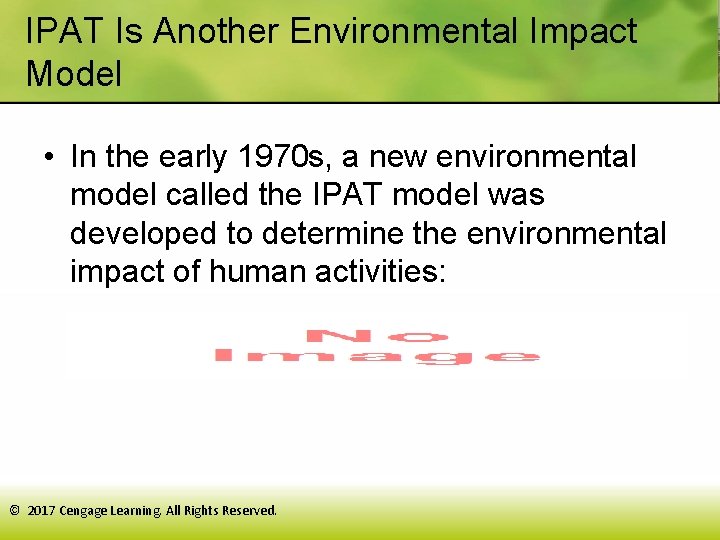
IPAT Is Another Environmental Impact Model • In the early 1970 s, a new environmental model called the IPAT model was developed to determine the environmental impact of human activities: © 2017 Cengage Learning. All Rights Reserved.
1. 3 What Causes Environmental Problems and Why Do They Persist? • Environmental and social scientists have identified five basic causes of the environmental problems society faces. – Population growth – Unsustainable resource use – Poverty – Lack of full-cost pricing for goods/services – Increasing isolation from nature © 2017 Cengage Learning. All Rights Reserved.
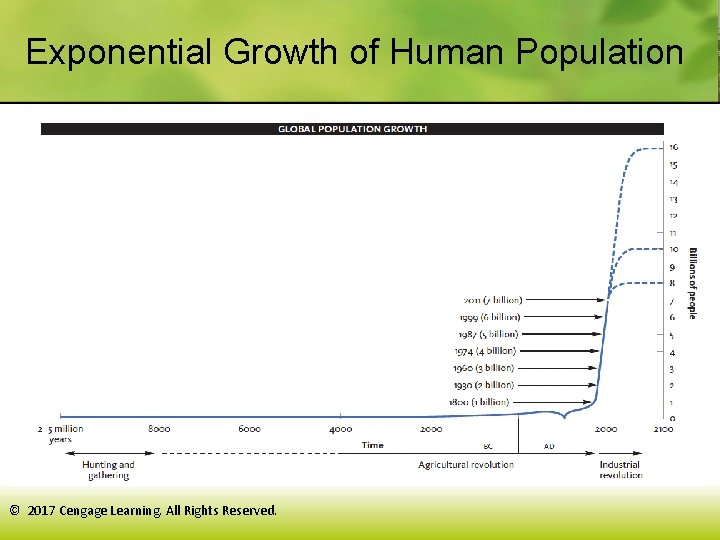
The Human Population Is Growing at a Rapid Rate • The human population is growing. – 2015 world population: 7. 3 billion; more than 89 million people added each year – Projected 2050 world population: 9. 8 billion • Slowing population growth could limit severe environmental degradation. – Aim to level off at 8 billion by 2050 – Promote economic development, family planning, elevated status for women © 2017 Cengage Learning. All Rights Reserved.
Exponential Growth of Human Population © 2017 Cengage Learning. All Rights Reserved.
Affluence Can Have Negative Environmental Impacts • High levels of consumption and waste of resources • More air pollution, water pollution, and land degradation • Acquisition of resources without regard for/awareness of the environmental effects of consuming them © 2017 Cengage Learning. All Rights Reserved.
Affluence Can Have Positive Environmental Impacts • Better education • Scientific research • Technological solutions resulting in improvements in environmental quality (e. g. , safe drinking water) © 2017 Cengage Learning. All Rights Reserved.
Poverty Can Have Harmful Environmental and Health Effects • Harmful effects – Short-term requirements for survival can lead to degraded forests, topsoil, grasslands, fisheries, wildlife populations • Health effects – Malnutrition, limited access to sanitation/clean drinking water, outdoor and indoor air pollution © 2017 Cengage Learning. All Rights Reserved.
Prices of Goods/Services Rarely Include Their Harmful Environmental/Health Costs • Consumers are unaware of the damage caused by their consumption due to lack of full-cost pricing. • Current government subsidies often increase environmental degradation. – Change subsidies to promote sustainability: • Tax pollution and waste • Shift from environmentally harmful to environmentally beneficial subsidies © 2017 Cengage Learning. All Rights Reserved.
People Are Increasingly Isolated From Nature • More than half the world’s population lives in urban areas. • Technology (cell phones, computers) adds to isolation from nature. • “Nature deficit disorder” – Symptoms: stress, anxiety, depression • Benefits of getting outdoors: exercise, improved health, brain function, creativity, sense of wonder © 2017 Cengage Learning. All Rights Reserved.
People Have Different Views About Environmental Problems/Solutions • What is an environmental worldview? – A set of assumptions and values reflecting how one thinks the world works and what one’s role in it should be • Some environmental ethics questions: – Why care about the environment? – Are humans the most important species? – Must we protect Earth for future generations? – Should everyone live more sustainably? © 2017 Cengage Learning. All Rights Reserved.
Three Major Types of Worldviews • Human-centered – Natural world is support system for human life – Divided into planetary/stewardship worldviews • Life-centered – All species have value even if not valuable to humans, should be protected from extinction • Earth-centered – Humans part of, dependent on, nature – Look to nature for ways to think and act © 2017 Cengage Learning. All Rights Reserved.
1. 4 What Is an Environmentally Sustainable Society? • In order to live sustainably, one must live off the natural resources without depleting or degrading the natural capital that supplies these natural resources. © 2017 Cengage Learning. All Rights Reserved.
Environmental Conservation and Protection in the United States: Early Years • Early conservation efforts – 1864: First conservation efforts (Marsh) – Early 20 th century • Preservation: Fully protect wilderness (Muir) • Conservation: Manage public lands wisely for their natural resources (Roosevelt, Pinchot) • Blending of preservation/conservation (Leopold) – Mid-20 th century • Industrialization leads to air/water pollution • Silent Spring by Rachel Carson © 2017 Cengage Learning. All Rights Reserved.
Environmental Conservation and Protection in the United States: 1970 s • The American public demands action in response to environmental problems. – First Earth Day (April 22, 1970) – Environmental Protection Agency (1970) – Most U. S. environmental laws passed – Establishment of environmental groups, college courses on environmental issues © 2017 Cengage Learning. All Rights Reserved.
Environmental Conservation and Protection in the United States: 1980 s and After • Backlash against environmental laws/regulations • Corporations, some lawmakers seek to weaken environmental laws – “Disinformation” campaigns • Call for United States to once again take lead on environmental issues © 2017 Cengage Learning. All Rights Reserved.
An Environmentally Sustainable Society • Natural income is the portion of renewable resources that can be used sustainably. • By living only on Earth’s natural income and not depleting the natural capital, society moves from an unsustainable lifestyle to a sustainable one. © 2017 Cengage Learning. All Rights Reserved.
A More Sustainable Future Is Possible • Given enough time, most degraded environments can recover, but many will take hundreds and even thousands of years to recover. – Time is our most scarce resource. – However, 5– 10% of a population that changes can make a difference. – Changes can occur in a shorter time than previously thought. © 2017 Cengage Learning. All Rights Reserved.
Environmental Science, 1 e SUSTAINING YOUR WORLD G. TYLER MILLER | SCOTT E. SPOOLMAN 1 Environmental Problems, Their Causes, and Sustainability © 2017 Cengage Learning. All Rights Reserved.