
Environmental Scanning Identify external opportunities and threats and

- Slides: 37
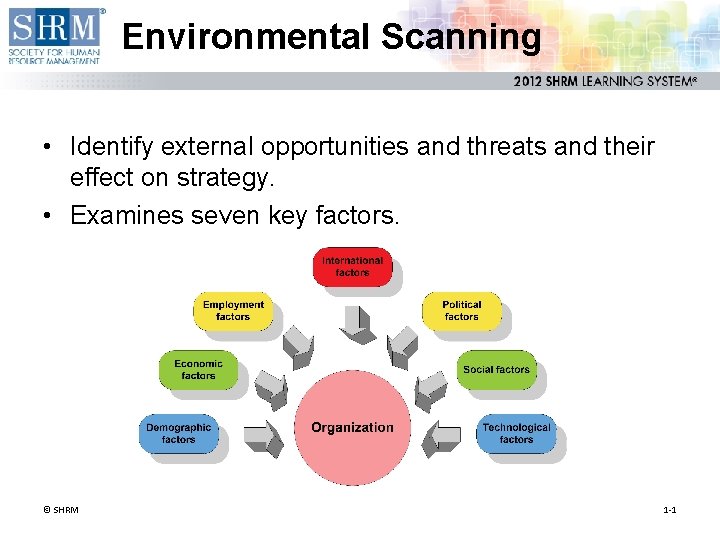
Environmental Scanning • Identify external opportunities and threats and their effect on strategy. • Examines seven key factors. © SHRM 1 -1
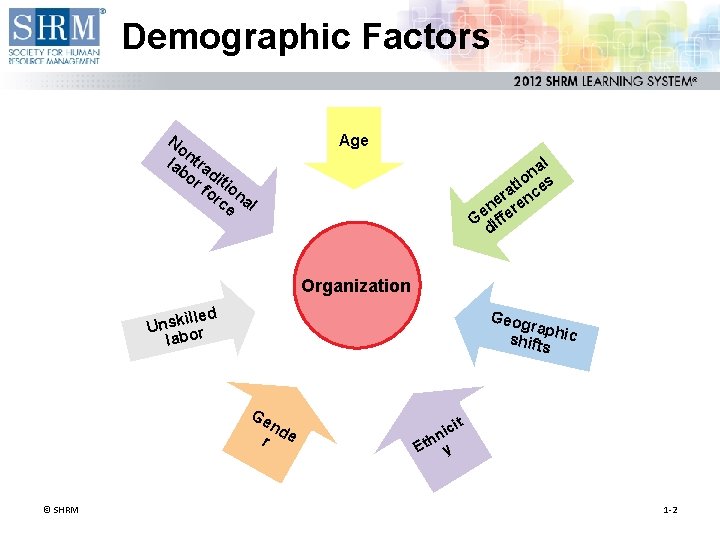
Demographic Factors No n la tra bo d r f itio or na ce l Age al n tio ces a er ren n Ge iffe d Organization illed k s n U labor Geog raphi shifts c Ge r © SHRM nd e t ici n h Et y 1 -2
Economic Factors GDP Interest rates CPI Economic Factors Inflation © SHRM Disposable income 1 -3
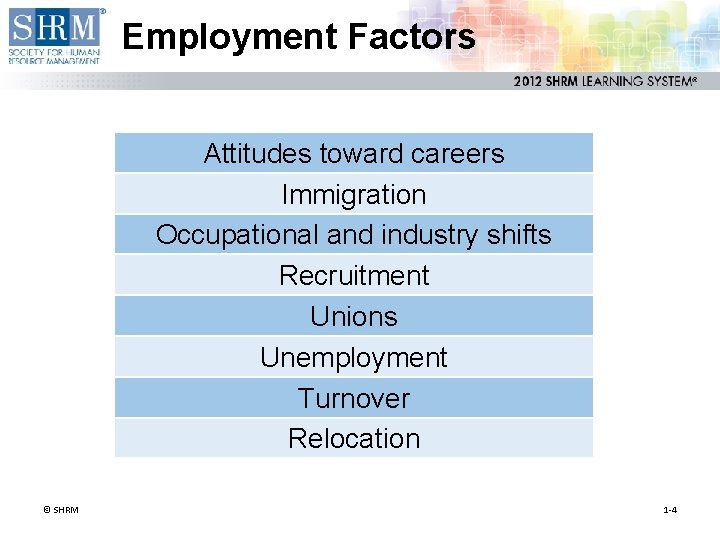
Employment Factors Attitudes toward careers Immigration Occupational and industry shifts Recruitment Unions Unemployment Turnover Relocation © SHRM 1 -4
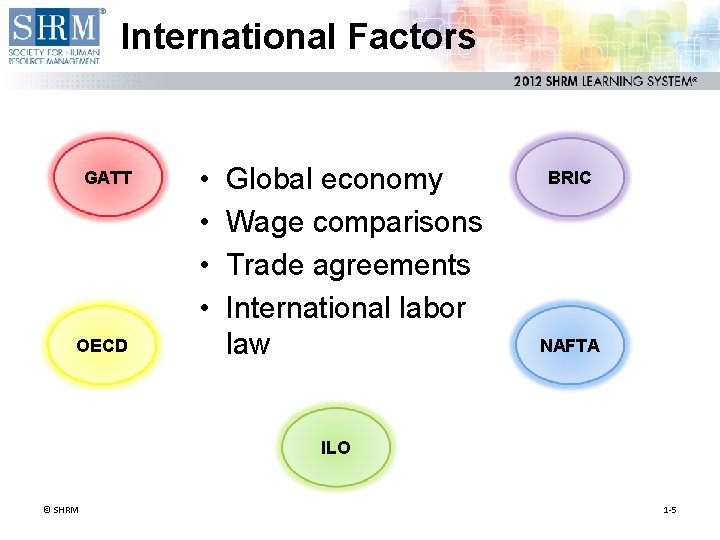
International Factors GATT OECD • • Global economy Wage comparisons Trade agreements International labor law BRIC NAFTA ILO © SHRM 1 -5
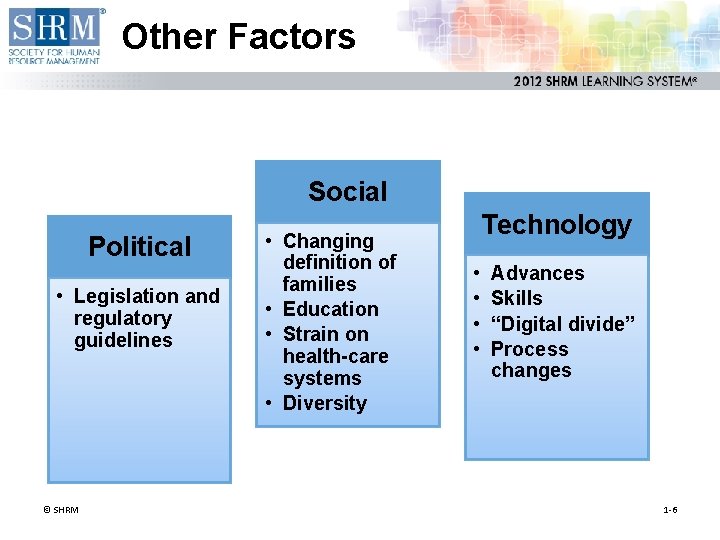
Other Factors Social Political • Legislation and regulatory guidelines © SHRM • Changing definition of families • Education • Strain on health-care systems • Diversity Technology • • Advances Skills “Digital divide” Process changes 1 -6
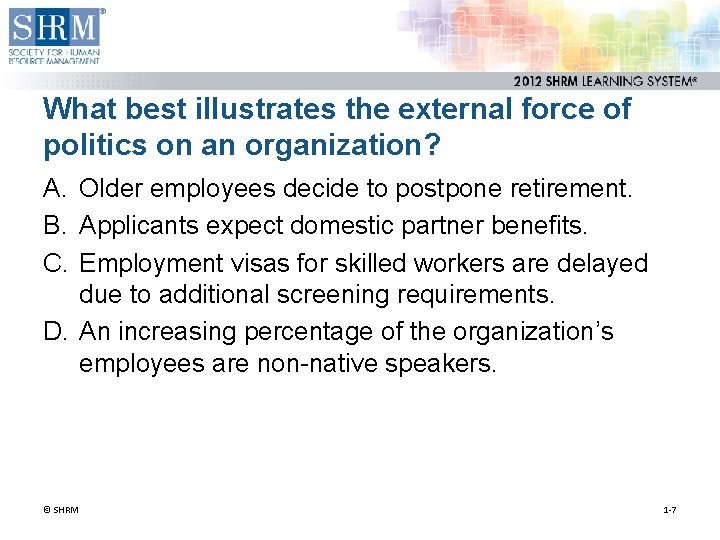
What best illustrates the external force of politics on an organization? A. Older employees decide to postpone retirement. B. Applicants expect domestic partner benefits. C. Employment visas for skilled workers are delayed due to additional screening requirements. D. An increasing percentage of the organization’s employees are non-native speakers. © SHRM 1 -7
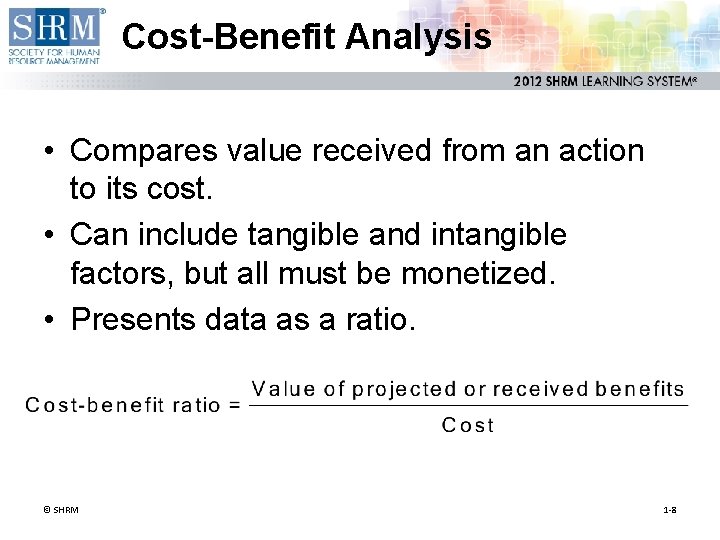
Cost-Benefit Analysis • Compares value received from an action to its cost. • Can include tangible and intangible factors, but all must be monetized. • Presents data as a ratio. © SHRM 1 -8
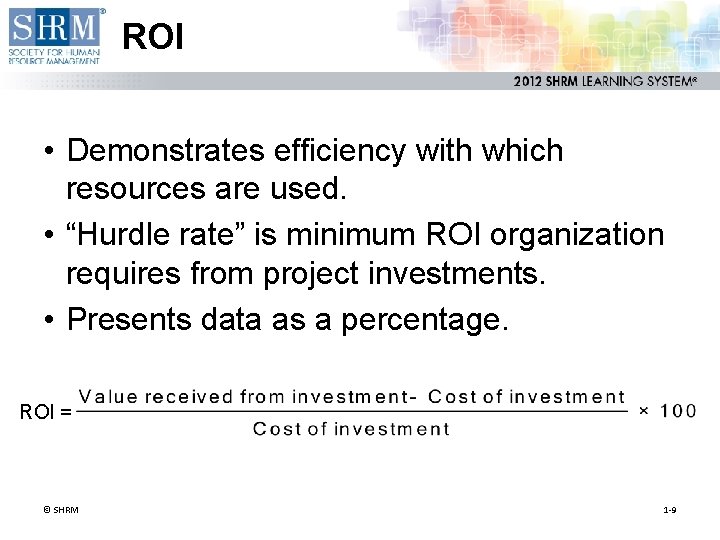
ROI • Demonstrates efficiency with which resources are used. • “Hurdle rate” is minimum ROI organization requires from project investments. • Presents data as a percentage. ROI = © SHRM 1 -9
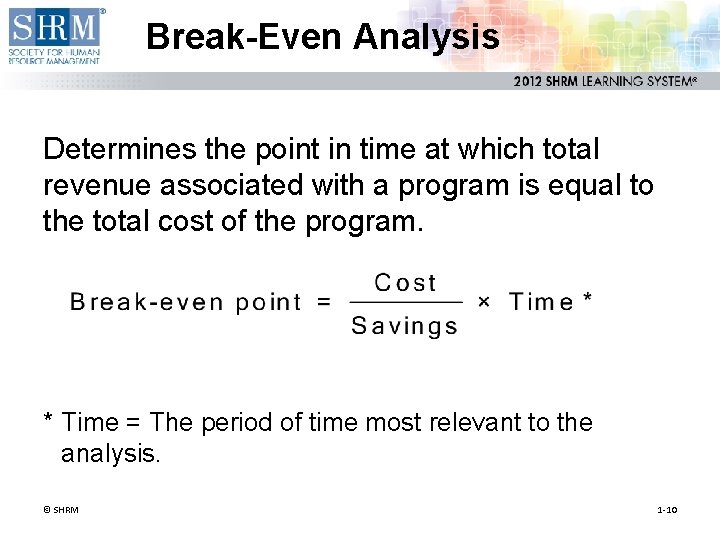
Break-Even Analysis Determines the point in time at which total revenue associated with a program is equal to the total cost of the program. * Time = The period of time most relevant to the analysis. © SHRM 1 -10
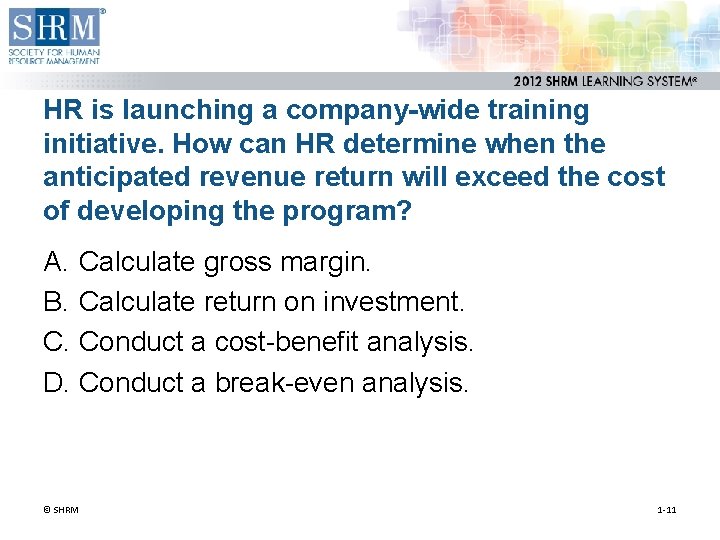
HR is launching a company-wide training initiative. How can HR determine when the anticipated revenue return will exceed the cost of developing the program? A. Calculate gross margin. B. Calculate return on investment. C. Conduct a cost-benefit analysis. D. Conduct a break-even analysis. © SHRM 1 -11
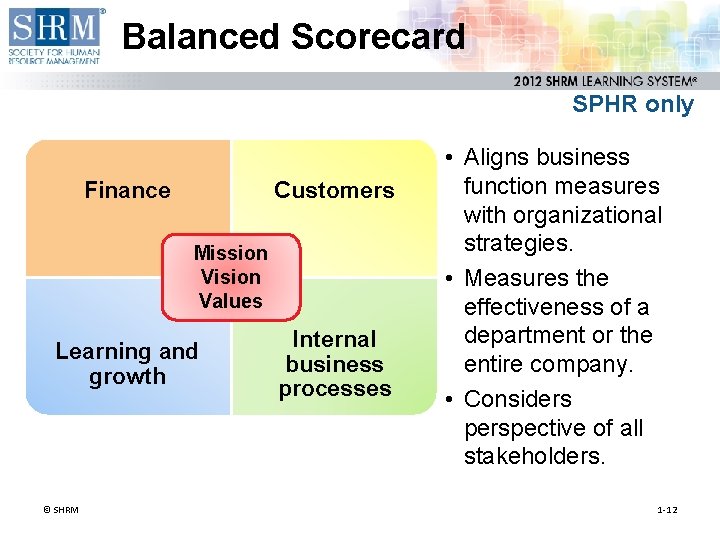
Balanced Scorecard SPHR only Finance Customers Mission Vision Values Learning and growth © SHRM Internal business processes • Aligns business function measures with organizational strategies. • Measures the effectiveness of a department or the entire company. • Considers perspective of all stakeholders. 1 -12
For a balanced scorecard system to be implemented effectively, it should SPHR only A. be introduced simultaneously to all divisions and departments. B. start at the bottom of the organization and work its way to the top. C. focus on specific measures that support business strategies. D. concentrate on tracking and reporting financial results. © SHRM 1 -13
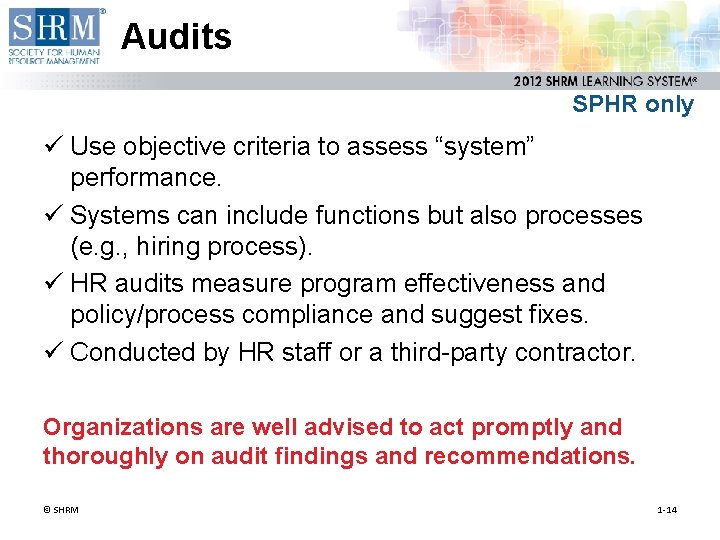
Audits SPHR only ü Use objective criteria to assess “system” performance. ü Systems can include functions but also processes (e. g. , hiring process). ü HR audits measure program effectiveness and policy/process compliance and suggest fixes. ü Conducted by HR staff or a third-party contractor. Organizations are well advised to act promptly and thoroughly on audit findings and recommendations. © SHRM 1 -14
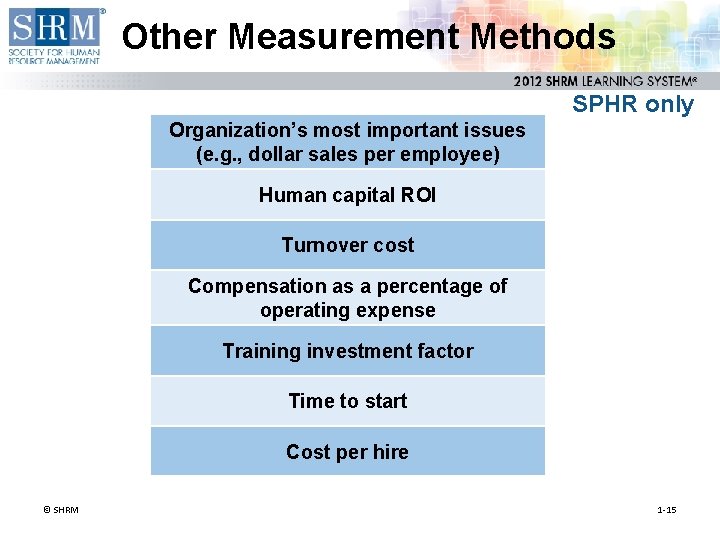
Other Measurement Methods SPHR only Organization’s most important issues (e. g. , dollar sales per employee) Human capital ROI Turnover cost Compensation as a percentage of operating expense Training investment factor Time to start Cost per hire © SHRM 1 -15
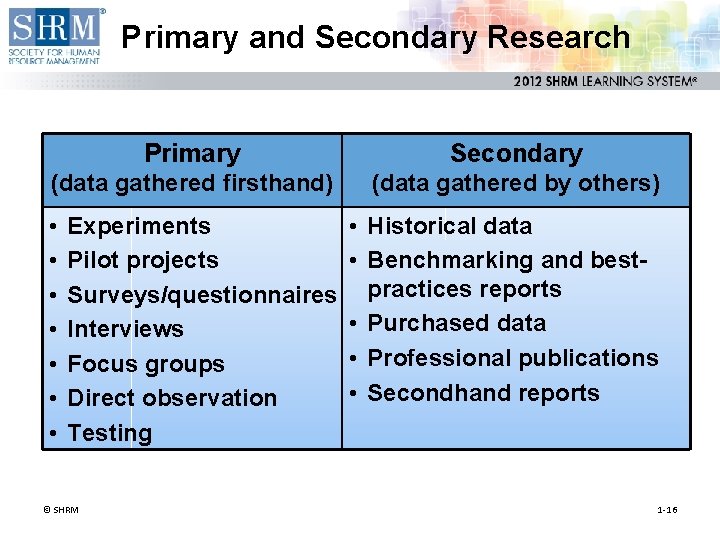
Primary and Secondary Research Primary Secondary (data gathered firsthand) (data gathered by others) • • Experiments Pilot projects Surveys/questionnaires Interviews Focus groups Direct observation Testing © SHRM • Historical data • Benchmarking and bestpractices reports • Purchased data • Professional publications • Secondhand reports 1 -16
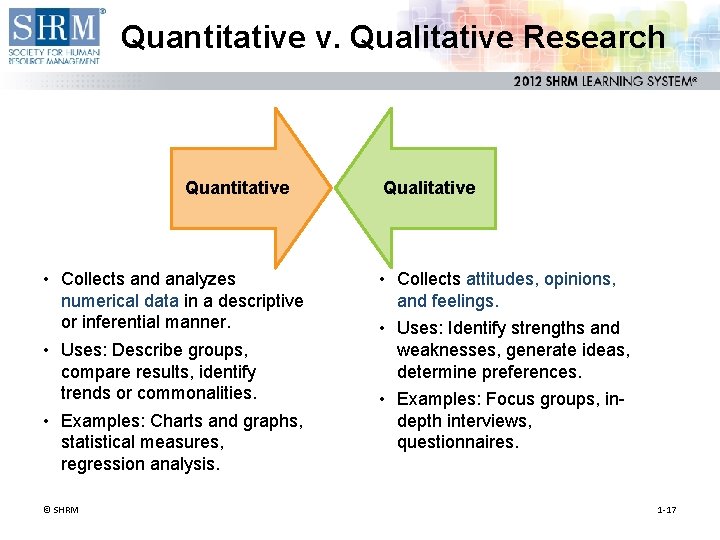
Quantitative v. Qualitative Research Quantitative • Collects and analyzes numerical data in a descriptive or inferential manner. • Uses: Describe groups, compare results, identify trends or commonalities. • Examples: Charts and graphs, statistical measures, regression analysis. © SHRM Qualitative • Collects attitudes, opinions, and feelings. • Uses: Identify strengths and weaknesses, generate ideas, determine preferences. • Examples: Focus groups, indepth interviews, questionnaires. 1 -17
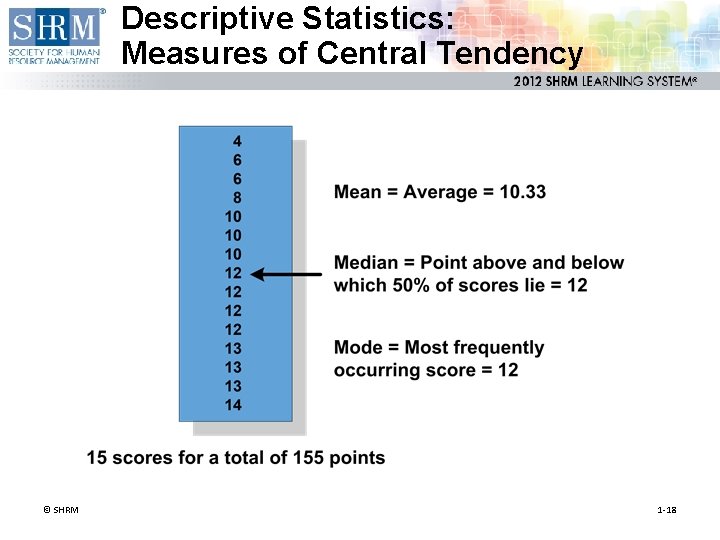
Descriptive Statistics: Measures of Central Tendency © SHRM 1 -18
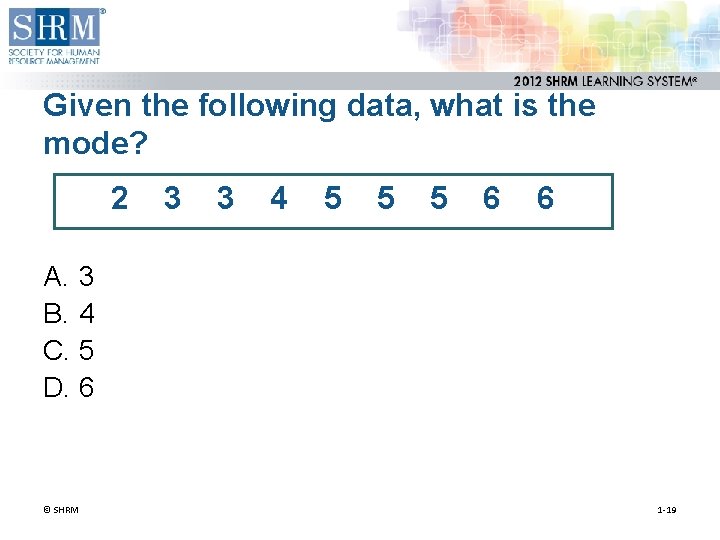
Given the following data, what is the mode? 2 3 3 4 5 5 5 6 6 A. 3 B. 4 C. 5 D. 6 © SHRM 1 -19
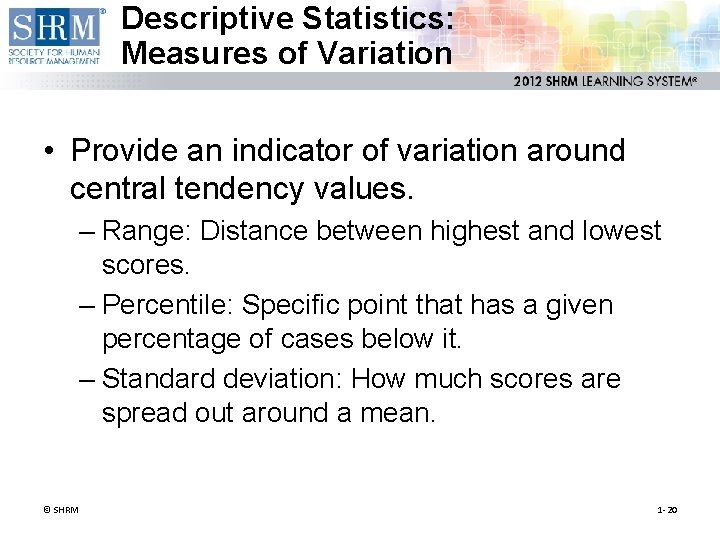
Descriptive Statistics: Measures of Variation • Provide an indicator of variation around central tendency values. – Range: Distance between highest and lowest scores. – Percentile: Specific point that has a given percentage of cases below it. – Standard deviation: How much scores are spread out around a mean. © SHRM 1 -20
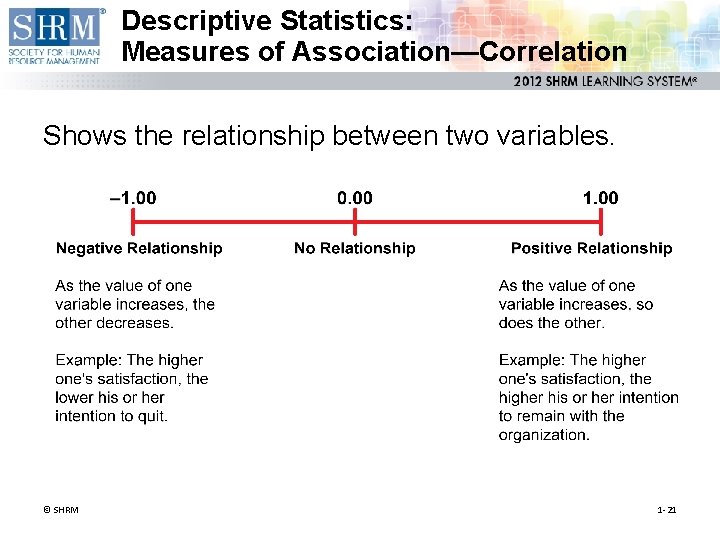
Descriptive Statistics: Measures of Association—Correlation Shows the relationship between two variables. © SHRM 1 -21
Descriptive Statistics: Measures of Association—Regression • Refers to a statistical method used to predict a variable from one or more predictor variables. • Determines: — Whether a relationship exists between variables and — The strength of the relationship. • Causal relationship exists when two variables are related in some way. © SHRM 1 -22
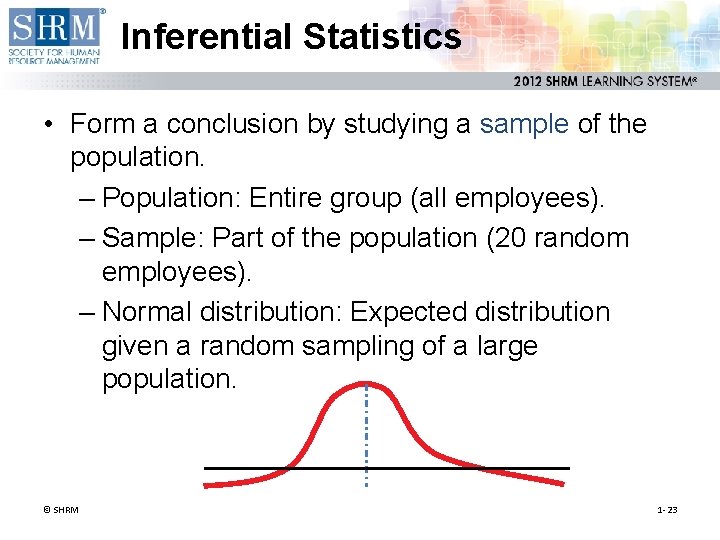
Inferential Statistics • Form a conclusion by studying a sample of the population. – Population: Entire group (all employees). – Sample: Part of the population (20 random employees). – Normal distribution: Expected distribution given a random sampling of a large population. © SHRM 1 -23
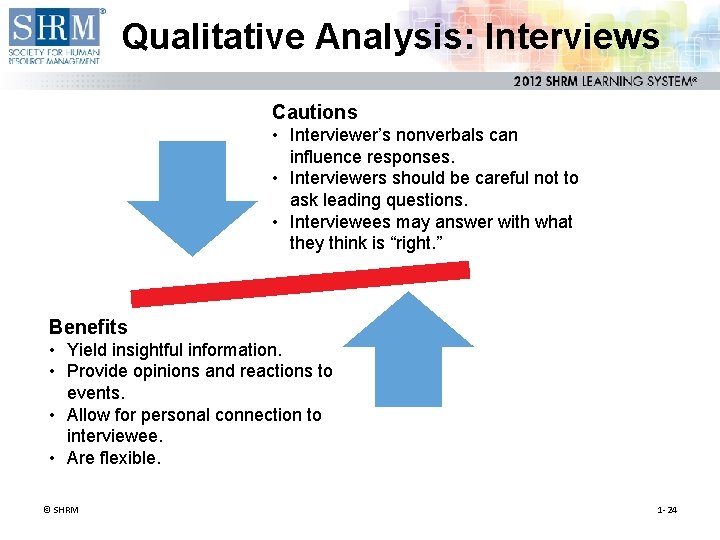
Qualitative Analysis: Interviews Cautions • Interviewer’s nonverbals can influence responses. • Interviewers should be careful not to ask leading questions. • Interviewees may answer with what they think is “right. ” Benefits • Yield insightful information. • Provide opinions and reactions to events. • Allow for personal connection to interviewee. • Are flexible. © SHRM 1 -24
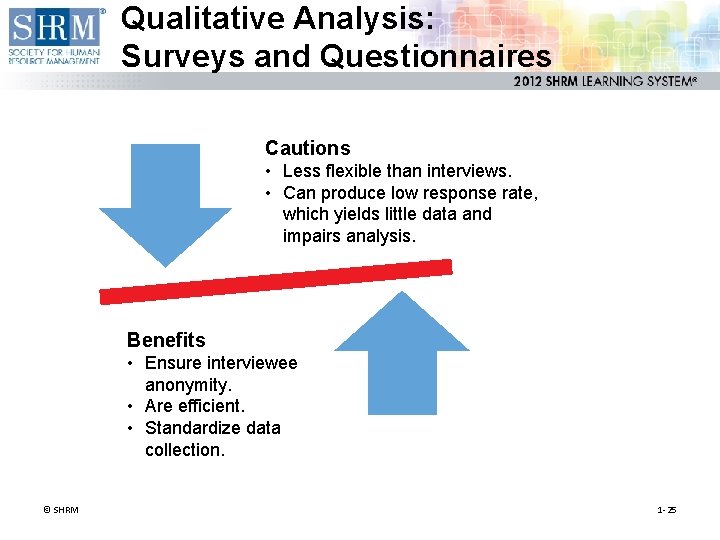
Qualitative Analysis: Surveys and Questionnaires Cautions • Less flexible than interviews. • Can produce low response rate, which yields little data and impairs analysis. Benefits • Ensure interviewee anonymity. • Are efficient. • Standardize data collection. © SHRM 1 -25
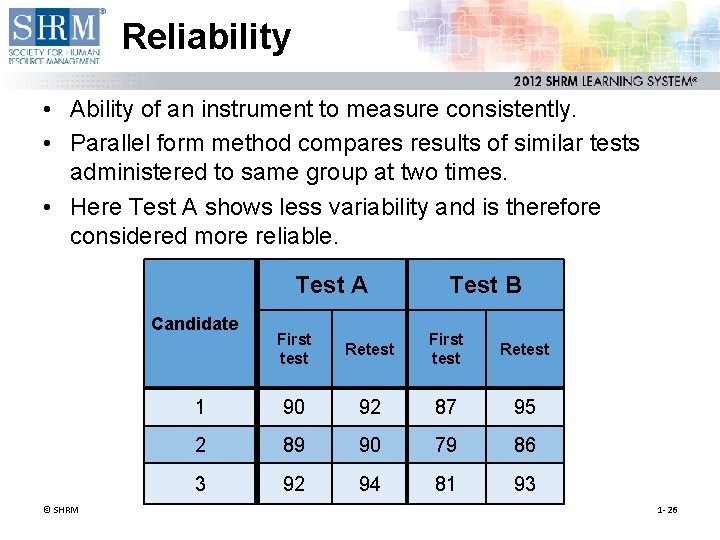
Reliability • Ability of an instrument to measure consistently. • Parallel form method compares results of similar tests administered to same group at two times. • Here Test A shows less variability and is therefore considered more reliable. Test A Candidate © SHRM Test B First test Retest 1 90 92 87 95 2 89 90 79 86 3 92 94 81 93 1 -26
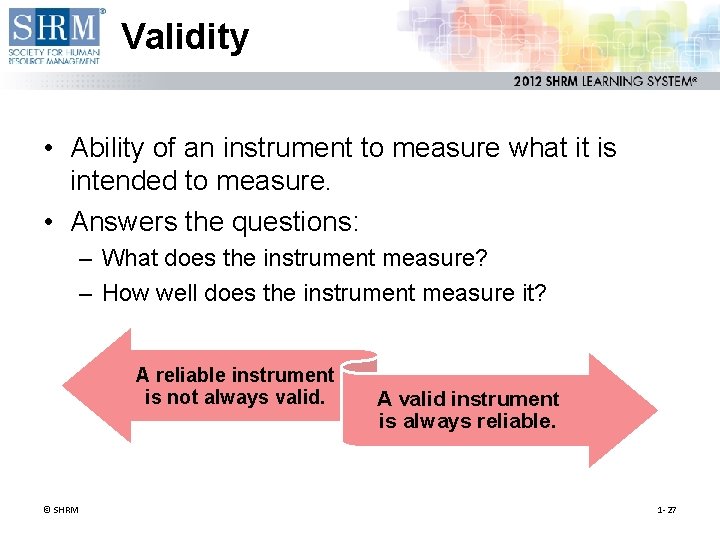
Validity • Ability of an instrument to measure what it is intended to measure. • Answers the questions: – What does the instrument measure? – How well does the instrument measure it? A reliable instrument is not always valid. © SHRM A valid instrument is always reliable. 1 -27
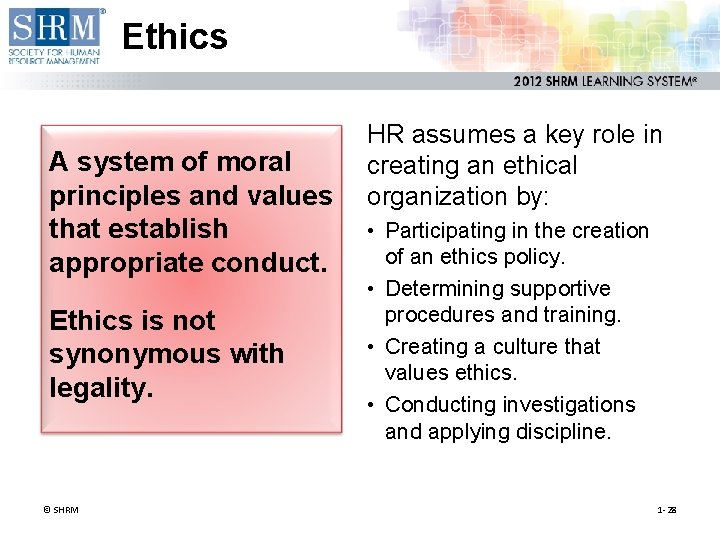
Ethics A system of moral principles and values that establish appropriate conduct. Ethics is not synonymous with legality. © SHRM HR assumes a key role in Ethics creating an ethical organization by: • Participating in the creation of an ethics policy. • Determining supportive procedures and training. • Creating a culture that values ethics. • Conducting investigations and applying discipline. 1 -28
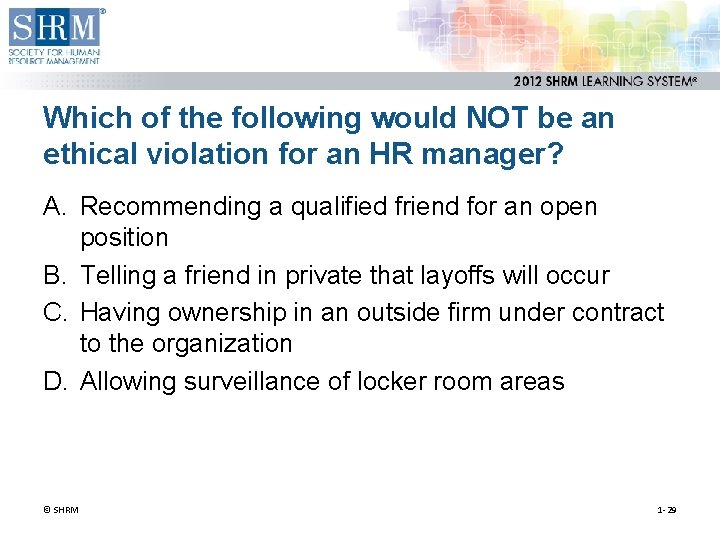
Which of the following would NOT be an ethical violation for an HR manager? A. Recommending a qualified friend for an open position B. Telling a friend in private that layoffs will occur C. Having ownership in an outside firm under contract to the organization D. Allowing surveillance of locker room areas © SHRM 1 -29
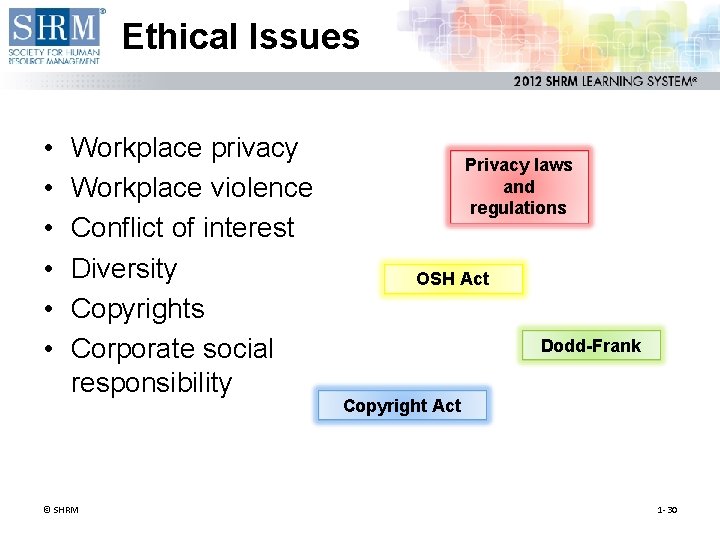
Ethical Issues • • • Workplace privacy Workplace violence Conflict of interest Diversity Copyrights Corporate social responsibility © SHRM Privacy laws and regulations OSH Act Dodd-Frank Copyright Act 1 -30
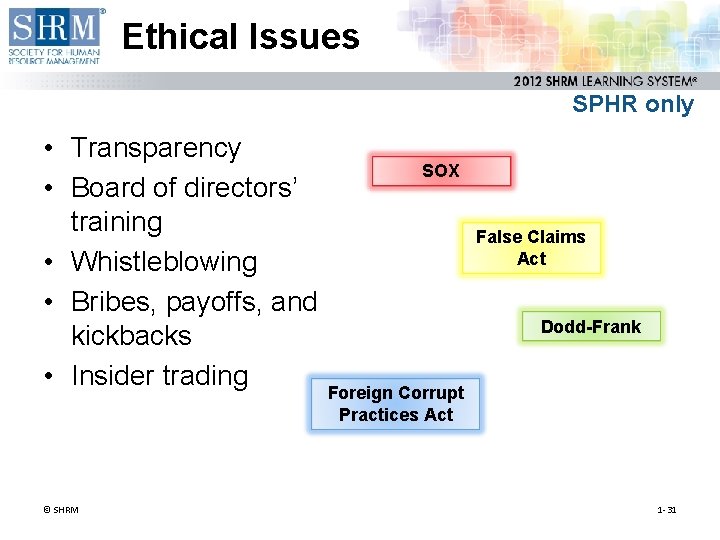
Ethical Issues SPHR only • Transparency • Board of directors’ training • Whistleblowing • Bribes, payoffs, and kickbacks • Insider trading © SHRM SOX False Claims Act Dodd-Frank Foreign Corrupt Practices Act 1 -31
Legislative and Regulatory Environment • Laws are actions passed by Congress and state legislatures. • Regulations reflect how laws will be implemented and often have the force of law. – Regulatory agencies may issue guidelines that interpret how regulations will be enforced. © SHRM 1 -32
A bill is introduced separately in House and Senate versions. Differences are significant. What happens next? A. After 30 days, if differences persist, both bills die. B. After each body passes its version, differences are resolved through the rule-making process. C. The Senate version prevails and is forwarded to the president. D. Both bills are directed to a joint conference committee. © SHRM 1 -33
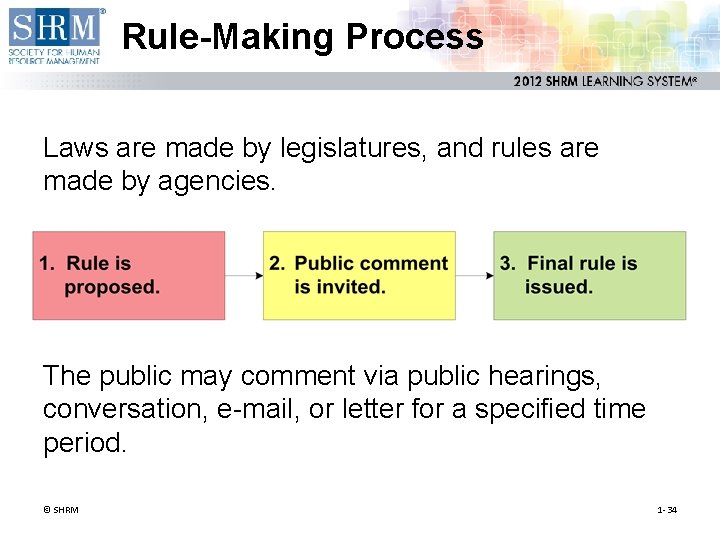
Rule-Making Process Laws are made by legislatures, and rules are made by agencies. The public may comment via public hearings, conversation, e-mail, or letter for a specified time period. © SHRM 1 -34
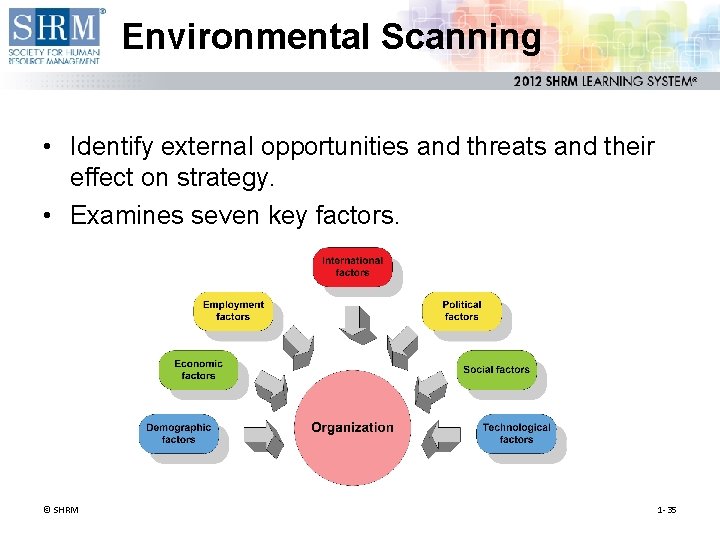
Environmental Scanning • Identify external opportunities and threats and their effect on strategy. • Examines seven key factors. © SHRM 1 -35
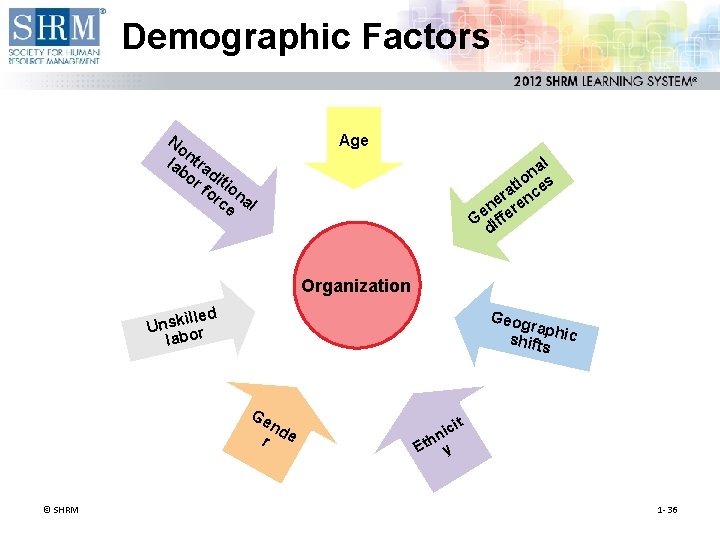
Demographic Factors No n la tra bo d r f itio or na ce l Age al n tio ces a er ren n Ge iffe d Organization illed k s n U labor Geog raphi shifts c Ge r © SHRM nd e t ici n h Et y 1 -36
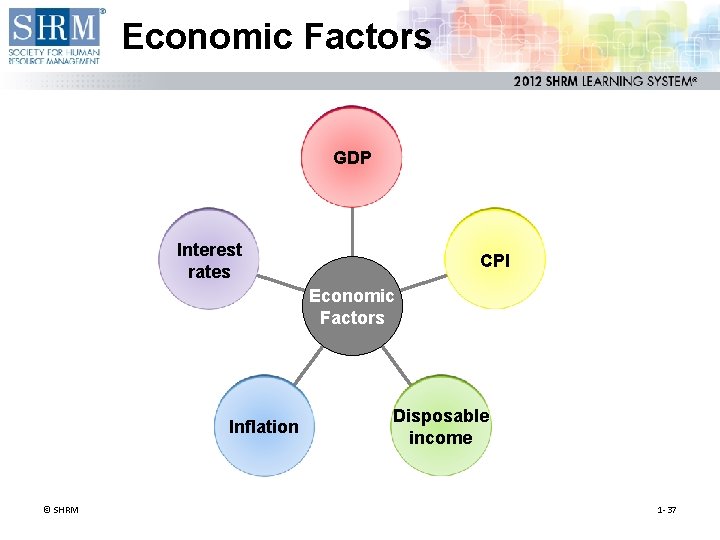
Economic Factors GDP Interest rates CPI Economic Factors Inflation © SHRM Disposable income 1 -37