
Environmental sanitation planning and infrastructure in developing countries
![Waste stabilization ponds - WRI Accra/Ghana [mg/l] 15000 10000 5000 0 Influent 16000 14000](https://slidetodoc.com/presentation_image_h/ce7922c002ef019816819a01b0c4e4f6/image-23.jpg "Waste stabilization ponds - WRI Accra/Ghana [mg/l] 15000 10000 5000 0 Influent 16000 14000")
![Waste stabilization ponds - WRI Accra/Ghana Faecal coliforms [no. /100 ml] 1. 00 E+04](https://slidetodoc.com/presentation_image_h/ce7922c002ef019816819a01b0c4e4f6/image-24.jpg "Waste stabilization ponds - WRI Accra/Ghana Faecal coliforms [no. /100 ml] 1. 00 E+04")
- Slides: 37
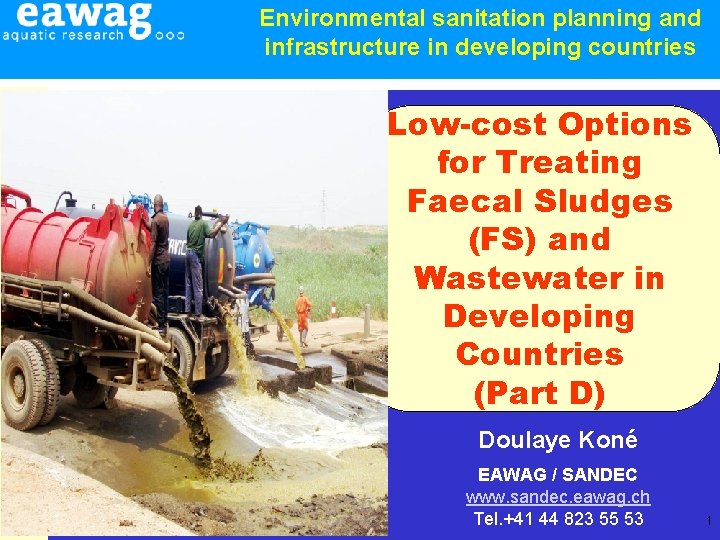
Environmental sanitation planning and infrastructure in developing countries Low-cost Options for Treating Faecal Sludges (FS) and Wastewater in Developing Countries (Part D) Doulaye Koné EAWAG / SANDEC www. sandec. eawag. ch Tel. +41 44 823 55 53 1
Contents Part D: Faecal sludge treatment options (design details and performance) 2
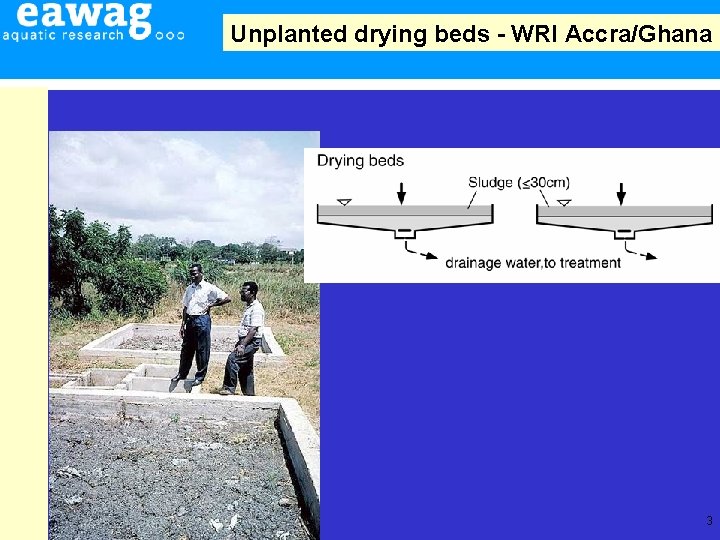
Unplanted drying beds - WRI Accra/Ghana 3
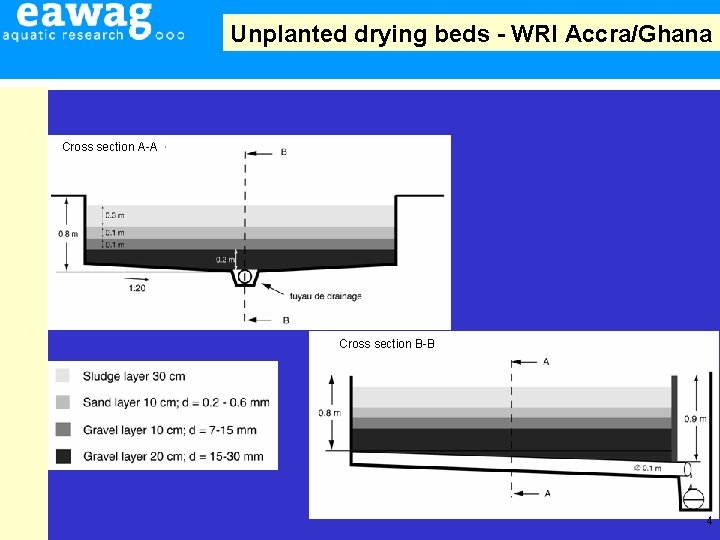
Unplanted drying beds - WRI Accra/Ghana Cross section A-A Cross section B-B 4
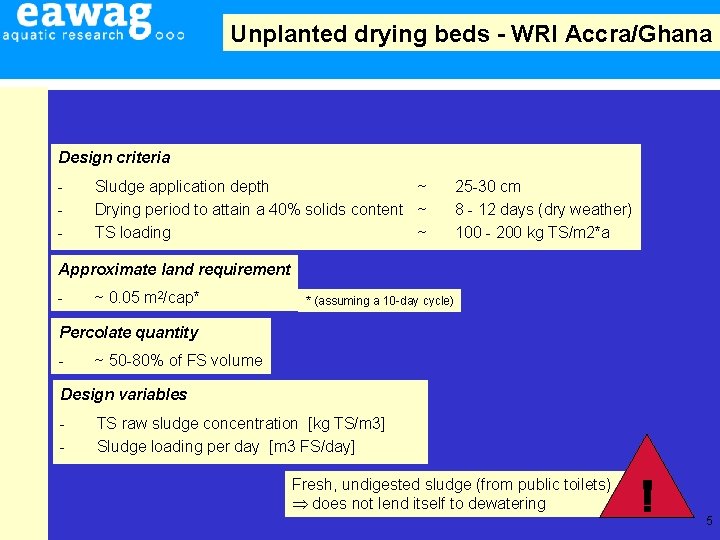
Unplanted drying beds - WRI Accra/Ghana Design criteria - Sludge application depth ~ Drying period to attain a 40% solids content ~ TS loading ~ 25 -30 cm 8 - 12 days (dry weather) 100 - 200 kg TS/m 2*a Approximate land requirement - ~ 0. 05 m 2/cap* * (assuming a 10 -day cycle) Percolate quantity - ~ 50 -80% of FS volume Design variables - TS raw sludge concentration [kg TS/m 3] Sludge loading per day [m 3 FS/day] Fresh, undigested sludge (from public toilets) does not lend itself to dewatering ! 5
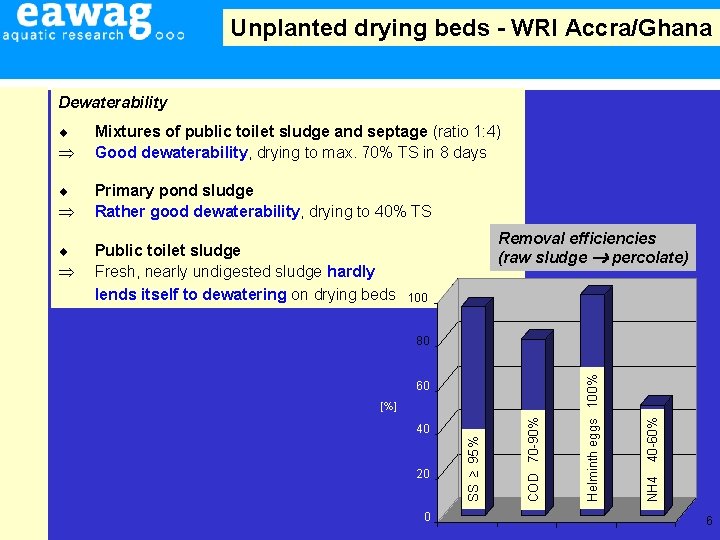
Unplanted drying beds - WRI Accra/Ghana Dewaterability Public toilet sludge Fresh, nearly undigested sludge hardly lends itself to dewatering on drying beds Removal efficiencies (raw sludge percolate) 100 80 60 [%] 40 20 0 40 -60% ¨ NH 4 Primary pond sludge Rather good dewaterability, drying to 40% TS Helminth eggs 100% ¨ COD 70 -90% Mixtures of public toilet sludge and septage (ratio 1: 4) Good dewaterability, drying to max. 70% TS in 8 days SS 95% ¨ 6
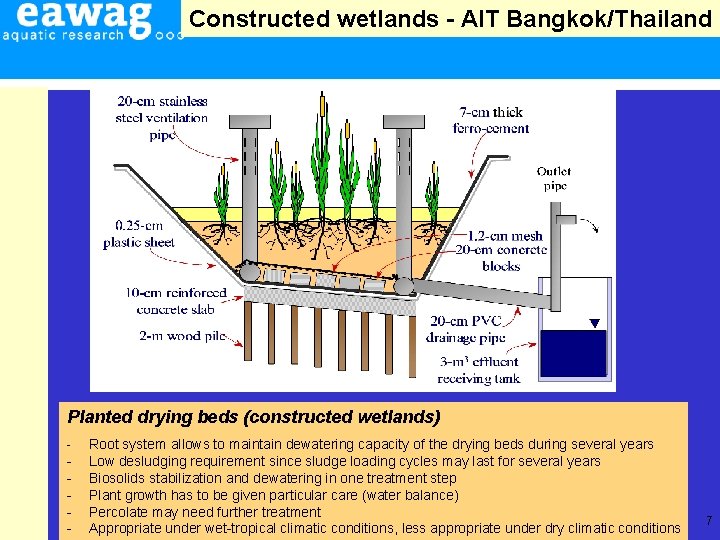
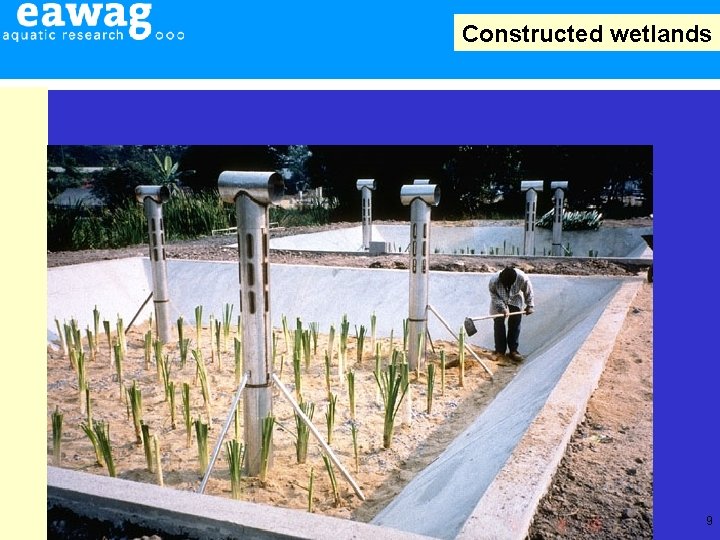
Constructed wetlands - AIT Bangkok/Thailand Planted drying beds (constructed wetlands) - - Root system allows to maintain dewatering capacity of the drying beds during several years Low desludging requirement since sludge loading cycles may last for several years Biosolids stabilization and dewatering in one treatment step Plant growth has to be given particular care (water balance) Percolate may need further treatment Appropriate under wet-tropical climatic conditions, less appropriate under dry climatic conditions 7
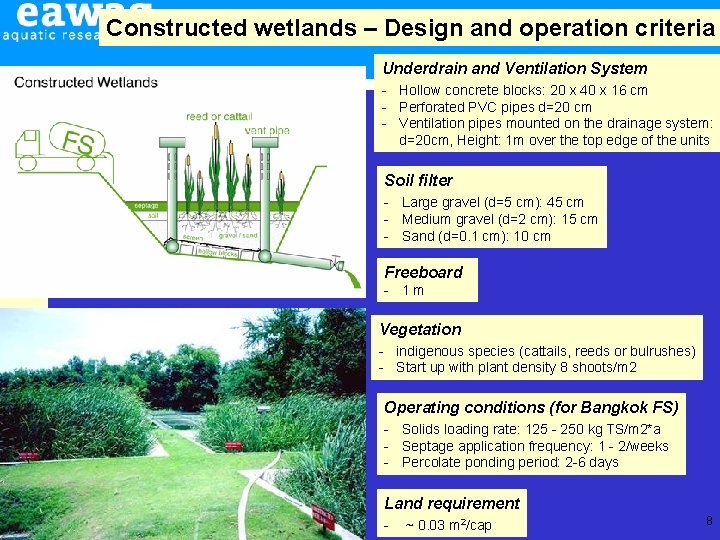
Constructed wetlands – Design and operation criteria Underdrain and Ventilation System - Hollow concrete blocks: 20 x 40 x 16 cm - Perforated PVC pipes d=20 cm - Ventilation pipes mounted on the drainage system: d=20 cm, Height: 1 m over the top edge of the units Soil filter - Large gravel (d=5 cm): 45 cm - Medium gravel (d=2 cm): 15 cm - Sand (d=0. 1 cm): 10 cm Freeboard - 1 m Vegetation - indigenous species (cattails, reeds or bulrushes) - Start up with plant density 8 shoots/m 2 Operating conditions (for Bangkok FS) - Solids loading rate: 125 - 250 kg TS/m 2*a - Septage application frequency: 1 - 2/weeks - Percolate ponding period: 2 -6 days Land requirement - ~ 0. 03 m 2/cap 8
Constructed wetlands 9
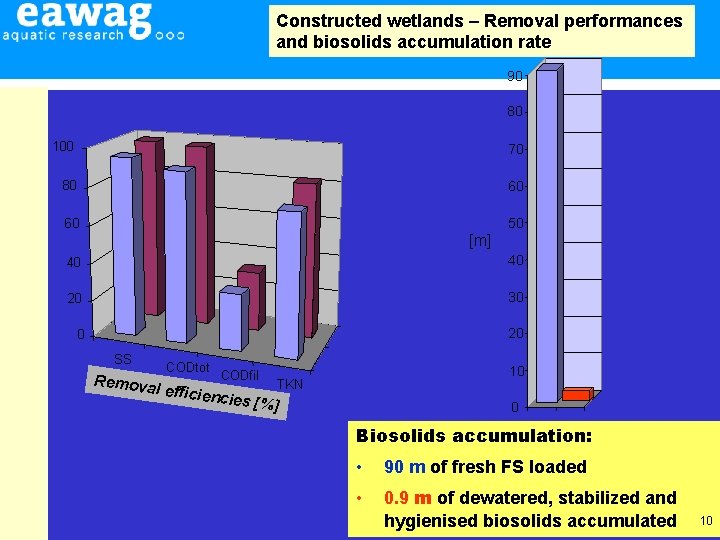
Constructed wetlands – Removal performances and biosolids accumulation rate 90 80 100 70 80 60 60 50 [m] 40 40 20 30 0 20 SS Remova CODtot l efficien CODfil 10 TKN cies [%] 0 Biosolids accumulation: • 90 m of fresh FS loaded • 0. 9 m of dewatered, stabilized and hygienised biosolids accumulated 10
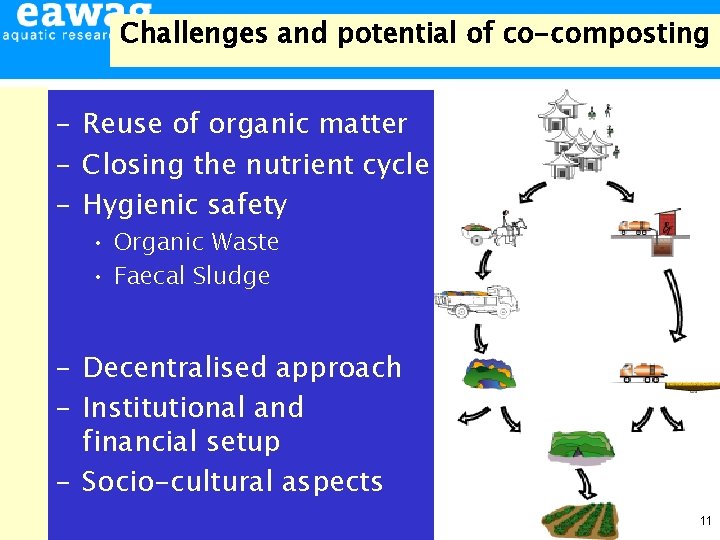
Challenges and potential of co-composting - Reuse of organic matter - Closing the nutrient cycle - Hygienic safety • Organic Waste • Faecal Sludge - Decentralised approach - Institutional and financial setup - Socio-cultural aspects 11
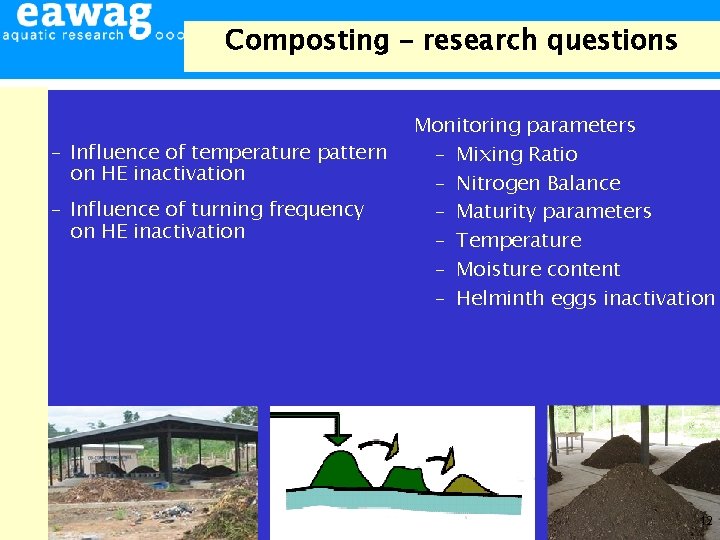
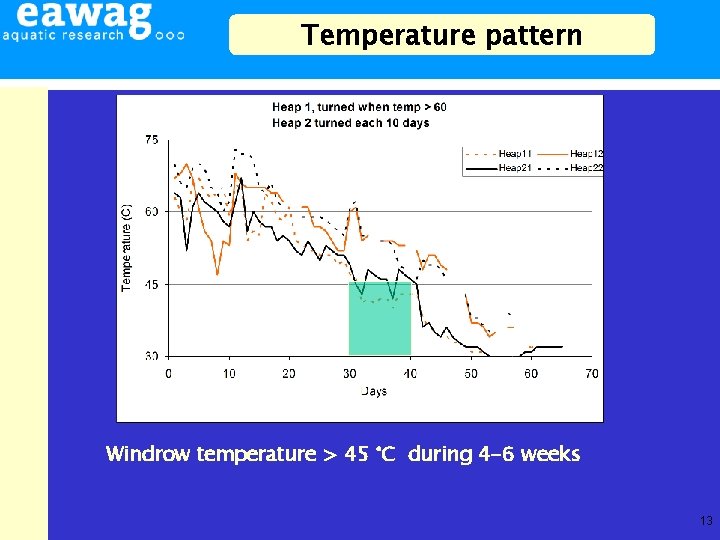
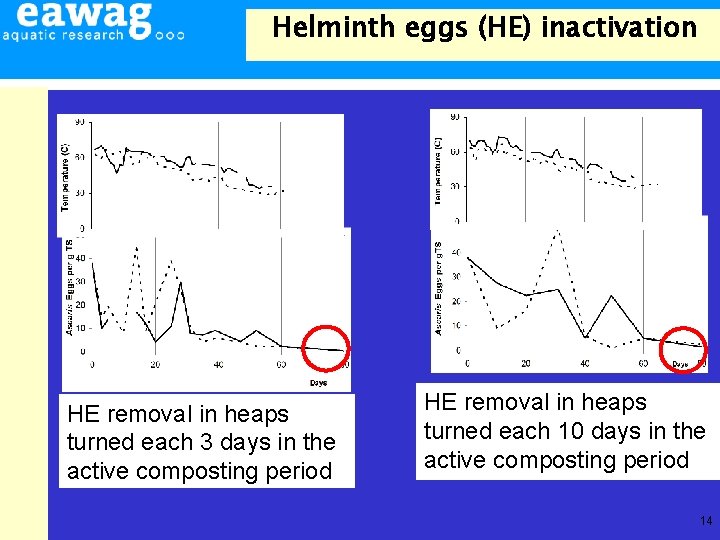
Composting – research questions - Influence of temperature pattern on HE inactivation - Influence of turning frequency on HE inactivation Monitoring parameters – Mixing Ratio – Nitrogen Balance – Maturity parameters – Temperature – Moisture content – Helminth eggs inactivation 12
Temperature pattern Windrow temperature > 45 °C during 4 -6 weeks 13
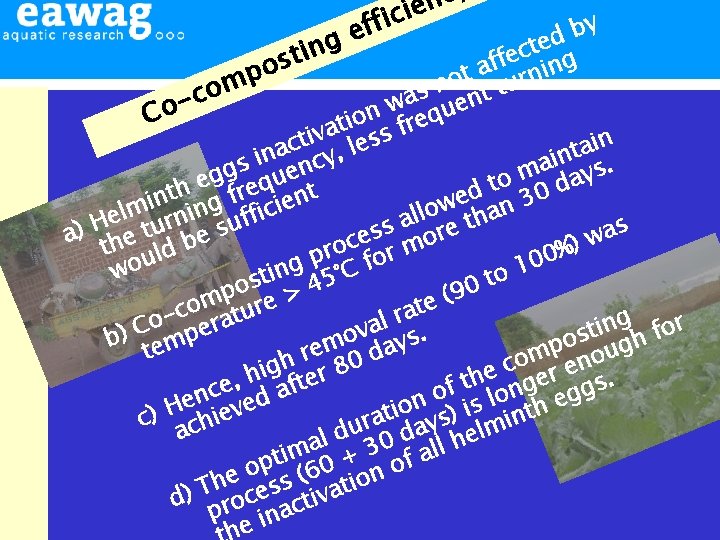
Helminth eggs (HE) inactivation HE removal in heaps turned each 3 days in the active composting period HE removal in heaps turned each 10 days in the active composting period 14
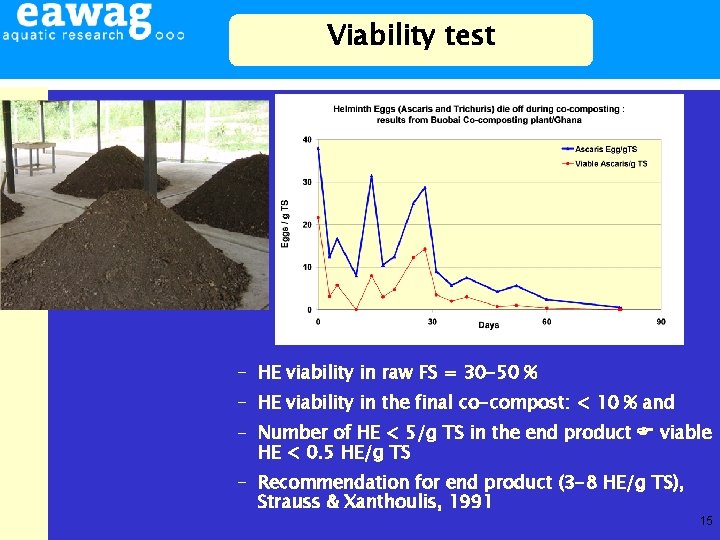
Viability test - HE viability in raw FS = 30 -50 % - HE viability in the final co-compost: < 10 % and - Number of HE < 5/g TS in the end product viable HE < 0. 5 HE/g TS - Recommendation for end product (3 -8 HE/g TS), Strauss & Xanthoulis, 1991 15
16
n e i c i f f e y b d e g t n c i e ng t f s f a o i t n p r o n t tu m o s c a n w e o u n req C o i t a ss f v i t n i c e l a a t in ncy, in s. a s g m ay g que o e t d e h t d r t 0 f n e n 3 i ing icie w an m o l l l f e n h f a t r H u s s e ) t a s r a he e e w o c rm ) o t uld b % r 0 p o 0 f g 1 n C wo i ° o t t 5 s 4 o 0 p e> (9 m e o r t c atu a r g or l o r n a i C e t v f. s o s b) emp h o y p oug em da t r m o c r en gh r 80 i e h h e gs. , t te g f e f n c a o g o l e en ved n s o H ti ys) i inth a c) chie r u m a l a d d e l 0 all h a 3 m i pt 60 + n of o e ss ( o h i t T a d) roce activ p e in
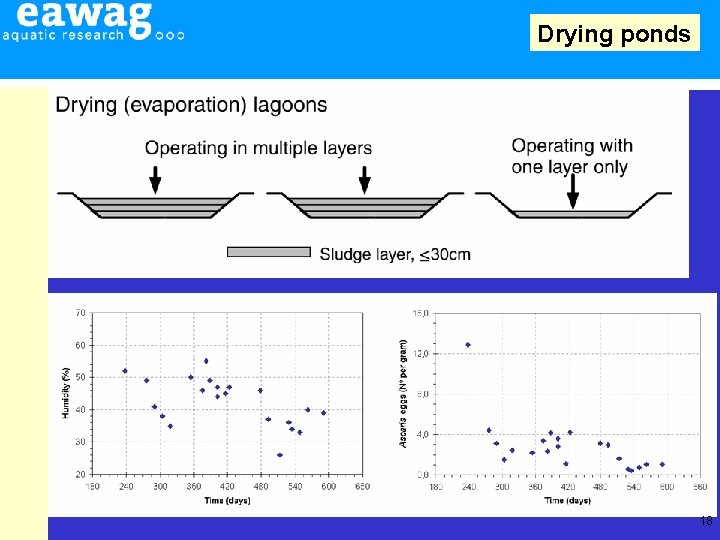
Drying ponds 18
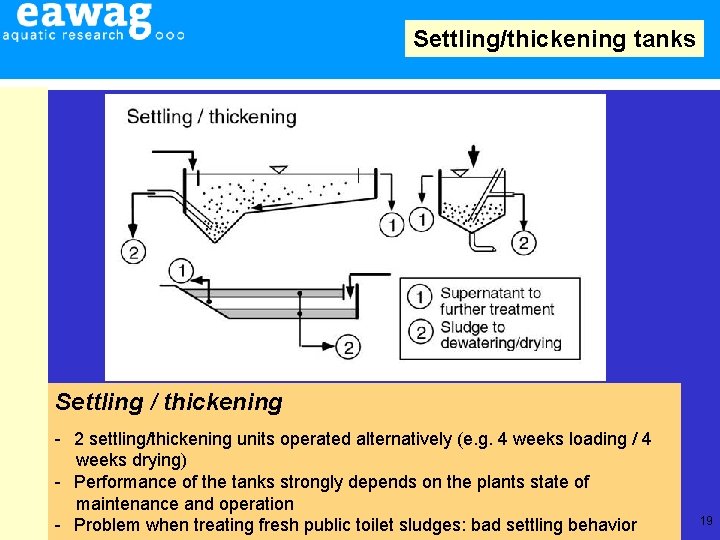
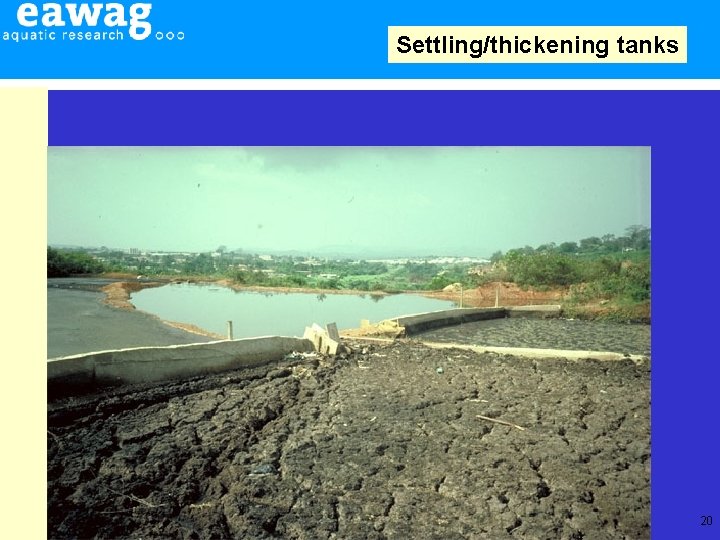
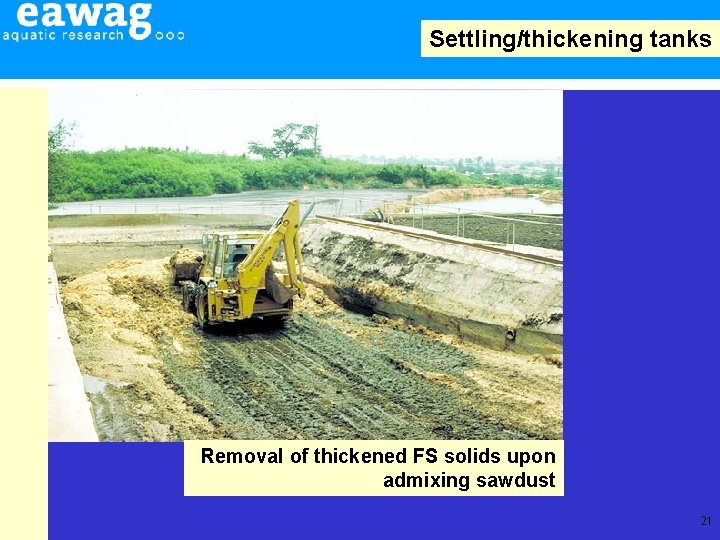
Settling/thickening tanks Settling / thickening - 2 settling/thickening units operated alternatively (e. g. 4 weeks loading / 4 weeks drying) - Performance of the tanks strongly depends on the plants state of maintenance and operation - Problem when treating fresh public toilet sludges: bad settling behavior 19
Settling/thickening tanks 20
Settling/thickening tanks Removal of thickened FS solids upon admixing sawdust 21
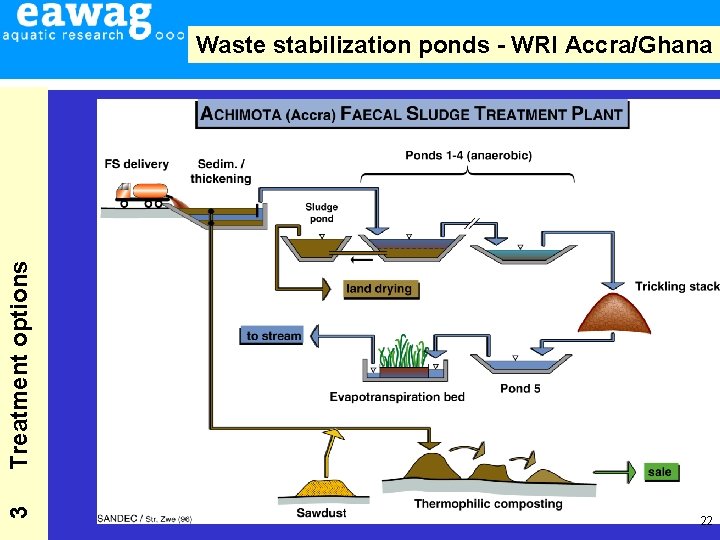
3 Treatment options Waste stabilization ponds - WRI Accra/Ghana 22
Waste stabilization ponds - WRI Accra/Ghana [mg/l] 15000 10000 5000 0 Influent 16000 14000 12000 10000 [mg/l] 8000 6000 4000 2000 0 Eff. sed. tank pond 1 pond 2 pond 3 pond 4 100 90 80 70 [%] 60 50 40 30 20 10 0 60% 20000 86% COD total Entire plant Sed. tank 23
Waste stabilization ponds - WRI Accra/Ghana Faecal coliforms [no. /100 ml] 1. 00 E+04 1. 00 E+03 1. 00 E+02 1. 00 E+01 1. 00 E+00 Influent Eff. sed. tank pond 1 pond 2 pond 3 pond 4 0% 100 90 80 70 60 [%] 50 40 30 20 10 0 1. 00 E+05 99% 1. 00 E+06 Entire plant Sed. tank 24
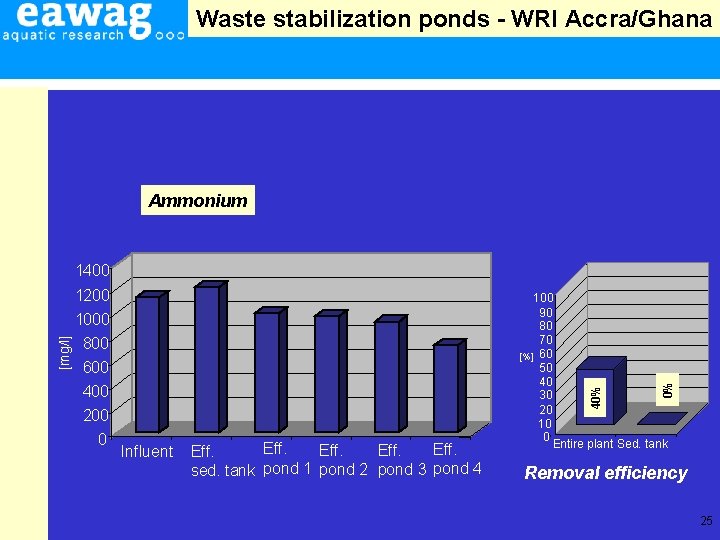
Waste stabilization ponds - WRI Accra/Ghana Ammonium 1400 800 600 400 200 0 40% [mg/l] 1000 100 90 80 70 [%] 60 50 40 30 20 10 0 Entire plant Sed. tank Influent Eff. sed. tank pond 1 pond 2 pond 3 pond 4 0% 1200 Removal efficiency 25
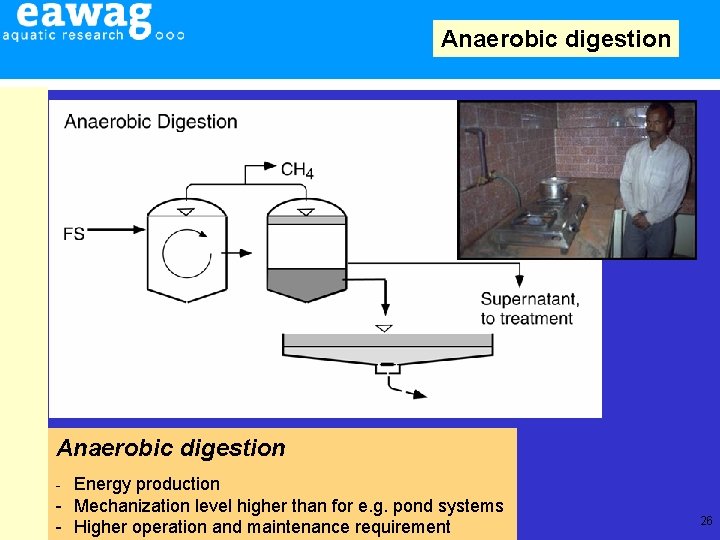
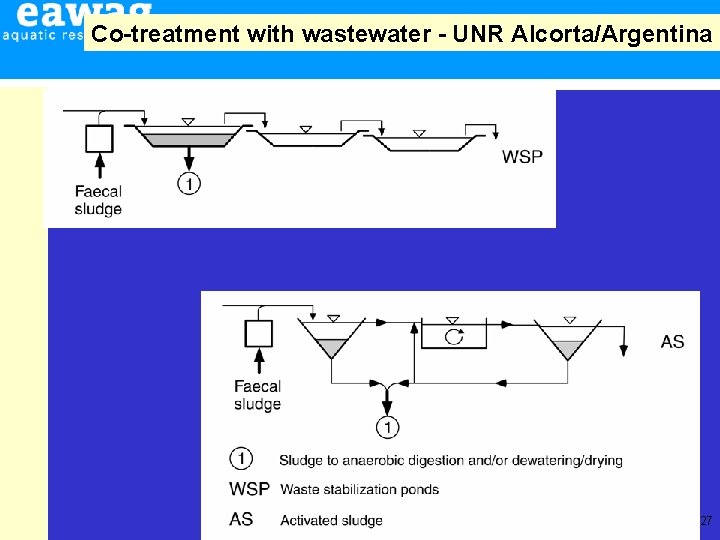
Anaerobic digestion - Energy production - Mechanization level higher than for e. g. pond systems - Higher operation and maintenance requirement 26
Co-treatment with wastewater - UNR Alcorta/Argentina 27
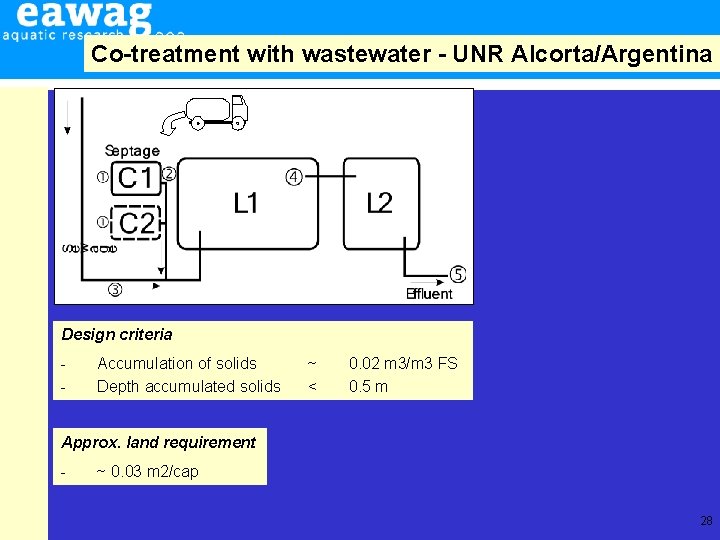
Co-treatment with wastewater - UNR Alcorta/Argentina Design criteria - Accumulation of solids Depth accumulated solids ~ < 0. 02 m 3/m 3 FS 0. 5 m Approx. land requirement - ~ 0. 03 m 2/cap 28
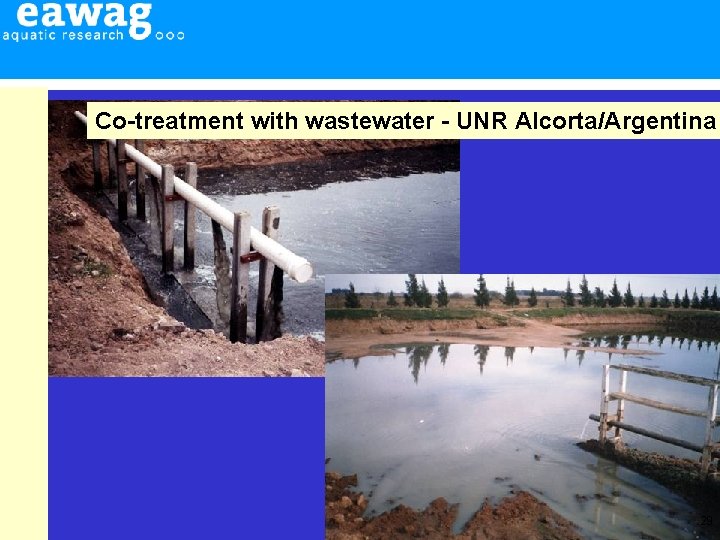
Co-treatment with wastewater - UNR Alcorta/Argentina 29
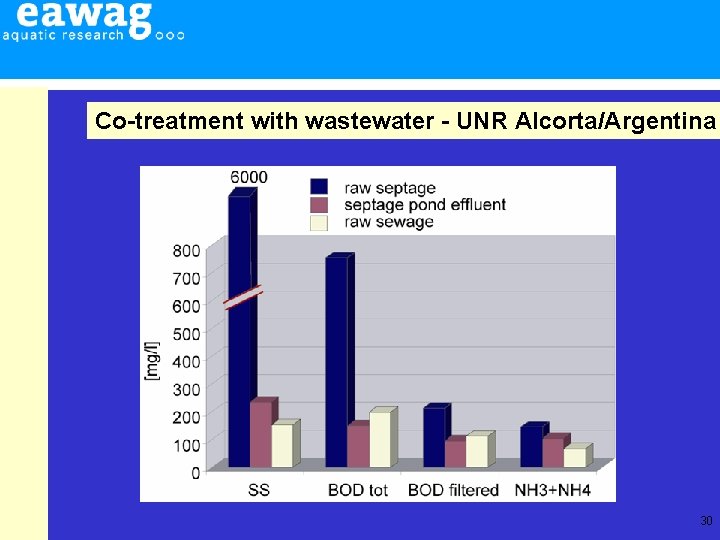
Co-treatment with wastewater - UNR Alcorta/Argentina 30
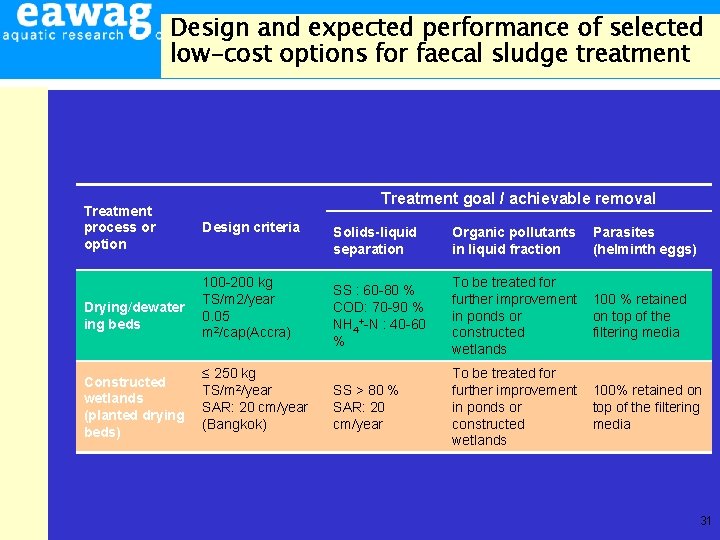
Design and expected performance of selected low-cost options for faecal sludge treatment Treatment process or option Drying/dewater ing beds Constructed wetlands (planted drying beds) Treatment goal / achievable removal Design criteria 100 -200 kg TS/m 2/year 0. 05 m 2/cap(Accra) ≤ 250 kg TS/m 2/year SAR: 20 cm/year (Bangkok) Solids-liquid separation Organic pollutants in liquid fraction Parasites (helminth eggs) SS : 60 -80 % COD: 70 -90 % NH 4+-N : 40 -60 % To be treated for further improvement in ponds or constructed wetlands 100 % retained on top of the filtering media SS > 80 % SAR: 20 cm/year To be treated for further improvement in ponds or constructed wetlands 100% retained on top of the filtering media 31
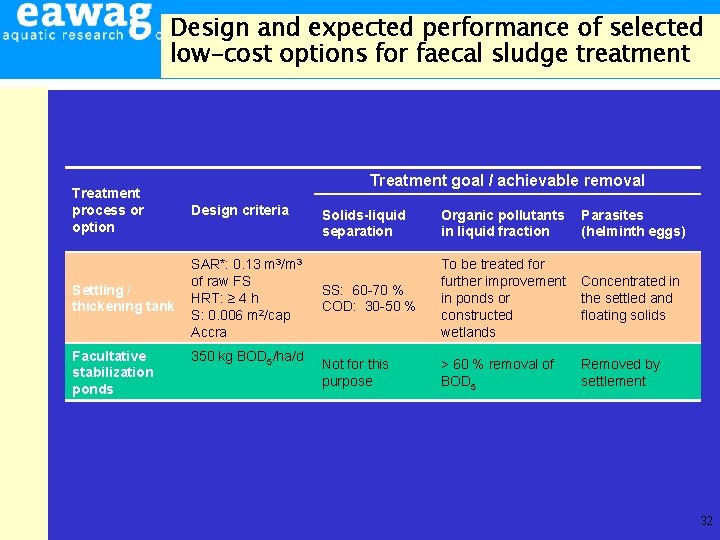
Design and expected performance of selected low-cost options for faecal sludge treatment Treatment goal / achievable removal Treatment process or option Design criteria Settling / thickening tank SAR*: 0. 13 m 3/m 3 of raw FS HRT: ≥ 4 h S: 0. 006 m 2/cap Accra Facultative stabilization ponds 350 kg BOD 5/ha/d Solids-liquid separation Organic pollutants in liquid fraction Parasites (helminth eggs) SS: 60 -70 % COD: 30 -50 % To be treated for further improvement in ponds or constructed wetlands Concentrated in the settled and floating solids Not for this purpose > 60 % removal of BOD 5 Removed by settlement 32
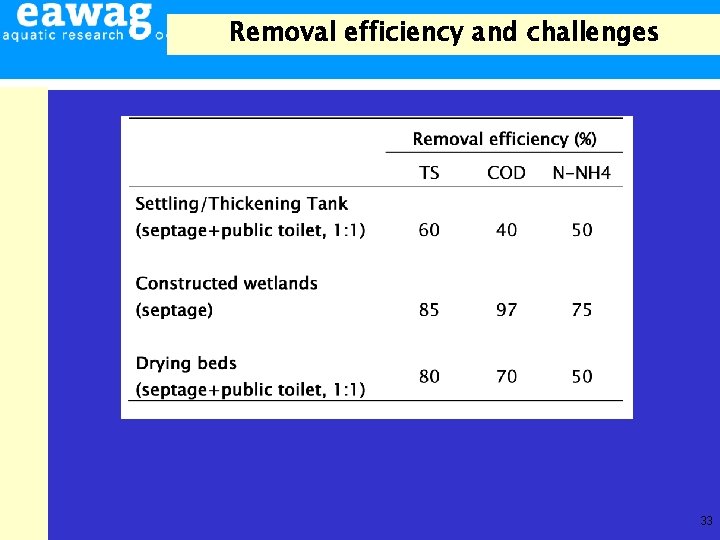
Removal efficiency and challenges 33
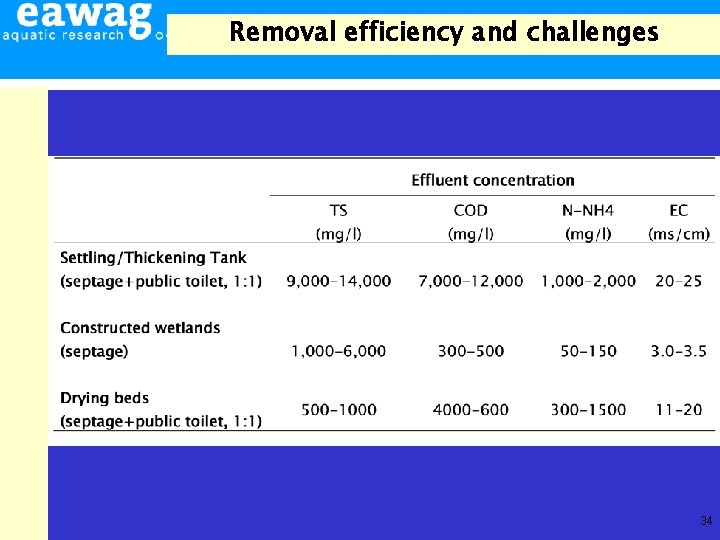
Removal efficiency and challenges 34
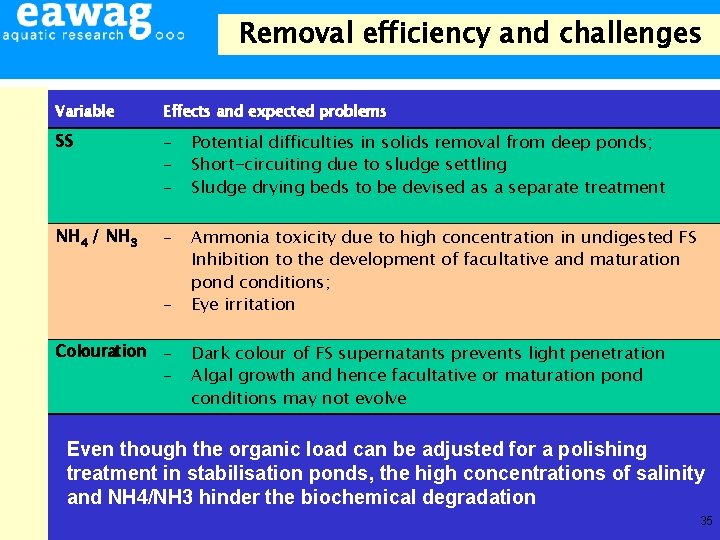
Removal efficiency and challenges Variable Effects and expected problems SS - Potential difficulties in solids removal from deep ponds; Short-circuiting due to sludge settling Sludge drying beds to be devised as a separate treatment NH 4 / NH 3 - Ammonia toxicity due to high concentration in undigested FS Inhibition to the development of facultative and maturation pond conditions; Eye irritation Colouration - Dark colour of FS supernatants prevents light penetration Algal growth and hence facultative or maturation pond conditions may not evolve Even though the organic load can be adjusted for a polishing treatment in stabilisation ponds, the high concentrations of salinity and NH 4/NH 3 hinder the biochemical degradation 35
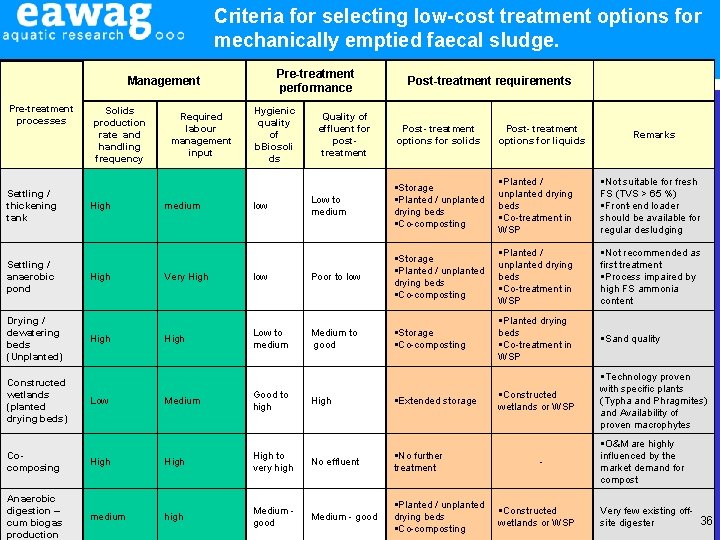
Criteria for selecting low-cost treatment options for mechanically emptied faecal sludge. Pre-treatment performance Management Pre-treatment processes Settling / thickening tank Settling / anaerobic pond Drying / dewatering beds (Unplanted) Constructed wetlands (planted drying beds) Solids production rate and handling frequency High Low Required labour management input medium Hygienic quality of b. Biosoli ds low Quality of effluent for posttreatment Post-treatment requirements Post- treatment options for solids Low to medium Planted / unplanted drying beds Co-treatment in WSP Not suitable for fresh FS (TVS > 65 %) Front-end loader should be available for regular desludging Planted / unplanted drying beds Co-treatment in WSP Not recommended as first treatment Process impaired by high FS ammonia content Planted drying beds Co-treatment in WSP Sand quality Constructed wetlands or WSP Technology proven with specific plants (Typha and Phragmites) and Availability of proven macrophytes Very High low Poor to low High Low to medium Medium to good Storage Co-composting Good to high Cocomposing High to very high Anaerobic digestion – cum biogas production medium high Medium good Remarks Storage Planted / unplanted drying beds Co-composting Medium Post- treatment options for liquids High Extended storage No effluent No further treatment Medium - good Planted / unplanted drying beds Co-composting - Constructed wetlands or WSP O&M are highly influenced by the market demand for compost Very few existing offsite digester 36
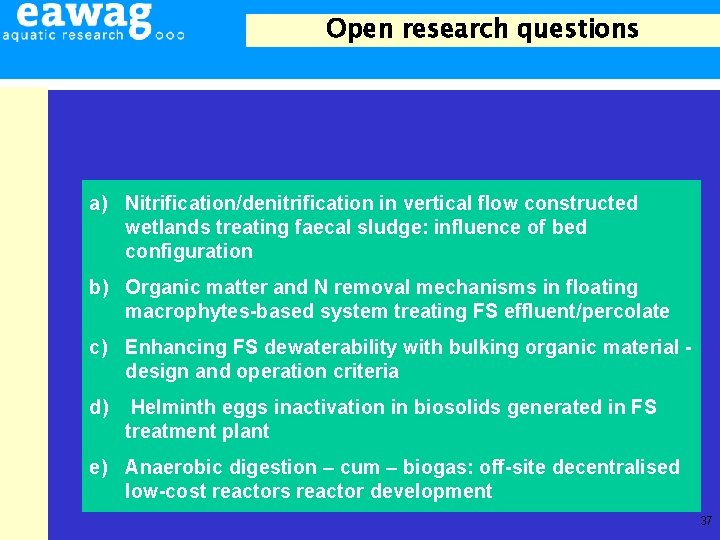
Open research questions a) Nitrification/denitrification in vertical flow constructed wetlands treating faecal sludge: influence of bed configuration b) Organic matter and N removal mechanisms in floating macrophytes-based system treating FS effluent/percolate c) Enhancing FS dewaterability with bulking organic material design and operation criteria d) Helminth eggs inactivation in biosolids generated in FS treatment plant e) Anaerobic digestion – cum – biogas: off-site decentralised low-cost reactors reactor development 37