
Environmental Safety Sustainability Risk Spill Prevention Control and

Environmental Safety, Sustainability & Risk Spill Prevention, Control, and Countermeasures (SPCC)
Overview The Purpose of an SPCC is to prevent the discharge of oil into navigable waters of the United States or adjoining shorelines as opposed to response and cleanup after a spill occurs.
The Law Oil Pollution Prevention Rule • Became effective January, 1974 (revised 2002). • Authority – Section 311 (j) (1) (c) of the Clean Water Act • Promulgated under Title 40, CFR, Part 112
Oil Definitions Oil means oil of any kind or in any form, including, but not limited to: Ø Ø Ø fats, oils, or greases of animal, fish, or marine mammal origin vegetable oils, including oils from seeds, nuts, fruits, or kernels; other oils and greases, including petroleum, fuel oil, sludge, synthetic oils, mineral oils, oil refuse, or oil mixed with wastes other than dredged spoil.
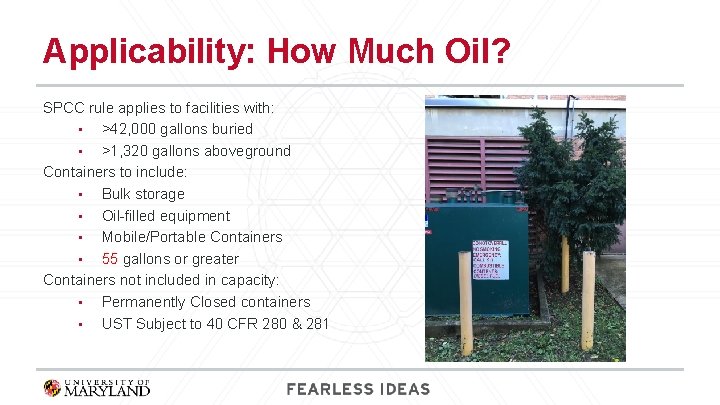
Applicability: How Much Oil? SPCC rule applies to facilities with: • >42, 000 gallons buried • >1, 320 gallons aboveground Containers to include: • Bulk storage • Oil-filled equipment • Mobile/Portable Containers • 55 gallons or greater Containers not included in capacity: • Permanently Closed containers • UST Subject to 40 CFR 280 & 281
Spill Reporting Facilities that discharge oil to navigable waters are subject to certain federal reporting requirements. • 40 CFR 110, Discharge of Oil Regulation • 40 CFR 112, Oil Pollution Prevention regulation • State laws/regulations may differ or be more restrictive
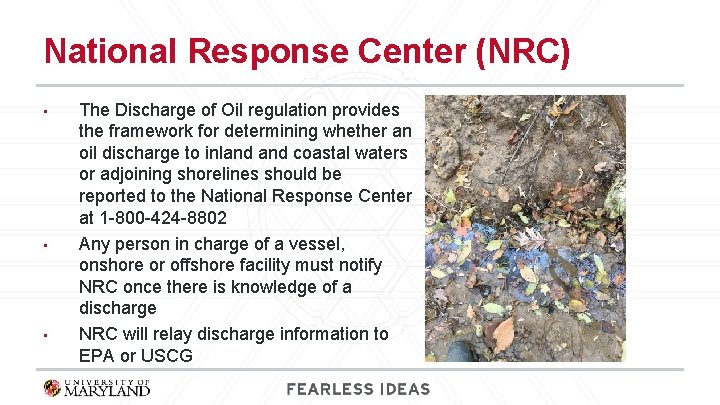
National Response Center (NRC) • • • The Discharge of Oil regulation provides the framework for determining whether an oil discharge to inland coastal waters or adjoining shorelines should be reported to the National Response Center at 1 -800 -424 -8802 Any person in charge of a vessel, onshore or offshore facility must notify NRC once there is knowledge of a discharge NRC will relay discharge information to EPA or USCG
SPCC Reporting Requirements • Report to the EPA Regional Administrator (RA) when there is a discharge to navigable waters or adjoining shores of: § § • • >1, 000 Gal of oil in a single discharge >42 Gal of oil in each of two discharges occurring within a 12 month period An owner / operator must report the discharge(s) to the EPA RA within 60 days All requirements found in CFR 40 112. 4
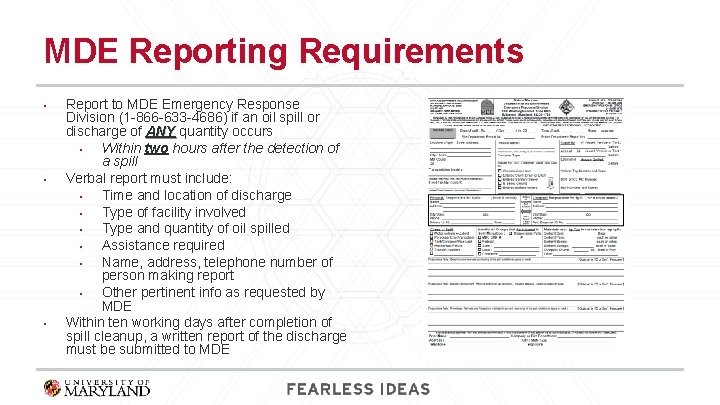
MDE Reporting Requirements • • • Report to MDE Emergency Response Division (1 -866 -633 -4686) if an oil spill or discharge of ANY quantity occurs • Within two hours after the detection of a spill Verbal report must include: • Time and location of discharge • Type of facility involved • Type and quantity of oil spilled • Assistance required • Name, address, telephone number of person making report • Other pertinent info as requested by MDE Within ten working days after completion of spill cleanup, a written report of the discharge must be submitted to MDE
Secondary Containment • All areas and equipment with the potential for a discharge are subject to general secondary containment provision, 112. 7(c). • • • Oil-filled operational equipment Loading/unloading areas Piping Mobile refuelers/ non-transportation related tank trucks Purpose is to contain or divert to prevent discharge: dikes, berms, retaining walls, curbing, drip pans, sumps, culverting, gutters, weirs, booms, spill diversion ponds, retention ponds, sorbent
Secondary Containment Active secondary containment is when an employee personally contains a spill, • • Deploying drain covers before a spill happens. Deploying drain covers after a spill has occurred, but before the spill reaches a drain Using a spill kit in the event of an oil discharge Closing a gate valve prior to a discharge Passive secondary containment does not require deployment or the action of an employee or employees to contain a spill. • • Placing containment pallets or decks under drums and other containers Surrounding machines and containers with berms Erecting retaining walls around machines and containers Placing drip trays under leaky machines and containers
Specific (Sized) Provision • • To address the potential of oil discharges from areas of a facility where oil is stored or handled, containment specified by SPCC rule CFR 40 112. 8, requirements are intended to address a major container failure • • Bulk storage containers, loading/unloading rack, mobile/portable containers, production tank batteries, treatment, separation installations Minimum containment capacity • • Largest single compartment Sufficient freeboard
Portable Containers • • • Drums placed on spill pallets Emergency generators; utilize drip pans Fuel trucks parked within bermed area
Loading/Unloading Area Containment l l l l Dikes, berms, or retaining walls sufficiently impervious to contain oil; Curbing or drip pans; Sumps and collection systems; Culverting, gutters, or other drainage systems; Weirs, booms, or other barriers; Spill diversion ponds; Retention ponds; or Sorbent materials.
Oil – Filled Operational Equipment • Equipment that includes an oil storage container (or multiple containers) in which the oil is present solely to support the function of the apparatus or the device. • • Does not include oil-filled manufacturing equipment (flowthrough process) Piping is considered a component if it is solely used to facilitate operation of the equipment device.
Inspection & Testing 112. 8(c)(6) • • Prevent discharge of oil caused by leaks, corrosion, brittle fracture, overfill, other forms of container/equipment failure AST are tested or inspected in accordance with industry standards • Integrity tests include: visual inspection, hydrostatic testing, radiographic testing, ultrasonic testing, acoustic emissions testing, or other systems of nondestructive testing.
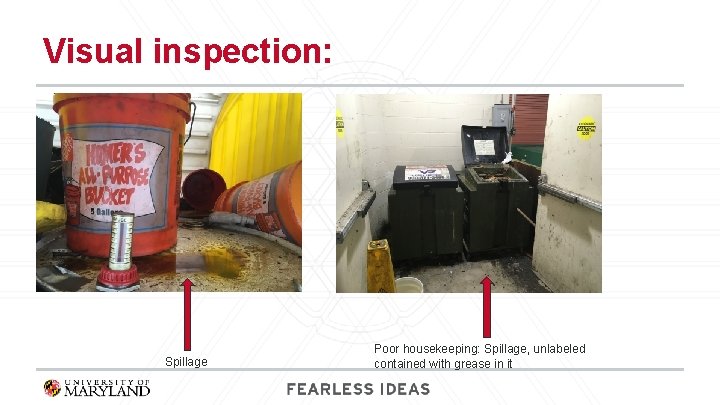
Visual inspection: Spillage Poor housekeeping: Spillage, unlabeled contained with grease in it
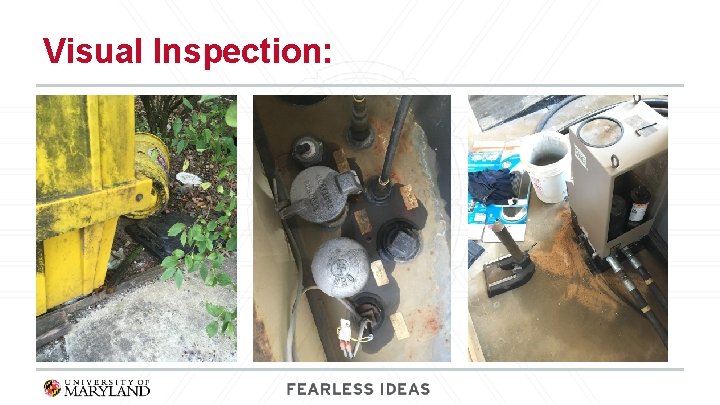
Visual Inspection:
Remember! • All actions (visual inspection or testing) must be documented & maintained • Some standards require records to be maintained for over 3 years for comparison reasons • Know objective: the tank IS or IS NOT suitable for continued use
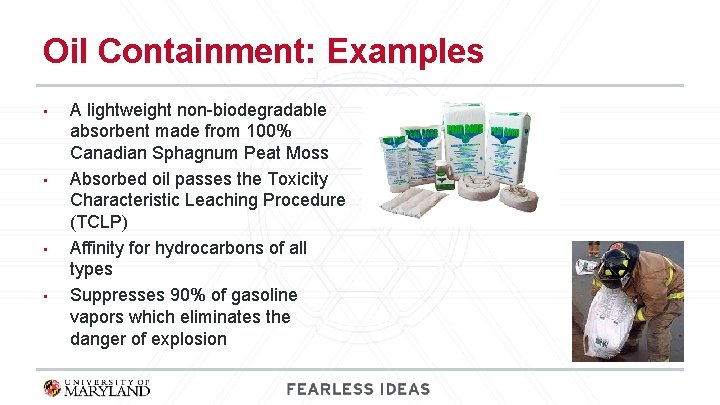
Oil Containment: Examples • • A lightweight non-biodegradable absorbent made from 100% Canadian Sphagnum Peat Moss Absorbed oil passes the Toxicity Characteristic Leaching Procedure (TCLP) Affinity for hydrocarbons of all types Suppresses 90% of gasoline vapors which eliminates the danger of explosion
SPCC Plan Requirements Each Plan Must Include: 3. Prediction of direction, rate of flow, and total quantity of oil that COULD be discharged if the potential for equipment discharge exists. 1. Description of physical layout and a facility diagram. 2. Key personnel contact list 4. Description of containment and/or and phone numbers for the diversionary structures to prevent discharge from reaching navigable facility response coordinator, waters. cleanup contractors, all appropriate federal, state, 5. Description of site specific spill local agencies to contact. prevention and control measures in place.
Additional Requirements • • Plan must have MANAGEMENT APPROVAL (signature) Plan must be prepared under the direct supervision of a P. E. (stamped) Plan must be maintained on-site AVAILABLE AT ALL TIMES for review by EPA/MDE. Key Facility Personnel must be trained annually. FOLLOW SOPs for any response actions!!! Plan must include periodic INSPECTIONS. Plan must be revised/updated to reflect facility changes. Plan required to be reviewed/revised at least every 5 YEARS.
UMD SPCC Details • Over 80 tanks* • • Generators, ASTs, Day Tanks Over 30 >55 -gallon Drums* • Cooking oil, food grease, used oil, hydraulic fluid Over 100 Hydraulic Elevators • Over 140 Transformers *Current inventory is still growing due to finding new tanks/drums •

How to Reach Us • • www. essr. umd. edu Call 301 -405 -3960 during business hours Call UMPD Communications at 301 -405 -3555 to reach oncall ESSR staff after business hours. Email essr@umd. edu
- Slides: 24