
ENVIRONMENTAL RESOURCES AND WASTE MANAGEMENT DEPARTMENT IWMSA SEMINAR
- Slides: 31
ENVIRONMENTAL RESOURCES AND WASTE MANAGEMENT DEPARTMENT IWMSA SEMINAR STATUS QUO: WASTE MANAGEMENT IN THE Co. E MJ MAGOLELA 1
TABLE OF CONTENT • The Integrated Waste Management Plan • Defining the geographical area • Demographic comparison of municipalities • Treatment and disposal • Available Airspace • Service area and estimated waste received per day • Waste received from outside City of Ekurhuleni • Percentage of different waste types disposed at the City of Ekurhuleni landfills • Waste generation percentage in total tonnage by income groups • Mini Waste Disposal facilities • Waste Recycling • Projection of monthly waste and recyclables for residential areas in the City of Ekurhuleni • Challenges for the City of Ekurhuleni • IWMP Goals • 5 Implementation Instruments • 6. Implementation planning
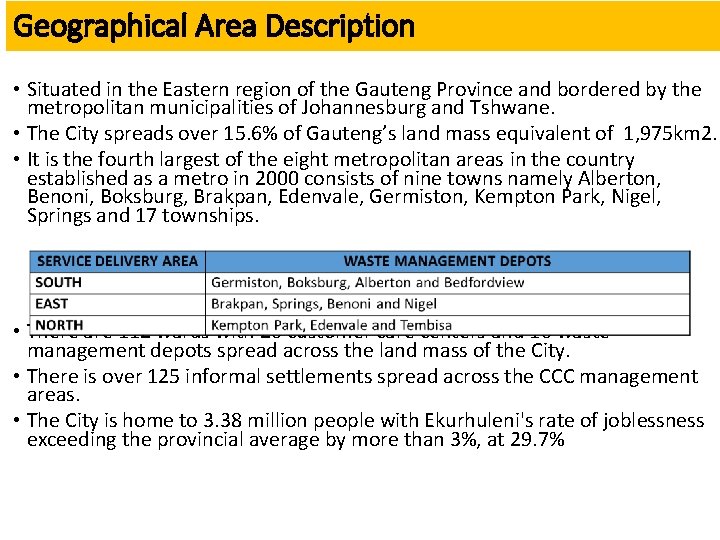
Geographical Area Description • Situated in the Eastern region of the Gauteng Province and bordered by the metropolitan municipalities of Johannesburg and Tshwane. • The City spreads over 15. 6% of Gauteng’s land mass equivalent of 1, 975 km 2. • It is the fourth largest of the eight metropolitan areas in the country established as a metro in 2000 consists of nine towns namely Alberton, Benoni, Boksburg, Brakpan, Edenvale, Germiston, Kempton Park, Nigel, Springs and 17 townships. • There are 112 wards with 20 customer care centers and 10 waste management depots spread across the land mass of the City. • There is over 125 informal settlements spread across the CCC management areas. • The City is home to 3. 38 million people with Ekurhuleni's rate of joblessness exceeding the provincial average by more than 3%, at 29. 7%
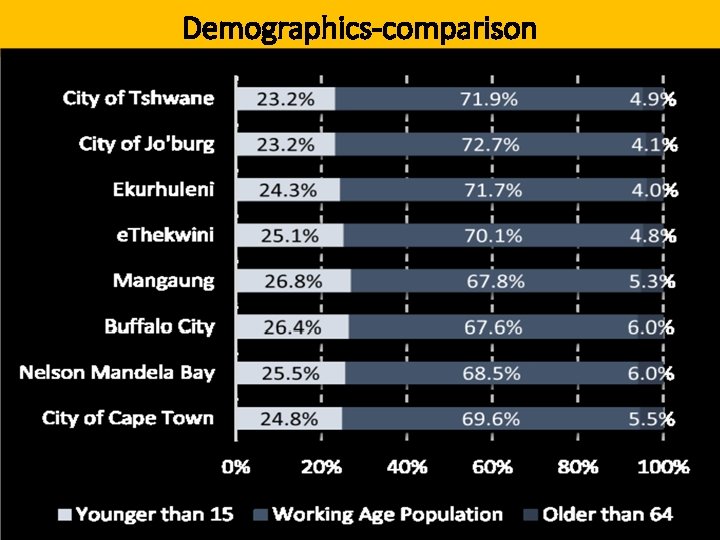
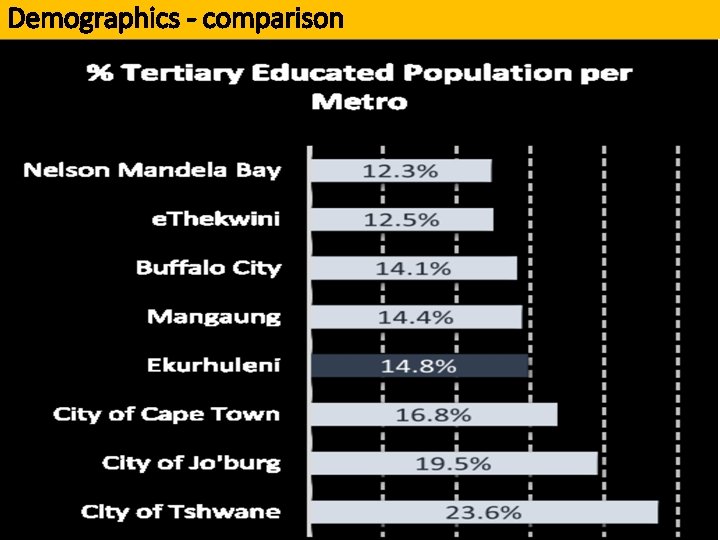
Demographics-comparison
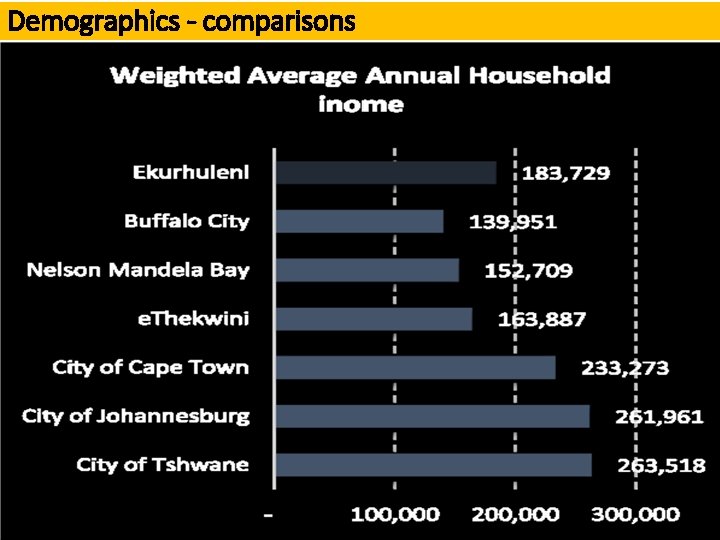
Demographics - comparison
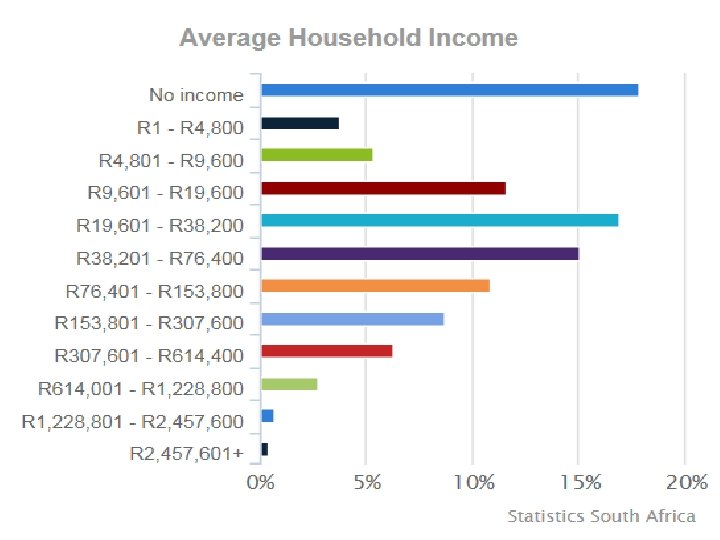
Demographics - comparisons
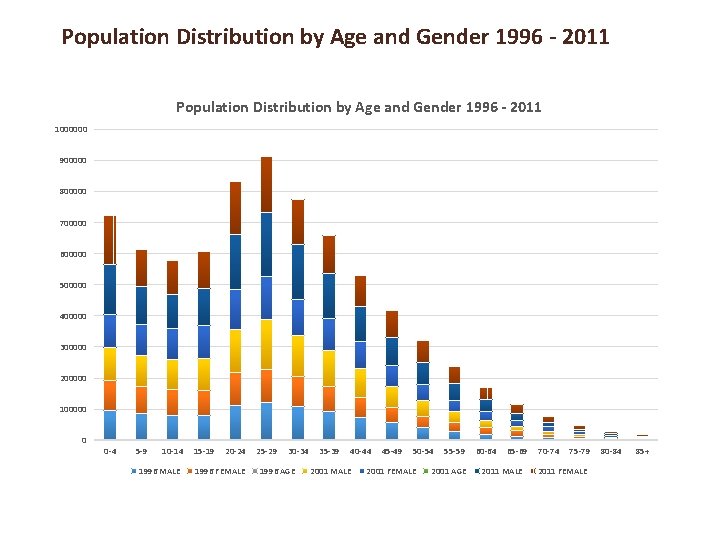
Population Distribution by Age and Gender 1996 - 2011 1000000 900000 800000 700000 600000 500000 400000 300000 200000 100000 0 0 -4 5 -9 10 -14 1996 MALE 15 -19 20 -24 1996 FEMALE 25 -29 30 -34 1996 AGE 35 -39 40 -44 2001 MALE 45 -49 50 -54 2001 FEMALE 55 -59 2001 AGE 60 -64 65 -69 2011 MALE 70 -74 75 -79 2011 FEMALE 80 -84 85+
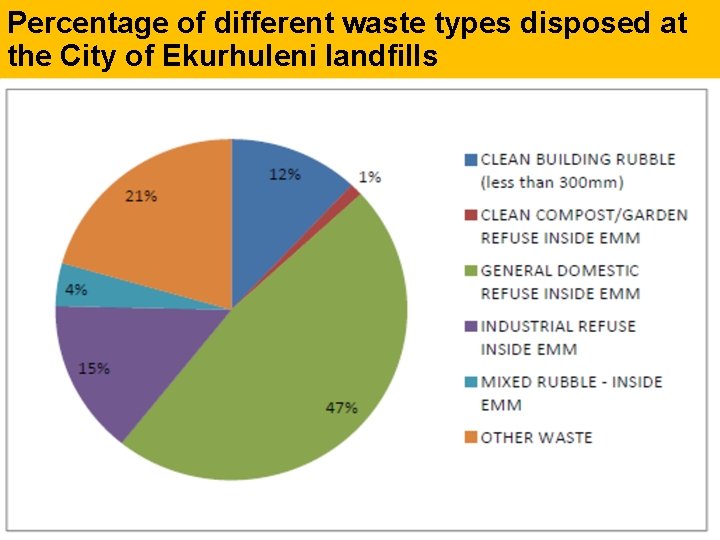
Treatment and Disposal • Calculation of available airspace is based on weighbridge data at each site • About 1. 2 million tons of waste per annum is landfilled in the five (5) City of Ekurhuleni landfill facilities. • The waste streams generated in the City of Ekurhuleni originate from households, commercial areas and industrial areas. • About 47% of the waste that is disposed in the landfills comprise of general domestic waste. • The City has adopted a split model of 60/40 outsourced and inhouse respectively for collection at residential and business districts areas. • City collects and dispose its domestic waste at five of its own sites and Chloorkop Landfill Facility at the northern side of the City without any form of treatment except at limited rubble crashing and shredding of garden waste. • Most of the industrial waste that comes to the landfills goes through some form of sorting to recover recyclables. • Some pilot project for sorting at source were implemented in some areas of Tembisa and Wadeville. • There are over 35 public off-loading facilities in the City
Treatment and Disposal • All landfills closed and operational are subjected to environmental audit for compliance and management of risk
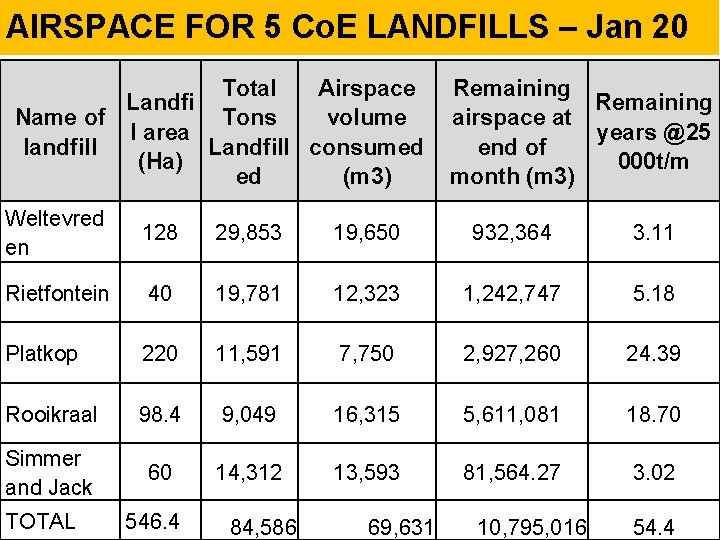
AIRSPACE FOR 5 Co. E LANDFILLS – Jan 20 Total Airspace Landfi Name of Tons volume l area landfill Landfill consumed (Ha) ed (m 3) Remaining airspace at years @25 end of 000 t/m month (m 3) Weltevred en 128 29, 853 19, 650 932, 364 3. 11 Rietfontein 40 19, 781 12, 323 1, 242, 747 5. 18 Platkop 220 11, 591 7, 750 2, 927, 260 24. 39 Rooikraal 98. 4 9, 049 16, 315 5, 611, 081 18. 70 Simmer and Jack 60 14, 312 13, 593 81, 564. 27 3. 02 TOTAL 546. 4 84, 586 69, 631 10, 795, 016 54. 4
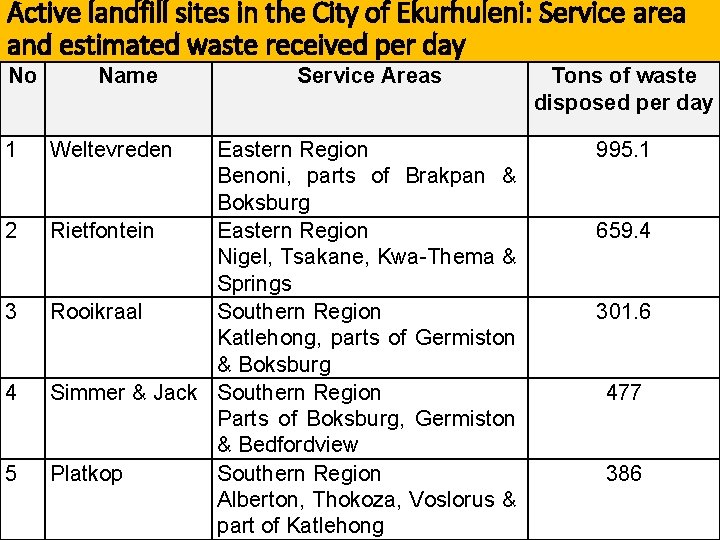
Active landfill sites in the City of Ekurhuleni: Service area and estimated waste received per day No 1 2 3 4 5 Name Weltevreden Service Areas Eastern Region Benoni, parts of Brakpan & Boksburg Rietfontein Eastern Region Nigel, Tsakane, Kwa-Thema & Springs Rooikraal Southern Region Katlehong, parts of Germiston & Boksburg Simmer & Jack Southern Region Parts of Boksburg, Germiston & Bedfordview Platkop Southern Region Alberton, Thokoza, Voslorus & part of Katlehong Tons of waste disposed per day 995. 1 659. 4 301. 6 477 386
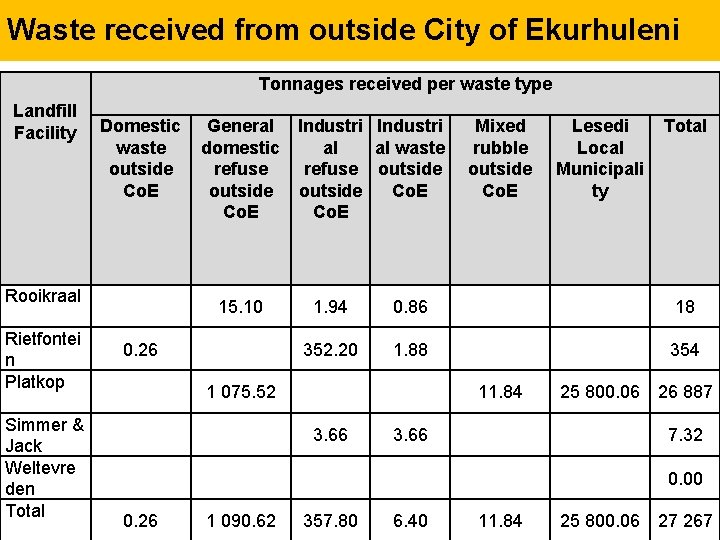
Waste received from outside City of Ekurhuleni Tonnages received per waste type Landfill Facility Domestic waste outside Co. E Rooikraal Rietfontei n Platkop Simmer & Jack Weltevre den Total General Industri domestic al al waste refuse outside Co. E 15. 10 0. 26 Mixed rubble outside Co. E Lesedi Local Municipali ty Total 1. 94 0. 86 18 352. 20 1. 88 354 1 075. 52 11. 84 3. 66 25 800. 06 26 887 7. 32 0. 00 0. 26 1 090. 62 357. 80 6. 40 11. 84 25 800. 06 27 267
Percentage of different waste types disposed at the City of Ekurhuleni landfills
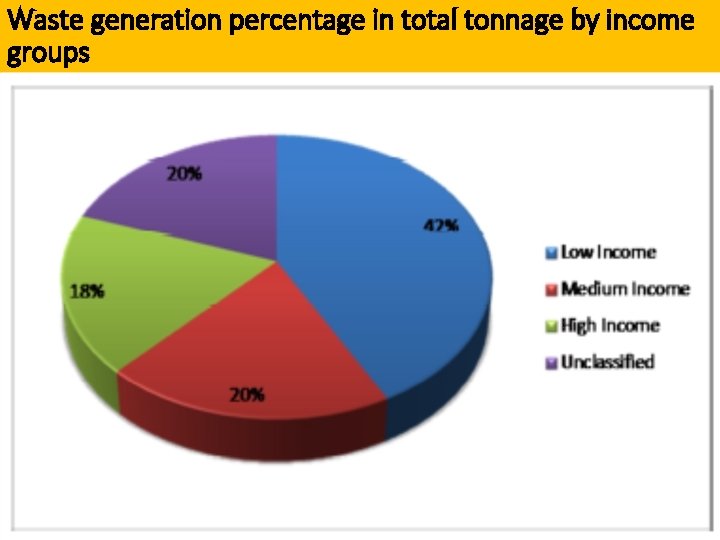
Waste generation percentage in total tonnage by income groups .
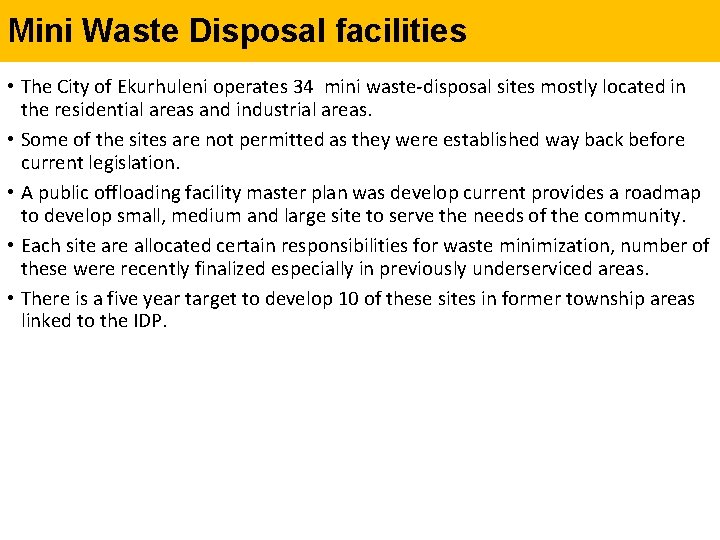
Mini Waste Disposal facilities • The City of Ekurhuleni operates 34 mini waste-disposal sites mostly located in the residential areas and industrial areas. • Some of the sites are not permitted as they were established way back before current legislation. • A public offloading facility master plan was develop current provides a roadmap to develop small, medium and large site to serve the needs of the community. • Each site are allocated certain responsibilities for waste minimization, number of these were recently finalized especially in previously underserviced areas. • There is a five year target to develop 10 of these sites in former township areas linked to the IDP.
Waste Recycling • The City has established a waste minimization unit that focus on providing support to community based recycling cooperatives – infrastructure and skilling • Five kerbside recycling pilot projects developed in Actonville, Wattvile and Thembisa. • Recycling initiatives has shown a significant increase in the past few years, resulting in more waste diverted from landfills by over 30 private recycling companies majority located in the Co. E – market for small players. • The metal, glass, paper and plastic industries are driving many recycling initiatives with participation of informal and small buy back centers at the low end of the value chain. • Drop-off facilities and buy back centers have been established where members of the public can take their recyclable material. • National Waste Management had set a target to divert 25% of recyclables from landfill sites for re-use, recycling or recovery by 2016 – this has not being achieved. • The population’s mind-set has been changing towards recycling and waste minimization although at very slow pace. • Lack of municipal incentives to encourage recycling at source add to the lack of interest or the slow pace of recycling at community level.
Recovery programme • The City of Ekurhuleni has established a landfill gas extraction and utilisation programme at four of its landfill sites; Rooikraal, Rietfontein, Weltevreden and Simmer & Jack. • The extraction and utilisation of landfill gas reduces harmful greenhouse gas (GHG) emissions and prevents explosion hazards at the landfill sites from the accumulation of methane gas. • At Simmer and Jack part of the methane gases are fed into the generator and produce 1 megawatt of electricity • The City also signed 45 independent power producer agreement for the use of renewables to generate electricity
Projection of monthly waste and recyclables for residential areas in the City of Ekurhuleni
Estimated Waste generation and recyclables
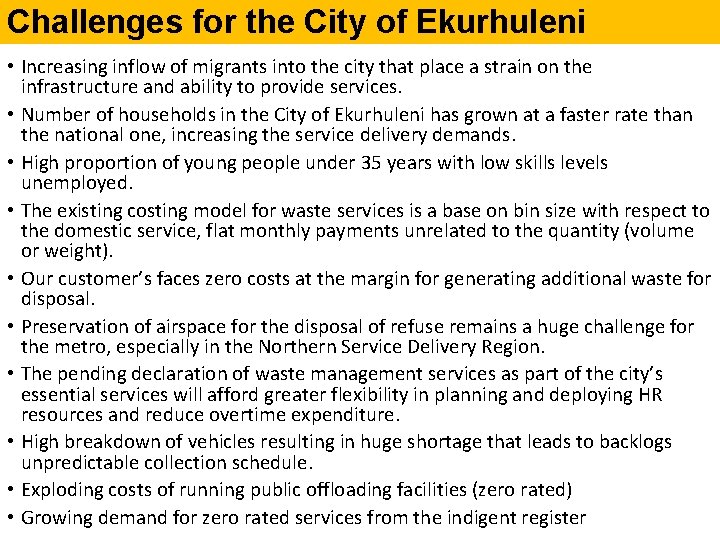
Challenges for the City of Ekurhuleni • Increasing inflow of migrants into the city that place a strain on the infrastructure and ability to provide services. • Number of households in the City of Ekurhuleni has grown at a faster rate than the national one, increasing the service delivery demands. • High proportion of young people under 35 years with low skills levels unemployed. • The existing costing model for waste services is a base on bin size with respect to the domestic service, flat monthly payments unrelated to the quantity (volume or weight). • Our customer’s faces zero costs at the margin for generating additional waste for disposal. • Preservation of airspace for the disposal of refuse remains a huge challenge for the metro, especially in the Northern Service Delivery Region. • The pending declaration of waste management services as part of the city’s essential services will afford greater flexibility in planning and deploying HR resources and reduce overtime expenditure. • High breakdown of vehicles resulting in huge shortage that leads to backlogs unpredictable collection schedule. • Exploding costs of running public offloading facilities (zero rated) • Growing demand for zero rated services from the indigent register
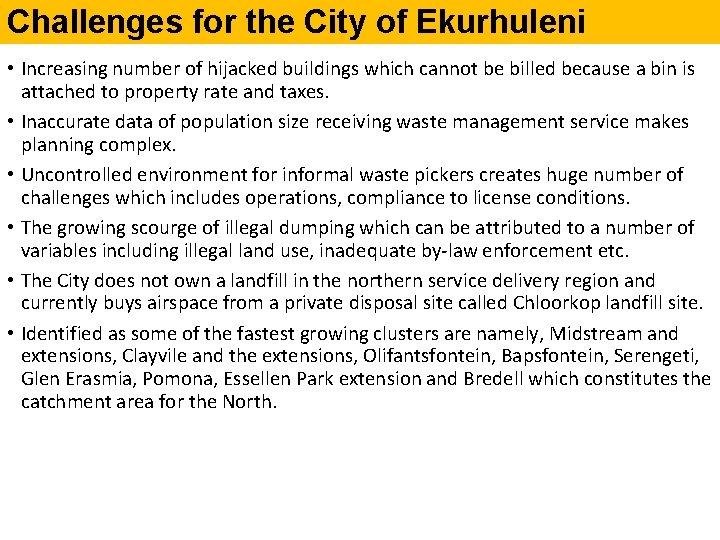
Challenges for the City of Ekurhuleni • Increasing number of hijacked buildings which cannot be billed because a bin is attached to property rate and taxes. • Inaccurate data of population size receiving waste management service makes planning complex. • Uncontrolled environment for informal waste pickers creates huge number of challenges which includes operations, compliance to license conditions. • The growing scourge of illegal dumping which can be attributed to a number of variables including illegal land use, inadequate by-law enforcement etc. • The City does not own a landfill in the northern service delivery region and currently buys airspace from a private disposal site called Chloorkop landfill site. • Identified as some of the fastest growing clusters are namely, Midstream and extensions, Clayvile and the extensions, Olifantsfontein, Bapsfontein, Serengeti, Glen Erasmia, Pomona, Essellen Park extension and Bredell which constitutes the catchment area for the North.
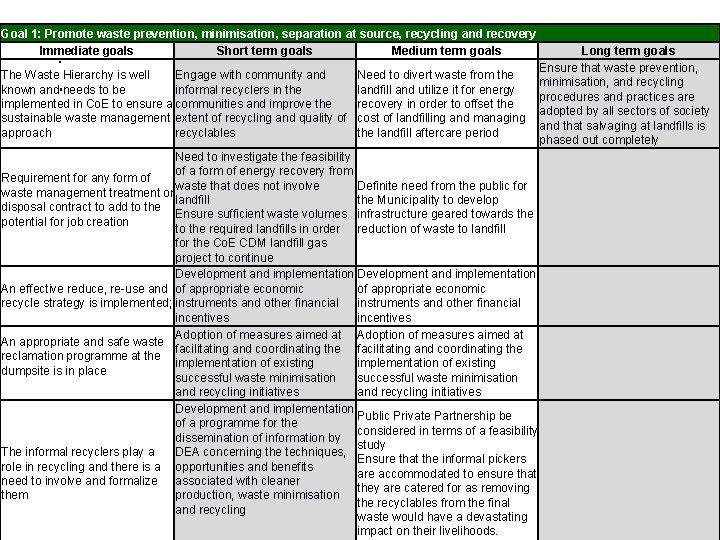
Goal 1: Promote waste prevention, minimisation, separation at source, recycling and recovery Immediate goals Short term goals Medium term goals . . The Waste Hierarchy is well Engage with community and known and needs to be informal recyclers in the implemented in Co. E to ensure a communities and improve the sustainable waste management extent of recycling and quality of approach recyclables Need to divert waste from the landfill and utilize it for energy recovery in order to offset the cost of landfilling and managing the landfill aftercare period Need to investigate the feasibility of a form of energy recovery from Requirement for any form of waste that does not involve Definite need from the public for waste management treatment or landfill the Municipality to develop disposal contract to add to the Ensure sufficient waste volumes infrastructure geared towards the potential for job creation to the required landfills in order reduction of waste to landfill for the Co. E CDM landfill gas project to continue Development and implementation An effective reduce, re-use and of appropriate economic recycle strategy is implemented; instruments and other financial incentives Adoption of measures aimed at An appropriate and safe waste facilitating and coordinating the reclamation programme at the implementation of existing dumpsite is in place successful waste minimisation and recycling initiatives Development and implementation Public Private Partnership be of a programme for the considered in terms of a feasibility dissemination of information by study DEA concerning the techniques, The informal recyclers play a Ensure that the informal pickers role in recycling and there is a opportunities and benefits are accommodated to ensure that need to involve and formalize associated with cleaner they are catered for as removing production, waste minimisation them the recyclables from the final and recycling waste would have a devastating impact on their livelihoods. Long term goals Ensure that waste prevention, minimisation, and recycling procedures and practices are adopted by all sectors of society and that salvaging at landfills is phased out completely
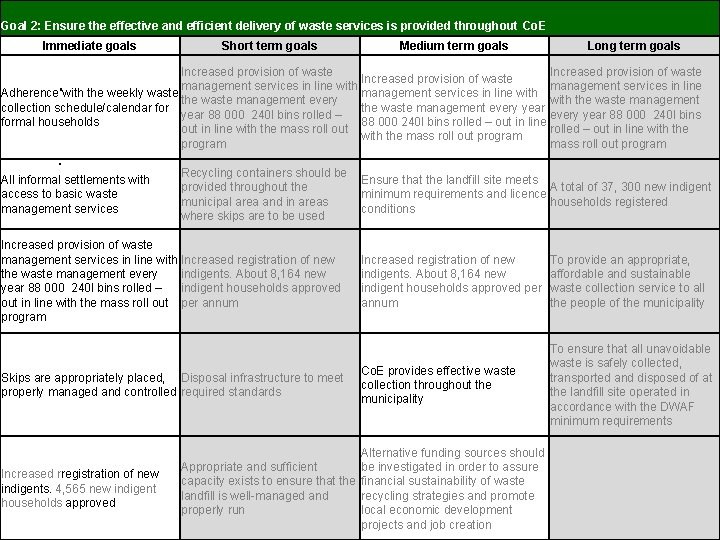
Goal 2: Ensure the effective and efficient delivery of waste services is provided throughout Co. E Immediate goals Short term goals Medium term goals Long term goals . Increased provision of waste management services in line with management services in line Adherence with the weekly waste management services in line with the waste management every year collection schedule/calendar for year 88 000 240 l bins rolled – every year 88 000 240 l bins formal households 88 000 240 l bins rolled – out in line with the mass roll out program mass roll out program . All informal settlements with access to basic waste management services Recycling containers should be provided throughout the municipal area and in areas where skips are to be used Increased provision of waste management services in line with Increased registration of new the waste management every indigents. About 8, 164 new year 88 000 240 l bins rolled – indigent households approved out in line with the mass roll out per annum program Skips are appropriately placed, Disposal infrastructure to meet properly managed and controlled required standards Increased rregistration of new indigents. 4, 565 new indigent households approved Appropriate and sufficient capacity exists to ensure that the landfill is well-managed and properly run Ensure that the landfill site meets A total of 37, 300 new indigent minimum requirements and licence households registered conditions Increased registration of new indigents. About 8, 164 new indigent households approved per annum To provide an appropriate, affordable and sustainable waste collection service to all the people of the municipality Co. E provides effective waste collection throughout the municipality To ensure that all unavoidable waste is safely collected, transported and disposed of at the landfill site operated in accordance with the DWAF minimum requirements Alternative funding sources should be investigated in order to assure financial sustainability of waste recycling strategies and promote local economic development projects and job creation
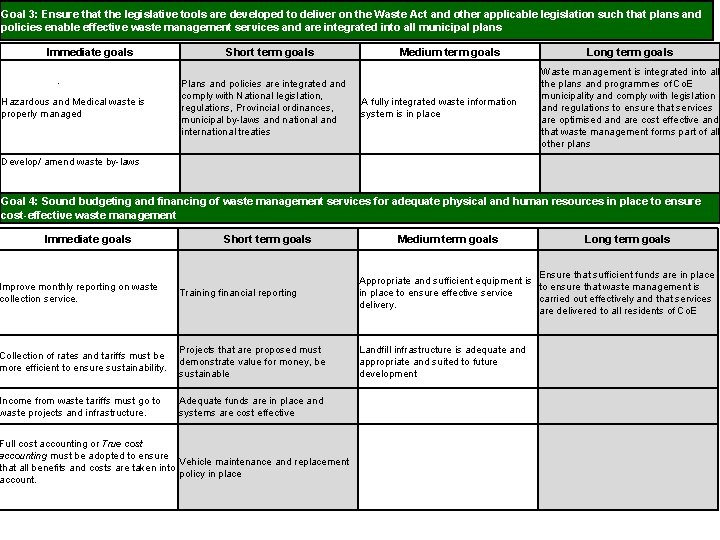
Goal 3: Ensure that the legislative tools are developed to deliver on the Waste Act and other applicable legislation such that plans and policies enable effective waste management services and are integrated into all municipal plans Immediate goals. Hazardous and Medical waste is properly managed Short term goals Plans and policies are integrated and comply with National legislation, regulations, Provincial ordinances, municipal by-laws and national and international treaties Medium term goals A fully integrated waste information system is in place . Long term goals Waste management is integrated into all the plans and programmes of Co. E municipality and comply with legislation and regulations to ensure that services are optimised and are cost effective and that waste management forms part of all other plans Develop/ amend waste by-laws Goal 4: Sound budgeting and financing of waste management services for adequate physical and human resources in place to ensure cost-effective waste management Immediate goals Short term goals Medium term goals Long term goals Improve monthly reporting on waste collection service. Training financial reporting Ensure that sufficient funds are in place Appropriate and sufficient equipment is to ensure that waste management is in place to ensure effective service carried out effectively and that services delivery. are delivered to all residents of Co. E Collection of rates and tariffs must be more efficient to ensure sustainability. Projects that are proposed must demonstrate value for money, be sustainable Landfill infrastructure is adequate and appropriate and suited to future development Income from waste tariffs must go to waste projects and infrastructure. Adequate funds are in place and systems are cost effective Full cost accounting or True cost accounting must be adopted to ensure Vehicle maintenance and replacement that all benefits and costs are taken into policy in place account.
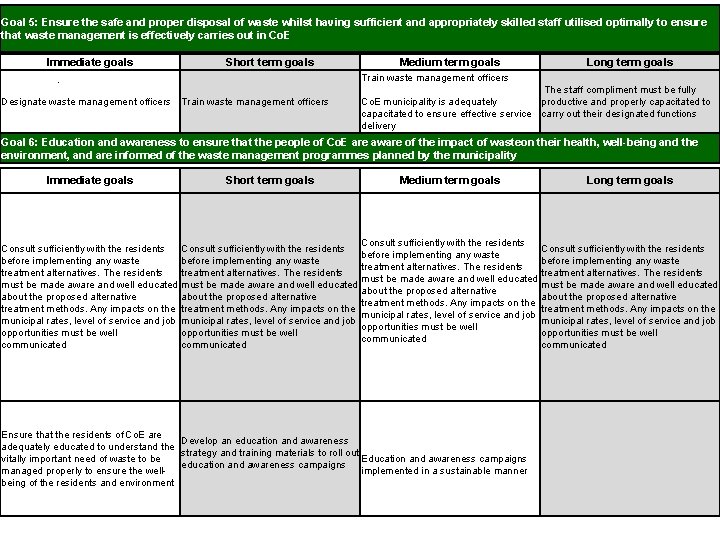
Goal 5: Ensure the safe and proper disposal of waste whilst having sufficient and appropriately skilled staff utilised optimally to ensure that waste management is effectively carries out in Co. E Immediate goals Short term goals Long term goals Train waste management officers . Designate waste management officers Medium term goals Train waste management officers Co. E municipality is adequately capacitated to ensure effective service delivery The staff compliment must be fully productive and properly capacitated to carry out their designated functions Goal 6: Education and awareness to ensure that the people of Co. E are aware of the impact of wasteon their health, well-being and the. environment, and are informed of the waste management programmes planned by the municipality Immediate goals Short term goals Consult sufficiently with the residents before implementing any waste treatment alternatives. The residents must be made aware and well educated about the proposed alternative treatment methods. Any impacts on the municipal rates, level of service and job opportunities must be well communicated Medium term goals Consult sufficiently with the residents before implementing any waste treatment alternatives. The residents must be made aware and well educated about the proposed alternative treatment methods. Any impacts on the municipal rates, level of service and job opportunities must be well communicated Ensure that the residents of Co. E are Develop an education and awareness adequately educated to understand the strategy and training materials to roll out vitally important need of waste to be Education and awareness campaigns education and awareness campaigns managed properly to ensure the wellimplemented in a sustainable manner being of the residents and environment Long term goals Consult sufficiently with the residents before implementing any waste treatment alternatives. The residents must be made aware and well educated about the proposed alternative treatment methods. Any impacts on the municipal rates, level of service and job opportunities must be well communicated
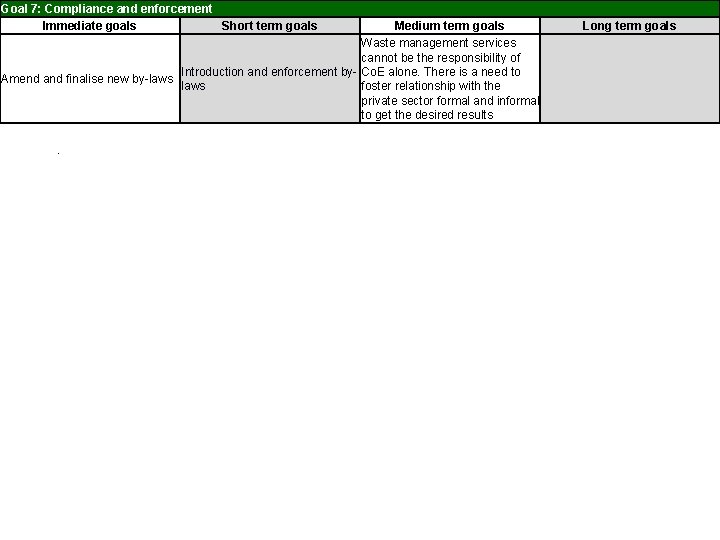
Goal 7: Compliance and enforcement Immediate goals Short term goals Medium term goals Waste management services cannot be the responsibility of Introduction and enforcement by- Co. E alone. There is a need to Amend and. finalise new by-laws foster relationship with the private sector formal and informal to get the desired results. Long term goals
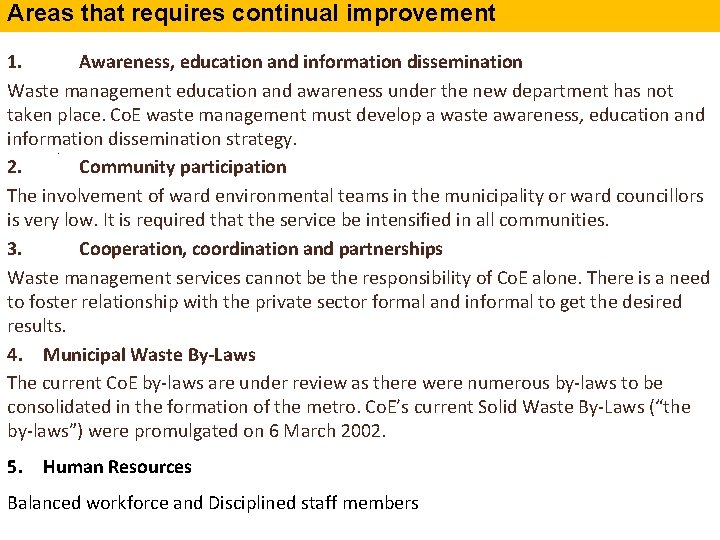
Areas that requires continual improvement 1. Awareness, education and information dissemination Waste management education and awareness under the new department has not taken place. Co. E waste management must develop a waste awareness, education and information dissemination strategy. 2. Community participation The involvement of ward environmental teams in the municipality or ward councillors is very low. It is required that the service be intensified in all communities. 3. Cooperation, coordination and partnerships Waste management services cannot be the responsibility of Co. E alone. There is a need to foster relationship with the private sector formal and informal to get the desired results. 4. Municipal Waste By-Laws The current Co. E by-laws are under review as there were numerous by-laws to be consolidated in the formation of the metro. Co. E’s current Solid Waste By-Laws (“the by-laws”) were promulgated on 6 March 2002. . 5. Human Resources Balanced workforce and Disciplined staff members
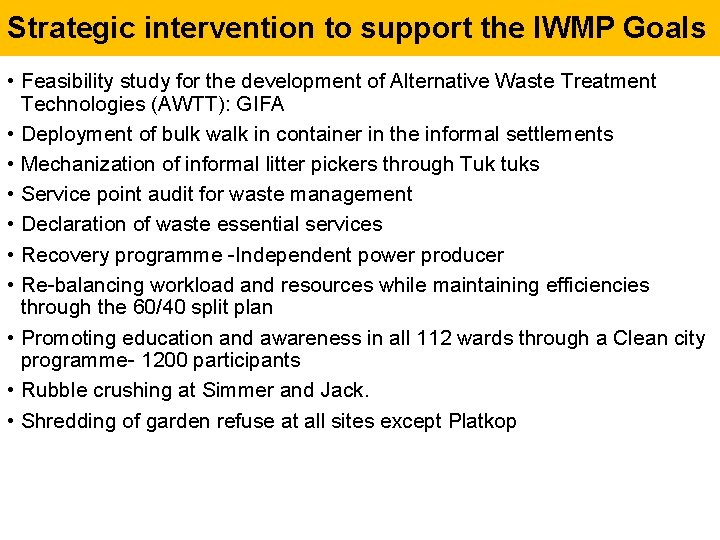
Strategic intervention to support the IWMP Goals • Feasibility study for the development of Alternative Waste Treatment Technologies (AWTT): GIFA • Deployment of bulk walk in container in the informal settlements • Mechanization of informal litter pickers through Tuk tuks • Service point audit for waste management • Declaration of waste essential services • Recovery programme -Independent power producer • Re-balancing workload and resources while maintaining efficiencies through the 60/40 split plan • Promoting education and awareness in all 112 wards through a Clean city programme- 1200 participants • Rubble crushing at Simmer and Jack. • Shredding of garden refuse at all sites except Platkop
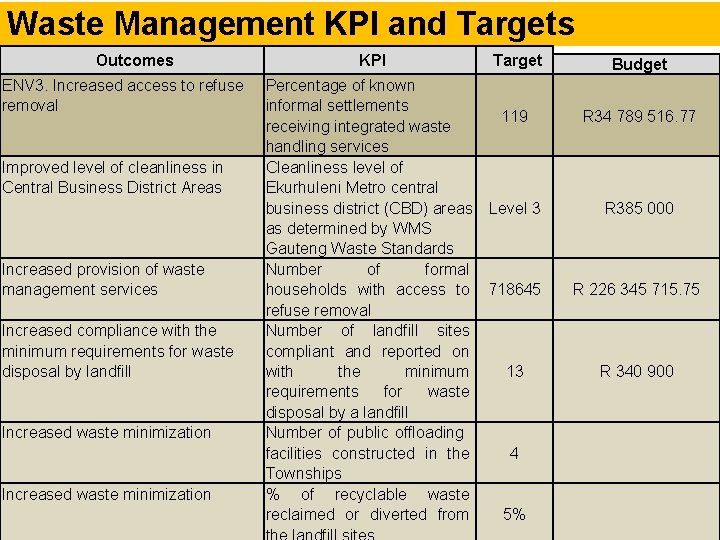
Waste Management KPI and Targets Outcomes ENV 3. Increased access to refuse removal Improved level of cleanliness in Central Business District Areas Increased provision of waste management services Increased compliance with the minimum requirements for waste disposal by landfill Increased waste minimization KPI Target Percentage of known informal settlements 119 receiving integrated waste handling services Cleanliness level of Ekurhuleni Metro central business district (CBD) areas Level 3 as determined by WMS Gauteng Waste Standards Number of formal households with access to 718645 refuse removal Number of landfill sites compliant and reported on with the minimum 13 requirements for waste disposal by a landfill Number of public offloading facilities constructed in the 4 Townships % of recyclable waste reclaimed or diverted from 5% Budget R 34 789 516. 77 R 385 000 R 226 345 715. 75 R 340 900
THANK YOU