
Environmental Processes Partitioning of pollutants 3 i Sorption
- Slides: 15
Environmental Processes Partitioning of pollutants 3. i Sorption involving organic matter (between air/soil and water/soil)
• Aims: – to provide overview of molecular interactions that govern phase transfer processes in the environment – to discuss partitioning behavior of a compound in the environment • Outcomes: – students will be able to evaluate compound partitioning between water, dissolved organic matter, and sediment organic matter based on physico-chemical properties of compounds – students will be able to estimate partition constants on the basis of compound's chemical structure and physico-chemical properties Environmental processing / Partitioning of pollutants / Sorption involving organic matter 2
Adsorption vs. Absorption: The difference between adsorption and absorption is that adsorption is the attraction between the outer surface of a solid particle and a contaminant, whereas absorption is the uptake of the contaminant into the physical structure of the solid. Identical molecules behave very differently, depending on whether they are: • • in the gas phase (gas), surrounded by water molecules (dissolved), clinging onto the exterior of solids (adsorbed), buried within a solid matrix (absorbed). Environmental processing / Partitioning of pollutants / Sorption involving organic matter 3
sorption affects transport: • generally, molecules which are sorbed are less mobile in the environment • sorbed molecules are not available for phase transfer processes (air-water exchange, etc) and degradation: • sorbed molecules are not bioavailable • sorbed molecules usually shielded from UV light (less direct photolysis) • sorbed molecules cannot come into contact with indirect photoxidants such as OH • rates of other transformation reactions may be very different for sorbed molecules Environmental processing / Partitioning of pollutants / Sorption involving organic matter 4
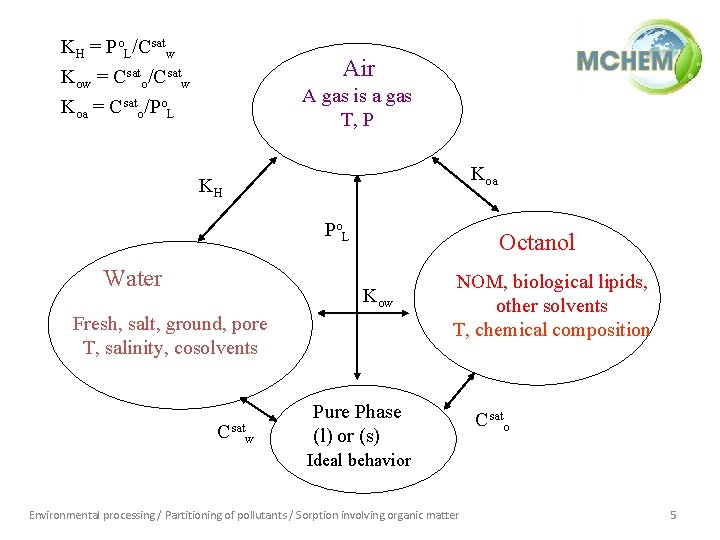
KH = Po. L/Csatw Kow = Csato/Csatw Koa = Csato/Po. L Air A gas is a gas T, P Koa KH Po L Water Octanol Kow Fresh, salt, ground, pore T, salinity, cosolvents Csatw NOM, biological lipids, other solvents T, chemical composition Pure Phase (l) or (s) Csato Ideal behavior Environmental processing / Partitioning of pollutants / Sorption involving organic matter 5
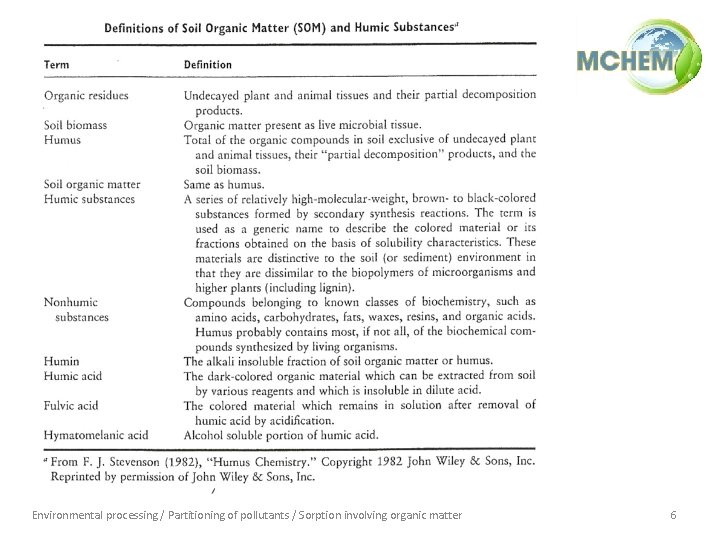
Environmental processing / Partitioning of pollutants / Sorption involving organic matter 6
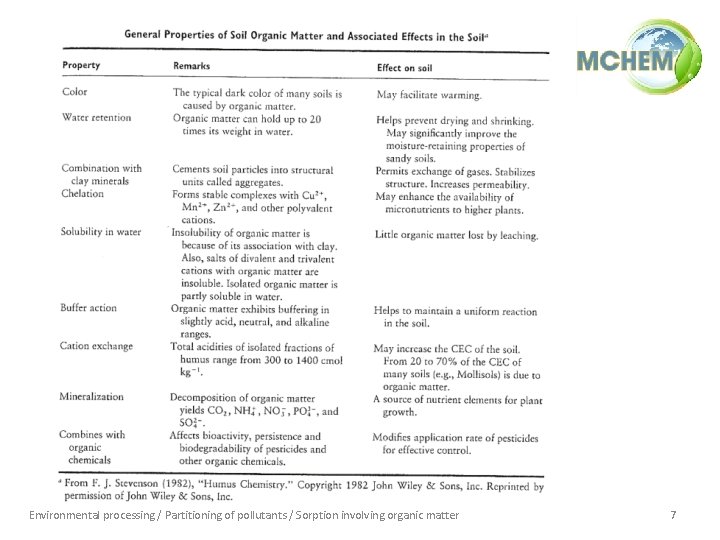
Environmental processing / Partitioning of pollutants / Sorption involving organic matter 7
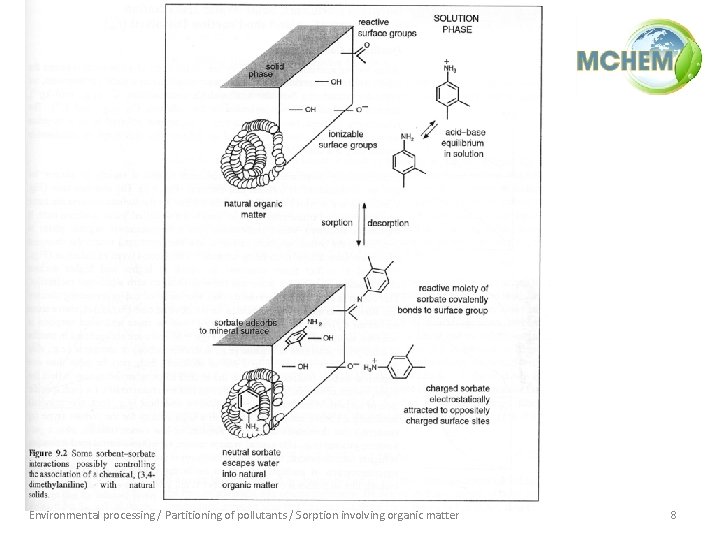
Environmental processing / Partitioning of pollutants / Sorption involving organic matter 8
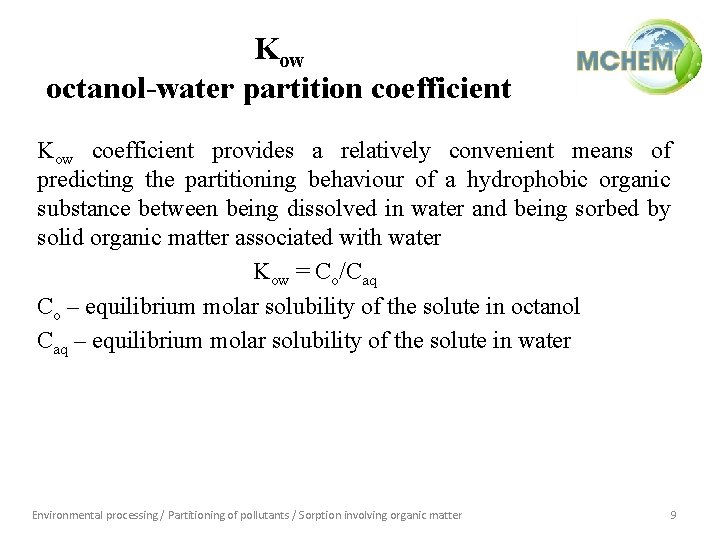
Kow octanol-water partition coefficient Kow coefficient provides a relatively convenient means of predicting the partitioning behaviour of a hydrophobic organic substance between being dissolved in water and being sorbed by solid organic matter associated with water Kow = Co/Caq Co – equilibrium molar solubility of the solute in octanol Caq – equilibrium molar solubility of the solute in water Environmental processing / Partitioning of pollutants / Sorption involving organic matter 9
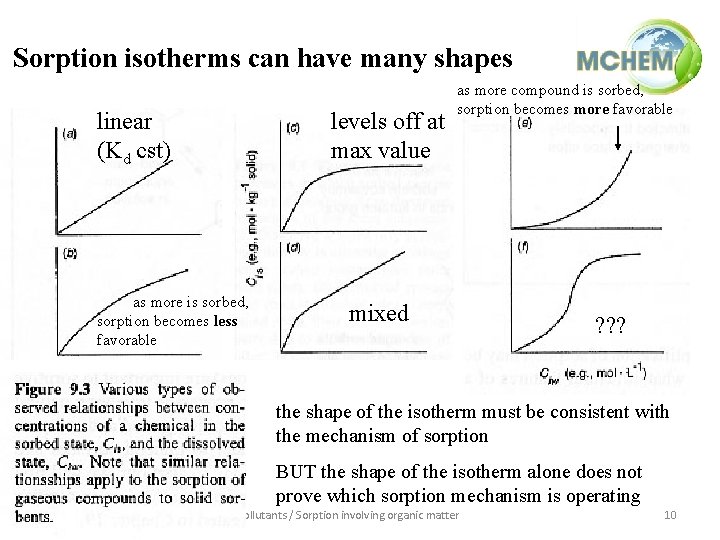
Sorption isotherms can have many shapes linear (Kd cst) as more is sorbed, sorption becomes less favorable levels off at max value as more compound is sorbed, sorption becomes more favorable mixed ? ? ? the shape of the isotherm must be consistent with the mechanism of sorption BUT the shape of the isotherm alone does not prove which sorption mechanism is operating Environmental processing / Partitioning of pollutants / Sorption involving organic matter 10
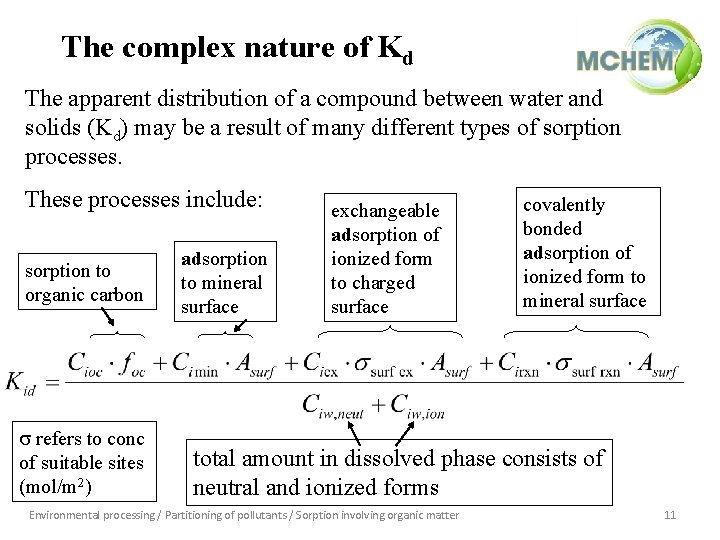
The complex nature of Kd The apparent distribution of a compound between water and solids (Kd) may be a result of many different types of sorption processes. These processes include: sorption to organic carbon s refers to conc of suitable sites (mol/m 2) adsorption to mineral surface exchangeable adsorption of ionized form to charged surface covalently bonded adsorption of ionized form to mineral surface total amount in dissolved phase consists of neutral and ionized forms Environmental processing / Partitioning of pollutants / Sorption involving organic matter 11
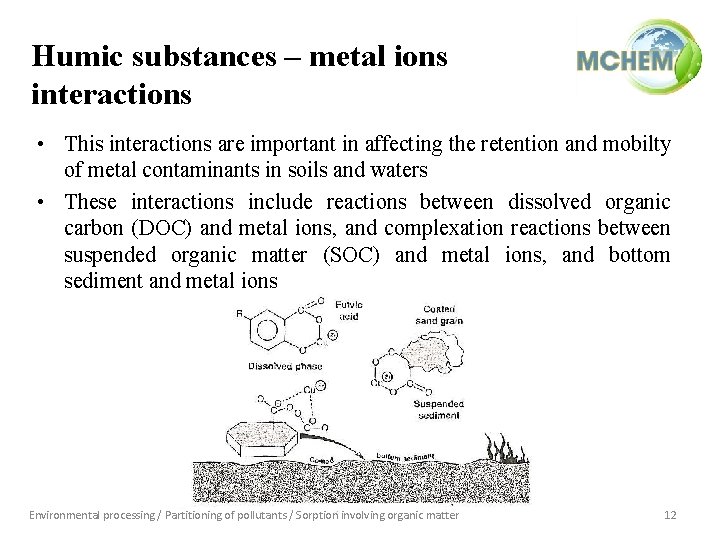
Humic substances – metal ions interactions • This interactions are important in affecting the retention and mobilty of metal contaminants in soils and waters • These interactions include reactions between dissolved organic carbon (DOC) and metal ions, and complexation reactions between suspended organic matter (SOC) and metal ions, and bottom sediment and metal ions Environmental processing / Partitioning of pollutants / Sorption involving organic matter 12
SOM – clay complexes • The types of interactions involved in SOM – clay complexes include: – physical adsorption or interaction via van der Waals forces – electrostatic interactions – cation and anion bridges (clay mineral – metal – HS) – chemical adsorption – hydrogen bonding Environmental processing / Partitioning of pollutants / Sorption involving organic matter 13
Retention of pesticides and other organic substances by humic substances • Pesticides have a strongly affinity for SOM and SOM is most important in pesticide retention • Factors that affect the retention of pesticides by SOM: § number, type and accessability of functional groups § nature of pesticides § p. H § exchangeable cations § moisture § temperature § soil component (types and quantities of clay minerals and other constituents) Environmental processing / Partitioning of pollutants / Sorption involving organic matter 14
Literature 1. Schwarzenbach, R. P. , Gschwend, P. M. , Imboden, D. M. (2003). Environmental Organic Chemistry, 2 nd Edition John Wiley and Sons, New Jersey. 2. Gary W. van. Loon, Stephen J. Duffy “Environmental Chemistry (a global perspective)” Oxford University Press, New York (2 nd edition), 2005. 3. Donald L. Sparks “Environmental Soil Chemistry” Academic Press, Published 1995. 4. G. J. Lair, M. H. Gerzabek, G. Haberhauer, Environ Chem. Lett. (2007) 5: 23– 27 Environmental processing / Partitioning of pollutants / Sorption involving organic matter 15