
Environmental Permitting Regulations 2007 Tom Fowler Environment Officer
- Slides: 17
Environmental Permitting Regulations 2007 Tom Fowler – Environment Officer © Environment Agency 2006
Environmental Permitting Regulations g g g The regulations came into force on the 6 th April 2008 The regulations combine Pollution Prevention and Control (PPC) and Waste Management Licensing (WML) regulations The Environmental Permitting (England Wales) Regulations 2007 SI 2007 No. 3538
The Environmental Permitting Regime g Aims to: g Protect the environment g Deliver permitting and compliance effectively and efficiently with increased clarity and minimising administrative burden. g Encourage regulators to promote best practice g Continue to implement European legislation
The Environmental Permitting Regime g g g The Scope of the Regime: Covers facilities previously regulated under the PPC and WML regulations and exemptions It extends to England Wales and now covers the adjacent sea as far as the territorial boundary The Legal Framework The Environmental Permitting (England Wales) Regulations 2007 SI 2007 No. 3538
The Regulations set out the following g g g The facilities that need environmental permits or need to be registered as exempt The process for registering exemptions How to apply for and determine permit applications, and the administration of permits after issue A simplified permitting system called standard rules Compliance obligations and enforcement powers and offences Provision for public participation in the permitting process
EPR PRINCIPLES g g g The main offence under the regulations is operating without a permit or the contravention of permit conditions Regulators are expected to apply the regulations in proportion to the environmental risk presented by the facility Regulators should exercise their function in an open and transparent manner © Environment Agency 2006
The Regulations: g Are made of various schedules: g g g Part A Installations (Old PPC) - Sch 7 Part B Installations (Old PPC (local authority) - Sch 8 The Waste Framework Directive - Sch 9 The Landfill Directive - Sch 10 Waste Motor Vehicles (End of Life Vehicles) - Sch 11 Waste Electrical and Electronic Equipment Directive – Sch 12 Waste Incineration Directive – Sch 13 Solvents Emission Directive - Sch 14 Large Combustion Plants Directive – Sch 15 The Asbestos Directive – Sch 16 The Titanium Dioxide Directive – Sch 17 The Petrol Vapour Recovery Directive – Sch 18 © Environment Agency 2006
What Facilities Require an Environmental Permit? g g g Regulated Facilities An installation (Sch 1 of the regs) A Waste operation A mobile plant (carrying out a Sch 1 activity or a Waste operation) Some activities are exempt or excluded © Environment Agency 2006
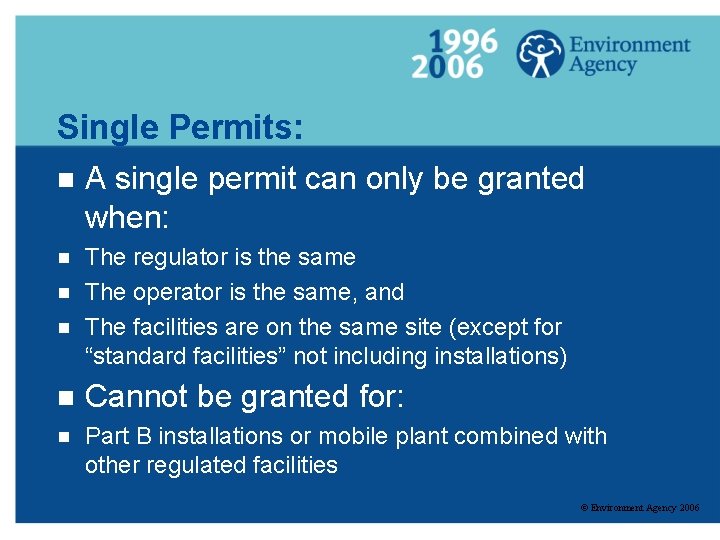
Single Permits: g g g A single permit can only be granted when: The regulator is the same The operator is the same, and The facilities are on the same site (except for “standard facilities” not including installations) Cannot be granted for: Part B installations or mobile plant combined with other regulated facilities © Environment Agency 2006
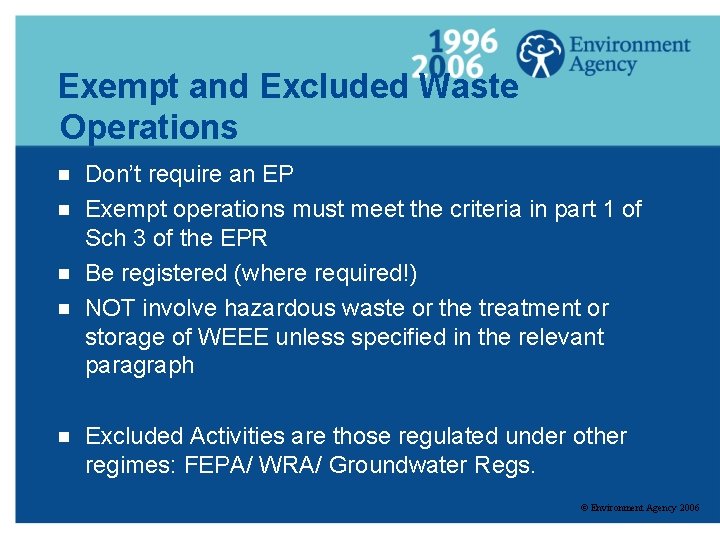
Exempt and Excluded Waste Operations g g g Don’t require an EP Exempt operations must meet the criteria in part 1 of Sch 3 of the EPR Be registered (where required!) NOT involve hazardous waste or the treatment or storage of WEEE unless specified in the relevant paragraph Excluded Activities are those regulated under other regimes: FEPA/ WRA/ Groundwater Regs. © Environment Agency 2006
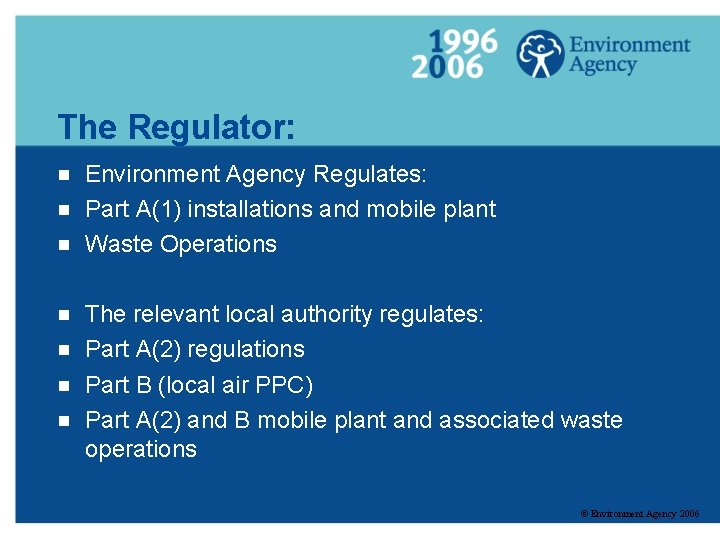
The Regulator: g g g g Environment Agency Regulates: Part A(1) installations and mobile plant Waste Operations The relevant local authority regulates: Part A(2) regulations Part B (local air PPC) Part A(2) and B mobile plant and associated waste operations © Environment Agency 2006
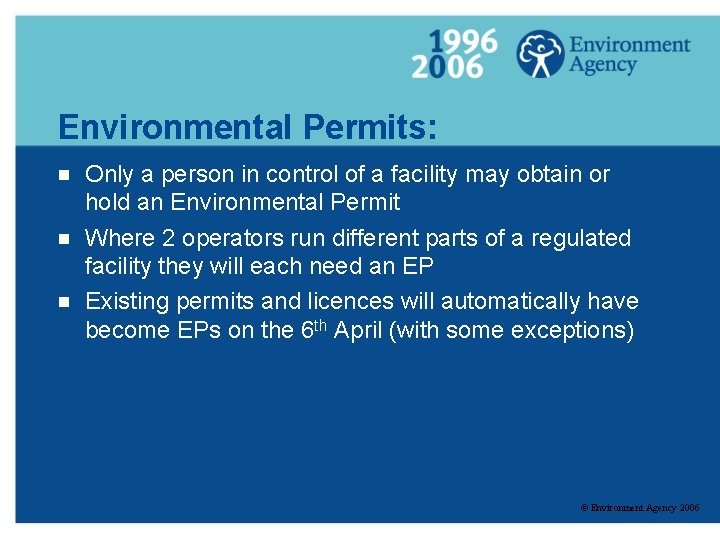
Environmental Permits: g g g Only a person in control of a facility may obtain or hold an Environmental Permit Where 2 operators run different parts of a regulated facility they will each need an EP Existing permits and licences will automatically have become EPs on the 6 th April (with some exceptions) © Environment Agency 2006
Application for a Permit: g Lots of guidance and all the forms on the EA EPR pages. Ring Us…. g Time Scales: g g 2 Months for a transfer 3 Months for a surrender/ mobile plant or a “standard facility” 4 Months for a new application or a variation needs public participation © Environment Agency 2006
Standard Permits: g g A set of common rules for a specific class of facility The Agency has produced 28 standard rules permits for low to medium risk activities: Waste transfer and treatment operations, Biological treatment of waste, Sewage sludge treatment, Waste Electrical and Electronic Equipment (WEEE), Metal recycling, Clinical and healthcare waste, Animal carcass incineration, Mobile plant for the treatment of waste soils and contaminated material, substances or products g No further site-specific risk assessments are required g No public consultation required g Operators can apply to operate under the standard rules if they meet the criteria © Environment Agency 2006
Operator Competence g g g The regulator must consider the operators competence when issuing a permit. The operator must have an adequate management system The operator must have adequate technical competence The operator must have adequate financial competence The operators previous compliance is taken into account © Environment Agency 2006
Management Systems g g g Must be in place and are risk based Complex regulated facilities are encouraged to use formal environmental management systems such as ISO 14001 or EMAS equivalent. Less complex sites should have a stepwise approach such as BS 8555 Agency regulatory effort will focus on ensuring good management and identifying root causes of problems
Compliance Assessment g Risk Based g Targeting activities that: g Pose the greatest risk to the environment or human health g Have poorer standards of operation g Are failing to comply with permits g Are having the greatest impact Reducing regulatory burden on operators whose standard of operation is consistently high