
Environmental Management Division NASA Environmental Management System EMS
- Slides: 24
Environmental Management Division NASA Environmental Management System (EMS) Pilot Test Program Michael J. Green Environmental Management Division NASA Headquarters Washington, DC 10/2/2020 NASA EMS 1
Environmental Management Division TEST PROGRAM REVIEW • • Factors affecting EMS Initial assessment EMS development activities Agency challenges Cost analysis Potential benefits Lessons learned 10/2/2020 NASA EMS 2
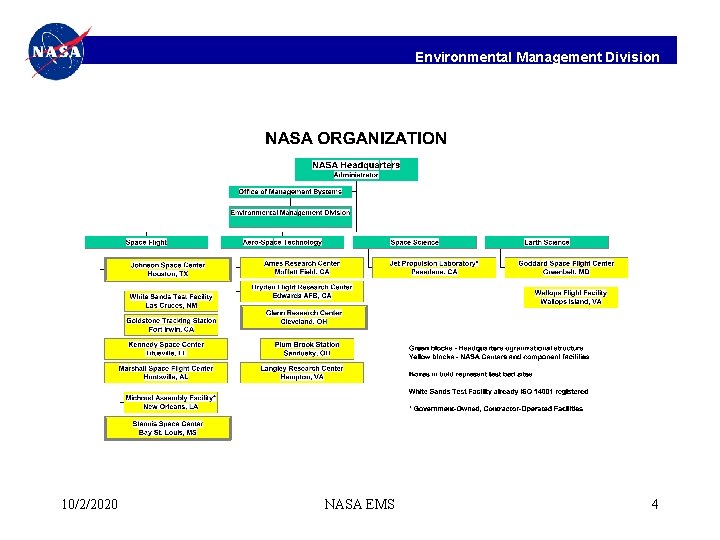
Environmental Management Division FACTORS AFFECTING EMS • Size of installations – Land area - 150 to 80, 000 acres – Population - 1, 000 to 10, 000 on-site personnel • Complexity of installations – Laboratories, test stands, wind tunnels, hangars, shops – Includes tenant organizations and private enterprises • Large contractor work force – Several GOCO facilities – About 4 contractor employees per civil service employee • Geographic variability - 10 states 10/2/2020 NASA EMS 3
Environmental Management Division 10/2/2020 NASA EMS 4
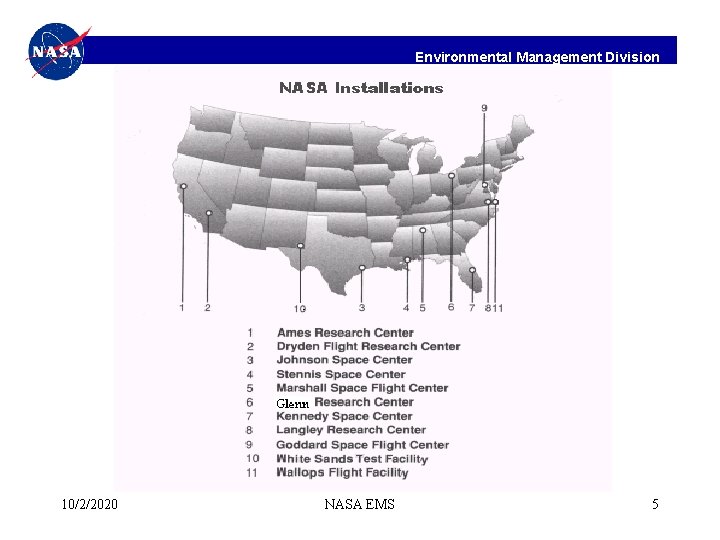
Environmental Management Division 10/2/2020 NASA EMS 5
Environmental Management Division INITIAL ASSESSMENT • Business Case & Gap Analysis conducted in 1998 – Included Headquarters and 12 NASA installations • ISO 14001 recommended as NASA’s EMS model – NASA was accomplishing 80% of ISO 14001 requirements – Many elements of ISO 9000 can be utilized (e. g. , corrective action, document and records management) – Existing processes can be utilized (e. g. , emergency response) – Internationally recognized – Protocols can be used for evaluation & performance tracking – Allows flexibility – Contractor acceptability 10/2/2020 NASA EMS 6
Environmental Management Division EMS DEVELOPMENT ACTIVITIES • Development of Agency EMS Procedures Manual – Developed by NASA team from 5 Centers – Consistent Agency approach but flexible at implementation level • Implementation at Glenn, Johnson and Stennis – Test sites provide lessons learned for Agency implementation – Developed implementation guidance – Includes independent Verification and Validation • Cost and Benefits Report – Identify projected costs, benefits, and lessons learned – Will use data to facilitate Agency-wide implementation • Presentation of results to management 10/2/2020 NASA EMS 7
Environmental Management Division ELEMENTS OF NASA EMS • Environmental Policy • Planning – – • Implementation & Operation – – – – Aspects & Impacts Legal & Other Requirements Objectives & Targets Environmental Mgmt Program • Corrective Action – Monitoring & Measurement – Nonconformance, Corrective & Preventive Action – Records – EMS Audits 10/2/2020 Structure & Responsibility Training & Awareness Communication EMS Documentation Document Control Operation Control Emergency Preparedness & Response • Management Review • Metrics NASA EMS 8
Environmental Management Division AGENCY CHALLENGES • • • Quantifying costs and benefits Developing EMS metrics Clarifying HQS & Center roles and responsibilities Obtaining senior management commitment Determining how EMS will apply to contractors Deciding how to implement EMS across Agency Handling intensive up-front activities with limited staff Deciding how to apply EMS to new programs Managing aspects, impacts, objectives & targets • Holding each activity accountable for its aspects & impacts 10/2/2020 NASA EMS 9
Environmental Management Division COST & BENEFITS ANALYSIS • Compare baseline EMS that meets requirements of Executive Order with ISO 14001 compliant EMS • Obtain better understanding of cost and level of effort of implementation – Develop budget estimates – – Comparison of NASA versus contractor cost and hours Training requirements Data management requirements Time requirements for implementation • Identify potential benefits 10/2/2020 NASA EMS 10
Environmental Management Division BASELINE EMS • • EMS implementation planning Identify priority environmental impacts Training, awareness & competence Internal & external communication Documentation & document control Corrective action program Environmental functional reviews Miscellaneous activities (e. g. , regulatory review) 10/2/2020 NASA EMS 11
Environmental Management Division UNIQUE EMS ACTIVITIES FOR ISO 14001 REGISTRATION • Additional communication & training activities to prepare for registration • Documentation of management review • ISO 14001 Registration process – – 10/2/2020 Internal EMS audits Training of internal auditors Preparing for and supporting registration audits Registration costs NASA EMS 12
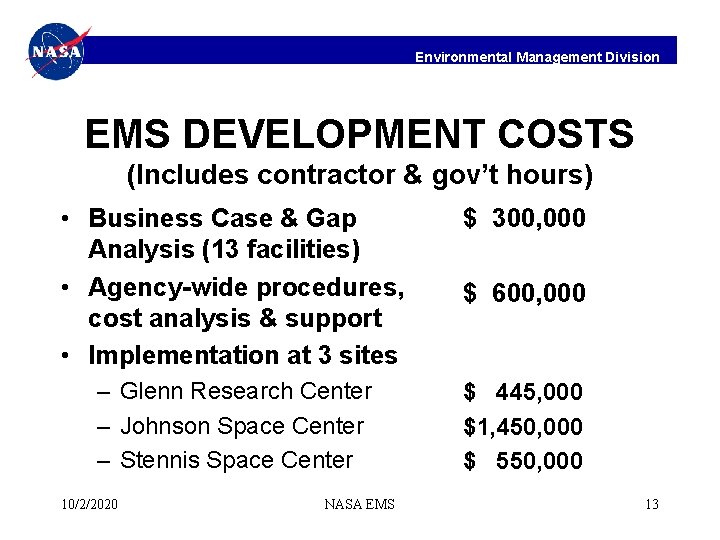
Environmental Management Division EMS DEVELOPMENT COSTS (Includes contractor & gov’t hours) • Business Case & Gap Analysis (13 facilities) • Agency-wide procedures, cost analysis & support • Implementation at 3 sites $ 300, 000 – Glenn Research Center – Johnson Space Center – Stennis Space Center $ 445, 000 $1, 450, 000 $ 550, 000 10/2/2020 NASA EMS $ 600, 000 13
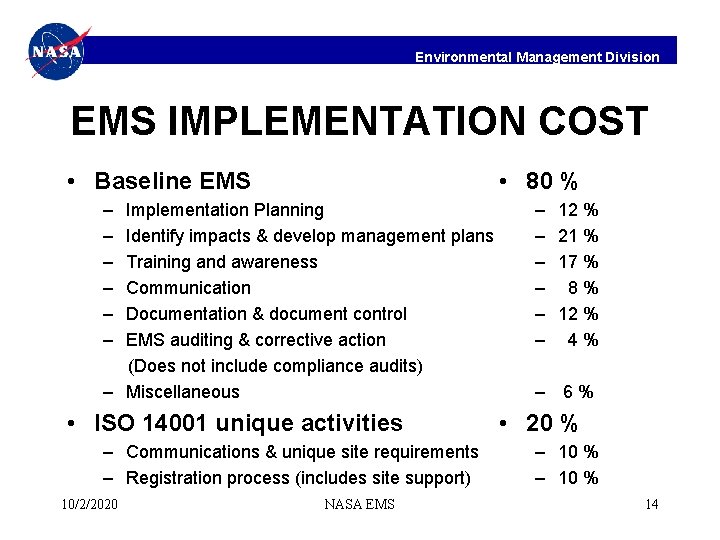
Environmental Management Division EMS IMPLEMENTATION COST • Baseline EMS • 80 % – – – Implementation Planning Identify impacts & develop management plans Training and awareness Communication Documentation & document control EMS auditing & corrective action (Does not include compliance audits) – Miscellaneous • ISO 14001 unique activities – Communications & unique site requirements – Registration process (includes site support) 10/2/2020 NASA EMS – – – 12 % 21 % 17 % 8% 12 % 4% – 6% • 20 % – 10 % 14
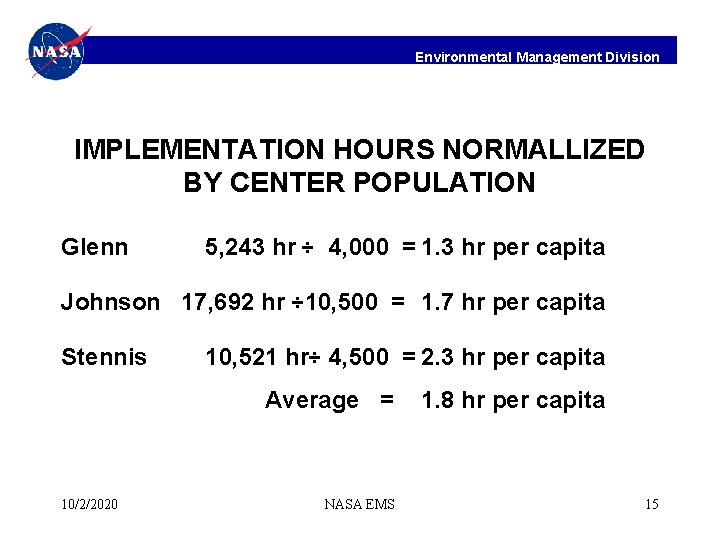
Environmental Management Division IMPLEMENTATION HOURS NORMALLIZED BY CENTER POPULATION Glenn 5, 243 hr ÷ 4, 000 = 1. 3 hr per capita Johnson 17, 692 hr ÷ 10, 500 = 1. 7 hr per capita Stennis 10, 521 hr÷ 4, 500 = 2. 3 hr per capita Average = 10/2/2020 NASA EMS 1. 8 hr per capita 15
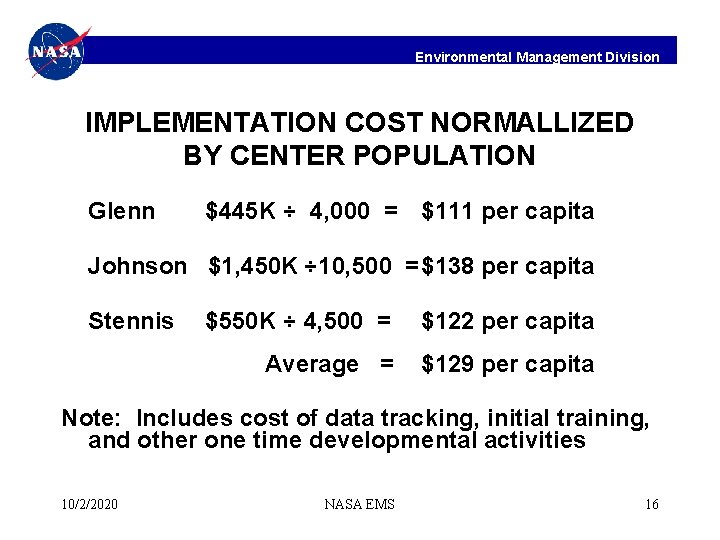
Environmental Management Division IMPLEMENTATION COST NORMALLIZED BY CENTER POPULATION Glenn $445 K ÷ 4, 000 = $111 per capita Johnson $1, 450 K ÷ 10, 500 =$138 per capita Stennis $550 K ÷ 4, 500 = $122 per capita Average = $129 per capita Note: Includes cost of data tracking, initial training, and other one time developmental activities 10/2/2020 NASA EMS 16
Environmental Management Division PROJECTED MAINTENANCE • About 1 fte to serve as EMS representative – Updating documentation – Continued coordination efforts • About 1 fte equivalent for other activities – Internal audits – Follow-up training – Management reviews 10/2/2020 NASA EMS 17
Environmental Management Division Potential Benefits Ø Mission delay reductions Ø Change order reductions Ø Environmental impact reductions Ø Reduced liability Ø Increased compliance Ø Increased management support and involvement Ø Increased pro-activity Ø Reduction of single-point failures Ø Continual improvement 10/2/2020 Ø Decreased energy use, water use, and materials reductions Ø Health benefits Ø Decreased # of fines and NOVs Ø Decreased employee time (fewer inspections) Ø Reduced # of inspections Ø Written procedures, process consistency, & repeatability Ø Increased efficiency Ø Improved communications NASA EMS 18
Environmental Management Division Potential Benefits Ø Increased # of pollution prevention initiatives Ø Cost reductions Ø Increased safety Ø Reduced # of regulations Ø Reduced # of spills Ø Increased affirmative procurement Ø Increased recycling revenue Ø Solid waste reduction 10/2/2020 Ø Prioritization of funding projects Ø Increased # of green building designs Ø Increased # of sustainability projects Ø Better NASA reputation (Center and Agency) Ø Better relationship with stakeholders Ø Increased trust and satisfaction from customers NASA EMS 19
Environmental Management Division LESSONS LEARNED • Early planning & communication critical – Substantial time required for planning & meetings to achieve support • Senior management involvement critical – Needs to be more than annual management review – Involvement needs to be visible • Build on existing procedures & systems – Establishing document management, recordkeeping, corrective action systems can be significant undertaking – Requires understanding of systems 10/2/2020 NASA EMS 20
Environmental Management Division LESSONS LEARNED • Cross-organization involvement critical – Establish core team representing different organizations and points-of-view – Use the core team to help with buy-in – Contractor involvement critical – Work with each organization to establish their responsibilities & management of aspects & impacts – High visibility program facilitates involvement 10/2/2020 NASA EMS 21
Environmental Management Division LESSONS LEARNED • Develop training/communications program – – – – 10/2/2020 Tailor training to situations & individual responsibilities Provide core team & key personnel with training early Combination of class room, OTJ, and facilitated training Keep people informed of progress Use existing tools (e. g. , newsletters) Consider web based techniques Consider special promotions Training is not a one-time event NASA EMS 22
Environmental Management Division LESSONS LEARNED • Flexibility needed due to varied activities • EMS Representative is a key player – Needs authority to make decisions on EMS implementation • Review results throughout implementation • Keep it simple at working level! – Normally only 1 or 2 aspects & impacts require management at the working level – Clarifies individual and organizational responsibilities – Individual employees find this to be acceptable 10/2/2020 NASA EMS 23
Environmental Management Division POINT-OF-CONTACT Michael Green Environmental Management Division NASA Headquarters (Code JE) Washington, DC 20546 Phone: (202) 358 -1097 e-mail: michael. j. green@hq. nasa. gov 10/2/2020 NASA EMS 24