
Environmental Legislation in Pakistan Policy Framework The 1973
- Slides: 14
Environmental Legislation in Pakistan
Policy Framework § The 1973 Constitution of Pakistan had included the subject of Environmental Pollution and Ecology in the concurrent legislative list. § The parliament and provincial governments were empowered to formulate necessary laws under Article 142 § Government of Pakistan (GOP) has announced the National Environmental Policy in the year 2005
Institutional Setup PEPC (Pakistan Environmental Protection Council), was established in 1998, under the provisions of Pakistan Environmental Protection Act (PEPA), 1997. o Environmental Protection Agencies has been established at the federal level as well as provincial level. o National Environmental Coordination Committee § Pak EPA has established the National Environmental Coordination Committee dated 24 December 1998. §
Legislative Framework § PEPO (Pakistan Environmental Protection Ordinance) had been enforced in the year 1983 § Pak EPA with prior approval of the PEPC, established and issued NEQS dated 24 August 1993. § These NEQS were related to municipal and liquid industrial effluents, industrial gaseous emissions and motor vehicle exhaust and noise
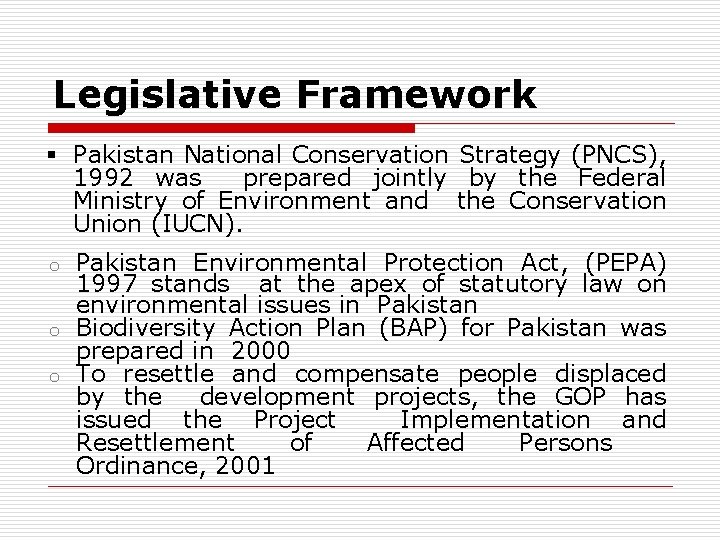
Legislative Framework § Pakistan National Conservation Strategy (PNCS), 1992 was prepared jointly by the Federal Ministry of Environment and the Conservation Union (IUCN). Pakistan Environmental Protection Act, (PEPA) 1997 stands at the apex of statutory law on environmental issues in Pakistan o Biodiversity Action Plan (BAP) for Pakistan was prepared in 2000 o To resettle and compensate people displaced by the development projects, the GOP has issued the Project Implementation and Resettlement of Affected Persons Ordinance, 2001 o
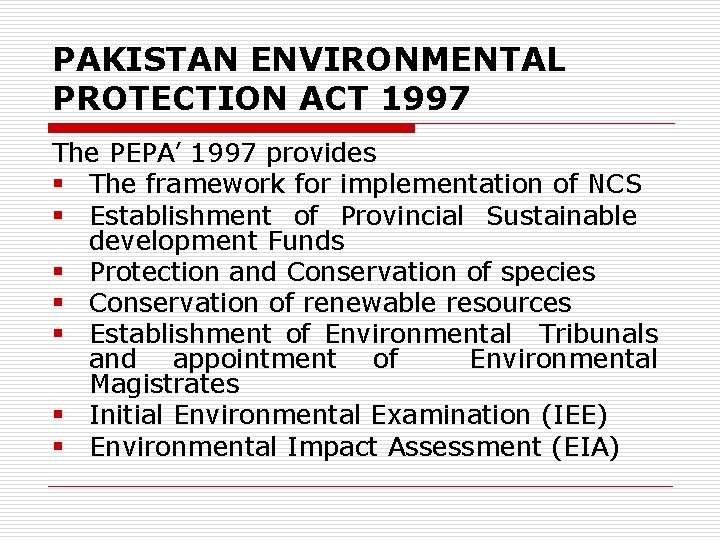
PAKISTAN ENVIRONMENTAL PROTECTION ACT 1997 The PEPA’ 1997 provides § The framework for implementation of NCS § Establishment of Provincial Sustainable development Funds § Protection and Conservation of species § Conservation of renewable resources § Establishment of Environmental Tribunals and appointment of Environmental Magistrates § Initial Environmental Examination (IEE) § Environmental Impact Assessment (EIA)
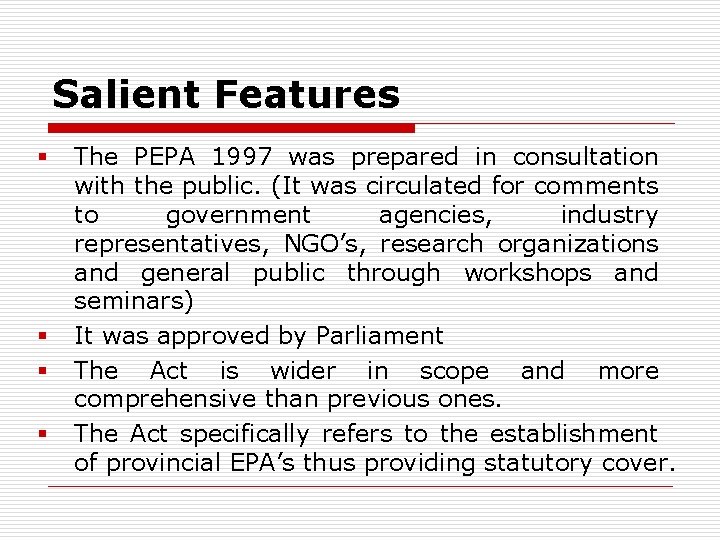
Salient Features § § The PEPA 1997 was prepared in consultation with the public. (It was circulated for comments to government agencies, industry representatives, NGO’s, research organizations and general public through workshops and seminars) It was approved by Parliament The Act is wider in scope and more comprehensive than previous ones. The Act specifically refers to the establishment of provincial EPA’s thus providing statutory cover.
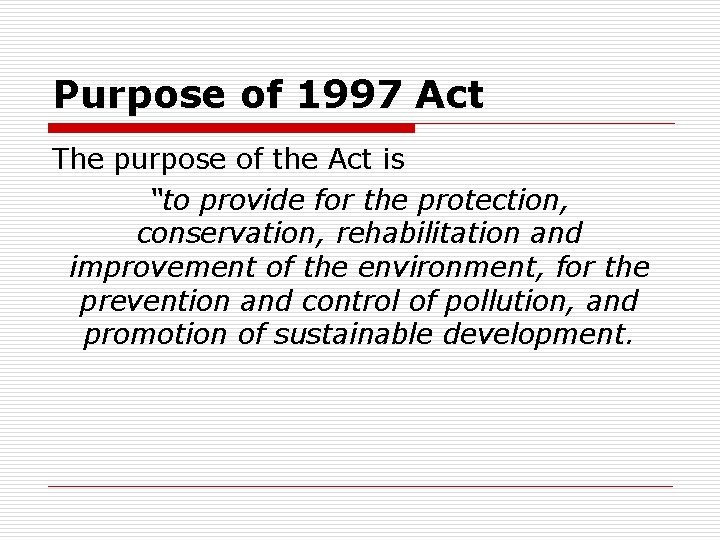
Purpose of 1997 Act The purpose of the Act is “to provide for the protection, conservation, rehabilitation and improvement of the environment, for the prevention and control of pollution, and promotion of sustainable development.
PEPA 1997 Section 11: Prohibition Discharges or Emissions of Certain Subsection 1: Under the provisions of this Act, “The rules and regulations made there under no person shall discharge or emit or allow the discharge or emission of any effluent or waste or air pollutant or noise in an amount which is in excess of NEQS Standards”
PEPA 1997 Section 15: Regulation of Motor Vehicles o Sub section (1) “Subject to the provisions of this Act and the rules and regulations made there under, no person shall operate a motor vehicle from which air pollutants or noise are being emitted in an amount, concentration or level which is in excess of the National Environmental Quality Standards. ” PEPA 1997 (Guzzete I)
PEPA 1997 Section 16: Environmental Protection § Where the Federal Agency or a Provincial Agency is satisfied that the discharge or emission of any effluent, waste, air pollutant or noise, or the disposal of waste, or the handling of hazardous substances, or any other act or omission is likely to occur, or is occurring or has occurred in violation of the provisions of this Act, § Federal Agency may, by order direct such person to take such measures that the Federal Agency or Provincial Agency may consider necessary within such period as may be specified in the order.
PEPA 1997 Section (13) Prohibition Hazardous Waste of Import of “No person shall import hazardous waste into Pakistan and its territorial waters, Exclusive Economic Zone and historic waters”
Weaknesses in 1997 Act § § § The NEQSs limit the concentration of gaseous emissions without regard to the magnitude of the emissions or total pollution load being emitted and hence without giving due consideration to the desired air quality. Pollution charges are worked out on the basis of concentration in excess of NEQS’s rather than the excess of pollution load. No ambient water quality standards to complement the NEQS’s have so far been established.
1997 Act after 18 th Amendment § § § The PEPA 1997 is confined to Islamabad since each Province is now able to legislate on the subject of environment. This is an opportunity for provincial legislatures to close gaps in the legislative framework for sustainable development and the welfare of the general public. Although theoretically provinces are effectively able to do so, it is widely believed that they lack the capacity to address such issues.