
Environmental Law Compliance and Enforcement Implementing Arrangement 10

- Slides: 5
Environmental Law Compliance and Enforcement Implementing Arrangement 10
Environmental Challenges Addressed Environmental laws are only protective and effective if they are implemented by the regulated community. Compliance failures can lead to environmental degredation, human harm, and disrespect of the law. Governments need appropriate tools to ensure compliance and appropriately enforce against violators Trained staff are critical, including inspectors, police, technicians, program managers, and prosecutors. Equitable sanctions and enforcement mechanisms are necessary to ensure appropriate deterrence. DRAFT PRESENTATION FOR DISCUSSION
Objectives Improve the system for addressing violations of environmental law in Taiwan through use of illegal economic benefit calculation model and mandating appropriate corrective measures. Strengthen the abilities of Taiwan environmental law inspectors and enforcement partners through domestic/international training programs. Cooperate with countries and organizations in the region, sharing training resources, experiences and information of environmental compliance and enforcement. DRAFT PRESENTATION FOR DISCUSSION
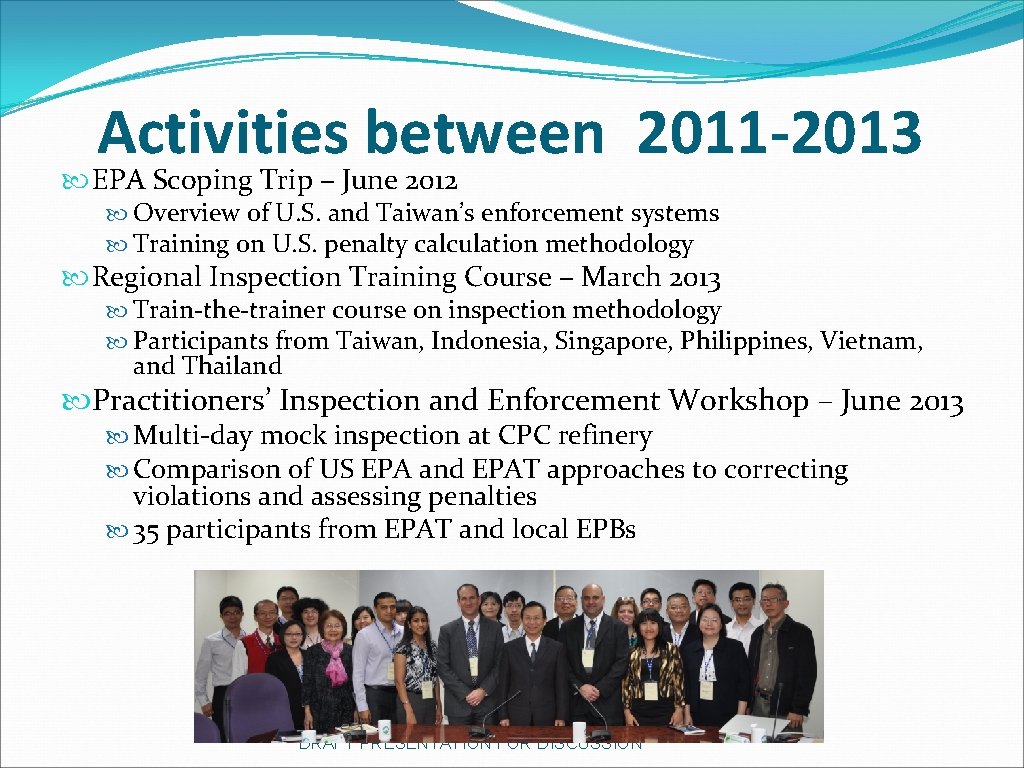
Activities between 2011 -2013 EPA Scoping Trip – June 2012 Overview of U. S. and Taiwan’s enforcement systems Training on U. S. penalty calculation methodology Regional Inspection Training Course – March 2013 Train-the-trainer course on inspection methodology Participants from Taiwan, Indonesia, Singapore, Philippines, Vietnam, and Thailand Practitioners’ Inspection and Enforcement Workshop – June 2013 Multi-day mock inspection at CPC refinery Comparison of US EPA and EPAT approaches to correcting violations and assessing penalties 35 participants from EPAT and local EPBs DRAFT PRESENTATION FOR DISCUSSION
Opportunities US EPA and EPAT will expand cooperation on enforcement processes, penalty calculation and inspection training. Development of Taiwan version of BEN Model for calculating economic benefit of non-compliance. (2014) Study tour from EPAT, local EPBs, and partner agencies to U. S. to discuss inspections, penalty calculations, and remedy selection. (2014) Potential regional workshop to share best enforcement and compliance practices between countries. (2015) DRAFT PRESENTATION FOR DISCUSSION