
Environmental Justice 1982 Warren County NC protest over

- Slides: 6
Environmental Justice
1982: Warren County, NC protest over a PCB landfill in an African American town puts the issue of EJ on the national agenda. There is a close tie to the Civil Rights Movement. 1983: US GAO finds that in the US south, about three of every four landfills are located in predominantly minority communities. 1987: UCC Commission on Racial justice study “Toxic Wastes and Race in the United States” finds that race is the best predictor of the location of a waste facility; three in five African Americans and Hispanic Americans, and half of Asian/Pacific Islanders and Native Americans live in a community with an uncontrolled toxic waste site. Modern origins
EPA Definition: Environmental Justice “The fair treatment and meaningful involvement of all people regardless of race, color, national origin, or income with respect to the development , implementation, and enforcement of environmental laws, regulations, and policies. ”
Environmental Injustice A situation in which a specific group is disproportionately affected by negative environmental conditions brought on by unequal laws, regulations, and policies.
Environmental inequality formation The evidence is fairly clear that socially marginalized communities (particularly those defined by race and/or income) are more likely to live in environmentally compromised areas. The questions that Environmental Justice research aims to answer are: 1) how this uneven distribution (inequality) of environmental hazards gets produced and reproduced, (what are the local, regional, national, and global structures and institutions that link income and race to environmental hazards) 1) the extent to which these differences can be characterized as injustice.
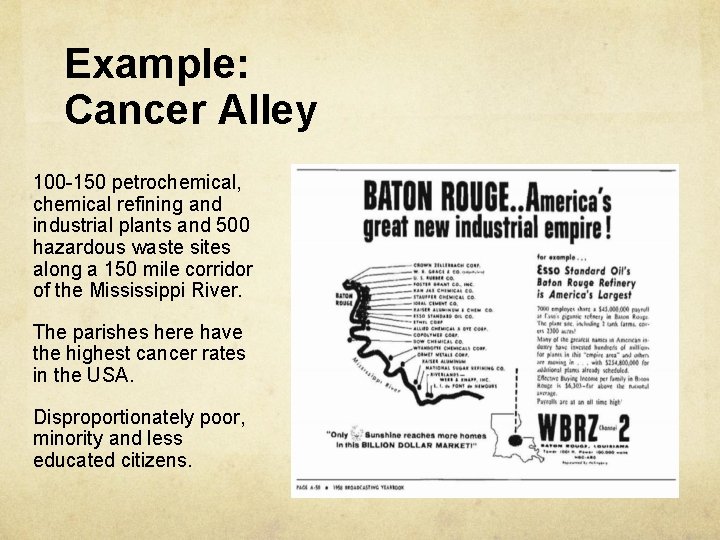
Example: Cancer Alley 100 -150 petrochemical, chemical refining and industrial plants and 500 hazardous waste sites along a 150 mile corridor of the Mississippi River. The parishes here have the highest cancer rates in the USA. Disproportionately poor, minority and less educated citizens.