
Environmental Issues WATER Is one of our most

- Slides: 54
Environmental Issues
WATER Is one of our most precious RESOURCES n
The water cycle the amount of water on and around this planet is fairly constant n availability of water is not as constant n
Water 97% is in oceans n 2% is freshwater n 1% is frozen in glaciers and icecaps n
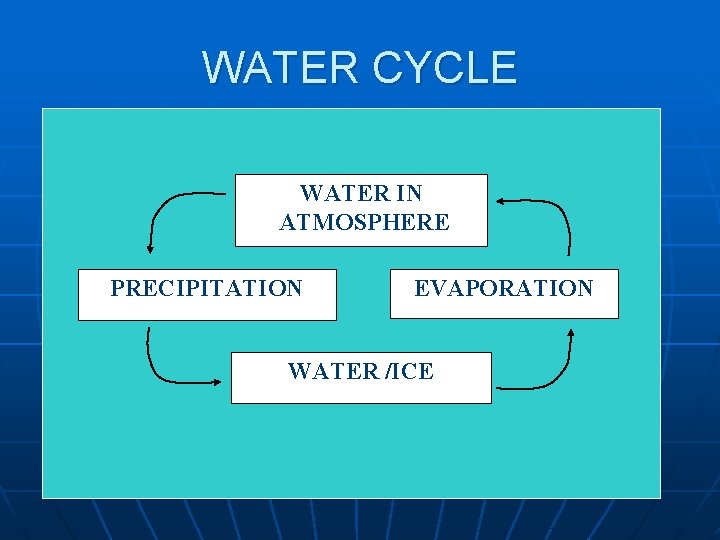
The water cycle water is continuously moving from place to place n the water cycle is called the hydrologic cycle n
The water cycle powered by solar energy n heats the water causing it to rise into the atmosphere n called evaporation n
The water cycle n if the oceans were not recharged, their water level would decrease over 40 inches per year
The water cycle rainwater accounts for only 1% of the total water supply n rain is vital in keeping the water balance on earth n
WATER CYCLE WATER IN ATMOSPHERE PRECIPITATION EVAPORATION WATER /ICE
Three zones 1. Surface 1. 2. dry soil accepts water until saturated Zone of aeration 1. empty spaces filled with air, extends from the deepest roots to just above the water table
Three zones 3. Groundwater zone 1. 2. 3. below zone of aeration water saturated rocks called aquifers can equal about 100 years of surface runoff volume
Industry uses more water than any other raw material n only a small part of the water is actually consumed n used as a medium for other processes n
Industry n Canning n water is used to clean product and the containers Cool ovens n Boil the product n Wash away wastes n
Industry may become part of the product n most water is recycled or returned to the natural water cycle in a drainage ditch or stream n
Industry paper is made in water n industry draws about 40 billion gallons of water per day n water supply - major factor in location of industry n
Industry n strong pollution control methods to recycle water rather than draw from an outside source
Hydroelectric plants major use of water n US leads the world in hydroelectric power n supplies only a small portion of our needs n
Hydroelectric Plants concern is with damming of rivers n fish runs are interrupted n habitat is changed n puts wildlife in danger n
Fish and Wildlife n the way water is handled affects the fish in the water and the wildlife around the water
Fish and Wildlife land wildlife, inland birds, waterfowl n different species require different types of water n
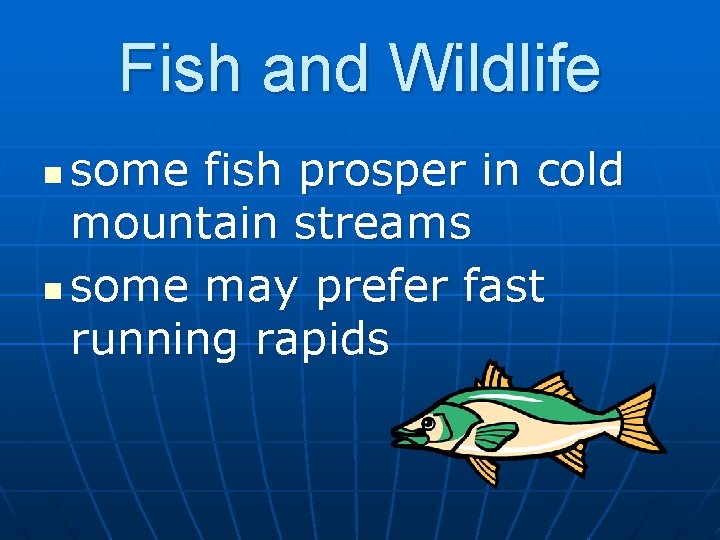
Fish and Wildlife some fish prosper in cold mountain streams n some may prefer fast running rapids n
Recreation boating, water skiing, fishing, sailing and swimming n Swimming pools n n require a lot of water to keep them in compliance with health regulations.
Recreation n Frozen water activities • ice skating • hockey • snowboarding • skiing
Domestic Uses cooking n baths or showers n carry away wastes n Each American uses more water than any other person in the world n
Domestic Uses In the US each person uses approximately 150 gallons of water per day n Bath n • 3 -40 gallons n Shower • 5 gallons per minute
Domestic Uses n Wash clothes n n 30 gallons flush the toilet n 3 gallons Water the lawn and garden, wash cars n Fire protection n
Use n How wasteful can we be and still have enough clean water to survive?
Pollution n The presence of a SUBSTANCE in water, air, or soil that makes them OFFENSIVE to humans.
Water n Water that is suitable for DRINKING is referred to as POTABLE water
Sources of Pollution Oil Products n Soil Erosion n Animal and Human Waste n Chemical fertilizers, pesticides, and herbicides n High temperature water discharge n
Eutrophication n An increase in the amount of NUTRIENTS in an environment
Nutrients n Nutrients in water are expressed in terms of PARTS PER MILLIONS (PPM)
Nitrates n Nitrates are a common source of POLLUTION
Sources of Nitrates Animal Waste n Human Waste n Chemical fertilizers n Dead and decaying organisms n
Eutrophication n One of the first INDICATIONS of eutrophication in water is the presence of ALGAE
Eutrophication n Also known as POND SCUM
Waste Control Sewage Treatment Plants n Septic Tanks n Waste Lagoons n
Sewage Treatment Plants Larger towns and cities n Treat waste water to remove B. O. D. n Use Oxygenation, Chlorine, & UV Light n Tremonton, Brigham City n
Septic Tanks Used in rural areas n Settling tank and Drain Field n Will not work if area is densely populated n
Waste Lagoons Used in dairies, feed lots, and some towns and cities n Logan and Perry n Animal waste is stored in a settling pond where it is decomposed by anaerobic bacteria n
Water Pollution n Occurs in both groundwater and in surface water
Ground water n Water stored in underground lakes called aquifers
Surface Water n Water is absorbed by the soil as it flows into the aquifers
Non-Point Source Pollution n Pollution that originates from many sources
Point source pollution n Pollution that results from a single source
Erosion Our largest environmental problem n Wasting away of soil by wind or water n
Two main problems of erosion The loss of Topsoil n The pollution of water by the erosion of soil n
Soil Erosion Damage n n n Loss of topsoil Pollution of rivers and streams Kills fish and plants
Soil Conservation Service n An agency organized to help prevent the loss of topsoil and to stop erosion caused by the washing away of soil.
Examples of soil conservation practices n n n Windbreaks Terracing Crop rotation (summer fallow) Contour plowing No-till and minimum till planting
Wetlands n A piece of land that stays underwater for most of the year
Wetlands provide several roles n n Habitat Filtering of water Water storage Flood prevention
EPA Regulations Restrict use n Incentives to preserve wetlands n Permit must be obtained before land can be disturbed n