
Environmental Impacts from U S Military Bases Marla
Environmental Impacts from U. S. Military Bases Marla Rawls Hill, MPH student Walden University PUBH 6165 -1 Instructor: Dr. Rebecca Heick Spring, 2010
Contents �Base Realignment and Closure (BRAC) � Community workshops � Role of the community �Case histories? Fort Mc. Pherson, Atlanta, GA ? Vieques Island, Puerto Rico ? Marine Corps Base Camp Lejeune, NC �Known and possible adverse health effects �Measures of concentration �Conclusion �Resources for further investigation 2
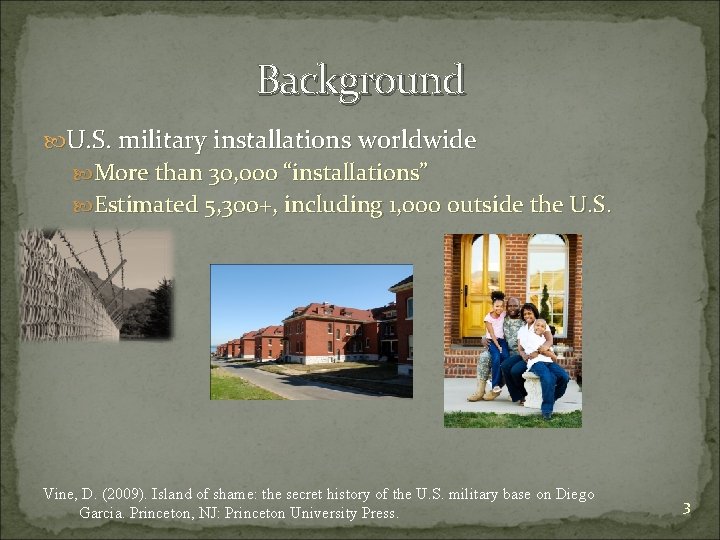
Background U. S. military installations worldwide More than 30, 000 “installations” Estimated 5, 300+, including 1, 000 outside the U. S. Vine, D. (2009). Island of shame: the secret history of the U. S. military base on Diego Garcia. Princeton, NJ: Princeton University Press. 3
BRAC Budget cuts forced base closures beginning 1960 s Closures peaked at end of Vietnam War Severe economic impact on communities BRAC Commission established to protect community interests - 1977 Community Environmental Response Facilitation Act amended BRAC code in 1992 Governed by NEPA regulations Base Realignment & Closure Commission. (1993). Report to the President. Retrieved from http: //www. brac. gov/docs/final/Chap 3 Prev. Expwith. BRAC. pdf Tavana, M. , Bourgeois, B. & Sodenkamp, M. (2009). Fuzzy multiple criteria base realignment and closure (BRAC) benchmarking system at the Department of Defense. Benchmarking, 16(2), 192 -221. Retrieved from ABI/INFORM Global. (Document ID: 1882614931). U. S. Environmental Protection Agency. (2006). Community Environmental Response Facilitation Act. Retrieved from http: //www. epa. gov/fedfac/documents/scan 5. htm 4
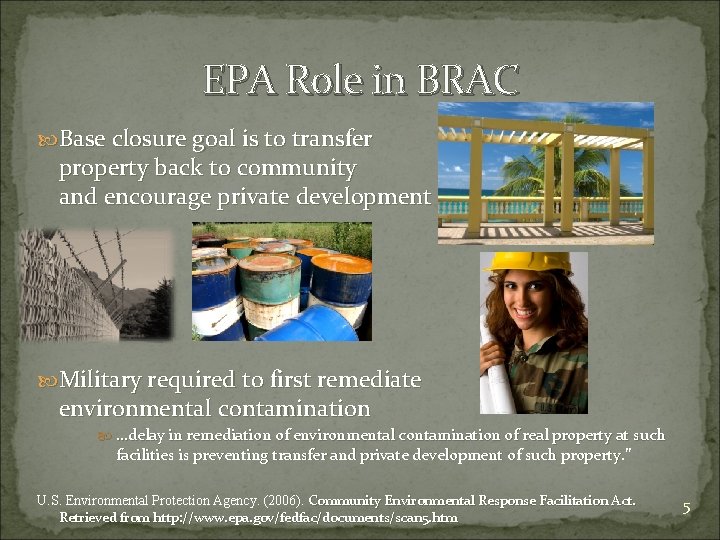
EPA Role in BRAC Base closure goal is to transfer property back to community and encourage private development Military required to first remediate environmental contamination …delay in remediation of environmental contamination of real property at such facilities is preventing transfer and private development of such property. ” U. S. Environmental Protection Agency. (2006). Community Environmental Response Facilitation Act. Retrieved from http: //www. epa. gov/fedfac/documents/scan 5. htm 5
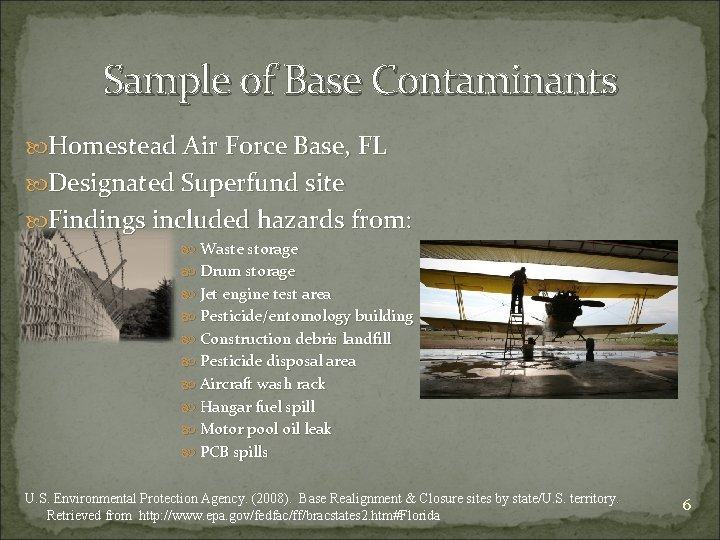
Sample of Base Contaminants Homestead Air Force Base, FL Designated Superfund site Findings included hazards from: Waste storage Drum storage Jet engine test area Pesticide/entomology building Construction debris landfill Pesticide disposal area Aircraft wash rack Hangar fuel spill Motor pool oil leak PCB spills U. S. Environmental Protection Agency. (2008). Base Realignment & Closure sites by state/U. S. territory. Retrieved from http: //www. epa. gov/fedfac/ff/bracstates 2. htm#Florida 6
BRAC Environmental Remediation Process Base identified for closure by US Military BRAC Commission accepts recommendation Public notice of closure Draft Environmental Assessment or Impact Statement is prepared Public review and comment Final Environmental Impact Statement Remediation recommendations to EPA Upon EPA approval (“Record of Decision”), remediation work begins Public is required to be kept informed and involved throughout U. S. Department of Defense. (2003). Army environmental clean-up strategy. Retrieved from http: //www. asaie. army. mil/Public/ESOH/doc/Army-Environmental-Cleanup-Strategy-Final-28 April 03. pdf 7
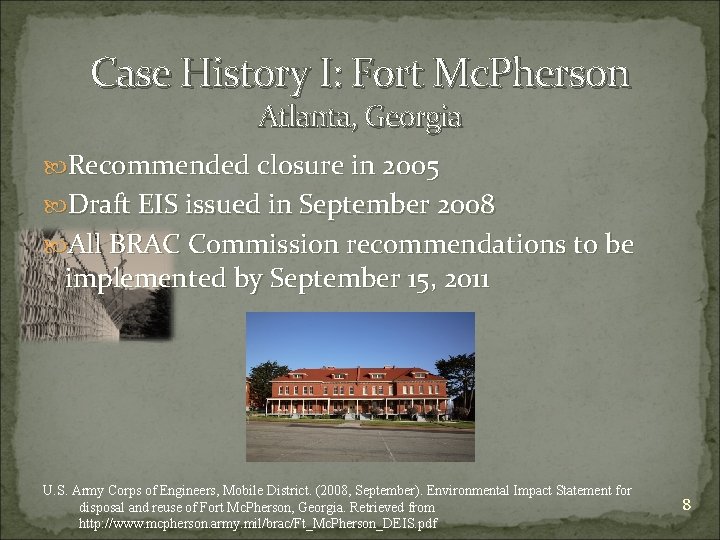
Case History I: Fort Mc. Pherson Atlanta, Georgia Recommended closure in 2005 Draft EIS issued in September 2008 All BRAC Commission recommendations to be implemented by September 15, 2011 U. S. Army Corps of Engineers, Mobile District. (2008, September). Environmental Impact Statement for disposal and reuse of Fort Mc. Pherson, Georgia. Retrieved from http: //www. mcpherson. army. mil/brac/Ft_Mc. Pherson_DEIS. pdf 8
Fort Mc. Pherson DEIS Findings Possibility of lead contamination at any of five firing ranges on the base Buried Munitions and Explosives of Concerns (MEC) may exist, posing safety hazards to construction and landscaping personnel Asbestos-containing materials Lead-based paint 90 -day hazardous waste storage, including paint and sulfuric acid Twenty underground storage tanks (USTs) containing propane, diesel, gasoline, waste oil, and fuel oil U. S. Army Corps of Engineers, Mobile District. (2008, September). Environmental Impact Statement for disposal and reuse of Fort Mc. Pherson, Georgia. Retrieved from http: //www. mcpherson. army. mil/brac/Ft_Mc. Pherson_DEIS. pdf 9
Fort Mc. Pherson DEIS Findings Remediation activities are currently underway at Fort Mc. Pherson More resources on Ft. Mc. Pherson: LRA www. mcphersonredevelopment. com CDC www. cdc. gov GHPC http: //aysps. gsu. edu/ghpc U. S. Army Corps of Engineers, Mobile District. (2008, September). Environmental Impact Statement for disposal and reuse of Fort Mc. Pherson, Georgia. Retrieved from http: //www. mcpherson. army. mil/brac/Ft_Mc. Pherson_DEIS. pdf Georgia Health Policy Center. (2010. ) Developing Fort Mc. Pherson as a healthier place. http: //aysps. gsu. edu/ghpc/3564. html 10
Case History 2: Vieques Island, Puerto Rico Atlantic Fleet Weapons Training Area is on the National Priorities list Long history of conflict between the public and DOD concerning base operations and environmental contamination Current status: Military operations curtailed Wildlife refuge on Eastern end Western end under control of Department of the Interior, city of Vieques, Puerto Rico Conservation trust Davis, J. , Hayes-Conroy, J. , & Jones, V. . (2007). Military pollution and natural purity: seeing nature and knowing contamination in Vieques, Puerto Rico. Geo. Journal, 69(3), 165. Retrieved from ABI/INFORM Global. (Document ID: 1376378161). U. S. Environmental Protection Agency. (2009, September). Vieques Island/Atlantic Fleet Weapons Training Area. Retrieved from http: //www. epa. gov/region 2/vieques/ 11
Vieques Island Findings 1999 Agency for Toxic Substances & Disease Registry (ATSDR) study Several contamination pathways tested: drinking water sources like surface water, groundwater, rainwater collection sources, and wells. Substances identified included: Barium VOCs (volatile organic compounds) Chloride Nitrate Boron Ammonia Fluoride Nitrite ATSDR Conclusion: No human health hazards Agency for Toxic Substances and Disease Registry. (2009). Vieques. Retrieved from http: //www. atsdr. cdc. gov/sites/vieques 12
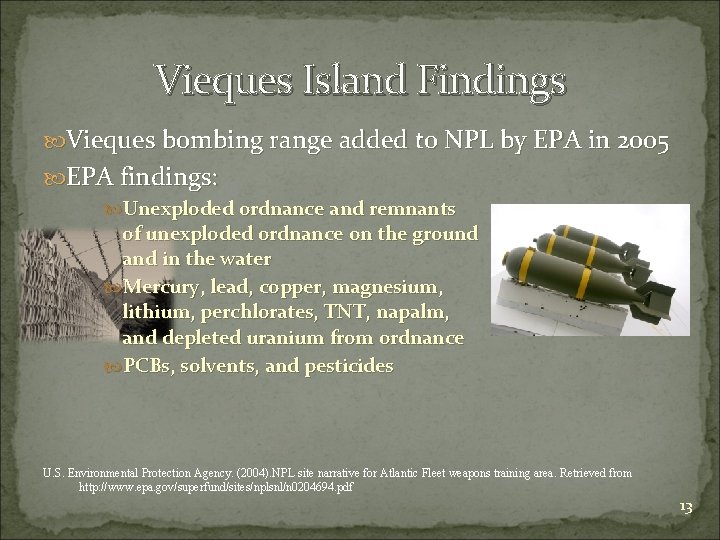
Vieques Island Findings Vieques bombing range added to NPL by EPA in 2005 EPA findings: Unexploded ordnance and remnants of unexploded ordnance on the ground and in the water Mercury, lead, copper, magnesium, lithium, perchlorates, TNT, napalm, and depleted uranium from ordnance PCBs, solvents, and pesticides U. S. Environmental Protection Agency. (2004). NPL site narrative for Atlantic Fleet weapons training area. Retrieved from http: //www. epa. gov/superfund/sites/nplsnl/n 0204694. pdf 13
Vieques Status ATSDR: Quantities of hazardous materials insufficient to affect human health Vieques citizens hired scientists and health experts In 2007, ATSDR agreed to take “fresh look” in response to ongoing community concerns Agency for Toxic Substances and Disease Registry. (2009). Vieques. Retrieved from http: //www. atsdr. cdc. gov/sites/vieques Davis, J. , Hayes-Conroy, J. , & Jones, V. (2007). Military pollution and natural purity: seeing nature and knowing contamination in Vieques, Puerto Rico. Geo. Journal, 69(3), 165. Retrieved from ABI/INFORM Global. (Document ID: 1376378161). 14
Case History 3: Camp Lejeune, North Carolina Camp Lejeune selected for partial BRAC 2005 Contaminants were discovered in 1982 at 2 water treatment plants Contaminants included perchloroethylene and tetrachloroethylene from off-base dry cleaner Other VOCs identified, along with metals and PCBs Sources included leaking USTs, industrial spills, waste disposal sites Base added to NPL in 1989 U. S. Marine Corps. (2006, April). Chapter 2: Description of Camp Lejeune. Final Integrated Natural Resources Management Plan. Retrieved from http: //www. lejeune. usmc. mil/emd/INRMP%20 MAY 06/Chap%202%20 April%2006%20 GH. pdf U. S. Marine Corps. (n. d. ). MCB Camp Lejeune. Retrieved from http: //www. lejeune. usmc. mil/about/ 15
Camp Lejeune Findings Tarawa Terrace Treatment Plant Main contaminant: PCE (perchloroethylene or tetrachloroethylene) Maximum level detected in drinking water - 215 parts per billion (ppb) Contaminated wells shut down in February 1985 ATSDR completed water modeling PCE concentration exceeded current limit of 5 ppb in drinking water for 346 months during November 1957 -February 1987 Hadnot Point Treatment Plant Main contaminant: TCE (trichloroethylene) Maximum level detected in drinking water was 1, 400 ppb The current limit for TCE in drinking water is 5 ppb Other contaminants detected included DCE (trans-1, 2 -dichloroethylene) at a maximum of 407 ppb in January 1985, PCE and benzene Agency for Toxic Substances and Disease Registry. (2009, July). Summary of the water contamination situation at Camp Lejeune. Retrieved from http: //www. atsdr. cdc. gov/sites/lejeune/watermodeling_summary. html 16
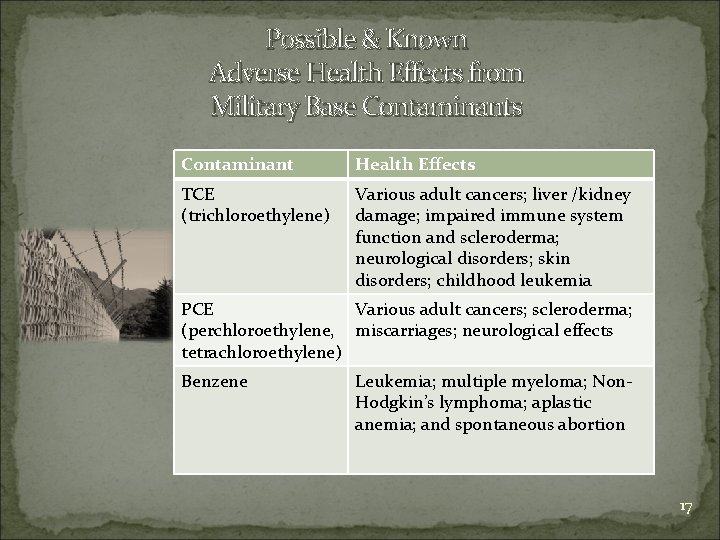
Possible & Known Adverse Health Effects from Military Base Contaminants Contaminant Health Effects TCE (trichloroethylene) Various adult cancers; liver /kidney damage; impaired immune system function and scleroderma; neurological disorders; skin disorders; childhood leukemia PCE Various adult cancers; scleroderma; (perchloroethylene, miscarriages; neurological effects tetrachloroethylene) Benzene Leukemia; multiple myeloma; Non. Hodgkin’s lymphoma; aplastic anemia; and spontaneous abortion 17
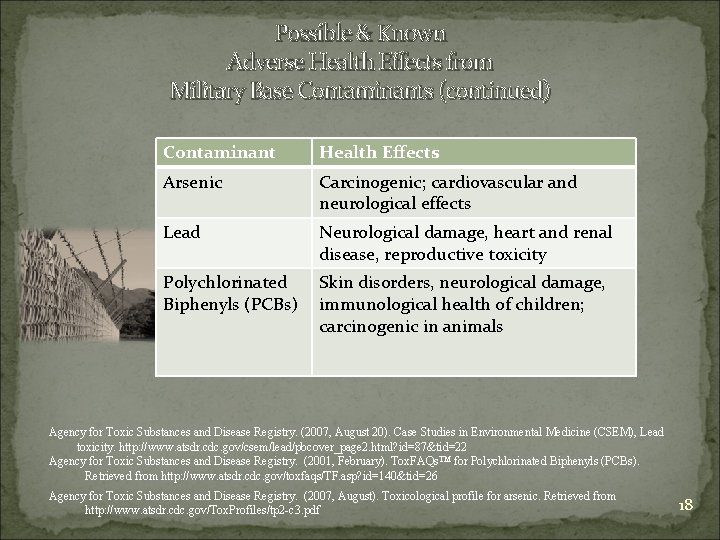
Possible & Known Adverse Health Effects from Military Base Contaminants (continued) Contaminant Health Effects Arsenic Carcinogenic; cardiovascular and neurological effects Lead Neurological damage, heart and renal disease, reproductive toxicity Polychlorinated Biphenyls (PCBs) Skin disorders, neurological damage, immunological health of children; carcinogenic in animals Agency for Toxic Substances and Disease Registry. (2007, August 20). Case Studies in Environmental Medicine (CSEM), Lead toxicity. http: //www. atsdr. cdc. gov/csem/lead/pbcover_page 2. html? id=87&tid=22 Agency for Toxic Substances and Disease Registry. (2001, February). Tox. FAQs™ for Polychlorinated Biphenyls (PCBs). Retrieved from http: //www. atsdr. cdc. gov/toxfaqs/TF. asp? id=140&tid=26 Agency for Toxic Substances and Disease Registry. (2007, August). Toxicological profile for arsenic. Retrieved from http: //www. atsdr. cdc. gov/Tox. Profiles/tp 2 -c 3. pdf 18
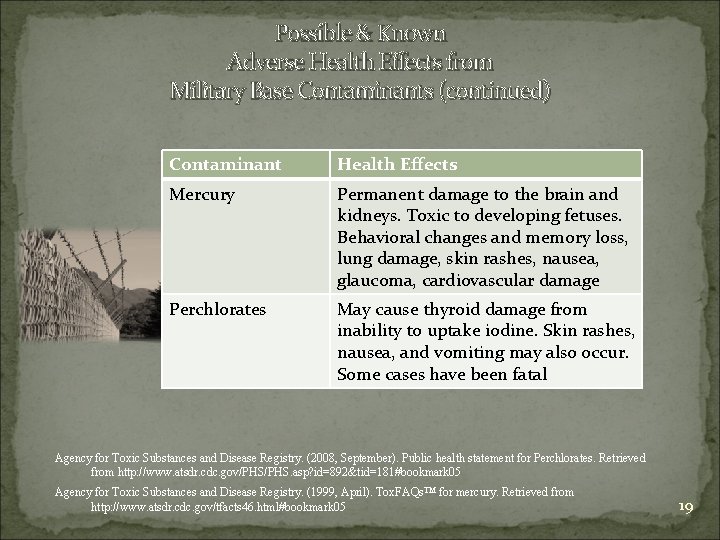
Possible & Known Adverse Health Effects from Military Base Contaminants (continued) Contaminant Health Effects Mercury Permanent damage to the brain and kidneys. Toxic to developing fetuses. Behavioral changes and memory loss, lung damage, skin rashes, nausea, glaucoma, cardiovascular damage Perchlorates May cause thyroid damage from inability to uptake iodine. Skin rashes, nausea, and vomiting may also occur. Some cases have been fatal Agency for Toxic Substances and Disease Registry. (2008, September). Public health statement for Perchlorates. Retrieved from http: //www. atsdr. cdc. gov/PHS. asp? id=892&tid=181#bookmark 05 Agency for Toxic Substances and Disease Registry. (1999, April). Tox. FAQs™ for mercury. Retrieved from http: //www. atsdr. cdc. gov/tfacts 46. html#bookmark 05 19
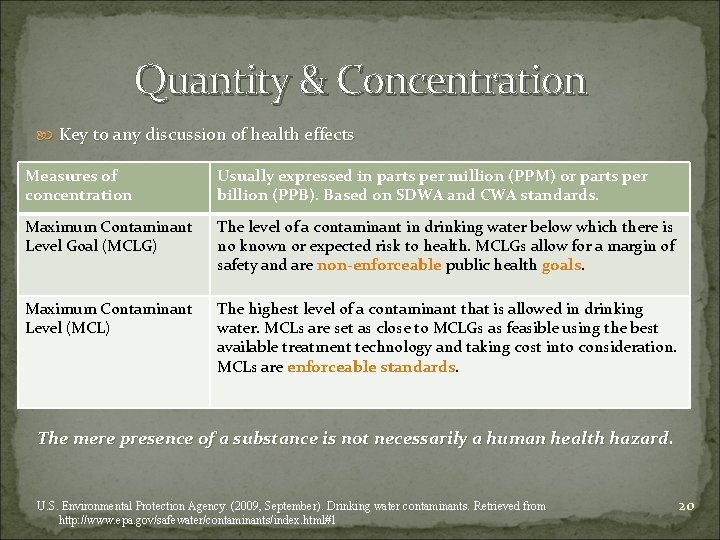
Quantity & Concentration Key to any discussion of health effects Measures of concentration Usually expressed in parts per million (PPM) or parts per billion (PPB). Based on SDWA and CWA standards. Maximum Contaminant Level Goal (MCLG) The level of a contaminant in drinking water below which there is no known or expected risk to health. MCLGs allow for a margin of safety and are non-enforceable public health goals. Maximum Contaminant Level (MCL) The highest level of a contaminant that is allowed in drinking water. MCLs are set as close to MCLGs as feasible using the best available treatment technology and taking cost into consideration. MCLs are enforceable standards. The mere presence of a substance is not necessarily a human health hazard. U. S. Environmental Protection Agency. (2009, September). Drinking water contaminants. Retrieved from http: //www. epa. gov/safewater/contaminants/index. html#1 20
Conclusion & Thanks Takeaways from today’s presentation: BRAC Closures = economic/environmental impacts US Military, EPA, Centers for Disease Control (ATSDR) lead investigation and remediation at BRAC sites Other communities’ experiences are available and useful Okay to hire your own “experts” Understand the nature of contamination: concentration Public involvement is your right: stay active and involved Thank you for your time! Any questions? 21
Resources for Further Study http: //www. epa. gov/safewater/cont Provides MCLs of various contaminants http: //www. epa. gov/fedfac/partners Federal Facilities Restoration and Reuse http: //www. epa. gov/fedfac/ff/index. FFRRO site that lists BRAC closures and aminants/index. html#1. htm. http: //www. asaie. army. mil/Public/E SOH/doc/Army-Environmental. Cleanup-Strategy-Final 28 April 03. pdf http: //www. epa. gov/superfund/rem edytech/remed. htm Office that lists “partners in cleanup” status of remediation activities Describes Army’s cleanup strategies, including prioritization methods; glossary of terms and acronyms associated with base cleanups List of “green” remedial technologies 22
References Agency for Toxic Substances and Disease Registry. (2007, August 20). Case Studies in Environmental Medicine (CSEM), Lead toxicity. http: //www. atsdr. cdc. gov/csem/lead/pbcover_page 2. html? id=87&tid=22 Agency for Toxic Substances and Disease Registry. (2009, July). Chemicals at Camp Lejeune: FAQs. Retrieved from http: //www. atsdr. cdc. gov/sites/lejeune/faq_chemicals. html Agency for Toxic Substances and Disease Registry. (2003). Public health assessment - drinking water supplies and groundwater pathway evaluation, Isla de Vieques Bombing Range, Vieques, Puerto Rico. Retrieved from http: //www. atsdr. cdc. gov/HAC/PHA/reports/isladevieques_10162001 pr/tables. html#T 1 Agency for Toxic Substances and Disease Registry. (2008, September). Public health statement for Perchlorates. Retrieved from http: //www. atsdr. cdc. gov/PHS. asp? id=892&tid=181#bookmark 05 Agency for Toxic Substances and Disease Registry. (2009, July). Summary of the water contamination situation at Camp Lejeune. Retrieved from http: //www. atsdr. cdc. gov/sites/lejeune/watermodeling_summary. html Agency for Toxic Substances and Disease Registry. (1999, April). Tox. FAQs™ for mercury. Retrieved from http: //www. atsdr. cdc. gov/tfacts 46. html#bookmark 05 Agency for Toxic Substances and Disease Registry. (2001, February). Tox. FAQs™ for Polychlorinated Biphenyls (PCBs). Retrieved from http: //www. atsdr. cdc. gov/toxfaqs/TF. asp? id=140&tid=26 Agency for Toxic Substances and Disease Registry. (2007, August). Toxicological profile for arsenic. Retrieved from http: //www. atsdr. cdc. gov/Tox. Profiles/tp 2 -c 3. pdf Agency for Toxic Substances and Disease Registry. (2009). Vieques. Retrieved from http: //www. atsdr. cdc. gov/sites/vieques Base Realignment & Closure Commission. (1993). Report to the President. Retrieved from http: //www. brac. gov/docs/final/Chap 3 Prev. Expwith. BRAC. pdf Davis, J. , Hayes-Conroy, J. , & Jones, V. . (2007). Military pollution and natural purity: seeing nature and knowing contamination in Vieques, Puerto Rico. Geo. Journal, 69(3), 165. Retrieved from ABI/INFORM Global. (Document ID: 1376378161). 23
References, continued Georgia Health Policy Center. (2010. ) Developing Fort Mc. Pherson as a healthier place. http: //aysps. gsu. edu/ghpc/3564. html Tavana, M. , Bourgeois, B. & Sodenkamp, M. (2009). Fuzzy multiple criteria base realignment and closure (BRAC) benchmarking system at the Department of Defense. Benchmarking, 16(2), 192 -221. Retrieved from ABI/INFORM Global. (Document ID: 1882614931). U. S. Army Corps of Engineers, Mobile District. (2008, September). Environmental Impact Statement for disposal and reuse of Fort Mc. Pherson, Georgia. Retrieved from http: //www. mcpherson. army. mil/brac/Ft_Mc. Pherson_DEIS. pdf U. S. Department of the Army. (2003). Army environmental clean-up strategy. Retrieved from http: //www. asaie. army. mil/Public/ESOH/doc/Army-Environmental-Cleanup-Strategy-Final-28 April 03. pdf U. S. Environmental Protection Agency. (2008). Base Realignment & Closure sites by state/U. S. territory. Retrieved from http: //www. epa. gov/fedfac/ff/bracstates 2. htm#Florida U. S. Environmental Protection Agency. (2006). Community Environmental Response Facilitation Act. Retrieved from http: //www. epa. gov/fedfac/documents/scan 5. htm U. S. Environmental Protection Agency. (2009, September). Drinking water contaminants. Retrieved from http: //www. epa. gov/safewater/contaminants/index. html#1 U. S. Environmental Protection Agency. (2004). NPL site narrative for Atlantic Fleet weapons training area. Retrieved from http: //www. epa. gov/superfund/sites/nplsnl/n 0204694. pdf U. S. Environmental Protection Agency. (2009, September). Vieques Island/Atlantic Fleet Weapons Training Area. Retrieved from http: //www. epa. gov/region 2/vieques/ U. S. Marine Corps. (n. d. ). MCB Camp Lejeune. Retrieved from http: //www. lejeune. usmc. mil/about/ U. S. Marine Corps. (2006, April). Chapter 2: Description of Camp Lejeune. Final Integrated Natural Resources Management Plan. Retrieved from http: //www. lejeune. usmc. mil/emd/INRMP%20 MAY 06/Chap%202%20 April%2006%20 GH. pdf Vine, D. (2009). Island of shame: the secret history of the U. S. military base on Diego Garcia. Princeton, NJ: Princeton University Press 24
- Slides: 24