
Environmental Impact Assessment of DISASTERS Dr Anil Kumar
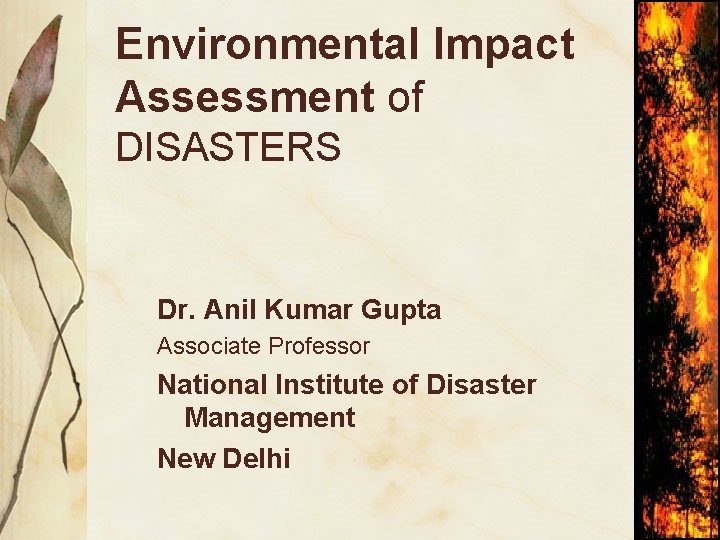
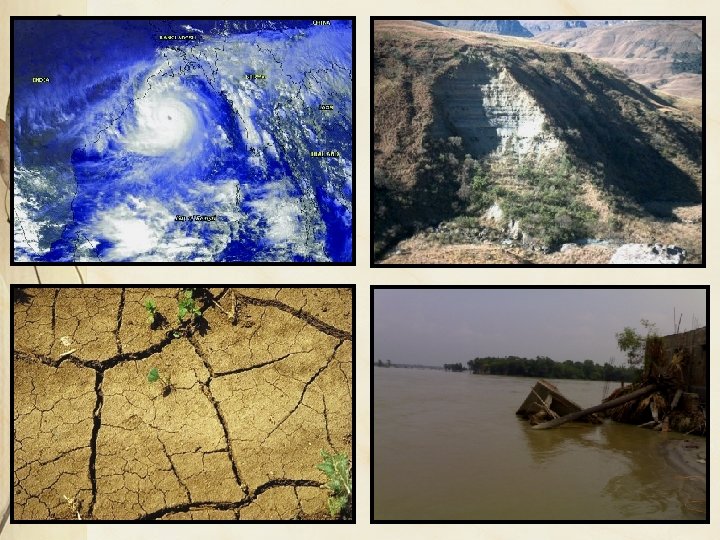
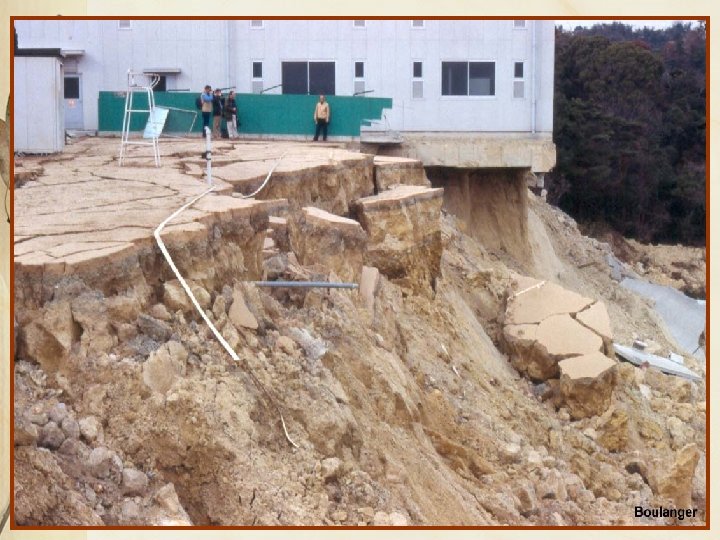
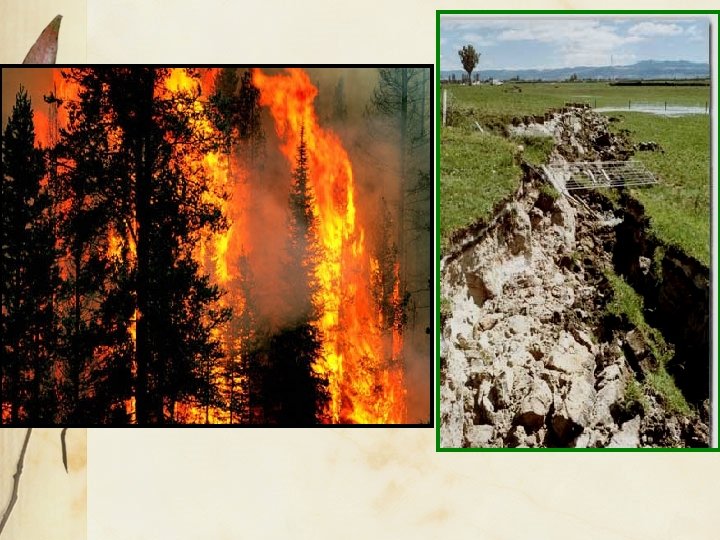

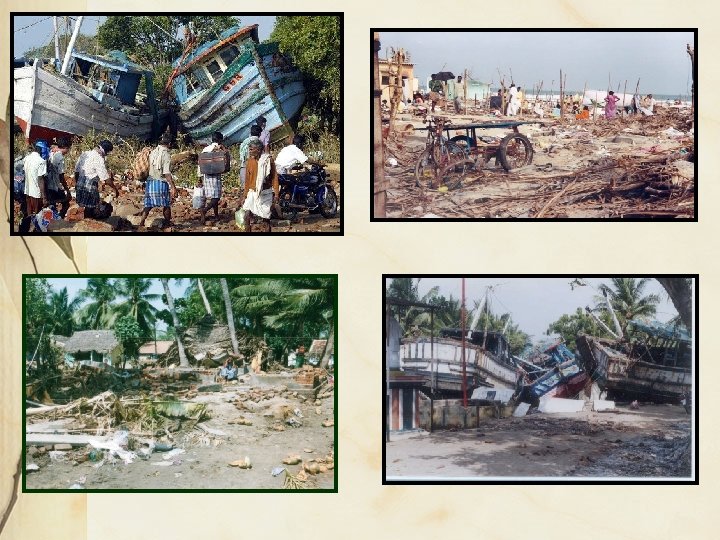
- Slides: 30
Environmental Impact Assessment of DISASTERS Dr. Anil Kumar Gupta Associate Professor National Institute of Disaster Management New Delhi
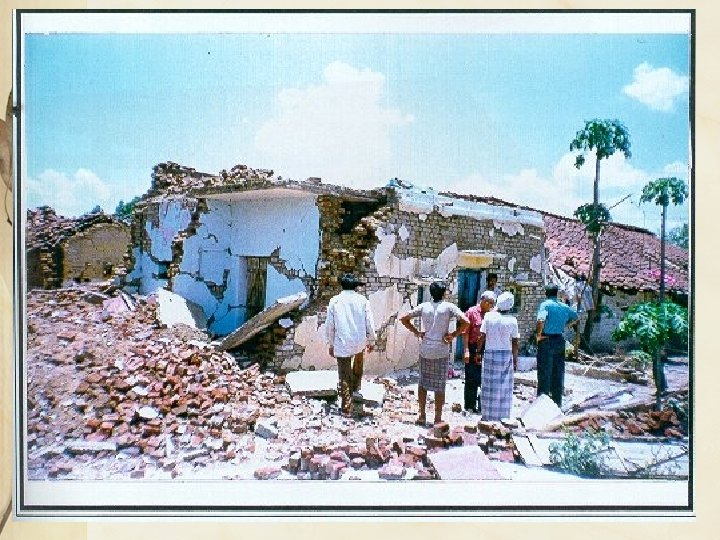
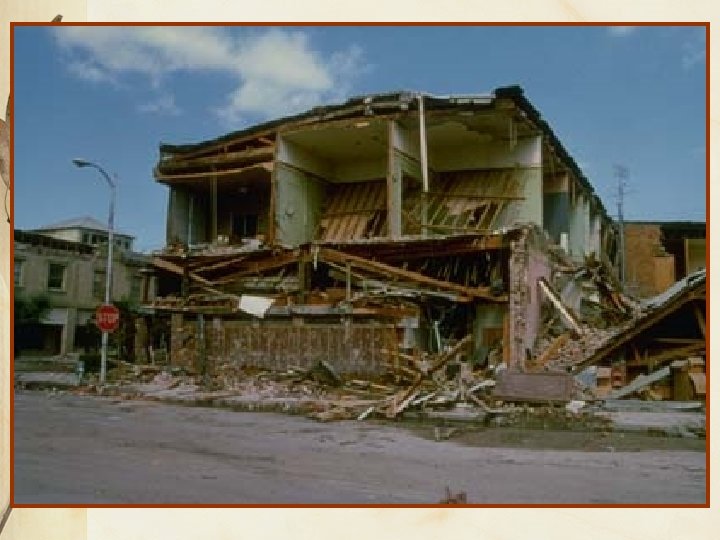
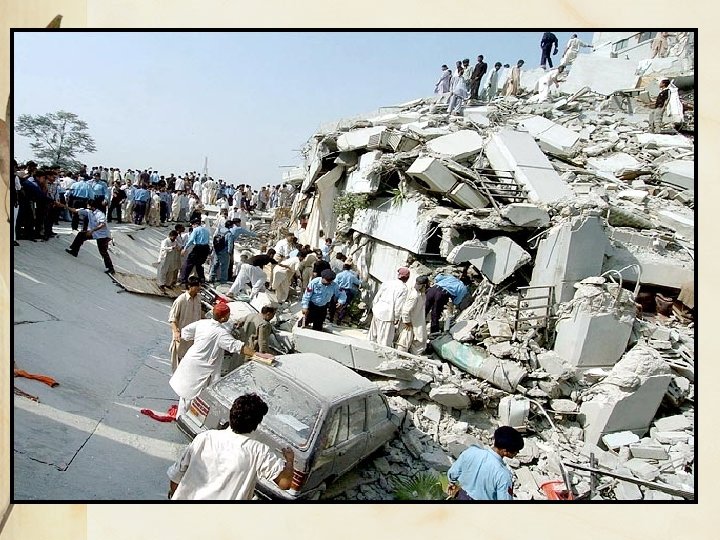
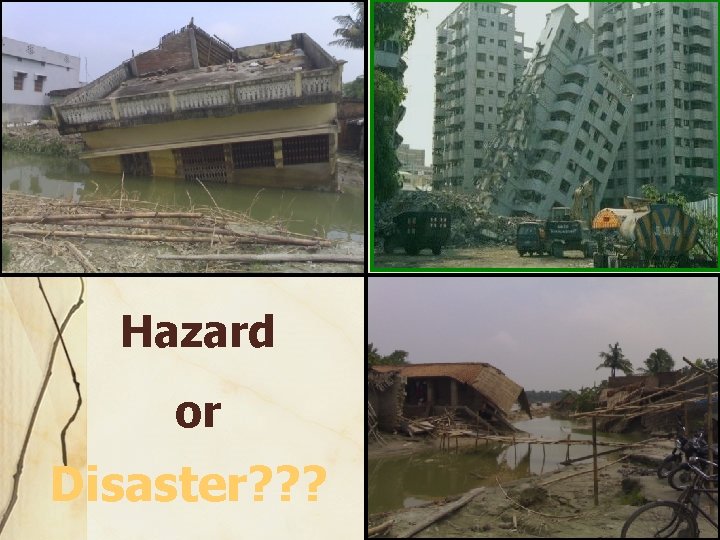
Hazard or Disaster? ? ?
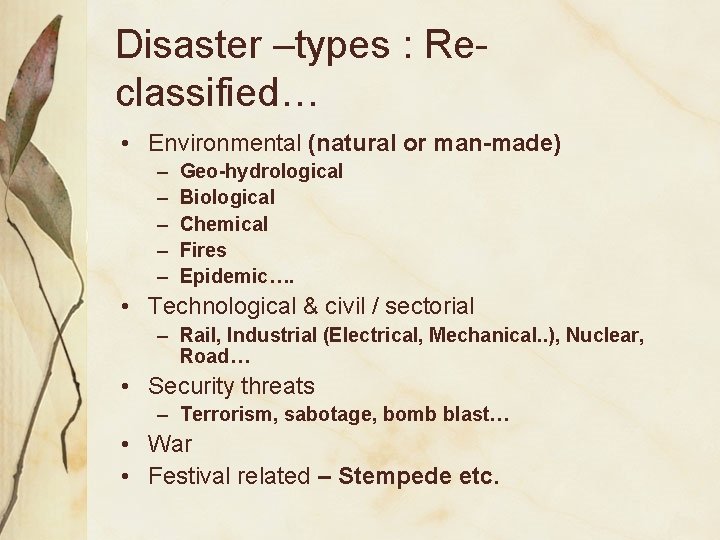
Disaster –types : Reclassified… • Environmental (natural or man-made) – – – Geo-hydrological Biological Chemical Fires Epidemic…. • Technological & civil / sectorial – Rail, Industrial (Electrical, Mechanical. . ), Nuclear, Road… • Security threats – Terrorism, sabotage, bomb blast… • War • Festival related – Stempede etc.
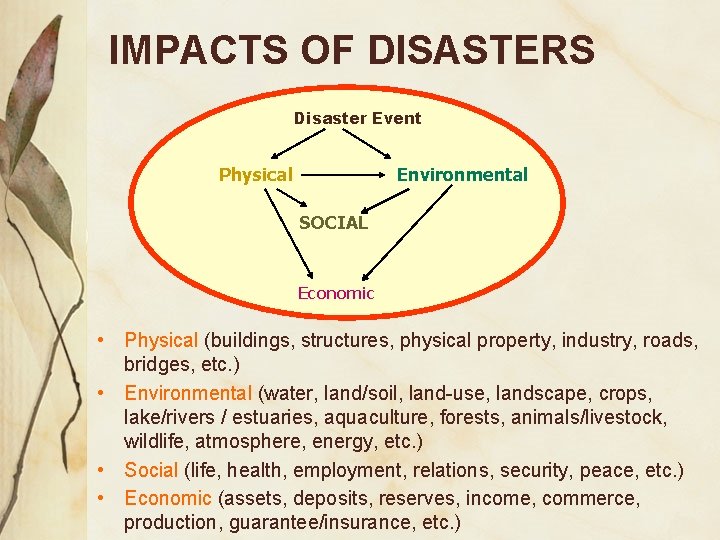
IMPACTS OF DISASTERS Disaster Event Physical Environmental SOCIAL Economic • Physical (buildings, structures, physical property, industry, roads, bridges, etc. ) • Environmental (water, land/soil, land-use, landscape, crops, lake/rivers / estuaries, aquaculture, forests, animals/livestock, wildlife, atmosphere, energy, etc. ) • Social (life, health, employment, relations, security, peace, etc. ) • Economic (assets, deposits, reserves, income, commerce, production, guarantee/insurance, etc. )
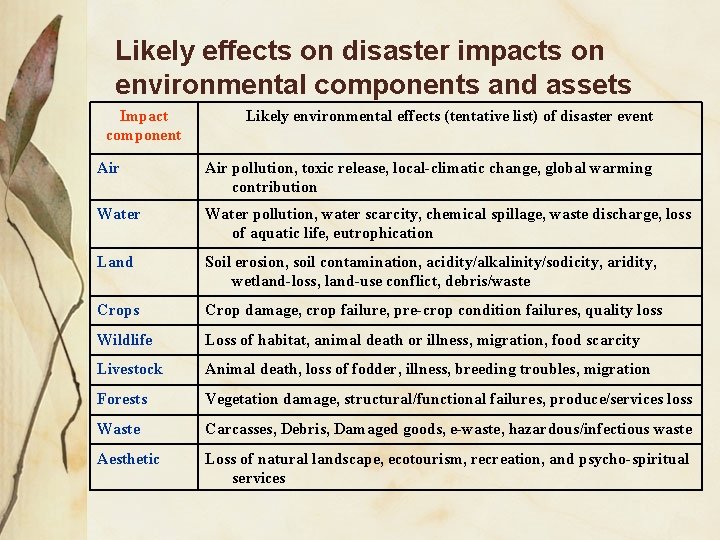
Likely effects on disaster impacts on environmental components and assets Impact component Likely environmental effects (tentative list) of disaster event Air pollution, toxic release, local-climatic change, global warming contribution Water pollution, water scarcity, chemical spillage, waste discharge, loss of aquatic life, eutrophication Land Soil erosion, soil contamination, acidity/alkalinity/sodicity, aridity, wetland-loss, land-use conflict, debris/waste Crops Crop damage, crop failure, pre-crop condition failures, quality loss Wildlife Loss of habitat, animal death or illness, migration, food scarcity Livestock Animal death, loss of fodder, illness, breeding troubles, migration Forests Vegetation damage, structural/functional failures, produce/services loss Waste Carcasses, Debris, Damaged goods, e-waste, hazardous/infectious waste Aesthetic Loss of natural landscape, ecotourism, recreation, and psycho-spiritual services
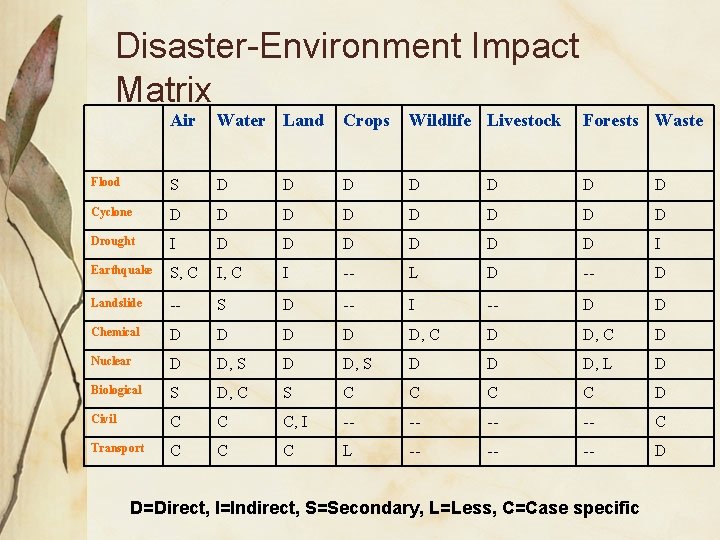
Disaster-Environment Impact Matrix Air Water Land Crops Wildlife Livestock Forests Waste Flood S D D D D Cyclone D D D D Drought I D D D I Earthquake S, C I -- L D -- D Landslide -- S D -- I -- D D Chemical D D D, C D Nuclear D D, S D D D, L D Biological S D, C S C C D Civil C C C, I -- -- C Transport C C C L -- -- -- D D=Direct, I=Indirect, S=Secondary, L=Less, C=Case specific
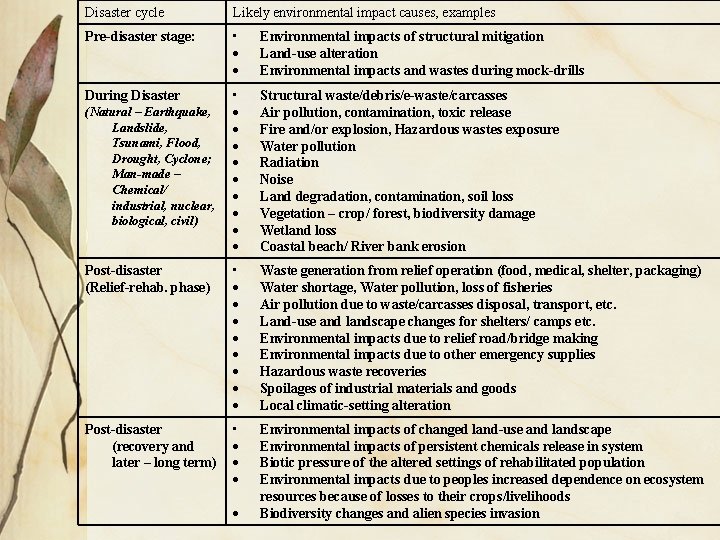
Disaster cycle Likely environmental impact causes, examples Pre-disaster stage: • Environmental impacts of structural mitigation Land-use alteration Environmental impacts and wastes during mock-drills During Disaster • Structural waste/debris/e-waste/carcasses Air pollution, contamination, toxic release Fire and/or explosion, Hazardous wastes exposure Water pollution Radiation Noise Land degradation, contamination, soil loss Vegetation – crop/ forest, biodiversity damage Wetland loss Coastal beach/ River bank erosion Post-disaster (Relief-rehab. phase) • Waste generation from relief operation (food, medical, shelter, packaging) Water shortage, Water pollution, loss of fisheries Air pollution due to waste/carcasses disposal, transport, etc. Land-use and landscape changes for shelters/ camps etc. Environmental impacts due to relief road/bridge making Environmental impacts due to other emergency supplies Hazardous waste recoveries Spoilages of industrial materials and goods Local climatic-setting alteration Post-disaster (recovery and later – long term) • Environmental impacts of changed land-use and landscape Environmental impacts of persistent chemicals release in system Biotic pressure of the altered settings of rehabilitated population Environmental impacts due to peoples increased dependence on ecosystem resources because of losses to their crops/livelihoods Biodiversity changes and alien species invasion (Natural – Earthquake, Landslide, Tsunami, Flood, Drought, Cyclone; Man-made – Chemical/ industrial, nuclear, biological, civil)
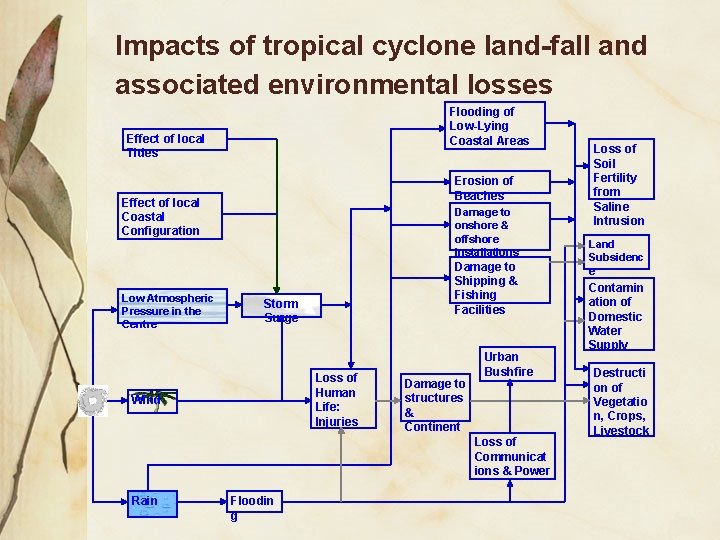
Impacts of tropical cyclone land-fall and associated environmental losses Flooding of Low-Lying Coastal Areas Effect of local Tides Erosion of Beaches Effect of local Coastal Configuration Low Atmospheric Pressure in the Centre Damage to onshore & offshore installations Damage to Shipping & Fishing Facilities Storm Surge Loss of Human Life: Injuries Wind Damage to structures & Continent Urban Bushfire Loss of Communicat ions & Power Rain Floodin g Loss of Soil Fertility from Saline Intrusion Land Subsidenc e Contamin ation of Domestic Water Supply Destructi on of Vegetatio n, Crops, Livestock
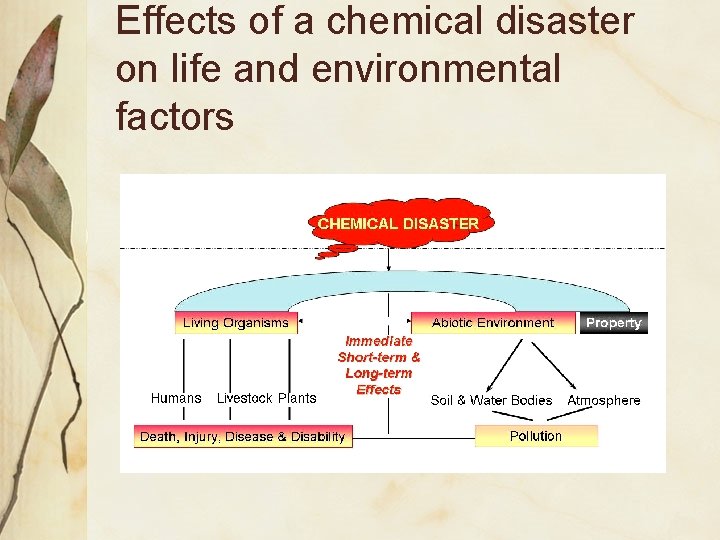
Effects of a chemical disaster on life and environmental factors
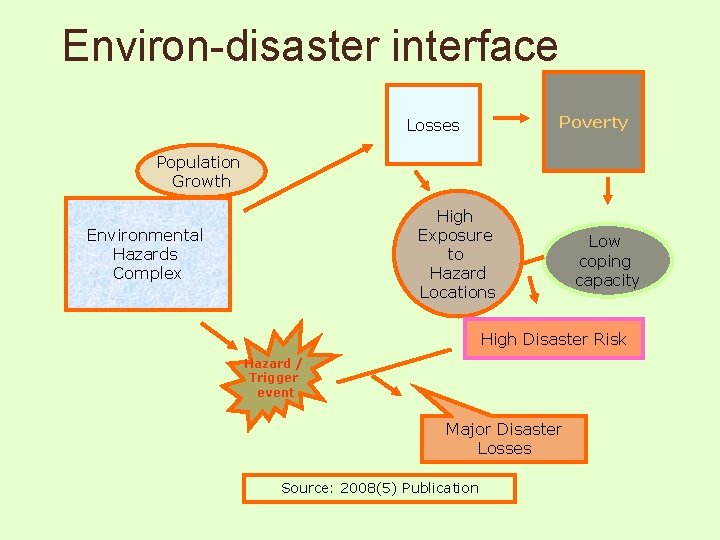
Environ-disaster interface Poverty Losses Population Growth High Exposure to Hazard Locations Environmental Hazards Complex Low coping capacity High Disaster Risk Hazard / Trigger event Major Disaster Losses Source: 2008(5) Publication
EIA: Best Practice Framework in Emergency Response • December 2001 Benfield Greig Hazard Research Centre, University of London • BGHRC and Care International – REIA • UN Economic Community for Latin American and the Caribbean (ECLAC) • Handbook for Estimating the Socioeconomic and Environmental Effects of Disasters 3, updated in
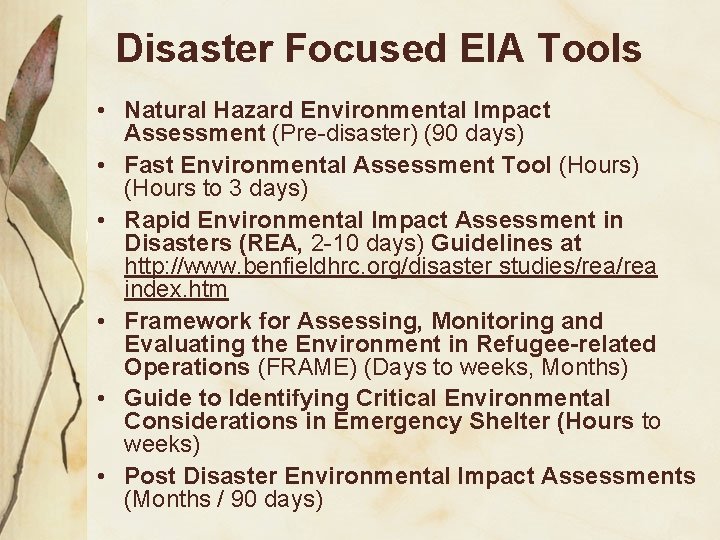
Disaster Focused EIA Tools • Natural Hazard Environmental Impact Assessment (Pre-disaster) (90 days) • Fast Environmental Assessment Tool (Hours) (Hours to 3 days) • Rapid Environmental Impact Assessment in Disasters (REA, 2 -10 days) Guidelines at http: //www. benfieldhrc. org/disaster studies/rea index. htm • Framework for Assessing, Monitoring and Evaluating the Environment in Refugee-related Operations (FRAME) (Days to weeks, Months) • Guide to Identifying Critical Environmental Considerations in Emergency Shelter (Hours to weeks) • Post Disaster Environmental Impact Assessments (Months / 90 days)
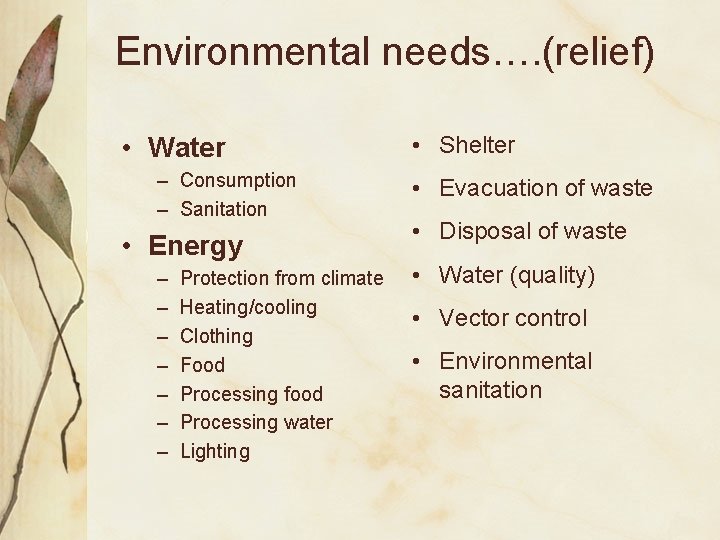
Environmental needs…. (relief) • Water – Consumption – Sanitation • Energy – – – – Protection from climate Heating/cooling Clothing Food Processing food Processing water Lighting • Shelter • Evacuation of waste • Disposal of waste • Water (quality) • Vector control • Environmental sanitation
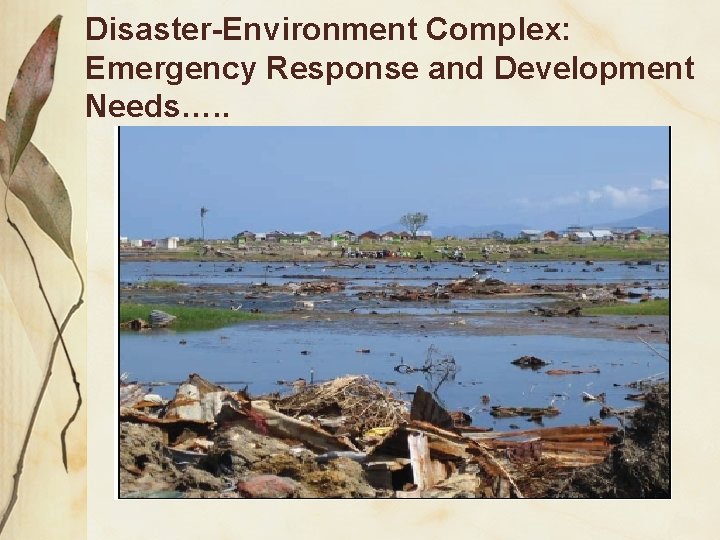
Disaster-Environment Complex: Emergency Response and Development Needs…. .
Disaster Debris: Katrina Case The primary types of disaster debris being removed in • • • the wake of Hurricane Katrina fall into the following categories: Municipal solid waste — general household trash and personal belongings. Construction and demolition (C&D) debris — building materials (which may include asbestoscontaining materials), drywall, lumber, carpet, furniture, mattresses, plumbing. Vegetative debris — trees, branches, shrubs, and logs. Household hazardous waste — oil, pesticides, paints, cleaning agents. White goods — refrigerators, freezers, washers, dryers, stoves, water heaters, dishwashers, air conditioners. Electronic waste — computers, televisions, printers,
REIA Rapid Environmental Impact Assessment in Disasters? • The REA is a tool to identify, define, characterize and prioritize potential environmental impacts in disaster situations which threaten human life and welfare. • The REA is a simple, qualitative assessment process. It uses easy to understand descriptions, rating tables and lists to identify and rank environmental issues and appropriate follow-up actions during a disaster. • The REA is used from shortly before a disaster strikes, up to 120 days after a disaster, or for any major stage-change in an emergency situation. The REA can also be used as an environmental impact check list in relief project design and review. Who undertakes a REA? • Primary REA users are non-specialists directly involved in disaster response operations, with a basic knowledge of the disaster management process but no background in environmental issues. It can be used by disaster victims with appropriate support The Joint United Nations Environment Program/ Office for the Coordination of Humanitarian Affairs Office, Geneva, Royal Norwegian Ministry of Foreign Affairs and Office of Foreign Disaster Assistance, USAID
Pro-Active Approach • Environmental Risk Assessment – Disaster Risk – Impact Risk • • Environmental Auditing Natural Resource Accounting Ecological Footprints of Disasters Economic Evaluation of Environmental Impacts • Environmental Health Preparedness • Environmental Response in Emergencies
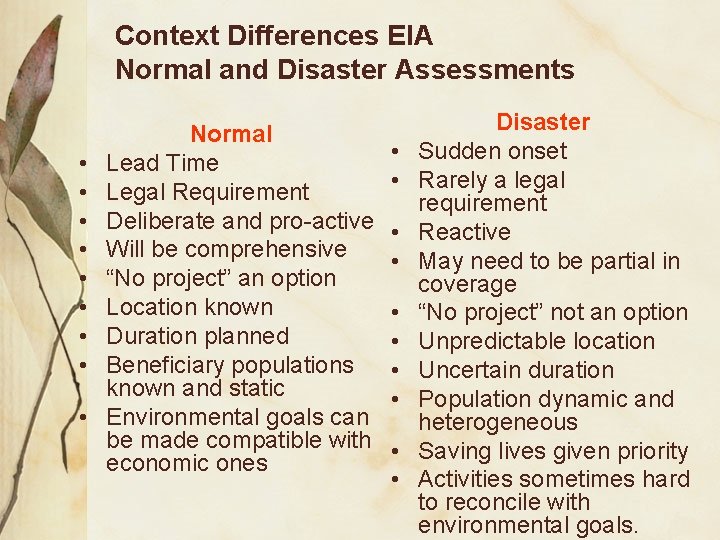
Context Differences EIA Normal and Disaster Assessments • • • Normal Lead Time Legal Requirement Deliberate and pro-active Will be comprehensive “No project” an option Location known Duration planned Beneficiary populations known and static Environmental goals can be made compatible with economic ones • • • Disaster Sudden onset Rarely a legal requirement Reactive May need to be partial in coverage “No project” not an option Unpredictable location Uncertain duration Population dynamic and heterogeneous Saving lives given priority Activities sometimes hard to reconcile with environmental goals.
EIA Exercise 001/NIDM • Participants divided in 4 groups • Each group will analyze 2 cases out of given 08 cases • Each group will identify: – 02 environmental aspects not related to development/livelihood /economic development – 03 environmental aspects related to development/livelihood / economic development
EIA Exercise 002 • Each group will be given Tsunami Case Environmental Aspects • Pre-disaster • During Emergency • Post-disaster relief • Rehabilitation • Recovery phase • Social-Environmental Impact Linkages – Identify 02 aspects which are not related – Identify 02 aspects which are related
environment a charity OR Our need? Disasters from A Disaster? Man-made Disasters…. .
THANK YOU…. envirosafe 2007@gmail. com