
Environmental Health Division Solid Waste Code Enforcement Complaint
- Slides: 1
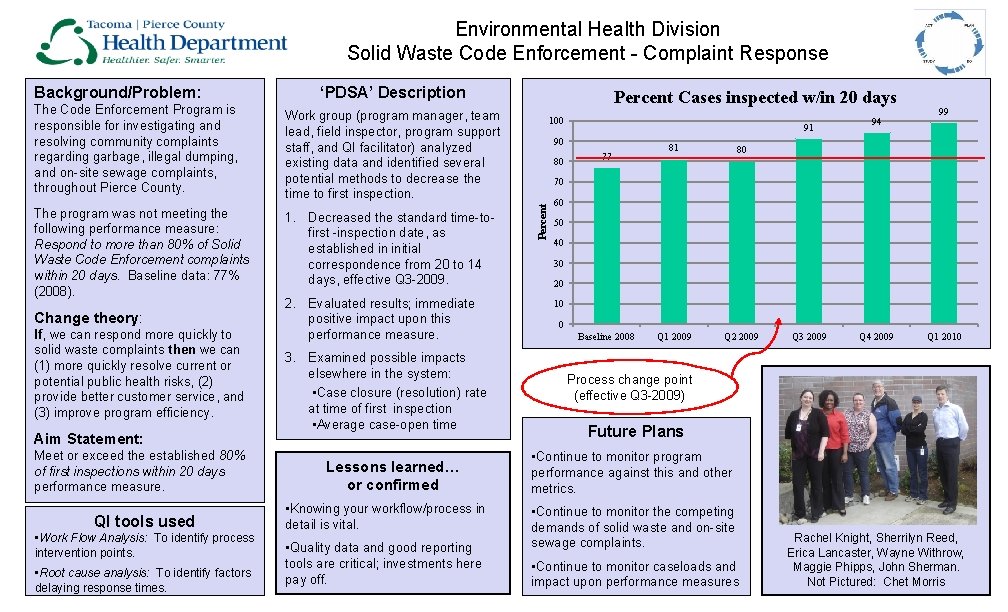
Environmental Health Division Solid Waste Code Enforcement - Complaint Response The Code Enforcement Program is responsible for investigating and resolving community complaints regarding garbage, illegal dumping, and on-site sewage complaints, throughout Pierce County. The program was not meeting the following performance measure: Respond to more than 80% of Solid Waste Code Enforcement complaints within 20 days. Baseline data: 77% (2008). Change theory: If, we can respond more quickly to solid waste complaints then we can (1) more quickly resolve current or potential public health risks, (2) provide better customer service, and (3) improve program efficiency. Aim Statement: Meet or exceed the established 80% of first inspections within 20 days performance measure. QI tools used • Work Flow Analysis: To identify process intervention points. • Root cause analysis: To identify factors delaying response times. ‘PDSA’ Description Percent Cases inspected w/in 20 days Work group (program manager, team lead, field inspector, program support staff, and QI facilitator) analyzed existing data and identified several potential methods to decrease the time to first inspection. 1. Decreased the standard time-tofirst -inspection date, as established in initial correspondence from 20 to 14 days, effective Q 3 -2009. 2. Evaluated results; immediate positive impact upon this performance measure. 3. Examined possible impacts elsewhere in the system: • Case closure (resolution) rate at time of first inspection • Average case-open time Lessons learned… or confirmed • Knowing your workflow/process in detail is vital. • Quality data and good reporting tools are critical; investments here pay off. 100 91 90 80 77 81 80 Q 1 2009 Q 2 2009 94 99 70 Percent Background/Problem: 60 50 40 30 20 10 0 Baseline 2008 Q 3 2009 Q 4 2009 Q 1 2010 Process change point (effective Q 3 -2009) Future Plans • Continue to monitor program performance against this and other metrics. • Continue to monitor the competing demands of solid waste and on-site sewage complaints. • Continue to monitor caseloads and impact upon performance measures Rachel Knight, Sherrilyn Reed, Erica Lancaster, Wayne Withrow, Maggie Phipps, John Sherman. Not Pictured: Chet Morris