
Environmental Endocrine Disruptors Part III Persistence and Prevention

- Slides: 20
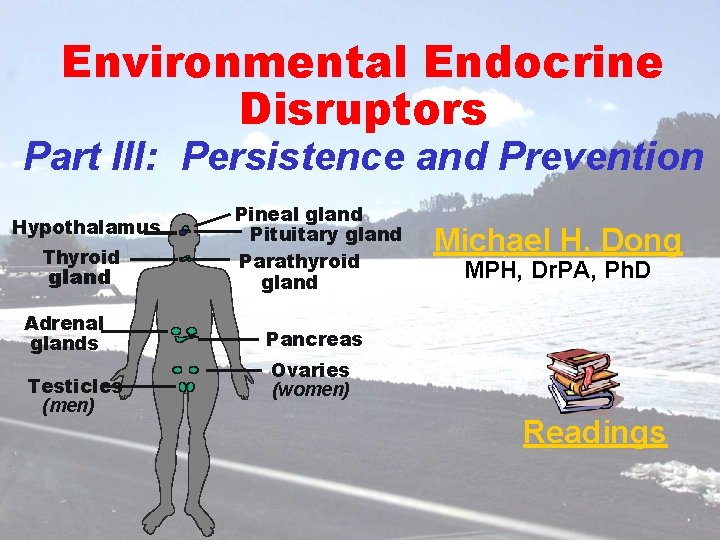
Environmental Endocrine Disruptors Part III: Persistence and Prevention Hypothalamus Thyroid gland Adrenal glands Testicles (men) Pineal gland Pituitary gland Parathyroid gland Michael H. Dong MPH, Dr. PA, Ph. D Pancreas Ovaries (women) Readings
05/30/2004, Elk Grove, California, USA
Course Objectives q Learn the terms pertaining to a chemical’s persistence properties, especially those of an environmental endocrine disruptor. q Recognize the science-based criteria and assessment models for the determination of persistence potential. q Appreciate the cumulative effects due to a disruptor’s persistence properties. q Review the processes and strategies for prevention of persistent pollution.
Basics of Persistence (I) q There are two major aspects or quantities of persistence for each chemical substance. q The first is its intrinsic or chemical persistence and the other, its persistence in the (overall) environment. q Environmental persistence is a term used to imply a constant quantity or availability of the chemical in the environment(s) at issue; this type of potential thus has greater public health importance.
Basics of Persistence (II) q Chemical persistence is often expressed in terms of a substance’s degradation half-life. q The amount of material lost by degradation in a medium is determined both by the rate constant specific to the reactivity occurring in that medium, and by the amount (initially and subsequently) present in that medium. q For chemicals in the environment, their degradation half-lives depend not only on their physicochemical properties, but also much more on the environmental conditions.
Basics of Persistence (III) q Environmental persistence is much more dynamic, situational, and complex, when compared to persistence in a single medium. q Many substances have properties that allow them to partition or dissolve in certain media, and even to speciate into a particular, irreversible form. q Environmental persistence thus should be evaluated on the basis of degradation rates, partitioning, speciation, and availability.
Long-Range Transport q An important aspect of environmental persistence is its effects towards long-range transport (LRT) of the environmental contaminants. q Through LRT, persistent pesticides and other industrial chemicals can be present in remote regions such as the Arctic, where these substances have never been used. q The modes of LRT are not limited to atmospheric, oceanic, or terrestrial, but include cyclone activities and animal migration.
PBT Endocrine Disruptors q Pollutants that are persistent, bioaccumulative, and toxic (PBT), of which a good number are endocrine disruptors, are longlasting and can build up in the food chain. q PBTs are of great ecological concern because they can induce severe adverse health effects, such as endocrine disruption. q Numerical criteria have been set up to identify the persistence and bioaccumulation potentials of toxic environmental pollutants.
Mass Balance Models (I) q For overall environmental persistence and persistence within a single medium, both the measurement and the quantity are typically based on some mass balance theories. q Mass balance per se is based on the law of conversion of mass; it builds on the concept that physical or chemical changes do not destroy or create matter. q In practice, the main task of a mass balance model is on knowing how much of a material is left in the form of interest.
Mass Balance Models (II) q Mass balance models (MBMs) appear to offer the most convenient means for assessing a pollutant’s persistence in a single medium or in a multimedia environment. q Simple or multimedia MBMs are actually mathematical constructs designed to gain an understanding of the environmental behavior of chemicals. q In almost all cases, the use of multimedia or simple MBMs is limited by the availability of data on degradation half-lives.
Low Levels of PBTs q For certain types of adverse health effects such as endocrine disruption, even low levels of persistent and bioaccumulative toxicants (PBTs) in the environment collectively are still of global concern. q This is because, by comparison, inducibility of environmental endocrine disruption is not chemical-selective. q Yet more importantly, inducibilities of certain multiple PBTs for the same adverse effect are likely additive, if not synergistic.
Cumulative Effects (I) q Concurrent or subsequent exposures to persistent and bioaccumulative toxicants, of which many are environmental endocrine disruptors, are of global concern even when these pollutants are present at very low concentrations. q Synergism or additive effects have been observed between steroid hormones; between temperature and hormone response; between weakly estrogenic compounds; and between pesticides.
Cumulative Effects (II) q More recently, additive effects have been observed from the combination of a strong estrogen 17 -estradiol and a weak estrogen such as bisphenol A, nonylphenol, phenyl salicylate, butylparaben, or genistein. q The natural estrogen estradiol is many thousand times more estrogenic than any of the weak xenoestrogens tested. q Additive antiandrogenic effects also have been observed with the pesticides vinclozolin and procymidone.
Cumulative Effects (III) q Additive-like effects have been observed from multiple thyroid hormone disruptors given to rats; these disruptors are dioxins, furans, and dioxin-likes such as PCBs. q Other thyroid hormone disruptors, such as aldicarb, atrazine, and nitrate, also have been found to exert synergistic effects. q Cumulative effects of this type are highly critical in that thyroid functions are important for proper growth, metabolism, reproduction, mental development, etc.
Cumulative Effects (IV) q Studies in various species (rats, salmon, mink, chickens) were conducted, which confirmed the bioaccumulative effects of concurrent or subsequent exposures to pollutants found in the Great Lakes fish. q So was an epidemiology study showing babies born with poorer visual recognition from cumulative maternal exposure to PCBs; mothers of this cohort consumed 2 to 3 meals of PCB-contaminated fish monthly for 6 years prior to and after pregnancy.
Time of Exposure q While exposure to environmental pollutants is mainly a function of their availability, time of exposure is equally a very crucial factor in the induction of endocrine disruption. q For example, estrogen levels in humans and rodents were seen to increase steadily throughout the pregnancy period, primarily due to a feed-forward mechanism of regulation; that is, any dose of a xenoestrogen would be additive with the endogenous level, due to the lack of feed-back control during this period.
Pollution Prevention (I) q The potency and toxicity of environmental endocrine disruptors (EEDs) are less critical. q The effects of an EED’s persistence and bioaccumulation are much more dynamic, more attenuable, and hence more critical. q One effective method of intervention is to divert the pollutant to an environment where its degradation half-life can be shortened considerably; in addition, chemical bioaccumulation can be intervened by segregation of relevant predators in the food chain.
Pollution Prevention (II) q All processes and strategies for prevention and intervention of environmental pollution revolve around the principles of use reduction and source elimination. q Modern methods tend to rely on integrated pest management and on chemical treatments for elimination and reduction of pollutants. q A great deal of sewage sludge and other wastes also have been reduced considerably in the USA through regulatory statues, such as the Clean Water Act.
Pollution Prevention (III) q Scientific procedures have been adopted worldwide for the elimination and the reduction of persistent and bioaccumulative toxicants (PBTs). q Numerical criteria are incorporated into Canada’s Persistence and Bioaccumulation Regulations for qualifying pollutants as PBTs. q Using numerical criteria somewhat more health conservative, U. S. EPA has continued updating its PBT Profiler for many chemical substances.
Pollution Prevention (IV) q International actions on persistent and bioaccumulative toxicants (PBTs) require a complex process of global compromise. q The Stockholm Convention in 2001 is a global treaty for protection from PBTs. Upon ratification, it will ban outright the use of 8 persistent pesticides and take initiatives to reduce the use of 4 non-pesticide PBTs. q Pollution prevention actually should start with an increase in public awareness of the environmental levels and sources of PBTs.