
Environmental Emergencies 12 October 2020 Burns Overview Burn
Environmental Emergencies 12 October 2020
Burns
Overview - Burn Classification - Depth and Extent Chemical, Electrical, Inhalation, Radiation, and Thermal Burns Patient Assessment Treatment Complications Special Considerations
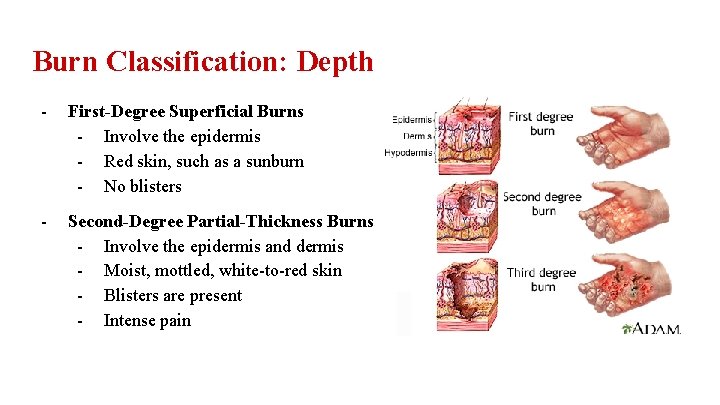
Burn Classification: Depth - First-Degree Superficial Burns - Involve the epidermis - Red skin, such as a sunburn - No blisters - Second-Degree Partial-Thickness Burns - Involve the epidermis and dermis - Moist, mottled, white-to-red skin - Blisters are present - Intense pain

Burn Classification: Depth - Third-Degree Full-Thickness Burns - Involve all skin layers and may involve muscle, bone, or internal organs - Dry and leathery skin - May appear white, dark brown, or charred - Patient may feel no pain if nerve endings are destroyed - Severe burns are usually a combination of all three types of burns

Burn Classification: Extent - Rule of Nines - Pediatric and Geriatric Patients - Moderate burns are automatically classified as critical Minor Moderate Critical Superficial < 50% > 50% Partial < 15% 15 -30% > 30% Full < 2% 2 -10% > 10%
Critical Burns - Full-thickness burns involving the hands, feet, face, airway, genitalia, joints, or circumferential burns of other areas - Full-thickness burns covering more than 10% of total body surface area - Partial-thickness burns covering more than 30% of total body surface area - Burns associated with respiratory injuries - Burns complicated by fractures
Chemical Burns - Fumes are especially harmful to the eyes and respiratory tract - Determine the chemical, concentration, and duration of exposure - Treatment - Take the appropriate PPE precautions - Brush off dry chemicals - Flush with water until 20 minutes after the burning sensation has stopped - Do not contaminate unaffected areas - Do not use a highly pressurized water source - Flush eyes with saline and remove contact lenses
Electrical Burns - Tissue along the entire path of the current is injured - Internal injuries are always more severe than indicated externally - Determine the type of current, magnitude of current, and voltage - Treatment - Do not attempt to remove someone from an electrical source - Look for entry and exit wounds - Prepare to perform CPR - Electrical burns tend to cause cardiac arrhythmias - Place dry, sterile dressings on the burns
Inhalation Burns - Determine the identity and source of the gas - Carbon Monoxide Poisoning - May be indicated if multiple people in a location report a headache, or if a person reports a repeated headache in one location but not anywhere else - Treatment - Look for a hoarse voice, hypoxia, singed nasal or facial hairs, soot around the nose and mouth, carbon particles in the sputum, and abnormal lung sounds - Always provide oxygen for inhalation burns - Patients with CO poisoning may have a normal pulse ox reading - Provide 15 L/min via NRB
Radiation Burns - Particles with a higher penetrating energy pass through materials more easily - Alpha < Beta < Gamma - Determine the source and length of radiation exposure - Treatment - Wait for a Haz. Mat team to decontaminate the patient before making contact - Increase your distance from the source - Decontaminate and irrigate open wounds
Thermal Burns - Contact burns caused by hot objects - Reflexes prevent prolonged exposure unless restricted from moving - Flame burns caused by fire - Clothing that catches on fire can cause deep injuries - Flash burns caused by explosions, lightning, or very intense heat - Scald burns caused by hot liquids - Quickly spread and cover a large body surface area - Steam burns caused by steam - May be a type of airway burn
Thermal Burns - Treatment - Cover with dry dressing or sheet - Consider cooling with water for burns isolated to less than 5% BSA
Patient Assessment - Determine how the patient got the burn - Remove the patient’s clothing, shoes, glasses, etc. - Ask about trouble breathing or swallowing Look for soot around the nose and mouth Look for singed nose hairs - Monitor for signs of shock - Check blood pressure, pulse, and skin perfusion
Treatment - Provide treatment as needed - Stop the burning - Submerge in cool water - Apply a dry, sterile, non-adhesive dressing Provide oxygen and monitor the airway Cover the patient with a blanket to prevent loss of body heat Monitor for signs of shock Transport immediately -
Complications - High risk for infection, hypothermia, hypovolemia, and shock - Burns to the airway can cause an airway obstruction - Circumferential burns to the chest can compromise breathing - Children and elderly patients are particularly at risk for complications
Special Considerations - Burns may be indicative of abuse - Signs and Symptoms - Multiple injuries in various stages of healing - New and old fractures, may involve more than one extremity - Burns that appear in a pattern - Small, circular burns may be indicative of cigarette burns - Scalding injuries to the hands or feet - Patients may be in severe distress - Be sure to take the appropriate time to debrief and seek resources if needed

Special Situations
Overview - Drowning Diving Lightning Spiders Snakes Heating and Cooling Emergencies
Drowning - 25% of unintentional drownings are children under 14 years old - Risk factors include alcohol consumption, preexisting seizure disorders, geriatric patients with cardiovascular disease, and unsupervised access to water - Treatment - C-SPINE PRECAUTIONS! - Maintain ABCs and be prepared to perform CPR - Never give up resuscitation efforts for a cold-water drowning victim - Administer supplemental oxygen - Cover the patient with a warm blanket - Even if a patient feels fine, watch for symptoms of secondary drowning or dry drowning
Diving - Decompression Sickness - Bubbles of gas obstruct blood vessels - Rapid ascent - Extended stay at a deep level - Repeated dives without sufficient time in between - Symptoms include severe abdominal or joint pain, causing the patient to double up, as well as dizziness, fatigue, or tingling - May not occur for hours after returning to the surface
Diving - Air Embolism - Ruptured alveoli release air into the pleural space, mediastinum, or bloodstream - Rapid ascent - Symptoms include blotching, frothing at the nose or mouth, dyspnea, dysphasia, cyanosis, and pain in the muscles, joints, or abdomen - Occur immediately when returning to the surface - Treatment - Maintain ABCs and be prepared to perform CPR - Place patient in a left lateral recumbent position with the head down - Transport to the nearest recompression facility with a hyperbaric chamber
Lightning - Injury Classification - Mild → loss of consciousness, amnesia, confusion, tingling, superficial burns - Moderate → seizures, respiratory arrest, asystole that spontaneously resolves - Severe → cardiopulmonary arrest - Treatment - Move to a sheltered location if possible - Provide full spinal stabilization - Use the jaw-thrust maneuver to open the airway - Begin reverse-triage and focus on patients in respiratory and cardiac arrest - Be prepared to treat fractures and burns
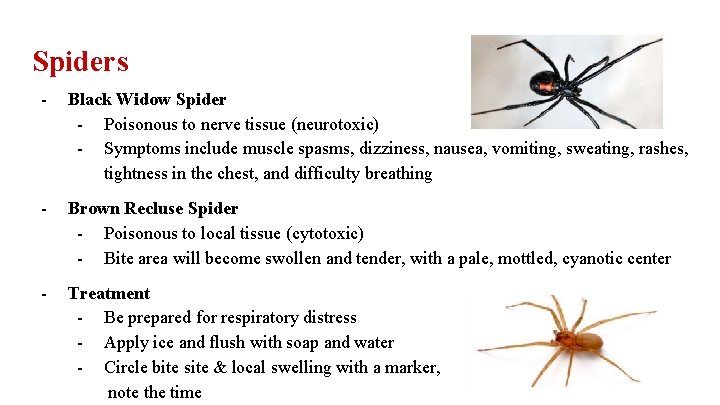
Spiders - Black Widow Spider - Poisonous to nerve tissue (neurotoxic) - Symptoms include muscle spasms, dizziness, nausea, vomiting, sweating, rashes, tightness in the chest, and difficulty breathing - Brown Recluse Spider - Poisonous to local tissue (cytotoxic) - Bite area will become swollen and tender, with a pale, mottled, cyanotic center - Treatment - Be prepared for respiratory distress - Apply ice and flush with soap and water - Circle bite site & local swelling with a marker, note the time
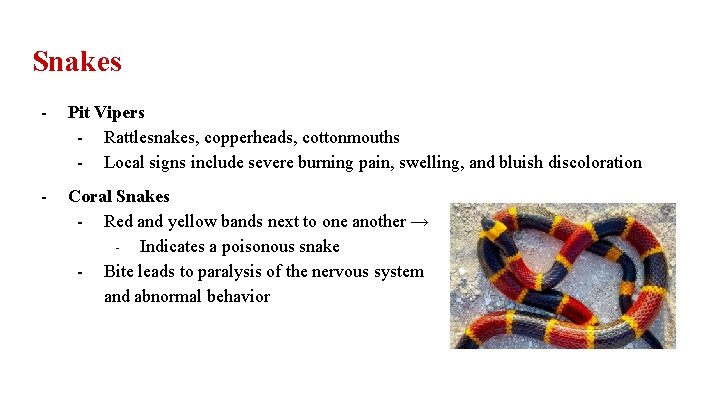
Snakes - Pit Vipers - Rattlesnakes, copperheads, cottonmouths - Local signs include severe burning pain, swelling, and bluish discoloration - Coral Snakes - Red and yellow bands next to one another → - Indicates a poisonous snake - Bite leads to paralysis of the nervous system and abnormal behavior
Snakes - Treatment - Calm the patient and minimize movement - Flush with soap and warm water (or a mild antiseptic) - Apply a pressure immobilization bandage for extremities - Keep site below the level of the heart - Provide supplemental oxygen and a blanket - DO NOT apply ice or give the patient anything by mouth
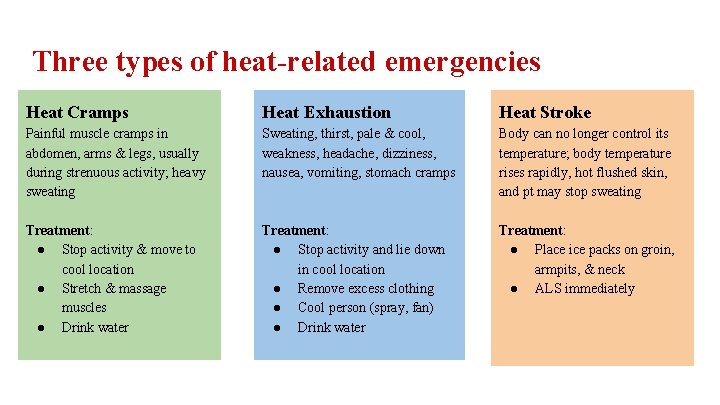
Three types of heat-related emergencies Heat Cramps Heat Exhaustion Heat Stroke Painful muscle cramps in abdomen, arms & legs, usually during strenuous activity; heavy sweating Sweating, thirst, pale & cool, weakness, headache, dizziness, nausea, vomiting, stomach cramps Body can no longer control its temperature; body temperature rises rapidly, hot flushed skin, and pt may stop sweating Treatment: ● Stop activity & move to cool location ● Stretch & massage muscles ● Drink water Treatment: ● Stop activity and lie down in cool location ● Remove excess clothing ● Cool person (spray, fan) ● Drink water Treatment: ● Place ice packs on groin, armpits, & neck ● ALS immediately
Other considerations of hyperthermia • Look at skin signs to determine severity • Remove extra layers of clothing. • Assess LOC • Attempt to remove from environment unless you need to provide immediate on-scene treatment. • Administer oxygen prn • Ask about nausea, length of time exposed, alcohol consumption, seizures What are some good follow up questions? ● How long were you in the heat? ● When was the last time they hydrated? ● Do they feel lightheaded? ● Have you experienced any nausea or vomiting?
Hypothermia/Cooling Emergencies • Remove from the environment • Assess LOC • Ask about length of time in environment • Administer oxygen prn • Remove wet clothing/items • Warm-up gradually – Move pt to warm environment & cover pt with emergency blanket or blanket/sheets *Frostbite: do not allow an area of frostbite to thaw and then refreeze as this causes more tissue damage

- Slides: 30