
Environmental Economics and Management Theory Policy and Applications
- Slides: 20
Environmental Economics and Management: Theory, Policy, and Applications 4 e by Scott J. Callan and Janet M. Thomas © 2007 Thomson Learning/South-Western Slides created by Janet M. Thomas
Chapter 1 The Role of Economics in Environmental Management © 2007 Thomson Learning/South-Western Callan and Thomas, Environmental Economics and Management, 4 e.
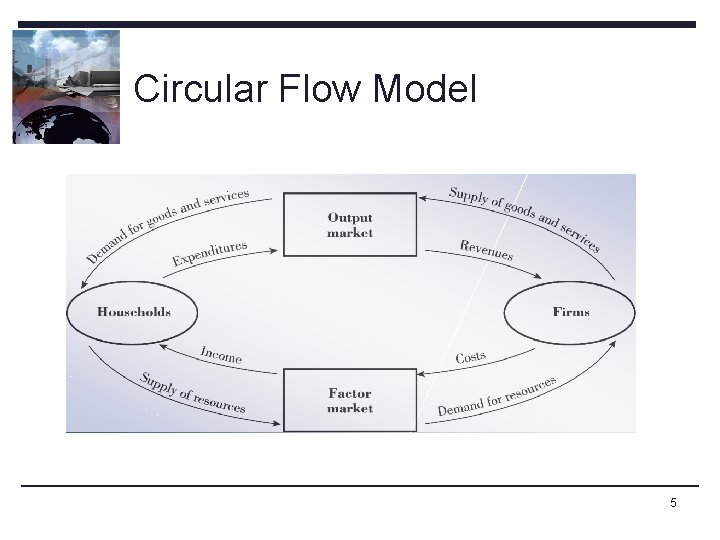
Economics and the Environment n Economic theory explains what we observe in reality, including environmental problems n Recognize the link between economic activity and the environment using models n n Circular Flow Model Materials Balance Model 3
Circular Flow Model n Shows the real and monetary flows of economic activity through the output and factor markets (see next slide) n n Forms the basis for modeling the relationship between economic activity and the environment But does not explicitly show the linkage between economic activity and the environment 4
Circular Flow Model 5
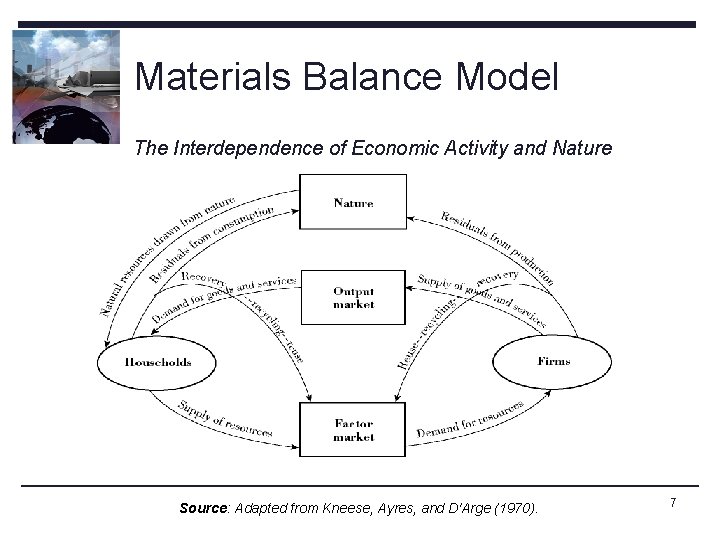
Materials Balance Model n Places the circular flow within a larger schematic to show links between economic activity and the natural environment via two sets of flows n Flow of resources from the environment to the economy p n The focus of Natural Resource Economics Flow of residuals from the economy to the environment p The focus of Environmental Economics n Residuals are pollution remaining in the environment after some process has occurred n Residuals can be delayed, but not prevented, through recovery, recycling, and reuse p Shown as inner flows in the model 6
Materials Balance Model The Interdependence of Economic Activity and Nature Source: Adapted from Kneese, Ayres, and D'Arge (1970). 7
Science and the Materials Balance Model n The flow of resources and residuals are balanced according to laws of science n First Law of Thermodynamics n Matter and energy can neither be created nor destroyed n Second Law of Thermodynamics n Nature’s capacity to convert matter and energy is not without bound 8
Fundamental Concepts in Economics Terms and Definitions
Causes of Environmental Damage n Natural Pollutants arise from nonartificial processes in nature p e. g. , ocean salt spray, pollen n Anthropogenic Pollutants are human induced and include all residuals associated with consumption and production p e. g. , chemical wastes, gases from combustion p Of greater concern to environmental economists 10
Sources of Pollution n Sources grouped by mobility n n Stationary Sources: fixed-site Mobile Source: any nonstationary source n Sources grouped by identifiability n n Point source: single identifiable source Nonpoint Source: a source that cannot be accurately identified, degrading in a diffuse way 11
Scope of Environmental Damage n Local Pollution n Damage not far from the source p e. g. , urban smog n Regional Pollution n Damage extends well beyond the source p e. g. , acidic deposition n Global Pollution n Involving widespread environmental effects with global implications p e. g. , global warming, ozone depletion 12
Environmental Objectives n Environmental Quality – reduction in anthropogenic contamination to socially acceptable levels n Sustainable Development – management of resources to ensure long-term quality and abundance n Biodiversity – assuring the variety of distinct species, genetic variability, and variety of inhabitable ecosystems 13
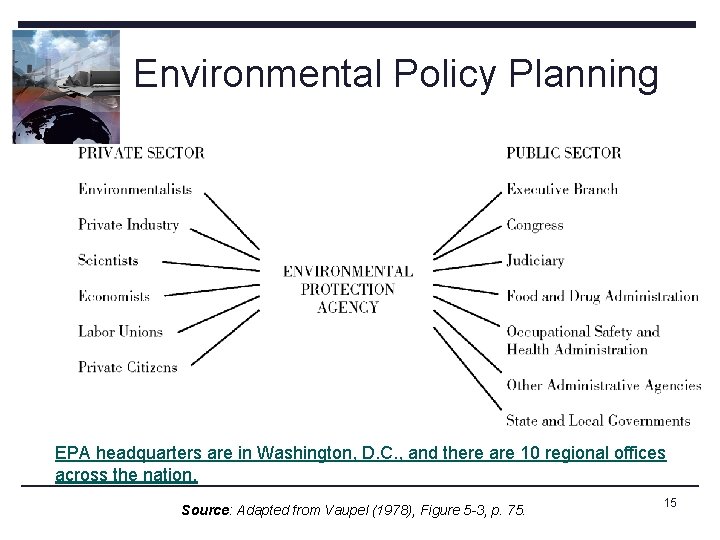
Environmental Policy Planning n Environmental planning involves many segments of society n In the U. S. , the Environmental Protection Agency (EPA) acts as liaison to numerous constituents within each sector 14
Environmental Policy Planning EPA headquarters are in Washington, D. C. , and there are 10 regional offices across the nation. Source: Adapted from Vaupel (1978), Figure 5 -3, p. 75. 15
National Environmental Policy Act (NEPA) of 1969 n Directs the integration of effort across agencies, executive departments, and branches of government in the U. S. n Guides U. S. federal environmental policy n Requires that environmental impact of public policy proposals be addressed n Calls for an Environmental Impact Statement (EIS) on proposals or major federal actions 16
Risk Analysis Chief Tool Guiding Policy Planning n Two decision-making procedures n n Risk Assessment – qualitative and quantitative evaluation of risk posed by an environmental hazard Risk Management – decision process of choosing from alternative responses to environmental risk 17
Risk Management Policy Evaluation Criteria n Economic Criteria n Allocative Efficiency – requires resources be appropriated such that benefits are equal to costs n Cost-effectiveness – requires the least amount of resources be used to achieve an objective n Equity Criterion n Environmental Justice – concerned with the fairness of the environmental risk burden across segments of society or geographic region 18
Government Policy Approach n Command-Control Approach – regulates polluters through the use of rules n Market Approach – incentive-based policy that encourages conservation or pollution reduction n Can follow the “polluter-pays principle” whereby the polluter pays for the damage caused 19
Setting the Time Horizon n Management Strategies – a short-term strategy intended to manage an existing problem n An ameliorative intent n Pollution prevention (P 2) – a long-term strategy aimed at reducing the amount of toxicity of residuals released to nature n A preventive intent 20