
Environmental Data Web APIs Current practice and future
Environmental Data - Web APIs Current practice and future directions Peter Taylor Hydro. DWG Workshop, 21 st Sept 2015 DATA 61

Method and scope Related domain Web APIs User requirements Nature of environmental data 2 | Environmental Data APIs | Peter Taylor Web API best practices Web APIs for the Bureau Open standards & computing trends
Some working definitions • Web APIs • Mostly associated with REpresentational State Transfer (REST) • Most use JSON encodings • The focus tends to be on web/mobile developers as consumers • Web Services • • Often associated with the W 3 C standards SOAP, WSDL, UDDI etc. However, also mentions REST Traditionally use XML encodings 3 | Environmental Data APIs | Peter Taylor
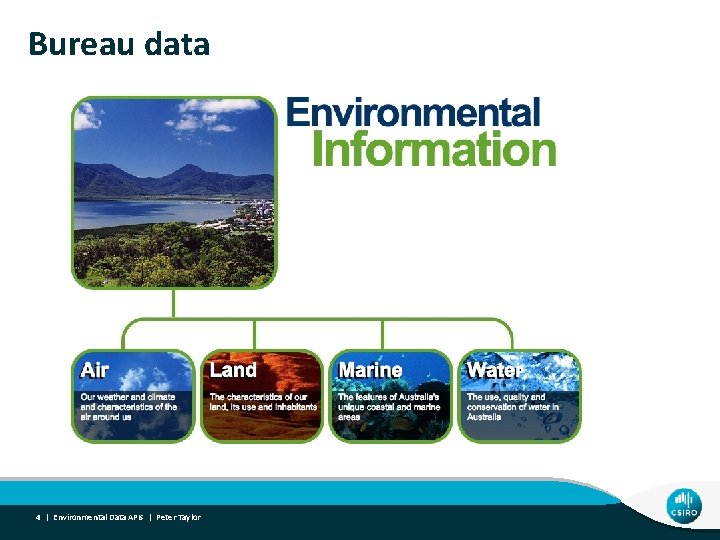
Bureau data 4 | Environmental Data APIs | Peter Taylor
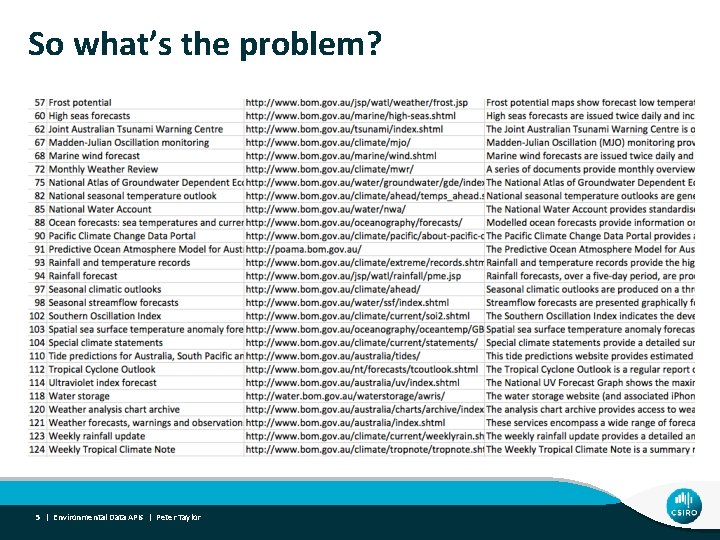
So what’s the problem? 5 | Environmental Data APIs | Peter Taylor
Please note • These are problems that face many organisations! • The Bureau has a long history, and has recently taken on new roles (water data, environmental etc) • The aim of this work is to find out how to improve consistency, not to point out problems • Multi-disciplinary data publishing is hard! 6 | Environmental Data APIs | Peter Taylor
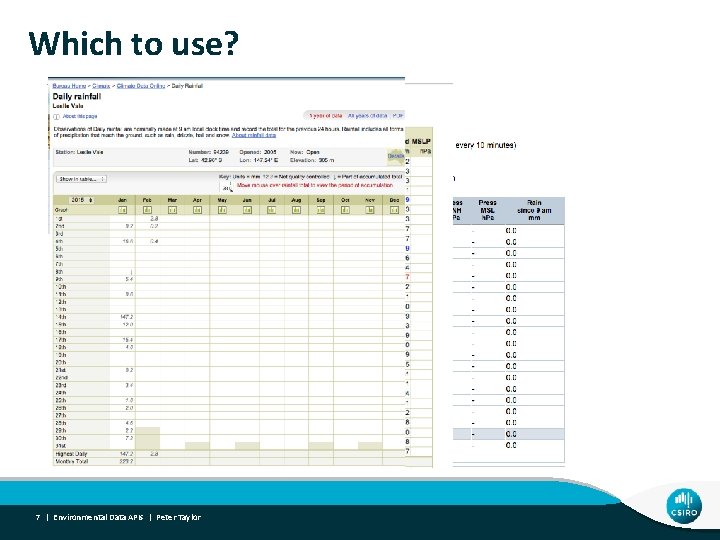
Which to use? 7 | Environmental Data APIs | Peter Taylor
Disparate data access makes it • • • Hard to have organisational visibility on traffic Hard to control traffic/load Hard to consistently manage change Fragmented community of developers Hard for users to find what they need • Different ways to do the same thing • • Redundant functionality Redundant development Data access and applications are tightly coupled Hard to monetize (if this is what you are after) 8 | Environmental Data APIs | Peter Taylor
Web API benefits • Can be for internal and external use • Many companies find internal use outgrows external use • Support multiple applications • • Web apps Mobile Widgets Etc. • Increase separation between web access and underlying information system • End up as an important part of the architecture 9 | Environmental Data APIs | Peter Taylor
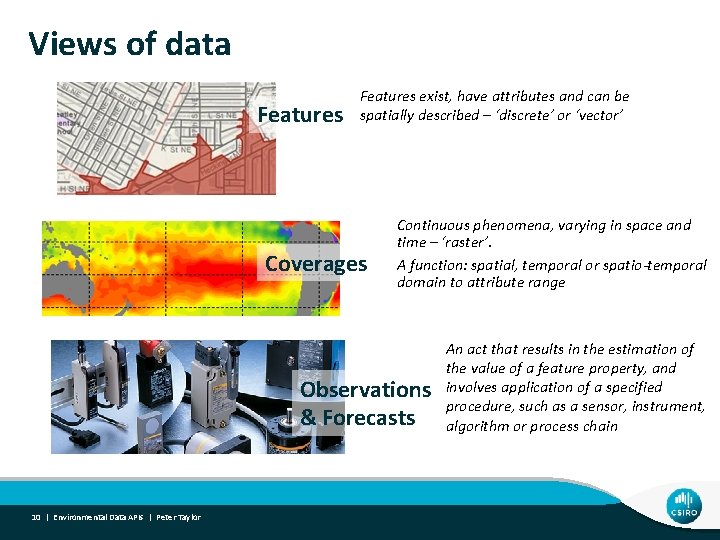
Views of data Features exist, have attributes and can be spatially described – ‘discrete’ or ‘vector’ Coverages Continuous phenomena, varying in space and time – ‘raster’. A function: spatial, temporal or spatio-temporal domain to attribute range Observations & Forecasts 10 | Environmental Data APIs | Peter Taylor An act that results in the estimation of the value of a feature property, and involves application of a specified procedure, such as a sensor, instrument, algorithm or process chain
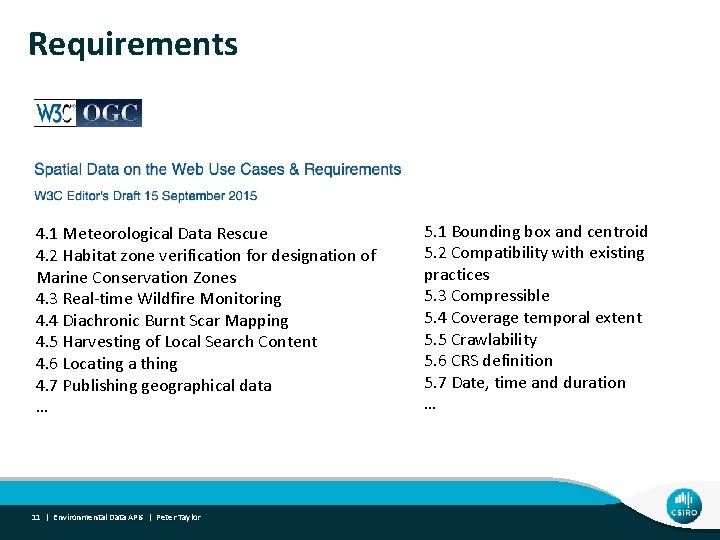
Requirements 4. 1 Meteorological Data Rescue 4. 2 Habitat zone verification for designation of Marine Conservation Zones 4. 3 Real-time Wildfire Monitoring 4. 4 Diachronic Burnt Scar Mapping 4. 5 Harvesting of Local Search Content 4. 6 Locating a thing 4. 7 Publishing geographical data … 11 | Environmental Data APIs | Peter Taylor 5. 1 Bounding box and centroid 5. 2 Compatibility with existing practices 5. 3 Compressible 5. 4 Coverage temporal extent 5. 5 Crawlability 5. 6 CRS definition 5. 7 Date, time and duration …
Existing Web APIs 12 | Environmental Data APIs | Peter Taylor
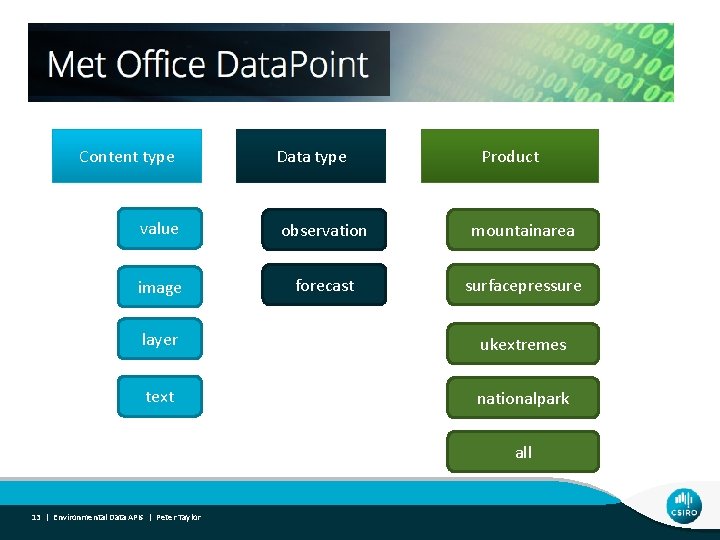
Content type Data type Product value observation mountainarea image forecast surfacepressure layer ukextremes text nationalpark all 13 | Environmental Data APIs | Peter Taylor
Example queries • • • Fetch three-hourly, five-day forecast for Exeter Fetch the national park forecasts for south west England Fetch the current UK rainfall radar map layers And so on. . API documentation • E. g. http: //datapoint. metoffice. gov. uk/public/data/val/wxfcs/all/dataty pe/sitelist? key=ce 54927 d-e 79 b-4334 -bf 56 -0 da 2 a 4 f 3 f 56 c 14 | Environmental Data APIs | Peter Taylor
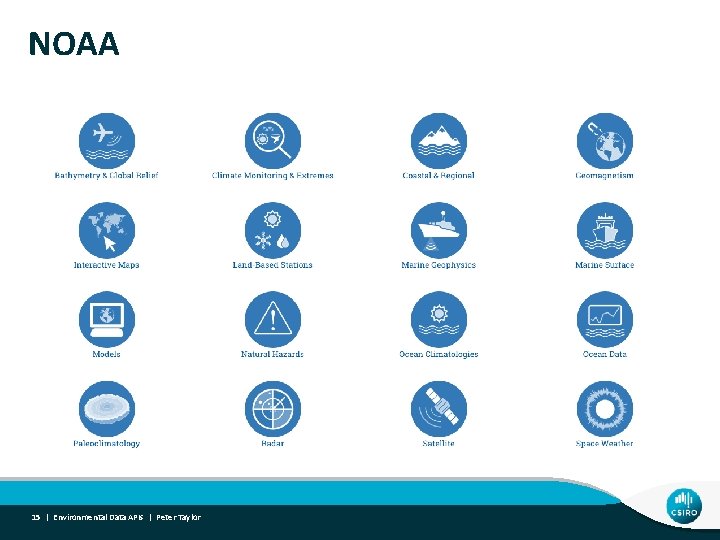
NOAA 15 | Environmental Data APIs | Peter Taylor
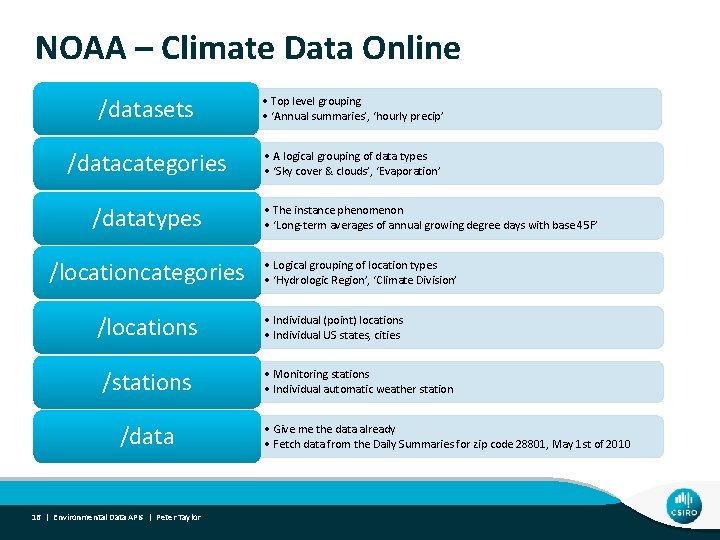
NOAA – Climate Data Online /datasets • Top level grouping • ‘Annual summaries’, ‘hourly precip’ /datacategories • A logical grouping of data types • ‘Sky cover & clouds’, ‘Evaporation’ /datatypes /locationcategories /locations /stations /data 16 | Environmental Data APIs | Peter Taylor • The instance phenomenon • ‘Long-term averages of annual growing degree days with base 45 F’ • Logical grouping of location types • ‘Hydrologic Region’, ‘Climate Division’ • Individual (point) locations • Individual US states, cities • Monitoring stations • Individual automatic weather station • Give me the data already • Fetch data from the Daily Summaries for zip code 28801, May 1 st of 2010
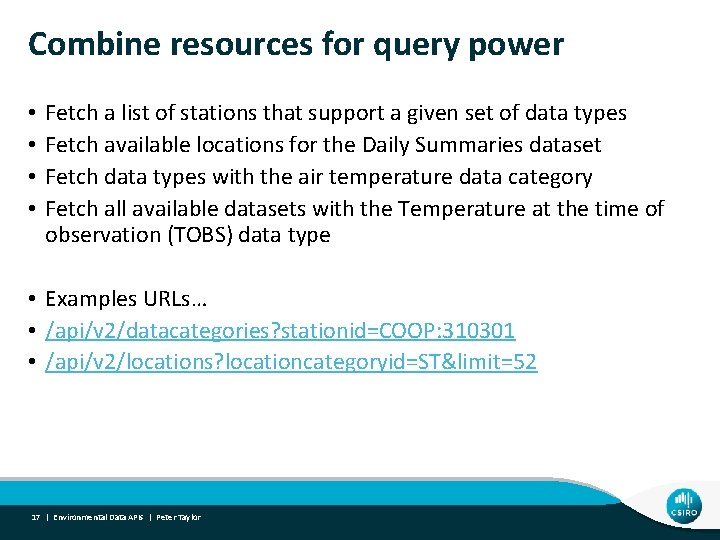
Combine resources for query power • • Fetch a list of stations that support a given set of data types Fetch available locations for the Daily Summaries dataset Fetch data types with the air temperature data category Fetch all available datasets with the Temperature at the time of observation (TOBS) data type • Examples URLs… • /api/v 2/datacategories? stationid=COOP: 310301 • /api/v 2/locations? locationcategoryid=ST&limit=52 17 | Environmental Data APIs | Peter Taylor
Some observations • These APIs make some core simplifications • These are handled by developers • Context is powerful • For example: • No CRS specified for location - most geo data on the web assumes EPSG 4326/WGS 84 • Elevations with no vertical datum (likely assumes a national height datum) • Aggregated concepts for ease of use: – E. g. ‘data coverage’ – a percentage indication of time coverage of the data • They provide the minimal set of metadata • They often hide operational complexities • Minimal, or no, quality information • Difference in users 18 | Environmental Data APIs | Peter Taylor
Spaceout • Anything that varies in space and time will have complexities • Space • The world is round • Geodesy is a science in itself • Custom and/or local reference systems • Time • Dealing with uncertain times • Different epoch/reference points • All simple APIs make large assumptions in these two areas! 19 | Environmental Data APIs | Peter Taylor
Conflicting requirements • Taken from W 3 C spatial data working group requirements: 1. Technologies must be easy to implement for people that generally do not have a high affinity with IT. This goes for data publishing as well as data consumption. 2. References to time and space are often inexact or have shifting frames of reference, so simple encodings like basic geo or ISO 8601 do not suffice. 3. References to time and space do need to be as exact as possible, to enable automatic discovery of spatiotemporal patterns. 4. …. 20 | Environmental Data APIs | Peter Taylor
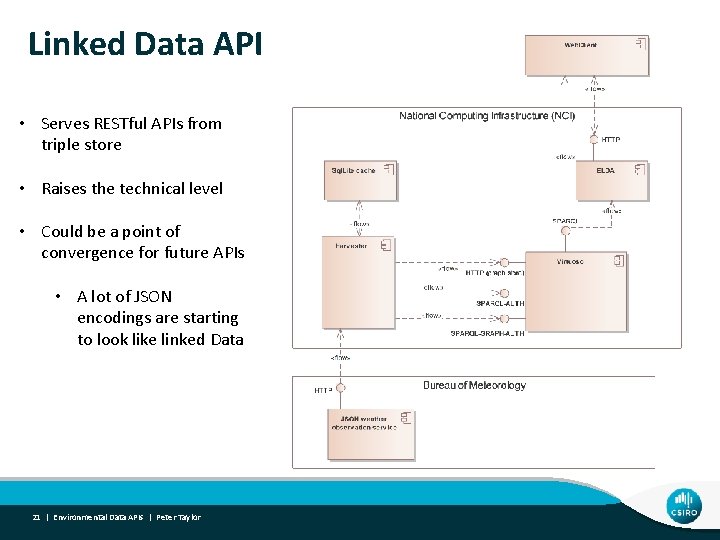
Linked Data API • Serves RESTful APIs from triple store • Raises the technical level • Could be a point of convergence for future APIs • A lot of JSON encodings are starting to look like linked Data 21 | Environmental Data APIs | Peter Taylor
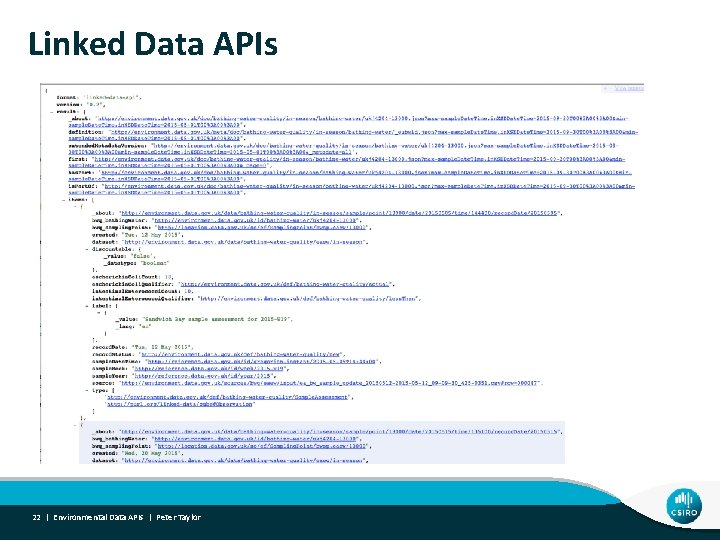
Linked Data APIs 22 | Environmental Data APIs | Peter Taylor
Guiding principles • Deciding what features not to include • Deciding the context you can assume • What’s your 80%? • Careful of ‘over handling’ the edge cases • Can we provide a spectrum of functionality to suit different uses? • Free/open version providing simple encodings, base metadata • Pay for a fully featured, provenance enabled, vocabulary-connected service. 23 | Environmental Data APIs | Peter Taylor
Guiding principles II • Identify core abstractions to assist with cross-domain • E. g. point vs. gridded, values vs. images • Follow current RESTful API practices • Don’t do anything crazy! • Be consistent • Provide a platform for a community to build on • Give your APIs a product feel 24 | Environmental Data APIs | Peter Taylor
Now your turn • Who knows of APIs that might be relevant? • Input into the review is welcome 25 | Environmental Data APIs | Peter Taylor

Thank you Data 61 Peter Taylor Research Engineer t +61 3 6237 5617 e peter. taylor@csiro. au w www. csiro. au DATA 61
- Slides: 26